Deshedding Tool vs Brush for Cats, Decided by Coat Layer
Deshedding tool vs brush for cats, by tine length (1 or 1.5 in), head width (5.5 or 7.5 in) & weight (10 lb), plus a written cap on the blade

Alfredo RamsesFounder · October 6, 2026 · 21 min read


On this page8 sections
- 1Deshedding Tool vs Brush Starts With Which Layer of the Coat Is Winning
- 2Where the Tool Stops and a Groomer or the Vet Starts
- 3Why the Brush in Your Drawer Keeps Losing
- 4Which Coat Gets Which Tool, and at What Size
- 5The Blade, and the Cap That Keeps It From Taking the Coat
- 6The Order When You Use Both, in an Apartment With One Cat or Two
- 7Comb This Week, Save the Blade for the Heavy Ones
- 8Frequently Asked Questions
You brush the cat most evenings, the brush comes away full, and the next morning there is still a soft gray drift along the baseboard and a fresh coat of hair on the sofa arm. The easy reading is that she sheds too much, or that you need a stronger tool, but the brush only reaches the top layer of her coat, and the hair that keeps landing on the sofa is coming from under it. The deshedding tool vs brush question comes down to which layer of the coat is letting go, and the tool that looks like the strongest answer is usually the one to use least.
People in r/grooming keep describing the same thing, brushing almost daily and still pulling loose strands out with two fingers, and the cause is the tool, not the hours. Below: what each tool does to each layer, where a tool stops and a vet starts, why the drawer brush keeps losing, which coat gets which size, the cap on a blade, and the order of use in an apartment with one cat or two.
Four tool families, read by the layer they reach and the way each one goes wrong:
| Tool | Layer it reaches | Coat it suits | How much, and where it goes wrong |
|---|---|---|---|
| Steel comb or undercoat rake | Through the top coat into the undercoat, separating hair | Any coat; the first tool for long and dense ones | Every session. Tines that scratch your forearm will scratch the cat |
| Slicker brush | The top coat and surface tangles | Smoothing a coat that has already been combed | Leaves the loose undercoat underneath; metal pins can scrape skin |
| Rubber brush | The surface, lifting loose and dead hair | Short or sensitive coats | Gentle, and still easy to overdo in long sessions |
| Deshedding blade | The undercoat, lifted with an edge | Dense undercoats in a heavy shedding week | A few passes per section, weekly at most; too many take more than loose hair |
Deshedding Tool vs Brush Starts With Which Layer of the Coat Is Winning
The hair on your floor is not a sign of a badly behaved coat. It is a sign of a layered one, and the tool you own was built for one layer while the hair is falling out of the other. So the choice in front of you is about coat and limits, not about which tool is better, and it is one decision inside the weekly routine and the order of the four jobs.
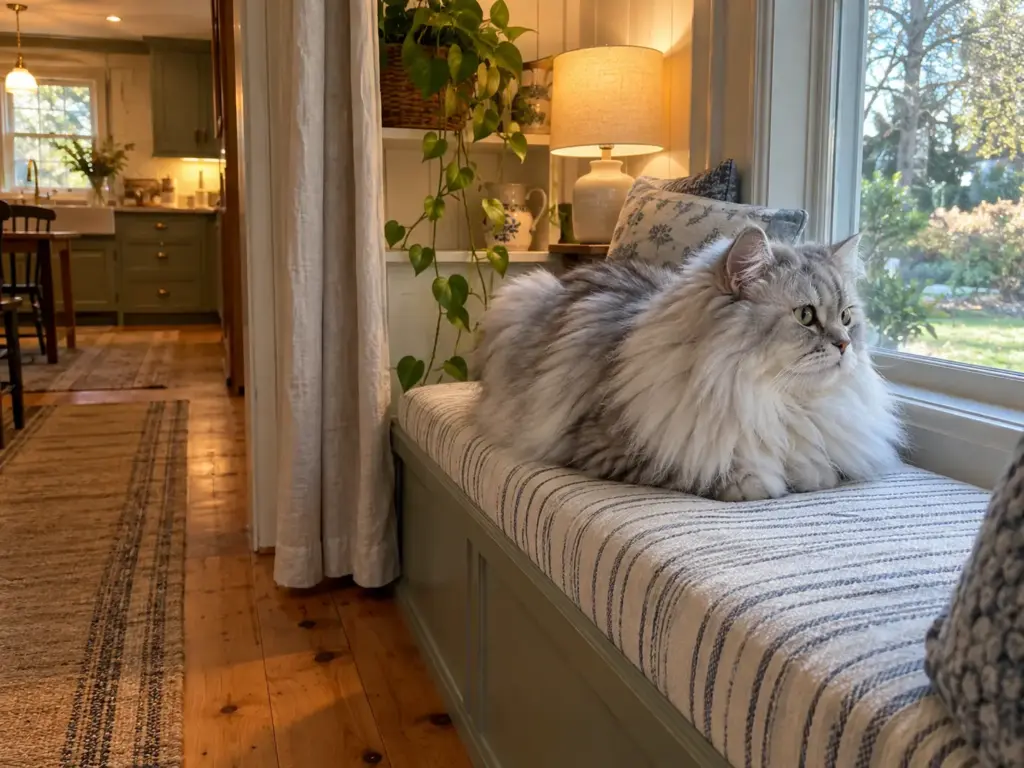
Two layers, and which tool reaches which
Most cats carry a smooth outer coat of guard hairs and, under it, a fine undercoat of soft hair that holds warmth. A brush works the outer layer. A deshedding tool is built to get under it, and that difference decides everything else in this article. According to VCA Animal Hospitals’ coat-care guide, “Cats that share our homes often shed their undercoat and guard hairs at low levels all year round.”
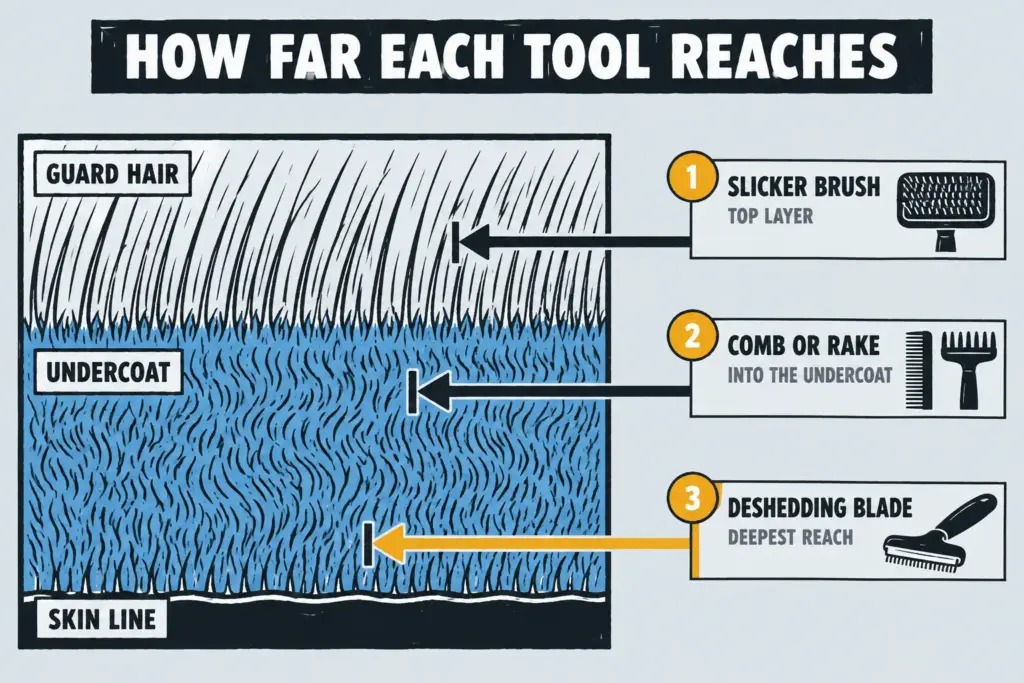
The same VCA guide treats combs that pull out clumps of loose undercoat as their own category, separate from brushes. That is the real border in this comparison. On one side sit tools that smooth and detangle the surface; on the other sit tools that go down and bring the loose under-layer up. If the hair you keep finding is fine, soft and almost cottony, it came from under the brush’s reach.
A blade lifts hair; a comb or rake separates it
The two families do the job by different means. A blade runs a fine-toothed edge through the coat and catches whatever gives way, which is mostly loose undercoat and, with too much pressure or too many passes, some hair that was not ready to leave. A steel comb or undercoat rake slides between hairs and pulls out what is already free.
A cat’s coat is also finer than the dog coats many of these tools are sold for (the FURminator rake, for one, is labeled for dogs and cats). The same stroke that suits a coarse double-coated dog asks for short sessions and a lighter hand on a cat. Cats are also quick to say when the pressure is wrong, which makes the cat, not the clock, the judge of the session.
Why a blade is a heavy-week tool, not a weekly habit, for an apartment cat
The usual schedule says deshed hard in spring and fall, when the coat turns over. That advice assumes a cat that lives through seasons. An apartment cat lives in steady heat and steady light, so instead of two bursts of seasonal shedding she has a slow trickle all year, and a calendar-based blade routine ends up running the edge through a coat that has little to give.
The better call is to let the comb decide. On an ordinary week, a steel comb lifts a small tuft per stroke and the coat looks the same afterward. In a heavy week the comb loads up after a few strokes along the back and keeps loading, and that is the week a blade earns its place. Everything outside those weeks is comb work.
Where the Tool Stops and a Groomer or the Vet Starts
Some things you find under the hair are not tool questions, and no amount of better equipment changes that. This section names those signs and hands them over. It does not explain them.
The cat’s own stop signs, whatever tool is in your hand
Cats signal the end of a session clearly. International Cat Care’s grooming guide lists the signs: skin rippling along the back, the tail thumping, the cat freezing in place, ears turning back, lip licking, growling. Its instruction is plain: “If your cat shows any of these signs, stop grooming them and see if they’ll tolerate it another day.”
Then there are signs in the coat itself. If the coat looks uneven or has patches with no hair, if the skin underneath is red or scabbed, or if the cat no longer lets you touch a spot she used to allow, put the tool away and call the vet before the next pass. And if what worries you is simply the amount of hair, that question belongs to when shedding itself stops being normal, not to a choice of tool.
Plan every session to end on the cat’s terms, not on an empty coat. Stopping at the first tail thump, with hair still left on her, is what keeps her willing to sit for the next one.
Mats at the skin, and the free fix that is not a tool
A mat that sits tight against the skin is not loose hair, so none of the tools on this page are for it. VCA sends large or widespread tangles to a groomer or a vet, sends any mat that has irritated the skin to the vet, and says mats come off with clippers, never with scissors. Pulling a comb or a blade through one only drags on the skin underneath it.
The free fix is to leave it alone and book a groomer or the vet. The part that is yours is regular combing with a comb that passed the forearm test, and the mat itself is theirs.
Why the Brush in Your Drawer Keeps Losing
If you brush every day, pull out hair every time and still collect clumps from the sofa, look at the tool before you worry about the amount. The brush is working on a layer where the loose hair is not. That is a tool problem, and more minutes with the same tool will not solve it.
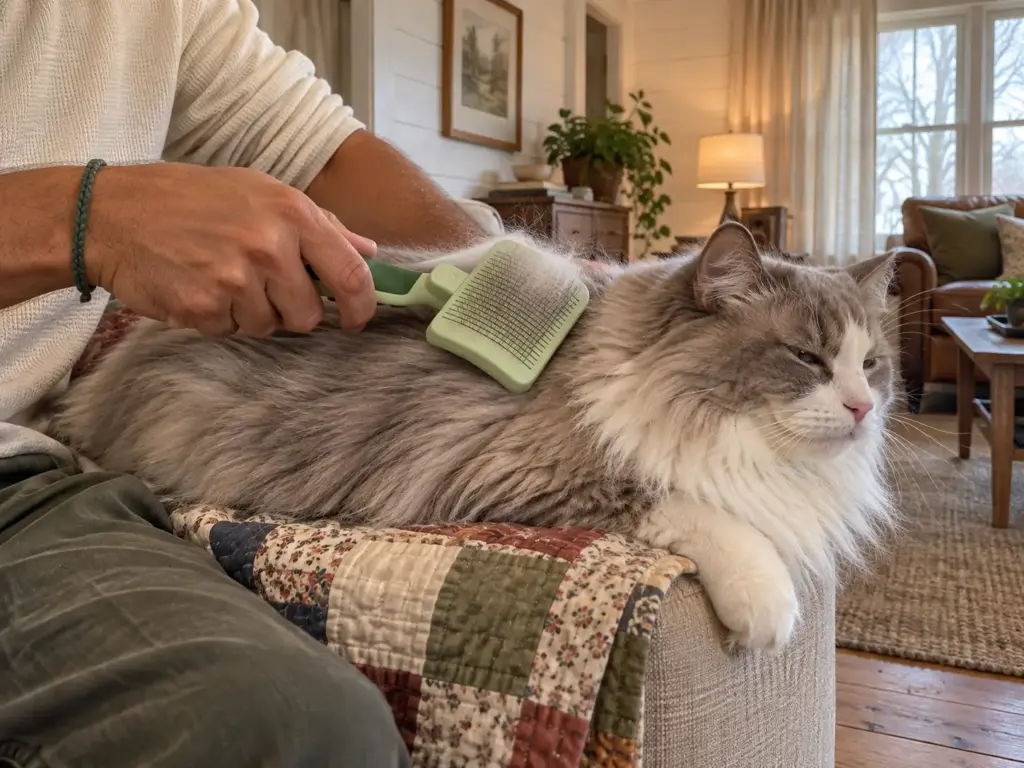
The slicker works the top; the loose hair is under it
The usual advice for a shedding cat is to brush more often. For a cat with real undercoat, more often with a slicker just means more trips across the surface. Kim Raisanen, a professional groomer writing for Groomer to Groomer, puts it directly: brushing “isn’t the best technique in removing shedding hair and undercoat,” because brushes do not reach down to the skin. She also avoids metal slickers on cats, since they can scrape the skin, and uses a soft brush plus a comb instead.
The threads say the same thing in owners’ words. A Siberian owner in r/grooming who combs and slickers every day said the slicker “doesn’t really do anything to separate the clumped strands,” and another owner in the same community described pulling out strands by hand despite brushing almost daily.
If yours is a Coastal Pet Safari Cat Self Cleaning Slicker Brush or something like it, keep it for smoothing the top coat once the coat is combed. That is the job it is for. It was never going to reach the undercoat, and it can scrape skin if you lean on it.
The steel comb first, and the scratch test before it touches the cat
Start with the comb you may already own. Before it goes anywhere near the cat, drag it across the inside of your own forearm: if it scratches or leaves a mark, it will hurt her, and the tines should feel rounded at the tips. That test comes from the same groomer, and it takes five seconds.
Tine length matters more than the brand. Raisanen keeps a flea comb with graduated tines for the head, ears, chin and front legs, a medium greyhound comb with 1 inch tines for the back, sides and belly, and a 10 inch comb with 1.5 inch tines for dense coats like a Maine Coon, Persian or Siberian. Start with the longest tines, and drop to the medium comb if the undercoat is not coming out.
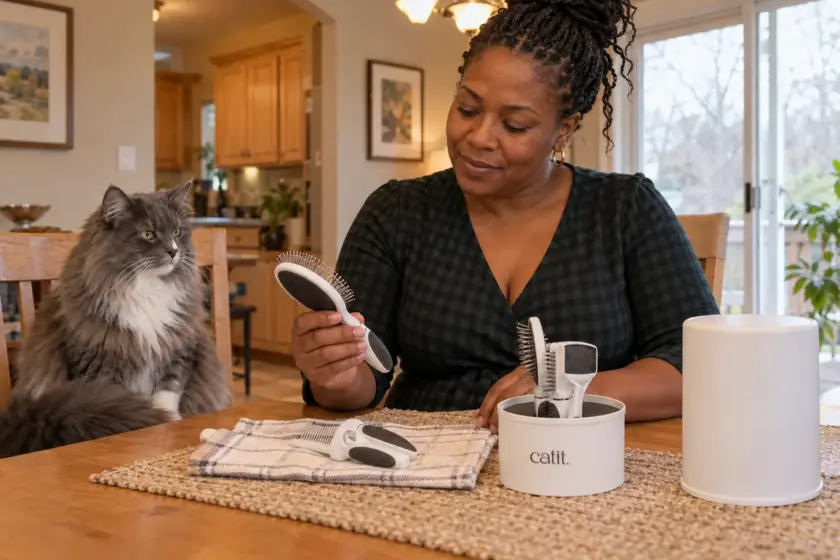
If there is no comb in the drawer, the PETTOM Steel Grooming Comb 7.5 inch carries coarse and fine teeth on one comb, which covers the first pass and the finishing pass with the same tool. It still goes through the forearm test first, like any comb whose tips you have not felt. For the separate question of how many times a week a cat’s coat needs brushing, the answer depends on the coat and has its own page.
Run the forearm test on every new tool, not only combs. A rake or a blade that leaves a pink line on your arm will do the same to skin covered by fur, where you cannot see it.
The other failure: a tool with no comb after it
The opposite mistake shows up once people buy a deshedding tool. They run it through, see a pile of hair, and stop. Loose undercoat the tool lifted but did not pull free stays tangled in the coat, and loose hair left in place is how mats start. A comb after the tool collects what it loosened.
Undercoat rakes (the threads call them a deshed rake) sit between the two worlds. Groomers in the Reddit threads put a rake ahead of a blade, while one cat owner in r/CATHELP called rakes “more for dogs” and said her long-haired cat can’t stand them. Both can be true for different cats, and the next section is about telling which one you have.
Which Coat Gets Which Tool, and at What Size
One house can need two different answers. This one has a very large, long-haired Maine Coon and a compact British Shorthair with a short, dense coat, and no single tool suits both: the long coat wants depth, the dense short one wants gentleness, and a head sized for one frame is wrong for the other. Size is the part that gets skipped, so here it is in numbers where numbers exist.
Short or sensitive coats: the soft tool first
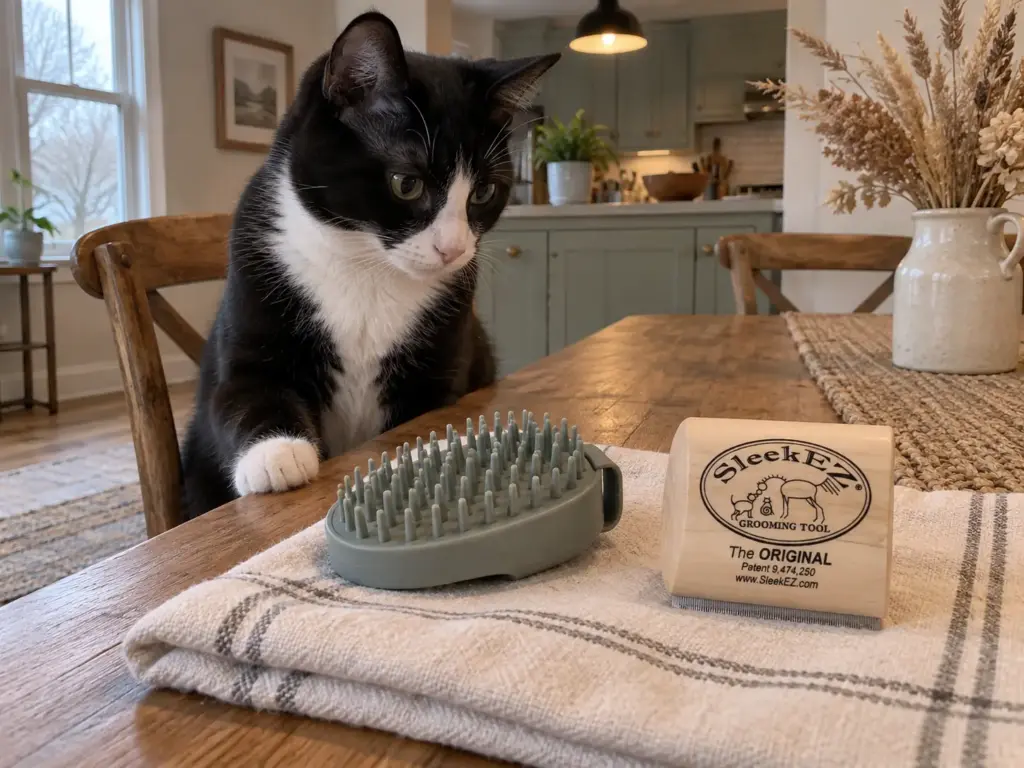
For a short coat, sensitive skin or a cat that flinches at metal, start with rubber. People in r/grooming name a rubber curry before any blade for short coats, because the soft nubs grab dead hair off the surface without an edge anywhere near the skin. The Cat Brush with Soft Rubber Pins measures 8 x 4.5 x 2.5 inches, which fills a hand and is wide enough for the back and flanks.
Soft does not mean unlimited. A commenter in a r/grooming thread warned that a cat can be overbrushed with a rubber curry too, so the same short-session rule applies. The rubber tool is the safe first step, and it is not a reason to keep going once the cat has had enough.
Normal-size cat with an ordinary undercoat: a head that fits the cat
Head width rarely gets checked, and it changes how a tool behaves. A narrow head follows the curves of a cat’s shoulders and ribs; a wide head bridges them, so the edge bears down harder on the high points and covers more coat per stroke. For an average adult cat, a deshedding brush like the SleekEZ Cat Brush for Shedding has a 5.5 x 3 x 1.5 inch head, small enough to follow the frame. It also covers the role of the small FURminator, which is sold for cats under 10 lb.
Like any tool that actually reaches the undercoat, the SleekEZ is easy to overdo. One person in r/grooming described using a SleekEZ for under ten minutes and finding bald patches on both sides of the back, and the most helpful reply was “a few passes over each section.” A coat that looks like that afterward is for the vet to look at before any tool goes back on it.
For comparison, a blade like the Safari shedding blade has a 7.5 x 3 inch head. On a large cat that width is efficient; on a small one, each stroke covers most of a flank at once. FURminator handles size by weight rather than width (under or over 10 lb), and its listing gives no head width, so check the head against your cat before you check the price.
Dense or long coats: tines against coat depth
For a dense double coat (the kind a Maine Coon, Norwegian Forest Cat or British Shorthair carries) or a long one, the measurement that matters is tine length against how deep the coat is. Part the fur at the shoulder with two fingers and look at how far down the skin sits. A tine that stops in the guard hairs will skim; a tine that reaches the undercoat without dragging the skin is the right length. Groomer to Groomer’s figures give the range: 1 inch tines for an ordinary coat, 1.5 inches for a dense one.
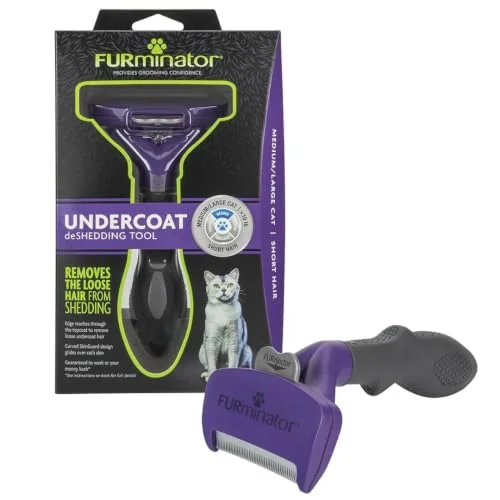
The FURminator Grooming Rake Tool for Dogs & Cats With Thick Coats is the kind of rake the Reddit groomers recommend over a blade: stainless pins that go through the coat instead of cutting it. Its listing does not give a pin length, so the shoulder check above is the only way to know whether it reaches your cat’s undercoat. And the long-haired cat in r/CATHELP who couldn’t stand rakes is a reminder that the cat gets the final say. For which breeds carry which kind of coat, see the coat structure behind which cats shed what.
Measure the coat before you buy the tool. Part the fur at the shoulder, hold a ruler or a pencil next to it, and compare that depth with the tine length you are about to buy, not with the fluffy cat on the box.
The Blade, and the Cap That Keeps It From Taking the Coat
The blade is where advice splits hardest, and where a reader most needs someone to take a side. This section takes one, gives the reasoning, and puts a written limit on it.
Where the groomers and the shop pages split, and where this blog lands
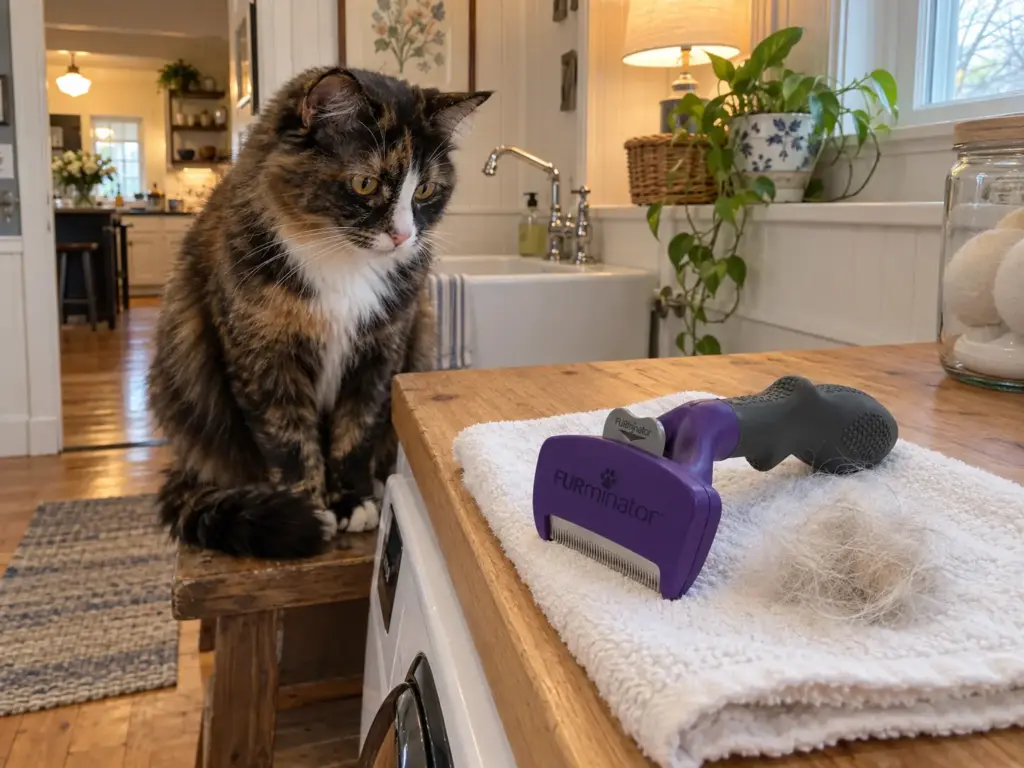
On the groomer side, the tools come in a clear order: a steel comb, then an undercoat rake, and a metal slicker kept away from the skin. In the Reddit threads, one commenter put it bluntly, “the furminator cuts hair,” and another said a flat, razor-edged deshedder was the wrong tool for a short-haired cat. Those are opinions from commenters, not tests, and they should be read that way. On the selling side, the FURminator listing says “Use Weekly,” and the stores that stock it present it as the best tool for the job.
International Cat Care does not recommend a blade at all. Its tool list is a bristle brush, a rubber pad or mitt and a wide-toothed comb, with rakes and slickers mentioned only as options for long coats. This blog lands with the groomers on the order and with the mechanism on the rest: a steel comb or rake first, every time, and a blade only in a heavy week, only on a dense undercoat, and only in short passes.
The obvious pick is the FURminator, and for a big cat with a thick undercoat in a heavy week it is a reasonable one. But for a short single coat, a cat under 10 lb, or a cat who is still deciding whether grooming is acceptable, the rubber brush or the comb is the better tool. The blade is the specialist, not the default.
The cap: a few passes per section, a heavy week, not a habit
No source gives a session cap for cats, so this one is the blog’s own, built on three anchors. The brand’s own ceiling is “Use Weekly.” The session limit comes from that r/grooming reply: a few passes over each section, then move on. The floor comes from International Cat Care, which says a session can be as short or as long as the cat is comfortable with.
Put together: a blade only in a heavy week, no more than once in it, a few strokes per section of coat, and the session ends when the cat ends it.
Store pages that sell blades tend to suggest a longer session length than that. The cat’s coat is the reason to ignore them. A blade’s work stacks up across strokes, and the coat has no way to tell you it has had enough until you see it. That is also why an apartment cat rarely needs one on a schedule: see why an apartment cat rarely has a shedding season.
The budget alternative is the Coastal Pet Safari Cat Shedding Blade, a stainless steel blade with the 7.5 x 3 inch head mentioned above, which makes more sense on a large cat than a small one. It carries the same risk as any edged tool, so the cap applies to it just the same.
The coat check afterward, and what the cat’s “hey” means
After a blade session, look before you put the tool away. This check is the house rule here, not a vet’s: the coat should feel even under your hand, the longer guard hairs should still be lying on top, and you should not be able to see skin through the fur anywhere you worked. If any of that is off, stop for the week and let the vet see it before the next session.
The cat runs her own check during the session. In r/CATHELP, an owner of a 13-year-old cat with a dense double coat described a routine of a blade every few days for about five minutes, which the cat enjoys, until a stroke pulls too hard and she lets out a tiny “hey.” That routine is one person’s arrangement with one cat, not a recommendation, but the “hey” is the useful part: it is the cat’s stop signal, and the session ends there.
Another owner in r/grooming said her cat simply refused the FURminator despite a very gentle hand, which says something about the cat’s limits rather than the tool. If yours says no to every tool, read what a cat that won’t be brushed is objecting to.
Treat the first protest sound, twitch or glance back as the end of the blade work, even with a tuft of loose hair still showing. Finish with two slow passes of the comb so the session closes on the gentle tool.
The Order When You Use Both, in an Apartment With One Cat or Two
A deshedding tool does not remove hair from your home. It moves hair from the cat to a pile you control, and the pile still has to reach the trash. The order of tools and the place you work decide how much of that hair stays where you put it.

Comb first, the shedding tool second, comb again to catch what it loosened
The sequence the groomers in the threads describe is simple. Comb through first to find tangles and open the coat; then, if this is a heavy week and the undercoat is dense, use the shedding tool; then comb again to collect what the tool loosened but left in place. Every pass goes with the grain, never against the grain, in short strokes, and nothing goes over a mat.
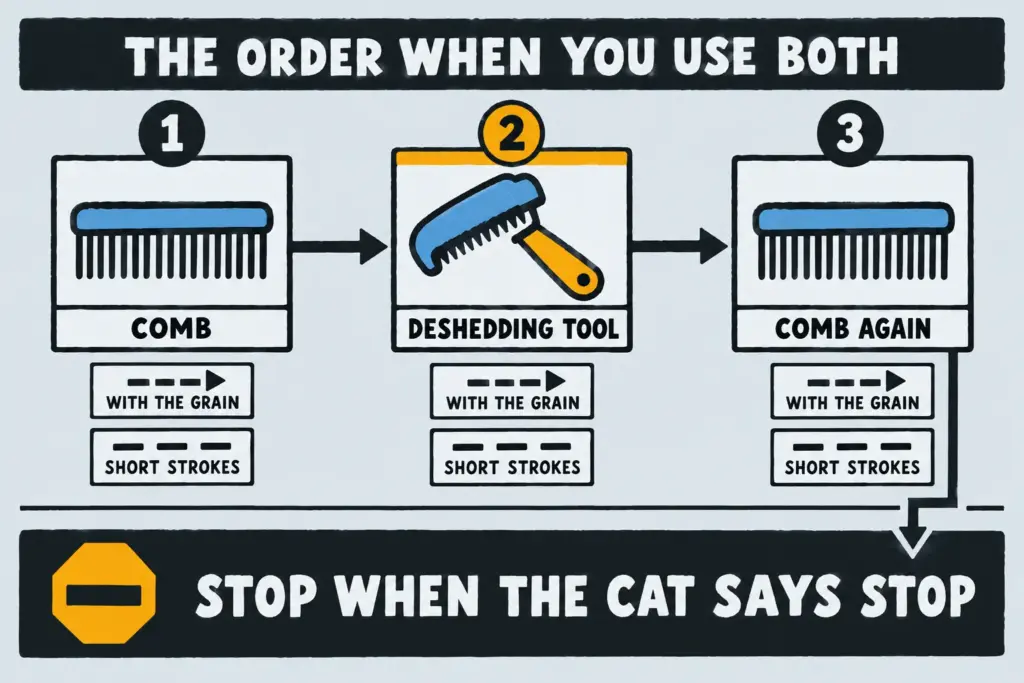
The cap from the previous section still applies to the middle step, so the blade gets a few passes per section and the comb does the rest. In most weeks the middle step does not happen at all, and comb, comb is the whole session.
Where the session happens, and where the hair goes
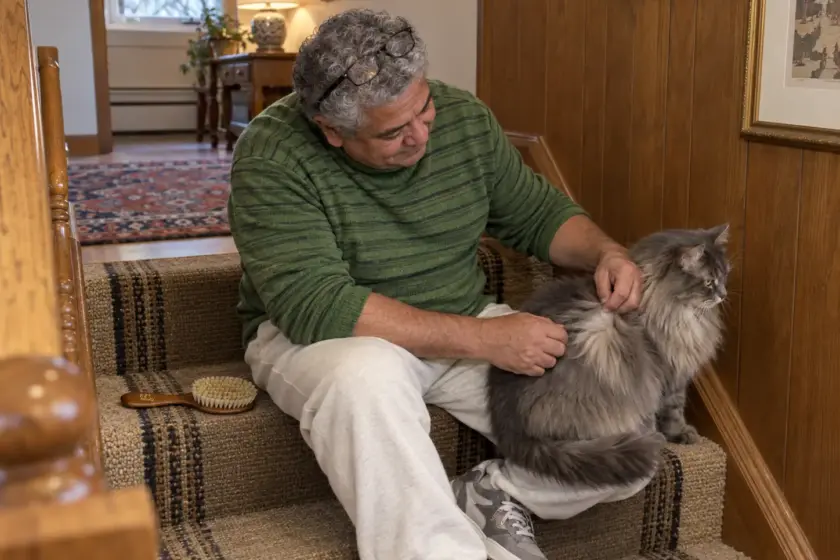
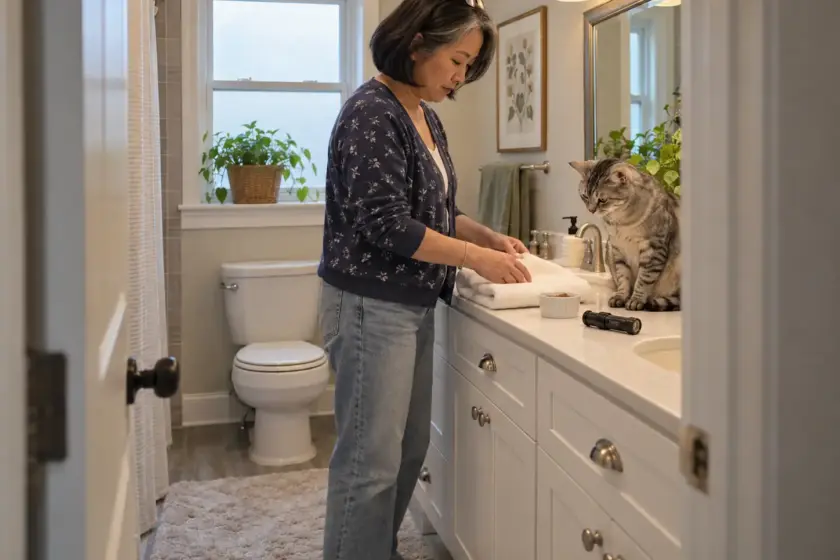
A rented apartment is not a grooming salon, and the couch is the worst place to work. The hair you lift settles into upholstery and comes back out for weeks. Work somewhere the hair can be gathered: a towel across your lap, the bathroom floor, an empty tub, any hard floor that a vacuum crosses in one pass. A good session lifts more than you expect, enough that one commenter joked she could make another cat out of the fluff.
When you are done, fold the towel inward and shake it outside or straight into the trash, then vacuum the spot. International Cat Care suggests a damp rubber glove (a rubber grooming mitt works the same way) as a final sweep over the coat, and a lint roller handles what lands on you. During a heavy week, a washable throw over the cat’s favorite sofa cushion catches what the session missed, and it comes off without touching the walls or the lease. For the rest of the hair once it leaves the cat, see where the loose hair lands once it leaves the cat.
One cat or two: one tool per coat, not one for the house
In a multi-cat apartment, one tool for every cat is the wrong default whenever the coats differ. A long, deep coat and a short, dense one need different tine lengths and different pressure, and a head that suits a large cat is wide on a compact one. Buy for each coat, not for the household.
Run the order cat by cat rather than tool by tool: the full comb, tool, comb sequence on one cat, clean the tools, then the second cat. Pull the hair out of the tines and wipe them between cats, so the second cat gets clean tools and you can see how much came off each cat. Whatever no tool fixes is covered under living with cat shedding in a rented apartment.
Keep each cat’s comb in a separate spot, or mark one with a strip of tape. When the tools look alike, the long-coat comb ends up on the short-coat cat within a week.
Comb This Week, Save the Blade for the Heavy Ones
- Reach for the steel comb or an undercoat rake first, every session; the blade is for a dense undercoat in a heavy week, in a few passes per section, with the cat deciding when it ends.
- A brush that leaves hair behind is not broken. It is a top-coat tool doing top-coat work, so keep it for smoothing after the comb.
- Two cats with different coats need two tools, and anything you find on the skin or in the coat’s pattern is a question for the vet, not for a better tool.
Three weeks after you change the routine, compare what the comb pulls on an ordinary evening with what it pulled at the start, look at whether the baseboards and the sofa arm are collecting less, and notice whether the cat still settles for the session. Tonight, pull the comb out of the drawer, run it across your forearm, put a towel on your lap and comb until the cat says she is done. Then look at the towel.
Frequently Asked Questions
01What is the difference between a cat brush and a deshedder?
A cat brush works the top coat and surface tangles, while a deshedder reaches into the fine undercoat underneath, where most of the loose hair waits to fall. That is why a well-brushed cat can still leave hair everywhere. Follow either one with a steel comb to catch what it loosened.
02Is it okay to use a deshedding tool on a cat?
Yes, on a dense undercoat during a heavy shedding week, with a few short passes per section and a stop the moment the cat objects. A steel comb or undercoat rake does similar work without an edge. If the coat looks patchy or the skin looks red, call the vet before another pass.
03What do groomers use to deshed cats?
Groomers who work on cats tend to reach for a steel comb first and an undercoat rake second, and they keep metal slickers away from the skin. Blade tools are where they disagree. Whatever the tool, drag it across your own forearm first: if it marks you, it will hurt the cat.
04What is the difference between the FURminator rake and a deShedding tool?
The rake uses steel pins that pass through the coat and separate loose hair, while the deShedding tool runs an edge through the coat to lift the undercoat. The rake suits long or dense coats; the blade is sized by cat weight, under or over 10 lb. Neither listing gives pin length or head width.
05What is the best way to remove cat hair from my cat?
Comb through the coat, use a shedding tool only if the undercoat is dense, comb again to catch what it loosened, then sweep with a damp rubber glove. Work on a towel or in the bathroom, and let the cat end the session. A mat at the skin goes to a groomer or vet.

Leave a comment