Do Hairball Remedies Work? What the Label Can’t Promise
Do hairball remedies work? 1 trial on 32 cats, 2 Cornell pages that disagree, and a before-and-after count (+ when the vet decides) for your home.

Alfredo RamsesFounder · Updated October 31, 2026 · 16 min read


On this page8 sections
- 1A Hairball Remedy Moves Hair That Is Already Swallowed
- 2Who Skips the Shelf and Goes Straight to the Vet
- 3What the Label Can't Promise, and What the One Trial Measured
- 4Cornell Calls It Routine and Also Says Never Without a Vet
- 5Count Before You Start, in a Home With One Cat or Two
- 6Read the Count After Three Weeks, Then Take It to the Vet
- 7Start the Log Today, Brush Before You Buy, and Let the Vet Name the Product
- 8Frequently Asked Questions
You are holding a tube that promises fewer hairballs, or you have one sitting in the cart, because there was another one on the hallway floor this morning. The cat did nothing wrong: grooming swallows loose hair every day, so the question of whether hairball remedies work is really a question about hair that is already inside him. A remedy can help that hair keep moving, but it does not stop the swallowing and it does not dissolve what has formed. Two pages from Cornell Feline Health Center, a handout from VCA Animal Hospitals and the one controlled trial on record carry most of what follows, which covers what a remedy does, what a label can and cannot promise, when to call the vet, and how to judge a tube with a hairball count from your own home.
Quick Answer
A remedy can help hair that is already swallowed keep moving, but it does not dissolve a hairball, and the one controlled trial here tested fiber in dry food, not a gel. A box cannot promise prevention. Which product, if any, is the vet’s call.
A Hairball Remedy Moves Hair That Is Already Swallowed
Every hairball starts as hair he swallowed while doing his job, and why cats get hairballs and where a vet takes over follows that hair from tongue to stomach. A remedy enters the story only after that point, which is exactly what limits it.
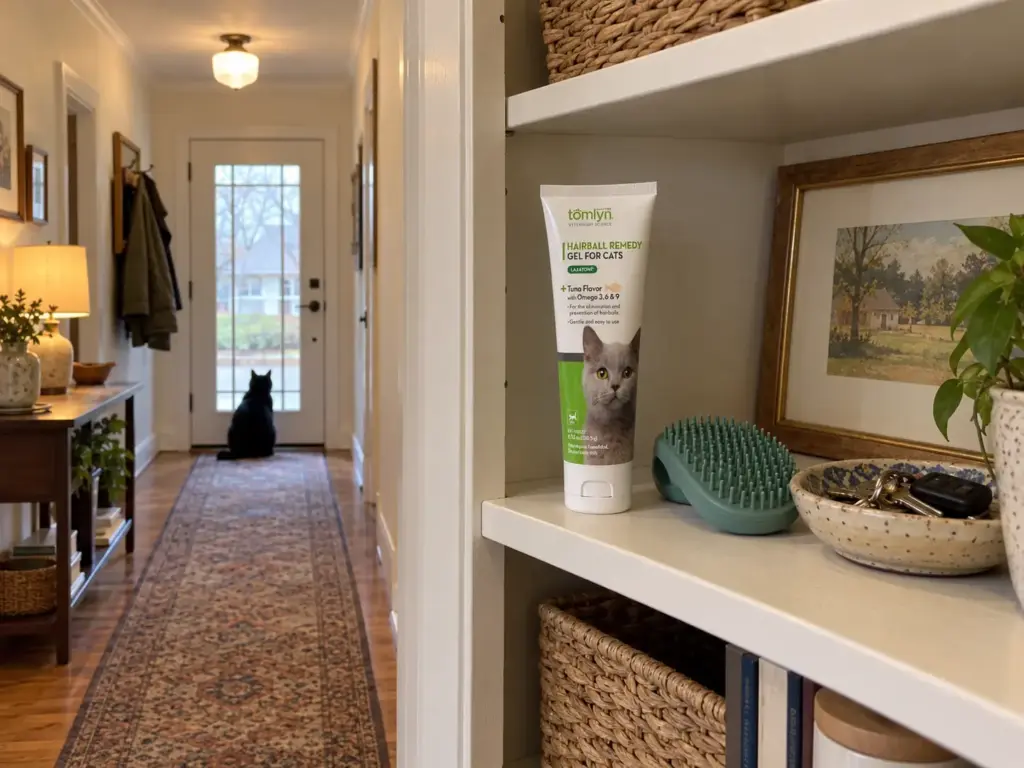
What a remedy can and cannot do to hair already in the stomach
Hair is made of keratin, and a cat cannot digest it. According to Cornell Feline Health Center on the danger of hairballs, most of what he swallows passes out in the stool, while some stays in the stomach and slowly builds into a damp clump.
A remedy works on that clump’s journey, not on its existence. VCA describes a hairball gel as an oil-based lubricant, meant to help the hair slide along, and a fiber product is meant to keep the gut moving, so either one aims at the same thing: hair already swallowed should keep going. Cornell calls keratin insoluble, which is the reason nothing on the shelf has a way to dissolve it.
That leaves a remedy one job, and a modest one. He will swallow hair tomorrow whatever is on the shelf, because grooming is how he keeps himself clean, so the useful questions are how much hair goes in and whether any of it can come out first.
Gel, treat, food or supplement: what the shelf actually sells
The shelf sorts into five kinds, and each one says more on the front than anything behind it can support:
- A hairball gel, a lubricant gel squeezed onto a paw or the nose so the cat licks it off, or a hairball paste that works the same way.
- A hairball control food with added fiber, dry or wet.
- A hairball treat sold with a claim on the bag.
- A supplement, powder or chew.
- A laxative that only comes through a veterinarian.
The last one is not something you pick off a shelf, and the next section explains why the other four earn the same caution.
What to know when the tube is in the cart
Owners standing at that shelf describe the same two snags. The first is a cat who turns the tube down. A 2004 TheCatSite reply puts it this way: “It might be that your cat does not like the hairball remedy, but would like others.” The word that keeps coming up for this cat is picky, and a picky cat settles the matter before any label does.
The second snag appears when the free option gets tried first. The first question about hairball food is usually whether you are brushing enough, and plenty of cats do not enjoy being brushed at all. Brush before you buy is the usual order, and it breaks the moment the cat won’t stand for it.
A refused brush describes the session, not the hair: how long it ran, where it happened, which tool, who was holding him. Shorten it, move it, and let the brushing guide sort out the rest.
Put the brush ahead of the tube. Hair that ends up in the brush never reaches his stomach, and a brush needs no flavor he has to accept. How often to brush your cat sets the rhythm by coat.
Three tubes show what the shelf looks like. The Tomlyn Laxatone Hairball Gel in tuna and the Vetoquinol Laxatone Hairball Gel in maple are the same kind of gel in 4.25 oz (120 g) tubes, in tuna and maple flavors. Neither has a trial behind it, and both depend on a cat who accepts the taste. If he turns his nose up at tuna, the flavor everyone names stops being the right pick.
A gel put on a paw or the nose is a different shape of the same idea. The Nutri-Vet Cat Hairball Paw Gel in chicken comes in a 3 oz (85 g) tube, and it stands for the type and not as a pick. No trial tested it either, and it only helps if the cat lets it near his paw.
Who Skips the Shelf and Goes Straight to the Vet
Before anyone opens a tube, three things belong to the vet and not to the house, and so does the question of when to call the vet. This section names them and stops.

Cornell’s rule on laxatives, in the vet’s own words
According to Cornell Feline Health Center on the danger of hairballs, “Dr. Goldstein strongly advises owners never to give their cats a laxative without the approval and supervision of a veterinarian.” The same page extends that caution to commercial diets that claim to prevent or relieve an obstruction. VCA says the same about gels, which are sold over the counter but should be used under a veterinarian’s direction.
A tube on an open shelf makes the rule easy to forget. It does not change the rule, and a supervised laxative is a different thing from a tube picked up on the way to the register.
The signs that come before any remedy
Cornell lists the signs that mean the vet comes before any product, and each one is a reason to call, not a reason to read more:
- A cat who seems lethargic.
- A cat who refuses food for more than a day or two.
- Repeated unproductive retching.
These are not a home project, and no flavor of gel comes before the phone call. Some cats barely eat in the weeks they deal with hairballs. An appetite that drops belongs in a conversation with the vet, not on a flavor list. If you are unsure what you saw, check the clock before the shape covers what to note about timing before you call.
What to tell the vet if a remedy is already in the cabinet
VCA’s handout on digestive lubricants and hairball gels asks you to tell the vet about every medication your cat gets before starting anything new. Bring the tube, or a photo of its label, and say what he has been given and since when. That is a record of what happened, not a reading of it.
What this article leaves out on purpose: amounts, how often to give anything, which brand suits which cat, and what to do for a cat who retches and brings up nothing. Those are the vet’s answers, given with the cat in the room.
What the Label Can’t Promise, and What the One Trial Measured
Two sentences end up on a hairball gel, the one the seller wrote and the one the rules require, and they do not say the same thing. Below come the label, then the single controlled trial found, then where the boldest claims come from.
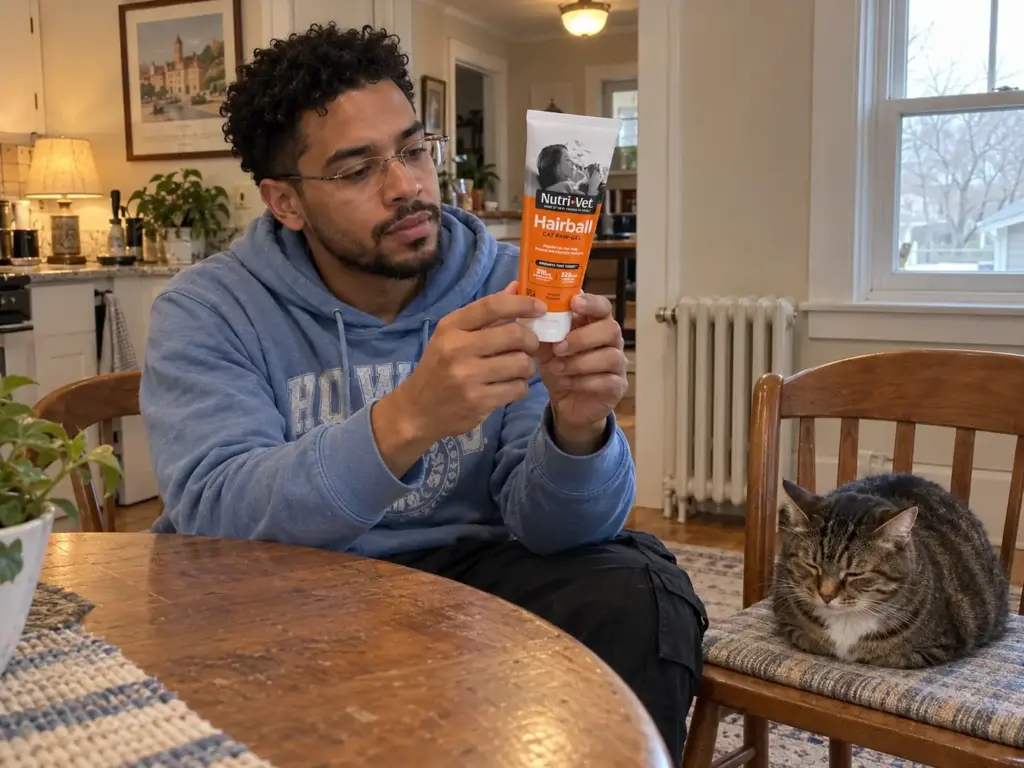
A box can say prevents; the fine print says something else
The wording on the front of a hairball product and the wording the rules require on the back are two different sentences. VCA’s handout on digestive lubricants and hairball gels quotes the line that non-drug health products must carry: “This product is not intended to diagnose, treat, cure or prevent any disease.”
The same handout describes hairball gels as oil-based lubricants sold as supplements, “to help to prevent and eliminate hairballs”. A supplement is a non-drug product, so the FDA disclaimer applies to it, and the pitch and the rulebook sit side by side on one tube. VCA adds that few supplements and herbs have been through rigorous scientific trials, so a product on the shelf has not thereby proved anything. The label is a pitch until a trial says otherwise.
Turn the tube over before you pay for the front. Treat the front as the pitch and the back as the claim, and look there for the not-intended-to-treat line that non-drug products carry.
The one trial found, and what it did and did not measure
The controlled work is thin. A 2014 study on sugarcane fibre and hairballs in cats put 32 cats on dry kibble diets and counted the trichobezoars, the formal name for a hairball, in their stool. Sugarcane fiber, an insoluble fiber, produced fewer small and medium ones per cat per day (P = 0.004), and cellulose, the other insoluble fiber it tried, made no difference.
Read what it measured. It counted hair in the stool, not vomiting, and it tested fiber inside the food, not a gel from a tube. The research was funded by a company, SPF do Brazil, and the proceedings it appeared in were supported by an unrestricted grant from Mars, so the paper’s scope belongs next to its result. A kibble finding does not transfer to a paw gel.
And in the paper’s review of earlier work, a psyllium chew cut a set of clinical signs by 29 percent without significantly reducing actual vomiting (as the paper reports it, from a study this article has not opened). A product can change what an owner sees without changing the hairballs.
The gels themselves have no controlled trial behind them in anything cited here, at least against hairball vomiting.
Where the strongest claims come from
The boldest wording, lines like “most effective” or “proven”, sits where a product is sold, and in none of the sources cited here does a study stand behind it. Treat a claim you can’t trace to a trial as what the seller says. It is a perfectly normal thing for a seller to say, and the cat has no way to read it.
Cornell Calls It Routine and Also Says Never Without a Vet
Two pages from the same Cornell center give an owner two different answers about a hairball remedy, and a tube in the cart is what makes the difference matter.

One page that lists a remedy among the routine habits
Cornell’s page on the hairy dilemma lists a hairball remedy, which it describes as usually a mild petroleum-based laxative, among the ways to reduce the risk. The page gives a schedule for it. A schedule is a vet’s call for a particular cat, so follow Cornell’s page and your vet.
The same page has Cornell’s vet saying that bringing up a hairball every week or two is not uncommon and nothing to worry about.
One page that says a vet decides, every time
The second page is about the hairball that grows too large to pass, a hairball blockage, and about what a vet does then. Its answer on laxatives is short: never without the vet’s approval and supervision, and the same goes for commercial diets that claim to relieve such an obstruction. That page is about the cat whose hair is no longer moving, which is where a tube is easiest to misuse.
How both can be true on the same shelf
Read side by side, the two pages are written for two different owners. One has a healthy cat and wants to lower the risk. The other has a cat that may already be blocked, and it says a vet decides what goes in.
The hairy-dilemma page never mentions a vet next to its remedy, and the blockage page says nothing moves without one. Where two pages from one center differ, take the stricter one: the routine on the hairy-dilemma list is a conversation to have with the vet, not a default to start.
The baselines differ too, and this is the number that depends. Cornell’s vet calls one every week or two unremarkable; Morris Animal Foundation’s guide to hairballs and cats calls an occasional one normal, even one every few weeks. Neither number fits every cat, and the log you keep sets yours. If the count in your house is climbing, you call, and you do not hunt for a figure that excuses it.
The brush carries part of the load the tube is asked to carry. A vet may recommend a laxative-based remedy, and may float shaving the cat if things stay bad, but a regular professional brush-out at a groomer can help a great deal.
Count Before You Start, in a Home With One Cat or Two
A remedy can only be judged against a number, and the number has to be written down before the first tube is opened. What goes into that page changes a little when a second cat lives in the house.

The count comes first, because the box can’t give it
The only test a house can run on a remedy is a hairball count, and it has to exist before the tube does. Call the morning find a gift if you like, but treat each one as a row: the date, which cat, where it turned up, and what changed in the house that month. The hairball log from the how-often piece already lays that log out, so it is not rebuilt here, and if you are unsure what belongs in it, what a hairball looks like sets out what gets counted.
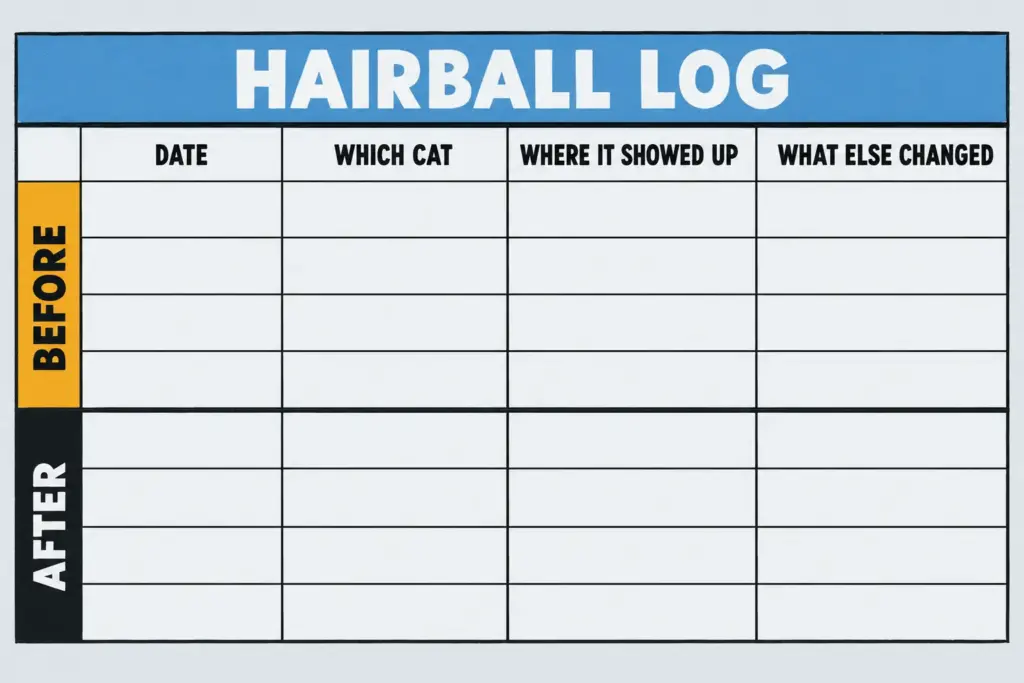
Count the same number of weeks before the first tube as after it. A cat whose hairballs arrive every few weeks may produce one entry in a short stretch, or none, and then the stretch should simply run longer. A single entry is not a verdict. The point of the window is the pattern.
One cat or two: which cat the count belongs to
With one cat, every entry belongs to him and the count is easy. In a multi-cat home, a hairball on the hallway floor has no name on it, and a gel that goes to one cat says nothing about hairballs that might belong to the other. Give each cat his own column, write who was home and which room, and write “unknown” when you can’t tell.
An entry marked unknown is a true entry, and it is worth more than a guess you will later forget was a guess. If the unknowns outnumber the names, the count can’t judge a tube yet, and that is useful to know before you spend anything.
Write down what else changed that month
This is the part no box can print. Any of these can move the count while the tube sits unopened:
- A new food, or the same food in a different form.
- Brushing more often than the month before.
- A shedding season arriving or ending.
- A cat joining or leaving the household, which changes who is producing the entries.
Write who was home and anything you changed that day (a new food, a longer brushing session, a new tube) on the same line as the date. A month later the line explains the number; without it you are guessing which change moved it.
If the count climbs, or the cat changes his habits all at once, stop reading the log as a test and call the vet with it in your hand.
Read the Count After Three Weeks, Then Take It to the Vet
Three weeks after the first entry, the log can finally answer a question, and the answer is only as good as the stretch of weeks it covers.
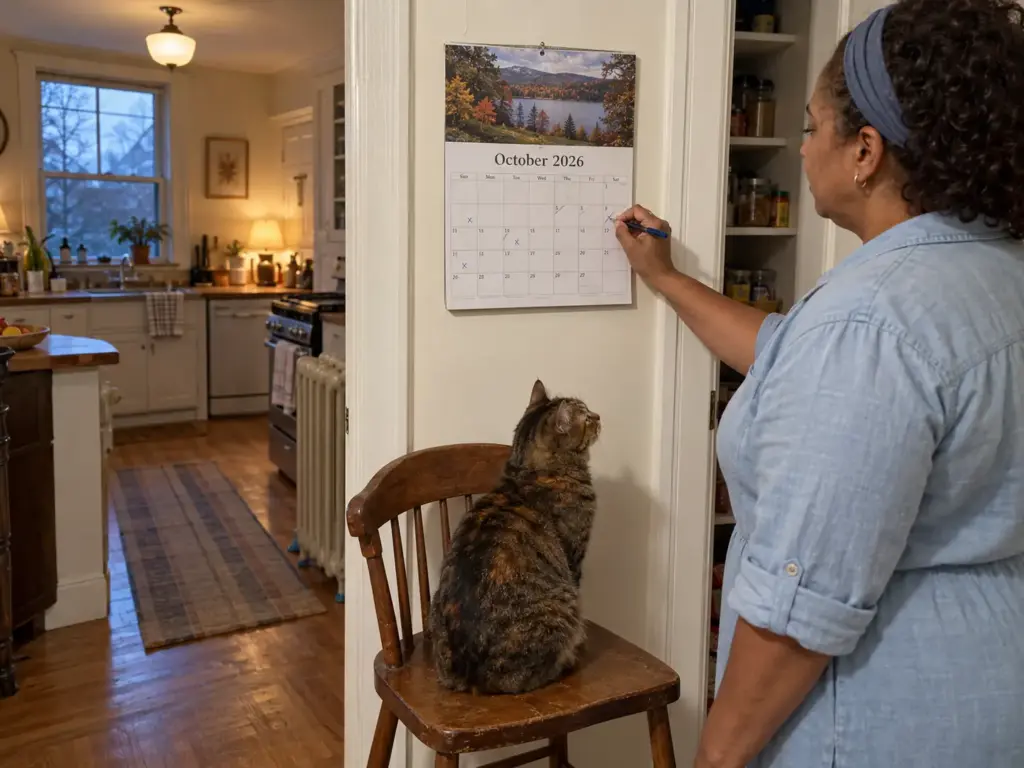
What the same count says after the same stretch of weeks
Lay the two stretches side by side, same number of weeks, same cat. If the number did not move, the tube did not do what its box implied in your house, and that is not a failure of the cat. If it dropped, go back to the list of what else changed before you credit the tube: a longer brushing routine or the end of a shed can do the same.
Morris keeps the frame honest, since an occasional hairball is normal. The log is there to show a pattern, not to raise an alarm over one entry.
What goes to the vet with the log, and what stays at home
The log goes to the vet: the dates, which cat, where each turned up, what changed in the house, and what he was given and since when. No interpretation goes with it. The brush, the count and the notes stay at home. Which product, how much, and whether a remedy is needed at all is the vet’s decision, and the log makes that decision faster.
One limit applies to this article too: a count from a house nobody has seen, on a cat nobody has examined, cannot be judged by this article. It can only help you bring better information.
Take the dated log to the appointment, not an opinion about the tube. A page of dates, cats and rooms tells a vet more in a minute than an owner can reconstruct from memory.
Why no remedy replaces the brush
Hair in the brush is hair that never reaches the stomach, which no tube can match. Shedding moves the count too, since a heavier shed means more loose hair to swallow, and when cat shedding is a problem is where that side of the count gets sorted out. The brush stays on the list whatever the tube does.
Start the Log Today, Brush Before You Buy, and Let the Vet Name the Product
Three things to carry out of this. A remedy may help swallowed hair keep moving, but it does not dissolve a hairball, and nothing cited here shows that a gel prevents them. Before a tube comes the brush and a call to the vet, and a laxative never goes in without the vet’s approval. The only thing that can judge a remedy in your house is a dated count with the house written beside it.
Open the log again three weeks after your first entry and set the two stretches next to each other before you decide a tube earned its place. Today, take a page and write the date, which cat, and the spot where you last found one, then leave the tube in the cart until the page has a few weeks on it.
Frequently Asked Questions
01Do hairball remedies work?
A remedy may help swallowed hair keep moving, but it does not dissolve a hairball, and no controlled trial cited here tested a gel against hairball vomiting. Which product, and whether your cat needs one, is the vet’s decision.
02What do vets recommend for hairballs?
The vet sources cited here agree: never give a laxative without a veterinarian’s approval and supervision, and call about warning signs before trying anything. Brushing is the free step to start with.
03Can a hairball remedy dissolve a hairball?
No. Hair is keratin, which Cornell calls insoluble, so at most a lubricant or fiber helps hair that is already swallowed keep moving. VCA’s handout describes gels as oil-based lubricants to use under a veterinarian’s direction.
04Do cats ever poop out hairballs?
Yes, Cornell Feline Health Center says most swallowed hair passes through and leaves in the stool. A cat who seems to need help with it should be seen by a vet, and no laxative goes in at home.
05How do I know if a hairball remedy helped?
Compare a dated count of the same stretch of weeks before and after you start, with what else changed in the house written beside each date. Bring that log to the vet; no box can tell you this, and only your count can.



Leave a comment