Hairball vs Vomiting? Check the Clock Before the Shape
Tell a hairball from food coming back or vomit by what it's made of and when it happened, then write down what the vet will ask for (+ which cat).

Alfredo RamsesFounder · Updated November 1, 2026 · 15 min read

On this page7 sections
- 1Hairball vs Vomiting Starts With a Third Thing on the Rug: Food That Comes Back as a Tube
- 2Count the Attempts, Not the Mess, and Know Where the Vet Line Sits
- 3The Clock: How Soon After the Meal, and How Soon After Grooming
- 4Two Cats, One Rug: Which Bowl, Which Cat
- 5What the Rug Can't Read: a Cough With Nothing Coming Up, and the Brush You Already Own
- 6Write Down the Clock and the Count, Then Change One Meal
- 7Frequently Asked Questions
You are standing over the rug with a paper towel, looking at a tube about an inch thick, and you are sure it is a hairball. The shape is the reason you are sure, and shape is the weakest evidence in any hairball vs vomiting question, because a meal that comes straight back up can leave the same outline. Your cat has two habits that end on that rug, grooming for hours and gulping his dinner, and only one of them is about fur. Below: how to sort the pile by what it is made of and by the clock, the one number worth counting, where the vet takes over, and what changes when two cats share the apartment.
The table below is the whole sort, contents first and clock second, and none of it replaces the call list in the second section.
| What to check | Hairball | Food coming back | Vomit |
|---|---|---|---|
| When it happens | After a long grooming stretch, following a retch | Within minutes of eating | Any time, with or without a meal before it |
| What comes before it | A gag or retch, usually brief | Usually no retching at all | Heaving; lip licking and repeated swallowing may come first |
| What is in it | A tube of fur strands, usually close to the coat color | Food you can name, as a tube or a pile | Stomach contents; photograph and describe them, do not decode them |
| First move at home | Brush, and log the attempt | Slow the meal, and log the attempt | Log the attempt and check it against the call list in the second section |
Hairball vs Vomiting Starts With a Third Thing on the Rug: Food That Comes Back as a Tube
Three things can be lying on the rug, or on the hard floor, not two: a hairball, vomit, and food that came straight back up. The third one is the reason the shape fools people.
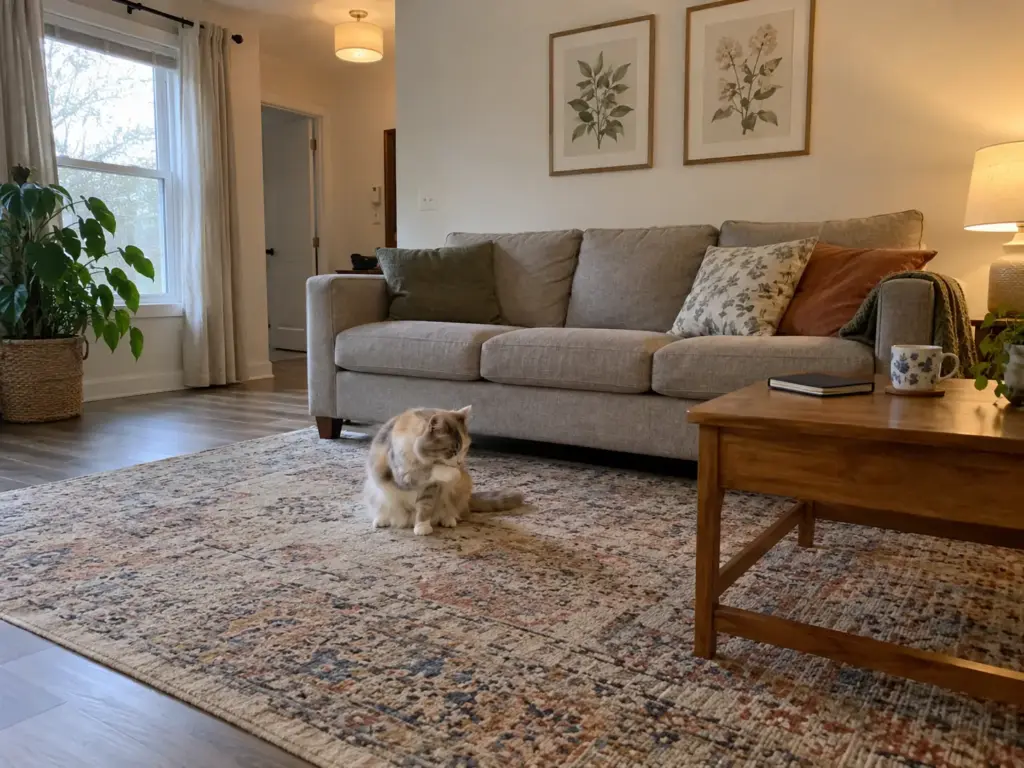
Why the tube test stops at fur
The simplest rule in our guide to why cats get hairballs is that a tube made of your cat’s own fur is a hairball. That rule is sound for fur and silent about food, because a tube of undigested food has the same outline.
Size does not separate them either. According to the Cornell Feline Health Center’s hairball guide, “Regurgitated hairballs are variable in size; though usually about an inch long, they can be as long as five inches and an inch thick.” Slender and cylindrical is the usual hairball shape, and it is also the shape food takes when it comes back whole.
So treat the tube test as the first half of a test. Shape says something came up as a tube; only the contents say what it was. Food that comes back is usually recognizable as whatever the cat’s food is, chunky and sometimes not even looking different from what’s in the bowl. The person who cannot tell the pile from a hairball is the common case, not the careless one, and the cat who bolts his dinner is the one leaving that pile.
Fur strands or food pieces: look at what it is made of
Look before you pick it up. A hairball is fur: strands pressed together, mostly running one way, usually close to your cat’s coat color. Food that comes back has pieces you can name, kibble shapes or a smear of wet food, and now and then it looks hardly different from what is in the bowl. Strands against pieces is the test, and it works on any rug color.
A pile with neither fur strands nor food you can name is not you failing the test. It is a description for the vet, so photograph it next to a coin, write down the time, and carry on to the count in the next section. How long a fur tube runs, in inches, lives in what a hairball looks like in inches, so it is not repeated here.
Read what it is made of before you clean it up: strands all running one direction point to fur, pieces you can name point to food. If it is neither, take one photo with a coin beside it and stop there.
Two words for one thing: regurgitate and regurgitation
Two vocabularies are in circulation, and they collide. Cornell uses regurgitated for the hairball itself, meaning fur that was swallowed and then brought back up. IDEXX reserves regurgitation for food that returns within minutes, undigested, usually without retching. Either use is fine on its own page; both on one rug makes a mess of the reading.
This article keeps them apart. A hairball is the tube of fur. Regurgitation is food coming back.
Vomiting is stomach contents that come up with heaving, and dry heaving that brings nothing up counts as an attempt. Each word means one thing from here down.
Count the Attempts, Not the Mess, and Know Where the Vet Line Sits
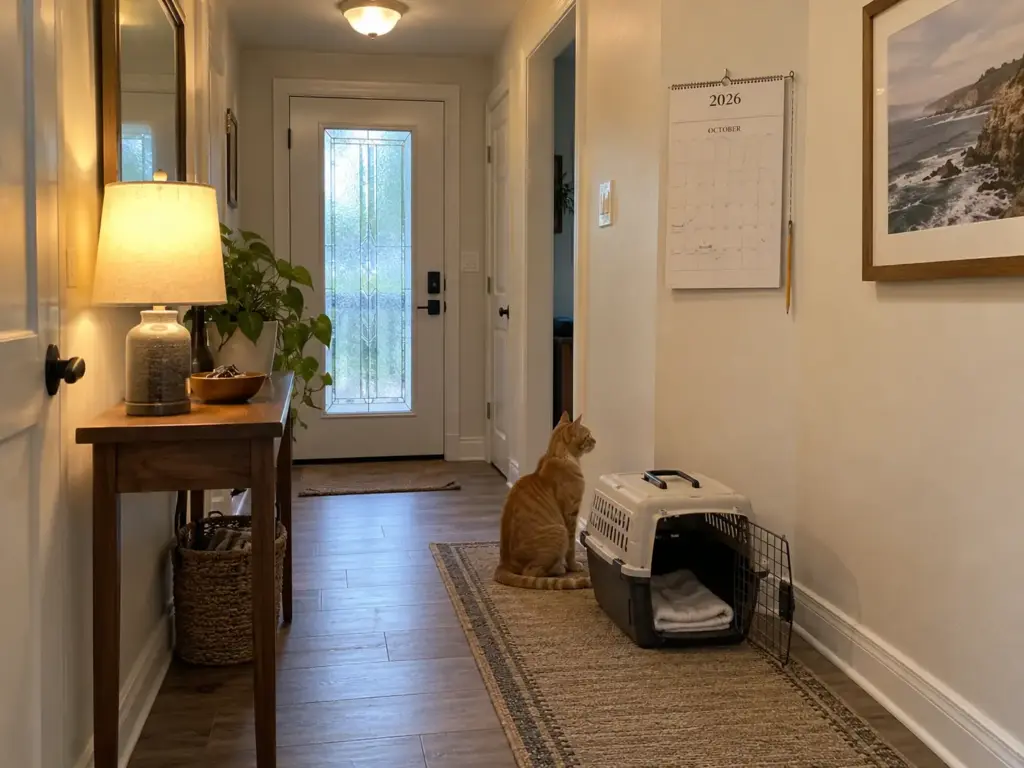
Why an attempt counts even when nothing comes up
With the vet’s office closed, the question is often whether it is okay to wait a few days. The question has no answer in the size of the mess, because the mess is only the attempts that ended with something to see. A retch that ends in nothing is still an event, so count the attempts, gagging included. The warning sound, HURK HURK HURK, means something is about to come up, and it is a workable definition of an attempt for a cat who announces himself first.
In a two-cat apartment the sound matters twice: it is an attempt, and it tells you which cat. Write both down.
Where the sources draw the line, and where this page draws it
The vet sources that put a number on this do not agree. Charlotte Carolina Vet says more than two episodes of severe vomiting within 24 hours. IDEXX says a cat with repeated vomiting should see a veterinarian, and gives no number. Cornell lists repeated unproductive retching or true vomiting among the signs for an exam.
This site’s own line sits below all of them: two or more attempts in one day, gagging included, with or without anything on the rug.
That is a house rule, not a figure from a source, and it is set low on purpose. A phone call that turns out to be nothing costs a few minutes; the cause behind a repeating pattern is something this page will not try to name. For the monthly picture, how many hairballs a month is normal, and why the sources disagree goes through it.
The list that is a phone call, not a wait
Cornell says a cat that is lethargic, refuses to eat for more than a day or two, or has repeated unproductive retching or true vomiting “should be examined by a veterinarian without delay.” That is Cornell’s list of signs that call for an exam, in the vet’s own words. Folded together with the other signs vet sources agree on, these are the ones that stop the sorting on the rug and start a call:
- Blood in vomit, or bile and nothing else
- Two or more attempts in one day, with or without anything on the rug
- Not keeping water down, refusing food for more than a day or two, or acting weak and tired
- Repeated retching that brings nothing up
- Worms or string in what comes up
- Breathing that looks hard during a cough-like episode (call right away, and film it)
None of it is explained here, on purpose. What any item means is the vet’s work. Yours is the notes: the date, the time, the meal before it, and which cat.
Keep one note per attempt on your phone: the time, how long after the last meal, and which cat. Three short lines per attempt are what turn the call to the vet into a short one.
The Clock: How Soon After the Meal, and How Soon After Grooming
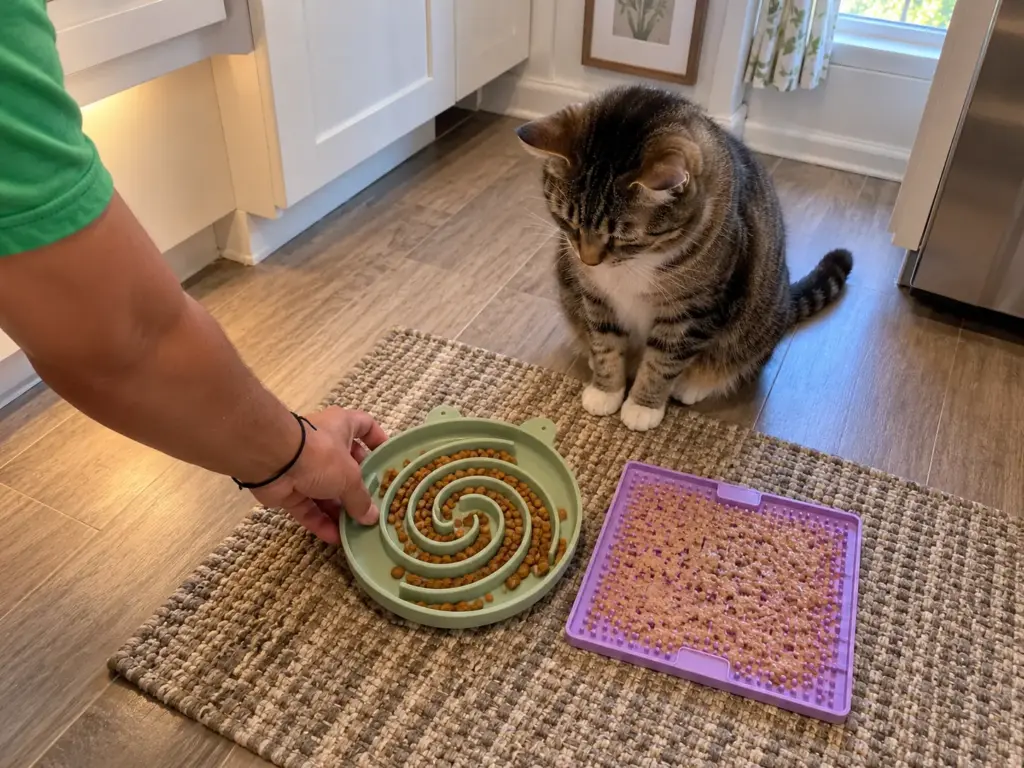
Minutes after eating, with no heaving
Some cats bring food up only after the biggest meal of the day, never after the small ones. That is the kind of pattern the clock catches and the shape never will.
The clock starts at the bowl. Food that comes back within minutes, undigested and usually with no retching, is regurgitation. The fast-eater version has a name, scarf-and-barf, and it describes the order of events exactly: eat, then up.
A hairball needs grooming to have happened first, and grooming leaves no mark on the clock at the bowl. So write the meal, how big it was, and how many minutes passed. If the timing tracks the meal rather than the grooming, that line in your notes is worth more than the photo.
After a long grooming session, a retch, then a tube
Cats spend around a quarter of their waking hours grooming, according to a veterinary review of hair balls in cats, hosted by the NIH’s PubMed Central, which means fur goes down every day and an occasional tube is within the ordinary range. The same review puts hair ball vomiting at around 10% in otherwise healthy shorthaired cats. What matters is your cat’s own count, not the average.
The sound comes first. IDEXX says most cats gag or retch shortly before a hairball comes up, and that it is usually brief. Charlotte Carolina Vet adds that lip licking and repeated swallowing may come before vomiting. Take that as a cue to start watching, not as a test, and keep the posture out of it: crouching and stretching the neck is shared by too many things to sort anything.
The three clocks, side by side:
- Minutes after the bowl, no heaving: food coming back
- After grooming, a brief retch, then a tube of fur: a hairball
- Any time, with heaving: vomiting, and a line in your count
Eating too fast is the part the house can change
A cat who bolts his dinner is running a race the house set up. IDEXX notes that cats are natural hunters and may gulp, especially when they feel they are competing with other pets, so the speed is information about the meal, not a flaw in the cat.
The free options come first. Spreading the food over the whole of a large plate is a cheap way to slow a fast eater. A large plate is already in most kitchens, so it costs nothing to try.
The same idea comes in other forms: four small meals in place of two, a timer bowl for the middle feeding, a splash of water mixed into dry kibble to slow one cat down. Split one meal across two bowls and see whether the pace changes.
If a plate does not slow him, the Bifeaw Slow Feeder Cat Bowl is a silicone bowl built so a cat has to work for each bite, the kind of tool IDEXX names for encouraging smaller mouthfuls, and it is made for dry and wet food alike. It slows the eating without touching the reason for the rush: if what he is watching is another cat’s bowl, he will still hurry the lap to it.
Wet food has its own free version, the same thin spread on a flat plate. The shop-bought one is the LickiMat Classic Playdate, a flat mat you smear the food across so the cat licks it off instead of swallowing it in a few mouthfuls. The seller’s own advice is to supervise the first few sessions in case a cat chews the mat, and a mat serves one cat at a time.
This section is about the pace of an ordinary meal. What to feed or hold back after an episode belongs to the vet.
Two Cats, One Rug: Which Bowl, Which Cat
The rug does not sign its work
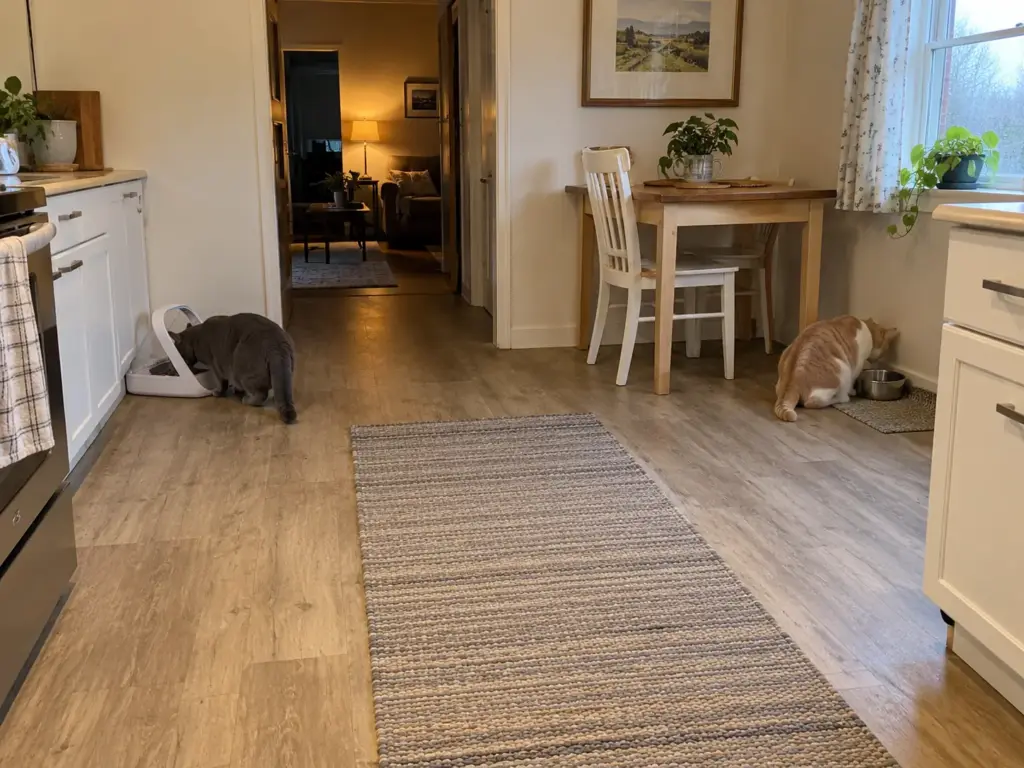
In a two-cat house, the evidence on the floor is the same whichever cat left it. Feeding in a multi-cat home can feel like herding cats in three different directions to three different bowls, and the apartment version is one counter, one kitchen and a rug in between. What the house can do is make the meal readable: who ate where, how fast, and who was watching the other bowl.
Owners describe the pattern in their own words. One cat goes “wolfing his food down so he can then push in and steal” the other’s, and the vomit lands “often into his food bowl while he’s still trying to eat more.” The bowl is a better witness than the rug. That is a clue for your notes, not a verdict on either cat.
Separate bowls, separate spots, half a portion in each
The cheapest answer comes first: two bowls, half the portion in each, so a greedy cat believes another bowl is waiting.
Put the second bowl in another room if the apartment allows it. Nothing to drill, nothing to install, and the cat who eats with his head turned toward the other bowl is the first suspect for the gulping. Separate meals, at separate times, are the next step if two stations in one room are not enough.
The slow bowl is the obvious pick for a gulper, and in a two-cat house it should be the second purchase, not the first. A slow bowl slows him down but leaves the other bowl exactly where it was, and the other bowl is what he is racing. Separate stations first, then a slower bowl if the pace is still too fast. For the layouts, feeding two cats in a small apartment, by floor plan has a version for each kind of floor.
The chip feeder, and the second cat that fits in the doorway
Its flaw first. The entrance is big enough that a second cat can fit in and eat at the same time. In a house where the second cat is the smaller one, that undoes the point.
The Sure Petcare SureFeed Microchip Pet Feeder Connect opens only for the cat whose microchip it reads, so the greedy cat cannot take the other’s meal. Buyers put the bowl at about 400 ml, and it sits on the floor like any other feeder.
It reads chips and nothing else: it does not know who threw up, so the notes stay yours. If the plan is one station per cat, two cats, two bowls, plus one covers the count. A pattern that keeps repeating in one cat goes in the count and to the vet, whichever bowl it came from.
Give each cat its own station and a different bowl color, then write which one it was. The rug will not tell you; the bowl sometimes does.
What the Rug Can’t Read: a Cough With Nothing Coming Up, and the Brush You Already Own
A cough that brings nothing up is not a rug question
You see the crouch, you hear the sound, and you find nothing on the rug, so you go looking for a hairball. The name for it is hairball, and the veterinary review on PubMed Central describes it the same way.
But Cornell’s note that a cough may be something else says the frequent hacking may have nothing at all to do with hairballs. An empty rug is not a clean result. It is the absence of one.
This page names only one thing here: if breathing looks hard during one of these episodes, call right away, and film it. It does not say what a wheeze means, and it will not.
What to bring when you call
The call goes faster with four things in hand: the dated count, a video of the episode, the name of the food, and which cat. The guides on how often hairballs are normal and what they look like cover how to keep the count, so this section is only the packing list. A phone clip of the crouch and the sound will carry more than any description you can give from memory.
Record a video of the episode on your phone before you do anything else. The clip of the crouch and the sound is worth more than any description, and it still works when the rug stays empty.
The one lever on the fur side: the brush
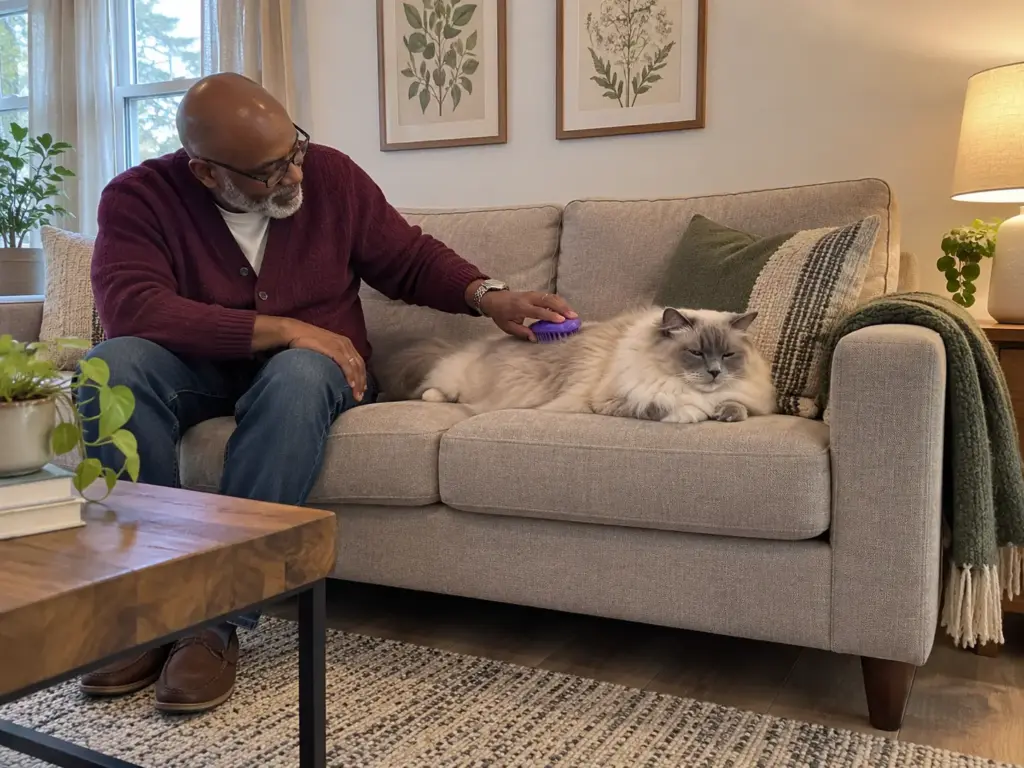
Loose hair is the only part of a hairball the house can touch, and IDEXX names the first home step as brushing often with a tool that removes loose hair. The brush already in your drawer is that tool, so start there. If nothing in the drawer suits your cat’s coat, the Cat Brush with Soft Rubber Pins is a washable silicone brush, 8 x 4.5 x 2.5 inches, small enough to hold in one hand. It is meant for loose hair on the coat surface, not for a knot pulled tight to the skin, which is a different job.
A long coat and a short dense coat do not ask the same thing of a brush, and how often is its own question: how often to brush your cat, by coat sorts it. Fewer swallowed hairs means fewer tubes to sort. The brush treats nothing.
Write Down the Clock and the Count, Then Change One Meal
Three things carry over from this page into your week:
- Read what the pile is made of before you read its shape, then check the clock: minutes after the bowl, after grooming, or any time with heaving.
- Count attempts, gagging included, with the date and the cat, and call the vet when the list in the second section is met, two in a day among them.
- In a two-cat apartment, make the meal readable before you buy anything for it.
When three weeks of notes have piled up, open them and see whether the count fell, held or climbed. If it did not fall, the notes are the first thing to read out on the phone, and a slower meal that changed nothing is information too.
Tonight, spread one meal over a large plate, or split it between two bowls in two spots, and watch whether the sound or the timing changes.
Frequently Asked Questions
01Did my cat throw up or is it a hairball?
A hairball is a tube of your cat’s own fur that follows a retch, while food back within minutes and without heaving is regurgitation. Heaving that brings up stomach contents is vomiting. Anything that fits none of these goes to the vet as a description, with a photo.
02Should I feed my cat after vomiting a hairball?
What to feed or withhold after an episode is a question for your vet, because the house cannot judge it from the rug or from the cat’s mood. If he is eating and drinking as usual after a single episode, write it down. If not, call.
03How long does it take for a cat to vomit a hairball?
Most cats gag or retch shortly before a hairball comes up, and the retching is usually brief, so the sound arrives just ahead of the tube. A retch that goes on, or repeats through the day, is the count the call list is about.
04Do cats feel better after throwing up a hairball?
What the house can see is whether the cat goes back to eating, drinking and using the litter box as usual after an episode. A change in any of those is a call. Mood is not something to read from the rug.
05Why does my cat bring food back right after eating?
Food that returns within minutes, undigested and without retching, is regurgitation, and in a multi-cat house the gulp is often about the other bowl. Slower meals and separate stations are the house’s levers. A cat who keeps doing it goes in the count and to the vet.




Leave a comment