What Hairballs Look Like, Measured in Inches
What hairballs look like: a tube about 1 inch thick, up to 5 inches long, coat-colored. A 3-step ruler + paper towel check tells it from poop.

Alfredo RamsesFounder · Updated October 30, 2026 · 13 min read


On this page8 sections
- 1What Hairballs Look Like: a Tube Shaped in the Throat, Not a Ball
- 2When What You Found Isn't a Tube, the Question Moves to the Vet
- 3Hairball or Poop? A Three-Step Check You Can Run on the Spot
- 4Measuring a Hairball: About an Inch Thick, Up to Five Inches Long
- 5Two Cats, One Rug: Matching the Tube to a Coat
- 6Where Tubes Turn Up Underfoot, and What to Do Once You've Looked
- 7Write It Down, Pick It Up, and Look Again in Three Weeks
- 8Frequently Asked Questions
You find it at the edge of the rug, and what hairballs look like is not what you pictured: damp, narrow, the color of your cat’s coat, and nowhere near a ball. His throat made that shape on the way up, not your cat’s choice, and the fur comes from a tongue that spends a large share of his awake hours grooming. Cornell’s Feline Health Center describes the same slender tube, which gives you something to hold up against whatever is on your floor. The sections below cover the shape, the finds that are not a tube and go to a vet, a three-step check for telling a tube from poop, and a way to measure one with a ruler.
Quick Answer
A hairball that has come up is a damp tube of fur, not a ball: about an inch thick, usually about an inch long and up to five, in the color of the cat’s coat or a shade darker. Anything that is not a tube of hair is a question for your vet.
What Hairballs Look Like: a Tube Shaped in the Throat, Not a Ball
Most people expect a sphere, and that mismatch is half of the confusion: the hairball shape on a floor is a tube, and a tube-shaped hairball is the ordinary version, not a strange one. The mechanism behind it, and why some cats produce them more than others, is in the full story of why cats get hairballs, so this section stays with what is lying in front of you.

Round inside the cat, a cylinder on the way out
According to Cornell’s Feline Health Center, “Despite the term, disgorged hairballs are not usually round. They are often slender and cylindrical, shaped more like a cigar or sausage than a ball.” The mass of hair can stay roughly round while it sits in the stomach. Once it climbs the esophagus it gets squeezed into a cylinder of fur, and that cigar-shaped hairball is what lands on your floor: the shape was made in his throat, not chosen on the rug, and a ball would still be inside him.
The coat’s own color, a shade darker
Hairball color follows the coat: it is mostly the color of the coat, darkened by food and stomach juices such as green bile on the way up, so a tube from a ginger cat comes out ginger-brown. If what you found looks nothing like his fur, that is the vet’s to read and not the rug’s.
Look at the floor around the spot where he sleeps or grooms before you vacuum or mop. That is where finds tend to turn up, and a vacuum or a wet mop turns a damp tube into a smear you can no longer read.
Wet when it lands, dry by the time you find it
A fresh wet hairball is damp and shiny, and it dries out fast if nobody sees it land. That makes the wet-or-dry test useful only when you find it soon; a dried hairball has had time to lose its shine and stiffen into the fibers of the rug.
The hair itself is the product of constant grooming, done with his tongue papillae: a 2018 study in the Proceedings of the National Academy of Sciences found that house cats can spend up to 24% of their waking time licking their coats, about a quarter of his waking hours with his tongue on fur. For the grooming side of that, see how much time a cat spends grooming.
When What You Found Isn’t a Tube, the Question Moves to the Vet
A tube of hair is the easy case
A damp tube of fur is the one find on this page you can deal with from the floor. Everything else in this section is about the finds that are not that, and for those this site stops being useful and your vet starts. We work in furniture, floors, litter and routine; what is going on inside a cat is not on that list.
Signs that skip the rug and go straight to a phone call
Cornell lists three signs that mean a veterinary exam without delay: a cat who is lethargic, a cat who refuses food for more than a day or two, and repeated retching or dry heaving that brings nothing up, or true vomiting. VCA Animal Hospitals’ guide to trichobezoars draws the line in the same place from another direction: a cat who cannot keep down food or water needs veterinary treatment. Another veterinary guide adds a count worth keeping in your head: two or three attempts to vomit in a single day, whether or not anything lands. Count the attempts, gagging included, not the mess.
Liquid, foam, bile, mucus or food where a tube should be goes in the same pile. What any of those means is a vet’s question, and this page will not guess at it. The full hairball vs vomit comparison is a separate question, and our guide to why cats get hairballs has a short section on telling a cough from a vomit.
What the house can and can’t answer
The house can tell you where the find turned up, how many times it has happened this week, and whether anything changed in the apartment around the time it started: a move, a new rug, a visitor, a different feeding spot. It cannot tell you what a particular tube, retch or color means for the cat. When you book the vet visit, those notes are the useful part, because the vet gets a count and a context and makes the call from there. The same split between what the house explains and what only an exam can answer shows up with fur on the sofa too, in our piece on when a change in hair is a vet question.
Hairball or Poop? A Three-Step Check You Can Run on the Spot
When a hairball looks like poop, the first reaction is usually that somebody missed the litter box. Someone who finds two tubes in two different spots may take them for poop at first, then pick one up and see that it looks like hair. A hairball can look like a clump of wet hair in the shape of a turd, which is exactly the look-alike: the resemblance is in the shape, not in what it is made of. Three steps settle hairball vs poop on the spot.
- Where. Note where it landed. A tube on the floor, a rug, a cushion or the bed is the usual place for a hairball; the litter box is not.
- What it’s made of. Lift it with a paper towel and look. Strands of hair pressed together into a tube are a hairball.
- What happens next. If it is a tube of hair and none of the signs from the last section are there, you are done. If it is liquid, foam or food, or any of those signs is there, you call the vet, and what you just saw is the first thing you tell them.
Where it turned up
VCA notes that many cats simply bring one up where they are standing, leave you to discover it on the floor, and carry on with their day. So the spot is the first clue, and it is not a message: he was wherever he was when it came up, and he did not carry it anywhere. A tube at the foot of the sofa, at the edge of the hallway runner or beside the bed fits that. Hair inside the box is a different matter, and it is not a hairball either.

What it’s made of when you lift it
Standing up, a damp tube is easy to take for something else. Lift it on a paper towel and the strands show, lying along the length of the tube and pressed together, the way they were squeezed on the way up.
The panic is understandable: picture a cat sitter calling in sure that one of the cats had pooped out of his mouth, ready to rush him to the ER. It was a hairball, the same kind of tube. Looking before deciding is what turned that call from an emergency into a paper towel.
Pick the find up with a paper towel before you decide what it is. From standing height almost anything damp and brown looks alike, and lifting it shows the strands in seconds. Wash your hands afterward and put the towel straight in the trash.
If what is on the towel is not a tube of hair, that is not a step in this check any more. It is a phone call, and the notes from the last section go with it.
Why hair in the litter box is not a hairball
Cornell explains the split: hair is keratin, which a cat cannot digest, so most of what a cat swallows while grooming travels through the digestive tract and leaves intact in the feces. Only the part that stays behind in the stomach and clumps comes back up as a tube. So hair in the box is the normal exit, and hair on the rug is the clumped part, and finding both on the same day does not mean anything went wrong twice. If it is the stool itself that looks off, reading it is the vet’s job and not something to do beside the box.
Measuring a Hairball: About an Inch Thick, Up to Five Inches Long
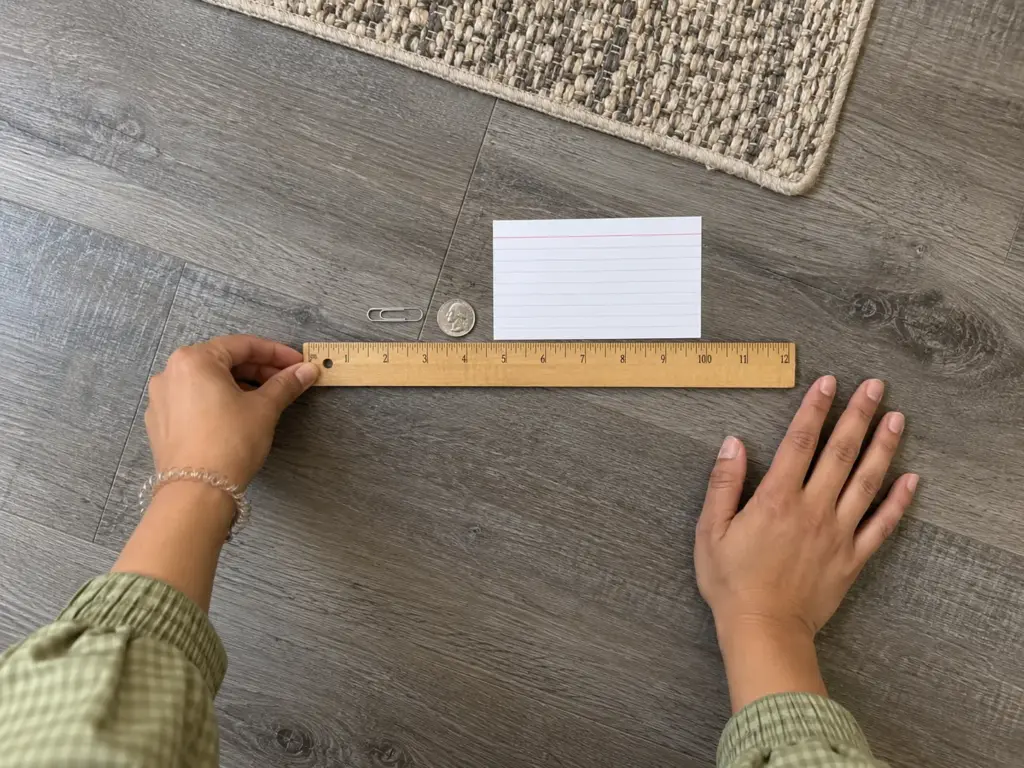
Lay the ruler beside it, not over it
Put a ruler on the floor next to the tube, lined up with its long side, and read the length from one end to the other. Then read the thickness at its fattest point.
Beside, not over: a ruler pressed onto a damp tube flattens it and drags it, and you end up measuring your own handiwork. If it has curled as it dried, measure it as it lies instead of straightening it. Two numbers, plus whether it was damp or dry when you found it, are all you need.
Cornell’s range as a reference, not a verdict
Cornell Feline Health Center puts the usual length of a regurgitated hairball at about an inch, with big ones reaching about five, and the thickness at about an inch. That range is the only reference worth holding your ruler against, and it is a reference, not a pass mark.
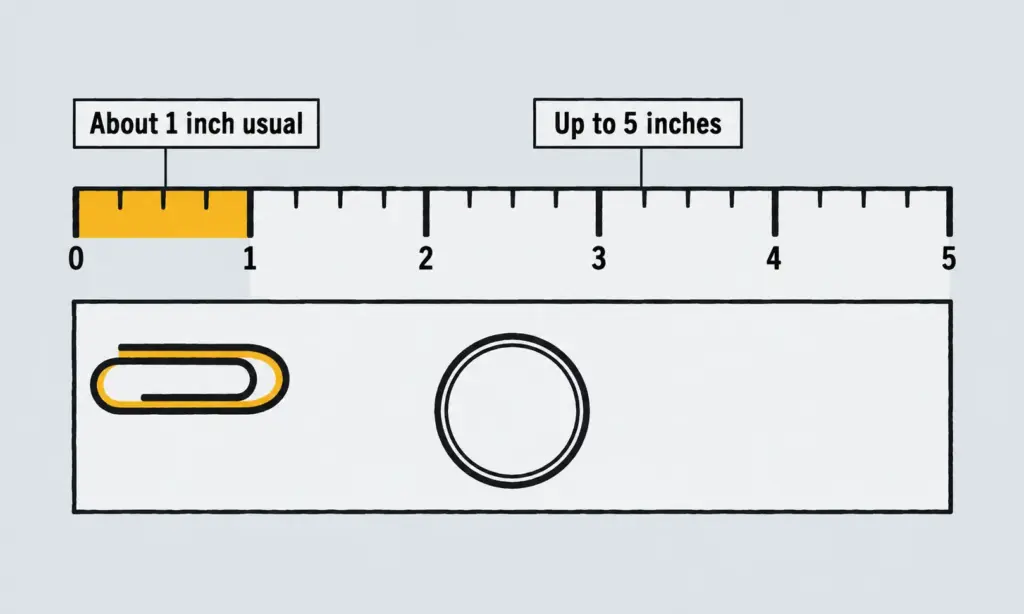
For the small end, a quarter is just under an inch across and a small paper clip runs about an inch. For the long end, the long side of a 3×5 index card is exactly five inches. You are not looking for a match. You are checking roughly where the find sits between those two, and Cornell’s wording puts the usual one at the small end.
Why this is a note for the vet, not a score
The size on its own says nothing about your cat’s health. A tube inside the range does not mean all is well and a tube outside it does not mean all is wrong, and no threshold exists that you can apply at home, so this page does not offer one. What the number is good for is the phone call. A line like “two inches long, as thick as a quarter, damp, beside the sofa, found this morning” is something a vet can use, and it is more useful than “a big one”.
Keep the log as a note on your phone, one line per find: date, length, thickness, place. Skip the photo of the contents. The numbers and the spot say everything a vet will ask for, and they do not leave a gallery you have to scroll past later.
Two Cats, One Rug: Matching the Tube to a Coat
The color of a tube is mostly the color of the coat it came from, so in a home with a long-haired cat that is ginger and a short-haired gray one, the tube usually answers the question of whose it is before you have asked it. Lift it and look at the strands: their color, and how long they are, point to one coat or the other.

Two cats with similar coats are the harder pair. For those, the clues are where each one sleeps and which corner of the room each one grooms in, and those are worth jotting down for a week instead of guessing. Whose it is tells you nothing about either cat’s health, and this page draws no conclusion from it.
The count for each cat is its own question, covered in a separate piece. And the vet rule from the last sections holds with two cats: if one of them changes suddenly, that cat goes to the vet, and the other cat’s finds do not change that.
Where Tubes Turn Up Underfoot, and What to Do Once You’ve Looked
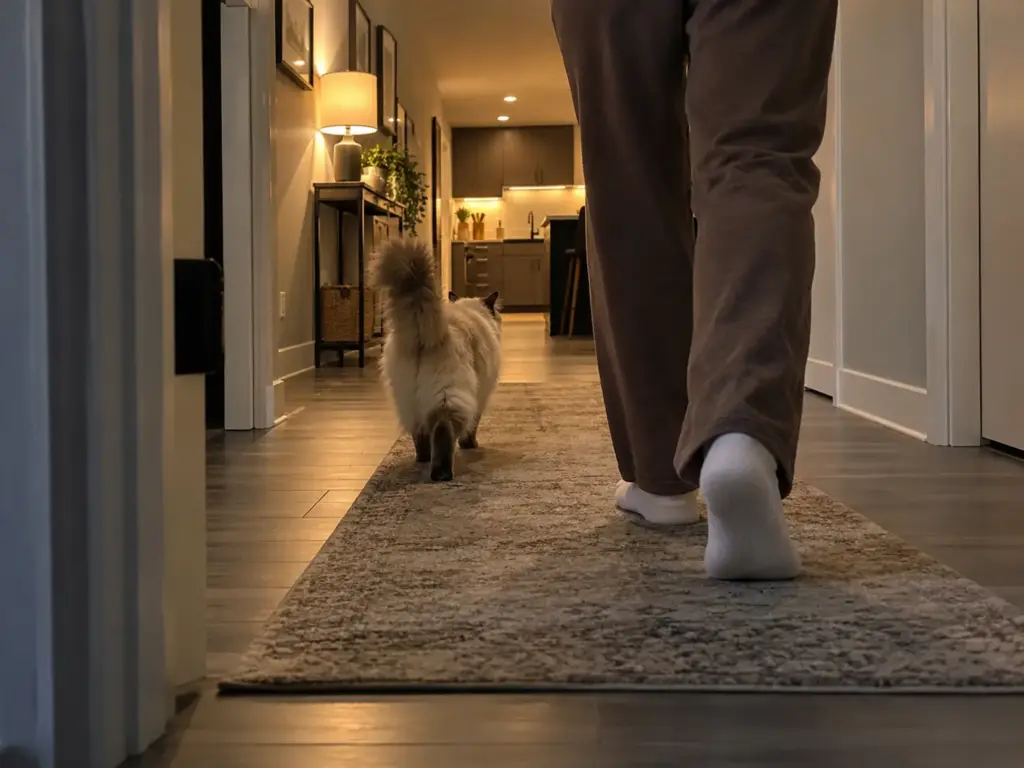
The spots to check each morning
Tubes are often found by stepping on one barefoot, which says a lot about where they land: the edge of the rug, the hallway, the foot of the sofa, the carpet beside the bed. A quick look at those four places before your feet get there is a cheap habit, and it means you meet the find while it is still damp and still readable.
Pick it up while it’s still damp
Use a paper towel and lift it straight up. A damp tube comes away whole; one that has dried grips the fibers of a rug and has to be worked out in pieces, which also destroys the shape and the length you were going to measure. Nothing to buy for this part. Fewer hairs swallowed in the first place is what brushing is for, and how often to brush your cat depends on the coat, with no promise attached about how many fewer tubes you will find.
Where the count lives
How many of these a month is usual for a cat is a separate question, and it gets its own answer in how often hairballs are normal. If anything changes suddenly, such as more attempts, a cat who stops eating or one who just seems off, the order does not change: the vet first, the house second.
Write It Down, Pick It Up, and Look Again in Three Weeks
Three things carry over from this article. A hairball that has come up is a tube of hair in roughly the color of the cat’s coat, and anything that is not that goes to the vet. The check is three steps long, where it landed, what it is made of and what happens next, and the ruler goes beside it and never over it. And the find is easiest to read while it is damp, so pick it up early and write down the place and the numbers.
Three weeks from now, look at what you have been finding. If it is still a tube of hair, in the same few corners and about the same size as before, the pattern is steady. If the shape, the spot or the cat has changed, that is a call, not a trend to watch. Today, put a paper towel and a ruler beside the corner where the last one showed up, and look at what the next find is made of before you do anything else.
Frequently Asked Questions
01How do I know if I have a hairball?
A hairball that has come up is a damp tube of fur, not a ball, usually the color of the cat’s coat or a shade darker. Lift it on a paper towel and you will see strands of hair pressed together. Anything else, such as liquid or foam, is a question for your vet.
02What does a hairball look like when something is wrong?
A hairball looks like a damp tube of fur, and the look alone cannot tell you whether something is wrong. Liquid, foam or food where a tube should be, or a cat who is lethargic, refusing food or retching again and again, is a call to your vet.
03Is my cat sick or is it a hairball?
A tube of damp fur made of hair strands is what a hairball looks like, but whether your cat is sick is not something the floor can answer. If he is lethargic, refusing food for more than a day or two, or retching repeatedly, call your vet.
04Can a hairball look like poop?
Yes, a damp tube of fur can look like stool at a glance, because the resemblance is in the shape. Where it landed and what it is made of tell them apart. Hair in the litter box is the normal exit, not a hairball.
05How big is a normal hairball?
Cornell puts the usual hairball at about an inch long and an inch thick, with large ones reaching about five inches long. Size alone does not say whether anything is wrong, so measure it, write it down and give the numbers to your vet if you call.



Leave a comment