Brushing to Prevent Hairballs Ends Where She Says No
Brushing to prevent hairballs, for the cat who only lets you do her back: what to brush, what to test, and when to count the rug again (3 weeks).

Alfredo RamsesFounder · Updated October 31, 2026 · 15 min read


On this page7 sections
- 1Brushing to Prevent Hairballs Takes Loose Hair, Not Swallowed Hair
- 2When Brushing Stops Being the Answer: Three Signs and a Count
- 3Map the Zones: What She Allows, What She Licks, What She Refuses
- 4The Zone She Refuses Is a Mats Check First, and Sometimes a Vet Question
- 5Coat, Season and Cat Count Set How Much Brushing the Zones Need
- 6Brush the Zones She Allows This Week, Then Count to Week Three
- 7Frequently Asked Questions
You brush her back and flanks most evenings, the routine feels finished, and the rug still gets its tube of hair every week or so. The routine is not the problem so much as its reach: a brush only counts where she lets it land, and her tongue handles whatever she won’t. Brushing to prevent hairballs does what vets say it does, which is take loose hair off before she swallows it, and it reduces hairballs without ending them. What follows maps the three zones that decide how much a routine does, what to do about the one she refuses, when the question belongs to a vet, and how coat and household change the routine.
Quick Answer
Brushing takes loose hair off a cat before she swallows it, so it reduces hairballs without stopping them, and only on the parts she lets you reach. Daily brushing is the standard vets name. Hairballs more often than every week or two, or any of the three signs below, are a question for the vet, not a brushing job.
Brushing to Prevent Hairballs Takes Loose Hair, Not Swallowed Hair
According to the MSD Veterinary Manual’s page on managing hairballs in cats, “You can limit the amount of hair your cat swallows and help prevent hairballs from forming by frequently brushing your cat to remove loose fur.” The word that matters is loose. Once hair is on her tongue it is on its way down, and no brush gets it back. Her tongue barbs, tiny and backward-facing, are built for self-grooming, so whatever the brush leaves behind she collects herself, which is the mechanism behind why cats get hairballs and where a vet takes over.

What the brush takes off before her tongue does
Picture the weekend session: ten minutes on her back and sides, a brush full of fur, and a tube on the rug by midweek. Both halves are true at once. The brush took a lot of loose hair, and it took it from the parts of her it could reach.
A single pass covers the coat she presents to you. The belly, the insides of her legs and the base of her tail mostly stay with her tongue, and the zone map further down takes that apart.
Daily is the bar vets name, and what a home can hold
The Cornell Feline Health Center names daily brushing and combing as the standard, and that is the bar everything below is measured against. Most homes hold daily for a few weeks and then it slips, which is ordinary in any house with a job in it. Treat several short sessions a week as the floor, and be precise about “short”: a short brushing session is one minute on the zone she allows, ended before she ends it.
Daily sounds like the better rule, and for the cat who stays put it is. For the cat who walks out of a daily session by the third day, a one-minute session she finishes four times a week does more than a daily one she has learned to dodge. Finished beats ambitious.
Time the first sessions by the clock, not by the brush. One minute on the zone she allows, stop while she is still settled, and add a minute only after she has stayed through the whole one.
Helps, does not stop, and why no one can promise a number
Brushing reduces hairballs. It does not stop them, because her tongue still collects what the brush misses, and no study puts a number on how much hair a brush saves. A promised percentage anywhere is a guess, and this page makes none.
The brush you already own and one free minute are enough to start (a new product is not step one). If you are weighing what comes after it, brush before you buy a remedy, and whether a remedy has a place at all is a question for your vet.
When Brushing Stops Being the Answer: Three Signs and a Count
A cat who brings up a hairball every few days makes her owner wonder whether more brushing will fix it. The house can only do so much, so this section says once, plainly, when to see a vet, and everything after it goes back to the brush.

The three signs that end the brushing question
Cornell Feline Health Center’s guide, A Hairy Dilemma, tells owners to consult a veterinarian without delay “if your cat is lethargic and refuses to eat for more than a day or so, or has had repeated episodes of unproductive retching.” In practice that is three things to watch for:
- She is lethargic.
- She refuses food for more than a day or so.
- She retches again and again and nothing comes up.
Any one of them is the moment to see a vet, not a reason to change the brushing routine. What they mean and what to do about them are the vet’s to say, and nothing on this page tries.
Counting in weeks: what a routine count looks like
Cornell’s veterinarians call one hairball every week or two nothing to worry about. So the count is in weeks, not days. One that comes more often than that is worth raising with your vet, with your numbers in hand.
If what is on the rug might not be a hairball at all, telling a hairball from vomit has a page of its own and this one does not try to answer it. The habit that makes every other number useful is writing each one down with what changed at home.
The spot she guards, and overgrooming, are not brushing problems
Two things look like brushing problems and are not. The first is a spot she guards: if she bites, flinches or cries when you touch one place, the session is over, and the refused-zone section below says what happens next. The second is overgrooming, a cat licking or pulling at the same place again and again, which is a question for your vet. In both cases the brush is the wrong tool for the question.
Map the Zones: What She Allows, What She Licks, What She Refuses
Think of her coat as three zones, because that is how a brush meets her. There is the zone she allows, the zone she licks hardest, and the zone she refuses. On an easy cat the first two overlap and the third is small. On plenty of cats the map is lopsided: you get the back, and her tongue gets everything else.
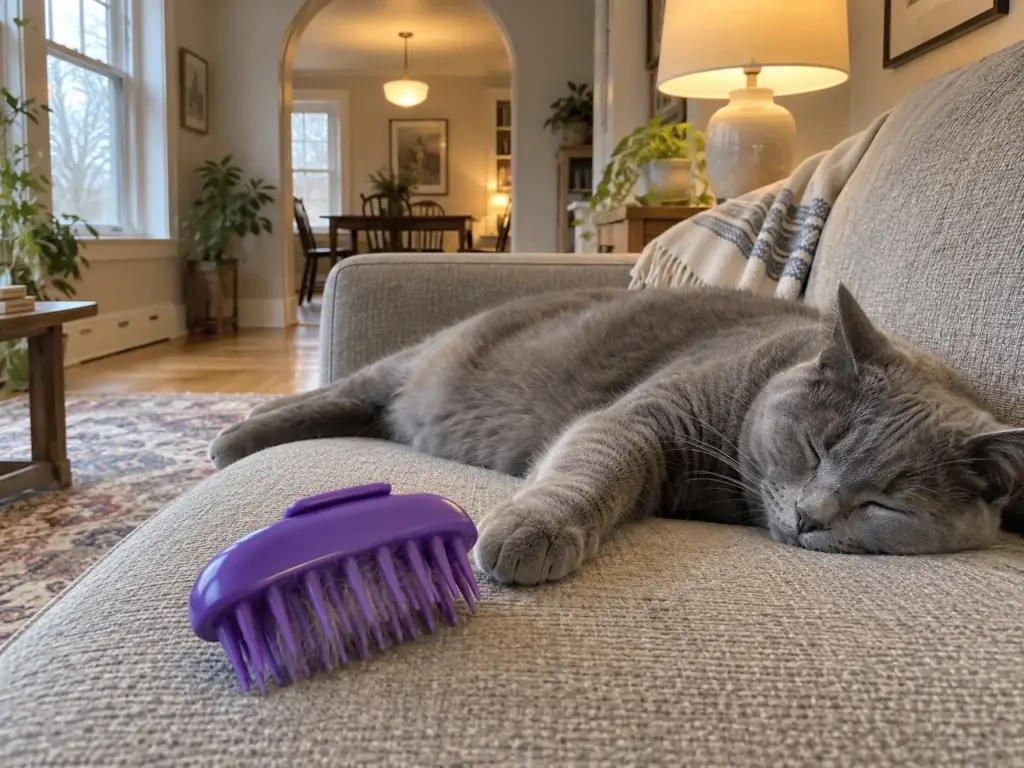
If she only lets you do her back, you are not failing at brushing. You are working with the part of her that is open to you, and the map below shows what that part is worth and where it stops.
The zone she allows: back, flanks, the top of the shoulders
A cat with frequent hairballs who objects to brushing may take the back and sides and grab the hand the moment it moves to the legs, belly or head. Other cats draw almost the same map: one welcomes the back, sides and neck and tolerates nothing else, another runs off the moment the brush nears the back of her hind legs and accepts it everywhere else. Back, flanks and the top of the shoulders are the zone most cats give you.
This is where a soft brush earns its keep. The Cat Brush with Soft Rubber Pins is a washable silicone brush, 8 x 4.5 x 2.5 inches, and soft pins suit a cat who accepts the back and flanks and little else (if you already own a brush she accepts, use that one and skip this). The cost shows up at cleaning time: buyers say the rubber pins hold on to the hair, so expect to pull it off by hand after each session. If this zone is all you can reach, picking a brush by how deep it reaches into her coat matters more than the brand on the handle.
The zone she licks hardest: belly, inner and hind legs, the base of the tail
Cats groom in a rough sequence, and the belly, the hindquarters and the inner legs are part of it. It is reasonable to expect that the zones she licks most and the zones she refuses overlap: the Maddie’s Fund guide from the San Francisco SPCA notes that most cats do not like their belly touched, so the place she tends most is probably the place she guards from you. That makes the brushed zone and the licked zone two different maps, and it would explain a routine that is done every day while the count stays where it was.
Say it plainly, though: this is inference. No source measures how much of what she swallows comes from the belly or the legs, and this article puts no percentage on it. What you can count is the rug.
A common counterpoint is that very few cats allow brushing of the legs or belly, so focus on the zones she allows, because the legs won’t make much difference. That is a reasonable judgment, and it may be right. It has no measurement behind it either way, so the three-week count is the test, not the argument. And if the count does move on the back and flanks alone, the answer is to keep doing exactly that.
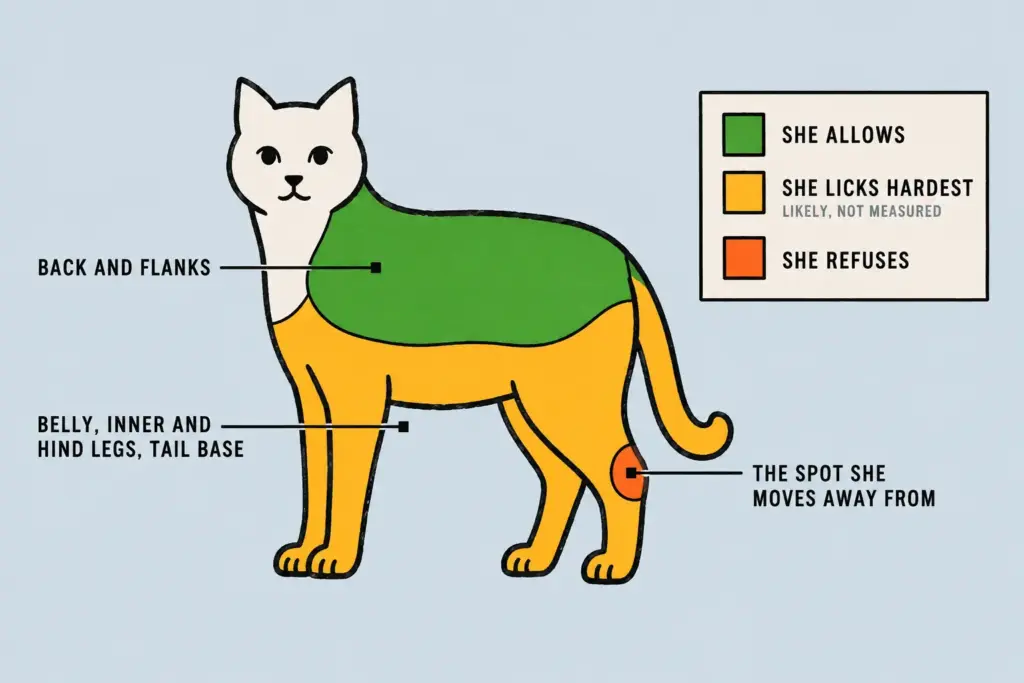
The zone she refuses, and a free test with your own hand
Before any tool, run the flat of your own hand through each zone for a minute, and watch what she does. She stays, she shifts, or she leaves. Do it for a week and write down which of the three happened where, and you have the map without buying anything.
When a cat reacts the same way to a deshedding brush, a slicker, a metal comb and a glove, the refusal usually belongs to the zone, not the tool.
The Maddie’s Fund guide adds that most cats rub their faces or sides on a brush when it is offered, and do not like long strokes. So hold the brush out, let her head-butt it first, and keep the strokes short. A simple rule for the first week is easy to keep: a minute to start, and add a minute when she stays.
Finish every session on the zone she allows, and finish it yourself, before she does. A cat who walks away mid-stroke has just learned how to end the session.
The Zone She Refuses Is a Mats Check First, and Sometimes a Vet Question
The hardest zone is the one she holds back for a reason, and the reason is not always stubbornness. This section gives you a way to test it that costs nothing, then a tool that does not force it, then the point where you stop.
Fingertips before tools: what to feel for in the refused zone
Start with your fingertips, not a brush. Draw them slowly through the zone she refuses, and feel for a lump, a knot, or a patch where the hair does not part. A tangle on the surface is different from a mat that has pulled tight against the skin, and it matters which one you are touching. The same possibility applies here: a cat who reacts to the brush in certain places may be reacting to a mat there.
If it is a small one, a mat smaller than a nickel has a home method. Anything bigger is a job for a vet or a groomer; cutting out a mat is not covered here.
Once she tolerates your fingertips in that zone, a comb shows what a brush slides over. The PETTOM Steel Grooming Comb is 7.5 inches long, with both coarse and fine teeth, and it picks up the undercoat and small tangles on the legs and belly that a brush skims over. Amazon’s review summary says the teeth bend after a few uses, so work it gently and do not pull it through a knot.
The gentler route: a glove, a minute, her pace
If she objects to brushing in general and not only to one spot, why a cat won’t let you brush it covers the objections one by one. This page adds the zone, and the zone is where a glove gets used.
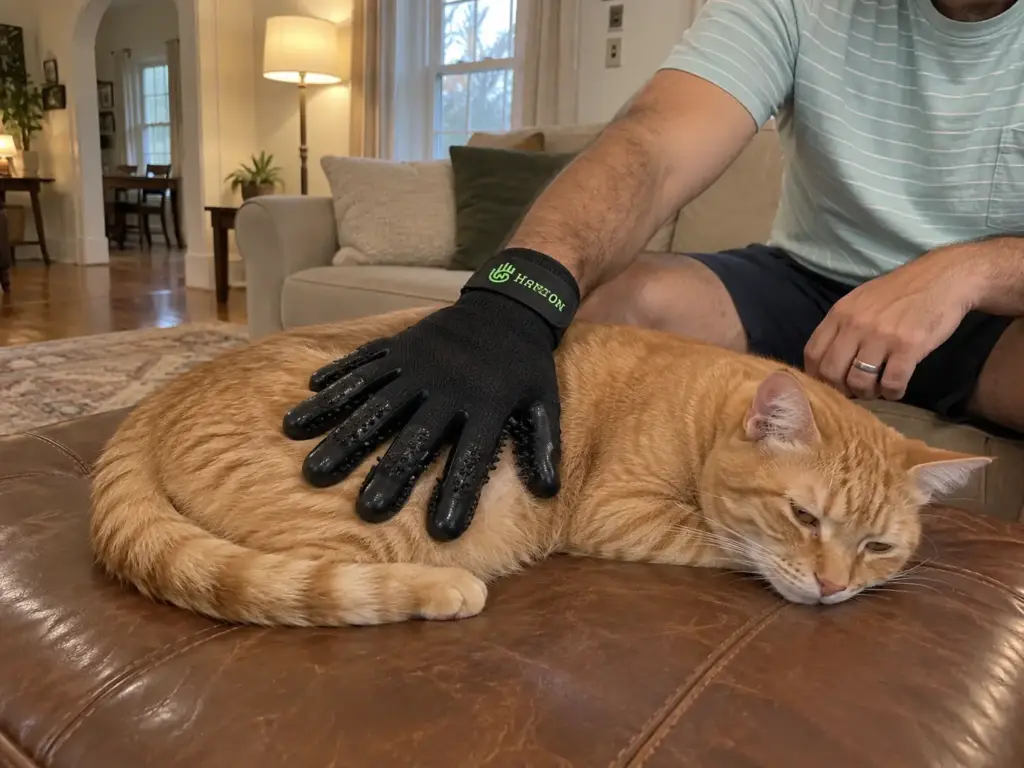
A brush is the obvious tool, and in the refused zone it is often the wrong one. The HandsOn Pet Grooming Gloves are five-finger gloves, worn like mitts, so what she feels is a hand and the grooming feels like petting.
A medium-haired cat may refuse the brush but like the glove. A third started with a glove that doesn’t go deep, stayed away from sensitive areas and used treats, and eventually got the cat up to a slicker.
The glove is no substitute for a good brush: it will never match a wire brush, and hair tends to fly around while you use it. As a bridge it does the job, and it is the cheaper route; a rubber-pin brush may already be in the house.
Let her sniff the glove and rub her cheek on it before it goes on your hand. A glove she has already investigated is no stranger, and the first stroke lands on a cat who has agreed to it.
Stop when it looks like pain, and hand it to the vet
A grooming guide for cats that resist being groomed, from the San Francisco SPCA, says that a cat who turns aggressive when touched at one particular spot could be in serious pain and needs to be examined by a veterinarian. The rule that follows is short. Biting, flinching or crying at a spot ends the session and starts a call to your vet.
Why the spot hurts is the vet’s question, not yours and not this page’s. What the house can do is stop pushing.
Coat, Season and Cat Count Set How Much Brushing the Zones Need
Once the zones are mapped, the question is how much brushing they need, with which tool, and how you will know it worked. The answer shifts with the coat, the season and the number of cats on the rug.
Long coats and shedding seasons: the same zones, more hair
How often to brush your cat by coat has the schedule by coat, so this section only covers what changes the zones. Cornell’s veterinarians put long-haired breeds such as Persians and Maine Coons at significantly greater risk than short-haired ones, and hairballs are more frequent in the seasons when cats shed. Shedding seasons come and go (how long one lasts), and the amount of hair rises while the zones stay the same: the brush still lands on the back and flanks, and there is more to take off.
Start free: a daily pass with the tool she already accepts, on the zone she allows. For undercoat on a long-haired cat, a slicker reaches deeper.
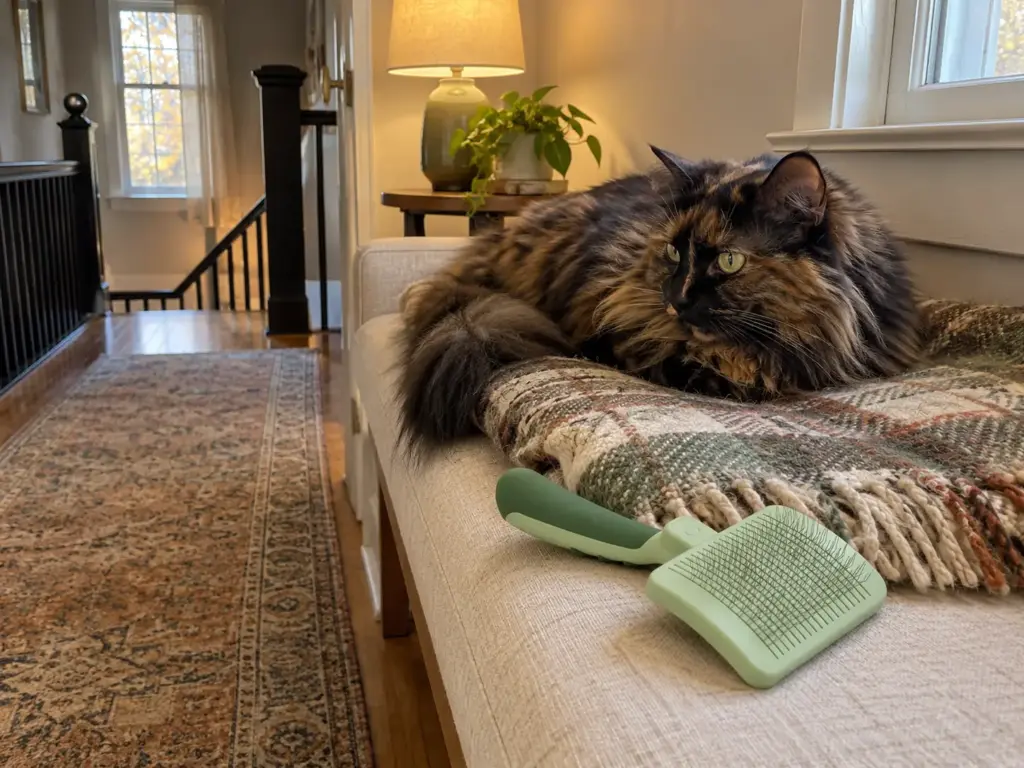
The Coastal Pet Safari Cat Self Cleaning Slicker Brush measures about 2 x 5 x 8.75 inches, and the obvious long-coat pick stops being obvious on a cat who tolerates only one zone: there it belongs on the back and flanks and nowhere else, and the glove keeps the legs. Buyers often mention bristles bending when cleaned between the two plates, and that the brush can hurt a cat’s skin. Light pressure, then.
One cat or two: whose hair is on the rug
The hair on the rug does not say whose it is. With two cats, brush the cat whose zones are the problem, and compare counts per cat only if the house can tell them apart, which is easiest when the coats differ in color. Where the hair lands matters too: on a tile floor a tube is easy to spot, while on a rental carpet it can sit unseen for days, so check the carpet before you count. Don’t diagnose either cat from the rug.
Different coats also want different tools. The household behind this site has a long-coated Maine Coon and a short, dense-coated British Shorthair, which is a standing reminder that one brush does not suit both.
Note the color and length of the hair in each hairball before you decide whose count you are keeping. Two coats leave two different tubes.
A routine that holds, and when to look at the count again
A routine that holds is a plain one: the zones she allows, a tool she accepts, a length of time she finishes, and a note of the count and of which zones she let you do. Change one thing at a time. Two changes in the same week leave you unable to say which one moved the count.
Before buying anything for the zones, rotate which one gets the minute, so the one you skipped early in the week gets its turn later. That costs nothing, and it tells you whether the problem was the tool or the schedule.
Brush the Zones She Allows This Week, Then Count to Week Three
Three things to take with you. Brushing takes loose hair, and only where the brush lands, so map the zones before you buy anything. The zone she refuses is a mats check with your fingertips before it is anything else, and a reaction that looks like pain is a call to your vet. And lethargy, no food for more than a day or so, and retching that brings nothing up end the brushing question, whatever the count says.
Three weeks is long enough for her to accept or refuse a new routine and for you to find out whether you will keep it up. When it is over, set the count you wrote down against the weeks before it, and look at which zones she let you do. If the number did not move, change one thing, the tool or the zone, not both.
Today, put the brush away and run the flat of your hand through each zone for a minute. Notice where she stays, where she shifts, and where she leaves.
Frequently Asked Questions
01Will brushing a cat help with hairballs?
Yes, brushing helps with hairballs by removing loose hair before your cat swallows it, but it reduces them rather than stopping them. No study puts a number on how much it saves. If she brings them up more often than every week or two, ask your vet.
02Is there a way to prevent cats from getting hairballs?
Not completely, but brushing the zones she allows on a routine you can keep, and counting each hairball, is the prevention a home can do. Questions about food or supplements belong to your vet.
03How to get rid of hairballs naturally?
From the home side, the natural approach is prevention: brush regularly on the zones she allows and write each hairball down. A cat who brings them up often, or shows any of the three signs, needs a vet, not a different brush.
04What do vets recommend for hairballs?
Vets name frequent brushing, daily if you can manage it, and ask to hear about lethargy, refusing food for more than a day, or retching that brings nothing up. Whether any product has a place is the vet’s call.
05Is it worth brushing if my cat only lets me do her back?
Yes, brushing only her back and flanks still takes loose hair off, but it leaves the zones she refuses untouched. Test those with your fingertips first; if she reacts as if it hurts, a vet should look.




Leave a comment