How to Remove Cat Mats Smaller Than a Nickel at Home
How to remove cat mats under 0.8 inches wide: split from the tips with a 7.5-inch steel comb, one piece a day (skin-tight mats go to a groomer).

Alfredo RamsesFounder · October 13, 2026 · 15 min read


On this page9 sections
- 1How to Remove Cat Mats Starts With a Nickel and Two Honest Checks
- 2Split the Mat From the Tips, Do Not Pull It
- 3Let the Cat Set the Length of the Session, and Plan Days, Not an Afternoon
- 4When the Cat Will Not Hold Still
- 5Cornstarch, Oil and Sprays: What Each Claim Can and Cannot Do
- 6Scissors and Clippers: Where the House Stops
- 7After the Mat Is Out: Thin Patches, Licking and the Date to Call
- 8Measure First, Stop Early, Hand Off What Touches Skin
- 9Frequently Asked Questions
Your fingers find it behind a shoulder or under a front leg: a flat, felted knot where the coat should be loose, and the instinct is to grab it and pull. The cat is gone before your hand closes, and he has a point, because the skin is attached to that knot and your pull lands on the skin. A mat comes out in pieces, in an order the cat allows, or it leaves the house for someone with clippers. To remove cat mats at home when the knot is small, you do three things: measure it, split it from the tips, and end every session at the first objection.
Quick Answer
The order that works has a stop built into every step.
- Measure the knot: a loose tangle the size of a nickel or smaller, with the skin staying still, means home work.
- Split it from the tips with a steel comb; stop at the first objection.
- Send bigger, skin-tight or red mats to a groomer or vet. No scissors, ever.
How to Remove Cat Mats Starts With a Nickel and Two Honest Checks
The nickel line, and why it is the edge of home work
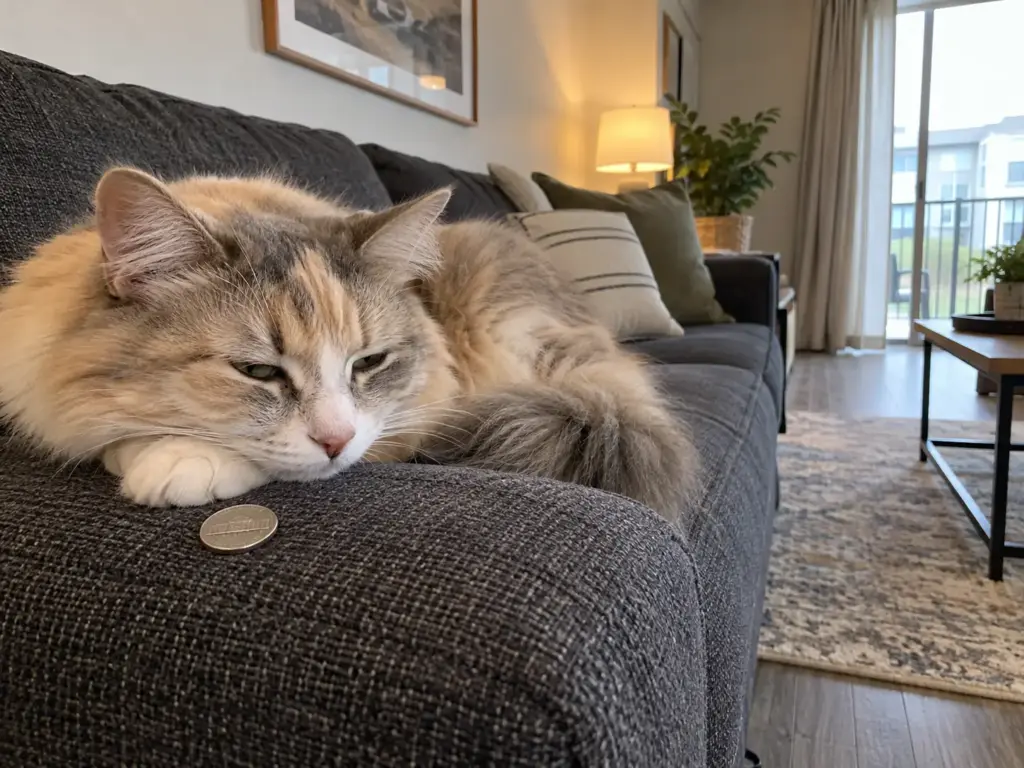
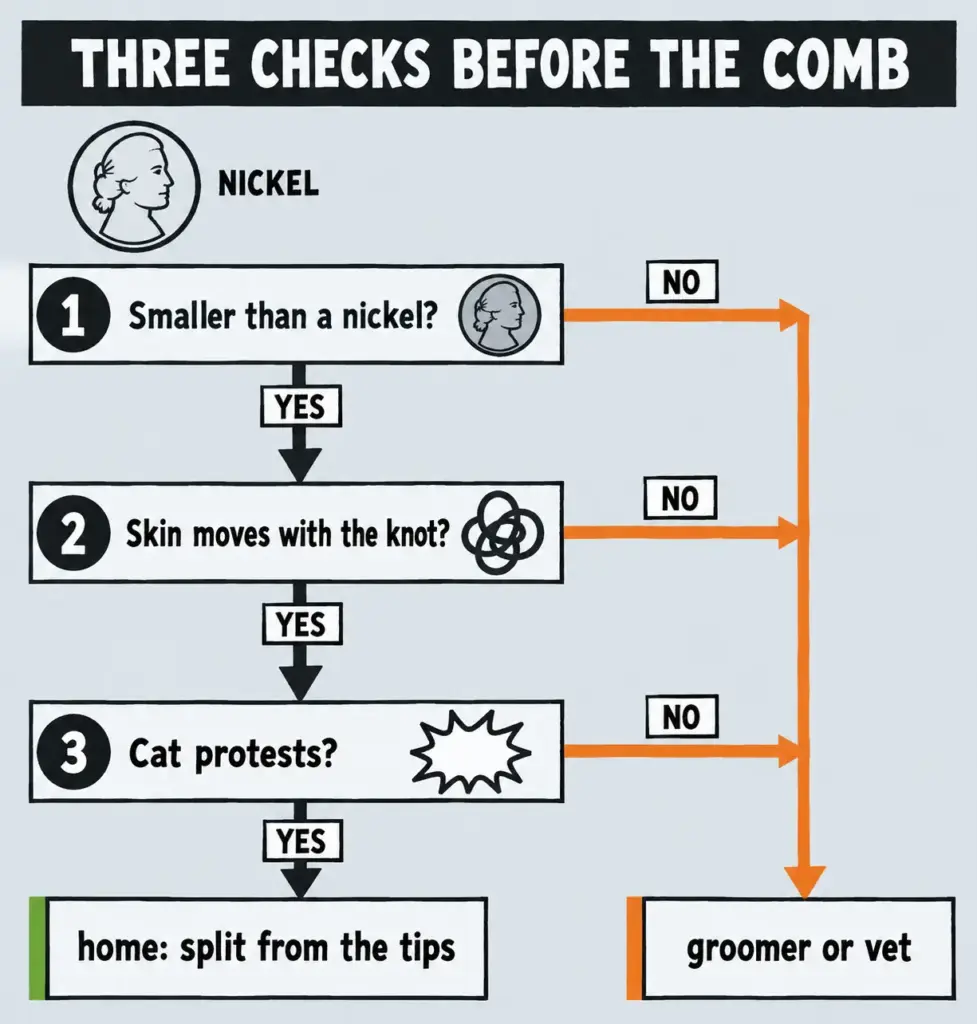
Mats come in more than one kind, and the mats guide for the cat hair room sorts them by where they sit and who can reach them. For the job in this article the sorting comes down to one coin. A certified feline groomer puts the edge of home work at a nickel size mat, one the size of a nickel or smaller, and says that is as big as a mat gets before it stops being a home job. A US nickel is about 0.8 inches (21 mm) across, so lay one in your palm next to the knot and the decision is made before the comb leaves the drawer.
The reason the line sits there is what a mat is. Matted cat hair is hair that knotted and died in place, which is why a brush slides over it and never clears it. It does not brush out. It has to be separated, strand group by strand group, and the bigger the knot, the more of that work there is and the more of it happens near the skin.
Anything wider than the coin, or any mat on the skin, belongs to someone else. The grooming guide’s rule on mats at the skin puts the test in one move: if you cannot slide a comb between the mat and the skin, it is not a home job.
For the small ones, the veterinary side agrees. According to Texas A&M’s veterinary college on feline grooming, “If your cat does develop mats, you may be able to tease out small ones with a comb and your fingers.” The same page treats large mats as the point where shaving enters the conversation, and that is a different question from this one. Owners who compare notes online describe a route that repeats: a tug, a cat who ends the session by leaving, and a second try the next day that goes better because it was shorter.
Hold the nickel flat beside the knot and look at both from straight above. A mat can look smaller from the side than it measures once it lies flat.
The two checks before the comb comes out
The first check is the skin. Hold the coat on either side of the knot and see whether the skin travels with it. If it does, every pull on the mat is a pull on skin, which explains why the cat moves away from your hand. The two-finger check in the mats guide for the cat hair room walks through it step by step, so this article does not teach it a second time.
The second check is the cat. Before any tool appears, rest a hand on the spot and see what he does with it. A cat who stays loose under your palm is giving you a session. One who tenses, twists round to look, or slides out from under your hand is giving you a different answer, and no comb changes it.
Signs that make this a groomer or vet visit before you start
Some things end the home plan before it begins, for a matted cat at home as much as anywhere: redness, an odor from the spot, a cat who pulls away or cringes when you touch the area, blood, or a wound. Any one of them and the comb stays in the drawer. Those belong to a groomer or a vet team, who can see skin that a mat is covering, and nothing in the rest of this article applies to that cat.
Split the Mat From the Tips, Do Not Pull It
You have a comb, a knot and the thought of getting it out in one go. The owners who report the cleanest results describe the opposite motion: to remove matted cat fur, take it apart a little at a time, with no pulling on the skin, and accept that one sitting will not finish it.
Open it with your fingers first
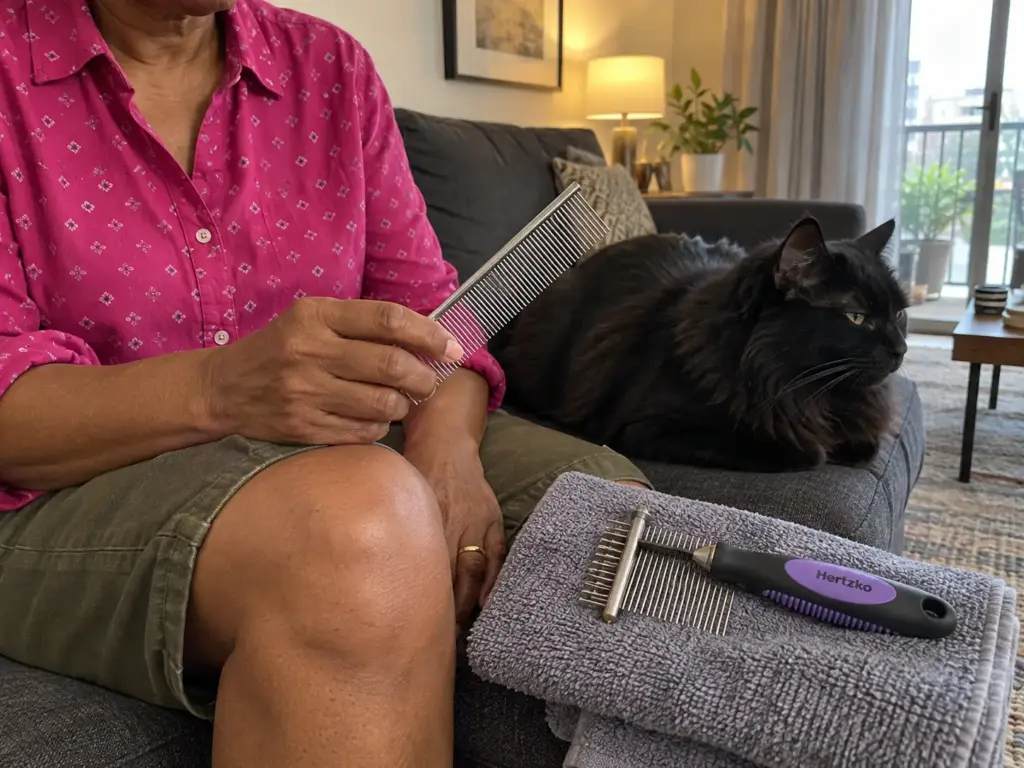
Fingers go first, and they are free. Take the loose outer hairs at the end of the knot and ease them out one at a time, the way owners in the threads describe it: finger pick apart. You are looking for the edge of the mat, where hair is still hair, and opening that edge gives the comb something to enter.
Stop at the first sign that the skin is following your fingers. With the free hand, hold the coat at its base, between the knot and the skin, so that a tug lands on your fingers and not on the cat. If the skin lifts anyway, the knot is closer than it looked. That ends the session and the home plan for that spot.
Short strokes with a steel comb, tips toward the skin
A metal comb of at least 6 to 8 inches is the tool the groomer names, and a flea comb is the wrong one: its teeth sit too close together to split anything. The logic of starting at the outer end is simple. A stroke that begins at the skin side drags the knot toward the skin, and the skin comes with it. A stroke that begins at the tips works on the knot’s loose end and finishes before it ever reaches the base.
The PETTOM Steel Grooming Comb 7.5 inch is that kind of comb: 19 cm of steel with a coarse side and a fine side, and the tool you probably already own in some form. Use the coarse teeth to open the knot into thinner pieces and the fine side for the last pass.
Its limit is spacing. One reviewer says the fine teeth sit too far apart to clear the last small tangles, and a Persian owner wrote that it did not work on her cat at all. So the strokes stay short, each only as long as the piece you have freed.
Sharp substitutes turn up in the threads: nail files, letter openers, seam rippers. A sharpened point or edge near a mat is scissors by another name, so the answer is the same, and none of them gets a recommendation here.
Loosen one piece, then put the comb down. If he is still relaxed, take the next piece. If he is not, you are done for today, whatever the knot looks like.
Where each comb stops
That first comb opens the knot and makes the last pass. The Hertzko Grooming Dematting Comb comes second, and only for a small knot that is already open and sits clear of the skin. It is about 9 inches long overall, with a thumb rest and blades on both sides.
Those blades are the catch: one reviewer found them not sharp enough to deal with matting without pulling on the cat’s skin too hard, and another said that for small mats not close to the skin it works fine. Both are describing the same limit from opposite ends.
And neither comb goes near a knot where you cannot see skin on both sides. That rule matters more than any difference between the two. If the kit question is bigger than two combs, which pieces of a grooming kit earn their place is answered in its own guide.
Let the Cat Set the Length of the Session, and Plan Days, Not an Afternoon
The first objection ends the session
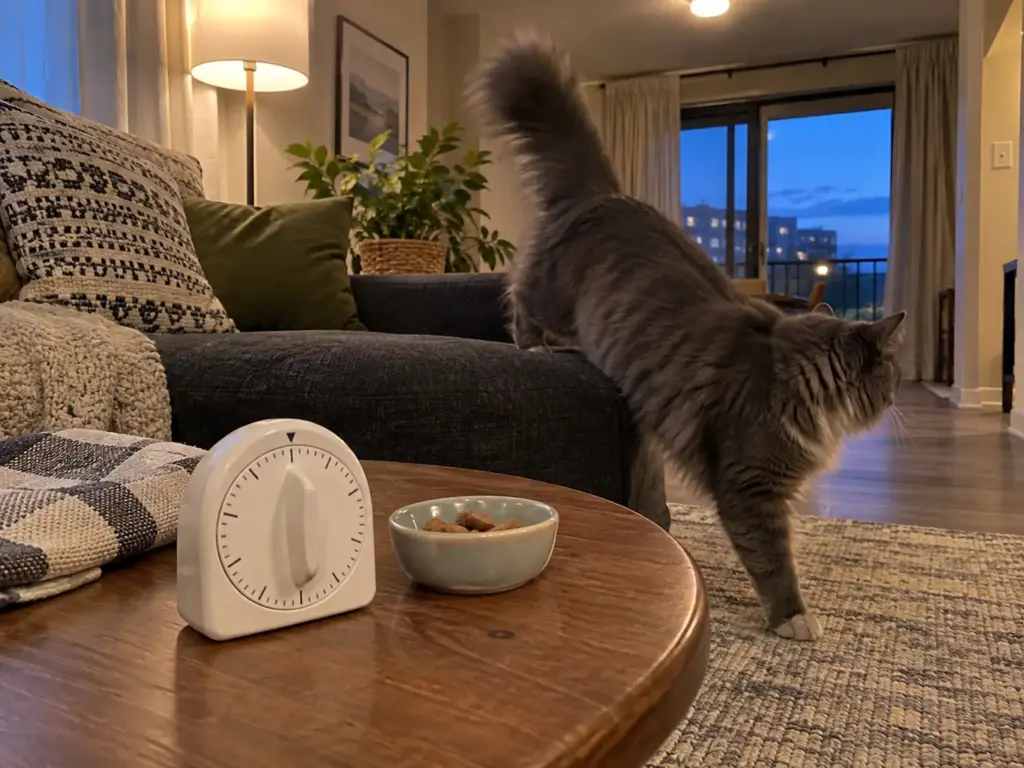
An objection is anything the cat does to leave the comb behind: leaning away, turning his head toward your hand, a tail that starts to lash, walking off. The first one ends the session, not the third. The knot may be one stroke from open, and that does not change it, because a cat who ends the session on his own terms comes back to the sofa arm tomorrow, and a cat who ends it by being pushed past his limit remembers the comb.
The ten-minute session cap from the grooming guide is a ceiling, not a target. For a mat, the cat usually reaches his own limit well before ten minutes.
What a week with one mat looks like
The plan for a small mat is days, and the evidence is a single owner’s story, not a measurement. On a cat forum, one owner describes spending about a week on the knots, “a little at a time,” because the cat only let her do a couple at a time. Take that as an account and not as a rule. The arithmetic still helps: if he accepts a piece or two per sitting, one nickel-sized knot is a few sittings across several days, with a rest day or two in the middle.
A sensible week, as reasoning rather than a promise, looks like this. One knot per session, never two. The same time of day if his routine allows it (a phone timer set to the cat’s limit, not yours, keeps you honest). A different piece each day, starting where the last one stopped.
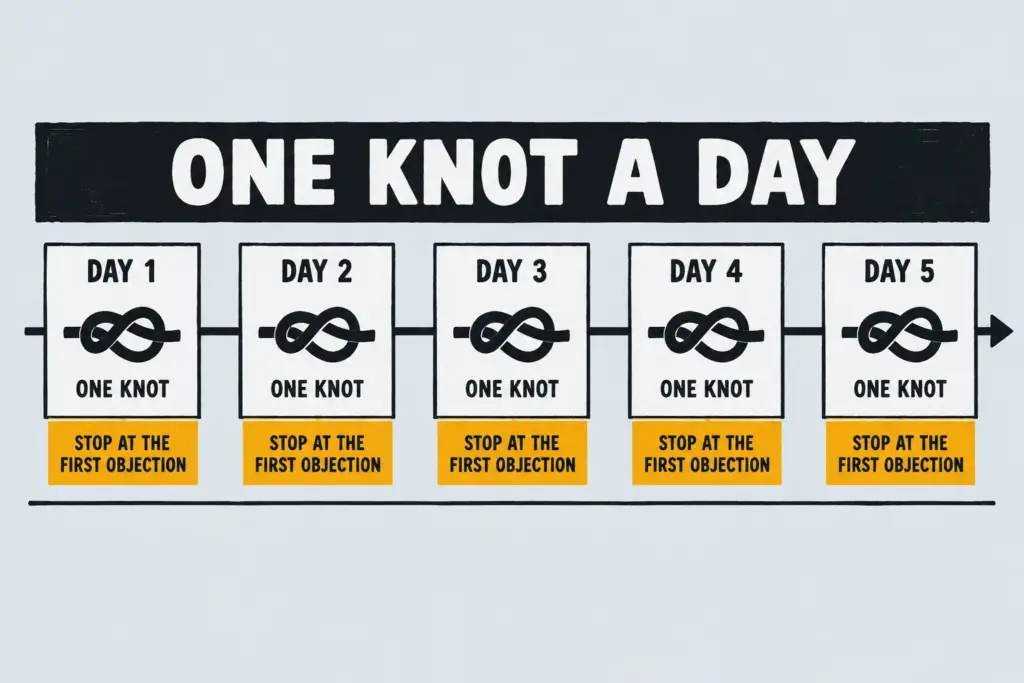
Jot in your phone where the session stopped, such as which side of the knot and how many pieces. Tomorrow’s start is then a note, not a guess.
Two cats, one session
In a house with a long-haired cat and a short-haired one, usually only one of them needs this session, and the other wants to watch from the doorway. That is a third party in the room, and a cat sitting by the door turns a quiet session into a performance for both of them.
Shut the door, or work on the cat who needs it and let the other one have something else to do. That is reasoning from how cats read a room, not a measured result.
When the Cat Will Not Hold Still
A cat that wriggles away from the comb is usually objecting to one of two things: the length of the session, or one particular tug. Shorten the first and remove the second, and he often comes back.
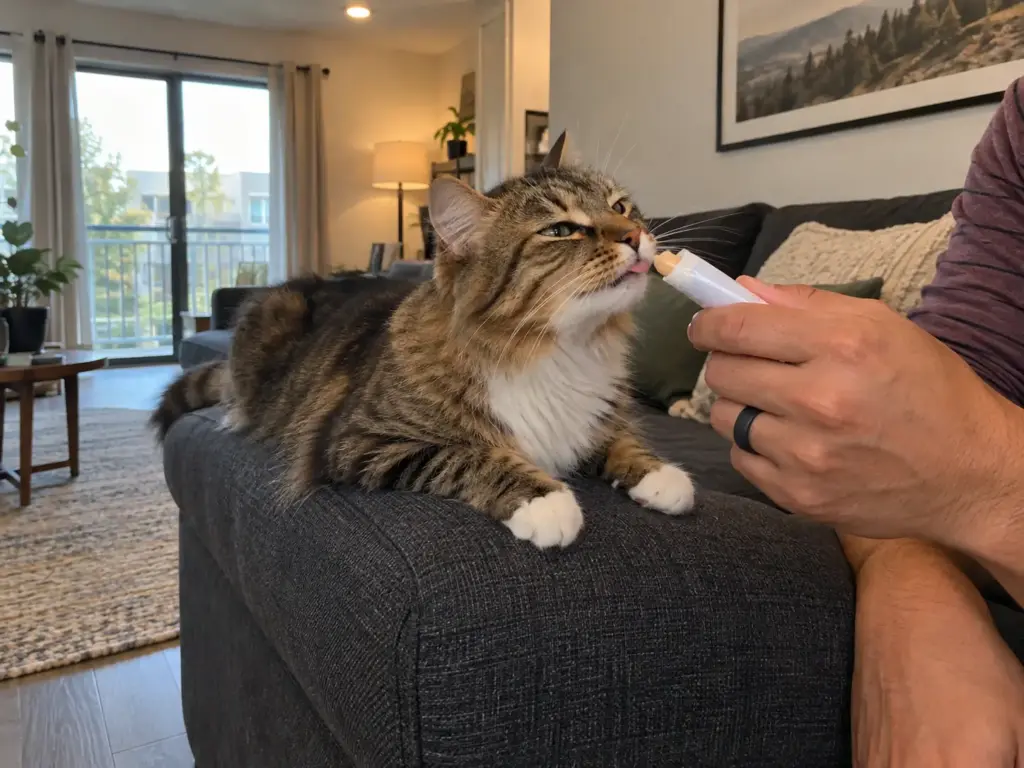
Treat during, not after
Treats while grooming work when they land while the comb is moving. Owners in the threads reach for a soft treat from a squeeze tube, which keeps his mouth and attention on one thing while your fingers work. A treat at the end of the session pays for putting up with it; a treat during it teaches him that the comb and the treat arrive together.
The pattern they describe is brief: one mat, one piece, one treat.
Start every session on the spot he lets you touch and leave the knot for the end. He relaxes into the comb first, and the hard part meets a calmer cat.
A spot the cat picks
Let him choose where. The place he already lies down is the place he will tolerate being handled, and in a small apartment that is usually the arm of the sofa or the end of the bed. Do not carry him to the kitchen counter because the light is better; a cat lifted to a high surface to be worked on is a cat looking for the way down. Small apartment grooming gets its own treatment in the mats guide’s section on where to run a session.
Why holding him down backfires
Holding a cat down ends the session faster than any objection could, and it teaches him to avoid the comb next time. Never wrap him, pin him, or comb him while he sleeps. A cat who does not hold still is describing a limit, and why a cat won’t let you brush it and what it objects to goes through the usual limits one at a time. If objections keep arriving within the first minute, the job is not a home job for this cat yet.
Cornstarch, Oil and Sprays: What Each Claim Can and Cannot Do
By the time most people reach this problem, they have read that a little powder or a spray will make the knot let go. Both claims are worth hearing out, because the people making them are describing something they did.
Dry powder, as the threads tell it
In the threads, the dry-powder story is cornstarch dusted on a knot on an older cat, then combed out so he does not lick it. No published source backs it up, so it stays what it is: a claim from a forum, not a method. The detail that matters is the one the owners themselves add. If the powder is not combed out completely, the cat ends up licking it, and a product you put on him can end up in his mouth.
Oil-based detangling spray, as one pet retailer’s guide tells it
A large pet retailer’s guide to combing out a mat takes the other route: apply an oil-based detangling spray, then use your fingers and a metal mat comb to separate the fur into smaller pieces with short, fast strokes. The same page also says to never cut a mat with scissors, because the skin is pulled up into it. It is the spray step that the groomer, in the next section, disagrees with.
What the groomer’s logic says about both
The groomer’s argument is about mechanism. A mat is dead hair, already broken and damaged, so a spray, cream or conditioner will not make it easier to remove, and whatever stays in the coat gets licked when the cat grooms later. This house sides with that reasoning, and it is reasoning, not a test of every product. A powder or a spray changes the coat’s surface; it does not change what the knot is.
Neither goes on skin under a mat. If you are weighing a product against a groomer, the groomer wins on anything that touches the skin.
Scissors and Clippers: Where the House Stops
Why scissors lose
Three commenters in one thread say to cut: trim the top of the mat, or cut the big ones off, just not too close to the skin. The groomer’s guide and the retailer’s guide both disagree, for one reason. Inside a mat the skin is pulled upward into the knot, so the scissors can nick it before you see it. The commenters mean well, and they are the dissent.
The seam rippers and letter openers from the earlier section belong here too. They are sharp, they are close to the skin, and they have the same problem as scissors. The mats guide on scissors, clippers and the bath holds the full line of where the house stops.
What a clipper with a guard is for
A groomer’s cat clipper with a guard is the tool for a mat pressed to the skin, used by someone who can keep the cat still and see the surface under the knot. That is the groomer’s job and it stays the groomer’s job, which is why no clipper appears in this article. Shaving is a separate question, and any shave that involves sedation is a decision for the vet.
After the Mat Is Out: Thin Patches, Licking and the Date to Call
A thin patch is normal for a while
Where a knot came out, the coat is usually thinner for a while. Nothing in the house needs doing about it: no product and no new routine. The one thing to watch is in the last part of this section.
Licking the spot
Some cats lick the area more once a mat is gone. Note it. Keep a rough count of how often you see it over the following days, and if the licking keeps going or the spot looks different, that is something to describe to a vet, not to interpret yourself.
The signs that mean a call, not a comb
Redness, an odor from the spot, a cat who pulls away when you touch it, blood, a wound, or a cat who suddenly stops grooming himself: any of those is a call to the vet or a groomer, and the comb stays down. The older cat who stops grooming is a topic of its own and not this article’s.
Measure First, Stop Early, Hand Off What Touches Skin
Three things carry this whole job. The measurement decides whether it is yours: a nickel or smaller, loose, with the skin staying put. The method is to split the knot from its tips in short strokes and stop at the first objection, which means a small mat takes days. And anything pressed to the skin goes to someone who can see the skin.
Three weeks from now, run a fingertip over the same spot. If the coat there is smooth and he still walks up to the comb on his own, the plan held. A new knot in the same place is a prompt to look at the weekly routine, and how often to brush your cat, by coat sets that rhythm.
Today, with the comb you already own, pick one small knot. Work one piece loose, and when the cat first leans away, put the comb down.
Frequently Asked Questions
01What is the best way to remove mats from a cat’s fur?
Measure the knot first, then split it from the tips with your fingers and a steel comb, and stop at the first objection. Nickel-sized or smaller and loose is home work; anything else is not.
02Do cats feel better when mats are removed?
A mat tugs on the skin whenever the cat moves, so taking out a small one removes that pull. If the skin is red, smells, or hurts to touch, that is a visit, and the comb waits.
03Is it painful for cats to have matted fur?
A mat pressed against the skin pulls with every movement the cat makes. Whatever hurts, or any sudden change in how he grooms or moves, is a question for the vet, not for a comb.
04What is the best tool for removing mats from cats?
For a small, loose knot, a steel comb of 6 to 8 inches is the tool, used from the tips in short strokes. A flea comb is the wrong one because its teeth sit too close together.
05Can you cut a mat out of a cat’s fur with scissors?
No. The skin is pulled up inside a mat, so scissors can nick it before you ever see it. Some forum commenters say to cut, and the groomer and the pet retailer both disagree.



Leave a comment