Should You Shave a Matted Cat? Sometimes, and Rarely at Home
Should you shave a matted cat? Comb vs. a groomer's lion cut vs. one shaved patch (what each leaves on her) and why a shaved patch mats again.

Alfredo RamsesFounder · October 13, 2026 · 16 min read


On this page7 sections
- 1Should You Shave a Matted Cat? Start With the Cat, Not the Coat
- 2Combing, a Lion Cut or One Shaved Patch: What Each Leaves on the Cat
- 3Why Shaving One Matted Patch Does Not Fix the Coat
- 4What Grows Back, and What a Dense Coat Changes
- 5After the Clipper: A Brushing Schedule and a Stop Point
- 6Read the Cat First, Then Check the Same Spot in Three Weeks
- 7Frequently Asked Questions
Weeks of combing, a knot that has not moved, and the thought arrives on its own: just shave it. That thought skips the question that comes first, because the cat is measuring something the clipper cannot, which is the skin attached to that knot and how long she can stand a hand on that spot.
So, should you shave a matted cat? Sometimes, and rarely at home. International Cat Care says severe mats often end up shaved off by the veterinary team, and what is left for the house is loose coat on a cat who sits still. She tells you which case you have faster than the knot does, so this article starts with her, then lays out the three options and what each one leaves on her, why a single shaved patch tends to come back, and what to do after the clipper.
Three options exist, and who does the work matters as much as which one you pick.
| Option | Who does it | When it fits | What it leaves on the cat |
|---|---|---|---|
| Keep combing | You, at home | A small, loose knot on a cat who sits still | Her whole coat, in exchange for several short sessions |
| The groomer’s lion cut | A groomer | A coat past combing, on a cat who accepts being handled | Face, feet and tail tip long; the rest short until it grows back |
| Shaving out one patch | A groomer or a vet; you, only for loose coat on a cat who sits still | One knot, with the rest of the coat clear | The rest of her coat, and the same spot to mat again |
Should You Shave a Matted Cat? Start With the Cat, Not the Coat
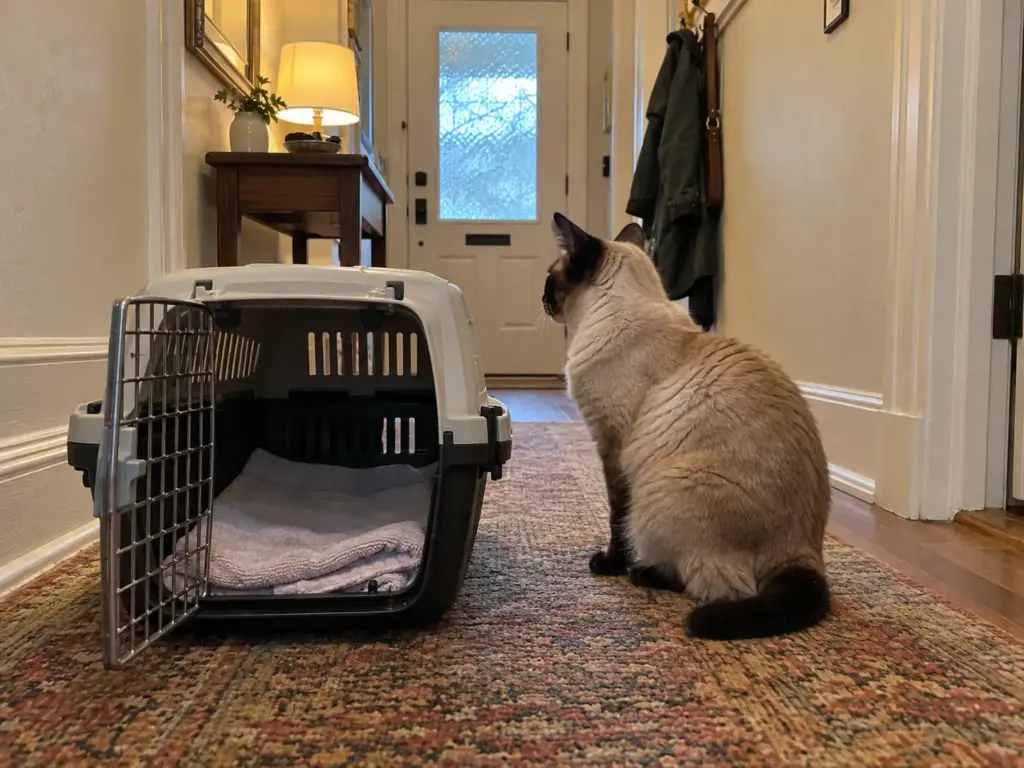
Who holds the clipper depends on the cat in front of you
The size of the knot is the obvious thing to measure, and it comes second. The cat comes first, because she decides who can hold the clipper: a cat who stays loose under your hand, with hair that lifts away from the skin, may leave you a small job at home, while a knot pressed flat against the skin sends the job to a groomer or a vet.
International Cat Care puts the far end of that range plainly. According to International Cat Care’s grooming guide, “in many cases, severe matts will need to be shaved off by your veterinary team.” Our Mats guide for the signs that send a cat to a groomer or a vet first keeps the full list of those signs, so this article does not repeat it.
Three questions about her settle most of it before any tool comes out. Does she stay still for a full minute while your hand moves through the coat near the knot? Is the knot lying against her skin, so that the skin moves when you move the knot?
And has she stopped her own self-grooming, or started to object to the brush? A yes to the first and a no to the other two leaves you a small job at home. Any other combination moves the job out of the house. A cat who pulls away from your hand near a knot has already answered for you.
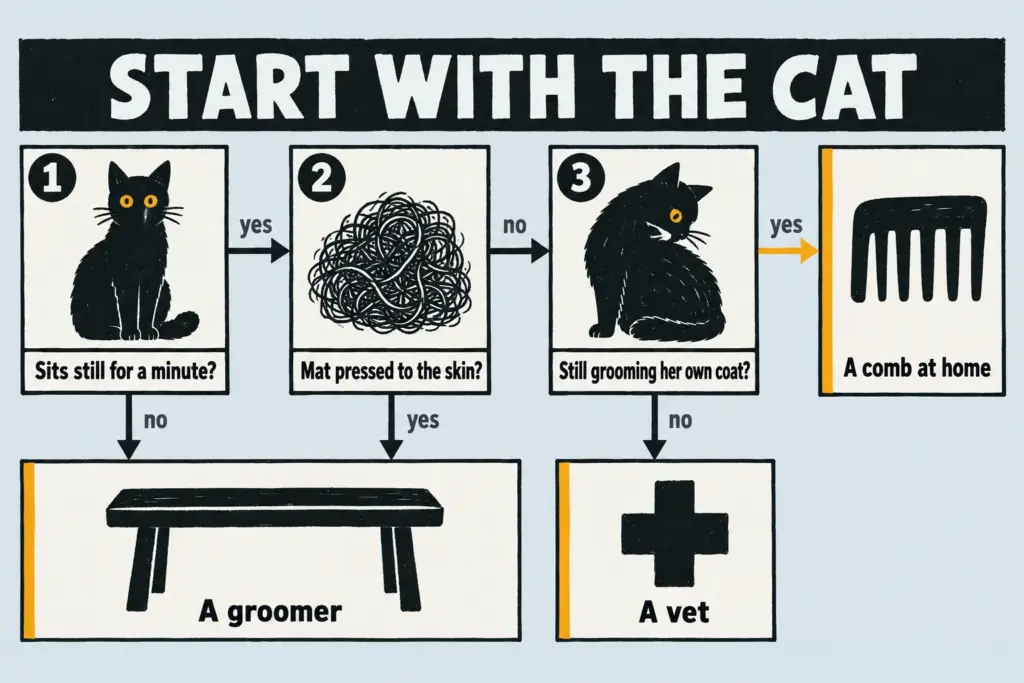
Size still counts, once the cat has passed. The line on this site is a nickel: a loose knot that size or smaller, with the skin staying still, is comb work, and the nickel line for a mat you can work on at home is where it gets measured and worked through. Past the coin, or at the skin, the clipper belongs to someone else.
A cat who stopped grooming or objects to the brush is a different question
One owner in an r/cats thread describes the case that turns a shaving question into another one: a cat who has stopped grooming herself, has mats along her sides, and is now afraid of the brush. The owner asks whether to just shave her, and whether the coat will ever grow back the same. The second half of that question has its own section further down.
The first half is not yet a clipper question. A cat whose habits changed from one week to the next goes to a vet’s desk before anything else, and nothing in this article explains why a cat would do that. What the house can do is keep every session short enough that she never has to object. A cat afraid of the brush has already told you where the session ends.
The same order applies to skin. VCA Animal Hospitals’ guide to grooming and coat care says it in one sentence: “If a mat has caused any skin irritation, take your cat to your veterinarian so the appropriate treatment can be prescribed.” This article does not describe what that skin looks like or what to do about it, because reading the skin under the mat is the vet’s job.
Sedation is a vet’s call, not a house rule
Whether a cat is sedated for a shave is decided by the vet, for that cat, after seeing the skin the mat is covering. International Cat Care’s page says severe mats often call for sedation or a general anesthetic, and this article names that for one reason: they are why a clipper in a living room and a clipper in a clinic are not the same tool. If a vet tells you your cat needs it, that is information about your cat, and nothing in the rest of this article argues with it.
If she tenses, turns round or moves off inside the first minute of your hand working through the coat near the knot, the session is over there and the question goes to a groomer. A cat who has said no once is not a cat to negotiate with.
Combing, a Lion Cut or One Shaved Patch: What Each Leaves on the Cat
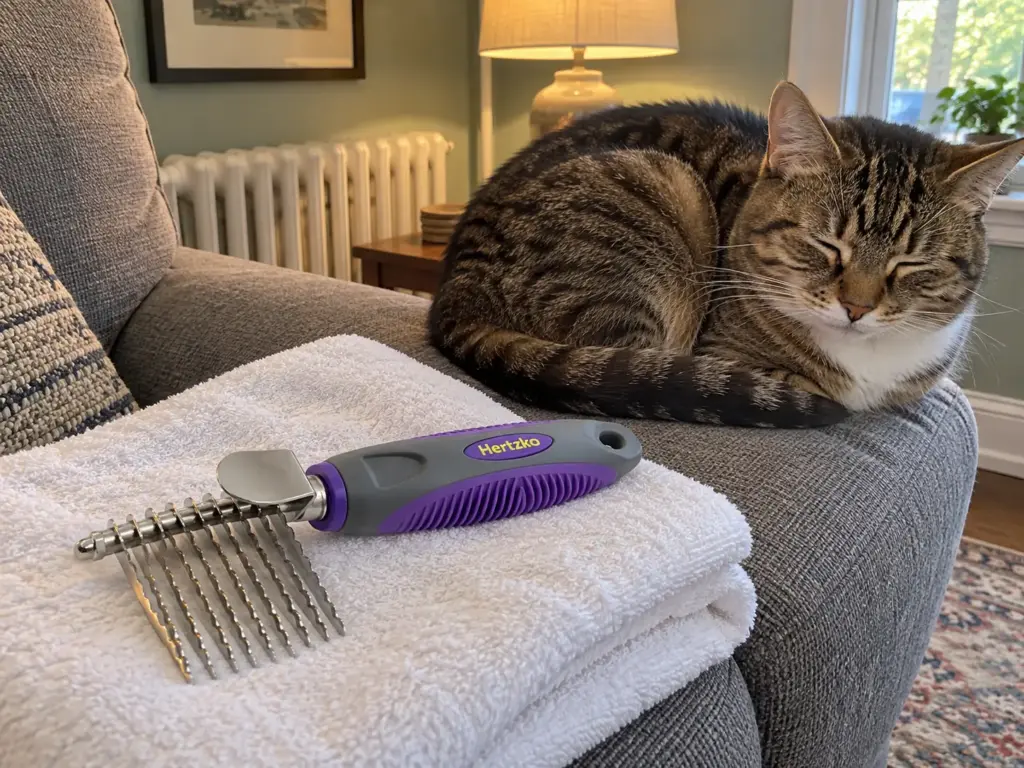
Keep combing, when the knot is small and loose
A brush is the wrong tool for a knot that has already formed: it glides over the top and leaves the clump underneath, because a mat has no loose strands left for a brush to take. Tangles give way to a brush; cat hair mats do not, and a small one means a different job, with the free part first.
Fingers go in before any tool: ease the loose hairs at the outer end of the knot out one at a time, holding the coat at its base so a tug lands on your fingers and not on her skin. If that opens an edge, a steel comb can work the knot from the tips, a few strands at a time. A flea comb is the wrong one for the job, since its teeth sit too close together to split anything.
For that step the Hertzko Grooming Dematting Comb for Pets, Stainless Steel is the comb the house points to. It measures 9 x 3 x 1 inches with serrated teeth 2.5 inches long, and Amazon’s review summary says customers find it effective, especially on long-haired cats.
Its limits are on the listing too: reviewers report the handle breaking off after about three months of use, and a four-star reviewer says the hardness of the steel comes at the price of softness and an edge that will not hold against hair. This is a de-mat tool for the stage before the nickel line is crossed. Past it, no comb is the answer.
Stop at the first objection and finish the knot another day. A small mat that takes three short sessions is still a small mat; one that takes a fight is already a groomer’s. For the cat who sits through a whole brushing, the grooming guide for the cat who takes a brush keeps its sessions to ten minutes at most.
The groomer’s lion cut takes the coat and leaves the face, feet and tail tip
A lion cut clips the coat on the torso and leaves the hair long around the face, the feet and the end of the tail, as VCA describes it. It is the groomer’s option, and the name matters because it is a cut with a pattern, not a shave of whatever is matted. It takes the whole coat in one sitting, and it asks the most of her in a single go: a whole coat’s worth of being held and clipped by someone who is not you.
What it leaves is worth picturing before you book it. International Cat Care says that a cat who has had severe mats shaved out is left with fur only on her tail, head and lower legs until it grows back. That is what will be waiting at the door when you collect her: a cat who looks bare except for those places, for as long as regrowth takes. Better to know the look in the groomer’s waiting room than in the hallway.
Shaving out one patch is the smallest cut, and the one that comes back
The question that gets asked most naturally is whether you can shave just the matts and leave the rest. The answer is yes: a groomer or a vet can, and at home it is only for loose coat on a cat who sits still.
It is the smallest cut and it leaves the rest of her coat alone. In the thread that raised it, the owner’s reasoning is easy to follow: the cat only grooms her belly and neck, so the sides are where the knots are. That is the first reason a single patch is not the end of it, and the next section goes through the mechanism. For now, keep the tradeoff in view: the patch is the shortest handling and the one that leaves the most behind.
The choice is about the cat, not the knot
Put the three side by side and they sort by what the cat has to give, not by how ugly the knot is. Combing asks for patience across several days, from a cat who tolerates a hand and a comb. The lion cut asks for one long handling by a stranger.
The patch asks for the shortest handling of the three and gives the least back. A cat who tolerates ten minutes of a comb should be combed first. A cat who does not, with a knot on the skin, goes to the person with the training.
Why Shaving One Matted Patch Does Not Fix the Coat

A shave-out removes the knot, not the grease that made it
Picture the knot gone on a Saturday and a firm patch in the same place three weeks later. Nothing went wrong with the shave. A mat is dead hair stuck together with oil from the skin, and the clipper takes away the clump while the oil stays where it was made. A trade article written for cat groomers says the same in its own terms: when you only shave out mats, the root cause is not fixed, the grease is still there, the loose hair keeps building up, and the mats come back fast.
That is the sentence to carry out of this section. A shave-out is a good answer to the knot you have, and a poor answer to the one you will have next month, because it handles the result and leaves the conditions.
The undercoat is still there, loose and ready
The second ingredient is the undercoat, the soft, dense layer under the longer top hairs. It is the layer that comes loose in clumps, and loose undercoat is the raw material of a mat: it collects where she cannot reach and gets pressed flat where she lies. Shave one patch and the undercoat around it is exactly as loose as it was. The cat did not change, the coat around the patch did not change, and the thing that holds the loose hair in place is the first ingredient again.
The spot the tongue cannot reach stays the spot
The third ingredient is the one no clipper touches. To clean her lower back, a cat has to twist her spine sideways, lift a hind leg out of the way and get her mouth down over her hindquarters, and the base of the tail is the farthest point of that reach. Why the lower back is the spot a cat’s tongue misses goes through that reach cat by cat, and this article takes only the consequence: a shaved patch in a spot she cannot reach is a patch that will collect oil and loose undercoat again, on the same schedule, unless something else reaches it.
That is what the owner in the thread was running into without having a name for it. She brushed three or four times a day and still could not keep up once her cat had stopped grooming herself.
More brushing of the coat the cat can reach does not help a coat she cannot. Aim the comb at the sides and the lower back, and treat the patch as a first step when nothing else fits (never as the fix).
Once a week, from the same spot on the floor, photograph her lower back and the base of her tail. If a knot comes back to the same point, it is no longer a loose knot but the place she cannot reach, and the photos are what you show the groomer.
What Grows Back, and What a Dense Coat Changes
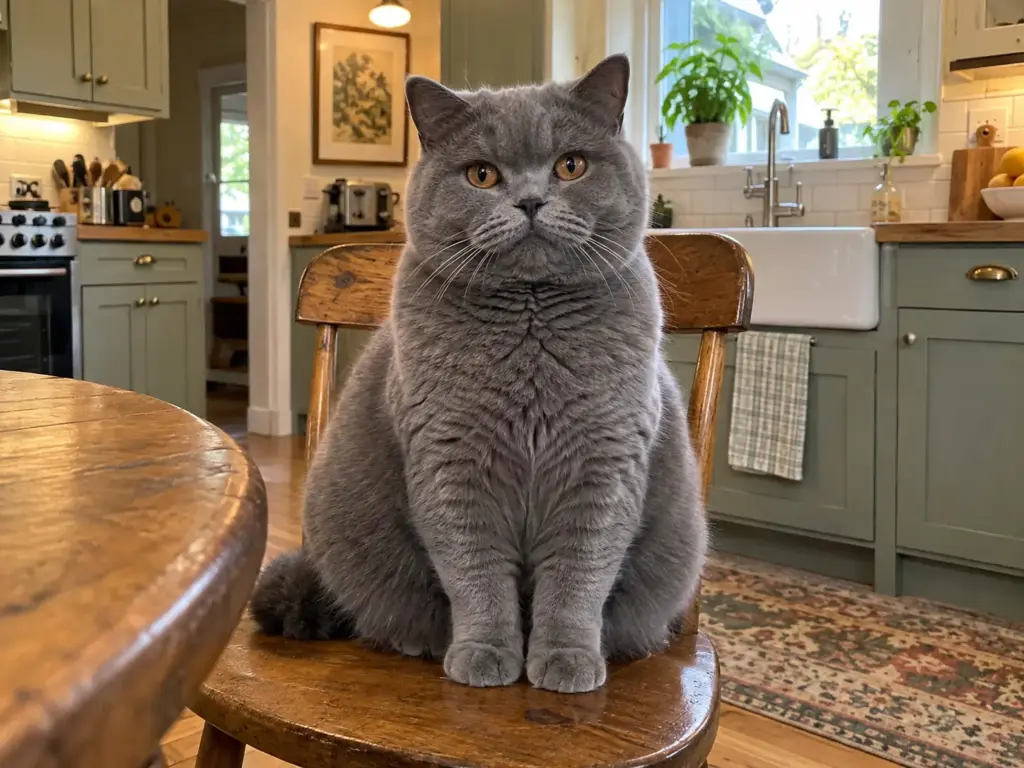
What the first regrowth looks like
The owner in the thread worried the coat would never come back the same. Another commenter, whose cat had her belly shaved for a surgery, described what came in first: “super fuzzy and soft in the beginning almost like peach fuzz,” with only a very slight difference in color. That is one cat and one reason for shaving, not a matted cat and not a rule, but it is the picture most owners are afraid they will not get.
A single coat and a dense double coat grow back differently
The same trade article for cat groomers splits regrowth in two. The wispy undercoat hairs, the ones more prone to matting, grow back quickly and heavier after a shave. The longer, protective guard hairs come back more slowly and less well, especially in older cats and in cats shaved over and over. Read that carefully: the thing that returns first and thickest is the part that mats.
What the article does not say is whether a single coat and a dense double coat behave differently. The reasoning is an inference, not a measurement: a dense double coat carries more undercoat to return heavy, and which coat structures a house is actually dealing with lists the dense double coats (the Russian Blue and the British Shorthair among them) next to the long coats that rarely mat, such as the Birman’s. So treat the idea as the trade’s mechanism plus the logic of the coat, to check on your own cat.
In a house with a long-haired cat and a short, dense one, do not assume they get shaved alike, grow back alike or want the same brushing. The long coat is the one with more to keep clear; the dense short one is the one whose undercoat can return in bulk. The same routine for both will fit one of them.
What nobody has measured
There is no reliable number for how many weeks regrowth takes. The veterinary and cat-welfare pages this site draws on do not put a number on it, and owner stories change with the cat, the coat and the reason for the shave, so this article does not invent one. What you can do is put the date of the shave in your phone and photograph the spot every week or two; your own cat’s timeline is the only one that exists.
After the Clipper: A Brushing Schedule and a Stop Point
Book the maintenance groom while the coat is short
The cat-groomer trade recommends maintenance grooming every four to six weeks. It is the trade’s habit, not a medical rule, and the logic is the one from the last section: a short coat is the easiest moment to keep clear. But the appointment is what keeps the cat from landing back in this decision, and it is easier to book while the coat is short than after the first new knot.
Put the maintenance date in your phone the day she comes home, four to six weeks out, instead of waiting for knots to show up. The date is what keeps the coat short without sending you back to this question.
Brush the spot she cannot reach, not the coat she can
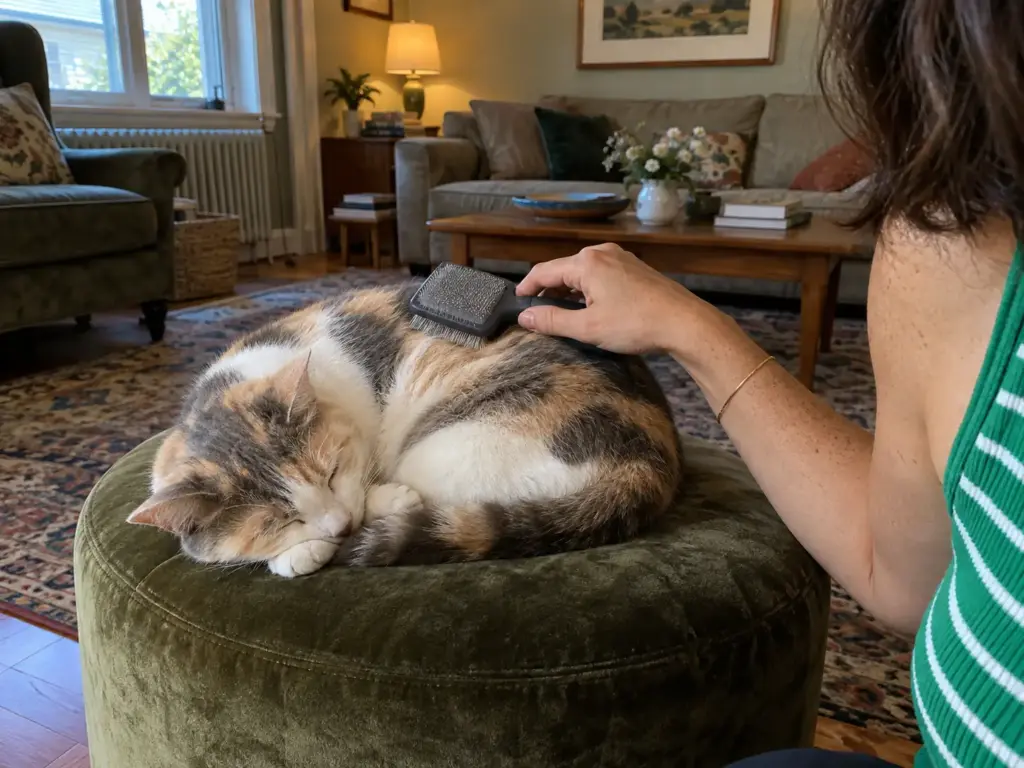
Fingers again, before any tool: run them along her sides, her lower back and the base of her tail while she is relaxed, and loosen what you find before it presses flat. A soft slicker brush is enough once the coat is clear.
The frequency by coat is already worked out in how often to brush by coat type, and this article leaves the numbers to that page. What it adds is the target. A long coat and a short dense one need different amounts of brushing, and both need it where the tongue stops, not where the cat already keeps clean.
Stop when the cat says stop
The stop point is the same one that started this decision. A cat who tenses, turns or leaves has ended the session, and the session stays ended: the next attempt is shorter, not longer. A cat who now refuses the brush altogether is objecting to something, and what a cat that refuses the brush is objecting to is where that is sorted, with the cases that go to a groomer or a vet named in it. If she was afraid of the brush before the clipper, she will not be less afraid of it after.
Read the Cat First, Then Check the Same Spot in Three Weeks
Three things are worth keeping. The cat decides who holds the clipper: a quiet cat with loose coat leaves you a small job at home, while a knot on the skin, a cat who has stopped grooming and a cat who objects all go to a groomer or a vet. Shaving out one patch removes the knot and leaves the oil, the loose undercoat and the spot she cannot reach, so it is a first step and not a fix. And what keeps the coat clear afterward is a dated maintenance groom and a comb aimed at the place the tongue misses.
Three weeks is long enough for a new knot to show and short enough that it is still small. Lay your hand on the same spot, and if a firm patch has come back where the last one was, treat that place as the one she cannot reach and change the plan, not the clipper.
Before anything is booked, run your fingertips along her sides, her lower back and the base of her tail while she is relaxed, and note which spot feels thicker than the rest. That is the spot to point to when you talk to a groomer, and the one to look at again in three weeks.
Frequently Asked Questions
01Can you shave a severely matted cat?
A mat pressed against the skin is a job for a groomer or a vet, and the vet decides whether the cat is sedated. International Cat Care says severe mats often end up shaved by the veterinary team. The house does not pick up a clipper for that one.
02Do cats feel better when mats are removed?
Nobody can promise relief, and none of the sources this site relies on measure how a cat feels about it. A knot pressed to the skin is a handling problem before anything else, and how much it bothers a given cat is for a groomer or a vet to judge.
03How do you get rid of severely matted cat hair?
Brushing does not take out a severe mat, because a mat has no loose strands left to separate, so a groomer or a vet takes it out. A small, loose knot at the nickel line can be split with a comb at home, as the nickel line for removing a mat at home lays out.
04How much does it cost to get a matted cat shaved?
The cost depends on the size and location of the mats, on who does the work and on whether the cat needs sedation, so ask for an estimate before you book. This article gives no figures, because they differ by clinic and city and go stale.
05Can you shave a matted cat at home?
Only loose coat, and only on a cat who sits still; the moment the knot is on the skin or she pulls away, it is no longer a house job. Everything else goes to a groomer or a vet, who can see the skin the mat covers.
Leave a comment