Mats vs Tangles on a Cat, and Whose Job Each One Is
Find out in one comb pass whether a cat's knot is a tangle you can work out or a mat for a groomer or vet (no ruler needed, no scissors).

Alfredo RamsesFounder · October 13, 2026 · 12 min read


On this page6 sections
- 1Mats vs Tangles on a Cat: Three Yardsticks for the Same Knot
- 2When the Skin Decides, It Is a Groomer's Call or a Vet's
- 3Where Each Yardstick Sends the Wrong Person
- 4Running the Comb Test on a Cat Who Won't Be Turned Over
- 5The Comb Test Is the One You Can Run Tonight, and Three Weeks Is When to Run It Again
- 6Frequently Asked Questions
Your fingers find a lump in the fur behind his elbow, and he twists out of your lap before you have finished the thought. He has a fair point: the lump sits where he cannot see it, and neither of you knows yet whether it is anchored to his skin. The question you typed, mats vs tangles, sounds like vocabulary, but on a cat it is really a question about whose job the knot is. Either it is yours, with a comb and a little patience, or it belongs to a groomer or a vet with the right tools and a steady hand.
The word you pick changes nothing; the rule you measure with changes everything, so below are the three rules side by side, where each one sends the wrong person, and the one test a house can run without a ruler.
The table puts that line side by side before the detail.
| The question | Tangle | Mat |
|---|---|---|
| Does a steel comb reach the skin and come out? | Yes, with a few catches on the way | No, it catches and will not go on |
| Where does the knot sit? | Loose, away from the skin | Tight, pressed against the skin |
| Can you tell what is under it? | Yes, the hair parts and the coat underneath is visible | No, the lump feels thick and chunky |
| Whose job is it? | The house, with fingers first and then a comb | A groomer or a vet |
Mats vs Tangles on a Cat: Three Yardsticks for the Same Knot
Three rules of thumb get used to settle a mat vs tangle question on a cat, and they are not the same rule. One goes by what a comb does, one by how big the knot is, one by how the cat reacts. The full guide to matted cat fur already defines tangle, mat and pelted coat as three different jobs and walks through the two-finger check, so none of that is repeated here. This section lines the three yardsticks up and says which of them a living room can actually run.

The comb yardstick: it goes through to the skin, or it catches
A tangle is a knot you can comb through, with a catch or two on the way down to the skin. A mat is where loose hair, often the soft undercoat, has locked into one lump and the comb stops and refuses to go on. A groomers’ trade blog gives the working version for cats as comb gently and stop when you come upon a mat, which is a rule you can follow with no vocabulary at all. The same source points out that brushes never reach down to the skin, which is exactly where the trouble sits, so a brush cannot be the test; it only tells you about the top of the coat.
The comb rule needs no ruler and no argument about words. But it has a weak spot, and the third section is about it.
Before you touch a loose knot, pinch the hair at its base between two fingers of your free hand. Every tug then lands on your fingers and not on his skin, and a vet answering owners’ questions gives this same instruction for a small loose mat.
The size yardstick: the nickel is the edge of home work, not a definition
Our removal guide draws its line at a nickel: a knot smaller than that is home work, and anything bigger moves out of it. Read the nickel line in the removal guide for how a small one is opened up.
What matters here is what kind of rule it is. It marks where your job ends. It does not say what the knot is, and a loose tangle can easily be bigger than a coin while a hard mat can be smaller. (Treat it as a fence around your own yard, not a botanical key.)
The cat yardstick: a chunky lump and a cat who flinches
VCA Animal Hospitals describes mats as feeling thick or chunky to the touch, with the cat possibly sensitive in the matted areas.
A vet on an owner-questions site likens a mat to felt that has shrunk in the wash, and felted fur does not open with a stroke. A lump that is dense under your fingers and a cat who pulls away when you reach it are two signals pointing the same direction. An owner on a vet-answer site asked whether there is an easy way to remove a fur mat; the answer was that there is no completely safe, quick fix. That is the cat’s side of the story in one exchange: nothing about this job is quick from where he sits.
When the Skin Decides, It Is a Groomer’s Call or a Vet’s
You have the comb in one hand and the scissors are sitting in a kitchen drawer. This is the section that tells you the scissors stay there.
Tight to the skin, large, or a cat who objects
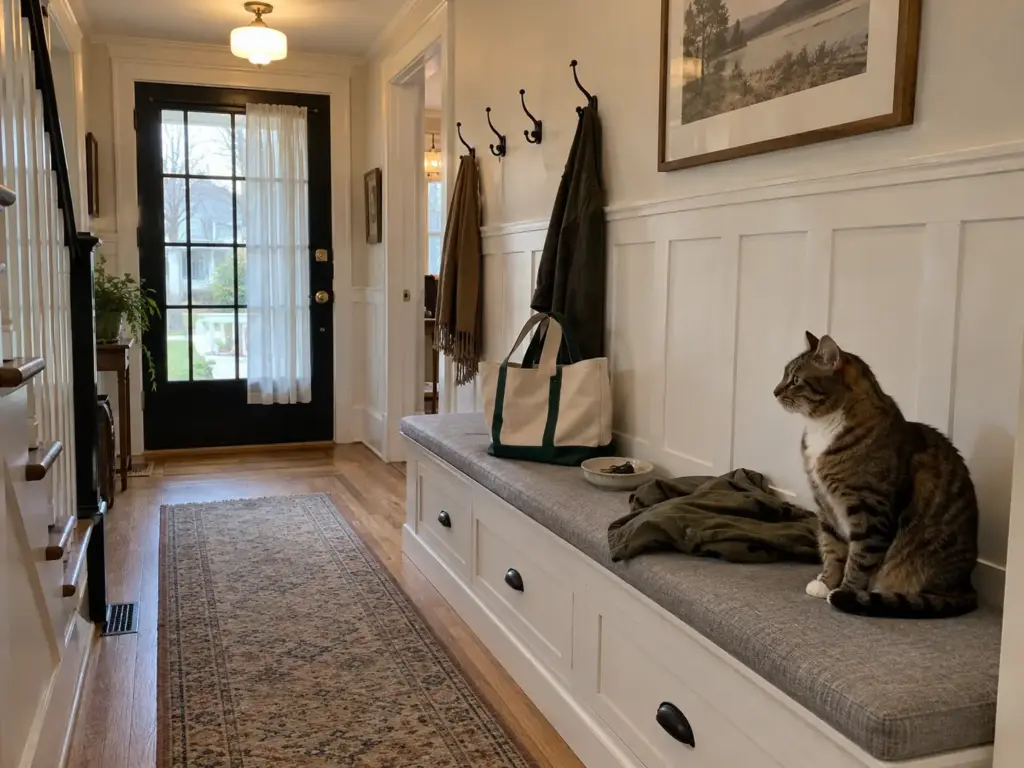
Three things hand the job over. The knot is tight against the skin. It is large or spread across several spots. Or your cat will not put up with handling at home.
VCA gives the same threshold in one sentence: if the cat is not tolerating at-home management, or the mats are large or widespread, see a vet or a groomer.
Dog groomers talking among themselves say much the same, that they will not brush out a mat on an animal who will not hold still because it takes too long and it hurts the animal, and that rule transfers to a cat on a sofa without any adjustment.
The comb-and-skin rule is already written up in the grooming guide’s section on mats at the skin, so it is linked here rather than copied.
The skin is the one thing a mat hides
This is the reason scissors lose. VCA Animal Hospitals’ guide to grooming a long-haired cat says mats sit so close to the skin that it is “easy to cut the skin, even if you don’t see it.” You cannot see the skin under the mat or where the knot ends, so there is no safe spot to snip.
A vet answering owners’ questions calls scissors work on mats one of the most common causes of accidental skin cuts in their own practice.
No scissors, then, and no clippers either. Clippers catch folds of skin that are hidden inside the tangle. Whether a matted cat gets clipped at all is a decision for the person with the training, and whether to shave a matted cat has that conversation in full.
And if the skin around a knot looks red, raw, wet or sore, that is a vet visit. It is not something to work out from a photo or from this page, so book it and leave the knot alone until you have.
Where Each Yardstick Sends the Wrong Person
Everything below is reasoning from how the three rules behave on cat tangles and cat mats, not a quotation from anyone. It is where the comparison earns its place, because each rule is fine in the middle and wrong at the edges.
A big loose tangle that the size line would hand off
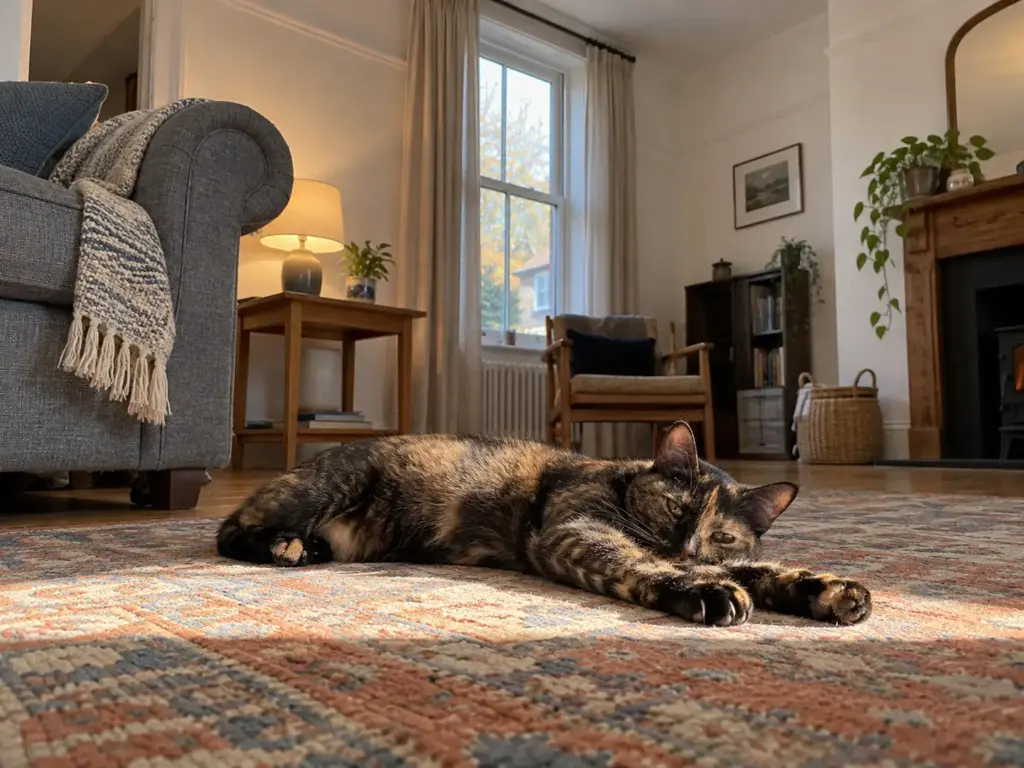
Take a tangle bigger than a nickel in the long fluff behind a large cat’s hind legs. It sits loose, the skin stays still when you hold the hair at the base, and a steel comb walks through it a few strokes at a time. By size it is outside the home zone, so the size rule tells you to book a groomer.
That means a carrier, a car ride and a stressed cat for something fingers and a comb would have opened in one calm session. The comb rule gets it right. The size rule sends the wrong person.
A small tight mat that the size line would hand back
Reverse it. A hard knot smaller than a nickel is pinned right at the skin, and the comb stops at its edge. By size it is home work, and a person with scissors in reach gets confident.
Here the comb saves you, because it catches before anything else does, and a comb that will not pass is the signal to stop. The size rule hands the risky job back to the house; the comb rule hands it on.
A cat who objects to everything, tangle included
The cat yardstick has its own failure. A cat who objects to being combed at all objects to a loose tangle exactly as much as to a mat, so the reaction cannot settle tangle or mat. What it measures is tolerance: whether you can work at all.
That still decides who does the job, because VCA’s threshold counts a cat who will not tolerate home handling as a reason to hand over. It just does not tell you what the knot is.
The comb test has the same weakness in a different spot. It only works if the comb reaches the skin, and on a cat the knot that matters is often under a front leg or on the back, in a spot he will not let you turn him to reach. Why the back is the spot a cat cannot reach goes through the mechanics, and the practical result is that the places a cat guards are the places the test cannot be completed.
With more than one cat, run the test cat by cat. A short dense coat and a long coat behave differently under the same comb, so one cat passing says nothing about the other.
The comb that catches is the one that ends the session. Leave the knot exactly as it is, put the comb away, and come back to the question tomorrow with fresh hands and a calmer cat.
One more thing worth saying aloud: there is no standard distance between a mat and the skin, and no standard gap for the comb teeth, for cats. Any figure in inches you meet on this topic has been made up. That is why the measuring in this article is done by the comb and your fingers, not a ruler.
Running the Comb Test on a Cat Who Won’t Be Turned Over
The test is easy to describe and awkward to carry out, since the person doing it is holding a cat who has opinions about the afternoon.
What the comb has to reach, and why a brush cannot answer it
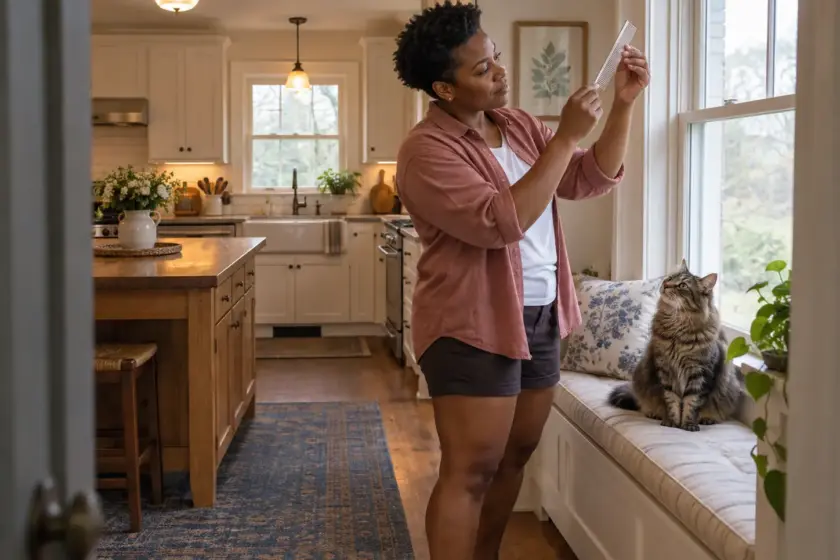
Fingers go first, because they cost nothing and they tell you where the lumps are. The two-finger check in the matted fur guide covers that step, so go there for the how. Only then does the comb come out, and it has to be a steel comb that can reach the base of the hair. A slicker brush or a bristle brush rides on top of the coat and gives a smooth stroke over a knot that is still sitting there.
Do it where the cat already sits: the arm of the sofa, your lap, the window ledge. A small apartment has no spare room for a grooming station, and the cat has no reason to follow you to one. A cat that is relaxed where he already is will give you more passes than one carried into the bathroom.
Rounded tines, tried on your own forearm first
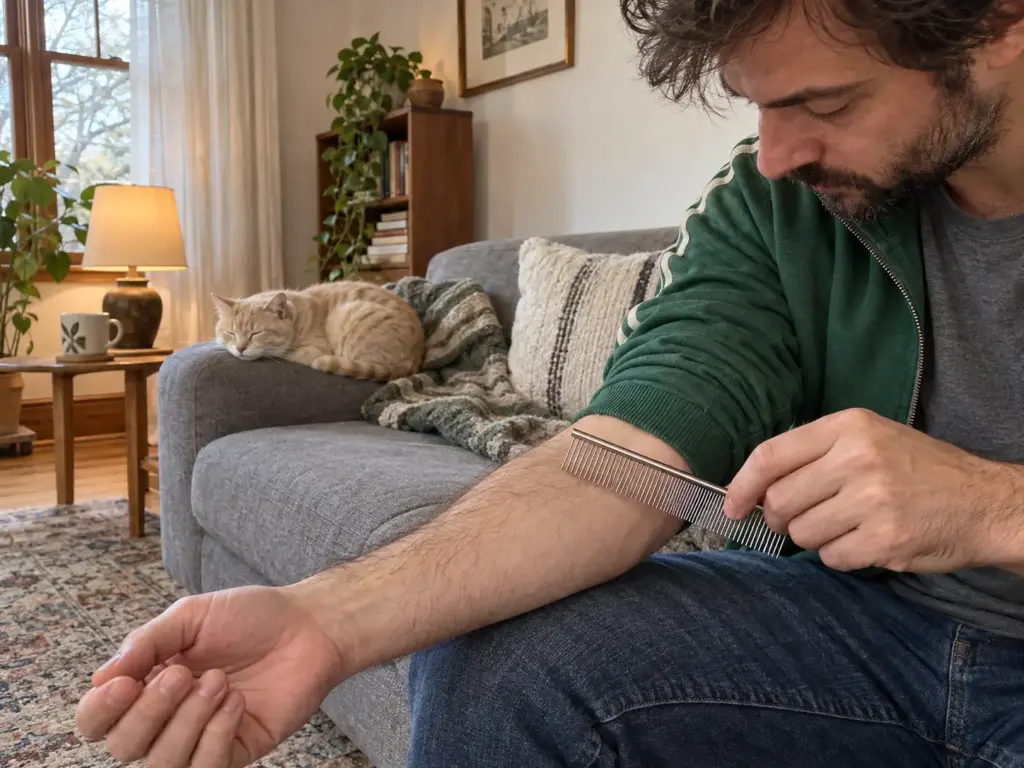
The comb must not scratch. A groomers’ trade blog gives the test: drag the comb you plan to use across your own skin, and if it scrapes you, it will scrape the cat, so the tips need to be rounded. Free comes first, as ever: your own forearm and a quiet minute do the check that no listing can.
For the tool itself, the PETTOM Steel Grooming Comb 7.5 inch is a 19 cm comb of steel with a coarse side and a fine side, which is the setup for this job: the coarse teeth go first to see whether the comb will pass, and the fine side checks the finish. It is the comb the removal guide and the matted fur guide use, so you may already own a version of it. The weak point is that the listing does not confirm the shape of the teeth, so the forearm test is not optional here: if the tips scratch you, do not use it on the cat. If you want to know what else a grooming kit needs, which pieces of a grooming kit are worth buying sorts the useful from the filler.
Drag the teeth along the inside of your forearm with the pressure you plan to use on him, then look for a pink line. If you see one, that comb stays in the drawer, whatever the label says.
The spot you cannot reach is the spot you stop at
If the comb stalls on a knot, or the cat says no before you have finished, you have your answer, and it is the answer from the skin section: that is a groomer’s or a vet’s job now. When a cat won’t sit still for the pass, he has told you something about the afternoon, not about your technique, and why a cat won’t let you brush it covers what he is objecting to. Stopping is the correct result of the test.
The Comb Test Is the One You Can Run Tonight, and Three Weeks Is When to Run It Again
Three things to keep:
- The comb that reaches the skin is the one yardstick you can run without a ruler, and it separates a tangle from a mat.
- The skin has the final word: a knot pressed against it, a large knot, or a cat who objects goes to a groomer or vet.
- Calling the knot a mat or a tangle changes nothing about the job. The rule you measure with does.
Three weeks is long enough for you to learn whether your routine held and for the cat to show whether he tolerates it, so that is when to run the same pass again on the same four spots: under the legs, the back end, the chest and around the collar. How often to brush by coat sets the rhythm that keeps a tangle from hardening into a mat in the first place.
Today, run your fingers over those four spots, comb the ones that feel smooth, and stop at the first catch. Write down where it was. That note is what you hand the groomer or vet if it turns out to be a mat.
Frequently Asked Questions
01How can I untangle a severely matted cat?
A severe mat is not a home job: large, widespread or skin-tight mats go to a groomer or a vet, and so does any cat who will not let you work. Loose tangles are the part the house can do.
02How do I tell a mat from a tangle on a cat?
Run a steel comb toward the skin: if it slides through to the base it is a tangle, and if it catches and will not pass it is a mat. A thick, chunky lump points the same way.
03Can I use dog grooming advice for a cat?
Only the principle carries over: the groomer’s rule comes before the tool, so a mat on the skin or an animal that will not hold still goes to a professional. The cat steps are in the removal guide.
04Is matted fur considered neglect?
Whether a matted coat counts as neglect is a label this page does not rule on. In practice it is a spot the cat cannot reach and a grooming job that went undone, and a mat against the skin is where a groomer or a vet comes in.


Leave a comment