Older Cats Stop Grooming, and Age Alone Is Not the Reason
Older cats stop grooming? Bring a 5-line list to the vet, brush 5 to 15 minutes where she sleeps & keep the scissors in the drawer [vet first].

Alfredo RamsesFounder · October 13, 2026 · 16 min read

On this page7 sections
- 1When Older Cats Stop Grooming, the Appointment Comes Before the Brush
- 2What the Vet Looks At, and Why Age Gets No Credit Alone
- 3The Brushing Session an Older Cat Still Accepts
- 4Nails and Skin Oil Keep Coming When She Stops Washing
- 5The Week Between the Phone Call and the Appointment
- 6Make the Call, Keep the List, and Let the Sofa Do the Rest
- 7Frequently Asked Questions
You are sitting with her on the sofa when your hand finds a stiff, dull patch over her hip, on a cat who kept that coat spotless for fifteen years. When older cats stop grooming, something about the reaching, or about the effort of it, has changed, and that makes the first job a phone call rather than a brush. Age alone is not a reason to wait, whether the stop was sudden or slow. This guide puts the visit first, with a written list to bring, and then covers the few minutes of coat care a senior cat will still take at home.
Quick Answer
When an older cat stops grooming herself, call the vet first, whether the stop was sudden or slow; age alone is not an explanation. Until the visit, keep to a few minutes of soft brushing where she already lies, and see why the scissors stay in the drawer.
When Older Cats Stop Grooming, the Appointment Comes Before the Brush
If you are weighing a clinic bill against a coat that looks scruffy, “she’s just old” is the easiest explanation to believe and a poor reason to wait. This section covers when to call the vet, what turns a coat problem into a phone call, and what to have written down when you make it.
Why a slow slide counts as much as a sudden stop
The vets at Cornell count a cat as older from about twelve to fourteen years, and they advise against putting health or behavior changes down to age. On grooming in particular, Cornell Feline Health Center’s guide to loving care for older cats says: “Be aware that a sudden lack of grooming may signal a health problem.”
Sudden is the version people notice: one week she washed, the next she did not. The slow version hides better. A coat that gets a little duller each month, a patch that was clean in spring and felted by autumn, a cat who now washes her face and nothing behind it. Every day of that slide is a day nobody mentions it to a vet, because nothing happened on any single day.
The zones that go first are the ones she has to twist for: the lower back, the base of the tail, the hips and hind legs. The mats guide maps where a cat’s tongue stops reaching, which is where a coat starts to felt once her washing thins out. In a thread on r/seniorkitties a sixteen-year-old cat stopped grooming herself, and the whole conversation turned on a question nobody in that house could answer: when did it start? Without a date, the first ten minutes of an appointment go to guessing.
The list to bring, in plain words
The vet visit list you take to the clinic has five lines: when the coat started to change and where, eating, drinking, litter box visits, and sleep and weight.
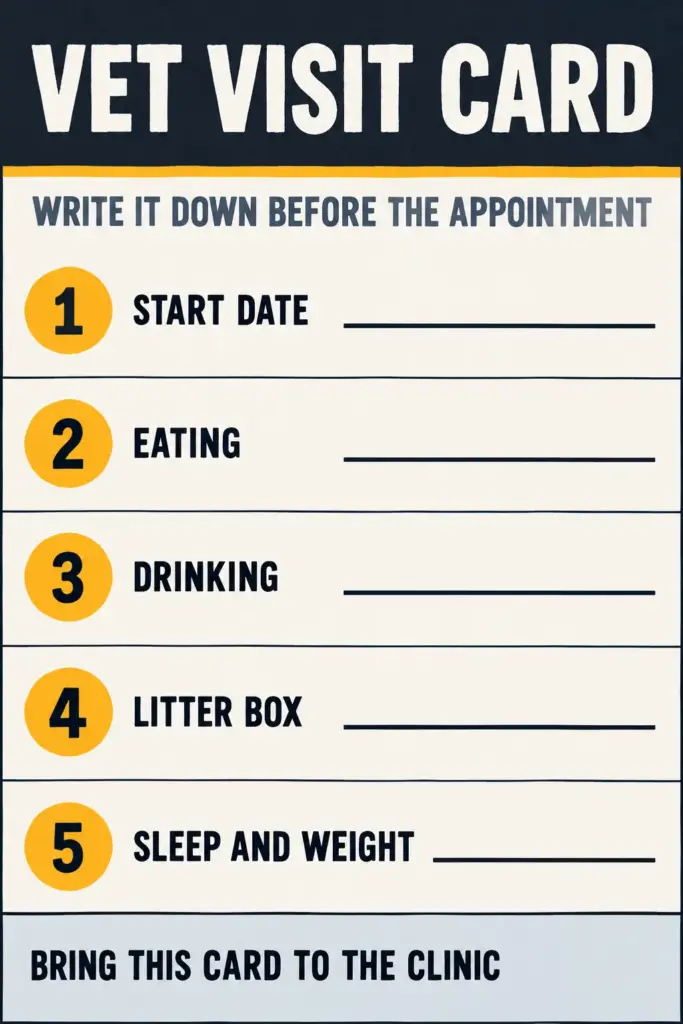
Under each line goes only what you saw, never what you concluded:
- Start: the date you first noticed the coat changing, and which spots, taken from the daylight photo rather than from memory.
- Eating: whether she finishes her meals, leaves some, or goes to the bowl and walks away.
- Drinking: whether you catch her at the water more or less often than before.
- Litter box: roughly how many visits you see, and anything about the route to the box that has changed.
- Sleep and weight: more sleep or less than before, and whether she feels lighter or heavier in your lap. The clinic’s scale gives the number.
“Left half her dinner twice this week” is useful to a vet. “Probably just her age” is a verdict, and the verdict is the one thing the visit is for. The mats article on what to show a vet covers the zone, the date and the daylight photo; this list adds the changes around the coat.
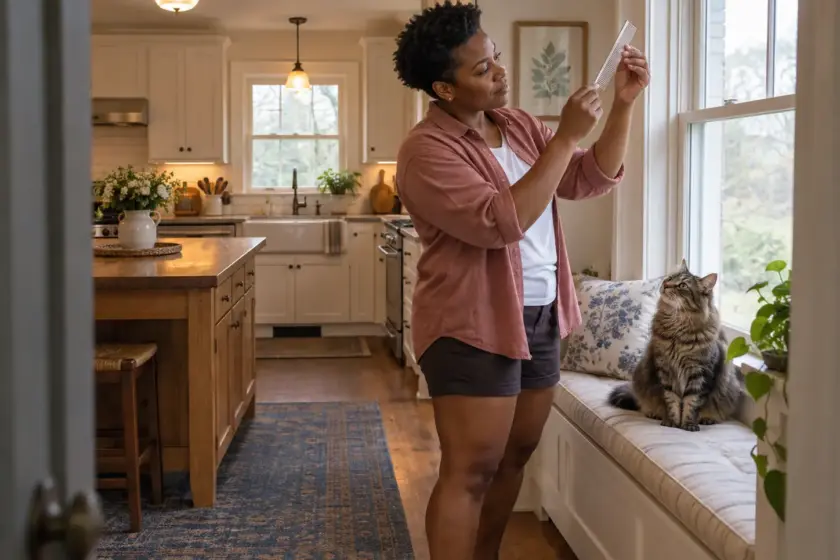
Photograph the coat in daylight by a window, and write the date on the first line of the list before anything else. A scruffy coat looks worse under a lamp and better in memory, and a dated photo lets the vet see the patch as it was the day you called.
What the Vet Looks At, and Why Age Gets No Credit Alone
You will want a cause the moment a senior cat stopped grooming, and a page cannot give you one. What it can do is show you what the exam covers, so the appointment is not a mystery and the list in your hand has a reason to exist.
Joints and the back
Arthritis in the spine and hips is the first reason PetMD’s senior cat grooming guide gives for why the motion of washing gets harder. Washing is a twist and a stretch, so it is easy to see why a vet would start there.
Whether it applies to your cat is something a vet finds with their hands, by watching her walk, turn and settle. Nothing about the coat can tell you, and nothing in this article tries. What you can check at home is only the map of which spots her tongue and paws can still reach.
Mouth, skin and weight
A senior exam also looks in her mouth, over her skin and at the scale. The mouth is the one place you cannot judge at home with any confidence. Skin and coat are what the vet reads under their hands as they work through the fur. Weight is a number the clinic keeps from visit to visit, which is why “she feels lighter” belongs on your list as a note and the scale is the measurement.
Kidneys, thyroid and the lab work
The vet-written guides also name the kidneys and the thyroid, and those are checked with bloodwork, not with a brush. PetMD describes a senior panel of bloodwork and a pressure check as part of the review.
A geriatric cat checkup is a schedule the clinic already keeps: Cornell suggests one every six months for geriatric cats, or, for a healthy older cat, a yearly exam with bloodwork and X-rays. Ask for a senior wellness exam when you book, and your list goes with you.
What this article will not decide
Which of those checks matters for your cat is not a question a house article can settle, and the list above is not a menu to pick from. These four stay with the clinic:
- Which of those checks explains why she stopped.
- Anything to give her or put on her skin, in any amount.
- Whether a dental cleaning, sedation or a shave is safe for her age and condition.
- What a change in her weight adds up to.
You will meet confident answers to all four from people who have never examined her. A chart and a pair of hands are the only things that settle them.
The Brushing Session an Older Cat Still Accepts
You want to help, and she purrs for a while before the brush becomes the problem. That arc sets the plan for elderly cat grooming: find where she already accepts you, keep to short grooming sessions, and stop on her schedule instead of yours.
The spot she already lies in
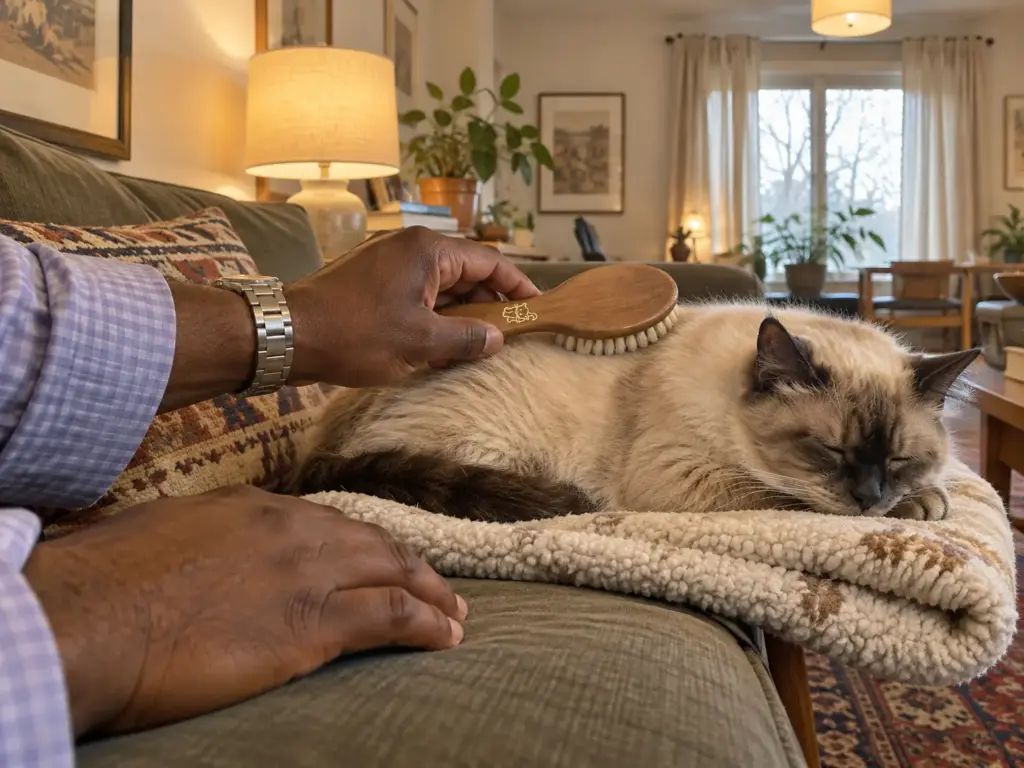
Skip the grooming table and the bathroom. In a small apartment with no spare room, the session happens on the cushion where she already sleeps, because a place she picked for herself is the one place she is not on guard.
The threads’ favorite trick is brushing while sleeping: owners in r/seniorkitties wait until the cat is asleep, or drowsy and asking for attention, and they keep it to somewhere between five and fifteen minutes. A reply on TheCatSite about a matted senior goes smaller: work a minute at a time, and stop long before she gets upset. Treat those as a range, and let the cat decide where in it you land.
Sit down first and let her settle against you; the brush stays in your lap until her breathing has slowed. The longer routine for a cat with no limits lives in the grooming guide, and this one is cut down for a cat who has some.
A few minutes, thin skin, and the direction of the hair
Begin with your fingers. Run them with the lie of the fur over her hip, the base of her tail and behind her ears, and tease away whatever comes loose without a tug. TheCatSite members describe skin at this age as “paper thin,” and on a bad day your fingers may be the only tool she takes.
When she takes more, a soft bristle brush is the next step, since PetMD advises softer bristles over wire for older skin. The Mars Coat King Bristle Cat Hair Brush is a natural bristle brush, with boar bristles about 3/4 inch long on a 7.25 by 2 inch head, a size that covers a small cat’s back in a few unhurried strokes, always with the direction the hair grows.
Two three-star Amazon reviews say why it is no miracle: “Not really good at brushing knots but cat likes it” and “it doesn’t get all that much hair off of her.” Think of it as a surface tool. It will not open a knot or clear a thick undercoat, so it suits the days when the goal is contact, not results.
A steel comb feels like the natural tool for a knot, and on skin this thin it is the second one. Only after your fingers have loosened a knot does the 7.5 inch, rounded-tooth PETTOM Steel Grooming Comb get near it, finishing what they started without scraping. Amazon’s summary of its reviews says others report the teeth bend after a few uses, which is a reason to expect it to wear, not to press harder.
When the purr turns to a hiss or a twitch of skin under your hand, she is showing you where her limit is. When a cat won’t let you brush goes through what she is objecting to; here the limit is simply the end of the session.
End the session at her first objection, even if that is the third stroke. Three strokes and a sit-down still count as a session, and tomorrow starts from how this one ended.
How often, and where to stop
For senior cat brushing, Mooresville Animal Hospital’s guide gives once a day for long coats and once a week for short ones. I would read the daily figure as daily contact: sixty seconds of fingers and brush over the places she can no longer wash counts. How often to brush by coat length has the figures for each coat. For a short coat, treat the weekly number as a floor while she is not washing herself.
The spots that matter are the ones her tongue no longer reaches: behind the ears, the armpits, the base of the tail, the hips and the hind legs. And the stopping points are plain. Stop at the first tug, the first hard patch against the skin, or the first twitch under your hand. A knot that does not open under your fingers is not for this session; it moves to the week-of-waiting section below, and then to the groomer or vet.
One older cat, or two
If another cat lives with her, watch who washes whom. Some pairs groom each other, so the change may not be only hers. Add one more line to the visit list: whether the other cat still washes her, and whether his own coat has changed. A second cat’s coat is information for the clinic, not a conclusion for you.
Nails and Skin Oil Keep Coming When She Stops Washing
She stops washing, but she keeps making what washing used to clear. Two things pile up where you can see them from the sofa: nails that snag in the blanket, and an oily cat coat, greasy or clumped, even on a short-haired cat. Neither is a fight with her. Both are what keeps growing in the background.
Thicker cat nails with age, and the outer layer that stops shedding
On TheCatSite, the owner of a twelve-year-old cat with thick nails reported that the outer layers just came loose, and brushed them away. PetMD describes the same pattern: claws grow thicker with age as the outer sheath sheds less, and it advises a senior cat nail trim about monthly. A thick nail that catches in a blanket is a good reason to trim before the month is up.
Ask the clinic to trim her nails during the same appointment. They are already handling her paws, and the request is one sentence at the desk.
The procedure itself lives in how to trim cat nails at home; what is different for an older cat is only the thickness and how soon they come back.
More skin oil and loose undercoat, even on a short coat
PetMD notes that older cats make more skin oil and carry more loose undercoat, and that this can mat even a short coat. Oil and undercoat that she used to lick away now stay where they fall, and they press into the fur whenever she lies down. Fingers and a soft brush over the hips and the base of the tail catch it early, before it needs anything sharper.
The clipper with a visible quick, and the pair already in the drawer
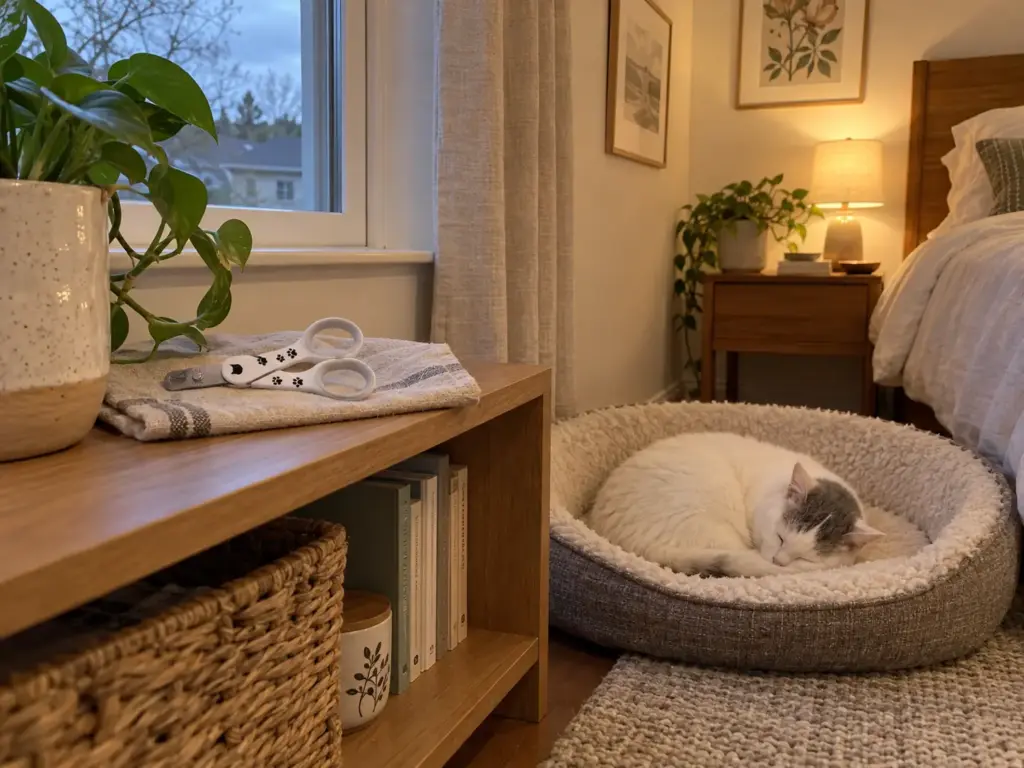
Use the pair already in the drawer first, as long as the blades are sharp. If you do buy, choose for the nail, not the handle: a thick nail is trimmed a sliver at a time, and you want to see the quick before each cut.
The Necoichi Purrcision Stainless Steel Cat Nail Clipper measures 2.28 by 3.78 inches with thin, sharp blades, and reviewers say the quick is visible through the cut. Its weaknesses are in the grip. A four-star reviewer wrote that “they don’t have a finger rest” and that they are “not much better than the cheap pair I already had.”
If you need a cheaper angled clipper, the BOSHEL Cat Nail Clipper Angled Small is the budget alternative.
The Week Between the Phone Call and the Appointment
The earliest slot is days away, or the budget pushes it later, and you would like to do something safe in the meantime. There is such a list, and it has a limit built in: everything on it is something the cat accepts, and nothing on it is medical.
What the house keeps doing that week
The week is for keeping things as they are, not for catching up on the coat.
- Keep the hips, the base of the tail, the armpits and behind the ears brushed short, with fingers and the soft brush.
- On old cat matted fur, leave a mat alone unless it opens under your fingers and the skin stays still while it does. How to remove a mat smaller than a nickel holds the size rule, and mats and tangles separates the ones fingers can handle from the ones that go to a groomer or the clinic.
- End every session at the first objection.
- Keep sprays, creams and anything sticky off her coat. A TheCatSite reply on a matted senior says to put nothing on her hair at all.
The scissors that do not belong by the sofa
One r/seniorkitties owner keeps a small pair of scissors by the sofa and trims the big lumps while stroking a cat who hisses at the brush. You can see the logic: she tolerates the hand, the lumps are right there, and it takes seconds. The usual first move with a knot is to cut it out. For an older cat I would put the scissors in a drawer and leave them there.
PetMD warns that older cats have especially delicate skin and that close trimming can injure it. Skin that thin moves with the fur every time she shifts, and the one second she does not hold still is the second the blade slips. If a knot will not open, the answer is a groomer or the clinic, and the shave question walks through when a coat goes to a professional instead.
Food, water and litter within her reach
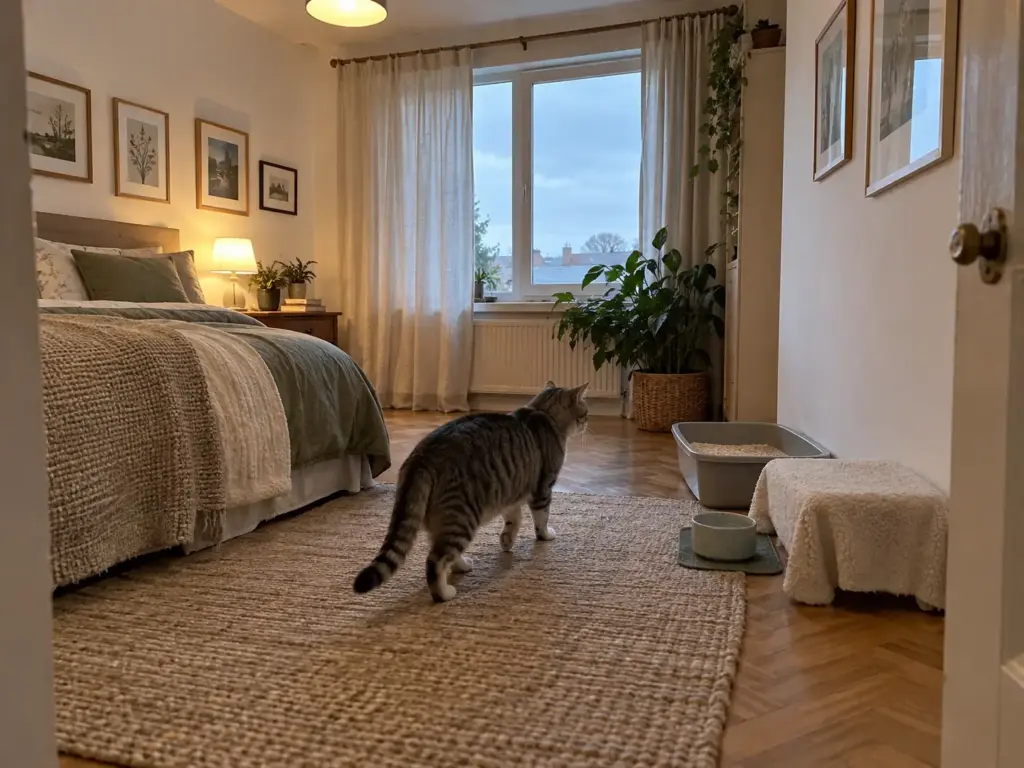
Cornell’s advice for the house is plain: a litter box on every floor, so no stairs sit between her and a tray, and food and water within reach. If getting into the box is the hard part, Cornell suggests very low sides, and how to choose a litter box by size, sides and entry covers entry height; a low-sided litter box is the one to look for.
Cornell also says to think warm, not hot. A warm resting spot is good for an old cat, but too much heat can burn one who cannot move away quickly, so check what she is lying on.
Pick three spots to touch today, say the hips, the base of the tail and behind the ears, and write them on the list beside the date. Touch the same three tomorrow and the day after. A spot that changes between visits is worth telling the clinic.
Make the Call, Keep the List, and Let the Sofa Do the Rest
Three things carry over from this page. Call the clinic whether the stop was sudden or slow, because age alone is not an explanation to settle for. Keep the five-line list and the dated photo, so the first ten minutes of the appointment go to her and not to guessing. And until then, keep the house to what she takes: a few minutes of soft brushing on the cushion where she already sleeps, nails that do not snag, and food, water and a low tray within reach.
Three weeks from now, look at whether she still accepts those few minutes on the sofa and whether the spots you can reach are as clear as the day you wrote the list. If the session has shrunk or a patch has grown, put that on the list too, dated, for the clinic.
Today, before any purchase: write the date at the top of a sheet of paper, take one photo of her coat by the window, and sit with her for a few minutes with your fingers moving with the lie of the fur over her hip, stopping at the first sign she has had enough.
Frequently Asked Questions
01Is it normal for older cats to stop grooming?
Not by default, because age alone does not explain a cat who stops washing herself, and Cornell advises against putting health or behavior changes down to old age. Call the clinic, bring the list, and keep to short, soft sessions until the visit.
02Why is my 17-year-old cat not grooming herself?
That is a question for the vet to answer by examining her, since a page cannot tell which of the usual checks, from joints to bloodwork, applies to her. Bring the dated list and a daylight photo of her coat.
03How can I help my elderly cat with grooming?
Brush for a few minutes where she already sleeps, with your fingers first and a soft-bristled brush after, and end the session at her first objection. Leave any knot that does not open under your fingers to the clinic or a groomer.
04Should I cut a mat out of my older cat’s fur?
No, not when the mat sits on the skin, because older skin is thin and moves with the fur, so a blade can reach her before it frees the knot. If it will not open under your fingers, it belongs to the clinic or a groomer.
05Do senior cats need their nails trimmed more often?
Often yes: PetMD says nails thicken with age as the outer layer sheds less, and its guide suggests trimming about once a month. Ask the clinic to trim them at the same visit, or see how to trim cat nails at home for the method.
Leave a comment