Best Litter Box Under $50 That Fits a Big Cat
Best litter box under $50, by the numbers: nose-to-tail-base x 1.5. A 20-inch cat needs 30 inches of pan (most "large" boxes stop at 19).

Alfredo RamsesFounder · August 25, 2026 · 20 min read

On this page8 sections
A reviewer at one of the big testing sites put a 17-pound cat in a box the manufacturer calls large, and the verdict they published was “a little too snug.” That is the whole problem in five words. Large on the label and large enough in the room are two different claims, and only one of them has a number behind it. The word most people use for the failure is junk, but junk does not mean basic: an open top litter box with no lid to fail is not the cheap option, it is the one with fewer places to break.
The sizing rule this article measures every pick against comes from the AAHA and AAFP, not from a brand’s marketing copy, and it does not get more forgiving because your budget did. Here is what a budget litter box under $50 actually buys, where it quietly gets cut, and which three clear the rule, including the one that fits a genuinely large cat.
Quick Answer
The best litter box under $50 is the one long enough for your cat, and that is a measurement, not a label.
- Measure nose to tail base, multiply by 1.5, and shop by that number.
- Under $50, an open high-sided pan beats a hooded box on both durability and smell.
- An 8 to 12 lb cat clears the rule in a standard large pan. A big cat needs the XX-large tier.
- Move the box you own before you replace it. That costs nothing.
What “Junk” Actually Means Under $50
Everybody says don’t buy the cheap one. Almost nobody says what actually breaks, which leaves the reader who has already owned a box that failed with no vocabulary for what went wrong and one useless lesson: spend more next time. That is the wrong lesson, and it is expensive.
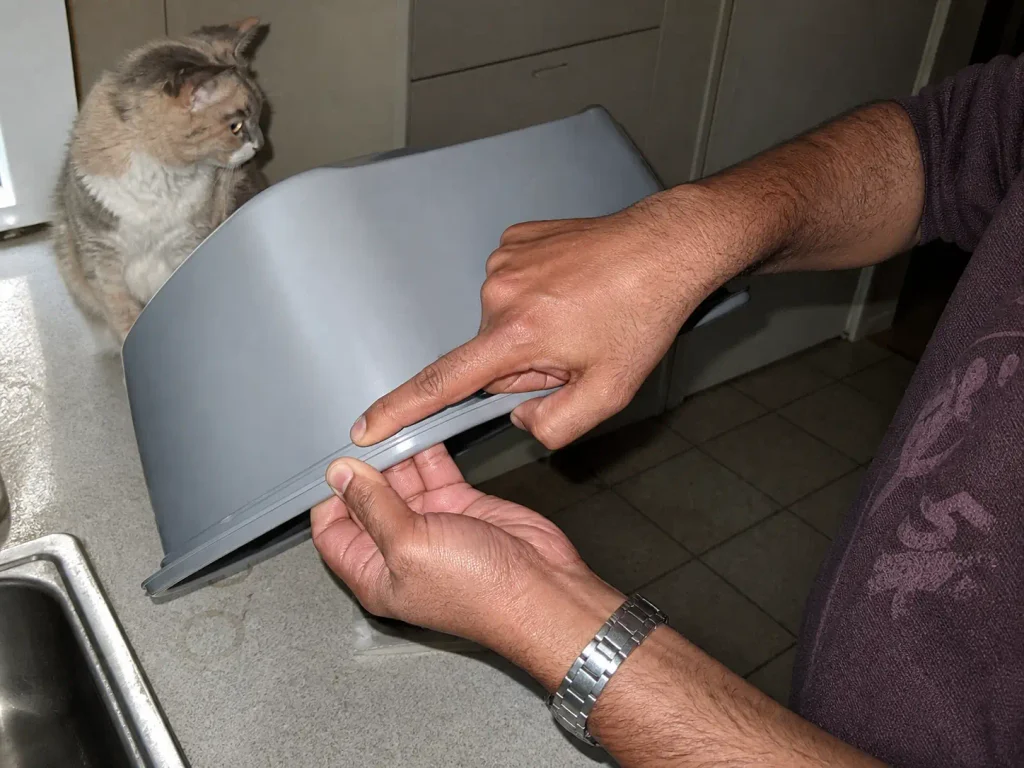
Cheap boxes do not fail across the flat floor of the pan. The plastic there is under no stress and it will outlive the cat. They fail at the molded seam, and there are two of them: the fold where the plastic turns to make the top rim, and the clip where a lid snaps down onto a base. Review threads for sub-$30 pans describe the same two failures over and over, in the same order.
The rim cracks along the fold. The lid stops snapping shut and starts sitting slightly proud, and litter and smell come out of that gap. Neither of those is the material giving up. Both are the geometry giving up at the point where the sheet was bent or joined.
That single fact decides the whole hood question at this price. A lid is an extra joint, and the joint is the failure point, so the box that costs you less and lasts longer is the one with nothing on top of it. This is the rare case where the budget answer and the good answer are the same answer, and readers reject it because it feels like settling.
It is not settling. A plain uncovered litter box that survives five years of daily use is not junk by any definition the community actually uses. In litter threads, a junk litter box is one with structural failure inside a few months. It has never meant uncovered.
Run a thumb along the top rim fold and along the lid clip, in the store or the moment the box comes out of the carton. Thin, sharp-edged flashing at the fold is the tell, and it is the exact line the crack follows later. It takes four seconds and it catches most of what goes wrong at this price.
There is one more thing worth naming, because it is the honest ceiling of this whole article rather than a corner anyone chose to cut. Under $50 you cannot buy grade-304 stainless steel in a size that fits a large cat. That is not a marketing boundary someone invented to sell you the next tier up. It is what the metal costs at that surface area.
That is the real argument in plastic vs stainless steel at this tier, and it is settled by arithmetic rather than preference. Stainless steel does hold odor better, but only grade 304, and the moment you need thirty inches of it, the price has already left this article. So a stainless steel litter box is off the table here and the budget play for a big cat is plastic, and the job becomes buying plastic that is the right shape rather than pretending it is something else.
Everything below applies one constraint, price, to a decision that actually has five. If you want the whole decision rather than the cheap slice of it, the five things that actually decide a litter box is the framework this article is borrowing from.
Measure the Cat, Not the Box
You have been shopping by label. Large, XL, Jumbo. Everyone has, because that is the only vocabulary the listings offer, and those words are set by whoever molded the plastic. The cat was not consulted.
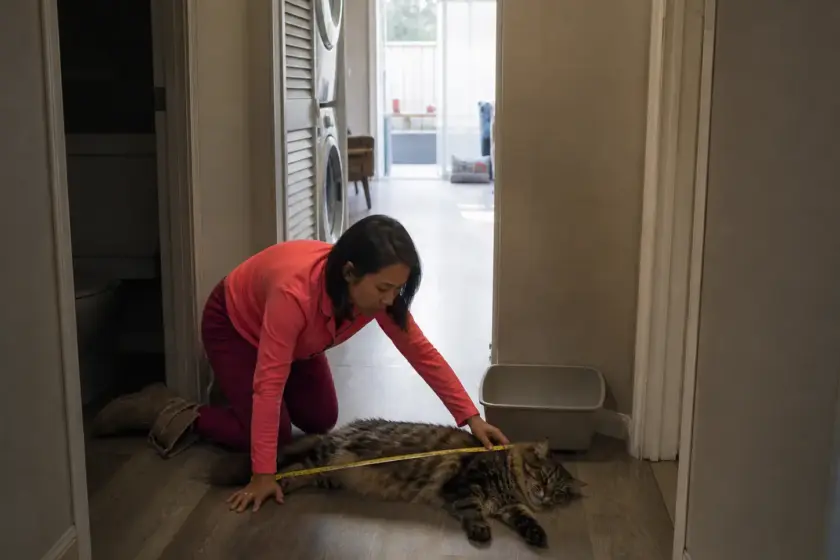
The measurement that would settle it takes about ninety seconds and a tape measure, and once you have the number, half the catalog disqualifies itself without you reading a single review.
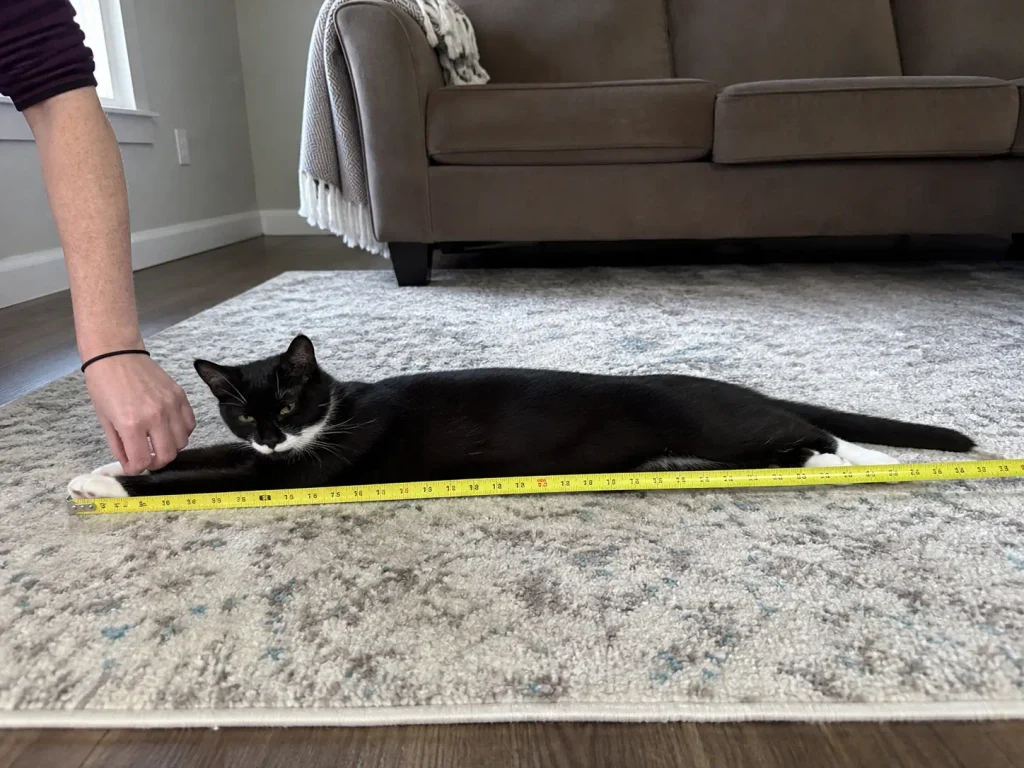
The rule is nose to tail base, times 1.5, and that product is the minimum interior length of the box. It is not blog folklore. It comes from the AAHA and AAFP’s joint feline life-stage guidelines on litter box sizing, which is a professional standard written by people with no boxes to sell.
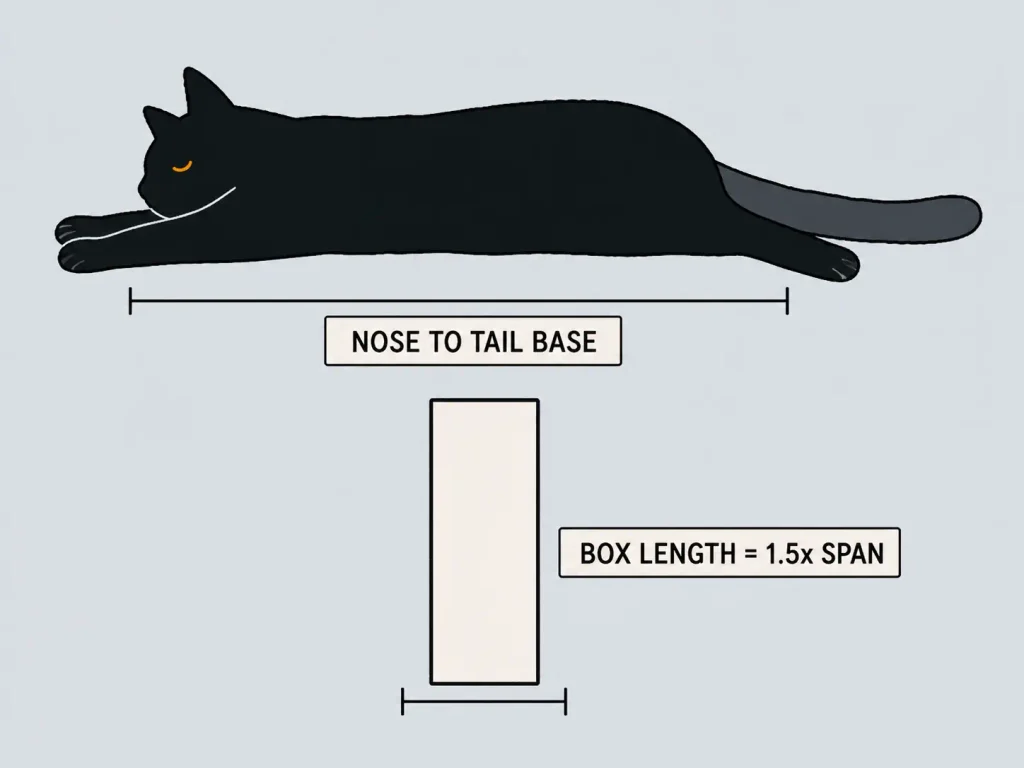
Nose to tail base. Not tail tip. This is where the rule goes wrong in practice, and it goes wrong in the generous direction: measuring to the tip adds five or six inches of tail to a number that then gets multiplied by 1.5, and the reader ends up shopping for a box nine inches longer than the cat needs. Then either they buy it and lose floor space they did not have to lose, or they conclude the rule is unreasonable and abandon it.
Tail base is where the tail joins the spine. Get your thumb there and stop.
Now run the number against what is actually on sale. A standard “large” pan is about 19 by 15 inches. Multiply backward: that clears the 1.5x rule for a cat measuring roughly 12 to 13 inches nose to tail base, which is an ordinary adult cat in the 8 to 10 pound range. For that cat the standard litter pan is not a compromise.
It is correct, and the label is telling the truth. A large cat measuring 20 inches needs 30 inches of box, and the same label is now telling a lie it does not know it is telling.
Which is the whole story of that 17-pound tester cat and its “little too snug” verdict. The box was not defective and the reviewer was not careless. The box was nineteen inches long and the cat needed closer to twenty-six, and the word standing between those two facts was large, a word that carries no number at all. The testing site reported the outcome honestly and never turned it into a rule.
That is the gap this article is standing in.
Two things this article deliberately does not solve: width and entry height. They are separate axes with their own answers, and the full sizing breakdown in inches covers them properly. What matters here is that a price ceiling is not allowed to quietly cut them without telling you.
The Honest Basic, for an Average Adult Cat
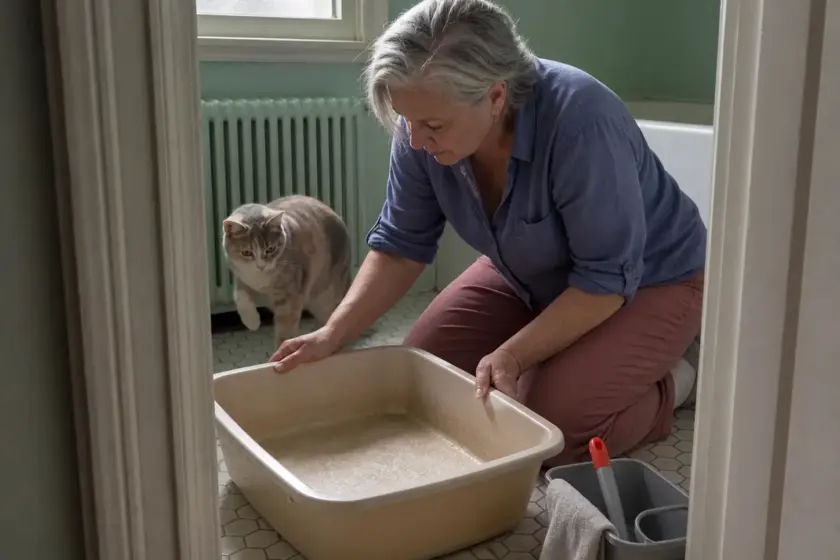
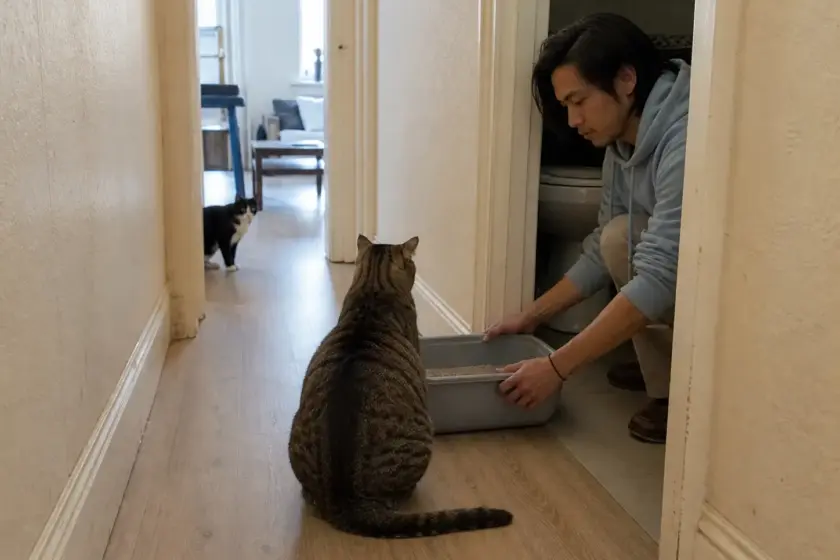
Before you buy anything, move what you already own. If the current box is the right length by the measurement above and the complaint is smell or refusal rather than fit, the box is probably not the problem. Placement is, or scoop frequency is. A box shoved into a corridor against a wall gives a cat exactly one way in and one way out.
Cats do not commit to a room with a single exit while they are in the least defensible posture of their day. Moving it costs nothing and takes a minute.
Before you replace a box that is already the right length, move it. Same box, new corner, one with two ways out of it. Give it four days. If the move fixes it, you just saved the money and learned something the new box would never have told you.
If the length genuinely does not clear the rule, then an open high-sided pan is where the money goes at this tier, and it wins for reasons that have nothing to do with being cheap. No lid seam to separate. No filter to remember or replace. Nothing that can fail because there is nothing there to fail.
And the odor control arithmetic runs the same direction: an open pan holds less smell than a hooded box at the same price, because a hooded litter box does not remove ammonia, it concentrates it at the height of the nose that is inside the box. You solved your problem and made his worse.
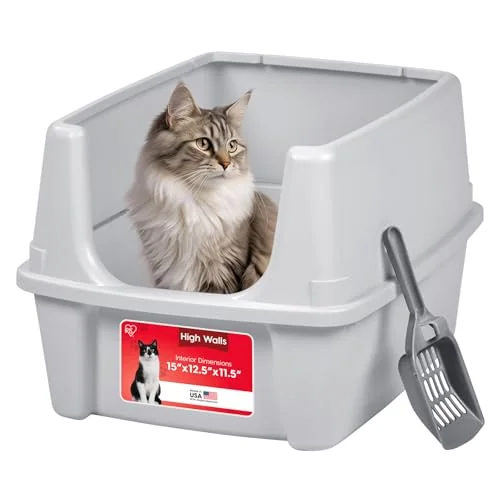
At 19 by 15 by 11.75 inches, the Amazon Basics pan clears the 1.5x rule for a cat measuring up to roughly 12 to 13 inches nose to tail base. Check your number against that before reading another word about it, because if your cat measures 16 inches this section is not yours and the next one is.
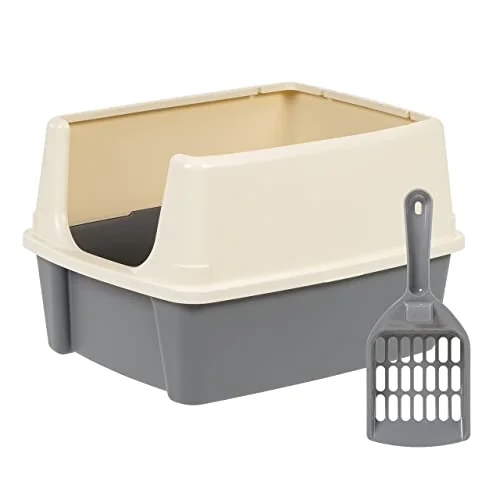
Most readers of an article like this do not have a Maine Coon. They have an eight-pound cat and a suspicion that anything under $50 is a trap, and for them the answer is short and the trap is imaginary. Buy the basic pan, put a mat under it, and spend the rest of your attention on where it goes.
That’s it.
The Big-Cat Problem Nobody Prices In
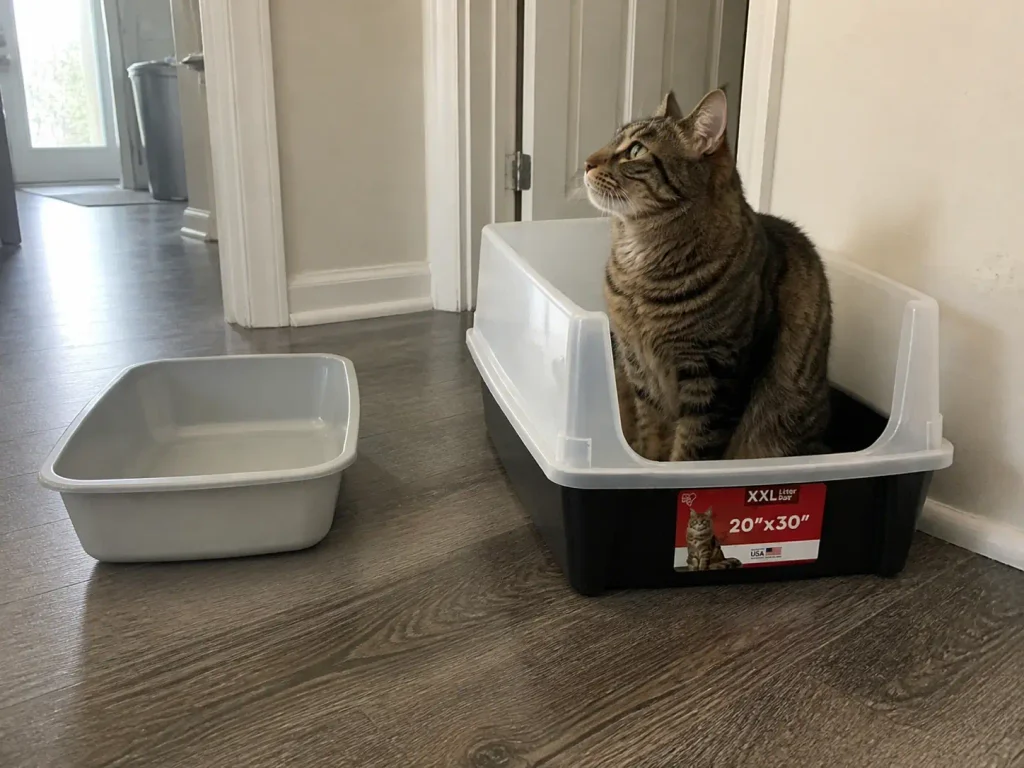
If you own a large cat, every roundup you have read has quietly failed you. You already own the box they recommend.
It is the one sold as large, it is the one that is too short, and you know it is too short because you have watched him stand in it with his front paws in and his back end out over the rim, or turn around in three careful movements when one should do. That is not defiance and it is not a preference. It is a cat solving a geometry problem you handed him, with the only tools he has.
So run the arithmetic out loud, because nobody publishes it. A large cat measuring around 20 inches nose to tail base needs 20 times 1.5, which is 30 inches of interior length. Now go and read the dimensions on every box in the “large” tier.
Nineteen inches. Twenty-two. Twenty-four at the generous end. Not one of them is within six inches of what the rule asks for, and all of them are sold under a word the reader has been trained to trust. This is why the failure feels mysterious to the person living it.
They did buy the big one. The big one was eleven inches short.
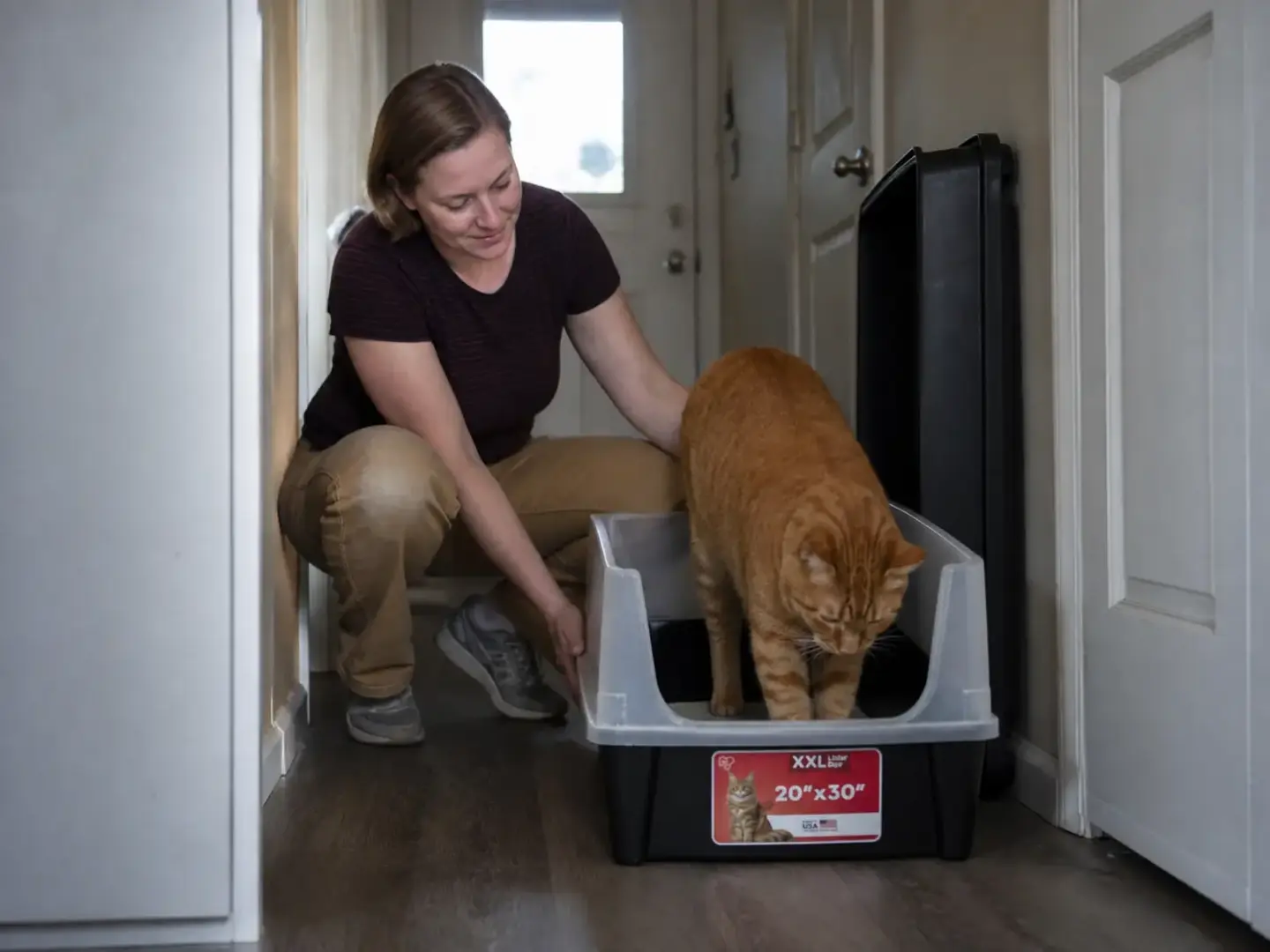
The tier that does clear it exists, and it is the only shape in this price band that does: XX-large open pans at roughly 30 by 20 by 14 inches. Thirty inches of interior length is the number, and it is worth saying plainly that there is no clever workaround. Width does not substitute for length, and a deeper vented pan does not substitute for length either. The cat needs to stand, turn, and dig without touching a wall, and the only dimension that buys all three at once is the long one.
The 14-inch wall solves the second problem in the same purchase, which is the part the arithmetic does not show you. The raised splatter shield lip earns its keep here: a bigger cat is not just longer, he digs harder and throws further, and wall height is what keeps a hard digger’s litter inside rather than distributed across the room. The three inches of extra wall over a standard pan sounds like a rounding error until you consider that the litter leaving the box has to clear that edge on a rising arc from a cat who is stronger than the average one.
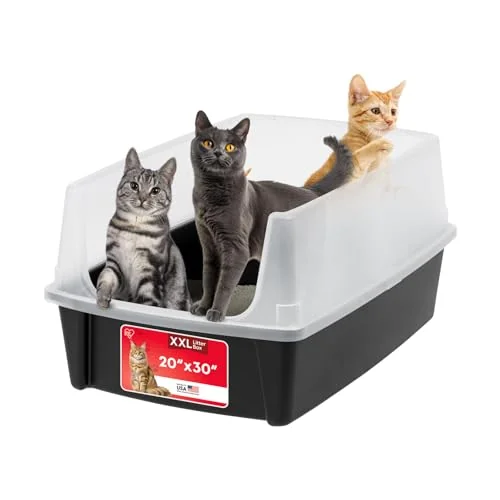
Entry height is the trade you are making, and it is worth understanding rather than accepting. Tall walls and a low step are in direct opposition: every inch of wall you add for containment is an inch the cat has to clear on the way in. The curved cutout at around 6.5 inches is how a box has both, dropping the entry point at one spot while keeping the other three sides high. For a healthy adult cat that step is nothing. For an older or stiffer cat it is not nothing, and if you notice hesitation at the lip, pausing, gathering, backing off and coming back, that hesitation is worth a conversation with your vet before it is worth a different box. It may be about the box. It may not be, and that is not a question this article can answer.
Back to the box. What a big cat costs you at this tier is not money, it is floor area. A 30 by 20 pan occupies about four square feet including the space a cat needs to enter and turn beside it, and that is roughly double the footprint of the basic pan. Which is exactly the constraint the next section has to deal with, because floor is the resource that runs out first in the apartments most of these readers live in.
Where the Money Goes When You Have Two Cats or One Room
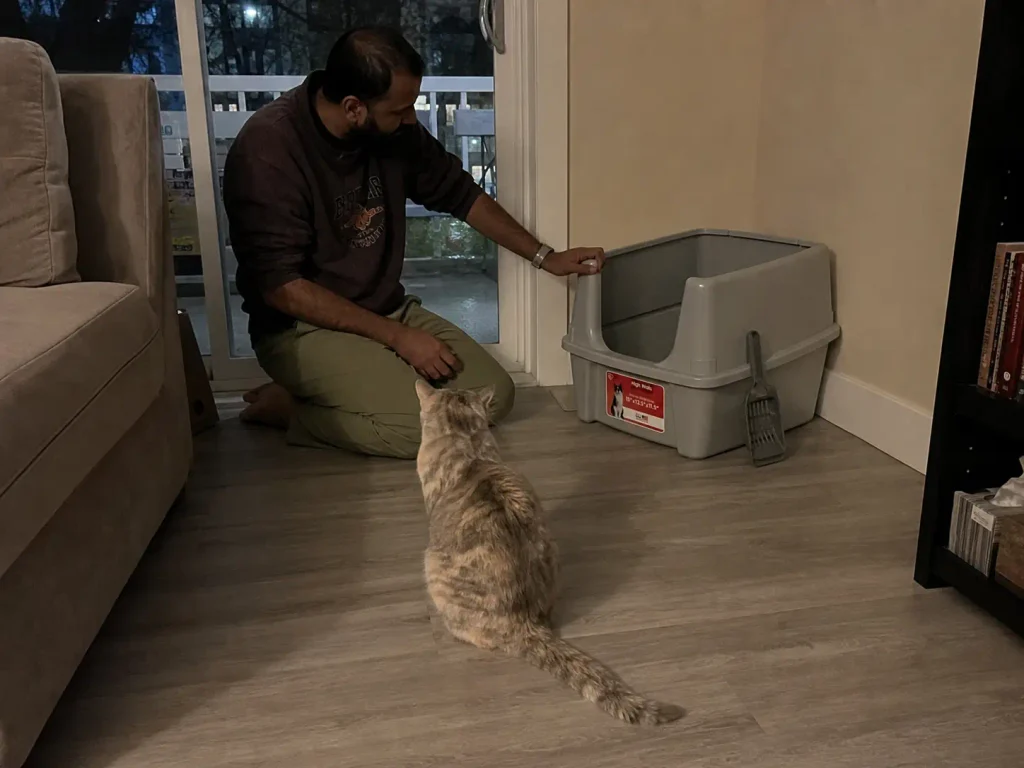
You are doing the sum wrong, and I suspect on purpose, because the right sum is uncomfortable. The comparison in your head is one $50 box against one $200 automatic, and framed that way the expensive box looks like it might be worth it. But that is not the comparison. For a two-cat household the real comparison is three cheap boxes against one expensive one, and the budget-friendly tier wins that argument so decisively it stops being about budget at all.
Here is why three.
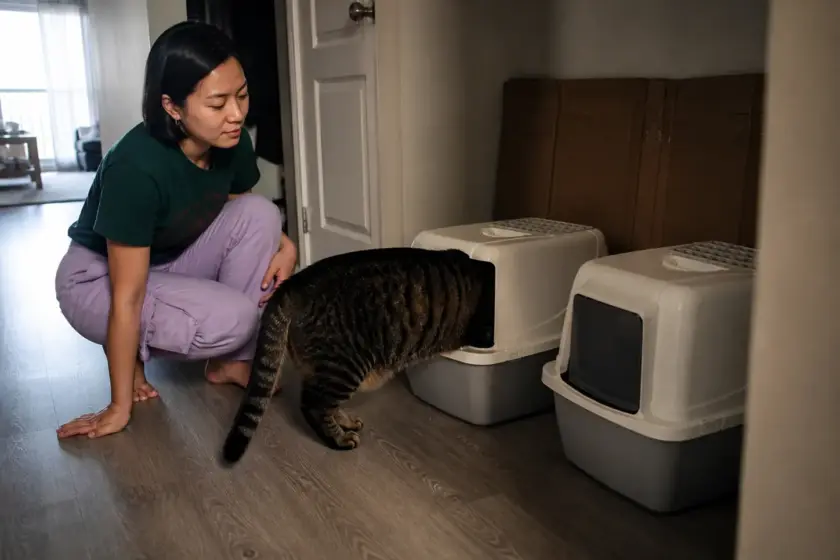
The N+1 rule means one box per cat plus one, so two cats need three, and it is the N+1 rule that shelter and vet behaviorists use rather than a tidiness superstition. The reasoning is territorial, not hygienic. A cat treats a box as claimable, which means one cat can be kept away from it by another cat simply sitting somewhere on the route, and none of this looks like conflict from a human vantage point. The cat that gets blocked does not complain. He finds somewhere else to go, and you find it later.
Why two cats usually means three boxes works through the full case, but the short version is that the number of boxes is really the number of independent locations.
Now put that against the ceiling. Three honest open pans at this tier lands somewhere around $75 to $105 all in, which is still under a single mid-range hooded box and nowhere near an automatic one. And the three boxes solve a problem the expensive box cannot solve at any price, because one box is one box however good it is.
That is the arithmetic a multi-cat household is actually doing, whether or not anyone writes it down. A $700 self-cleaning litter box sitting in the hall is still exactly one location that one cat can control. The money you were about to spend on mechanism buys geography instead, and geography is what the actual problem is made of.
One cat still benefits from two. The rule does not start counting at two cats, it starts at one, for the same reason: a single box is a single location, and a single location can be blocked by a closed door, a vacuum running, a visitor in the hall, or nothing you will ever identify.
| Box | Interior length | Wall height | Clears 1.5x for a cat measuring |
|---|---|---|---|
| Amazon Basics Large, Open Top | 19 in | 11.75 in | Up to 12-13 in |
| IRIS USA Large, Scatter Shield | ~24 in | 12 in | Up to 16 in |
| IRIS USA XX-Large, Scatter Shield | 30 in | 14 in | Up to 20 in |
The middle row is where most secondary boxes should land. In a multi-cat house the primary box gets sized for the largest cat in it, and the second and third do not have to match it inch for inch, they have to be somewhere else and be adequate.
The small-apartment version of this problem is the one nobody writes, and it is the one more readers actually have. Past a certain point the constraint stops being money and becomes floor area, and no amount of budget discipline creates square footage. Three 30 by 20 pans do not fit in a studio. They barely fit in a one-bedroom. So the trade is to size for the largest cat in the house on the primary box, put the standard large pan in as the secondary, and accept that arrangement rather than the reverse. Never the reverse. A big cat with a small primary box and a spacious backup he has to negotiate for is the worst version of this, and it is the version people build by accident because the small box was already there.
And never three boxes lined up in a row against the same wall, which is the instinctive solution when floor is scarce and the wrong one. To the cats that is one location with three compartments, and it buys you nothing that a single box would not have bought. Where the boxes actually go in a small apartment is a layout problem rather than a shopping one, and it is worth solving before you buy the second box rather than after.
Two boxes side by side count as one location to the cats, and so do three. Separate them: a different room, or at absolute minimum opposite ends of the same one, with something between them that breaks the sightline. If the second box shares a wall with the first, you bought a wider box and nothing else.
One last thing in favor of the cheap plastic pan, and it is a real advantage rather than a consolation. It needs no assembly, no hardware, no wall mounting and no conversation with a landlord, and it survives a move in one piece because it is one piece. Furniture-style enclosures are not true of any of that at any price, and if you are renting, that difference is worth more than most of the features people pay extra for.
What to Skip, Even When It’s Cheap
Your cart probably has one of these in it right now. This is the section that saves you the return shipping.
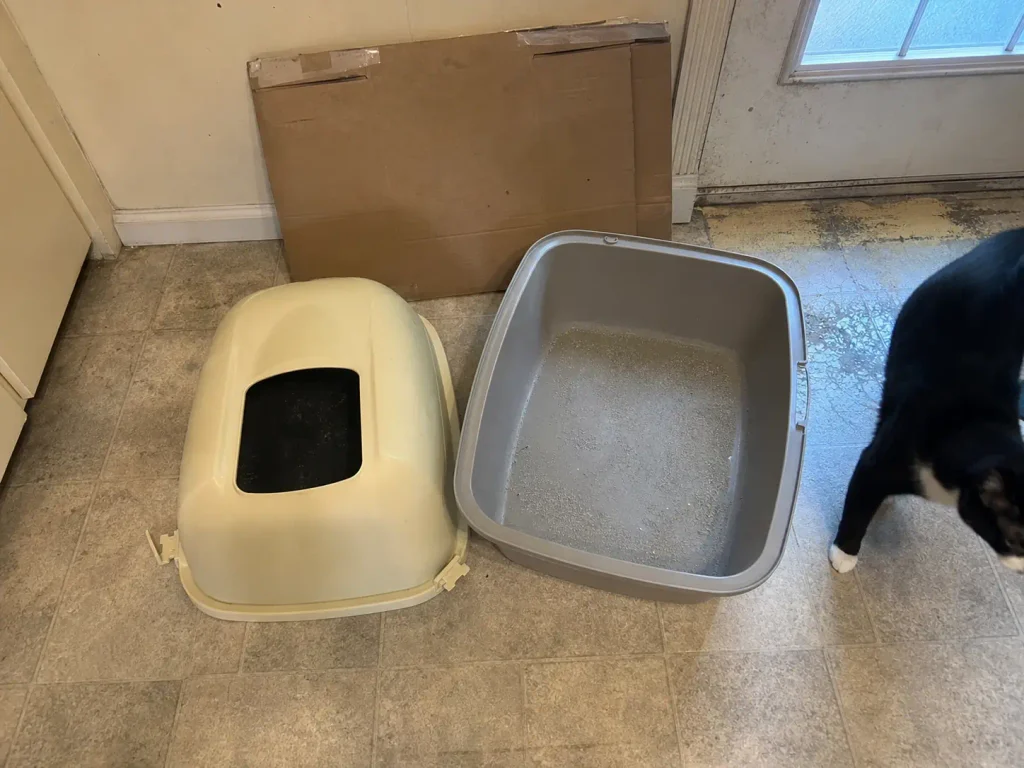
The hooded box at this tier. The lid is the seam and the seam is what fails, so at $50 you are paying extra for the single component most likely to break. A covered litter box does have a real case in some homes, with some cats, in some rooms. It is just not a case a $50 budget can execute well, because the version of covered that works costs more than the version of open that works. It is a genuine decision with genuine arguments on both sides, and the covered versus uncovered case, by the numbers deserves reading on its own terms rather than being settled by a price ceiling.
A top entry litter box or anything sold as self-cleaning under $50. The top entry litter box solves scatter by making the cat climb, which is a trade a heavy or older cat should not be asked to make, and at this price the lid it depends on is the same seam that fails everywhere else in this article.
And the self-cleaning tier. The mechanism is where the money goes in an automatic litter box: the motor, the sensors, the rake, the housing that keeps all of it aligned after ten thousand cycles. At $50 there is not enough money in the product to build that well, so the mechanism is the corner that got cut, and the mechanism is the entire reason you were buying it.
A “large” box bought on the label without the measurement. This is the single most common way this purchase goes wrong, and it is the most expensive, because it costs you the full price twice. You buy the large one, it does not fit, and then you buy the right one. Ninety seconds with a tape measure ahead of the first purchase removes the second one entirely.
Furniture-style enclosures at the bottom of the range. The cheap ones are particleboard with a laminate skin, and particleboard sitting next to a litter box lives in the one environment specifically designed to defeat it: humidity, ammonia, and the occasional miss. It swells at the base, the laminate lifts, and it cannot be scrubbed. It is also the least renter-friendly thing in this article, since it is assembled in place and does not survive disassembly twice.
And what not to skip on: the litter box mat. It is the cheapest item mentioned in this entire article and it does more for tracking than any box upgrade available under the ceiling. Every pan here throws some litter scatter. The mat is where that scatter stops, and going without one to save a few dollars undoes most of what the box was chosen for.
The Bottom Line
Measure first, shop second. Nose to tail base, times 1.5. That number decides which of the three boxes is yours, it takes ninety seconds, and it is the only thing on this page that cannot be replaced by a cheaper alternative.
At this tier, open beats hooded and no lid beats a lid. Fewer seams, less trapped smell, nothing to snap off. The budget answer and the correct answer are the same answer here, which happens rarely enough to be worth trusting when it does.
If you have two cats, buy three cheap boxes instead of one good one. The sum comes out under a single mid-range box and it solves the thing the expensive box structurally cannot, because you are buying locations rather than hardware.
Check back in three weeks, and look for one thing: is the cat turning around inside the box, or is he backing in and out? Turning means the length is right and the decision is done. Backing in and out means it is not, whatever the label said. Three weeks is also about how long a new scooping routine takes to either become automatic or quietly stop happening, so it tells you two things at once.
Then the practical next step, which is not a purchase: move the box you already own before you replace it. Different corner, two ways out, four days. If the move fixes it you saved the money, and if it does not, you now have a measurement that tells you exactly which box to buy.
Amazon’s Audible — free for 30 days
Your cat won’t let you read. Let someone read to you.
Audible is Amazon’s audiobook library — thousands of titles, read out loud, on your phone. Free for a month, plus one audiobook to keep forever.
Frequently Asked Questions
01Is a $50 litter box any good?
Yes, as long as it is the right length for your cat and has no lid. Under $50 the money buys plastic and size rather than mechanism, so an open high-sided pan at this price outlasts a hooded box at the same price because it has one less joint to come apart.
02What should I avoid in a cheap litter box?
A lid, a motor, and the word large without a measurement beside it. Cheap boxes fail at the molded seam where the plastic folds at the rim or where a lid clips on, which makes every extra joint an extra failure point.
03What size litter box does a big cat need?
Measure nose to the base of the tail and multiply by 1.5. A large cat measuring around 20 inches needs roughly 30 inches of interior length, which is the XX-large tier. Most boxes labeled large are about 19 inches and fall well short of it.
04How many litter boxes do I need for one cat?
Two. The N+1 rule from the AAFP means one more box than you have cats, and it starts counting at one cat rather than at two. A single box is a single location, and a single location can be blocked by a closed door or another animal.
05Can I just use a plastic storage bin instead?
It works for length and wall height, and it is the cheapest way to fit a big cat. The trade is the entry: you cut it yourself, and a cut edge needs sanding or edge trim before a cat steps over it every day for years.
Leave a comment