How to Set an Automatic Cat Feeder Without 5 a.m. Begging
Don't add feedings to fix begging (it backfires). How often to set an automatic cat feeder by life stage + the overnight gap that causes 4 a.m. wake-ups.

Alfredo RamsesFounder · September 15, 2026 · 16 min read

On this page7 sections
- 1How Many Meals a Day, by Life Stage
- 2Meal Count and Portion Size Are the Same Setting
- 3Why More Feedings Can Make the Begging Worse
- 4The Gap That Causes the 4 a.m. Wake-Up
- 5Setting the Schedule When the Feeder Lives in the Room You Sleep In
- 6The Schedule You Should Actually Set
- 7Frequently Asked Questions
The feeder is programmed. It dispenses on time, every time, exactly the amount you told it to. And your cat is still standing on your ribs at 4:40 in the morning, yelling into your face.
Deciding how often to set an automatic cat feeder is the easy half of the question, and it is the half every article answers. The interval between those meals and the size of each one are what actually decide whether the schedule holds. Below: how many meals your cat’s age calls for, how to turn a daily total into a portion, why adding feedings often makes the begging louder, how to close the gap that produces the pre-dawn wake-up, and what changes when the machine lives in the same room you sleep in.
Quick Answer
Set the meal count by your cat’s life stage, then divide the daily food total by that number to get the portion.
- Kittens under 6 months: 3 to 4 meals a day
- Kittens 6 to 12 months: 2 to 3 meals a day
- Adults 1 to 7 years: 2 to 3 meals a day
- Seniors 7 years and up: 2 to 4 smaller meals a day
- The daily total gets divided across that count, never multiplied by it
How Many Meals a Day, by Life Stage
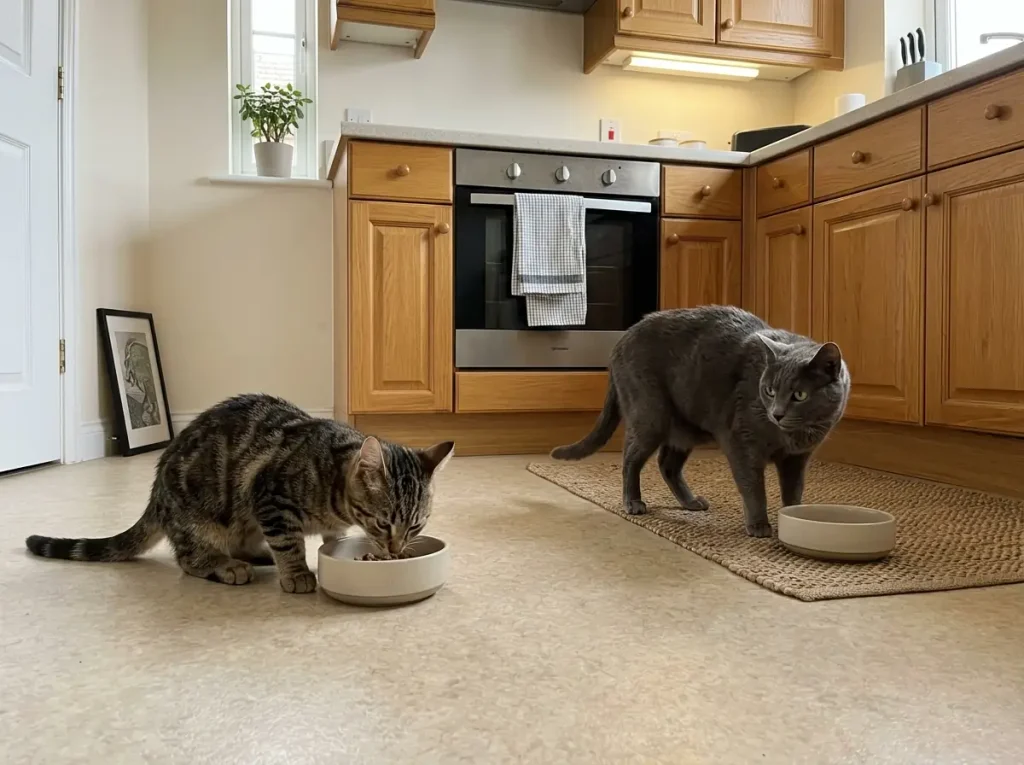
This is the number you came here for, so here it is before anything else. Kittens under six months eat three to four times a day, because a stomach that size cannot hold what a growing kitten burns. From six to twelve months that drops to two or three.
Healthy adults between one and seven years want at least two, and most do better on three. Seniors are the split decision, and the range widens to two through four smaller meals. These counts assume dry food, which is what a programmable feeder dispenses; wet food runs on a different clock and a different machine.
- Kitten, under 6 months — 3 to 4 meals. High energy demand, small stomach capacity, no flexibility here.
- Kitten, 6 to 12 months — 2 to 3 meals. Growth is slowing; the count comes down before the portion does.
- Adult, 1 to 7 years — at least 2, and 3 is better if your day allows it.
- Senior, 7 years and up — 2 to 4 smaller meals, decided by the individual cat rather than the birthday.
Those brackets are not blog convention. They map onto the AAHA and AAFP feline life stage guidelines, which split a cat’s life into kitten up to one year, young adult one to six, mature adult seven to ten, and senior from ten on. It is worth knowing that the buckets came from somewhere clinical, because the ranges inside them are where the disagreement lives.
Seniors are where sources openly contradict each other. One camp says fewer and larger meals, because an older digestive system does better with fewer transitions. The other says lighter and more frequent, because an older cat eats less at a sitting. Both are right, just about different cats.
The deciding factors are digestion, metabolism and current weight, not the number of birthdays. A senior who leaves food in the bowl needs smaller and more often. A senior who inhales everything and is gaining needs fewer and measured.
And the community answer is blunter than the guideline answer, which is usually a sign it is worth hearing. Ask in a cat food forum and the reply that comes back is some version of three to four meals a day, and stop obsessing about dawn and dusk. That is closer to correct than it sounds. The exact clock time matters far less than the interval spacing between the times you pick, which is the entire subject of the fourth section below.
There is a reason to set any schedule at all, and it is not human convenience. A free-living cat is an obligate carnivore who eats somewhere between twelve and twenty small meals across a day, hunting in short cycles.
Two large bowl-fulls is the shape that suits the person, not the animal, and a bowl topped up whenever someone walks past is the shortest road to overeating. Scheduled feeding on a machine is the closest a household gets to splitting the difference. If you are still deciding which machine to buy, the full breakdown of feeder types, capacity and power covers the purchase side that this article assumes you have already made.
Meal Count and Portion Size Are the Same Setting
Open any feeder app and you will find two controls that look completely independent: how many times a day, and how much per dispense. They sit on different screens. They have different icons. They are the same dial, and treating them as two is the single most common way a correct-looking schedule quietly ruins a cat’s weight.
Here is the arithmetic, worked all the way through, because nobody publishes it as an actual example. A healthy adult indoor cat runs at roughly 20 kcal per pound of ideal body weight per day. That word ideal is doing real work: it means the weight the cat should be, not the weight on the scale this morning. A ten-pound cat lands near 200 kcal a day.
That number is the daily total, and it never changes because you changed the meal count. Four meals means four portions of about 50 kcal. Two meals means two portions of about 100. Same food, different packaging.
Run it once more with bigger numbers so the pattern is unmistakable. A cat on 360 kcal a day, fed four times, gets about 90 kcal per dispense.
Not 360 four times. It sounds obvious written down like that, and people do it anyway, because the app asked “how many portions?” and then separately asked “how big is a portion?” and never connected the two out loud.
APOP’s daily feeding calculator will give you the daily total if you would rather not do the math, and underneath it sits a real formula: resting energy requirement equals 70 times body weight in kilograms to the power of 0.75, multiplied by an activity factor of roughly 1.0 for a sedentary cat, 1.2 for a typical indoor one, and 1.4 for an active one. Most people will never run that by hand. You should still know the number you were handed came from somewhere.
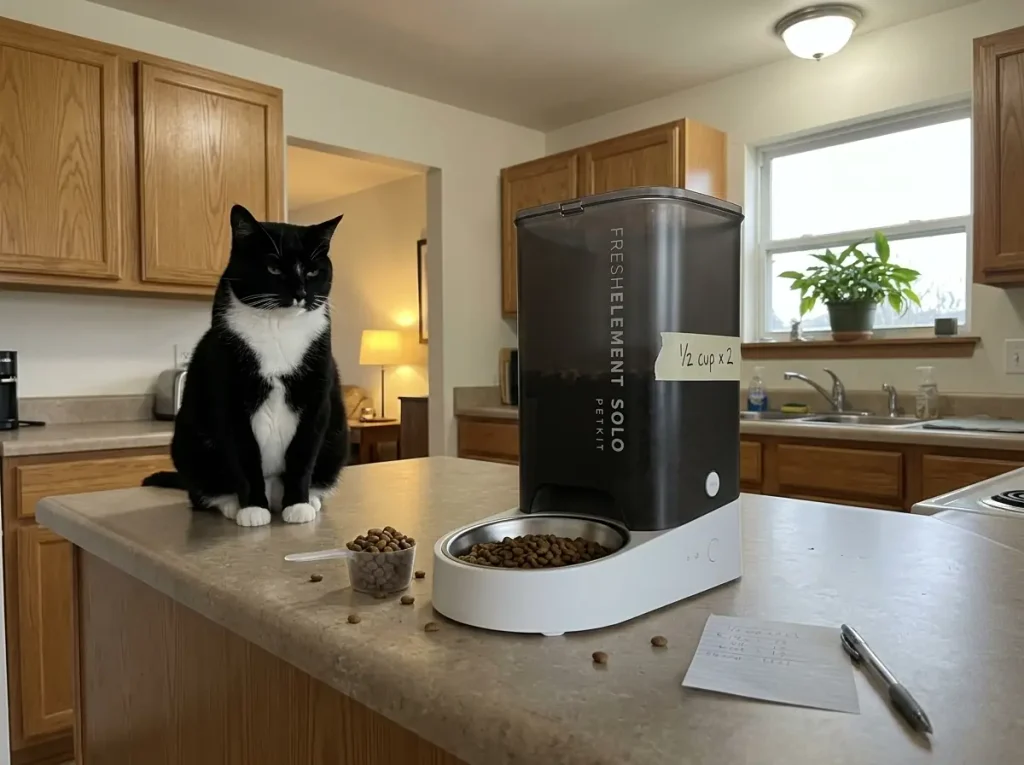
Write the daily total in grams or kcal on a piece of tape and stick it to the hopper. Every future change is to that number divided by the meal count, not to whatever the app happens to be showing. The tape outlives your memory of what you set in March.
Where the machine enters the picture is granularity. A feeder whose portion increments are coarse forces you to round, and rounding upward four times a day is how a daily total drifts fifteen percent over a month without anyone touching a setting. An app-controlled feeder with fine increments gives you somewhere to put the remainder, down to a few pieces of kibble.
The PETKIT Automatic Cat Feeder is the shape of the thing: a 3L hopper, small enough to sit on a counter in a studio without an installation, with increments you set in the app rather than by turning a physical wheel to the nearest notch. It is the example, not the prescription. The catch that applies to every WiFi feeder in this class is the same one: the schedule lives partly on your router, and a network that drops takes the app with it even when the machine keeps dispensing on its last known settings.
What actually moves over a cat’s life is the daily total, not the feeding frequency. Activity level is the usual reason it moves: a low-activity cat comes down maybe ten to fifteen percent, a high-activity one goes up by about the same, and any weight management plan from your vet lands on that number too.
The meal count stays where the life stage put it, and you adjust the portion to match the new total. Change the total, redo the division. That is the whole maintenance routine.
The failure people report most often is the graduation, and it is worth naming because it happens silently. The kitten turns one, the owner dutifully drops the meal count from four to two, and nobody increases the per-meal portion to compensate. The cat is now on half rations.
Nothing looks wrong in the app, the machine dispenses reliably, and the weight loss takes a month to become visible. The meal-count change reads like the whole job at that milestone. It is the smaller half of it.
One line here and then back to the machine: an appetite or weight change your schedule does not explain is a vet visit, not a dial. Everything in this article assumes a cat who is otherwise well.
Why More Feedings Can Make the Begging Worse
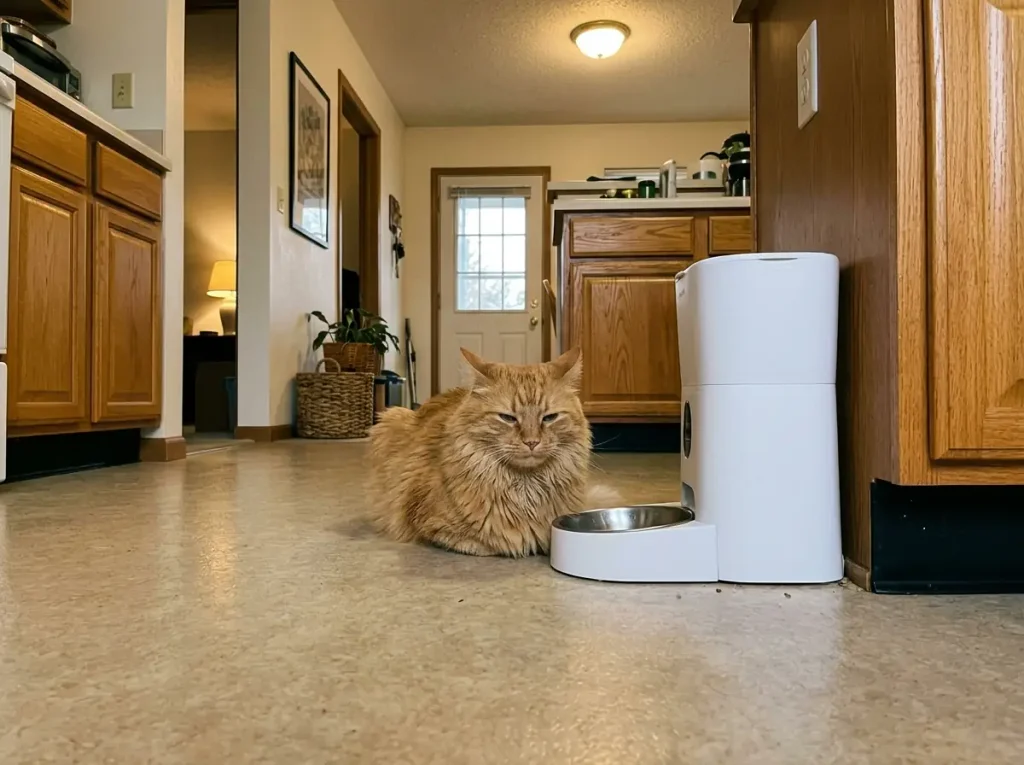
Somebody whose cat begs does the intuitive thing. They go into the app and take the schedule from three meals to six, reasoning that a cat fed more often has less to complain about. The begging gets louder. That result runs against what every source implies, and it has a mechanical reason that nobody states.
A cat’s stomach empties within a few hours of a meal, and hunger signaling starts up around the eight to ten hour mark. That gives you the outer edge. What it does not give you is the inner edge, which is that a portion has to be big enough to register as a meal.
Six tiny dispenses across a waking day can leave a cat mildly hungry in the gap between each one and the next, which is six separate opportunities to be unsatisfied instead of three. Same daily total. Worse shape.
So the fix for begging between meals is usually the opposite of the instinct: a longer interval with a slightly bigger portion. Not more feedings. You are not trying to minimize the time your cat spends hungry, which is impossible anyway. You are trying to make each meal substantial enough that the interval after it is quiet.
And the cat is reading the situation correctly, which is the part worth sitting with. Six small dispenses teach a cat that this machine gives food often. A machine that gives food often is worth sitting in front of. He is not being greedy or pushy or manipulative; he has run a very short experiment on your schedule and drawn the right conclusion from it.
The begging is accurate feedback about the interval you set.
This is also the clearest place in the whole subject where what the human wants and what the cat gets pull apart. More feedings feels generous. It reads as attentiveness, and it makes the person setting the app feel better about leaving for nine hours. What the cat actually receives from it is a shorter satisfying window and a standing reason to camp by the hopper.
The generous-feeling choice and the good choice point in different directions, and the app will not tell you that.
Change one thing and hold it for a full week. Adjusting the meal count and the portion in the same evening means the next seven days tell you nothing about which one did what.
One more thing to expect, and it catches nearly everyone: the begging gets worse before it gets better. Behavior people call it an extinction burst, and when a feeding schedule changes it usually runs three to seven days. A cat who has been rewarded at a certain hour will push harder at that hour once the reward stops, on the reasonable theory that more effort might restore it. Someone who abandons the new schedule on day four has quit during the loudest part and concluded the schedule failed.
It did not fail. It was working exactly as it looks when it is working.
The Gap That Causes the 4 a.m. Wake-Up

You have done all of it right. The meal count matches the life stage, the portions divide out of a correct daily total, and you are still awake at 4:40 with a cat chewing your hair. The daily total is not the problem. The problem is where the longest gap of the day happens to fall.
Look at your schedule as intervals rather than as times. In almost every household the overnight gap is the longest one by a wide margin, because the last feeding lands in the evening when you are still up and the first one lands whenever you get out of bed. If that gap runs past the eight-to-ten hour mark where hunger signaling starts, the cat gets loud, and the correctness of the daily total is completely irrelevant to him.
He is not commenting on the total. He is commenting on the interval.
The method works on any feeder, and it takes about two minutes. Count backwards from the hour you actually wake up, not the hour you intend to. Count forwards from the last hour you are reliably awake at night. The rule is simply that the overnight gap should not be dramatically longer than the daytime gaps.
Run the arithmetic on the most common schedule there is.
Two meals at 7 a.m. and 6 p.m. gives you an eleven-hour daytime gap and a thirteen-hour overnight one. Four meals at 7 a.m., noon, 5 p.m. and a small one around 10:30 p.m. brings the overnight gap down to about eight and a half hours, and the daytime gaps sit at five, five, and five and a half.
Same food. Same daily total. No dawn shift. That last small dispense before bed is doing almost all of the work.
Which points at the free fix, and it comes before any purchase. Moving the last dispense of the day later costs nothing, takes thirty seconds in an app, and for most households it is the entire solution. No new machine, no extra food, no additional feeding. Just the same food arranged differently across the clock.
Try that before you buy anything, including before you decide the feeder itself was a mistake. If you are second-guessing the machine rather than the schedule, whether a feeder is the right answer for your household at all is a separate question with a separate answer.
A small late dispense near your own bedtime buys more sleep than the same amount of food added to breakfast. It is the gap that wakes the cat, not the total.
Retraining a cat who is already locked onto 4:40 works differently from setting a schedule from scratch, and it is slower than anyone wants. Nudge the first feeding of the day ten to fifteen minutes later every few days. Not every day, and never in one jump. Move it an hour overnight and you buy yourself a week of noise, because the expectation was built over months and it unwinds on roughly the same kind of timescale.
Fifteen minutes every third day gets you an hour in under two weeks, quietly.
A single cat makes this arithmetic simple. In a multi-cat household the overnight gap belongs to whichever one wakes first.
That is not a compromise you can average out; the schedule has to satisfy the earlier riser, and the later riser will simply eat when food appears. Beyond that, feeding two cats from one machine turns into a different problem entirely, about who eats whose portion, and it belongs to the multi-cat feeder article rather than this one. The same tension shows up at the bowl, where two cats and one feeding station is a question of stations rather than timing.
Setting the Schedule When the Feeder Lives in the Room You Sleep In
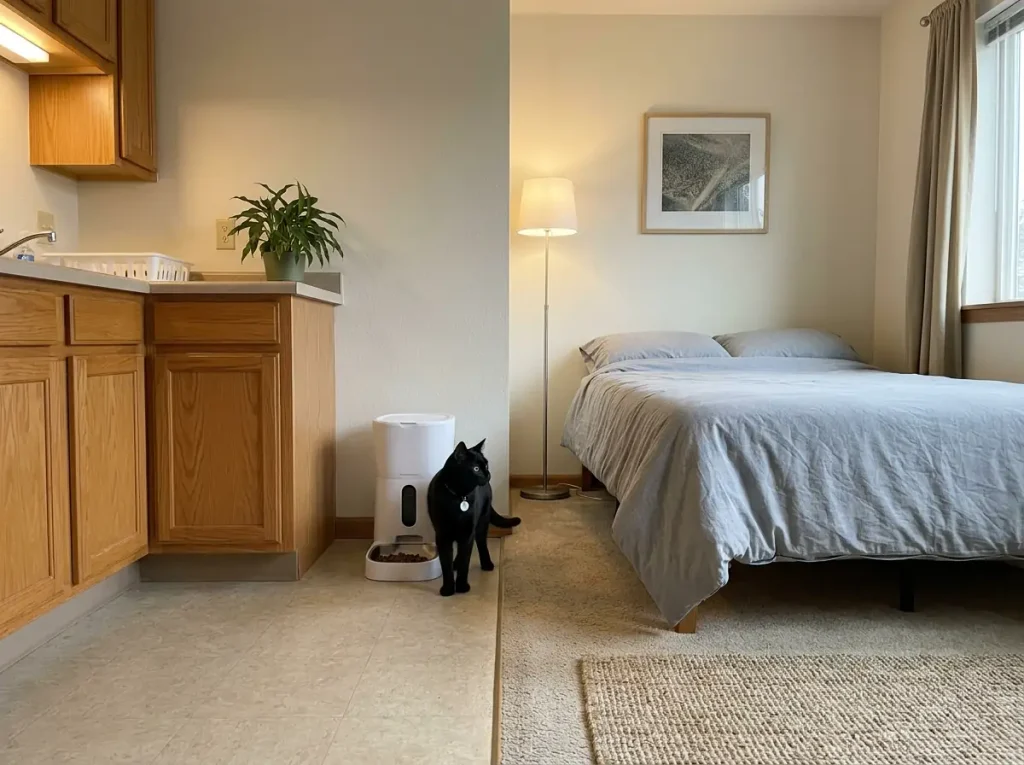
Every article on this subject optimizes for feline biology in a house with a spare room. In a studio or a one-bedroom, six dispenses a day means six click-whirrs happening a few steps from the bed or the desk, and that changes the answer. Nobody writes this part down, so here it is.
The trade-off, stated plainly: fewer and larger meals is the noise fix, and it costs you a little against the biological ideal. For a healthy adult cat that is usually a trade worth making, because the difference between three meals and five is small for him and enormous for you. For a kitten it is not worth making. A kitten’s meal count is a growth requirement rather than a preference, and if the machine is too loud for the room, the machine moves, not the schedule.
The dispense that matters most in a small apartment is the last one of the night, and the fix is free. Set it before you go to bed instead of after. A 10:30 p.m. dispense while you are still reading is silent as far as your sleep is concerned.
The identical dispense at 1 a.m. is the loudest thing in a 400-square-foot apartment. Same food, same schedule shape, and the only variable is whether you are conscious when the motor runs.
Something else happens in one room that does not happen in a house, and it explains why frequency rather than volume is what makes a feeder feel loud in a small space. Cats learn the sound before they learn the clock. Most feeders make a short pre-dispense noise, a whirr or a click as the auger engages, and within about two days that becomes a countdown the cat can hear. He gets up and goes to sit in front of the machine, which means every dispense is now a small event with an audience, in the room you are in.
Five of those a day in one room is not five quiet mechanical noises. It is five occasions.
Then there is the constraint that decides everything and that no biology-first article accounts for: the feeder goes where the outlet is. In a studio the outlet is rarely far from the bed, and a rental gives you no say in where the outlets went. Battery-backup models buy you some freedom on placement, but a machine that runs on battery alone still has to be charged from somewhere.
Schedule around where the machine can actually stand rather than pretending the placement is a free choice. That is the honest version of this problem, and a floor plan is not negotiable.
Three meals in a studio usually beats five. The cat adapts to the longer interval inside a week. You never adapt to the 2 a.m. whirr.
The Schedule You Should Actually Set
Three things to take out of this and act on tonight.
The meal count comes from your cat’s life stage, and the portion comes from the daily total divided by that count. Those are one setting wearing two costumes, and changing either one without checking the other is how a cat ends up on half rations or double.
If the begging is at dawn, the fix is the overnight gap, not the daily total. Move the last dispense later. It is free, it takes thirty seconds, and for most households it is the whole answer.
More feedings is not a stronger version of the same setting. A longer interval with a bigger portion usually beats six small ones that never quite land, and adding dispenses to a begging problem tends to make the machine more interesting rather than less.
Check back in three weeks. That is long enough for the cat to have settled past the extinction burst and long enough for your own discipline about the schedule to have started slipping, which is the more likely failure of the two. Two things to look at: has the dawn begging actually stopped, and is the cat’s weight steady on the same daily total.
Tonight, move the last dispense of the day ninety minutes later. Change nothing else. If the 4 a.m. wake-up stops, you just solved it for free.
Amazon’s Audible — free for 30 days
Your cat won’t let you read. Let someone read to you.
Audible is Amazon’s audiobook library — thousands of titles, read out loud, on your phone. Free for a month, plus one audiobook to keep forever.
Frequently Asked Questions
01Can I leave my cat alone for 2 days with an automatic feeder?
For a healthy adult cat, two days sits within what a working feeder covers, provided water is handled separately and someone can check in if the machine jams. Keep the same meal count and portions rather than loading extra food to be safe.
02Do vets recommend automatic cat feeders?
The consistency is the part that gets recommended: measured portions at set times beat a bowl topped up whenever someone walks past. Free feeding is a well-documented driver of feline obesity. The machine is not the point, the portion control is.
03How many days can an automatic cat feeder last?
Most dry-food hoppers hold three to five days of food for one cat before a refill, and hopper capacity rather than battery is usually the limit. Wet food is a different machine entirely, and its autonomy is measured in hours rather than days.
04Is feeding my cat every 6 hours ok?
Yes. Six hours is a reasonable feeding interval and lands close to a four-meal schedule across a waking day. The number that matters more is the overnight gap, which runs longer than six hours no matter how the daytime meals are spaced.
Leave a comment