How Long Do Automatic Feeders Last Before They Jam
How long do automatic feeders last? Motorized 3-5 years, mechanical dial 8-15, gravity 2-5. Jammed augers cause 40% of all dispensing failures.

Alfredo RamsesFounder · September 21, 2026 · 19 min read


On this page8 sections
- 1How Many Years an Automatic Feeder Actually Lasts
- 2The Four Parts That Die First
- 3Why the Simplest Feeder in the House Outlives the Smartest
- 4What an Apartment Does to the Clock
- 5Jam, or Dead? A Three-Minute Triage
- 6Buying for a Long Life Instead of a Long Feature List
- 7Conclusion
- 8Frequently Asked Questions
There is a sound a feeder makes right before it quits. The motor runs half a second longer than it should, the kibble comes out short, and you notice three weeks later that your cat has started asking for food at 6 p.m. again. Ask the internet how long an automatic feeder lasts and every answer that comes back tells you how long your cat can be left alone, which is a completely different question.
The feeder lifespan numbers do exist, publicly, in warranty tables and independent teardown comparisons. They just do not live in the articles that rank. Here is what a pet feeder is actually good for in years, which four parts do nearly all the dying, why the dumbest machine in the apartment usually outlasts the smartest one, and how to tell a fifteen-minute fix from a machine at the end of its life.
Quick Answer
A motorized automatic feeder lasts about 3 to 5 years. Cheap plastic-auger units run 1 to 3, geared mechanical dial feeders reach 8 to 15, and a gravity feeder lasts 2 to 5 limited by its plastic, not its mechanism. Warranties cluster at 1 to 2 years across every major brand.
How Many Years an Automatic Feeder Actually Lasts
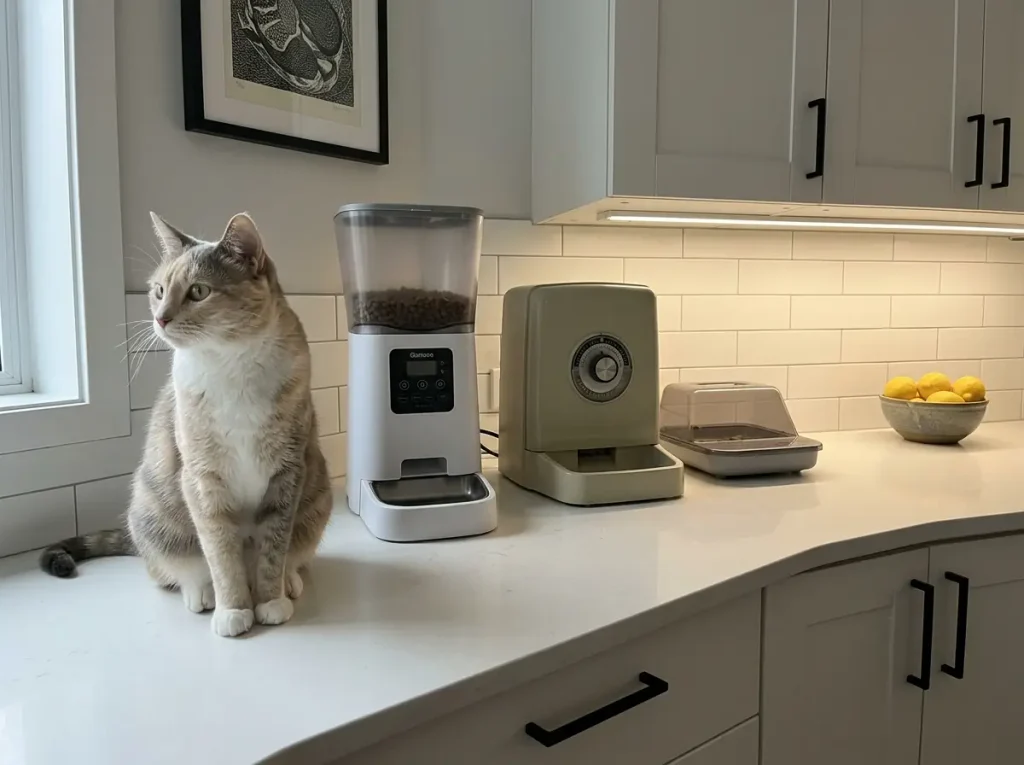
You bought a machine whose entire job is feeding a living animal while you are somewhere else, and nobody will tell you how long it can be trusted to do that. The manufacturer prints a warranty on the box and then stops talking. Every review measures portion accuracy on day one. Nothing tells you what day one thousand looks like.
So here is the spread, sorted by the thing that decides it, which is the drive mechanism rather than the brand name. A geared mechanical feeder, the kind with a dial you wind instead of an app you pair, runs 8 to 15 years. A geared programmable feeder lands at 5 to 10.
A plastic direct-drive auger feeder, which describes most of what sells on Amazon right now, gives you 3 to 5. The cheapest units on the shelf come in at 1 to 3. That is not a quality ranking so much as a parts count, and one independent durability comparison put mechanical feeders at 8 to 15 years against 3 to 5 for app-connected models using the same logic.
What the Drive Mechanism Tells You Before the Brand Does
Pick up any hopper feeder and the question that predicts its life is whether the motor turns metal gears or drives a plastic screw directly. Metal gears distribute load.
A direct-drive plastic auger takes the full torque of the motor every single dispense, which on a four-meal feeding schedule is roughly 1,460 cycles a year, every one of them scraping dry food against a plastic thread. Nothing about that is dramatic. It is just arithmetic with a slow answer.
Why the Warranty Is the Only Honest Number on the Box
A feeder warranty is a business decision, not a durability statement, and the gap runs in both directions. Cat Mate puts two years on a machine that can still be dispensing in year twelve, which badly undersells it. PETLIBRO’s 12-to-18-month coverage lands almost exactly on the month its portion accuracy starts drifting, which is either honest or accidental and works out the same either way.
But the cluster is the useful part. Petkit around a year, Whisker around a year, Petlibro roughly two on its newer lines, Pawsync one year that becomes two if you register it. Every major brand lands between one and two years, and that is the only durability figure all of them are willing to publish about themselves. Read it as the floor, not the ceiling.
Write the purchase month on a strip of masking tape and stick it inside the hopper lid. Nobody remembers when they bought a feeder, and the answer to “is this thing old or is it broken” depends entirely on that date. Ten seconds now saves you a guess two years from now.
The Portion Drift That Starts a Year Before the Failure
This is the part worth internalizing, because it is where the years number becomes something you can act on. Feeders do not stop. They shrink. On plastic-auger units, portion consistency begins measurably degrading after roughly 12 to 18 months of daily use, and what that looks like from your side of the apartment is a cat who seems hungrier than he used to be.
One honest caveat on all of the ranges above: they assume a unit that survives its first month, and a meaningful number do not. The review piles are full of feeders that failed in the first weeks, one Cat Mate that broke on day eight, a Trixie whose lid stopped opening after five or six uses.
An owner whose feeder died in a week is not an outlier, they are the left tail of a distribution nobody publishes. If yours makes it past sixty days, the years numbers start applying to you. If you have not committed yet and want the case for and against running one at all, the pillar guide covers whether a feeder belongs in your household in the first place.
The Four Parts That Die First
“It stopped working” is not a diagnosis, it is a shrug, and malfunction is the word every competitor uses right before changing the subject. Four components account for nearly every automatic feeder failure, and the useful thing about them is that three announce themselves well before they quit. You just have to know what the announcement sounds like.
The auger goes first and goes most often. It is the plastic screw that pushes kibble from the hopper toward the chute, and jammed augers account for roughly 40% of all dispensing failures. Not motor burnout, not electronics. A piece of kibble wedged sideways in a plastic thread.
The Auger, and Why Kibble Size Decides Its Life
Auger feeders are built around kibble between 2 and 10mm across. Feed something larger or oddly shaped, a triangular dental piece, an oversized large-breed formula, and jams stop being an event and become a routine. The kibble in your cabinet is a spec, the same way the feeder is.
And here is the mechanism that makes it worse than it sounds. A dispenser jam is progressive, not sudden. A partial jam goes completely unnoticed because the feeder still dispenses, just less.
The motor pushes harder against the obstruction every cycle for days. By the time anyone looks at the thing and says “it is not dispensing,” the mechanism has been straining all week and the motor has taken damage that clearing the jam will not undo.
A feeder that under-portions is not being stingy, it is warning you. Once a month, catch one dispense in a bowl on a kitchen scale and compare it to the setting. A drift of more than a few grams means the auger is already dragging, and you have months of notice instead of a surprise.
Seals, Gaskets and the Room You Put It In
The lid seal is the second one. On covered units and on any refrigerated feeder that runs an ice pack, gasket failure shows up around 12 to 18 months, and considerably faster in a humid spot. Silicone hardens, stops sitting flush, and the hopper quietly stops being airtight.
You will not see this. You will smell it, or you will notice the kibble at the bottom of the hopper going soft. Wet food puts a different kind of stress on the seal and runs on a much shorter clock, which is its own article and its own set of rules.
What a Battery Backup Actually Protects
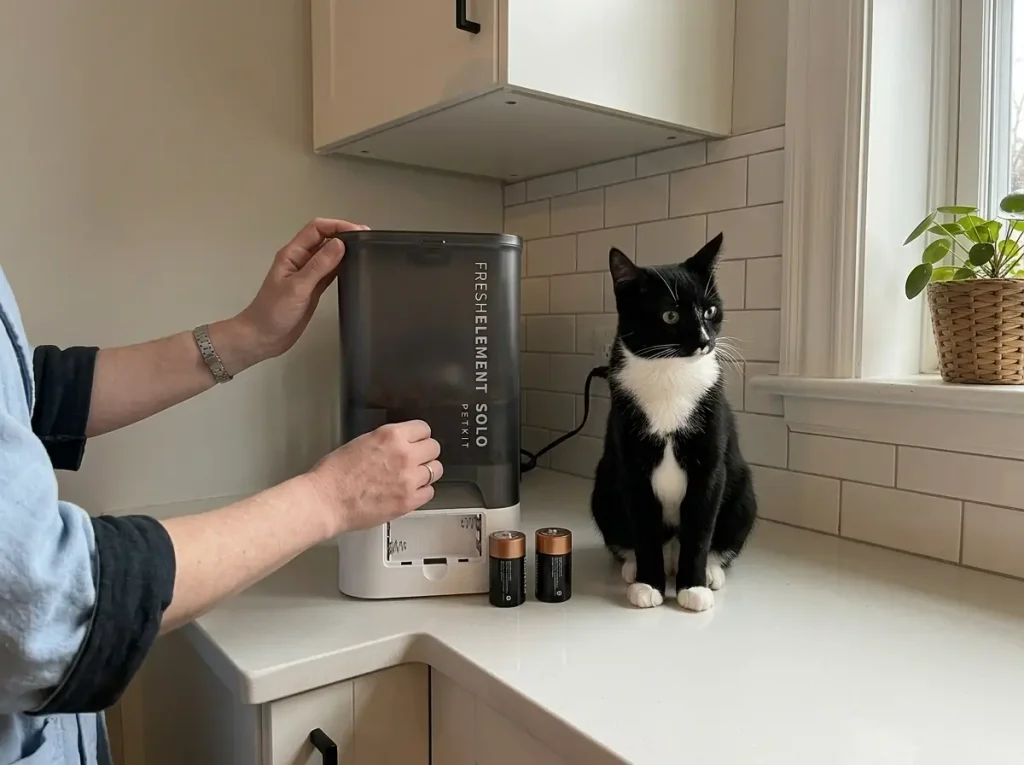
Third: the battery contacts. Corrosion in the battery tray is the documented first failure on some of the most durable-motor brands on the market, and the irony is worth saying out loud. The motor outlives the compartment that powers it. Food dust gets in, moisture gets in, and a machine whose gears are good for a decade dies of a crusted spring.
This is also where most people misunderstand what a backup is buying them. On a plug-in wi-fi connected feeder, three or four D-cell batteries hold the schedule for 3 to 7 days during an outage. They do not run the dispensing motor. The clock survives, the meal does not.
On a mechanical spring timer, the opposite is true, the dispensing runs off the wound spring and could not care less what the battery is doing. The free fix comes first here: before you travel, pull the backup cells and check they still have charge. Costs nothing, catches most of this, and almost nobody does it.
If you want one machine that covers both cases, the PETKIT Automatic Cat Feeder with 2.4G WiFi and dual power runs its 3L hopper off wall power with an onboard battery that keeps dispensing rather than just remembering, which is the specific failure this section is about. It is still an app-controlled feeder, though, with every board that implies.
Fourth and last, on a microchip feeder or an RFID feeder, the part most likely to die is not the chip reader everyone worries about. It is the small motor lifting the lid every time a cat walks up to it, which on a curious cat in a busy kitchen is a lot more cycles than the four meals you scheduled.
Why the Simplest Feeder in the House Outlives the Smartest
Somewhere in the back of a closet there is a feeder that still works. It is almost always the one with the fewest parts. The one that died had a camera in it.
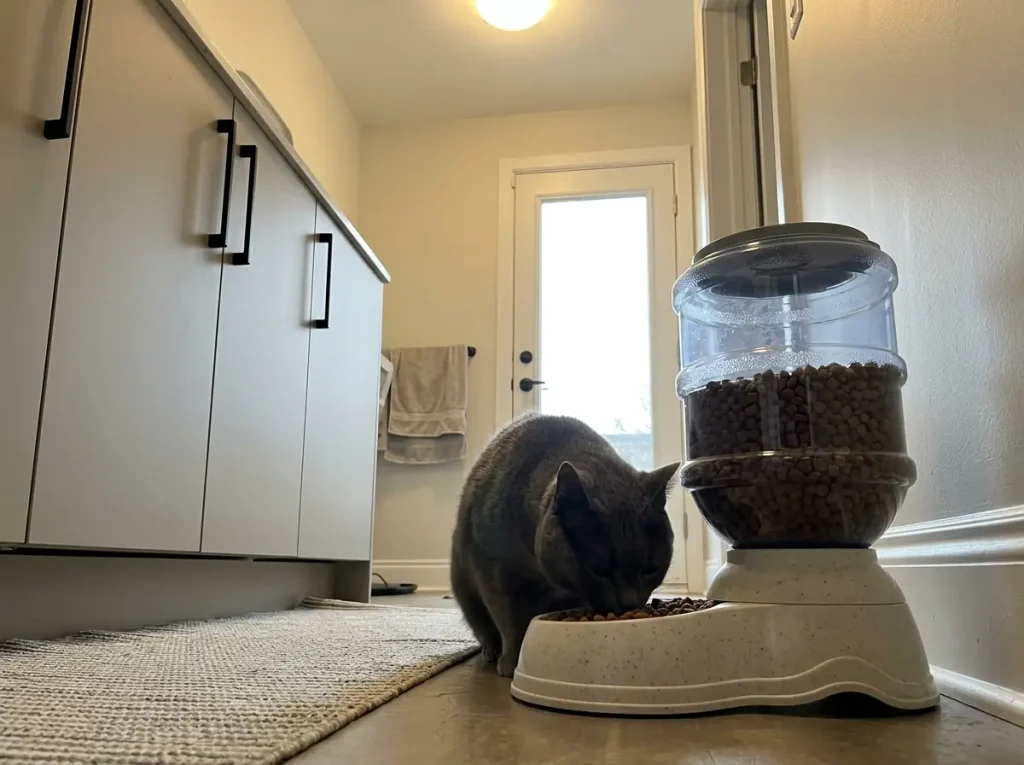
Count the failure points from the last section against a plain gravity-fed feeder and the total is zero. No motor, so no auger to jam. No lid mechanism.
No battery tray to corrode. No Wi-Fi board. Just a plastic hopper doing one job.
What is left is a hopper, a tray feeder bowl below it and gravity, and gravity has an excellent service record.
Counting the Parts That Can Fail
That is why a gravity feeder’s 2-to-5-year life is a material question rather than a mechanical one. It does not wear out, it cracks, gets brittle in sunlight, or gets stepped on. A stainless steel bowl insert pushes the number further because the thing that limits it is the plastic itself.
The Amazon Basics Gravity Pet Food Feeder in the 1-gallon size is the worked example of this whole argument, a hopper and a bowl with nothing between them that can seize. The limitation is equally blunt and needs saying in the same breath: it has no portion control at all, cannot schedule, and cannot stop a food-motivated cat from working through the entire hopper by Tuesday. It buys longevity by giving up control.
What a Gravity Feeder Buys You, and What It Costs
So the trade is real, and which side of it you want depends on your cat rather than on the machine. A free-feeding household with a cat who self-regulates gets years of reliability for nothing. A household with a cat on measured meals gets a device that actively undermines the thing they needed it for.
I used to point people toward the most-featured feeder in their budget, on the logic that you can ignore a feature you do not use. The recurring story in feeder threads changed my mind: the app-connected unit replaced twice while the dumb hopper beside it never missed. A feature you do not use is not free. It is a board, a motor or a seal that ages whether you touch it or not.
The Middle Ground Nobody Stocks Anymore
There is a category between those two that has quietly disappeared from the shelves, and it is the one that actually lasts longest. A mechanical spring-timer feeder has geared metal, a wind-up dial, and one wear part, a timer spring that gets replaced somewhere around year five to eight. That is a repair. Almost nothing else in this category is repairable at all.
Before buying anything for longevity, though, the cheapest reliability upgrade in this article is matching your kibble to your machine. Pieces between 2 and 10mm, nothing oversized, nothing oddly shaped. It costs the price of a different bag. The same arithmetic applies to a water fountain, which is a pump running every day, where the filter nobody changes does exactly what the auger nobody cleans does.
What an Apartment Does to the Clock
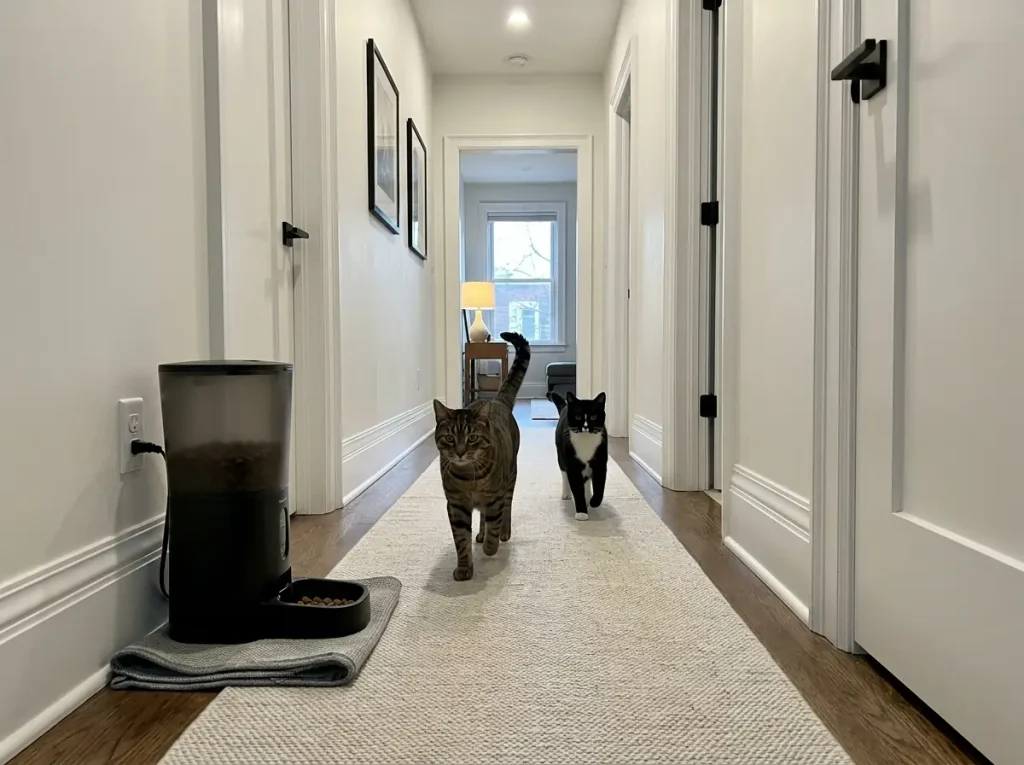
Two identical feeders bought the same week will not die the same week. Where it sits in your home decides the gap, and in a small apartment there are not many places to put it.
Humidity is the biggest lever and the least discussed. Near a stove, a kettle, or a bathroom door, the same unit that runs five years in a dry hallway starts losing its gasket and corroding its contacts at 12 to 18 months. That is not a small penalty. That is most of the machine’s life, decided by a countertop.
The Driest Corner With an Outlet
The mechanism compounds, too. Kibble in a humid hopper absorbs moisture and clumps, and clumped kibble is precisely what wedges an auger. So the damp spot is not just aging the seal, it is manufacturing the jams. The two failure modes feed each other, which is how a feeder that seemed fine in March becomes unreliable in August.
You cannot rebuild the kitchen. But counter placement is yours to change: move the feeder off the counter beside the stove and into the driest, coolest corner that still has an outlet. In a rental that move is the single largest lifespan lever available to you, and it is about as renter-friendly as a fix gets. It takes two minutes and costs nothing.
Put your palm on the wall behind where the feeder sits. If it feels even slightly damp, or warm from a fridge or a boiler on the other side, that is not the spot. Walls tell you things about a room that the room does not.
Two Cats and a Shared Hopper
A second cat changes the answer entirely, and not in the way people expect. In a multi-cat home the wear is not about food theft, it is about force. A cat bumping, pawing, or shouldering a shared unit applies mechanical stress to the lid seal and the hopper seam, which are two of the four points already documented as the first to go.
A feeder knocked off a counter does more damage in one afternoon than a year of ordinary dispensing. He is not being destructive about it, either. A cat who shoves food around has a reason for it, and the feeder takes the impact that a bowl would have absorbed harmlessly.
Resource guarding at a shared hopper has a fix that protects the machine and lowers the tension at the same time: two feeding stations in two rooms, so neither cat has to work past the other to eat.
Dust, Hair and the Vents You Never Look At
The slow version of the same story is dust. Hair and kibble powder get drawn into a vented housing, settle on the board and in the tray, and hold moisture against contacts that were fine when dry. Nobody opens a feeder to look at this. A dry cloth around the vents once a month is the entire intervention.
Jam, or Dead? A Three-Minute Triage
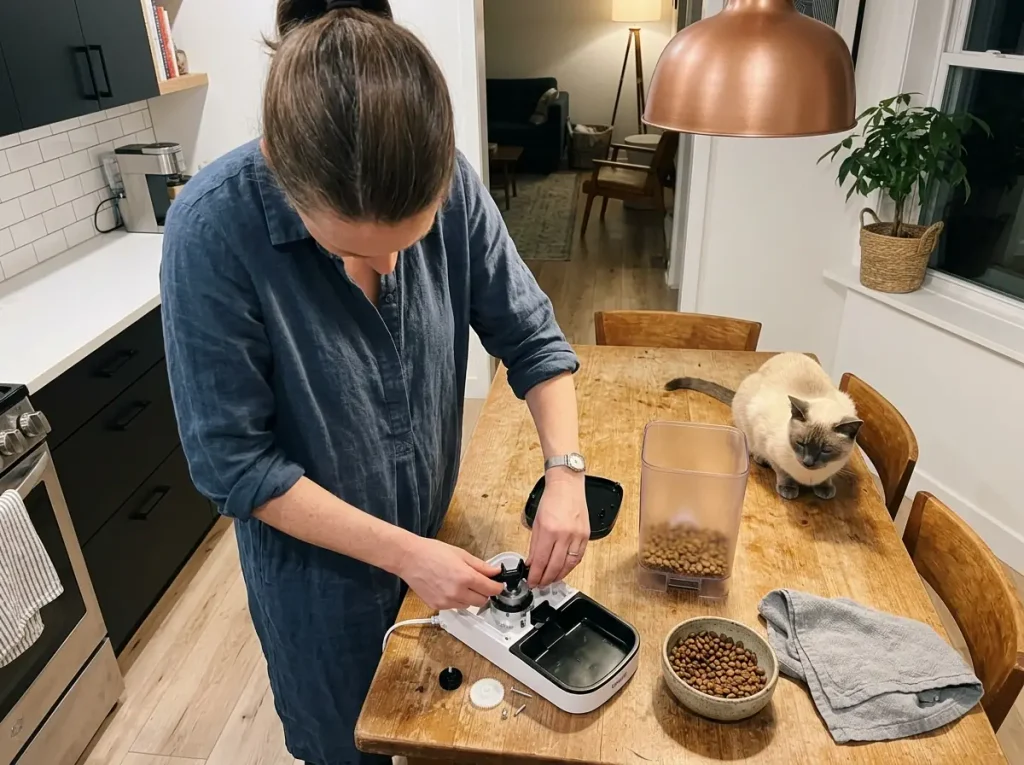
The feeder failed while you were out. Before you order a replacement, three checks settle the replace vs repair question, and most troubleshooting guides skip the third one entirely.
- Stuck auger. Fixable. Unplug it, empty the hopper completely, find and clear the wedged piece, dry any residue in the chute, and restart with smaller dry kibble. Most first failures are this and nothing else.
- Dead or corroded batteries. Fixable. Clean the contacts, fit fresh cells, then check whether the schedule survived. If the clock reset itself, the backup was already gone before the feeder was.
- Repeat jams after a proper cleaning, or portion drift past 12 to 18 months. Replace it. When it keeps jamming after maintenance, the problem is design rather than usage, and no amount of cleaning restores a worn auger.
The Fifteen-Minute Fix
Work in that order, because the first two cover the large majority of failures and cost nothing but the time. The single most common mistake is skipping the “empty the hopper completely” step. People tip out the top layer, see nothing, and put it back. The wedged piece is almost always down at the throat where the hopper narrows into the auger, which is exactly where you cannot see it with food on top.
What Cleaning Cannot Undo
Here is the honest cutoff, and it is the reason the triage has a third branch. A motor that has spent weeks straining against a partial jam does not recover once you clear it. The gears have already worn under a load they were never specified for. Cleaning that feeder buys you days, sometimes a few weeks, and then you are back where you were with the replacement still unordered.
Portion drift is the other one-way street. When a machine has been dispensing short for months, the auger thread has worn down and a wide thread cannot push a precise volume no matter how clean it is.
When to Stop Repairing It
One line that is not ours, and it matters more than the hardware. If the feeder failed while you were away and your cat has not eaten, or has gone off food since, that is a call to a vet rather than a question about a machine. Cats do not tolerate missed meals the way dogs do. Make that call first, then come back and deal with the feeder, which will still be broken when you get to it.
Keep the old feeder for a week after the new one arrives, in a cabinet, doing nothing. If the replacement fails the same way in the same spot, the problem was never the feeder, and you have a working backup while you figure out what the spot is doing to it.
Buying for a Long Life Instead of a Long Feature List
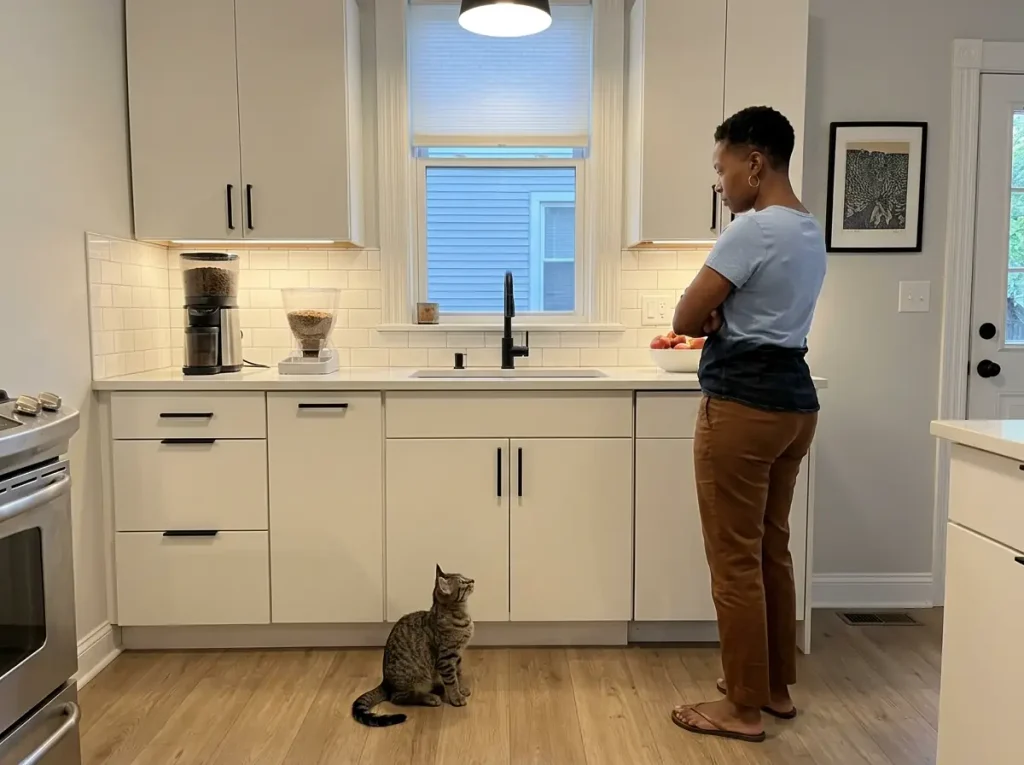
Every feature on the box is another part that can fail. That is not an argument for buying the cheapest thing on the shelf. It is an argument for knowing which features you are genuinely going to use, because you are paying for the others twice, once at checkout and once when they break. If you are earlier in this than you thought and whether a feeder suits your household at all is a separate question, start there instead.
The Four Questions to Ask Before the Feature List
In order, and none of them is about the app. How many moving parts does it have. Do the hopper and bowl come apart for cleaning without tools.
Is the battery tray sealed away from the food path, or does dust reach the contacts. And does the maker sell replacement parts at all, because a machine with no spares is disposable by design whatever the warranty says.
Meal count belongs in that list too, and it is the one nobody connects. How many meals you set changes how hard the auger works, because six small dispenses a day is half again the cycles of four. That is a scheduling decision with a hardware consequence.
A camera and an app are genuinely useful to some households, and pretending otherwise would be dishonest. They are also two more boards that can die on a schedule unrelated to the mechanism.
As VCA Animal Hospitals notes, automatic feeders run from around $55 to $300 depending on how many moving parts they add, which is the clearest confirmation you will find that price tracks complexity here. You are not buying quality as you climb that range. You are buying parts.
What You Already Own, and Whether It Needs Replacing
Before any of that: the feeder currently on your counter probably has years left in it if the kibble fits the auger and the spot is dry. Most of this article is maintenance rather than shopping. Move it, match the kibble, weigh a dispense, check the backup cells. If it stops jamming, you have your answer and you have not spent anything.
Matching the Hopper to How Your Cats Eat
If you do need to buy, the two picks below were chosen for simplicity rather than features. For a household that free-feeds, the Amazon Basics Gravity Pet Food Feeder holds a gallon and has nothing in it that can seize, which is the whole case for it. For a household that needs measured meals and cannot risk a power cut erasing the schedule, the PETKIT dual-power feeder and its 3L hopper removes the failure mode this article documents most often. Its cost is stated plainly: it has far more parts than a gravity hopper, and every one of them is a thing that can eventually fail.
A 1-gallon gravity hopper and a 3L motorized hopper are not better and worse versions of the same machine. They are different machines for different feeding styles, and choosing on capacity alone is how people end up with a feeder that works perfectly and solves nothing.
Conclusion
Three things to take out of this. A motorized feeder is a 3-to-5-year machine, and the warranty cluster at one to two years is the industry saying the same thing in smaller type. Four parts do nearly all the dying, the auger, the lid seal, the battery contacts and the lid motor, and three of them warn you first in short portions and missed schedules. And fewer parts means longer life, which is why the cheapest feeder in the room is so often the one still running in year five.
Set a check-back for three months, and this is the rare topic where three months is the right number rather than the lazy one. An auger and a gasket degrade on a scale of months, not on whether a cat accepts something. When it comes around: weigh one dispense against its setting, look at the gasket for hardening, and confirm the backup batteries still hold charge.
Start by moving the feeder to the driest corner that has an outlet, and match your kibble size to the auger. If the jams stop, you just saved yourself the price of a replacement and learned something about your kitchen.
Amazon’s Audible — free for 30 days
Your cat won’t let you read. Let someone read to you.
Audible is Amazon’s audiobook library — thousands of titles, read out loud, on your phone. Free for a month, plus one audiobook to keep forever.
Frequently Asked Questions
01What are the common problems with auto feeders?
Jammed augers account for roughly 40% of dispensing failures, followed by lid seal wear, corroded battery contacts and a failing lid motor on microchip models. Nearly all of them begin as short or missed portions rather than a feeder that stops outright, so a portion drifting smaller is the earliest warning you get.
02Can I Leave My Cat Alone for 2 Days With an Automatic Feeder?
Two days is within what a working feeder handles, but the feeder is not the only thing a cat needs. Water, a clean litter box and someone checking in matter as much. Test the exact schedule while you are home first, because a jam you would catch in an hour becomes a missed day when nobody is there.
03Does Cat Food Get Stale in an Automatic Feeder?
Dry kibble holds up for weeks in a sealed hopper, but humidity is what ruins it. Moisture makes kibble clump, and clumped kibble is the main cause of auger jams. In a damp kitchen, fill the hopper with less food more often rather than loading it to the top.
04How Do I Know if My Feeder Is Jammed or Broken?
Unplug it, empty the hopper and look for a wedged piece of kibble in the auger. If clearing it and restarting with smaller dry kibble fixes the problem, it was a jam. If it jams again within days of a proper cleaning, or portions have been drifting for months, the mechanism is worn and cleaning will not bring it back.
Leave a comment