Automatic Feeder Wet Food Rules, and the 2-Hour Clock
Wet food in an automatic feeder has a clock [2 hours uncooled, 8-24 on ice packs, days only with active cooling] + why two cats change the answer.

Alfredo RamsesFounder · September 21, 2026 · 19 min read

On this page8 sections
You are standing in the kitchen at seven in the morning, holding a pouch of wet food and looking at the feeder you bought for kibble, doing the math on whether you can just put one inside the other. Every product page in this category says the same two words, “keeps fresh,” and not one of them says for how long or against what. The honest answer to automatic feeder wet food questions has almost nothing to do with the brand and everything to do with a clock that food-safety agencies published decades ago and nobody in this niche bothers to quote. Here is that number, where it comes from, and which two machines can actually hold it.
Quick Answer
Only dish-style feeders work with wet food: a sealed rotating tray with ice packs, or an actively cooled dish. A dry hopper with an auger cannot do it at all. The limit is the clock, not the machine: about two hours uncooled, most of a day on ice packs, days only with active cooling.
Why a Dry-Food Feeder Can’t Do This
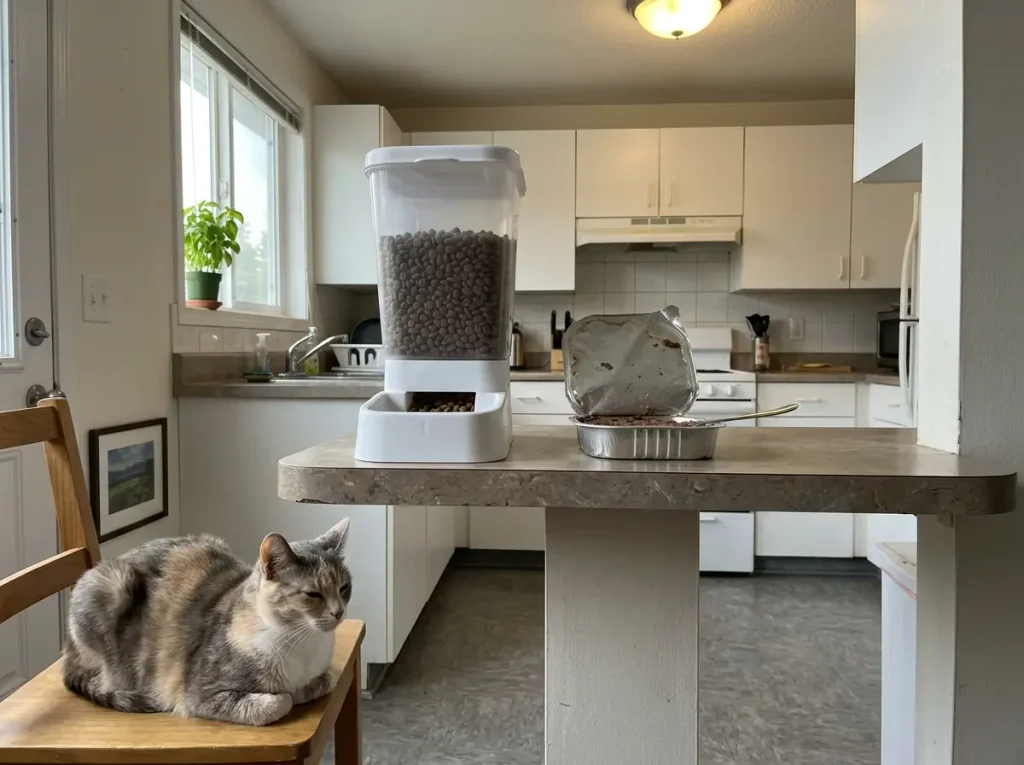
The feeder already on your counter was almost certainly built for kibble, and kibble feeders all work the same way: a screw turns inside a chute and walks dry pellets down toward a bowl. Nothing in that food path is sealed, because dry food has never needed a seal. So when the cat switches to wet food and the obvious thought arrives, the machine will physically accept the wet food and appear to work, which is the problem. Before you go any further down this road, the Feeders pillar covers whether an automatic feeder earns its place in your kitchen at all, and this article assumes you have already decided that it does.
Wet food does not fall. It clings. A spoonful pressed into a hopper coats the auger on its way down and leaves a film on the screw threads, and that film does two things at once: it dries into a varnish, and it swells whatever kibble dust was already sitting in the corners of the chute. Neither of those is visible from the outside. You close the lid, the motor sounds normal, and the failure starts quietly.
Then it arrives. Not on day one, which is what makes this expensive. Reports of forced-wet-food auger jams cluster around the two-to-four-month mark, and the giveaway is that the feeder does not stop. It keeps turning. It just moves less food each cycle, so the cat gets short-fed while every light on the unit says everything is fine, and nobody catches it until the bag of food lasts suspiciously long or the cat starts getting loud at odd hours.
The mental model behind all of this is a phrase that gets used approvingly in dry-feeder threads and critically in wet-food ones: set and forget. That is a completely reasonable way to think about a hopper full of kibble. It is the wrong way to think about a machine that touches wet protein, and carrying it across is the reason the jam goes unnoticed for months. Wet food feeders are the opposite of set-and-forget, which is the whole of the next few sections.
So the free move comes first. If you own a hopper feeder and your cat eats wet, the feeder is not broken and you do not need to replace it with anything. It is simply the wrong tool. Keep it for a dry topper, hand it to someone whose cat eats kibble, or put it in the closet. Buy nothing yet.
If you already ran wet food through a hopper feeder once, do not just rinse it. Take the auger out and run a finger along the screw threads before you use it for dry food again. Dried residue there is what catches the next batch of kibble, and it comes off with a brush now and with a screwdriver later.
The Two-Hour Clock, and Where It Comes From
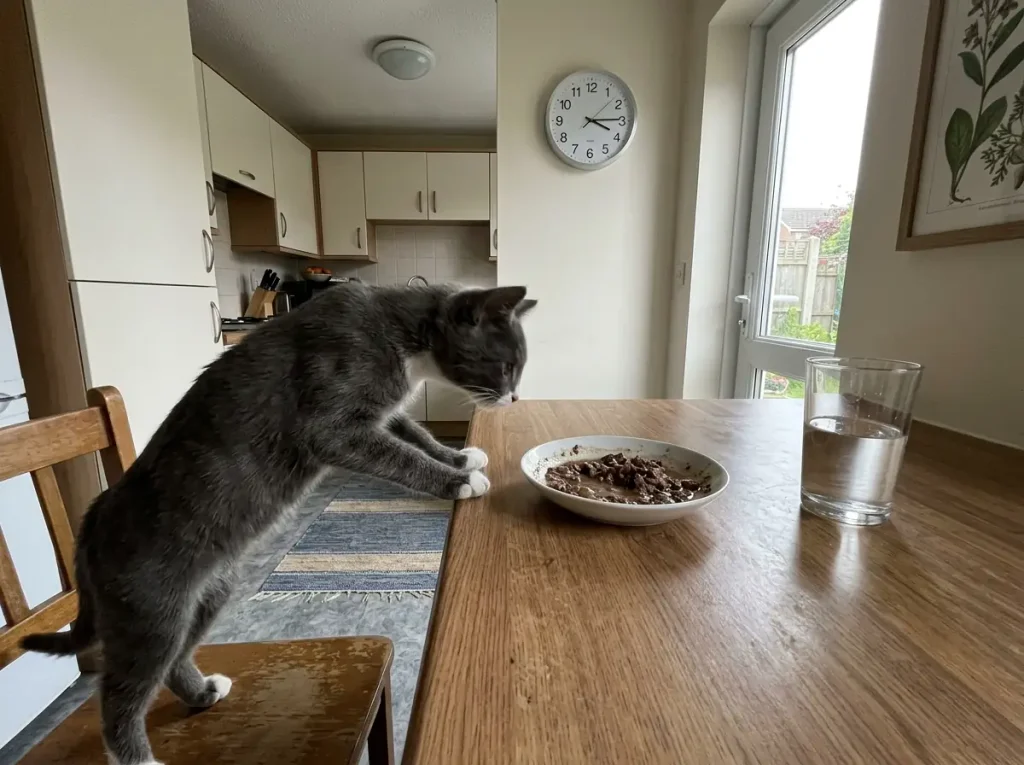
Here is the number the whole category is built around and never prints. Food-safety guidance puts the bacterial danger zone between 40°F and 140°F, and inside that range bacteria can double roughly every twenty minutes. That is the USDA’s 40°F to 140°F danger zone for bacterial growth, and it is not a pet-industry figure at all. It applies to a deli platter, a bowl of chili, and a tray of wet cat food equally, because the bacteria have no idea who the protein is for.
The rule that falls out of it: perishable food should not sit out more than two hours at room temperature, or one hour if the room is above 90°F. Wet cat food is a perishable protein in an open dish, and canned food behaves exactly like the chili once the lid is off. It is not exempt, and food spoilage here is a clock rather than a smell. That is where the article title’s clock comes from, and once you have it, every “keeps food fresh” claim on every box becomes a question you can actually check.
Two hours is the ceiling for an uncooled dish, and that is the single most useful thing to understand here, because it reframes what a feeder is even for. A feeder does not make wet food safe. It buys hours against that ceiling, and the three ways of buying them are genuinely different machines.
| Type of dish | Realistic safe window | What it costs you in the kitchen |
|---|---|---|
| Uncooled dish or open tray | About 2 hours, 1 hour above 90°F | Nothing. It is a bowl on a timer. |
| Sealed tray with ice packs | Roughly 8 to 24 hours, pack and room depending | Freezer space, and remembering to refreeze |
| Actively cooled dish | Rated in days, not hours | Permanent counter space and a constant low hum |
A passive ice-pack tray buys hours by starting the food cold and letting it drift, so it holds below the bottom of the danger zone instead of climbing into it. Realistically that is 8 to 24 hours depending on the pack, the room, and how often you open the thing. An actively cooled dish is a different argument entirely: it holds a temperature continuously, which is why that category gets rated in days instead of hours.
One is a cooler. The other is a small refrigerator. Coolers warm up.
And the thing that actually breaks the number is not the machine at all, it is the re-freeze. Ice packs need a genuinely full freezer cycle before they go back in, and the failure story that repeats in feeder threads is always the same shape: a pack that went in cool rather than solid, a window that turned out shorter than the box promised, and food that had gone off by the time anyone got home. Nobody tells you how much a half-frozen pack costs you, because it depends on your freezer. So plan the pack into the routine rather than into the trip. Freeze it the night before, every time, the way you would charge a headset.
Set the very first scheduled meal for a time you would normally be home anyway, not for the moment you walk out the door. If the compartment sticks, the timer is off by an hour, or the cat cannot work out where the food came from, you find out with you standing in the room instead of from four hundred miles away.
The Two Machines That Actually Work
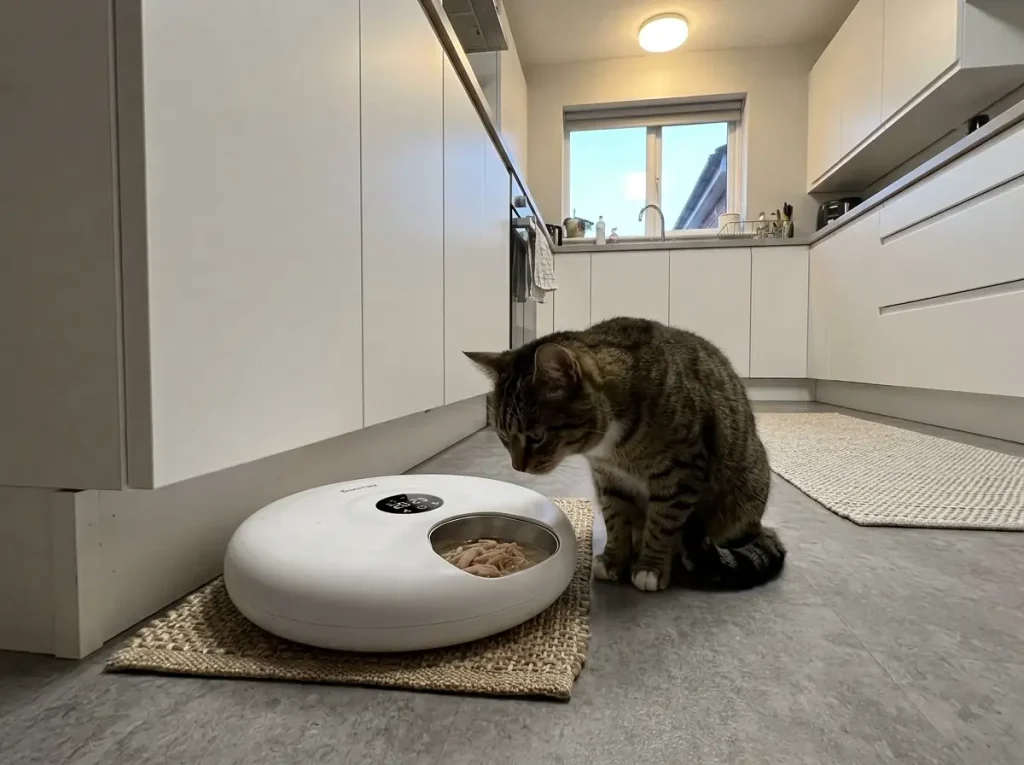
You have narrowed it to “a feeder that does wet food,” and that is still two appliances with two different answers to the only question that matters, which is how many hours you are gone.
The first is a sealed rotating tray with ice packs. It is passive: no compressor, no continuous power draw, nothing running while you are out. Compartments sit under a lid and rotate open one at a time, so meal four is still sealed while meal one is being eaten, which is the entire mechanical trick that makes multi-meal wet food work without refrigeration. The second is an actively cooled dish, where a semiconductor cooling element runs continuously and the food never leaves the cold.
The dividing question is not budget. It is hours. Under a day, passive is honest. Past a day, passive is pretending, and no amount of extra ice packs changes what physics is doing to the tray while you are not there.
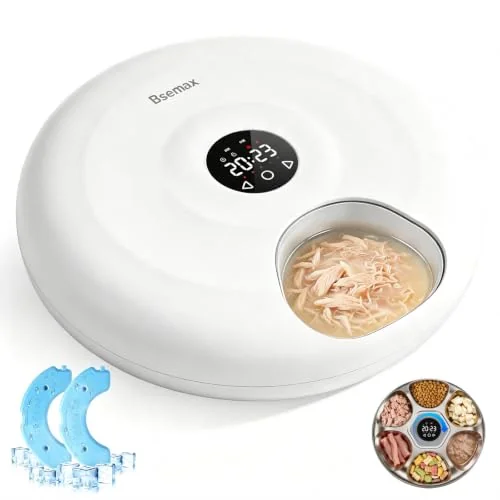
Past a day, you are in the other category. The PETLIBRO Automatic Cat Feeder for Wet Food, Refrigerated, Semiconductor Cooling, Stainless Steel Bowl is the reference point for that tier, holding three wet meals for up to three days because the cooling never stops rather than because the insulation is clever. That is the honest framing of the whole category: you are not buying a better cooler, you are buying a machine that refuses to enter the danger zone in the first place. The limitation is the one nobody puts on the box, and it is not a defect so much as a fact: it is a small appliance that has to stay plugged in and stay out, which the last section deals with properly.
Compartment count is the second measurement and it gets ignored because it sounds like a feature rather than a constraint. Three sealed meals and six sealed meals are not the same tool. Three covers a long day. Six covers a long day for a cat who does better on small frequent portions, or a weekend with someone stopping by once in the middle. Count the meals your cat actually eats in the window you will be away, then buy the next size up, because the compartment you did not need costs nothing and the one you did is the whole reason you bought the thing.
I used to treat a stainless tray as a nice-to-have on these, filed under “easier to wipe.” After reading enough residue and smell complaints in feeder threads, I moved it to the top of the list, because the surface is where wet food either releases or doesn’t. On the same principle, the shape of the dish matters more with wet food than most people expect, and a shallow compartment your cat can clear without pressing his whiskers into a wall is doing quiet work the spec sheet will never mention. BPA-free plastic is worth checking on the parts that touch food, though it matters less than whether those parts come apart far enough to actually scrub.
One more thing before anyone spends anything. For a single overnight, buy nothing. A covered bowl in the coolest room in the apartment plus a neighbor with a key beats both machines outright, because a person notices things no feeder can: that the food is untouched, that the water bowl is empty, that your cat is sitting somewhere he never sits. That is free, and it is better. The community’s own test for a tray is whether it is “cat-burglar-proof,” meaning whether a determined cat can lever a compartment open ahead of schedule, and it is a real spec that no listing quotes. A neighbor is burglar-proof by definition.
What You’re Signing Up For Every Single Day
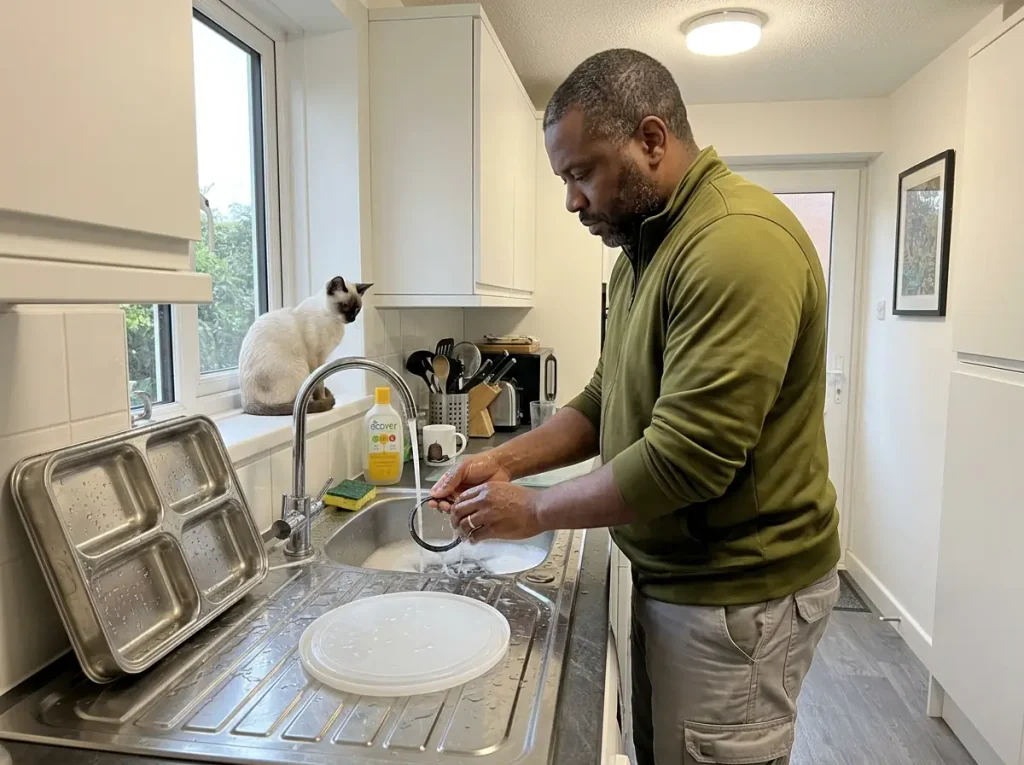
A machine that holds wet food is a machine that touches wet protein every single day, and that is a chore, not a feature. This is the section that decides whether your feeder is still on the counter in month three or in a box on top of the closet, and it is the part the entire SERP skips.
The baseline is cleaning wet-contact parts after every use. Weekly is the absolute floor, and calling weekly a floor is generous, because weekly is already a compromise you are making against a protein that sat at room temperature in a sealed plastic box. The trays are the easy part. You will do the trays.
The part that gets missed is the gasket. Sealed lids work by pressing a rubber ring into a channel, and that channel holds moisture after every single meal, in the dark, at room temperature, out of sight. The recurring discovery in feeder threads is people finding mold “not immediately near the food,” which is exactly the phrase that gives the failure away: in the seal, in the hinge, under the rim of the lid. Rinsing the tray feels like enough because the tray is the part you can see. The tray was never the problem.
The reason a dry-feeder owner never learned this habit is that a dry feeder never punished them for it. Kibble leaves dust; dust does not grow anything. Move to wet food and the same fifteen-second rinse that kept a hopper honest for two years becomes actively misleading, because now it cleans the visible eighty percent and leaves the twenty percent that matters sitting damp under a lid. That is the same trap as the auger, arriving from the opposite direction: a habit that worked, applied to a machine it was never tested on.
There is also a drying step, and it is the one people drop first because it feels optional. A gasket that goes back into its channel still damp is a gasket that spends the next twelve hours in exactly the conditions it just got washed out of. Lay the seal and the lid out separately and let them dry all the way through before reassembly, which usually means leaving the feeder open on the counter while you do something else rather than snapping it shut the moment it is clean.
Condensation is the other quiet one, and it belongs to the cooled units specifically. A chilled dish sitting in a warm kitchen sweats, the same way a glass of iced water does, and that water goes somewhere. Usually it goes into the seam between the bowl housing and the base, where it sits. In a humid apartment or a kitchen that gets steamy at dinner, wipe the underside and the housing seam as part of the same routine, not as a separate job you will invent later.
Which makes dishwasher-safe components worth more than an extra compartment, and it is not close. The chore that is easy is the chore that still happens in week six. A feeder whose parts go in the top rack survives your worst week; a feeder that demands ten minutes at the sink gets skipped once, then twice, and then it is the appliance you feel vaguely guilty about. Buy for the version of you who is tired.
One boundary, and then back to the hardware: if a cat eats food that has been sitting out too long and then seems unwell, that is a vet visit, not a feeder adjustment. Nothing on this page is the right response to that. Get him seen, and fix the schedule afterward.
Pull the gasket out once a week, not just the tray, and do it in the store if you can before you ever buy one. If the seal does not come out without a fight, that is a design flaw worth knowing about while the box is still open, because a gasket you cannot remove is a gasket you will never actually clean.
Two Cats Break This in a Way One Cat Doesn’t
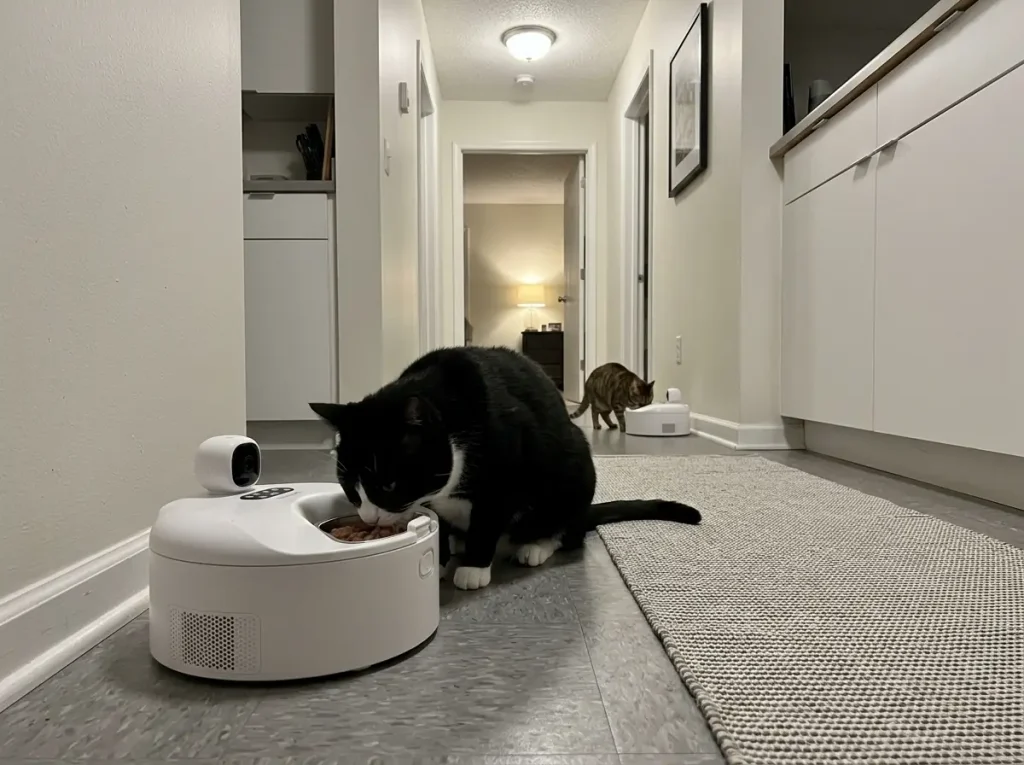
With one cat, a timed tray is a timed tray: it opens, he eats, everyone is fine. With two, the machine develops a flaw that has nothing to do with the machine, and the entire SERP treats these as the same question.
Here is the mechanism. A compartment opens on a timer, not on a cat. The moment it rotates, that meal is exposed and the two-hour clock starts, whether or not the cat it was meant for is in the room. So the fast eater finishes his, wanders over, and finds a second open dish that is now his problem to solve.
Food stealing is not the cat being greedy; it is a second meal sitting open in a room with nobody assigned to it. Meanwhile the slow eater arrives to an empty compartment, or to food that has been sitting open since whenever the tray decided.
That is two separate problems wearing one coat, and this is where the money gets wasted. Sealed until it opens is a tray problem. The right cat gets it is an identification problem. A microchip or RFID feeder solves the second and does nothing about the first. A sealed rotating tray solves the first and does nothing about the second.
People buy one expecting both, then conclude the feeder is bad, when what actually happened is that they bought half a solution at full price.
The honest answer for two cats is usually one feeder per cat, in separate rooms, rather than one larger feeder. Separate rooms, not separate corners: a cat who can see the other feeder from his own is still negotiating, and the point of the whole arrangement is that there is nothing to negotiate. This is the same logic as two cats and two bowls is the baseline, not the upgrade, just with a motor in it. Two modest feeders beat one impressive one here, every time.
And the tell is worth knowing, because it is quiet and it runs the wrong way from intuition. You will not notice the fast cat eating more. You will notice the slow cat eating less, and you will see it in his bowl weeks before you would ever see it on a scale. Full compartments at the end of the day, food pushed around instead of finished, a cat who used to show up at the sound and now doesn’t. That is the signal, and none of it is defiance. He has worked out that the tray is not reliably his, and he is behaving accordingly.
For longer absences with a cooled unit, the Automatic Cat Feeder for Wet Food, 5 Meals, Semiconductor Cooling and Pre-Heating, with Camera runs five sealed meals rather than three, which is what changes a weekend from a stretch into a plan. The camera is a byproduct and not the argument; what you are buying is two extra compartments. Two of these in two rooms is a serious amount of appliance for a two-cat apartment, though, so be honest about whether your absences really need it before you double up.
Whether It Earns the Counter Space
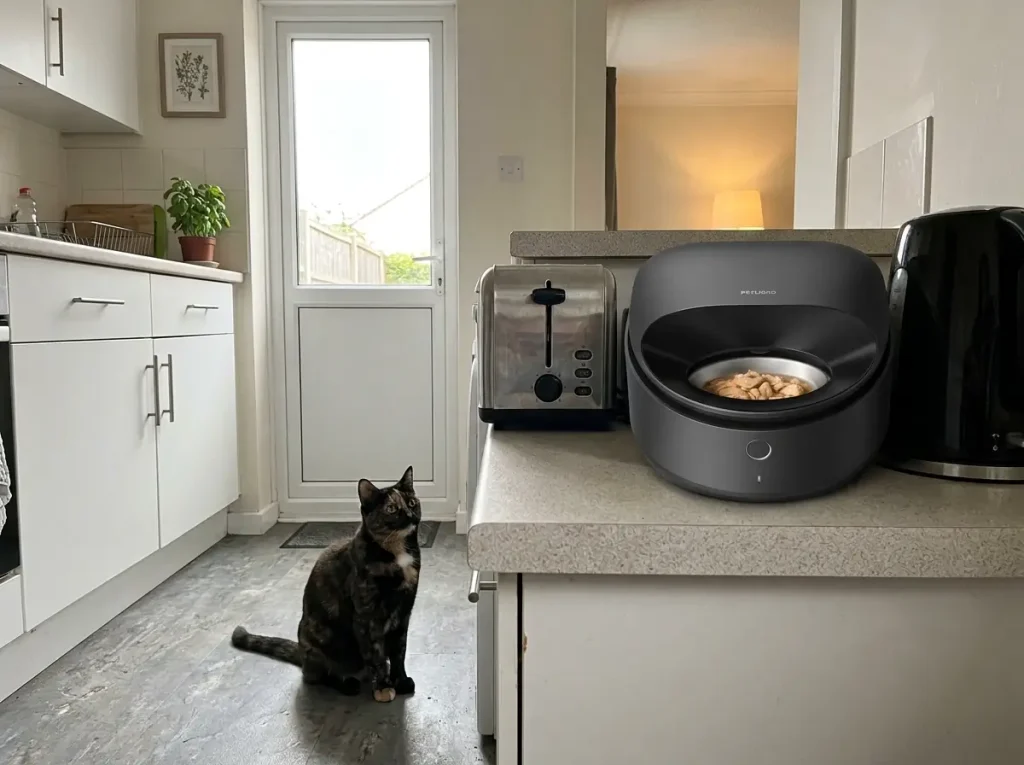
In a small kitchen the question is never what a thing costs. It is what it displaces, permanently, from a surface you already fight over.
An actively cooled dish is roughly a toaster oven’s footprint, and unlike a toaster oven it never gets put away. That is the tradeoff nobody states in space terms, because stating it in price terms is easier and sells better. If your counter has room for one more appliance and you already own an air fryer, this is a real decision rather than a detail.
It also runs continuously, which means a low hum in a room you also eat in. In a house you will stop hearing it by week two. In a studio, where the kitchen and the bedroom are the same air, that hum is a genuine consideration and not a nitpick. Stand next to a running one before you commit, if you get the chance.
A passive tray, by contrast, goes back in the cabinet between trips. That is the renter’s answer and the small-kitchen answer, and it is why the cheap category keeps winning arguments it is not supposed to win: it is the only one of the two that gives the space back.
So, plainly. Away one night a month, buy nothing at all: cover the bowl, ask a neighbor, keep the money. Away most weekends, an ice-pack tray. Feeding wet on a fixed schedule every single day, for a household that is genuinely not home at those hours, is the one case where a cooled dish stops being a luxury and starts being the tool for the job.
And none of this fixes a cat who will not eat on a schedule in the first place. That is a feeding-rhythm question rather than a hardware one, and it is worth settling how often to set the feeder in the first place before you spend anything at all on the machine that executes it. If you are still working out whether any of this belongs in your kitchen, the sibling piece on the four things that decide whether an automatic feeder is a good idea for your household is the right place to start, and it will happily talk you out of it.
The Short Version
A hopper feeder will never do wet food. That is not a settings problem, no amount of cleaning fixes it, and the failure shows up two to four months later as a cat who is quietly being short-fed.
Hold onto the clock rather than the brand. Two hours uncooled, most of a day on ice packs, days only with active cooling. Every product claim in this category can be checked against those three numbers, and most of them get vaguer the closer you look.
Two cats change the answer to two feeders, not one bigger one, and the cat to watch is the slow one.
Put a reminder three weeks out. Three weeks is when the cleaning routine slips, when the ice packs start going in half-frozen, and when you find out whether your cat is actually eating at the scheduled hour or just eating eventually. If the gasket is still getting pulled and the slow cat’s compartments are still coming back empty, the system is real. If not, it was a habit, and habits are fixable in a way hardware isn’t.
And if you are only away one night a month, cover the bowl, ask a neighbor, and keep the money. The feeder is for the schedule you actually have, not the one you are planning to have.
Amazon’s Audible — free for 30 days
Your cat won’t let you read. Let someone read to you.
Audible is Amazon’s audiobook library — thousands of titles, read out loud, on your phone. Free for a month, plus one audiobook to keep forever.
Frequently Asked Questions
01Do automatic feeders work with wet food?
Only dish-style ones do: a sealed rotating tray with ice packs, or an actively cooled dish. A hopper feeder that augers dry food down a chute has no seal in the food path, and wet food clings to the screw instead of falling.
02How long can wet food sit in an automatic feeder?
Uncooled, treat two hours as the ceiling, and one hour if the room is above 90°F. That is general perishable-food guidance, and wet cat food is not exempt from it. Ice packs stretch it to roughly 8 to 24 hours depending on the pack and the room; only active cooling is rated in days.
03Are automatic wet food feeders worth it?
It depends entirely on how often you are away, not on the cat. For one night a month, no: cover the bowl and ask a neighbor. For most weekends, a sealed ice-pack tray. For a daily wet-food schedule you are not home for, an actively cooled dish is the only one that is not pretending.
04How can I feed my cat wet food while I am on vacation?
For a single night, an ice-pack tray covers it comfortably. Past about a day, a feeder is the wrong tool for a vacation: a person who comes in is more reliable than any machine, because no feeder notices that your cat has stopped eating.
05Can you put wet food in a regular automatic cat feeder?
You can, and it is the mistake that costs the most. Residue coats the auger and the feeder jams two to four months later, usually without looking broken. It just dispenses less each cycle, so the cat gets short-fed while everything appears to be working.
Leave a comment