Are Automatic Cat Feeders a Good Idea? 4 Things Decide It
Wet food lasts 2-4 hours in a feeder (not all day) & a microchip gate stops theft but not blocking. 4 things decide if yours is worth it.

Alfredo RamsesFounder · September 15, 2026 · 18 min read


On this page8 sections
- 1What an Automatic Feeder Actually Fixes, and What It Only Hides
- 2Where the Machine Stops and Your Vet Starts
- 3Factor One: One Cat or More Than One
- 4Factor Two: Dry Food or Wet
- 5Factor Three: How Long You Are Actually Gone
- 6Factor Four: The Room You Have to Put It In
- 7The Verdict, in Three Lines
- 8Frequently Asked Questions
He is on your chest at 5 a.m. again, and you have started to think of it as a discipline problem. It is not. A cat’s stomach is built for many small meals a day, and you feed him twice, roughly twelve hours apart, on a schedule that suits a human workday and nothing else. He is not testing you. He is telling you the gap is too long, and on that point he happens to be right.
What we can say with some confidence is where a machine helps and where it quietly does not. An automatic cat feeder is very good at repeating a time, useless at judging a portion, and wet food in an open bowl is a four-hour tool rather than an all-day one. So the answer is yes for some houses and a genuinely bad idea for others, and four things decide which one you are.
Quick Answer
An automatic feeder is a good idea when your problem is timing, and a poor one when your problem is anything else. Four things decide it:
- How many cats. One cat, yes. Two or more, only with spacing or a microchip gate.
- Dry or wet. Dry, yes. Wet, only for a few hours unless the unit actively chills it.
- How long you are gone. A workday, yes. Past a day or two, no, because nothing confirms he ate.
- How much room you have. If the stations cannot sit apart, the multi-cat fix does not work.
What an Automatic Feeder Actually Fixes, and What It Only Hides
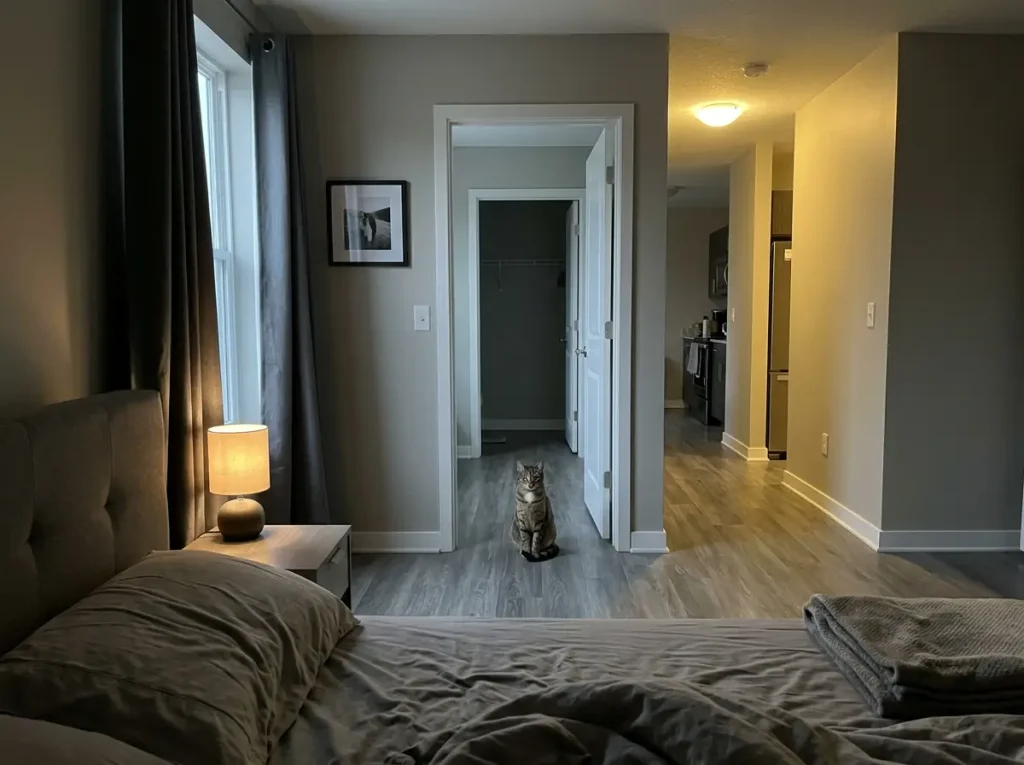
People arrive at this question carrying one of three different problems, and the machine has a different answer for each. The first is an inconvenient schedule: you leave at seven and get back at seven and the middle of the day is a hole. The second is a cat who eats too fast, or too much, or both. The third is the 5 a.m. wake-up.
Before any of that, it is worth knowing which of the five feeder types you are actually looking at, because “automatic feeder” covers a gravity hopper with no electronics and a microchip-gated unit that scans a cat as he approaches, and those two machines solve almost nothing in common.
The Three Problems People Are Actually Trying to Solve
A feeder is excellent at the first problem, partial at the second, and does nothing at all for the third on its own. That is the honest ranking, and putting it up front is the only reason to keep reading.
Timing is a machine problem, so a machine fixes it. Quantity is a judgment problem, and the feeder has no judgment: it dispenses what you told it to, at the time you told it to, whether that amount is right or badly wrong.
And a gravity feeder is not doing portion control in any sense of the phrase. It is a funnel. Food falls until the bowl is full, and the only limit on a food-obsessive cat is the hopper running dry, which is exactly the opposite of what the person buying it usually wants.
Timing Is the One It Does Well
Here is where the machine genuinely earns its place. Split the same daily amount across four or five scheduled feedings instead of two, and the twelve-hour hole disappears without anybody having to be home at two in the afternoon. It is closer to how a cat eats when nobody is organizing him, and it is not a thing a person with a job can do by hand.
The limit is the one the community says most plainly, and it is worth writing down: the feeder does not watch the cat. It reports that it dispensed. It cannot report that anyone ate. Everything in this article that sounds like a warning traces back to that one sentence.
Why the 5 a.m. Wake-Up Outlives the Machine
The dawn wake-up is a learned expectation, not hunger, and the thing it is attached to is you. Months of you being the source of breakfast built a rule in his head: this human, awake, equals food. A feeder helps only because it slowly breaks that association, and slowly is the operative word. People report the pestering fading over weeks, not over the first weekend, and the ones who give up early usually gave up at day four.
Set the first meal BEFORE the hour your cat currently wakes you, then walk it later by ten minutes a week. Setting it after that hour teaches him the opposite lesson: that waking you is the thing that makes food happen.
Where the Machine Stops and Your Vet Starts
A lot of people are here because somebody in a white coat said the word “overweight,” which makes this the most consequential section in the article. The good news is that they bought the right tool.
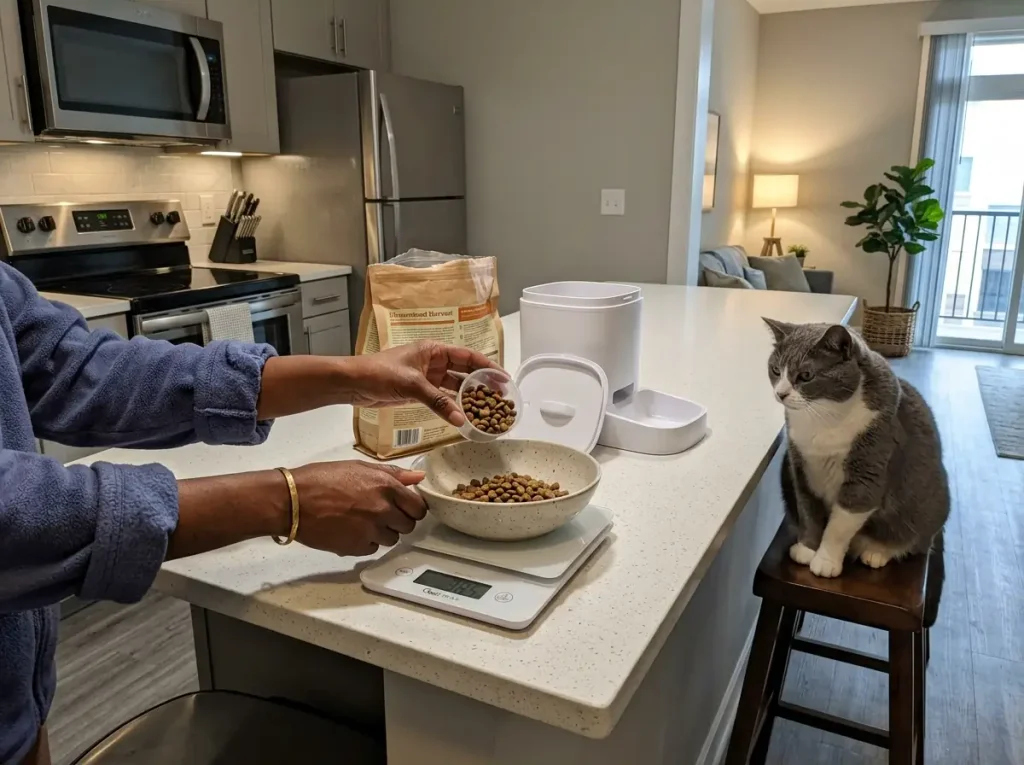
AAHA’s nutrition guidelines list automated feeders as a tool for controlling food access and amount, sitting inside a feeding plan built on body condition scoring and a calculated calorie target. Inside a plan. Not instead of one.
The Feeder Executes the Portion, It Does Not Set It
The machine is the execution layer and nothing more. How many grams, which food, whether losing weight is even the right goal for this particular animal: none of those are questions the hopper answers, and none of them are questions the app answers either, however confidently the app phrases things. The number comes from a person who has had hands on your cat.
There is a free step that comes before all of this, and it is the one worth doing tonight. Weigh a week of meals on a kitchen scale before you automate anything. Most people are startled by the gap between what they think they pour and what they actually pour, and until you close that gap you do not know what you are asking the machine to repeat.
A therapeutic or prescription diet adds a constraint the hardware may simply not meet. These units are built around a narrow kibble size, and a prescription formula can come in a shape that does not travel through an auger. That is a compatibility question to settle before the purchase, not after.
What Belongs to Your Vet, and Stays There
Some things are a phone call, and this article will not pretend otherwise. A cat who suddenly eats much more or much less than usual. A cat losing weight on a portion that has not changed. A cat vomiting after meals. Those are a vet visit, today, and what they mean is not something a feeder article gets to guess at.
Everything below this line assumes the vet has already cleared him and the only open question is logistics.
Factor One: One Cat or More Than One
Nothing changes the answer as much as the number of cats in the apartment, and the reason is not the one most guides give. A 2022 study in the Journal of Feline Medicine and Surgery found automated, portion-separating feeders made weight-loss plans significantly easier in multi-cat households: cats fed six times a day by portion-separating units hit ideal body condition 83.2% of the time over six months, against 40% fed twice daily and 0% fed from a shared bowl. Owners in the same study rated the plan far easier to run with a feeder than with a bowl, and the begging, following and pawing dropped along with it.
Two Cats Turn a Schedule into a Starting Pistol
Read that 0% again, because it is the part that matters. A shared bowl does not fail because of hygiene. It fails because the portion math stops being real the moment one cat can eat the other’s dinner.
But a plain scheduled feeder can make that worse before it makes it better, and almost nobody says so. Free-feeding at least spread the conflict across the whole day. A unit that fills one bowl at 7:00 and again at 13:00 concentrates every bit of competition into two loud, predictable moments, and both cats learn the sound within about two days. You have not removed the friction. You have scheduled it.
Theft, Guarding and Blocking Are Three Different Problems
Owners call it food theft, which is the right word for the first one and the wrong word for the other two, and buying the wrong fix follows directly from blurring them. Theft is the wrong cat eating the food. Guarding is one cat camping on the resource. Blocking is one cat standing between another and the bowl without doing anything you could point at.
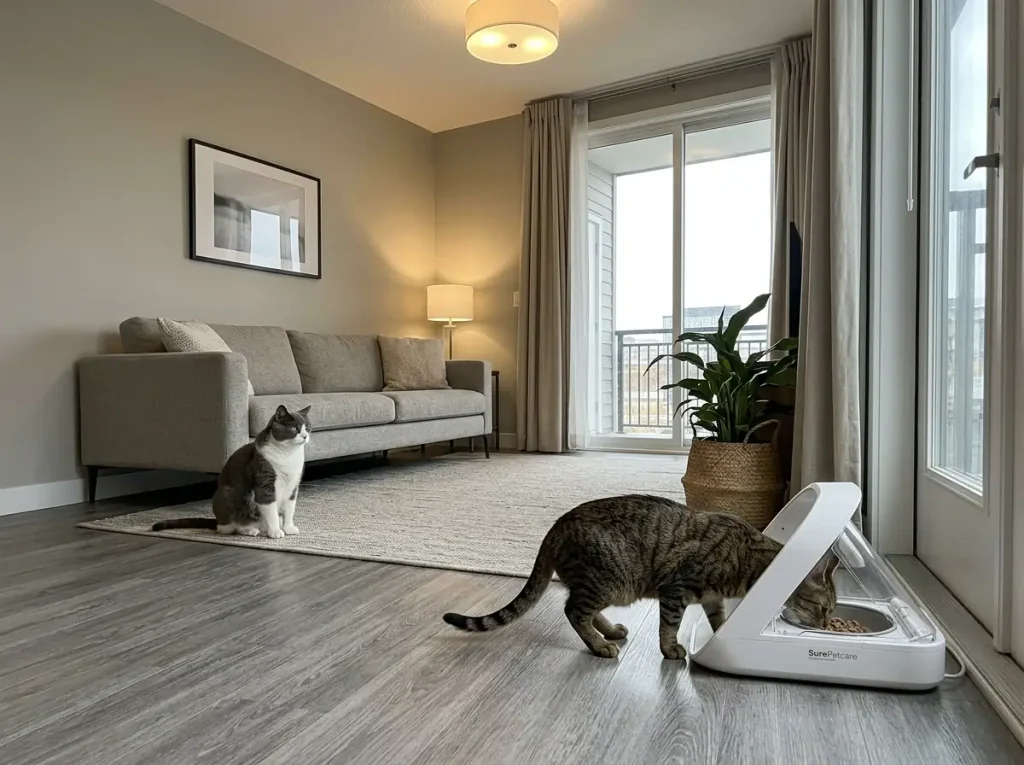
A microchip feeder solves exactly one of those three. The Sure Petcare SureFeed Microchip Pet Feeder Connect scans the chip your cat already has and only opens the lid for that cat, which ends theft cleanly and takes about ten minutes per cat to program. Its bowl holds 13.5 fluid ounces, and its real ceiling is roughly two to three cats per unit before guarding creeps back in.
What it cannot do is make a timid cat feel safe walking up to it. A confident cat can park two feet away, eat nothing, open nothing, and still keep the other one waiting until the appetite passes. The gate decides who can eat. It has no opinion about who will.
I used to treat a microchip unit as the whole answer for a two-cat house. Enough forum threads describing exactly that standoff, where the theft stopped and the thin cat stayed thin, moved me to the same conclusion the studies keep pointing at: the gate handles access, and placement handles everything else.
Move Them Apart Before You Buy Anything
So do the free thing first. Put five feet between the stations, minimum, and preferably put them in different corners or different rooms. This is the same arithmetic behind one station per cat plus one spare, set well apart, and it is free, reversible and often enough on its own. If the eating evens out over a week, you never had a hardware problem.
Factor Two: Dry Food or Wet
This is the factor that quietly disqualifies the most readers, and it is where most buying guides go silent. If you feed wet food and work a ten-hour day, the thing you think you are shopping for mostly does not exist at that price.
Wet Food Is Measured in Hours, Not Meals
Here are the numbers nobody in the top results prints. Unrefrigerated wet food is safe for roughly two to four hours, and that drops to 60 to 90 minutes once the apartment is above 80°F. A frozen ice-pack insert buys four to twelve hours, depending on how warm the room gets. Active refrigeration reaches up to 72 hours.
Line those up against your actual day and the answer falls out. An ice-pack wet feeder covers a late arrival home, or a dinner that slips two hours. It does not cover a full workday in August, and a July apartment can push a bowl past the safe window before lunchtime.
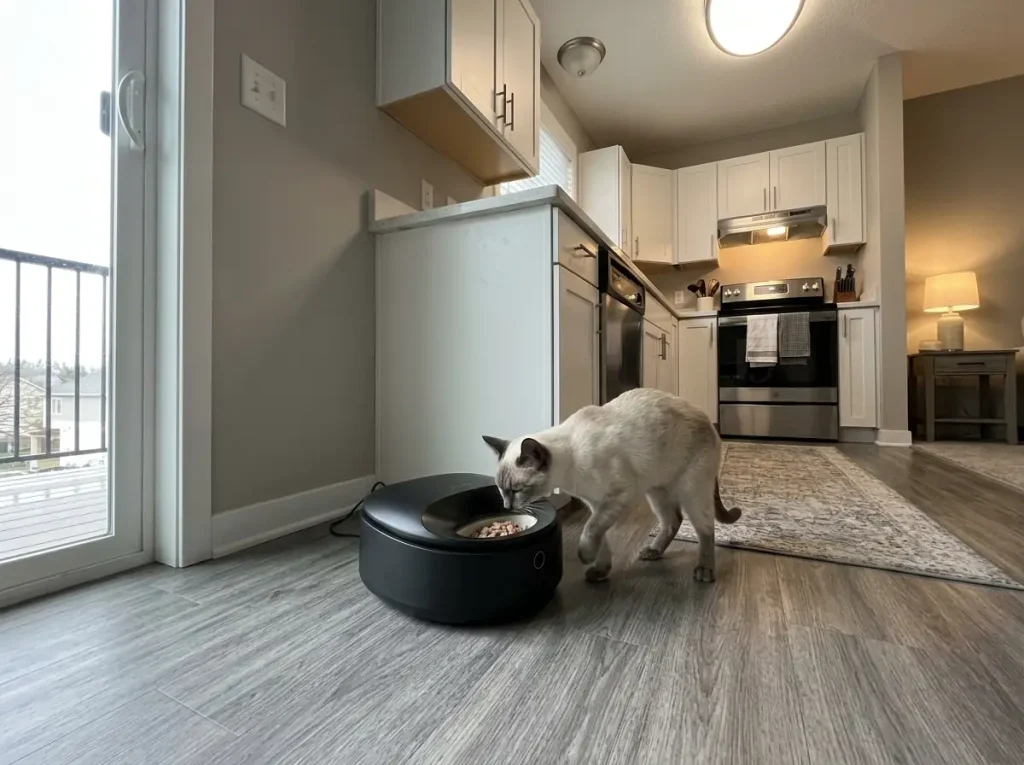
If your household is wet-food-only and that ceiling is the thing blocking you, active cooling is the one category that clears it. The PETLIBRO Polar Automatic Wet Food Feeder uses semiconductor cooling rather than an ice pack, which is what moves the window from that four-to-twelve-hour range to roughly three days. It is the premium end of this shelf and it is worth naming the tradeoff plainly: an ice-pack unit costs a fraction of it and does the job if you are gone for a work shift rather than a weekend. Buy the cooling only if the hours you need are hours an ice pack cannot reach.
Dry Food’s Real Failure Is the Shape of the Kibble
Dry food has the opposite problem. It will not spoil on any timescale that matters here, so the constraint moves somewhere less obvious: jamming. And the top cause of a jam is not a failing motor. It is the food.
These units are engineered around kibble roughly 2 to 10 mm across. Oversized pieces, and triangular ones in particular, bridge across the opening the way gravel arches over a funnel, and the auger turns against a wall of food that is going nowhere. What happens next is the part worth knowing: the owner reads a jam as a dead unit and sends it back, when the mismatch was between the food and the hopper the whole time. Same machine, different bag, no jam.
Before you blame the feeder, measure a piece of your kibble. Most units are built for 2 to 10 mm pieces, and the large triangular shapes bridge across the opening and stop the auger. A food change fixes more jams than a replacement unit does.
Factor Three: How Long You Are Actually Gone
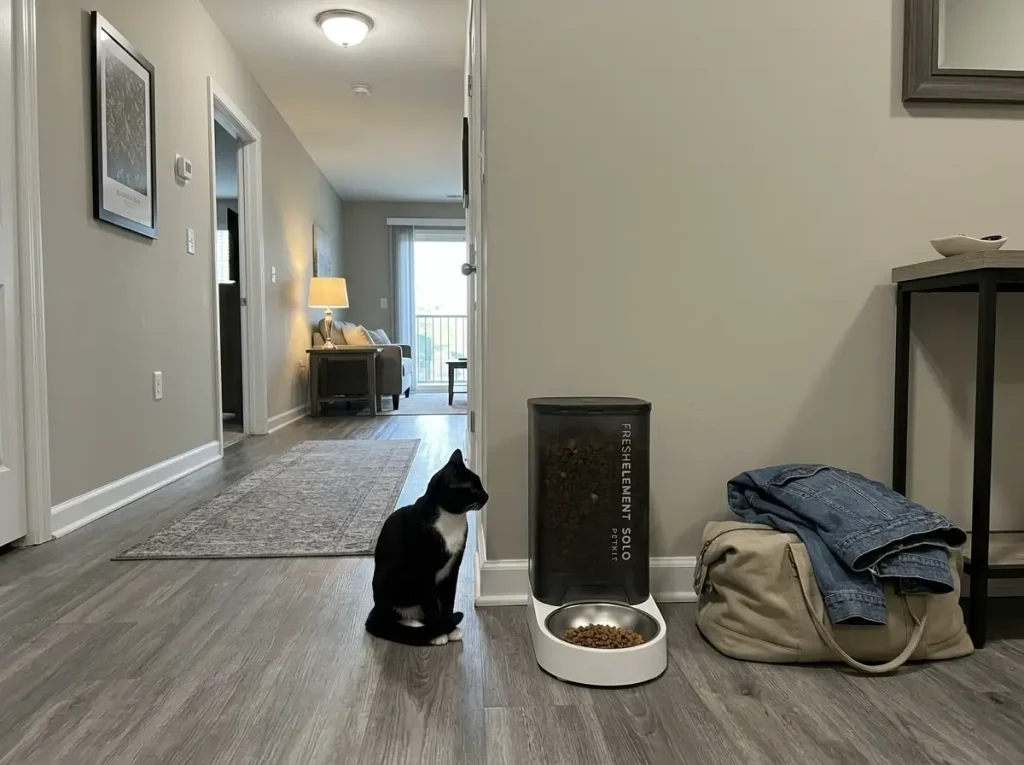
“Great for travel” is the line on every box, and it is the vaguest promise in the category. Here is a ceiling instead: a feeder covers a workday comfortably and an overnight at a push. Past one to two days it should never be the only plan. A vacation does not become cheaper because you bought a machine. It becomes a machine plus a pet sitter, and the machine is the smaller half of that.
The reason has nothing to do with capacity. Hoppers hold far more than a cat eats in a weekend. The reason is the sentence from the first section, arriving now with consequences attached: nothing in the machine confirms that the cat ate, drank, used the box, or is behaving anything like normal. Two days of a feeder dutifully dropping food into a bowl nobody has touched looks identical, from your phone, to two days of everything going fine.
One Workday, Yes. One Weekend, with Someone Checking
A camera changes less than people expect. It confirms the unit dispensed, which you mostly already knew, and it tells you nothing on the many hours you are not watching. A pet sitter who opens the door once a day is a different category of assurance entirely, and past forty-eight hours it is the only one that counts.
What the Beeping Is Telling You
Two beep patterns mean two completely different things, and this distinction is missing from almost everything written about these machines.
A chirp every 30 to 60 minutes is the low-battery warning, and on most units that cycle runs 24 to 48 hours before the batteries actually die. That is a “deal with it tomorrow” sound. Continuous beeping every one to two minutes is a hard fault: a jam, a stalled motor, or a sensor that has stopped reading. That is a “deal with it now” sound, and if you are away it is the point where you call whoever has your key.
Learn which is which while you are standing in the kitchen, not while you are three hundred miles away trying to interpret a noise over a phone speaker.
The Outage Nobody Plans For
The failure that empties a hopper into nothing is a power cut, and it does not need to be dramatic. Twenty minutes of building work on your street at eleven in the morning is enough to stop a mains-only unit and hand you a clock reset to midnight and a schedule that will not fire again until you are home.
This is the one feature worth paying for if you are ever away overnight. The PETKIT Automatic Cat Feeder with 2.4G WiFi and dual power runs on mains with battery backup, so an outage costs you the app connection rather than the meal, and its 3 L hopper covers a single cat for well over a week. The caveat is the one attached to every connected unit: the WiFi is a convenience, not a safety net, and a notification saying food was dispensed still says nothing whatsoever about whether food was eaten.
There is one more way these fail, and it has nothing to do with electronics. Every unit makes a sound when it runs, and a cat with real noise sensitivity will treat that whirr as something to avoid rather than something to come to. In the lab study behind most of the numbers on this page, one cat in twenty-four refused the feeder outright. That is not a common outcome, but it is not a zero either, and it is the kind of thing you want to discover in your own kitchen rather than on day one of a trip.
Run the feeder for a full week while you are home before you rely on it for a single day away. A jam, a bad hopper fit, or a cat who refuses the machine outright all show up in that week, and all of them are cheap to find out while you are standing there.
Factor Four: The Room You Have to Put It In
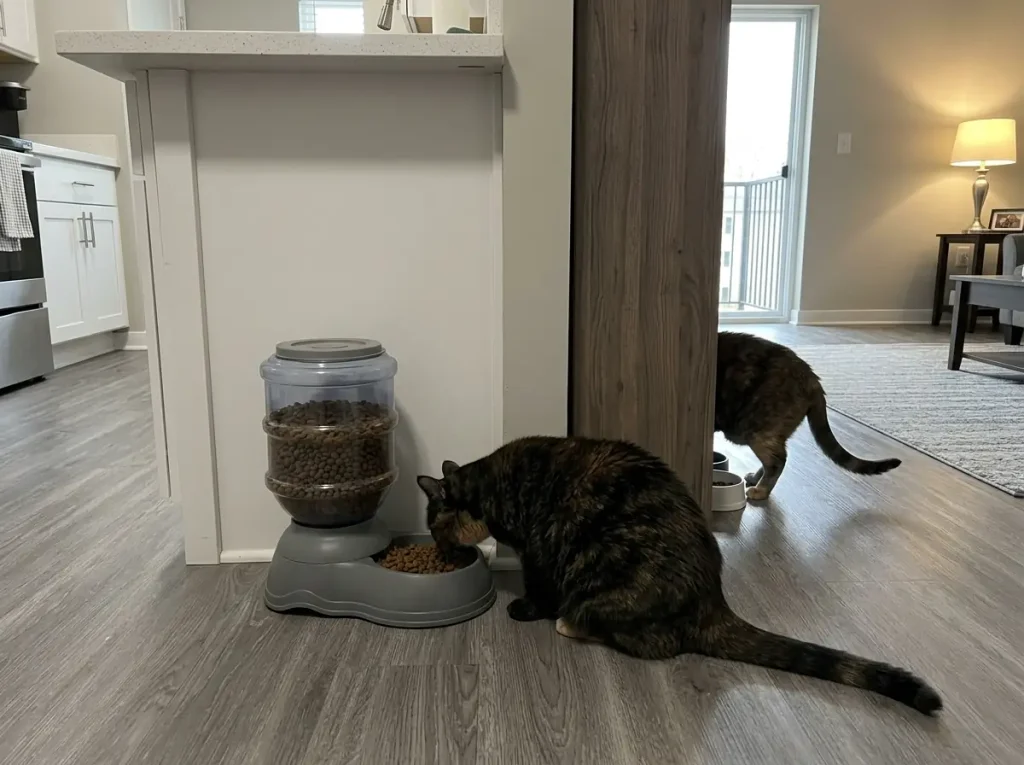
Two sections ago this article told you to give each cat its own station, well apart, ideally in separate rooms. That advice assumes rooms. In a studio it is not advice, it is a joke, and the reader renting one deserves the version of the answer that fits the apartment they actually pay for.
When “Put Them in Separate Rooms” Is Not Advice
Say the collision out loud, because no competitor does. The multi-cat fix needs distance, and a studio has no distance to give. Two microchip units side by side are not two stations. They are one station with extra steps and a bigger receipt, because the cat doing the blocking can stand where he can see both.
The per-unit ceiling stacks on top of this. Roughly two to three cats per microchip feeder before guarding returns, which means a three-cat household in 400 square feet is being told to fit multiple units into genuinely separate spots that do not exist. At that point the honest answer stops being a product. Below a certain amount of floor space, feeding the cats by hand at staggered times beats two machines fighting over one corner, and it costs nothing.
Sightlines Do What Walls Do
Here is the workaround that makes small apartments survivable, and it is free. A cat who cannot see the other cat eating behaves a great deal like a cat in another room. The blocking behavior needs a line of sight to sustain itself.
So break the line. The end of a bookcase, an open door held at an angle, the side of the sofa, the corner where the kitchen turns. Any of them turns one room into two feeding contexts. Vertical separation counts too: a unit on the counter and a unit on the floor read as two different places to a cat, even standing four feet apart, because a cat’s map of the apartment is three-dimensional in a way ours is not.
Where the Outlet Decides the Answer
In an older apartment the outlet, not the cat, usually picks the feeding spot. There is one socket in that wall, it is behind the fridge, and the corner where the cat actually likes to eat has nothing.
Battery-powered and dual-power units solve exactly this, and it is their most underrated feature in a rental: the station goes where the cat wants it, not where the wiring allows. No drilling, no adhesive, nothing that comes up at the walkthrough. And if there is a dog in the apartment as well, keeping a dog out of it changes the placement rules again, because reach height enters the calculation on top of everything here.
One last case, and it is the most common one on this page. If you have worked through all four factors and landed on one cat, dry food, a normal workday and a small apartment, you do not need a programmed machine at all. The Amazon Basics Gravity Pet Food Feeder holds a gallon and has nothing inside it to jam, because there is nothing inside it.
Its cost is stated in one line: zero portion control, ever. If a vet has given you a number to hit, this is the wrong shelf entirely. If your only problem was that you are not home at six, it is the whole answer.
The Verdict, in Three Lines
If your problem is only timing, and it is one cat, dry food and a normal workday, the answer is yes and the cheapest version of yes is enough. Buy the simple thing and stop reading buying guides.
If your problem is two cats eating each other’s food, the feeder is half the answer. Spacing and sightlines are the other half, and they come first because they are free and because a gate that ends theft can leave the intimidation completely untouched.
And if your problem is a number your vet gave you, the feeder is the right tool and the wrong authority. It repeats a portion faithfully. It does not choose one, and it will never tell you the cat stopped eating.
🗓️ Check back in three weeks. This is a schedule and a behavior change, not slow wear on an object, so three weeks is when you will know.
Look at three things. Is the bowl empty at roughly the same time each day, which means the schedule is holding. Is one cat consistently loitering at the other’s station, which means the spacing failed and not the machine. And are you still being woken up at five, which means the reassociation has not landed yet and the fix is the timer, not the hardware.
Before any of that, do the free experiment: move the two stations to opposite corners and leave them there for a week. If the eating evens out, you just found out you had a floor-plan problem instead of a hardware problem, and you kept the money.
Amazon’s Audible — free for 30 days
Your cat won’t let you read. Let someone read to you.
Audible is Amazon’s audiobook library — thousands of titles, read out loud, on your phone. Free for a month, plus one audiobook to keep forever.
Frequently Asked Questions
01Are automatic cat feeders a good idea for kittens?
For a healthy kitten past weaning, a scheduled feeder is generally fine, and the many-small-meals pattern suits how kittens eat anyway. How much a growing kitten needs changes month to month, though, and that number comes from your vet. The feeder just repeats it.
02Can You Use an Automatic Feeder with Wet Food?
Yes, but the clock is short. Unrefrigerated wet food is safe about two to four hours, an ice-pack insert stretches that to roughly four to twelve, and only actively cooled units reach a couple of days. A full workday in a warm apartment is past the limit of most of them.
03How Long Can a Cat Be Left with an Automatic Feeder?
One workday comfortably, one overnight at a push. Past a day or two it stops being a feeding question: nothing in the machine confirms your cat actually ate, drank or is behaving normally, and that part needs a person.
04Do Automatic Feeders Stop Cats from Waking You Up in the Morning?
Eventually, and not by themselves. The wake-up is a learned expectation that you are the source of breakfast, so it fades only once food reliably arrives without you. Setting the first meal earlier than his current wake-up time, then walking it later, is what does the work.
05Will an Automatic Feeder Stop One Cat from Eating the Other’s Food?
A microchip feeder stops the wrong cat from opening the bowl, which handles theft. It does not stop a confident cat from standing near the unit and making a timid one wait, so spacing the stations well apart still matters, and that part is free.
Leave a comment