How to Add Water to Cat Food Without Losing the Meal
Kibble carries 0.5 tbsp of water, canned carries 6-9. Start at 1 tablespoon per meal, hold 3 days, and know why soaked kibble has 30 minutes.

Alfredo RamsesFounder · September 21, 2026 · 18 min read

On this page8 sections
- 1How Much Water Is Already in the Bowl
- 2The Dosing Ladder, Starting at One Tablespoon
- 3When He Licks the Gravy and Leaves the Food
- 4What to Add, in Order of How Little Can Go Wrong
- 5The Broth Cubes, and How to Actually Make Them
- 6The Clock, and What Changes With a Second Cat
- 7Conclusion
- 8Frequently Asked Questions
You read that wet food is the fix, so you poured a splash of water over dinner and stirred it in. He walked up, put his nose to the bowl, held there for about two seconds, and left. Now the food is going in the trash, he has drunk nothing, and you are somehow further back than you were this morning.
Here is the thing nobody tells you before you try it: the amount of water in a meal is a number you can measure, and a kibble serving carries about half a tablespoon where a canned meal carries six to nine. So this is an arithmetic problem before it is ever a behavior problem, and knowing what to add to cat food for hydration starts with how much, not what. Below: the dose to start at, what to add it to, what to do when he refuses, and how long the bowl can safely sit there afterward.
Quick Answer
Add water to the meal in small, boring increments and let the cat approve each one.
- Start at about one tablespoon of water per meal and hold there two or three days
- Mix it into pâté-style wet food, not gravy style, which a cat can lick clean
- Plain water works. For flavor, homemade fish or plain chicken stock only
- Skip commercial broth: onion, garlic and far too much sodium
- Water shortens the clock. About an hour for wet food, 30 minutes for soaked kibble
How Much Water Is Already in the Bowl
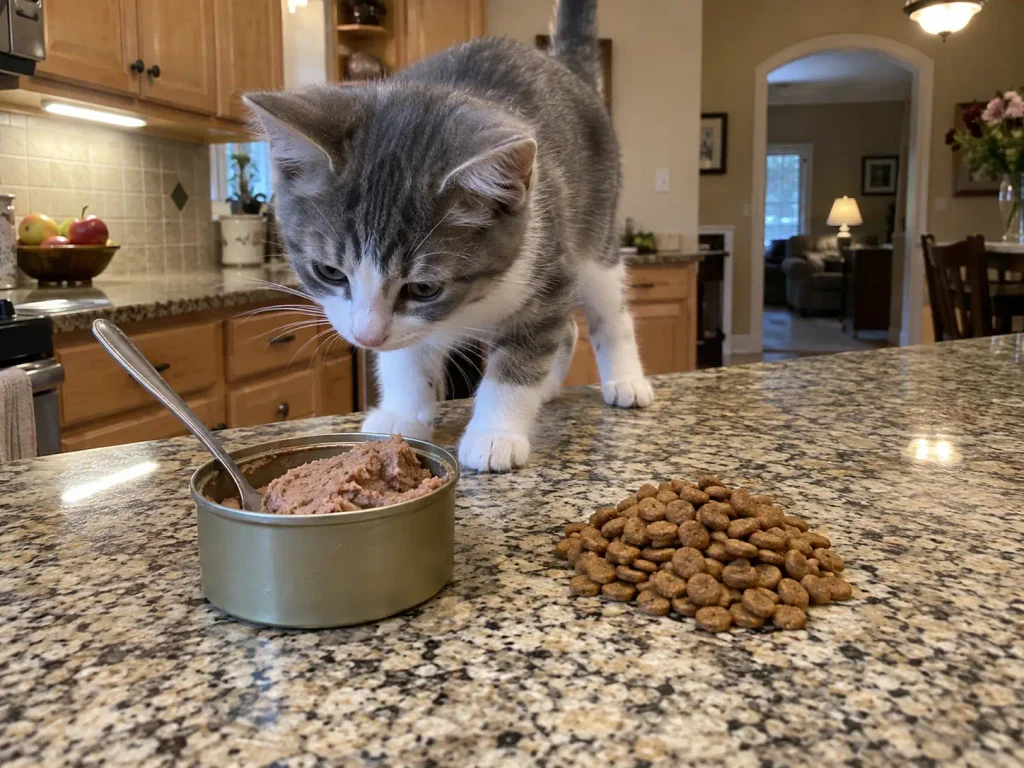
Most people who search this have a kibble cat, a full water bowl, and no idea why the two do not add up. They have been counting the bowl. The food is where the water was supposed to come from, and for an obligate carnivore built to get most of it from prey, a bag of dry food is close to the driest thing on the menu.
Here is the gap in numbers. A typical kibble serving carries roughly half a tablespoon of water. A canned or homemade meal sitting at 77% moisture content carries six to nine tablespoons. Same size dinner, same cat, five-plus tablespoons of difference, every single meal, twice a day, forever.
Nobody publishes that comparison because “wet food has more moisture” sounds like it covers it. It does not cover it. It hides a gap you could measure with a kitchen spoon.
Against that, the daily target. A cat needs roughly four ounces of water per five pounds of lean weight per day, which lands around a cup a day for a ten-pound cat, food and bowl combined. The Cornell Feline Health Center notes that “feeding wet food and/or adding water to food is another good way to increase water intake.”
Across a whole day the working range runs somewhere between 8 and 27 tablespoons depending on the apartment, the season and the cat, so no single addition has to carry the whole number by itself. If you want the full arithmetic by weight and diet, what a cat’s whole day of water actually adds up to does the ounces properly.
Which means the answer to this question is not one answer. A cat on a moisture-rich diet of canned food is already most of the way there and needs a nudge. A dry-food-only cat is starting from almost nothing and needs a plan. A raw diet cat is somewhere near the canned number; a freeze-dried raw one is back at the bottom until you rehydrate it, which is the whole point of the instruction on the bag.
And here is the part that trips up the wet food half. The water bowl looks untouched at six in the evening, you conclude he is not drinking, and you start worrying about a cat who is genuinely fine. He got most of it out of his dinner. The bowl was never going to tell you that.
Weigh the question before you solve it. If he already eats canned food twice a day, the food is doing most of the work and your job is a tablespoon, not a project. The people who need the whole ladder are the ones feeding dry food only.
The Dosing Ladder, Starting at One Tablespoon
Every article on this subject says add water to your cat’s food. Not one of them says how much. So people do one of two things: they add a dribble that changes nothing and decide the advice was useless, or they turn dinner into soup and lose the meal entirely.
He is not rejecting water. He is rejecting a meal that changed all at once, which from where he is standing is a different food arriving in the same dish. Anyone who has ever had to transition diet gradually onto a new brand already knows the shape of this: you go slowly or you go back to the start.
The fix is to make the change too small to be worth noticing, then repeat it.
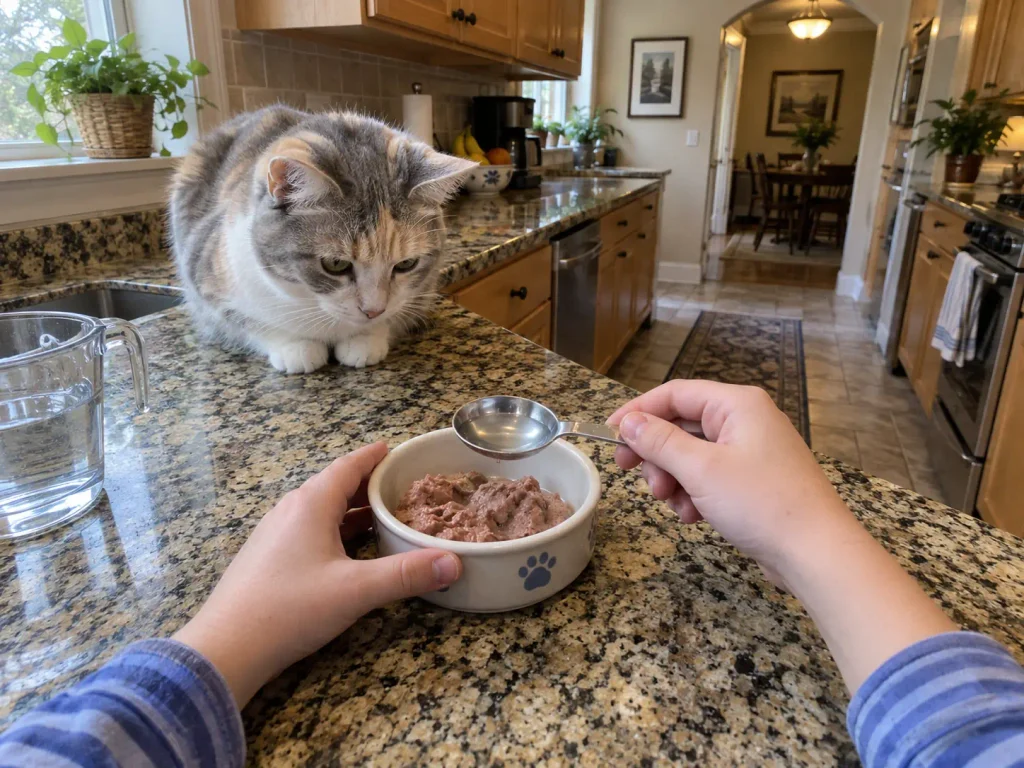
- Start at about one tablespoon of water per meal. Mixed in, not poured on. For most cats that is under the threshold where the bowl becomes a new object.
- Hold there for two or three days. You are watching exactly one thing: does the bowl come back as empty as it used to?
- If it does, add another tablespoon. Then hold again for two or three days.
- If it does not, go back down one rung and stay there a week. The ladder only moves up when the last step was accepted, and there is no prize for reaching the top.
Use warm water rather than cold. Warm lifts the smell, and smell is most of how a cat decides whether what is in front of him counts as food at all. Cold water out of the faucet kills that smell stone dead, which is a small thing that turns into the whole thing when you are already asking him to accept a change he did not request.
One adjustment for a cat who grazes. If he eats small frequent meals rather than two sittings, the tablespoon goes into each portion he actually gets, not into the day’s total poured over one bowl. Grazing cats are also the ones most likely to leave a wet bowl sitting past the safe window, which is the last section.
A word on the ceiling, because nobody sets one. There is no target rung. A dry-food cat who settles at two tablespoons a meal and keeps eating is a success, and pushing him to four because an article implied more is better is how you go back to square one in week three. The number that works is the biggest one he finishes without comment.
And the line that is not a dosing problem at all: a cat who has stopped eating or drinking altogether is not somewhere on this ladder. That is a vet visit today, and it is not what this page is for. If you are trying to work out how urgent that is, how long a cat can actually go without water covers the window and the signs. Everything below assumes a cat who is eating normally and just running dry.
When He Licks the Gravy and Leaves the Food
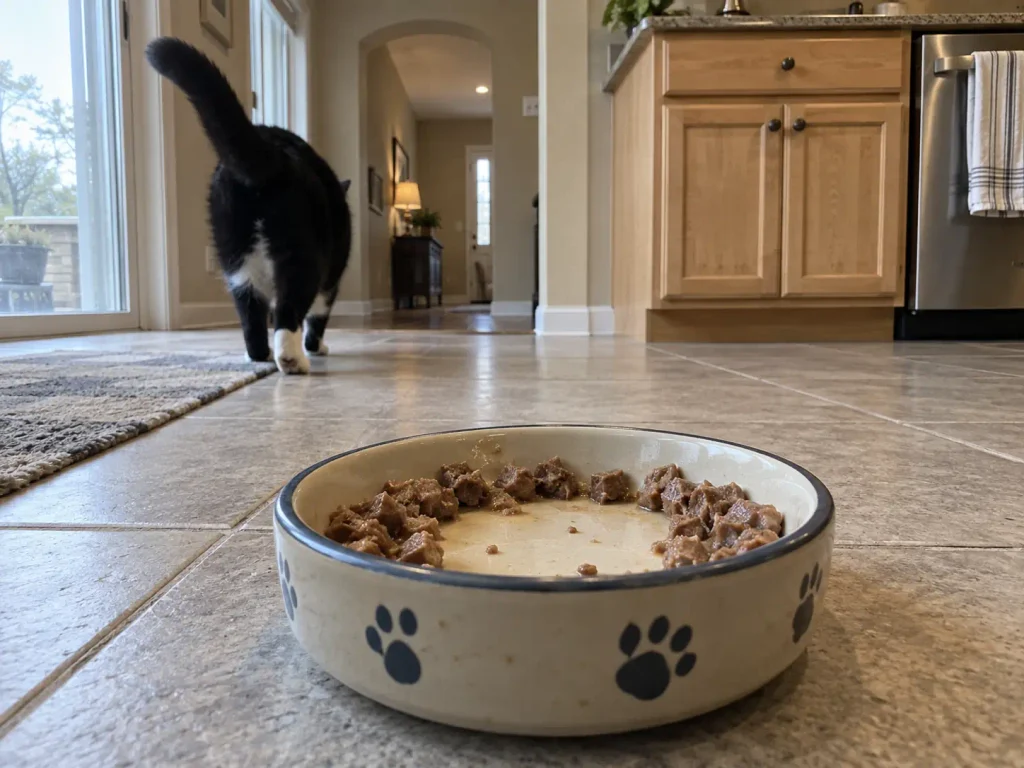
The bowl comes back licked clean in the middle and full around the edges. It reads as “he ate,” so nobody counts it as a problem, and it can run for days before somebody notices that the cat is living on sauce and getting thinner while the bowl keeps looking finished.
This happens often enough that Petco runs a standing vet Q&A on it. The cat takes the topper and abandons the solids underneath, and every thread about it arrives at the same confused owner asking whether the cat is being difficult on purpose.
He is not. A topper poured over food changes the smell of the whole bowl. The part that smells new is the part he takes, and the food underneath now smells like something that has been tampered with. From his side that is a completely rational sort.
Here is the correction, and it took longer than it should have: the fix is almost never the topper. The fix is the base food.
Gravy-style wet food, and morsels in gravy especially, can be separated, which means you are asking him to make a choice, and he will make the wrong one every time. A pâté cannot be licked clean the same way, so the water goes down with the meal instead of in place of it. Change the texture underneath and the topper question mostly stops existing.
Same logic applies to the water itself. Mixing water into a pâté beats pouring it over chunks, for exactly the reason above: you are removing the choice rather than hoping he makes it correctly. Stir until the texture is even. A bowl with a wet layer floating on a dry layer is two foods, and he will eat one of them.
The second version of this failure is louder and easier to spot. He walks up, smells a bowl that smells different today, and leaves without touching anything at all. Food neophobia, in the behavior literature. In the kitchen it looks like a cat who has decided dinner is suspicious.
Same cause as the gravy sort, just with a clearer verdict, and the answer is the same: back down a rung and go slower. A cat with a reputation as a picky eater is usually a cat whose household keeps changing things faster than he can approve them. If the refusal is happening at the water bowl rather than the food bowl, that is a different problem with different causes, and a bowl that looks perfectly fine to you covers what he might be objecting to over there.
If the bowl comes back clean in the middle and full at the edges, that is not a fussy cat, that is a cat sorting your mixture back into its parts. Switch the base food to a pâté before you change anything else about the routine.
What to Add, in Order of How Little Can Go Wrong
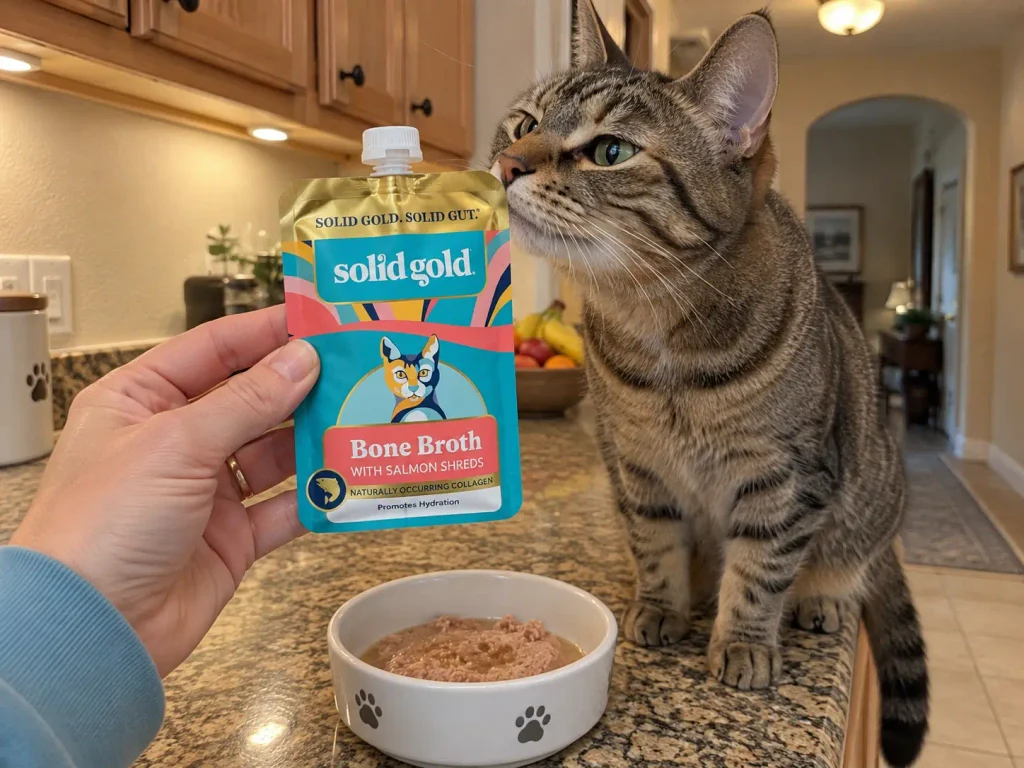
Start with the one that costs nothing. Plain water is what the whole ladder above is built on, it is already in the kitchen, and for most cats it is the end of the conversation. The reason people skip past it is that it feels like it cannot be the answer, because it was free and it was already there. It usually is the answer.
Next rung up, still free: the water from a can of tuna or sardines, as long as they are packed in water rather than oil or brine. Tuna water is the cheapest flavor you can add to anything, it comes out of a can you already opened for your own lunch, and a tablespoon of it turns plain water into something worth investigating. Sardine water does the same job and smells stronger, which for a reluctant cat is a feature rather than a complaint.
Oil-packed fish is a different product and the liquid does not belong in the bowl. Brine is salt, which is the whole problem in the next paragraph. Clam juice gets recommended in forums for the same reason sardines work, and it carries the same warning: the bottled kind is usually salted, so it is the homemade-versus-carton question all over again.
Plain homemade stock is the third option and the first one that requires a pot. Bones simmered in water, nothing else in it, no salt, no stock cube, no vegetables. In small amounts that is fine for a cat and it is genuinely more interesting to him than water.
Then the trap, and the entire SERP walks straight into it. “Add a splash of chicken broth” gets repeated everywhere as though the carton in the supermarket and the pot on your stove were the same substance.
They are not. A healthy cat needs about 21 mg of sodium a day. A single cup of a popular supermarket chicken broth can carry 800 mg or more, which is not a rounding error, it is the whole daily budget several times over in one splash. A low-sodium chicken broth is better arithmetic and still not a solution, because the sodium was never the only problem.
Most commercial broths list onion or garlic, including the powdered versions that never show up as a visible piece of anything. Both damage feline red blood cells. Read the label, and if either word is on it, the carton does not go near the bowl. That is not a preference, it is the reason this section exists.
One more that is not an addition at all: if you feed freeze-dried, the instruction to rehydrate freeze-dried food on the back of the bag is the single largest moisture lever you already own, and most people under-water it because the pieces look done before they are. Give it the full soak and the meal goes from bone dry to canned-food territory without you adding anything extra on top.
Which leaves the people who want the flavor without the pot and the straining and the three days of leftovers. The Solid Gold Bone Broth Cat Food Topper comes as 1.4 oz single-serve pouches in a 12-count box, and the single-serve part is the whole reason it is here rather than the brand.
In a small apartment, opening a can that then needs fridge space for three days is a real constraint, and a pouch you use entirely at one meal sidesteps it. The caveat: you are paying for packaging and for somebody else doing the simmering, and if you have a can of tuna in the pantry you already own a version of this that costs nothing. Which is the next section.
The Broth Cubes, and How to Actually Make Them
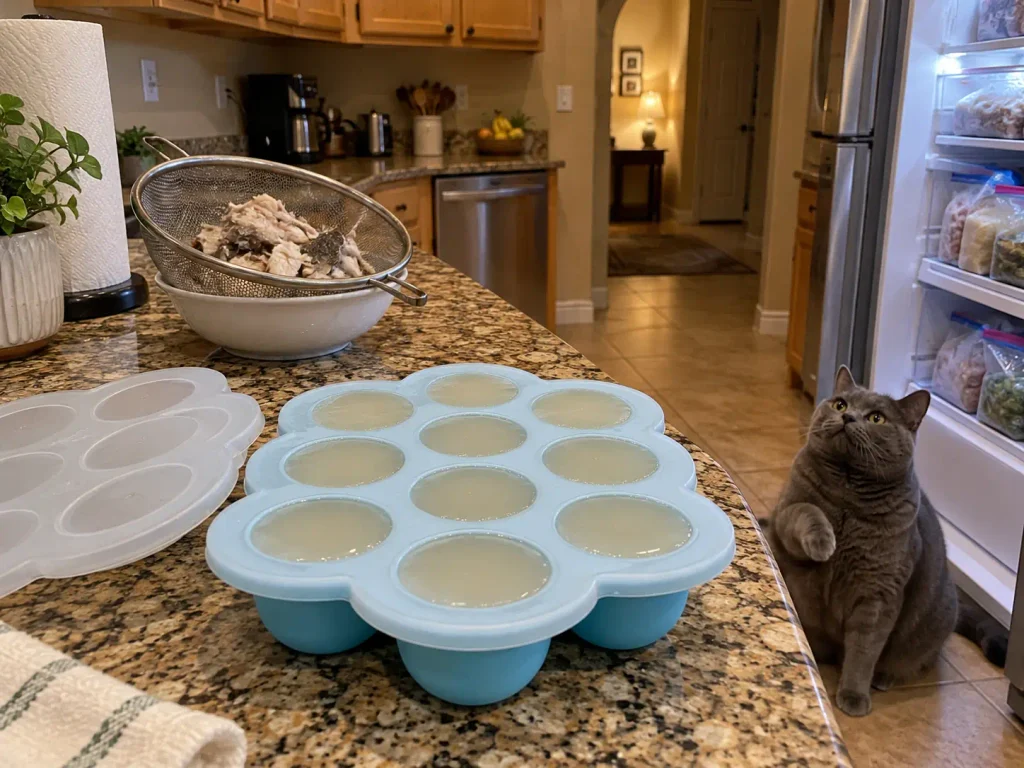
“Freeze broth into ice cubes” turns up in every list post on this subject as a single bullet, as if the reader already has broth and the only missing piece was the tray. Nobody writes down what goes in the pot. Here is the pot.
- Simmer a 6 oz can of salmon or tuna, or two small tins of sardines packed in water, in two cups of water for ten minutes.
- Strain it through cheesecloth into a jug. You want liquid, not fish soup with solids in it.
- Pour into a tray and freeze.
- Dose: one or two cubes a day, dropped into the food or melted into the water bowl.
A two-dollar can of fish becomes weeks of flavored water. It is worth saying plainly, because the rest of the internet will not: this is the better version of the commercial topper, not the compromise. If you have a can of tuna and any tray at all, you do not need to buy anything for this to work, and the first batch should always go in a tray you already own.
Now the part nobody mentions, which only shows up about four days in. An open ice cube tray in a small kitchen freezer picks up every smell in there, and it works in both directions. Fish broth going in means fish coming out of the ice you put in a drink, and whatever else is in that freezer going into the cubes you are feeding the cat.
In a chest freezer in a garage there is room for a clean zone. In an apartment freezer that is already full of frozen bread and one bag of peas, there is not.
That is what a lid fixes. The WeeSprout Silicone Freezer Tray has ten 1.5 oz sections and a clip-on lid, and the lid is the entire reason it is in this article. The sections are also portion-sized rather than cocktail-sized, which matters more than it sounds: a standard ice cube is a guess and a 1.5 oz section is a dose you can repeat. The limitation is honest enough, silicone trays hold a faint fish smell in the material over time even with the lid on, so this becomes the cat’s tray and stops being yours.
The same trick solves a second problem you already have. An opened can of wet food has a three-day window and most cases of wet food do not get used up inside it, which is how half a can ends up in the trash every week. Scoop the open can into portions, freeze them, and warm one with a tablespoon of water at mealtime. You get the portion control, the water goes in during the warming, and the three-day rule stops costing you money.
Freeze the first batch in a tray you already own. If he takes the cubes, then buy the lidded one, because by then you know it is worth the freezer space. Half the trays bought for this end up back in the drawer for the opposite reason.
The Clock, and What Changes With a Second Cat
The method works on day one. It falls apart in week three, and it falls apart in one of two ways: the bowl sat out too long on a warm afternoon, or it turns out only one of your two cats has been getting any of this.
Take the clock first, because adding water shortens it and nobody warns you. Untouched wet food gets one to two hours at room temperature. Wet food with water added should come up after about an hour, roughly half the normal window, because you just raised the water activity in something that was already a bacterial opportunity.
Soaked kibble is stricter still: 30 minutes, or 10 to 15 in a hot room. The general rule everyone repeats is to discard after two hours, and the whole point of this paragraph is that adding water makes two hours wrong. Treat these as a practical ceiling rather than a lab result and err downward, because a cat cannot smell early bacterial growth and will eat it cheerfully. If you are also running an automatic feeder, the two-hour clock on wet food goes into what that means for a machine that drops a meal while you are at work.
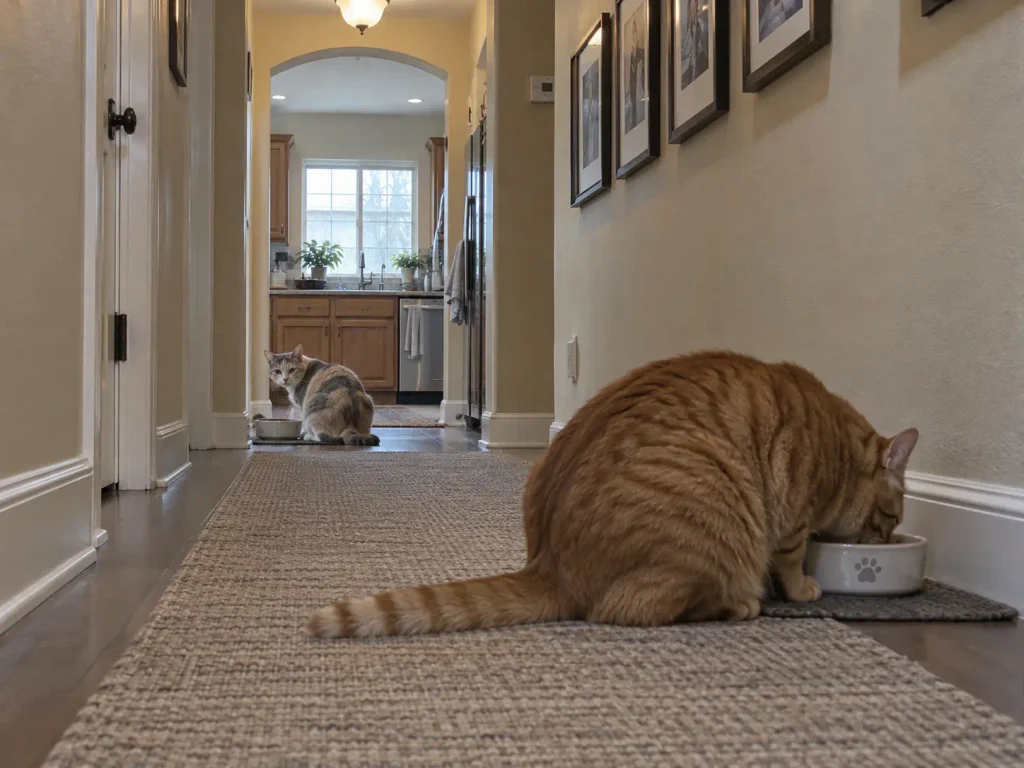
Then the second cat, which changes the whole shape of this. In a single cat house the bowl is the measurement: what went in is what he got. In a multi-cat household that stops being true the moment both of them eat in the same place.
With two cats, a topper on a shared bowl is not a dose, it is a race. Whoever eats first and fastest takes most of the added water, and it is almost never the cat you were worried about. The slow, careful, under-drinking one is the one who gets there to find the wet part gone and the dry part waiting. You have been dosing the wrong cat for three weeks and the bowl gave you no way to know.
Separate bowls, separate rooms, same time. That is the only version of this that tells you anything. If they eat at different speeds, feed the slow one where the fast one cannot reach the bowl the moment he finishes his own, because a cat who has finished his dinner considers your other cat’s dinner to be unattended property. Shape matters here too: a shallow, wide dish means he can finish what you added instead of leaving a ring of it around a bowl his whiskers do not like, and a bowl shallow enough that he can finish it gets into the depths that actually work for wet food.
In a one-bedroom apartment, “separate rooms” usually means one bowl in the kitchen and one in the bathroom with the door pushed to. That counts. Nobody needs a dedicated feeding station in each room, and the pictures of matching double bowls on a mat are working against you here, because a shared feeding station is the exact arrangement that makes the dose unmeasurable. You need enough distance and enough of a visual break that neither cat is eating with one eye on the other, and in a small apartment a door at forty-five degrees does that job.
Set a timer when the bowl goes down. Not for the cat, for you. The water you added is what shortened the window, and nobody remembers that at four in the afternoon with the laundry going.
Conclusion
Three things to carry out of here. Start at one tablespoon per meal and move up only when the last rung came back finished — the number is the method, and what you add matters far less than how fast you added it. If he takes the topper and leaves the food, change the base to a pâté before you change anything else, because you are removing a choice rather than winning an argument. And plain water plus the water off a can of tuna costs nothing and works for most cats. Read the label on anything that comes in a carton, and if it says onion or garlic, it does not go in the bowl.
Come back to this in three weeks. What you are looking for is not dramatic: is the bowl still coming back empty, or has it quietly started coming back with a little left in it every time? That drift is the ladder telling you it went up one rung too many, and the fix is to go back down and stay there.
One tablespoon of tap water, twice a day, is the entire method. Everything else on this page is flavor you add only if the free version was not enough.
Amazon’s Audible — free for 30 days
Your cat won’t let you read. Let someone read to you.
Audible is Amazon’s audiobook library — thousands of titles, read out loud, on your phone. Free for a month, plus one audiobook to keep forever.
Frequently Asked Questions
01How can I add moisture to dry cat food?
Mix in about a tablespoon of warm water per meal and let it stand a minute or two before serving. Warm water lifts the smell, which is most of how a cat decides whether something still counts as food. Soaked kibble should not sit out longer than about 30 minutes.
02How can I rehydrate my cat’s food?
Add water gradually rather than all at once: a tablespoon per meal, held two or three days, then another if the bowl keeps coming back empty. Pâté-style wet food takes added water better than gravy style, because a cat can lick gravy off and leave the rest behind.
03Is it normal for cats to drink less water when eating wet food?
Yes. A canned meal carries six to nine tablespoons of water where a kibble serving carries about half a tablespoon, so a wet food cat gets most of his daily requirement from the food bowl rather than the water bowl. An untouched water bowl is not automatically a problem.
04Can I put chicken broth in my cat’s food?
Only if it is plain and homemade: bones simmered in water with nothing else added. Most supermarket broths list onion or garlic, which damage a cat’s red blood cells, and a single cup can carry many times a cat’s entire daily sodium allowance.
05What is the fastest way to hydrate a cat?
If a cat has stopped drinking and eating altogether, that is a vet visit and not something to solve at the bowl. For a cat eating normally but drinking little, the fastest change you control is moving part of the meal to wet food, which carries more water than any topper.
Leave a comment