How Long Can a Cat Go Without Water? Days, Not Hours
Vets say 2-4 days, and they disagree on purpose. Dehydration signs by 24 hours, 8 for a kitten + why a full bowl proves nothing (evaporation, cat #2).

Alfredo RamsesFounder · September 21, 2026 · 20 min read

On this page9 sections
- 1The Honest Number, and Why No Vet Will Give You Just One
- 2Where the Clock Stops Being Yours and Becomes the Vet's
- 3The Two Checks You Can Run Standing Over the Cat
- 4The Bowl Looks Full and That Tells You Almost Nothing
- 5With More Than One Cat, the Clock Restarts From the Wrong Moment
- 6What the Apartment Is Doing to a Bowl That Looks Fine
- 7Raising Intake Without Turning It Into a Project
- 8Conclusion
- 9Frequently Asked Questions
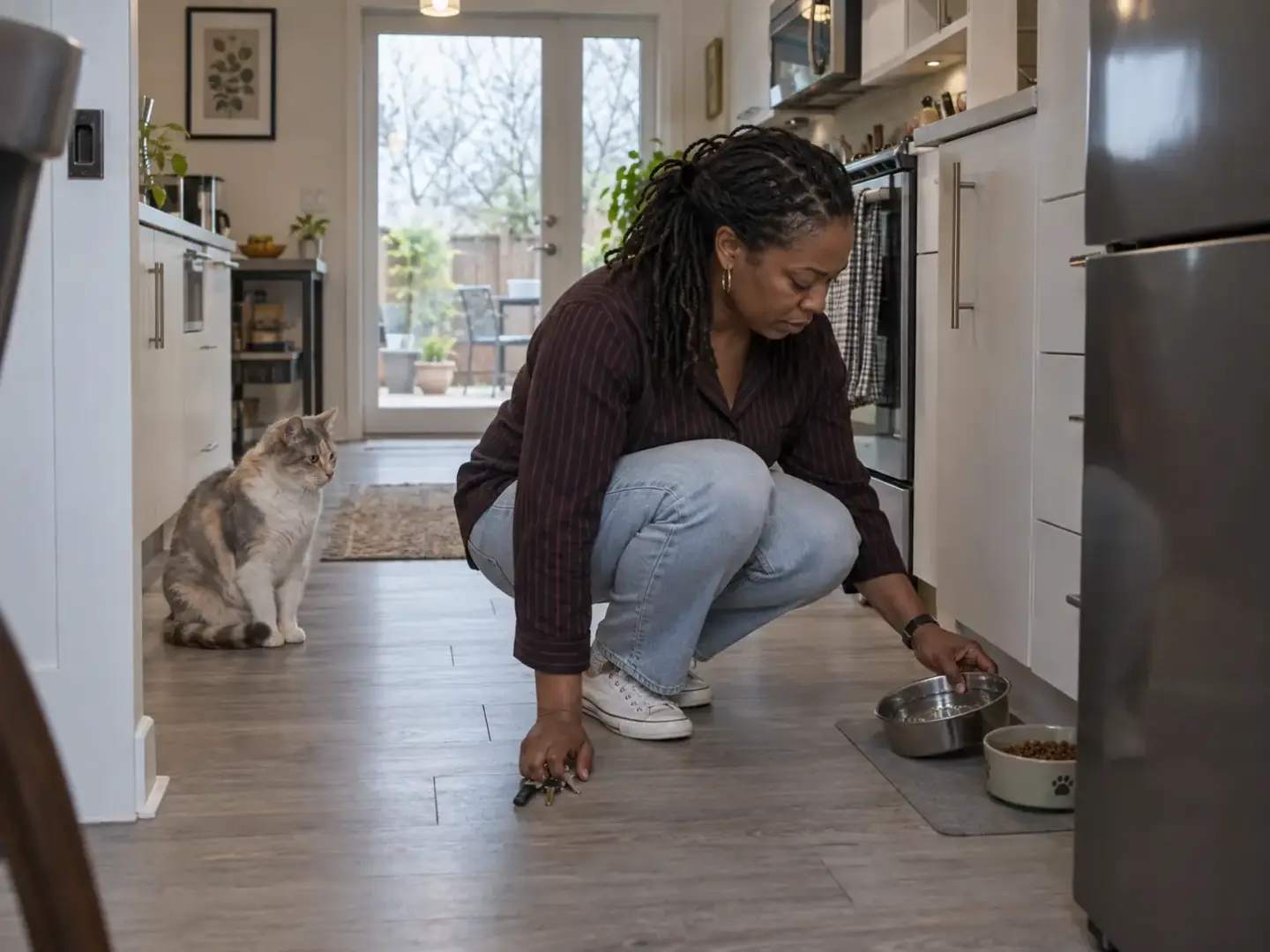
You reach for the water bowl at the end of the day and the level is exactly where you left it this morning. Same ring on the ceramic, same tiny bit of dust floating on top.
Nobody has touched it, and now you are standing in your kitchen trying to remember whether that is normal for this cat or the first sign of something. Here is the honest part nobody leads with: the vets who answer this question do not agree with each other on the number, and the range they give runs from two days to four. That disagreement is the most useful thing on this page, and below you get the real range, the exact point where this stops being your problem and becomes a phone call, and why a full-looking bowl is one of the worst instruments you could possibly use to make that decision.
Quick Answer
A healthy adult cat starts showing signs of dehydration at around 24 hours without water, and vets put survival somewhere between two and four days. Nobody agrees on the exact ceiling because no controlled study exists. Treat 24 hours as the moment you look closely, not the moment you relax.
The Honest Number, and Why No Vet Will Give You Just One
Start with what the sources actually say, because the spread matters. Signs of dehydration show up in a healthy adult cat at around the 24-hour mark, and survival past three or four days is unlikely. A DVM writing for Daily Paws puts the ceiling tighter still, at two to three days once that first day has passed. Two reputable veterinary sources, two different numbers, and both of them published with a straight face.
That is not sloppiness. There is no controlled study on how long a cat survives without water, for reasons that should be obvious, so there is no hour 71 where a cat is fine and hour 73 where he is not, and 72 hours is a headline, not a threshold. What exists is a range that veterinarians converge on from clinical experience, and a range is the honest shape of the answer. Any article that hands you one confident number made it up, or rounded somebody else’s guess and dropped the hedge.
There is a second reason the number slides around, and it has nothing to do with medicine. Wet food is 70 to 80% water, and dry food is around ten percent. A cat eating canned food pulls most of his daily intake through his dinner, which means he may visit the bowl once a day, or functionally never, and be completely fine. The Cornell Feline Health Center notes that normal intake is roughly four ounces of water per five pounds of lean weight per day, and that total counts everything: bowl, fountain, food moisture, the drips he steals off the bathroom sink. If you want the full arithmetic on what that works out to for your cat, how much water a cat actually needs in a day breaks the ounces down by weight and by diet.
Which is why the question people type into Google is almost never the question they mean. Search “how long can a cat go without water” and you get a timeline. Read the forum threads underneath and the real question is always the same one, asked five different ways: is this normal for my cat? Those are not the same question, and the second one has a better answer.
The range is not permission. Neither source is telling you that you have two days to work with. Both are telling you that by hour 24 you are already late to start looking, and the back end of the range describes how bad it gets, not how long you get.
Where the Clock Stops Being Yours and Becomes the Vet’s
Most people reading this do not need a survival timeline. They need permission to stop arguing with themselves. So here is the line, stated plainly, before any of the furniture advice.
Twenty-four hours with no water in a healthy adult cat with nothing else going on is your cue to look closely. Not panic. Look closely, run the two checks in the next section, and start counting properly.
As Dr. Nat Scroggie, MRCVS, puts it, “We start to see signs of dehydration in healthy adult cats by around 24 hours without water.” Around. By. Both of those words are doing work.
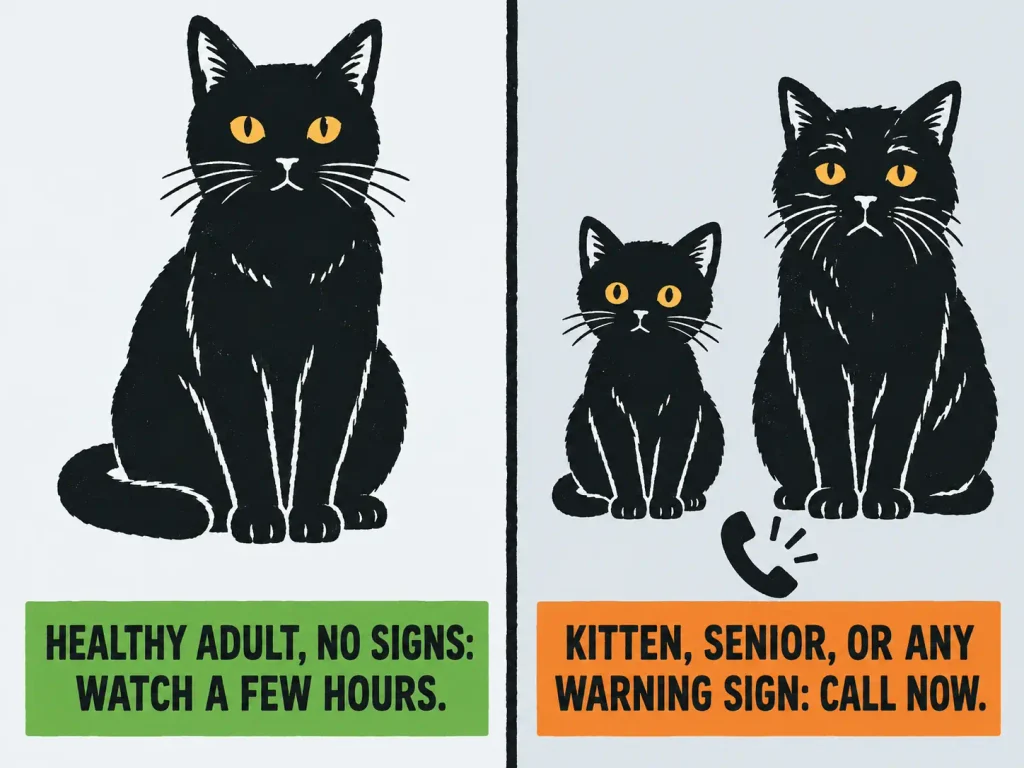
And the clock shortens on its own for three groups. A kitten can show signs in as little as eight hours, which means “wait and see” is simply the wrong instrument for a young cat. A senior cat has less margin in every direction. And any cat who has stopped eating as well as drinking is in a different conversation entirely, because water-only survival is much shorter than food-only survival and the two get flattened together constantly in headlines.
Then there is the list that ends the deliberation. If you see any of these alongside the empty bowl, the clock is not yours anymore:
- Vomiting or diarrhea, either one, at any point in the same window.
- Lethargy or weakness, meaning he is not just sleeping more but is slow to respond when he does get up.
- A decreased appetite arriving at the same time as the drop in drinking.
- Gums that feel dry or tacky instead of wet and slippery, or gum color that has gone pale rather than pink.
- Sunken eyes.
- Urinating noticeably less, or litter box straining.
- He is a kitten, a senior, or a cat who has also stopped eating.
The one about urinating is the hardest to judge, because most people have no idea what their cat’s normal output looks like; how often you should be scooping, per cat per day gives you the baseline to measure a drop against.
This article does not tell you what any of those mean. That is on purpose and it is the whole editorial line here: those signs are the vet’s to interpret, not ours, and a page that explains them to you is a page that helps you wait longer. Everything past this section assumes the vet has already told you the cat is fine.
For a healthy adult cat with none of those signs, watching for a few hours is a reasonable call. For a kitten or a senior, it is not a call at all.
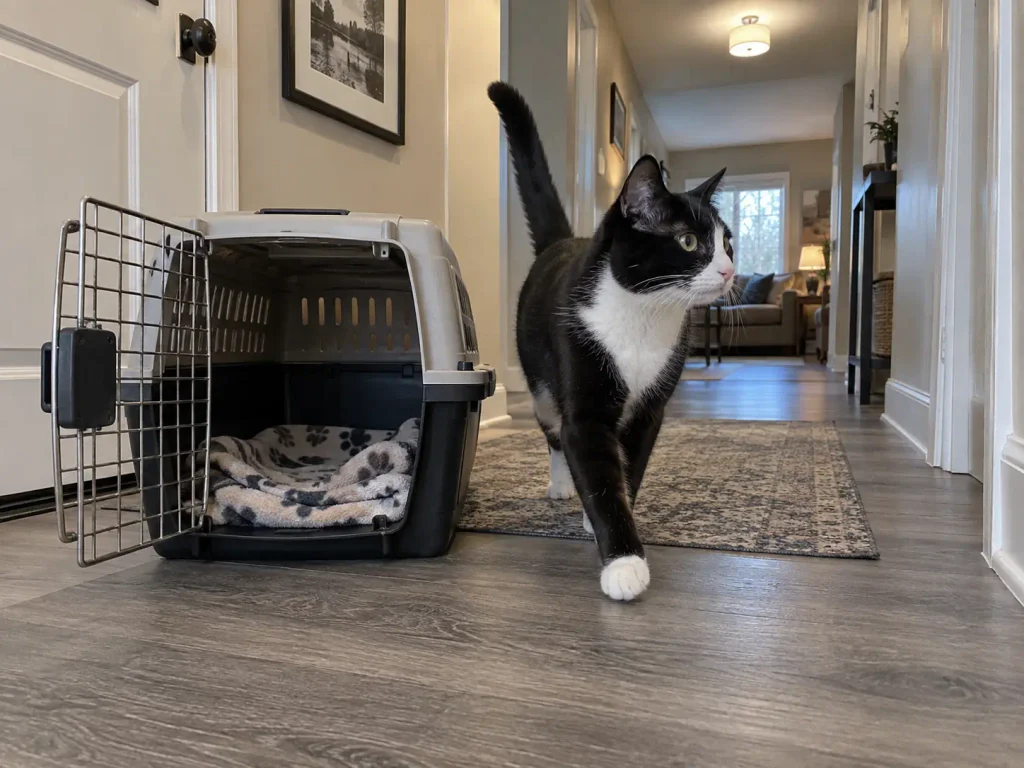
Out of hours, that means the emergency vet rather than waiting for your own clinic to open, and the cost of phoning too early is one consultation fee. The other side of that trade does not have a price you would accept, and the pattern that shows up over and over in forum threads is somebody deciding to see how the weekend goes. Do not see how the weekend goes.
The Two Checks You Can Run Standing Over the Cat
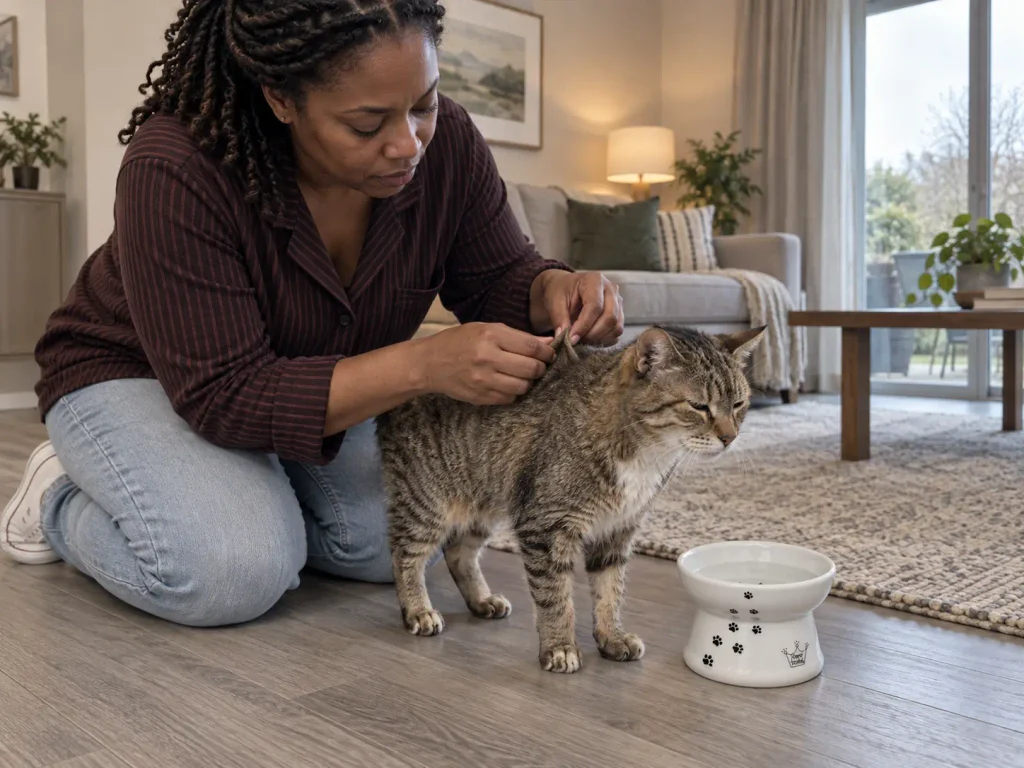
Between “the bowl is full” and “I am calling the vet” there is a wide gap where most people have nothing to do except worry. Two free checks fill it, and both take under ten seconds.
The skin tent test is the one everyone knows. Lift a fold of skin between the shoulder blades, let go, and watch. On a well-hydrated cat it drops back almost instantly. If it stays standing, even for a second, that is a signal.
The gum check is the one people skip. Press a finger against the gum and look: healthy gums are pink, wet and slippery. Dry or tacky is a signal.
Here is the part almost nobody publishes, and it is the reason to run both. Skin turgor is unreliable on old and very thin cats, because they can tent like a dehydrated cat while being perfectly hydrated, because the elasticity is gone from the skin regardless. It fails the other direction too: an overweight cat can snap back normally while genuinely dehydrated.
So on a senior, a skinny cat, or a heavy cat, the skin test alone is not a result. It is half a result, and the gums are the other half. Run both or run neither.
And the rest of Cornell’s list (lethargy, weakness, loss of appetite, sunken eyes, reduced urination) works the same way. It is a set, not a menu. One sign in isolation on a cat who is otherwise bright and eating is a very different picture from three of them stacking up on a Tuesday afternoon.
There is an odd overlap worth naming while we are here. The cat whose skin test you cannot trust is usually the older cat, and the older cat is often the one for whom crouching all the way to a floor-level bowl has quietly become work.
Raising the bowl a few inches removes that barrier, and the Necoichi Ceramic Elevated Cat Food Bowl sits at about the height of a closed fist, wide enough that whiskers never touch the sides. The caveat is real and goes in writing: elevation does not suit every cat, and a short-legged cat can find a raised bowl worse than the floor. It is a furniture adjustment for a cat who finds bending down awkward, and it is not an answer to a dehydration sign. Those go to the phone, not to the store.
On a cat over about ten, treat the skin test and the gum check as one procedure with two halves. Doing only the skin fold on an old cat is how people talk themselves into waiting, in both directions: a false tent sends them to the clinic in a panic, and a normal-looking fold on a thin senior tells them nothing at all.
The Bowl Looks Full and That Tells You Almost Nothing
This is the section that should change how you watch your cat, so it gets the most room.
You have been using the water level as your instrument. Everyone does. It is the only thing in the room that appears to keep a record. The trouble is that a bowl measures the volume of water in a bowl, and you are trying to measure how much a specific cat drank, and those two numbers are connected by about four different variables that nobody mentions.
Evaporation moves the line on its own. Heat and climate do it for you: a wide, shallow bowl in a heated apartment loses a visible amount of water over a day with nothing living going anywhere near it. You come home, the level is down, and your brain files it as “he drank.” Nothing drank. The radiator did.
A second cat holds the line steady. In a two-cat house, the daily drop looks exactly like it always has, because it is still one cat’s worth of water leaving the bowl. Only now it is all coming from one cat. The bowl is reporting a household total and you are reading it as an individual, which can run for a week before anything looks wrong.
And there is almost always a water source you have not counted. A tap that drips, the glass on your nightstand, the bathtub after a shower, the condensation tray under a plant pot. Cats are opportunists about water in a way they are about very little else, and every one of those sips is invisible to your instrument. This one cuts the reassuring way as often as the alarming way, which is exactly why the bowl cannot be trusted in either direction.
The forums have a name for the trap this creates. “Topping off” — pouring a splash into a bowl that only lost water to evaporation, seeing the level come back up, and walking away satisfied. You just erased the one piece of evidence you had and replaced it with a feeling.
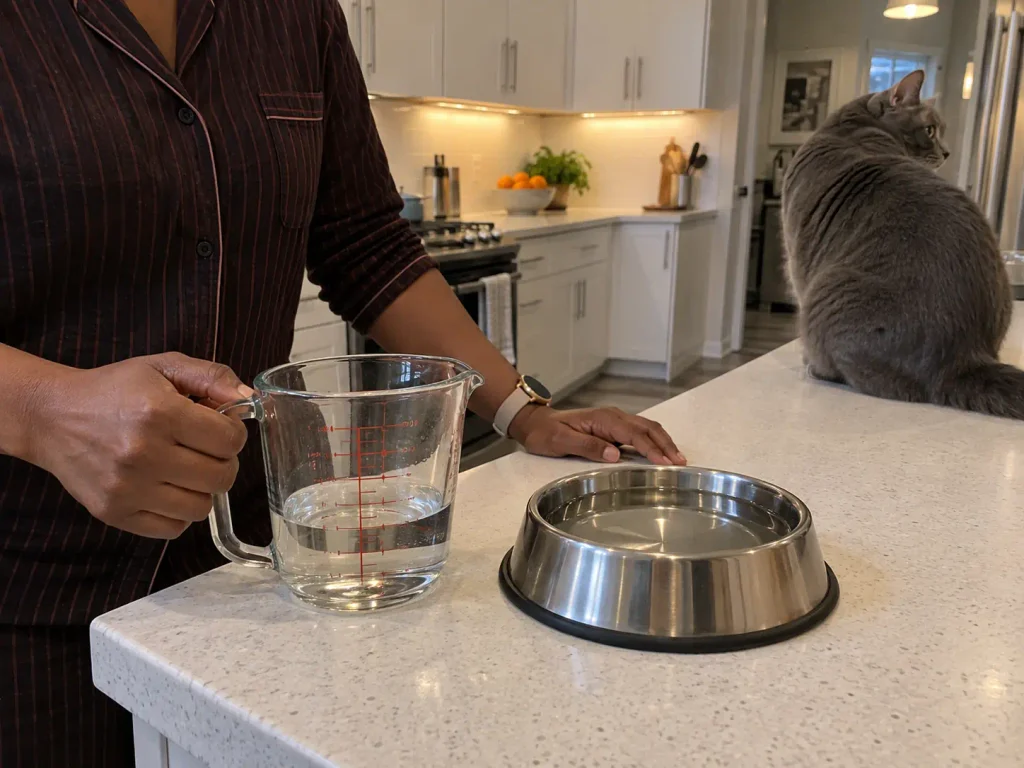
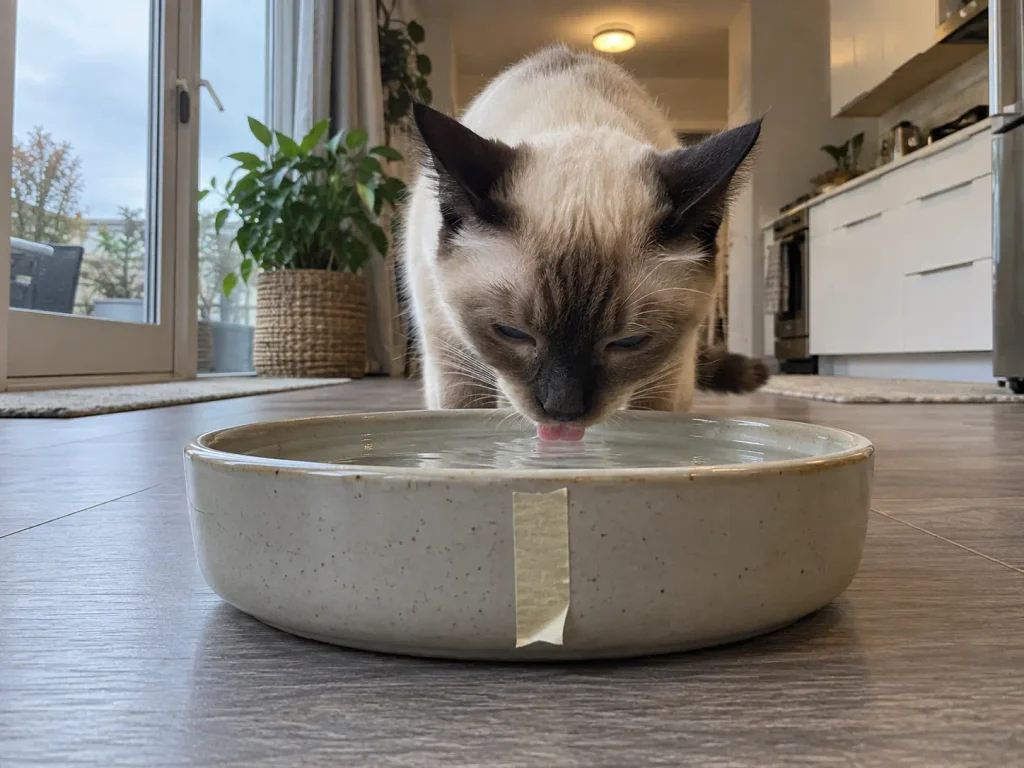
The fix costs nothing and takes a week. Put a strip of tape on the outside of the bowl at the fill line, or fill it from a measuring jug once a day at the same time and write the number down.
Seven days of water intake tracking gives you something the eye cannot give you: this cat’s actual baseline. And the baseline is what the whole question turns on, because the useful signal was never the absolute number. A wet-food cat who barely visits the bowl is not in trouble. That same cat suddenly drinking twice what he normally does is worth a call, and you will only catch it if you knew what his normal looked like.
The same logic applies to freshness, incidentally — a bowl that looks full does not look old either, and water in a fountain runs on three separate clocks that have nothing to do with the level.
One strip of tape, one week, and you stop guessing forever. Do it now, while nothing is wrong. A baseline collected during a calm week is worth ten times a baseline you try to establish on the day you are already frightened, because on that day every number looks like evidence.
With More Than One Cat, the Clock Restarts From the Wrong Moment
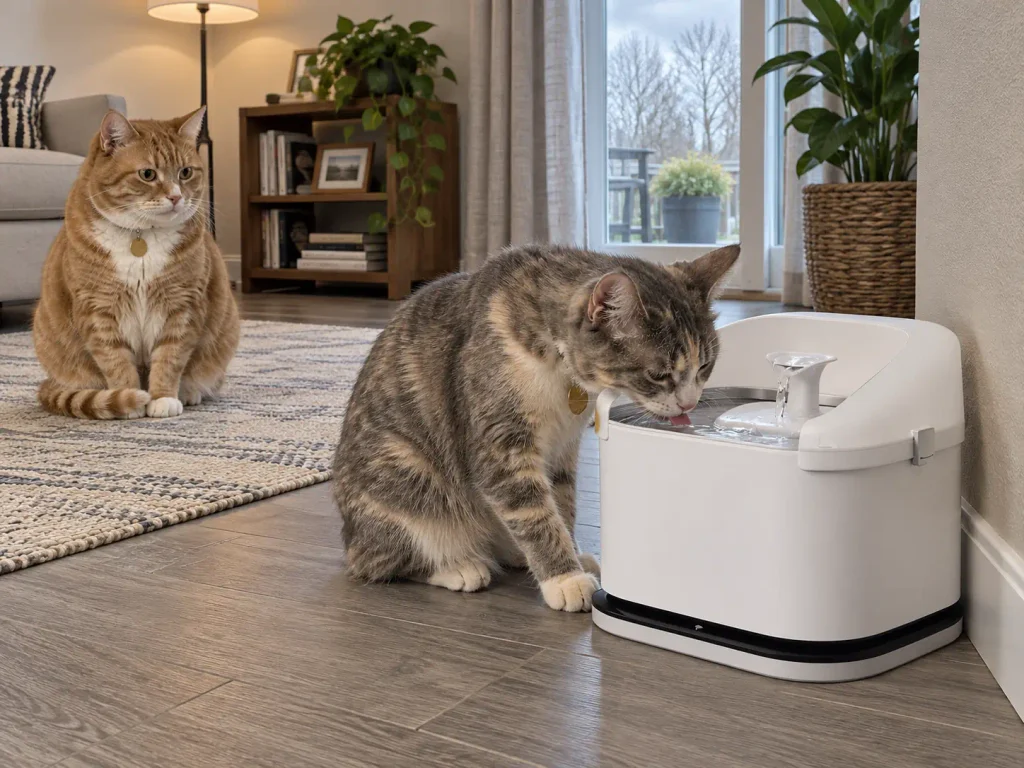
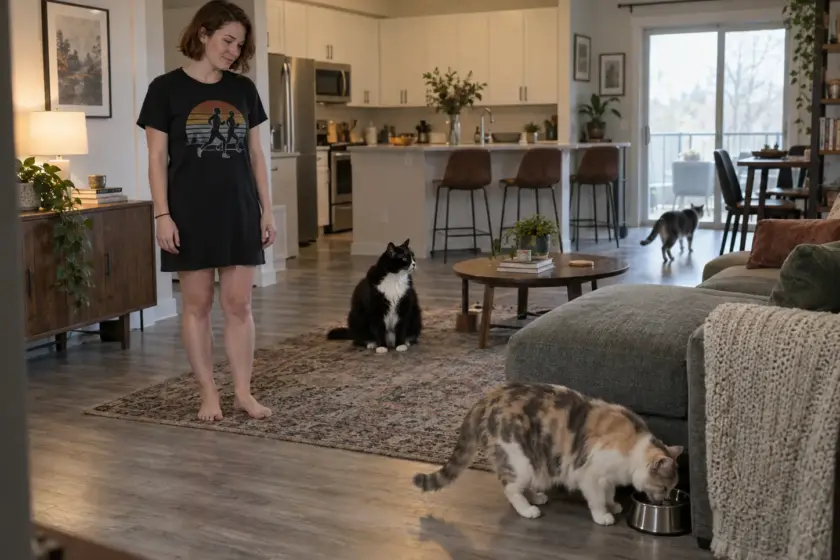
Two cats, one bowl, and the level drops every day the way it always has. Everything looks normal. And it can look normal for a week while only one of them is drinking. One cat versus multiple cats is not a footnote on this question: it changes which number you are even allowed to use.
This is where the 24-hour rule quietly breaks, and it breaks in a specific, fixable way. In a shared-bowl house, the clock does not start when you last filled the bowl. It starts the last time you actually watched that specific cat drink. Read that again against how you have been counting, because in most multi-cat households those two events are days apart. Every article on this subject hands you a 24-hour marker built for a one-cat house and never mentions that you have no way to apply it.
And this is not a house theory. Cornell names territorial conflict between cats over resources as a recognized cause of one cat being effectively shut out of the water bowl. It rarely looks like a fight. It looks like one cat sitting in the doorway of the kitchen, and the other one deciding he is not thirsty right now, and that decision repeating for a week.
The free fix is first, as always. Separate the cats briefly, even just at mealtimes, into different rooms with their own marked bowl. Two days of that tells you which cat’s intake actually changed, which is the single piece of information you cannot get any other way without spending money. It is slow and mildly annoying and it works.
While you are at it, add a second water station in a different room permanently, because multiple water sources are what stop a single water point becoming a resource one cat can control. The full case for that arithmetic is in why two cats need two bowls plus one.
When separating them is not realistic (one-bedroom apartment, two cats who do not take kindly to closed doors), there is a paid answer to the same blind spot. The PETLIBRO RFID Multi Cats Water Fountain holds 101 ounces and reads a tag on the collar, so each cat’s visits get logged separately instead of averaging into one useless household number. It is the most expensive thing on this page, it needs a collar the cat will tolerate, and it deserves the same caveat everything else here gets: it measures visits, not health.
It can tell you which cat changed. It cannot tell you why, and it is not a reason to delay a call. The separation trick does the same detective work for free, just slower.
What the Apartment Is Doing to a Bowl That Looks Fine
Once the vet has cleared him, the question becomes ordinary again: why is this cat avoiding a bowl with nothing wrong with it? In an apartment, the answer is usually water bowl placement, and usually a spot you chose for reasons that made sense to you and none to him.
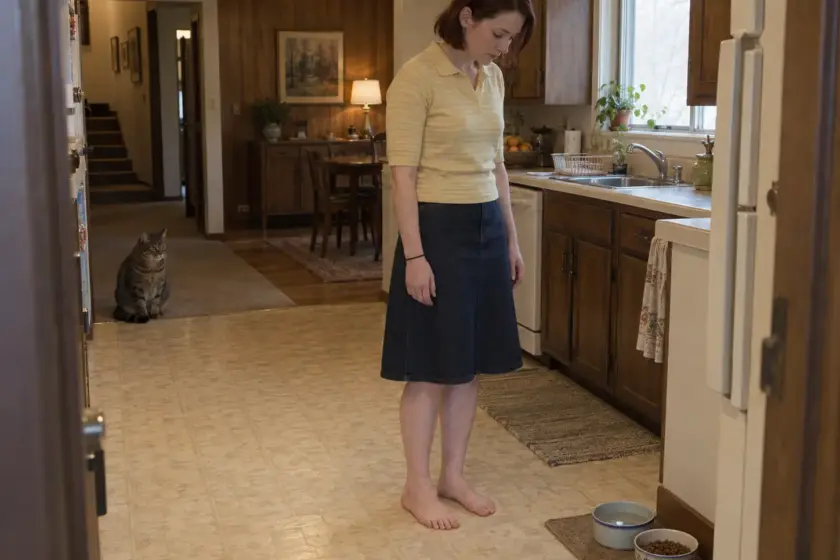
The free fix goes first and it is the highest-yield thing on this entire page. Move the water away from the food, and move both away from the litter box. Cats prefer their water source physically separate from where they eat, and that preference is strong enough to override thirst for a while. In a small apartment those three things end up within six feet of each other because that is where the tile is, and the cat has been objecting to the arrangement the only way available to him. Moving a bowl ten feet costs nothing and resolves this more often than any purchase will.
Then the apartment-specific list, which competitors write as “stress” and leave there. In a small space it comes down to two things: noise near the water bowl, and foot traffic behind it.
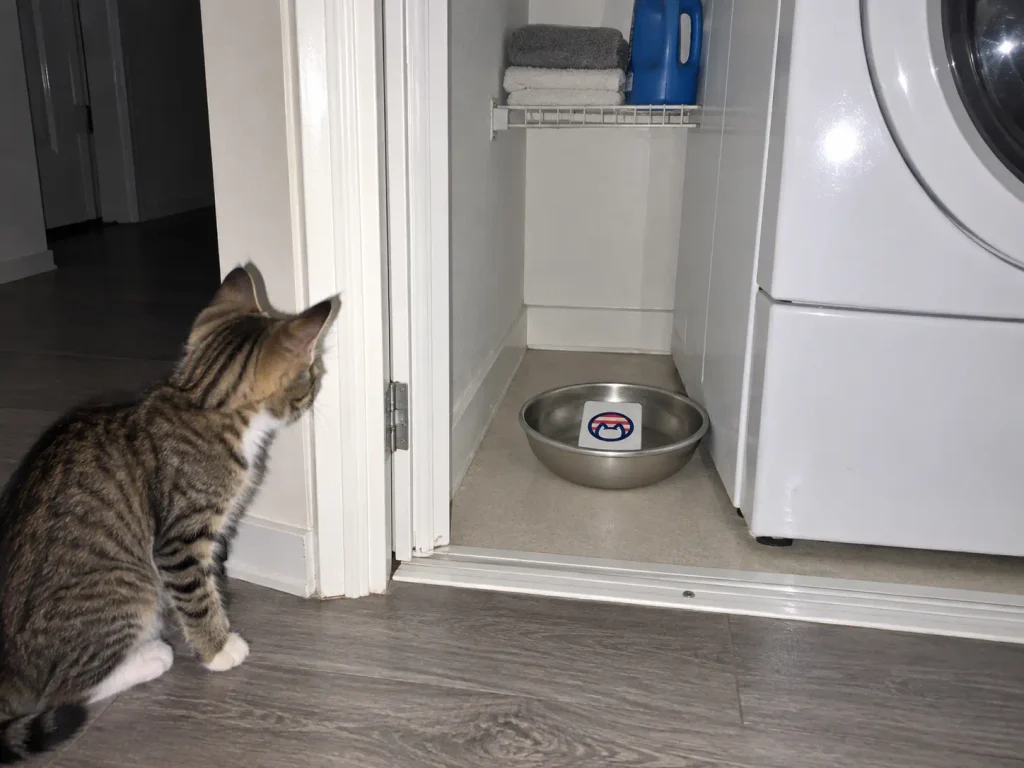
A bowl parked against the washing machine gets abandoned the first time a spin cycle starts while he has his head down. Same for a bowl next to an AC unit, a radiator that ticks, or a fridge compressor that kicks in unpredictably: noise near the water bowl is the single most underrated reason a good bowl goes unused. A bowl in a hallway puts him in the one spot where somebody walks past his back while he is committed, head lowered, in a position he cannot leave quickly.
Neither of those is fussiness. Both are a cat declining to drink somewhere he cannot watch the room, which is a reasonable position for a small animal to hold. If the noise is the part you cannot move away from, the quiet-fountain problem is worked through properly there.
And there are the triggers that have a date attached. A cat shut in a bedroom by accident for an afternoon. A move, a renovation, a week of furniture in the wrong place. A routine that broke.
These are real causes of reduced drinking with nothing medical behind them, they resolve on their own once the house settles, and they are worth remembering before you conclude something is wrong.
If relocation helps but does not fully fix it, the bowl itself is the next variable rather than the first. The Americat Company Stainless Steel Cat Bowls come as a pair in food-grade 18/8 steel, which makes them the efficient way to build that second water station and get out of plastic at the same time.
Wide and shallow, about the footprint of a large saucer, not a deep well that presses on his whiskers with every mouthful.
Material matters less than placement, but it is not nothing: a ceramic bowl or a stainless steel bowl both wash properly, while bowl cleanliness on plastic is a losing battle once the surface scratches, and a plastic bowl allergy is a real if uncommon reason for a cat to keep his chin off the rim. The honest caveat: if the problem was where the bowl was sitting, a new bowl in the same spot changes nothing at all. This is step two. Step one was free.
Move the bowl you already own before you buy a different one. Pick somewhere with no noise near the water bowl and nobody walking behind it, and give the new spot four days, because a cat needs to find it before he can decide about it. If the drinking picks up, you have solved it for the price of walking across the room.
Raising Intake Without Turning It Into a Project
Once the scare has passed, the question changes shape. It stops being how long he can last and becomes how to get more water into him without a daily argument. Ordered from free to expensive, which is also roughly the order of what works.
Food moves more water than any accessory. Wet food is 70 to 80% water, so switching a single meal a day from dry to canned shifts more fluid than a fountain ever will. That is not a marketing claim, it is arithmetic, and it is why a cat on an all-wet diet can go days without visiting a bowl and be in no difficulty whatsoever.
More water points beat one better water point. Two ordinary bowls in two rooms outperform one excellent bowl in the kitchen, for the same reason the multi-cat section gave: a single station is a single point of failure, both territorially and geographically. Then material and cleanliness, which matter more than they sound like they should. A plastic bowl that has been scratched holds a film and a faint smell that you cannot detect and he can, and a bowl that gets rinsed rather than washed develops a slick you would not drink from either.
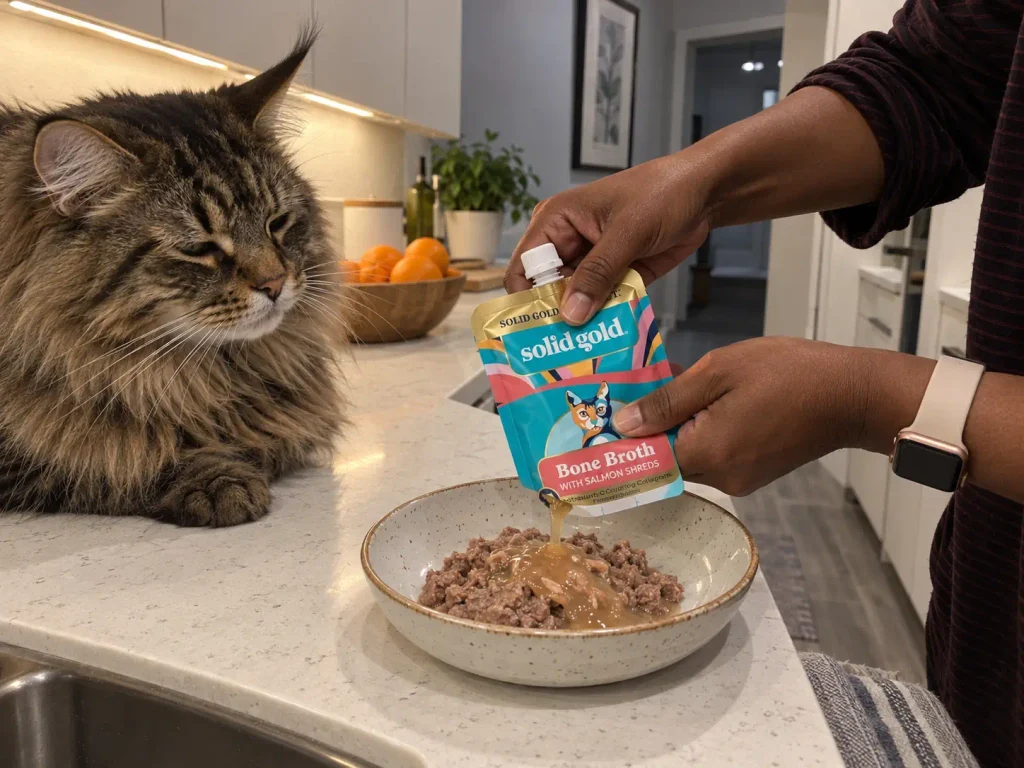
For the cat who rejects the switch to wet food outright, and some will, loudly, for weeks, the Solid Gold Bone Broth Cat Food Topper is a bridge. Lickable pouches poured over the usual kibble, which gets moisture in without asking him to accept a whole new texture in one go. Caveat in plain terms: it is a topper, not a meal, and a can of ordinary wet food does the same job for less. It is a hydration tool and nothing more than that.
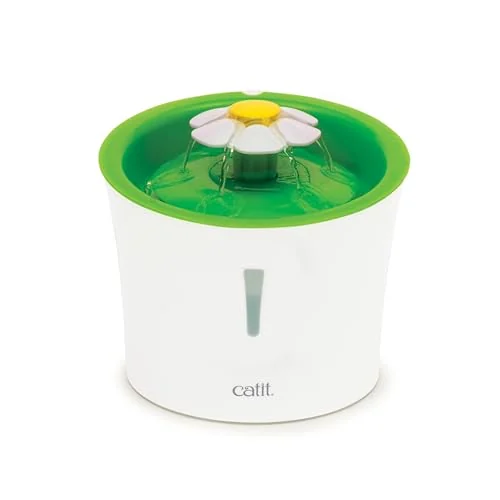
Running water is the last rung, and it is genuinely last. Some cats drink far more from a fountain and some ignore it completely, and there is no way to know which yours is until you own one.
The research is less impressive than the marketing too, which the study on whether fountains actually raise intake covers without softening it. If you are buying one anyway, the PetSafe Drinkwell Stainless 360 holds 128 ounces in stainless steel, which in practice means a multi-cat house refills it far less often and there is no plastic reservoir slowly acquiring a biofilm. The catch is the pump: it needs real disassembly and cleaning on a schedule, and a neglected fountain just relocates the problem you were solving.
And if you want to test the whole fountain theory before committing to the expensive version, do not.
None of these is the first move. The first move is still moving the bowl.
Conclusion
Three things to carry out of here. At 24 hours without water you stop waiting and start looking — run both checks, count properly, and with a kitten or a senior cat skip the looking and make the call. The bowl is not a measuring instrument, and a strip of tape on the side of it for one week will tell you more about your cat than a year of glancing at the water level. And before you buy anything, move the bowl away from the food, away from the litter box, and away from whatever in your apartment makes noise without warning.
Come back to this in three weeks, not three months. That is long enough for a new water station to prove whether it is actually being used or just being ignored politely, and long enough to see whether your taped baseline held. In a multi-cat house, add one more item to that three-week check: have you personally watched each cat drink recently, with your own eyes? If you cannot answer that, you are back to counting from the wrong moment.
Move the bowl ten feet. If it works, you just saved yourself the fountain.
Amazon’s Audible — free for 30 days
Your cat won’t let you read. Let someone read to you.
Audible is Amazon’s audiobook library — thousands of titles, read out loud, on your phone. Free for a month, plus one audiobook to keep forever.
Frequently Asked Questions
01What happens if a cat doesn’t drink water for 3 days?
Three days sits at or past the outer edge of every range vets give, and it is not somewhere to find out. Signs of dehydration begin around the 24-hour mark; by day three a cat needs a veterinarian, not a different bowl.
02What is the 3-3-3 rule for cats?
It describes a newly adopted cat settling in: three days hiding, three weeks learning the routine, three months feeling at home. It has nothing to do with water or hydration. The numbers get it confused with survival timelines in search results.
03How can I tell if my cat is dehydrated without going to the vet?
Two free checks: lift a fold of skin between the shoulder blades and see whether it drops straight back, and press a finger to the gums to see whether they stay pink and wet. On a senior or very thin cat the skin tent test alone is unreliable, so run both. Neither replaces a vet visit; they tell you how fast to make the call.
04My cat eats wet food and I never see him drink. Is that a problem?
Usually not. Wet food is up to 70 to 80% water, so a cat on an all-wet diet can go a long stretch without visiting the bowl and still be well hydrated. What matters is a change from that cat’s own normal, not the absolute number of visits.
05How do I know which of my cats stopped drinking?
You cannot tell from a shared bowl, because the level drops the same either way. Separate them briefly with individually marked bowls, or use a fountain that reads a collar tag and logs each cat’s visits. Until then, count the clock from the last time you actually saw that specific cat drink.
Leave a comment