Automatic Litter Box for 3 Cats — Where It Breaks
Automatic litter box for 3 cats: 12L drawers drop from 14 days to 5-7, the cycle timer resets on every cat, and no brand publishes a 3-cat number.

Alfredo RamsesFounder · Updated August 26, 2026 · 21 min read

On this page8 sections
- 1The Number on the Box Was Measured With One Cat
- 2Which Capacity Tier Actually Holds Three Cats
- 3Three Cats, One Seven-Minute Clock
- 4The Camera Does Not Know You Have Three Cats
- 5One Machine Is One Door, and Three Cats Notice
- 6One Unit or Two, and the Cheaper Answer
- 7The Short Version
- 8Frequently Asked Questions
The box said eight days. It is Wednesday, you bought the thing on Sunday, and the waste drawer is already full. Nothing is broken, and you did not do anything wrong. You bought a number that was measured in a house with one cat in it, and no part of the packaging says so.
An automatic litter box for 3 cats works, but it works on a completely different schedule than the one you were sold, and the interesting part is not the drawer. It is what happens to the clock, the camera, and the single door when a third cat joins the queue.
Quick Answer
One automatic unit can serve three cats. Here is what actually changes when it does.
- Expect to empty it every two to four days, not the printed eight to fourteen.
- Buy drawer volume for days, not for immunity: three cats roughly halve any interval.
- Distrust the per-cat health data; camera and weight ID confuse similar cats.
- Add a fourth receptacle elsewhere. A cheap manual tray, not a second machine.
The Number on the Box Was Measured With One Cat
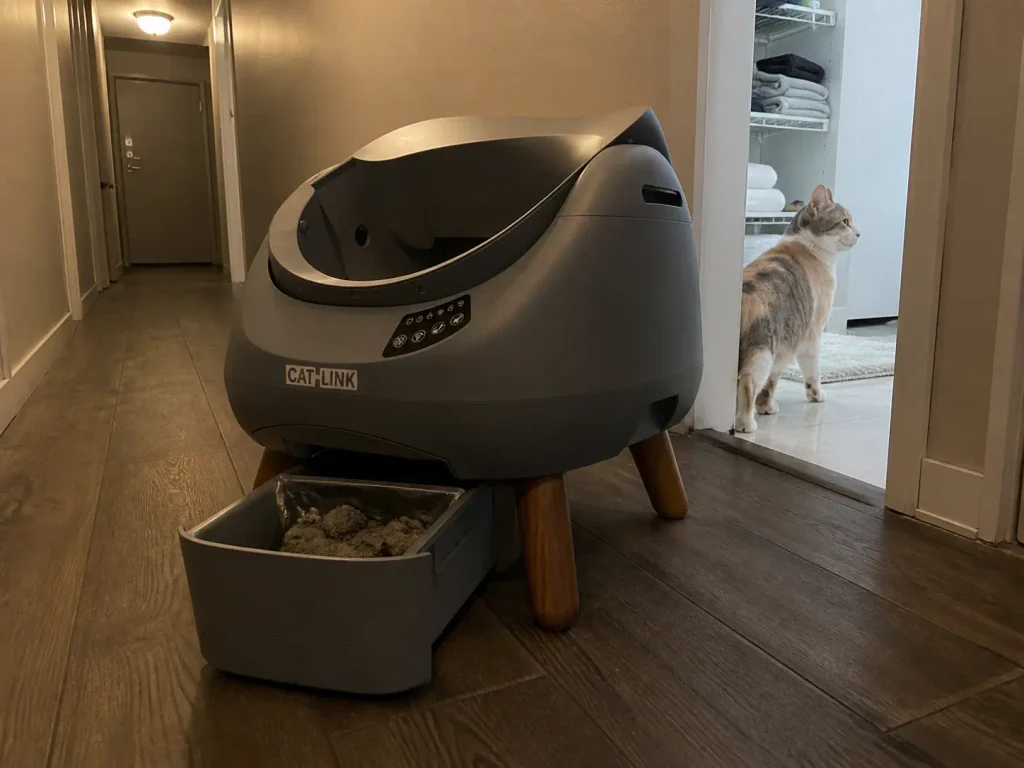
Your unit is not defective and your cats are not unusually productive. The capacity figure printed on the box is a real number that was true in a real house, and that house had one cat in it. Before you go any further, it is worth being clear that this article assumes you have already settled whether a self-cleaning box earns its place in your home at all and are now asking a narrower question: what three cats do to a machine designed around one.
Where the eight-day figure actually comes from
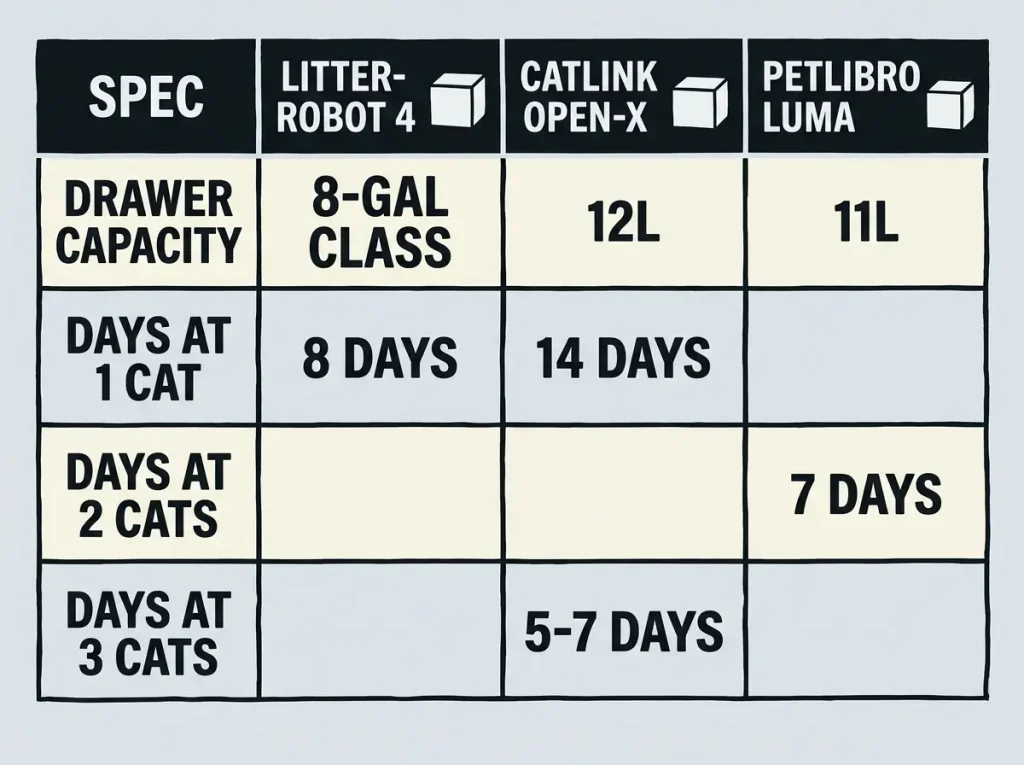
Litter-Robot’s published FAQ says the waste drawer “may only need to be emptied once every 8 days.” That sentence is accurate. It is also a one-cat sentence, and nothing on the product page, the ad, or the shipping carton flags it as such.
The same document is unusually honest a few lines down, where the manufacturer’s own FAQ notes that too many cats per unit can leave the litter bed unclean for the next use. Two claims live on one page: this unit supports four cats, and this unit may not stay clean for four cats. Only the second one describes the thing you live with.
That gap is the whole article in miniature. Brands rate their machines by cat count because it fits on a spec sheet. Cats use them by cycles per day, which does not.
Why a bigger drawer does not buy proportional time
The obvious move is to buy volume. It helps less than the math suggests.
CATLINK’s Open-X carries a 12L drawer, the biggest of the units worth considering, and the brand’s own copy puts it around fourteen days at one cat and roughly five to seven days at three. Same machine, same drawer, less than half the time. Independent capacity comparisons land in the same place from a different direction: households with two or three cats empty 10-11L drawers every three to five days, and three or more cats can push that to every other day during heavy weeks.
So doubling the drawer roughly buys you a day.
That is because container volume was never the binding constraint. Three cats produce clumps at roughly three times the rate of one cat, and each of those clumps triggers a cycle that rakes waste into the drawer whether the drawer is nearly empty or nearly full. The waste drawer fills on a schedule set by the cats, not by the liters. Buyers describe exactly this: the promise holds beautifully at two cats and quietly stops holding the week the third one arrives.
Before you decide your unit is underperforming, count the actual days between empties for one week and write the number on a sticky note stuck to the lid. That number is your interval. The one on the box belongs to a house you do not live in.
Measuring your own interval in one week
One week of counting settles arguments that months of reading reviews will not.
Empty the drawer on a Sunday, note the date, and empty it again only when it genuinely needs it. Do it twice. If you land at four days, one unit plus a backup tray is a fine setup and you can stop shopping. If you land at two, you have a queue problem, a capacity problem, or both, and the next four sections separate which.
And write the number down rather than trusting your memory of it. The interval you remember is always longer than the interval you actually keep, because the week you were annoyed enough to empty it early is the week that gets forgotten.
Which Capacity Tier Actually Holds Three Cats
Every brand sells “multi-cat” as a checkbox. The real threshold is sitting in their own spec sheets, unmarked, because framing it as a buying decision would cost them the sale of the cheaper model. The numbers below are all published by the manufacturers. Nobody arranges them side by side, which is the only arrangement that answers your question.
| Unit | Brand-rated cats | Drawer | Entry width | Cat weight range |
|---|---|---|---|---|
| Litter-Robot 4 | Up to 4 | 8-gallon class | ~15.75 in | 3-25 lbs |
| Litter-Robot EVO | Up to 2 | Smallest of the range | Compact | Brand-capped at 2 cats |
| Litter-Robot 5 | Up to 5 | Larger than the 4 | ~15.75 in | 3-30 lbs |
| CATLINK Open-X | Not cat-count rated | 12L, largest here | ~17 in | Up to 22 lbs |
The entry model the brand itself caps at two cats
The Litter-Robot EVO is rated for up to two cats by Litter-Robot’s own FAQ. That is not a reviewer’s opinion or a cautious guess. It is the manufacturer, in writing, telling a three-cat household to buy something else, and there is nothing at checkout that mentions it. This is the single most common way a three-cat buyer ends up disappointed: they bought the cheapest model in a range they trusted, and the range had already answered their question three pages deep on a support site.
If you have three cats and you are looking at the entry model to save money, save the money a different way. Buy the tier that fits and put a plastic tray in the spare room. That combination costs less than the next unit up and works better than either alone.
What the step up actually buys you
The Litter-Robot 4 is rated up to four cats with a weight range of 3-25 lbs, which is the only real headroom above three in this class. The Litter-Robot 5 extends to 3-30 lbs and up to five cats. What the step up buys is drawer volume and identification accuracy. What it does not buy, and what no unit at any tier buys, is exemption from the box-count math in the last section of this article.
I used to point three-cat households straight at the biggest unit available and call it solved. Enough three-cat threads describing the same mid-week drawer surprise changed that: the capacity tier decides how often you walk over there, and a second receptacle decides whether all three cats will use the machine at all. Those are different problems, and only one of them has a price tag attached.
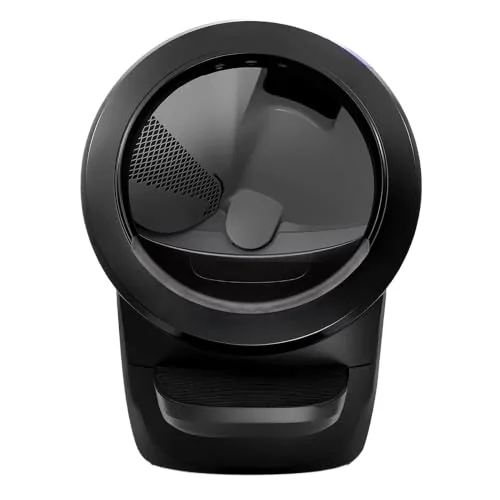
If per-cat tracking is the feature you actually want, the mid-tier option is worth knowing about before you spend at the top of the range. Read the next section before you buy it for the tracking, though, because that is the feature with the biggest gap between the marketing and the household.
The largest drawer in the class, and what it still cannot fix
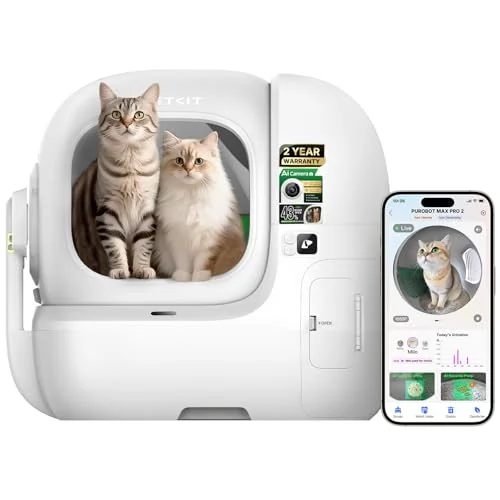
The CATLINK Open-X has the biggest drawer here at 12L, with a roughly 17-inch entry and support for cats up to 22 lbs. If you are committed to running one machine and one machine only, it buys you the most days per empty of anything in this comparison. It is a genuinely good answer to the question you asked.
It is not an answer to the question you did not ask. A wider entry and a deeper drawer do nothing about three cats needing the box in the same fifteen minutes, and nothing about one entrance being one entrance. Both of those are next.
Three Cats, One Seven-Minute Clock
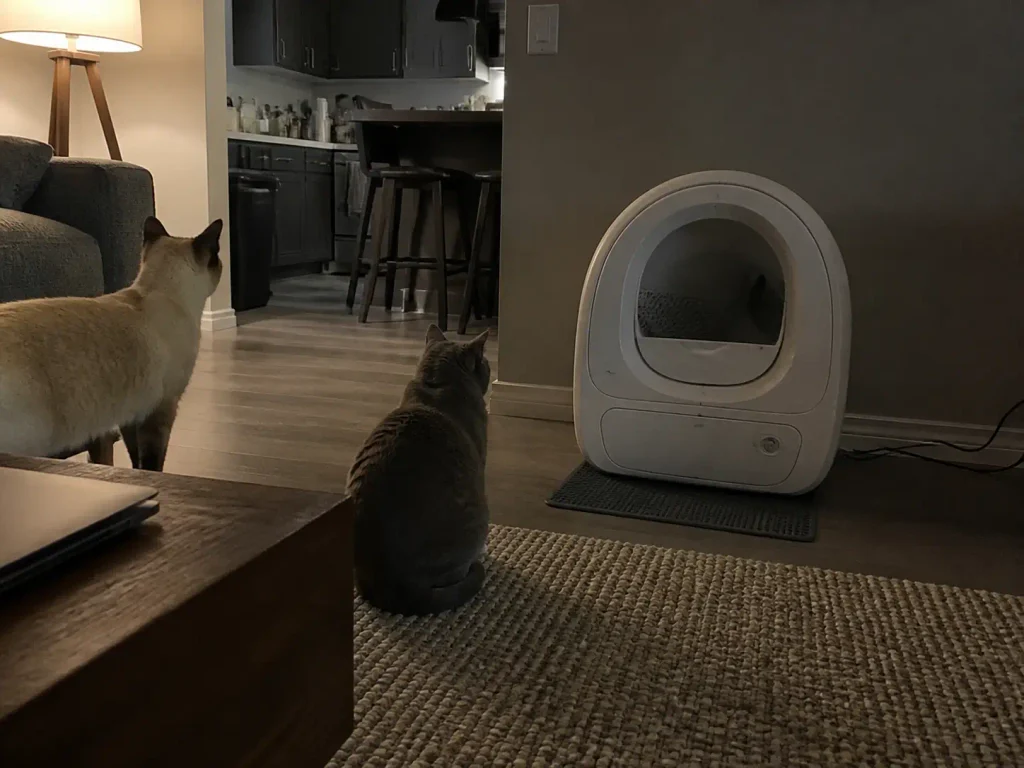
You keep finding waste sitting in the globe long past the cycle time and you assume the sensor is failing. It is working precisely as designed. It is just designed around a queue of one.
What the delay is for, and what it assumes
Litter-Robot’s default Cycle Delay is seven minutes after a cat steps out of the globe. The delay exists for a good reason: it gives the litter time to clump properly so the rake gets it in one pass, and it stops the machine from spinning up while a cat is still hovering nearby. Every automatic unit has some version of this timer. All of them assume one cat goes, one cat leaves, the timer runs, the machine cleans.
How the reset chains in a busy household
Here is the sentence that matters, and it is in the manufacturer’s own FAQ rather than in any review: if the wait is interrupted by another cat entering, the timer resets for another seven minutes. It can chain. Cat two arrives at minute five, and the clock goes back to zero. Cat three arrives at minute four of that, and it goes back to zero again.
Three cats do not spread their bathroom visits evenly across twenty-four hours.
They cluster around the same two windows you cluster around: the hour after breakfast and the hour after you get home. Which means the globe is at its dirtiest at exactly the moment it is busiest, and cleanest at three in the afternoon when nobody needs it. That is the opposite of what you paid for, and it is not a defect. It is a queue.
This is also why the cleaning schedule shifts by cat count, not by the calendar — the parts that need a manual wipe are getting used three times as hard during those same windows.
Stand where you can see the unit for ten minutes on a weekday morning, before you touch a single setting. If a second cat walks up before the cycle fires, the queue is your constraint and no drawer size or delay setting will fix it. If the cycle completes undisturbed, your problem is capacity, and that one you can buy your way out of.
Why the fix is the queue, not the setting
The instinct is to go into the app and shorten the delay.
Resist it. A shorter delay does not clear a queue, it just cleans a shallower clump and sends more litter into the drawer, which makes the capacity problem worse. Lengthening it does not help either. You cannot tune your way out of three cats and one machine, because the setting was never the problem.
What clears a queue is a second place to go. A plain tray in another room, and the chain breaks at no cost, because cat three now has somewhere to be while the machine is mid-cycle. And the cat who walks up, sniffs, and walks away is not being fussy. He found the globe uncycled and made a completely reasonable decision about it.
The Camera Does Not Know You Have Three Cats
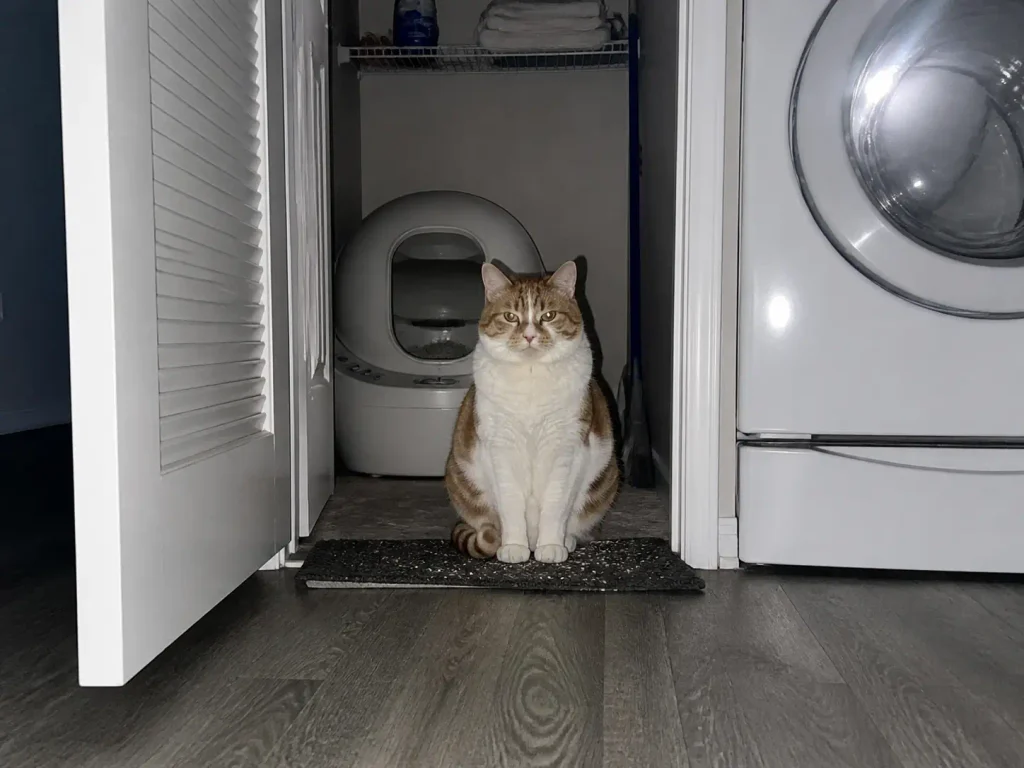
You paid extra for the tracking because you wanted to know which cat is going less often than usual. With three cats, that is the feature most likely to be quietly wrong, and quietly wrong is worse than absent.
How camera ID confuses two similar cats
Independent reviewer testing of PETKIT’s camera-based identification found it mixing up two cats. Two. The system was not being asked to do anything exotic; it was matching a cat entering a box against the profiles it had. Three cats do not give that system a harder version of the same job, they give it more chances per day to make the same mistake, and every wrong attribution lands in a log you are going to read later as if it were data.
Coloring matters more than people expect. Two black cats of similar build are close to indistinguishable to a camera at that angle in that light, and the app will not tell you it is guessing. It reports a name with the same confidence either way.
The weight band that merges two profiles into one
Weight-based recognition has the same failure with a different mechanism. The weight sensor in the base sorts cats by what it reads, and two cats whose weights fall inside the same few-kilogram band become one profile in the log. An eleven-pound cat and a twelve-pound cat are not two entries in that system. They are one entry with double the visits, and the app will show you a beautifully steady line that describes nobody.
The floor of that sensor is worth knowing about too, especially if one of your three is young and light: there is a real threshold below which the unit registers nothing at all, and a cat light enough for the sensor to miss entirely is invisible to both the tracking and the anti-pinch sensor that is supposed to stop the rake.
What the app still tells you accurately
None of this makes the tracking worthless, which is where most criticism of it goes wrong. The household total is reliable. Total visits per day across all three cats is a simple count of cycles, and counting is the one thing these machines do well. A household that goes from eighteen visits a day to eleven has told you something true and important even if the per-cat split behind that number is fiction.
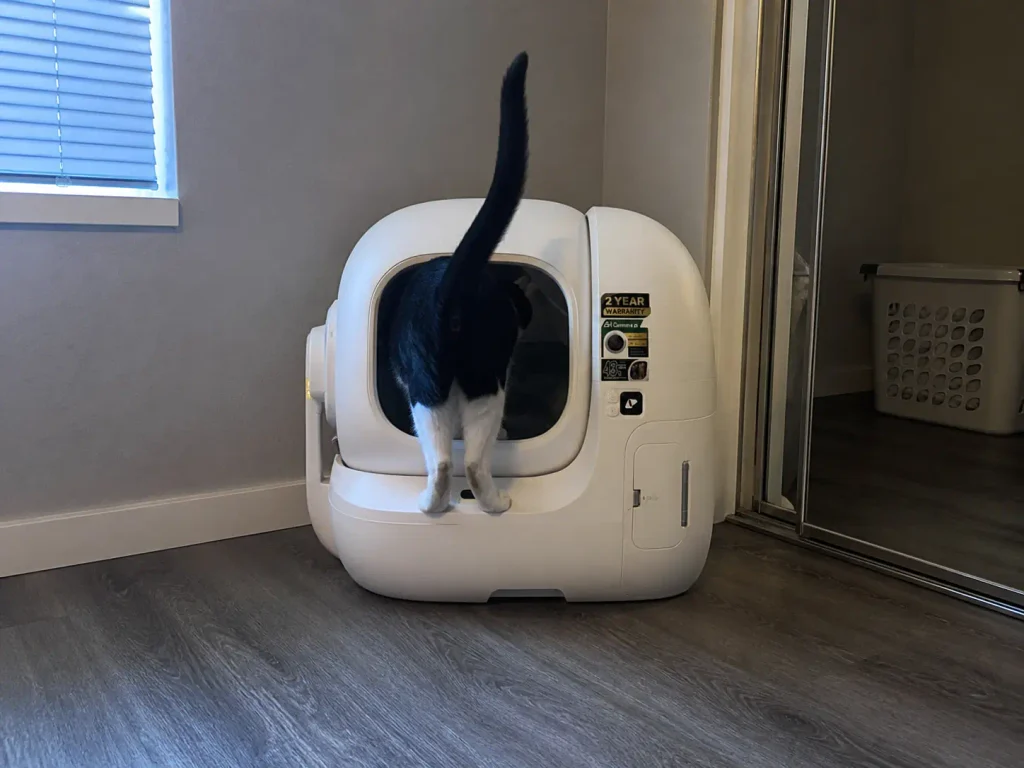
The PETLIBRO Luma is the clearest illustration of where the published data stops. It advertises recognition of up to ten individual cats and puts its 11L bin at around seven days for two cats. There is no three-cat figure. Not in its copy, not in Litter-Robot’s, not in PETKIT’s.
Ten cats’ worth of recognition and a capacity number that stops at two is not a contradiction, it is a tell: the recognition claim is a spec and the capacity claim is a promise, and nobody wants to promise anything about three.
🚑 One line before moving on, because it does not belong to the hardware. A cat that suddenly stops using the box, or starts going far more often than usual, is a vet visit rather than a settings problem. That is not something this article diagnoses or works around. Everything below assumes the vet has already cleared all three.
And if the app is not going to run your multi-cat setup, something has to. That is where the standard advice from cat-behavior consultants is the N+1 rule — one box per cat, plus one comes in, and it is the next two sections.
One Machine Is One Door, and Three Cats Notice
The unit is spotless. It cycles on schedule. The drawer has room.
And one of your cats has started going on the floor beside it. That cat is not commenting on the cleanliness. He is telling you he could not get through the door.
Why one entrance behaves like one resource
An automatic box is one receptacle with one entrance, and an entrance is a chokepoint. A confident cat can sit near it and own it exactly the way he would own a doorway, without a hiss, without a swipe, without anything you would notice from the sofa. The other two read the room and adjust. From your side of the apartment, nothing happened.
Behavioral guidance on multi-cat homes makes a related point that reframes a lot of setups: cats read boxes lined up side by side as one big box. It is proximity they register, not count. That is resource guarding in its most ordinary form, and it does not need an aggressive cat to happen. Two receptacles against the same wall is one resource with two doors, and three cats will treat it that way regardless of what you paid for either one.
This is also the moment to think about what a machine does when it runs unattended around cats who are negotiating for space, and the risks worth taking seriously before you leave a machine running unattended belong in that decision.
What separation looks like in a small apartment
You do not need a second room, though a second room is better. Separation is a spectrum, and most apartments have more of it available than they look like they do.
- Different rooms. The real thing. Two receptacles a cat cannot see at the same time are two resources.
- Opposite ends of one main room. Genuine separation in a studio or one-bedroom. Different sightlines, different approaches, different escape routes.
- Opposite walls. Workable, weaker. Better than adjacent, worse than distance.
- Side by side. One box. Whatever you paid for the second one, the cats have not registered it.
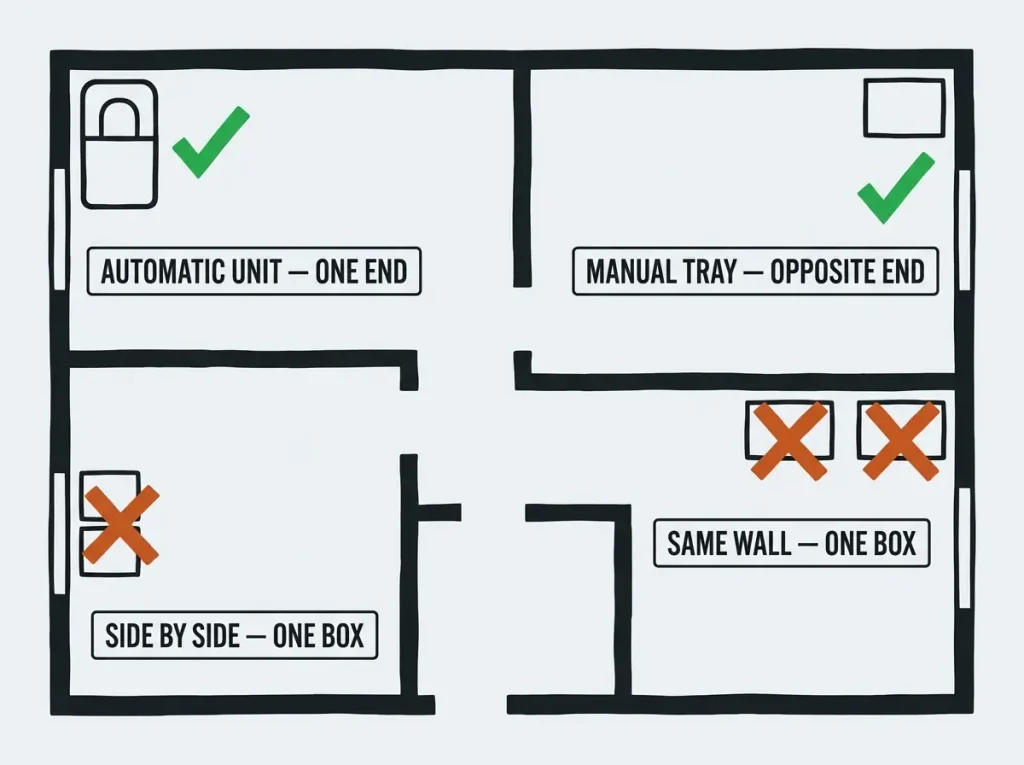
Before you buy anything at all, move what you already own. If there is a spare tray in a closet, put it at the far end of the apartment and give it a week. It costs nothing, needs no permission from a landlord, leaves no holes in a wall, and it resolves a surprising share of three-cat complaints on its own. Do that before you spend, not after.
Reading the cat that goes beside the box
Going next to the unit rather than in it is one of the most legible things a cat does. He walked to the right place, which means he knows where the box is and intends to use it. He then did not go in. Something about the entrance was unavailable: another cat near it, another cat’s smell on it, a globe that had not cycled, or a door that has been contested for a week and he has stopped trying.
That is information, delivered clearly, by an animal with very few ways to tell you anything. He is right about the constraint, and no amount of self-cleaning fixes a territory question. The fix is another door somewhere else, which brings us to the number.
One Unit or Two, and the Cheaper Answer
Everyone who wants to sell you a second machine has a reason to frame this as a machine question. It is not. Three cats want four receptacles, and nothing ever said all four have to plug in.
Four receptacles, and only one has to plug in
The N+1 rule is one box per cat plus one spare, and for three cats that is four. It does not stop applying because one of the four is automatic and cost as much as a refrigerator. It is the same arithmetic the box-count math worked out for two cats, extended by one cat and one box.
Which quietly changes the question you have been asking.
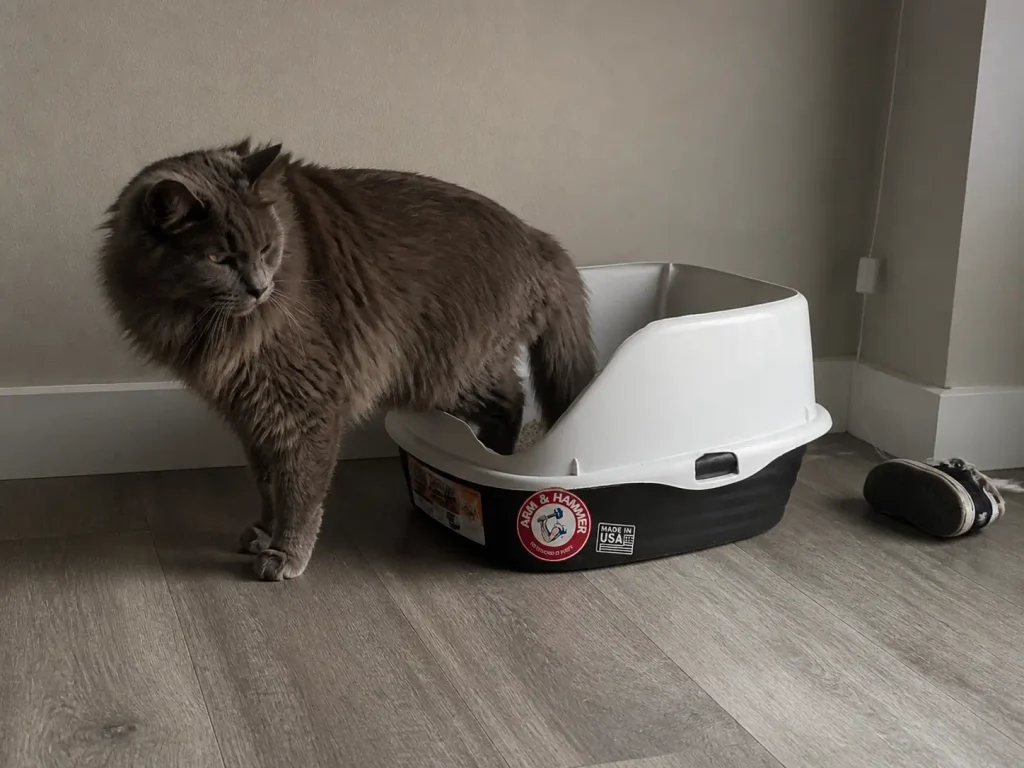
It was never “can one machine do everything.” It is “how do I reach four receptacles while owning an automatic unit,” and that is a far cheaper question with a far duller answer. A basic manual tray in a second location satisfies the count. The Arm & Hammer Rimmed Cat Litter Box with High Sides and Microban is 18.7 by 15.5 by 10.6 inches with sides tall enough for an enthusiastic digger, it needs no outlet, and it goes anywhere there is floor.
The catch is that you will scoop it, which is the thing you bought the machine to stop doing. You will scoop it once a day for maybe thirty seconds, and it will fix the queue, the chokepoint, and part of the capacity problem at the same time.
That is the recommendation. It comes before any upgrade, and for most three-cat homes it is the end of the story.
When a second automatic unit is genuinely worth it
There is one case where a second machine earns it: two of your three cats will not share, and you have both the outlets and the floor for two units in genuinely separate places. Not two units against the same wall, which the cats will read as one. If that is your household, buy the second one and skip the rest of this section.
If you are set on staying with a single machine, the CATLINK Self Cleaning Cat Litter Box Open-X and its 12L drawer buys the most days per empty of anything sourced here, with a ~17-inch entry that suits a larger cat. It will still land in that five-to-seven-day band with three cats rather than the fourteen it manages with one, and it still leaves you one receptacle short of N+1. Biggest drawer available is a real advantage. It is not a different category of solution.
The running costs nobody adds up
The purchase is the part everyone budgets for. The ongoing part is liners, carbon filter replacements, and a weekly wipe-down of the parts the rake touches, and it continues for as long as you own the unit. Three cats burn through all of it faster, because consumables track cycles and cycles track cats. A consumables bundle like the Litter-Robot Supply Kit by Whisker covers the liners, filters, and wipes in one order if you would rather not reorder four things separately, and it is an add-on rather than something to factor into the buying decision.
Honestly, the running costs matter less than the fact that nobody mentions them at all. Odor control in these units is a consumable, not a feature, and that is the part the box never says. A machine that quietly asks for filters every few weeks is a different proposition than the one-time purchase it looks like on the shelf, and knowing that going in is worth more than the money.
Put the second tray in before you decide anything about a second machine, and give it three weeks. If the automatic unit’s interval stretches by even a day, you have just answered an expensive question for the price of a plastic box. If nothing changes, you have ruled out the cheap fix and you can spend with confidence.
The Short Version
Time your own emptying interval for one week and write it down. The number printed on the box was measured in a one-cat house and was never going to be yours, and knowing your real interval turns every other decision in this article into arithmetic instead of guesswork.
Add the fourth receptacle before you add the second machine. A plain tray at the far end of the home clears the queue, breaks the chokepoint, and takes real load off the drawer, and it does all three for a fraction of what a second unit costs.
Trust the household total in the app and treat the per-cat split with suspicion. With three cats, the split is the number most likely to be wrong, and a confident wrong number is more trouble than no number.
🗓️ Check back in three weeks. Look at two things: whether the second tray is actually being used, and whether the automatic unit’s interval stretched. Three weeks is long enough for three cats to have made up their minds and short enough that you have not yet given up on the routine. Both answers together tell you whether you need to spend anything at all.
Move a spare tray to the far end of the apartment this week. It costs nothing, and it answers the expensive question for you.
Amazon’s Audible — free for 30 days
Your cat won’t let you read. Let someone read to you.
Audible is Amazon’s audiobook library — thousands of titles, read out loud, on your phone. Free for a month, plus one audiobook to keep forever.
Frequently Asked Questions
01Is one automatic litter box enough for 3 cats?
Mechanically yes, if the unit is rated above three cats, but you will empty it every two to four days instead of the week the box advertises. You still need a fourth receptacle elsewhere in the home. One machine covers the scooping, not the box count.
02How often do you empty an automatic litter box with 3 cats?
Plan on every two to four days for most units, and every other day during heavy weeks. Larger drawers stretch that toward five to seven days, but no drawer in this class holds a three-cat household for the eight to fourteen days printed on the packaging.
03Do automatic litter boxes know which cat used them?
They try, and they get less accurate as the household grows. Camera systems have been observed confusing two similar cats in independent testing, and weight-based systems merge cats whose weights fall in the same band. The daily household total stays reliable; the per-cat split is what to treat with suspicion.
04Why does my cat wait and then walk away from the automatic box?
Most often the unit has not cycled yet. The delay timer restarts each time another cat approaches during the wait, so in a three-cat home the globe can stay uncleaned well past the advertised cycle time, and a cat that finds it dirty is making a sensible decision.
05Should I buy a second automatic litter box for 3 cats?
Usually not. Three cats want four receptacles and only one of them has to plug in, so a cheap manual tray at the other end of the home satisfies the count for a small fraction of a second machine. A second automatic unit earns its place only when two of your cats will not share and you have two genuinely separate spots with power.

Leave a comment