6 Parts of a Self-Cleaning Litter Box You Have to Wash
Six parts, two rules + the 122°F ceiling nobody prints. How to clean a self-cleaning litter box by what tolerates water, and why dusty sensors fake cycles.

Alfredo RamsesFounder · August 25, 2026 · 19 min read

On this page8 sections
The box rakes itself every twenty minutes and the apartment still smells by six. Or the cycle starts, travels halfway, and stops, and you have been standing there for a week now wondering whether the motor is dying. The unit is almost certainly fine. What happened is that two manufacturers who compete with each other, PetSafe on the ScoopFree and Whisker on the Litter-Robot, publish the same warning from two completely different product designs: litter dust settles on the sensors until the machine can no longer tell whether a cat is in it. That is not one brand’s quirk. That is what these boxes do when nobody washes them.
So here is how to clean a self-cleaning litter box: six parts, split by which ones tolerate water and which ones are ended by it.
How often, too, and where you actually do this when you have one bathroom and nowhere to put a disassembled machine.
Quick Answer
Three parts get washed, three parts stay dry, and the order matters.
- Unplug the unit and pull the waste drawer out.
- Wash the globe, drawer, sifter, step and fence in warm soapy water.
- Dry-wipe the sensor windows with microfiber or an alcohol swab.
- Leave the base, panel and power adapter completely dry.
- Dry every part fully before reassembly. No bleach, ammonia or citrus.
What Self-Cleaning Was Actually Promising
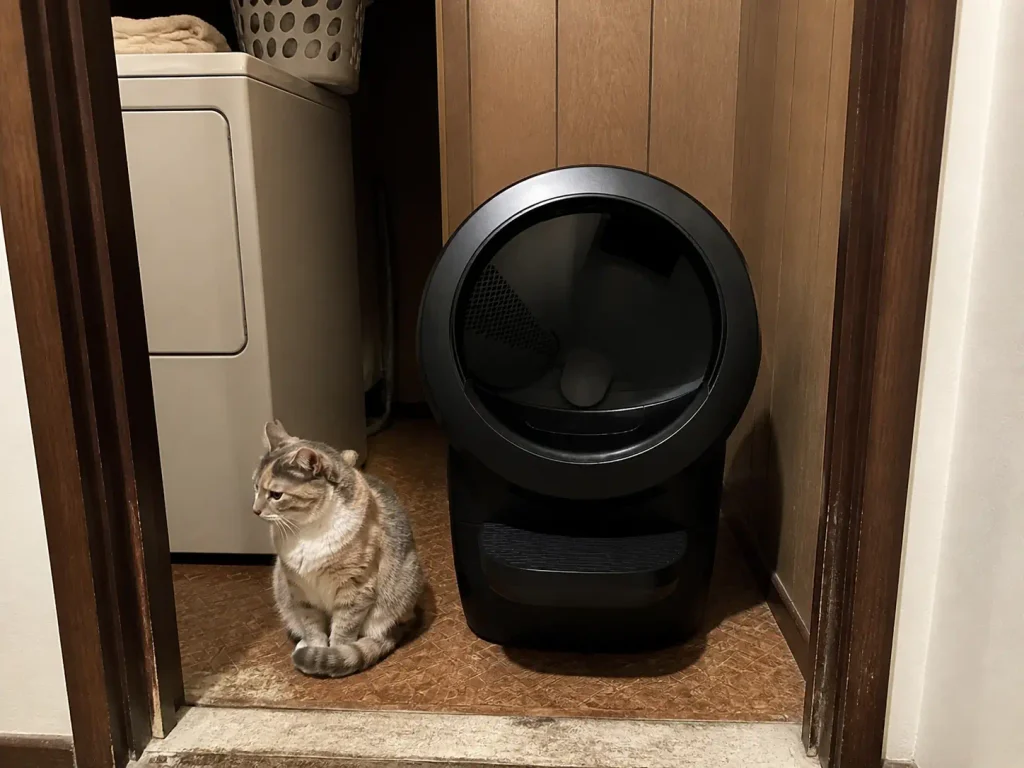
You did not buy the wrong box. You bought a box whose marketing named the one job it does and went quiet about the four it does not. It scoops. That is the whole claim, and it is a real claim, worth something on a Tuesday when nobody wants to kneel next to a tray.
What it never said out loud is that automating the scoop does nothing about the wash, the liner, the carbon filter, or the sensor. Nobody reads a support article before the smell starts, so the gap between self-scooping and self-maintaining usually gets discovered around month four, in the worst possible way.
If you are still deciding whether one of these belongs in your apartment at all, that is a different question and it deserves its own answer: whether a self-cleaning box was the right call for your household in the first place comes before any of this. This article assumes the machine is already sitting in your hallway and the honeymoon is over.
The tell is buried in the manufacturer’s own instructions. Read the official deep-cleaning guide for the Litter-Robot 4 and somewhere in the middle of the procedure you are told to sweep leftover litter toward the waste port. Sweep it. With a hand.
The brand that sells the automation has written a step into its own documented process that assumes a human standing there mid-clean with a brush. That is the myth conceding the point in its own words, and it is the most honest sentence in the whole category.
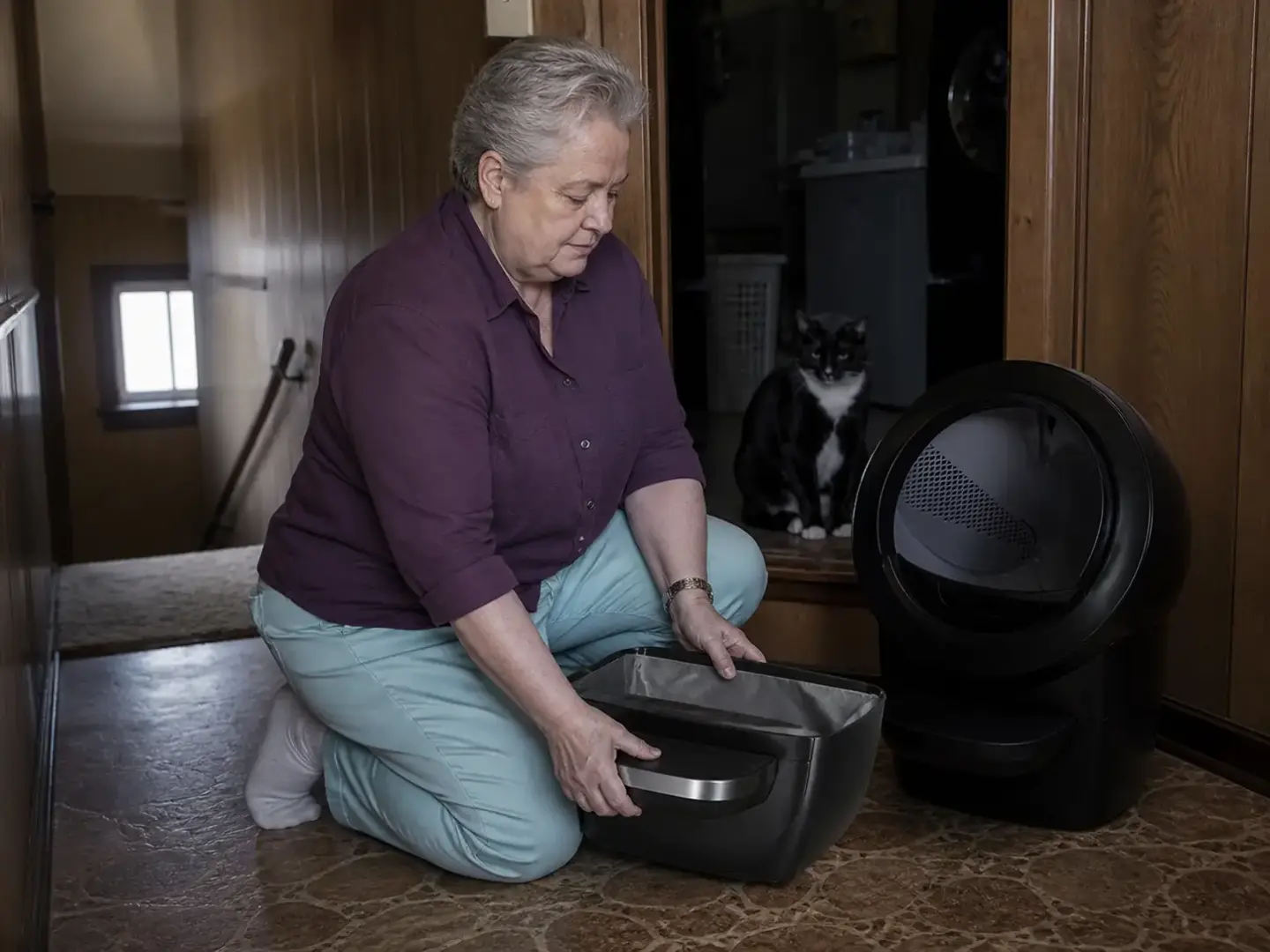
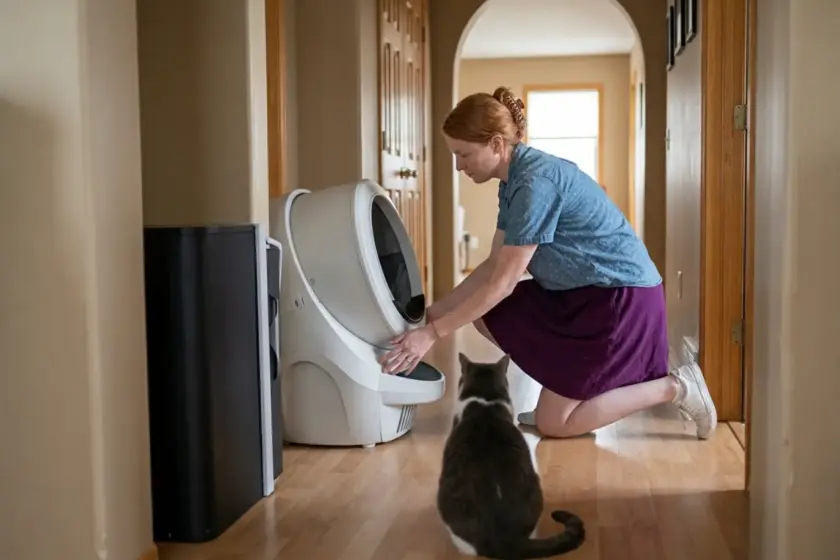
The machine most people are maintaining when they land on this page is the Litter-Robot 4 with Step and Fence, so the parts get named the way that unit names them: the globe is the rotating chamber, the waste drawer is the bin underneath, and the step and fence are the clip-on pieces that catch tracking on the way out. Other brands rearrange the geometry and rename everything, but the split holds. Whatever the box, some parts touch litter and some parts contain electronics.
One honest caveat before the steps, because leaving it out would make everything below sound like a cure. Whisker’s own troubleshooting lists power faults, the wrong litter type, a foreign object, and software as causes of a cycle that will not complete.
Cleaning fixes a large share of stuck cycles. It does not fix all of them. If you have washed everything in this article and the globe still refuses to turn, you have a support ticket, not a chore.
And the frustration is real, which is worth saying before the instructions start. One five-cat owner on a Sphynxlair thread describes taking her unit apart in the tub every single week, reaching her arm clear up inside it, and walking back through her own front door to the same smell. She calls it litter robot hell.
She is doing dramatically more work than the machine promised, not less. Her problem turns out to be a real one and it shows up in the last section, but notice the shape of it: more scrubbing did not help. The right parts did.
The Three Parts That Can Go in the Sink
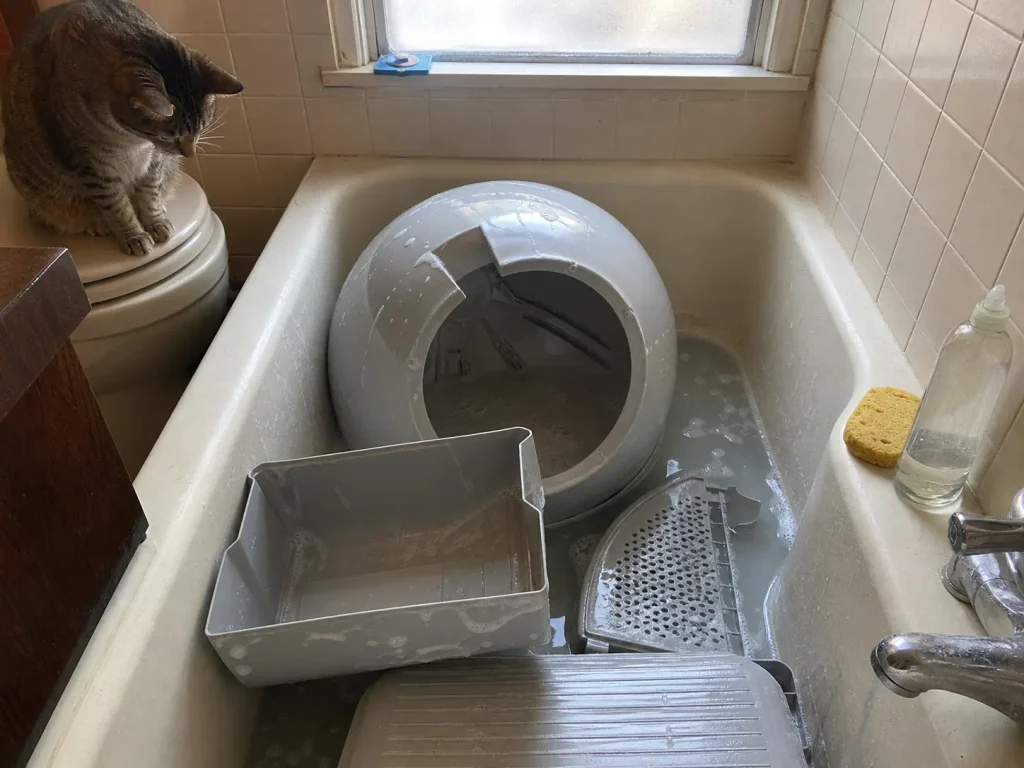
The instinct with anything that smells is to drown it. With half of this machine that instinct is exactly correct, and this is the half where you can stop worrying and just wash the thing.
The globe or inner drum goes first, and Whisker states the permission plainly: there are no electronic components inside the globe that soap and water can damage. Warm water, mild detergent, and enough time to get into the seam where the litter cakes. This is the single biggest odor source in the unit because it is the surface urine actually contacts, and it is the part people are most nervous about washing, which is a bad combination.
The waste drawer is second, and PetSafe says the same about its equivalent: the drawer and the litter sifter both get warm soapy water. The drawer holds concentrated waste in a sealed space, so it accumulates faster than the globe does even though the globe looks dirtier. The step, fence, shield and any accessory that clips on finish the list. None of them carry electronics, so none of them need special handling. Off, washed, dried, back on.
There is one number nobody prints on the box, and it is the reason some units come out of a deep clean worse than they went in. Keep the water under about 122°F, and keep metal scrubbers away from the plastic entirely. Hotter water warps thin molded plastic in ways you will not see immediately, and a metal scrubber scores the surface with thousands of shallow scratches.
Those scratches are not cosmetic. They are permanent housing for the exact organic residue you are trying to remove, the kind that later needs an enzymatic cleaner instead of soap, which means an aggressive clean today buys you a box that smells worse in six months. Hot and rough feels thorough. It is the opposite.
Warm water and unscented mild dish soap handle the routine wash, and both manufacturers specify that in their own instructions, which is a quietly useful fact. The endorsed method is the bottle already sitting next to your sink. You do not need a branded spray for the weekly and monthly work, and any product marketed as a required companion to the box is solving a problem the manufacturer does not think you have.
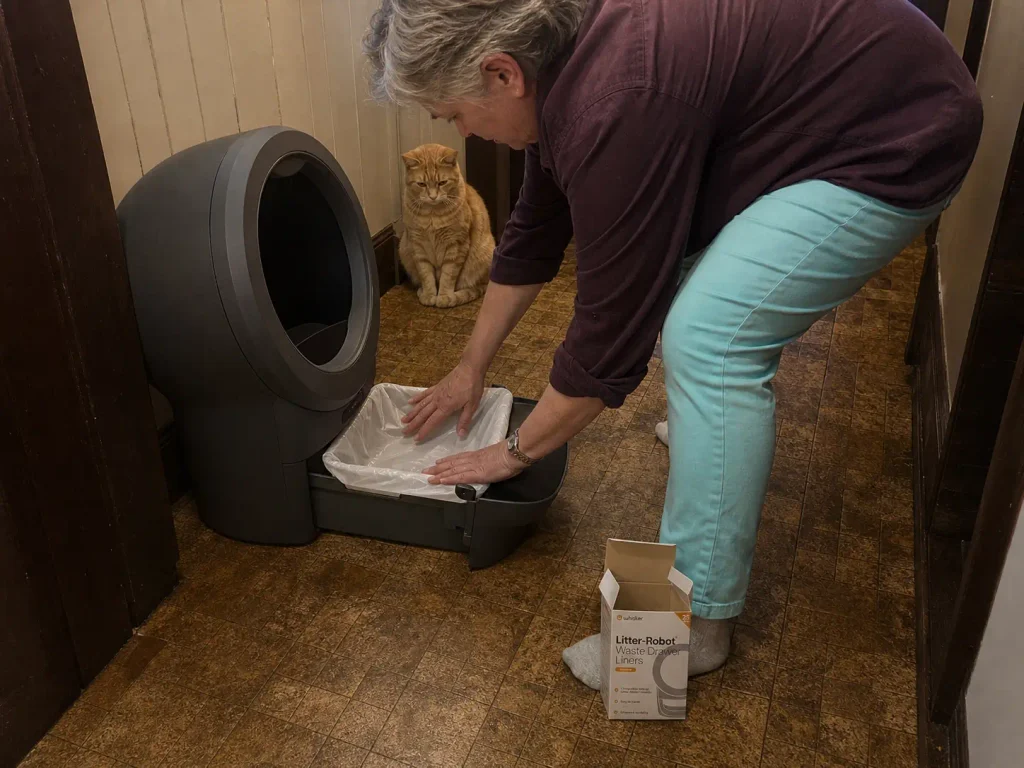
Use white drawer liners, not dark ones. Whisker states that white bags read more accurately for the drawer-full indicator, and the routine wash behind them is soap and warm water, not a branded spray. Your kitchen sink already has everything this step needs.
The Three Parts That Water Destroys
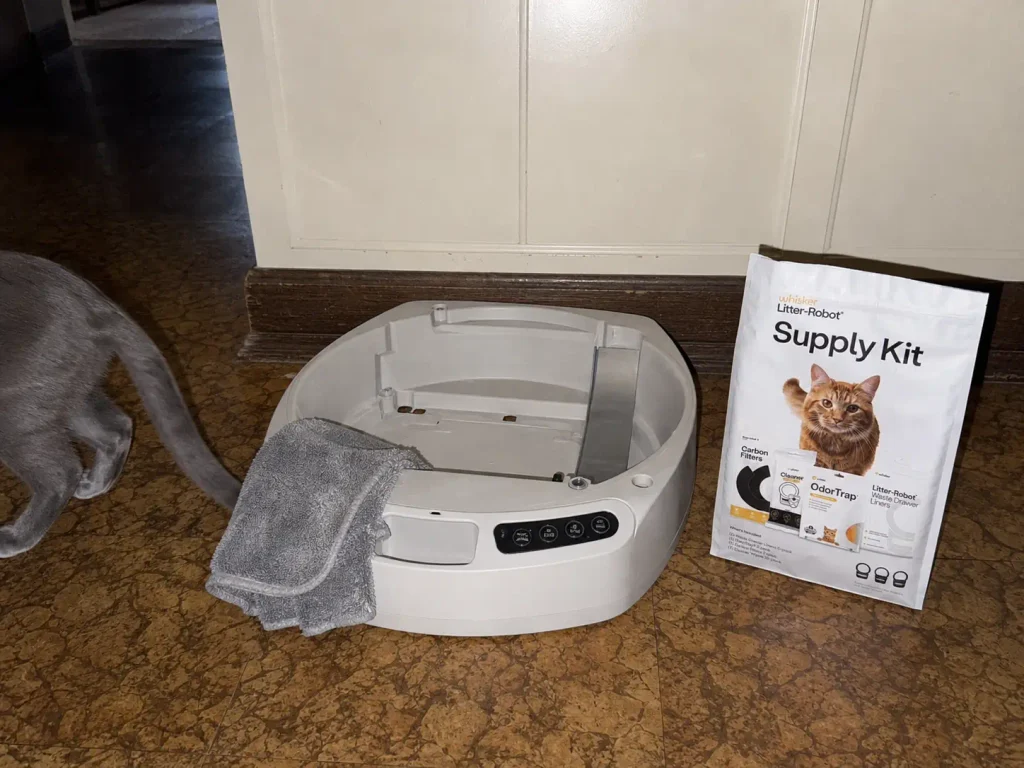
This is where an honest person stands there with a damp cloth in one hand, aims it at the base, and hesitates, because nobody ever told them exactly where the line falls. Here is the line, by part, so you stop guessing.
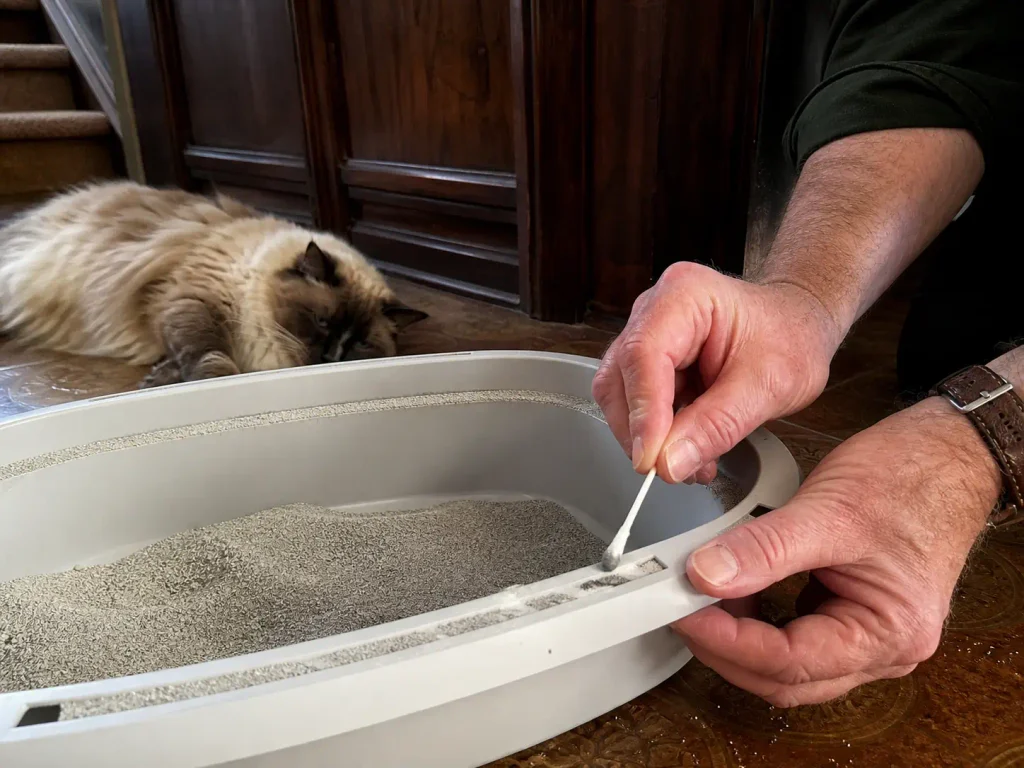
The sensor windows get a dry microfiber cloth, weekly. When a film has already built up and dry wiping smears it rather than lifting it, a cotton swab with rubbing alcohol takes it off and evaporates in seconds. What they never get is a wet wipe held against them, or a spray aimed anywhere nearby. Alcohol on a swab is controlled. Water on a cloth runs where it wants.
The weight sensors and the motor get compressed air or a blower, and nothing else, ever. There is no gentle version of this and no cloth that is damp enough to help but dry enough to be safe. Any contact with water is the failure mode, full stop, and it is a failure you find out about days later when the readings drift.
The base, control panel and power adapter, and behind them the circuit board, get dry dusting. The manufacturer language here is worth quoting because the redundancy is deliberate: never submerged, never sprayed, never soaked. Three verbs for one rule, written by people who have processed the warranty claims.
The reason two brands agree on this is that they arrived at the same vulnerability from opposite directions. PetSafe puts its sensors in the cutouts around the inside rim of the base, and says outright in the PetSafe teardown instructions for the ScoopFree that litter dust accumulates there and stops them working. Whisker’s layout is nothing like it. Same failure point.
When two competing engineering teams independently land on the same weak spot, it is not a design flaw either of them can fix. It is what happens when you put an optical sensor in a box full of powder.
Which brings up the part that reframes the whole chore: optical sensors have the shortest service life of anything in the unit, roughly three to five years with proper care, and dust is what shortens it. The part that ages fastest is the part that gets cleaned least, because it is the only part that never looks dirty. Nobody skips the drawer. Everybody skips the sensor.
Once you accept that the routine involves wipes, correctly sized liners and carbon filters on an ongoing basis, buying them one at a time gets old. The Litter-Robot Supply Kit bundles thirty cleaner wipes, ten waste drawer liners, three OdorTrap refills and two carbon filters, which covers three separate consumables in one order and saves you rediscovering each shortage individually. The obvious caveat is that a bundle only makes sense if you use all four things. If your filters last longer than your liners, and for most single-cat households they do, you are buying carbon you do not need.
Why a Dusty Sensor Reads a False Cycle
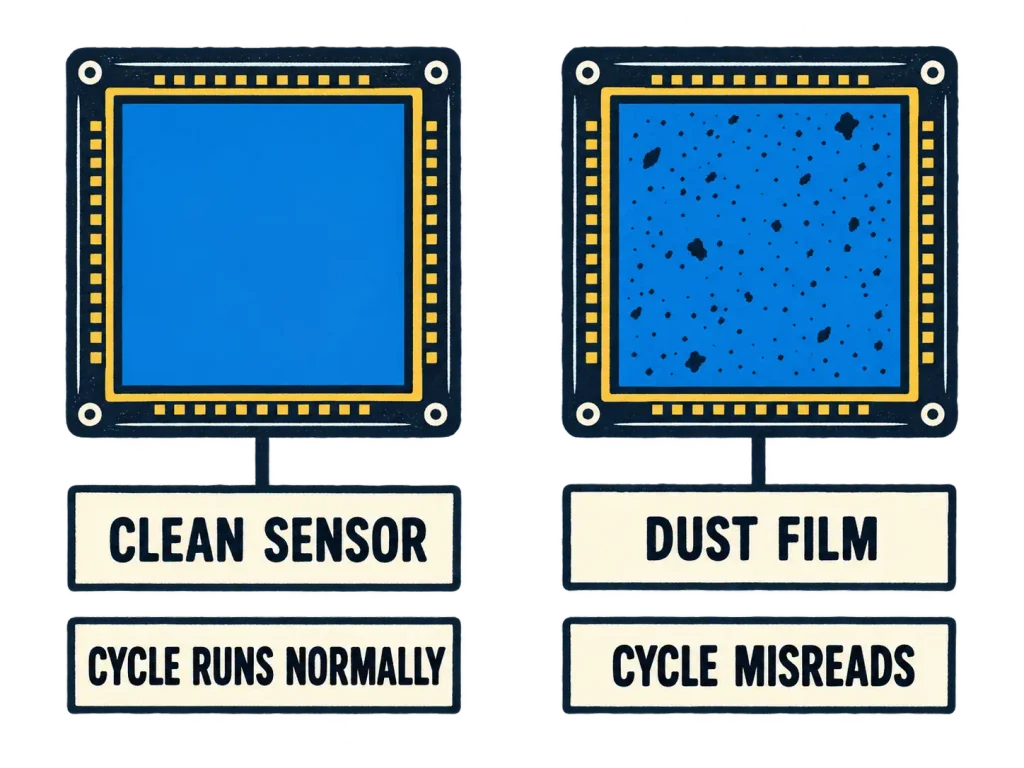
A rake that stops halfway looks mechanical. It looks like something is jammed, or a gear has stripped, or the motor is on its way out, and that is what most people conclude, because a machine behaving erratically reads as a machine that is breaking. It usually is not breaking. It is a machine that can no longer see, doing precisely what a blind machine would do.
The causal chain is stated by Meowant and confirmed independently by PetSafe’s design notes, and it runs like this. Fine litter dust coats the sensor window, and litter buildup collects near the weight module. The box loses the ability to read accurately whether a cat is present. So it starts a cycle with nobody in it, or stops one early because it thinks somebody just arrived, or throws an alarm about a condition that does not exist.
The film that causes this is thin. It is invisible at a glance, on a dark plastic surface, in a hallway, which is exactly why it is the step everyone skips.
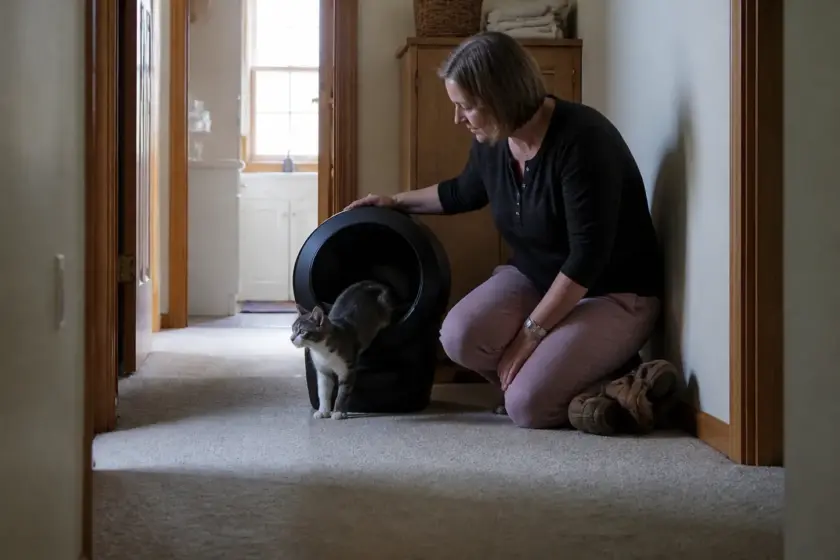
Now follow that from the cat’s side of it, because she reached her conclusion long before you reached yours. What she experiences is a box that sometimes starts moving while she is standing in it. Not always. Not predictably. Just often enough that a place she has to visit several times a day has become a place that occasionally does something startling underneath her.
A cat who begins going next to the box after that is not being difficult and is not protesting. She is applying a rule that any sensible animal applies, which is that you do not sit down somewhere that has moved without warning. The box became unreliable before she did.
And that boundary matters here, because a cat who used a box reliably for a long time and then suddenly stops is a vet visit before it is a maintenance question. Get her cleared first. Then come back and clean the sensors.
Not every misread is dirt, though, and this is where the honest version diverges from the tidy one. Meowant lists an unstable floor or soft carpet as the leading cause of false alarms, because a surface that flexes distorts weight readings no matter how spotless the hardware is. If your unit sits on a rug, on old floorboards, or on anything that gives when you press it, move it onto something firm and level before you take a single screw out. It costs nothing, it takes ten seconds, and it resolves a share of these complaints outright.
The other free fix is the liner. A stretched bag, or one that is not pressed flat against the drawer walls, will throw off the drawer-full indicator by itself, because the sensor is measuring the level of something that is not sitting where it should be.
Press it flat, use white rather than dark, and see whether the readings settle before you assume anything is wrong. If they do not, the Litter-Robot Waste Drawer Liners are cut to the drawer’s 9 to 11 gallon shape so they seat flat without stretching, which is the entire reason they exist. But try the kitchen bag you already own first, flattened properly. An unscented bag that genuinely fits does the same job for nothing, and the anti-sell here is real: this is a fit problem, not a brand problem.
How Often, by Cat Count and by Symptom
Every brand gives you a number and every number is wrong for somebody. Three cats do not generate the load of one cat on a schedule that pretends they do, and a humid apartment in August is not the same room it was in February.
The baseline by household runs like this: one cat, every four to six weeks. Two or three cats, every three to four. Four or more cats, or a genuinely humid apartment, every two to three. That is a floor to work from, and Whisker’s own published range for the Litter-Robot says the same thing in a different way, calling for basic globe cleaning every one to three months and a monthly deep clean cadence only for heavier households, with a full deep clean at least quarterly, then adding that more frequent deep cleaning may be necessary depending on use.
Read that again. The manufacturer with every commercial reason to promise a fixed, low number published a range and a disclaimer instead. They know the calendar is not the trigger.
Because the real trigger is the symptom, and there are three of them. After a diarrhea episode, the box needs a full clean regardless of what the date says. (The episode itself is a vet question if it repeats or persists. The box is your department; what caused it is not.)
When odor turns from intermittent to constant, meaning it is there when you walk in rather than only when you walk past, that is residue the last clean did not remove. And when the sensors start misreading, that is dust, and the calendar has already lost. Whichever comes first, date or symptom.
Separate from all of that, and much smaller: a weekly wipedown of the sensor windows, one dry pass. It takes less time than scooping a manual box does once. If you are choosing which single habit from this article to actually keep, keep that one, because it prevents most of the problems the other five parts get blamed for.
Monthly, recalibrate the weight sensors, particularly if the unit has been moved. Moving it to the bathtub for a deep clean counts as moving it, which means the deep clean itself creates the recalibration need. It is worth understanding what the sensors are and are not built to catch before you assume a recalibration will fix a reading that was never within range to begin with.
A multi-cat household is not simply the same job more often. It is a different failure curve, and the five-cat owner from that forum thread shows where it bends. She stopped using her second unit because maintaining both was more work than the machines were saving her, and by the end of the thread she was talking about rehoming cats.
Read the sequence rather than the outcome. The schedule failed first. Then the workload became unmanageable. Then the animals started looking like the problem. That is how a maintenance question turns into a household one, and it turns quietly.
Attach the weekly sensor wipe to the day you top up the litter, not to a calendar reminder. A maintenance task with no physical trigger is a maintenance task that quietly stops in week three, and this is the one that costs you the most when it does.
Where You Actually Do This in a One-Bathroom Apartment
Every set of instructions ever written for these machines assumes a utility sink and a spare room. You have a bathtub, a hallway, and a cat who needs somewhere to go within the next twenty minutes. So let us answer the question that actually decides whether this ever gets done.
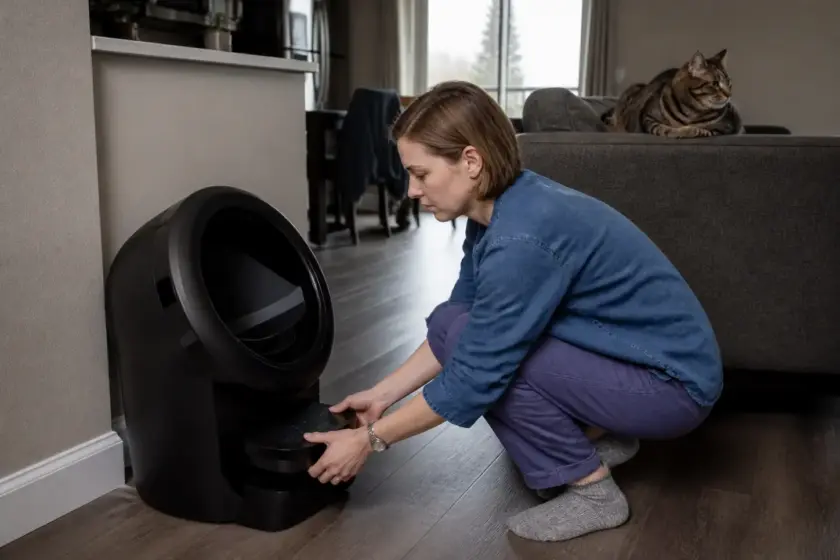
The tub is the honest answer, and it is what people do. Two refinements make it work rather than just happen. Lay a towel down and do the disassembly on that, so hard plastic edges are not dragged across enamel, and rinse the tub properly afterward, which takes about a minute and prevents the clean from relocating the problem. If you have a balcony or a porch and the weather cooperates, that is better, mostly because it keeps the smell out of the only bathroom in the apartment for the hour this takes.
The base never travels. It stays exactly where it is, dry, while the washable parts go to the water. That is not just a warranty rule, it is the practical safeguard that makes the whole thing survivable in a small space: if the electronics never leave the hallway, they never pass under a running tap, and there is no moment where a tired person at 9pm makes a decision they regret.
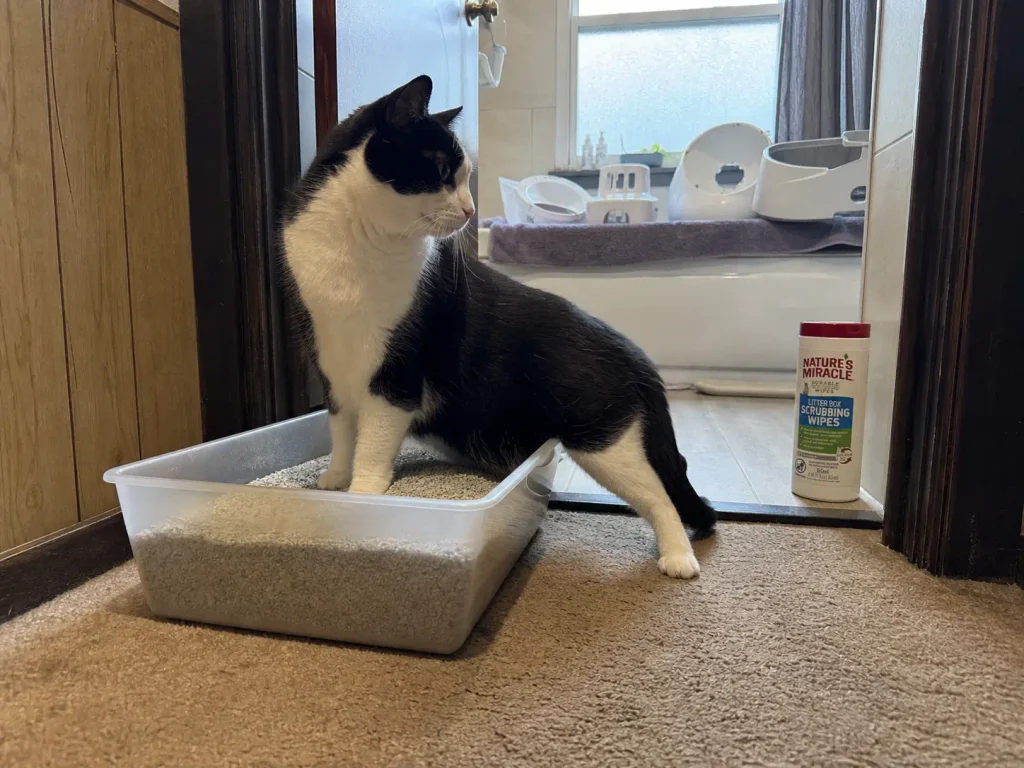
Your cat still needs a functioning box while hers is in pieces on a towel. Set a temporary litter box out in the same room, with the same litter she already uses, and do it before you start rather than after.
Same room matters considerably more than same box. She has already worked out which spots in your apartment are acceptable, probably vetoing a couple along the way, and a tray in the correct location is a compromise she will make. A perfect box in the wrong corner is not.
Then there is drying, which is the step that gets rushed because it is the boring end of a job that is already over in your head. Let them air dry completely. Parts go back together completely dry or the film starts forming again immediately, and you will have bought yourself nothing. Give it real time. Sunlight or a fan turns two hours into one.
And the rule that surprises people: no bleach, no ammonia, no citrus, no essential oils. Two manufacturers ban these for two different reasons, which is what makes it worth stating twice. Whisker says bleach inside the globe can produce irritating fumes, which is the reason most people would guess. PetSafe says citrus-scented cleaners repel the cat from using the box, which is the one nobody expects, and it is the more expensive mistake. You get a spotless, pleasant-smelling machine that your cat has quietly written off, and then you spend a month diagnosing a behavior problem you created with a cleaning product.
Which leaves the failure the forum poster hit, the one no amount of weekly scrubbing solved. Her theory was that urine had seeped into the pores of the hard plastic and was there to stay, and she is close to right. Mild soap lifts surface residue but does not break down organic compounds that have worked into scored or aged plastic, which is why the smell survives a clean box and why odor control fails on a unit that looks spotless.
For that case an enzymatic cleaner is the correct tool, and the Nature’s Miracle Cat Litter Box Scrubbing Wipes do it in a single-purpose product rather than a brand-locked system. Use them on the part that is holding the odor, not as a replacement for the routine wash, and give the enzymes a minute of contact time instead of wiping straight through. Worth knowing: if the plastic is badly scored, enzymes reduce the problem rather than end it. This particular smell is one instance of a broader pattern, and the smell that survives a clean box covers the rest of it.
I used to treat that conclusion as defeatism. After enough threads where someone had done everything right for a year and the odor still won, I stopped. If you are standing over a disassembled robot in your tub thinking this is more work than scooping was, that is a legitimate reading of the evidence, not a failure of patience. A box that is simply easy to clean by hand is a real answer for some households, and the machine you already own resells fine.
Set the temporary tray out before you take anything apart, not after. A cat who finds nowhere to go picks a spot herself, and the spot she picks is the one you will be cleaning next weekend.
What to Do With This
Six parts, split in two. Three take water and soap: the globe, the waste drawer, and the clip-on pieces. Three take a dry cloth and nothing else: the sensor windows, the weight sensors and motor, and the base with its panel and adapter. That split is the entire skill, and everything else is scheduling.
Clean by date or by symptom, whichever arrives first. The date is a floor, not a plan. Diarrhea, persistent odor, or a sensor that starts misreading all override whatever the calendar says, and the weekly dry pass over the sensor windows is the small habit that prevents most of what the other five parts get blamed for.
Before you order anything, do the two things that cost nothing. Move the unit onto a firm, level surface, and press the drawer liner flat against the walls of the drawer. Between them they account for a real share of the false readings that people replace whole machines over.
Three months from now, check two things: has the false-cycle behavior stayed gone, and did the weekly sensor wipe survive past week three? The first tells you whether the deep clean worked. The second tells you whether the routine is real or was just a good weekend.
Amazon’s Audible — free for 30 days
Your cat won’t let you read. Let someone read to you.
Audible is Amazon’s audiobook library — thousands of titles, read out loud, on your phone. Free for a month, plus one audiobook to keep forever.
Frequently Asked Questions
01How often should you clean a self-cleaning litter box?
Deep clean every four to six weeks with one cat, every three to four with two or three, and every two to three with four or more or in a humid apartment. Wipe the sensor windows weekly regardless of cat count, and deep clean early if odor turns persistent or the cycle starts misreading.
02Can I use Dawn dish soap to wash my cat litter box?
Yes, on the washable parts. Mild unscented dish soap and warm water is what both PetSafe and Whisker specify in their own instructions. Keep the water under about 122°F, skip metal scrubbers, and keep soap away from the base, control panel and sensors entirely.
03Are automatic litter boxes hard to clean?
Not hard, but not optional either. The washable parts come apart in a minute or two, and the job is a bathtub and twenty minutes plus drying time. What makes it feel hard is discovering the requirement months in, after the smell or the false cycles have already started.
04What are the disadvantages of using a self-cleaning litter box?
The maintenance the name implies you avoided, electronics that fail in ways a plastic tray cannot, and a cycle that can misread and put the cat off the box entirely. Against that, it scoops several times a day without you, which is a real thing to weigh rather than a settled argument.

Leave a comment