Why Kittens Get Missed by an Automatic Litter Box
Kittens under 3 lbs don't register on the sensor at all. The weight floor, the manual-mode protocol Whisker publishes & what to do with two cats at home.

Alfredo RamsesFounder · August 25, 2026 · 21 min read

On this page8 sections
- 1The Kitten Is Under the Weight the Sensor Is Built to See
- 2What This Is Not, and Where the Line Sits
- 3Why a Kitten Is a Different Problem Than a Small Cat
- 4The Bridge, or Running the Machine Without the Automation
- 5When Only One Cat in the House Clears the Line
- 6The Weeks After She Clears It
- 7Conclusion
- 8Frequently Asked Questions
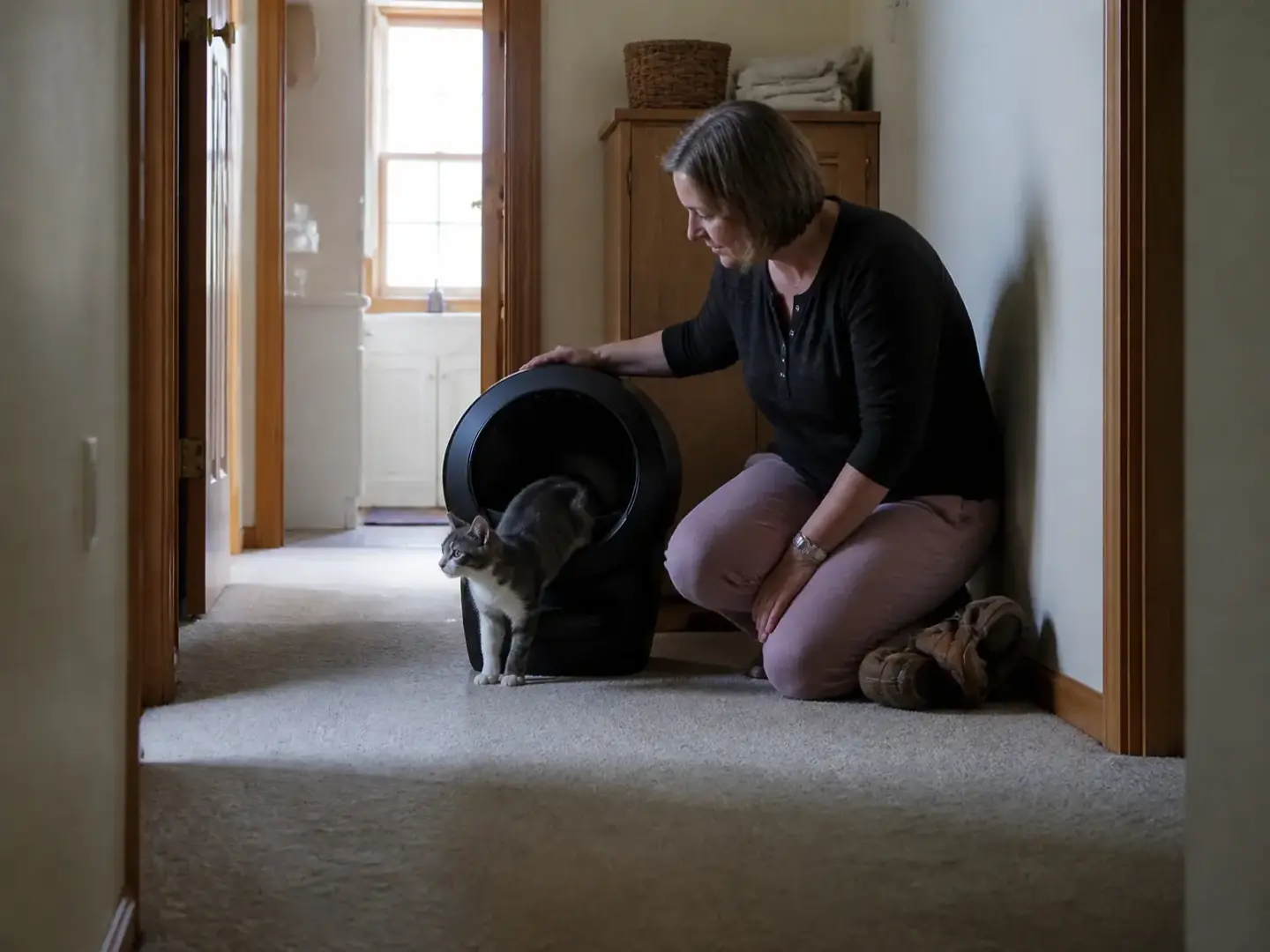
The kitten walks into the machine, scratches around, walks out, and nothing happens. No light, no whir, no rake. You paid several hundred dollars for a self cleaning litter box and it is sitting there like an expensive plastic cave.
The box is not broken, and neither is she. She weighs less than the sensor was built to notice, and the machine is doing exactly what its manual says it will do.
The number that governs all of this is published by the manufacturer, it is the same on the Litter Robot 4 and the Litter Robot 5, and it appears nowhere near the box itself. So here is what the threshold actually is, where this stops being a hardware question and becomes a vet question, how to bridge the gap without buying a second machine, and what changes when there is a full-grown cat in the apartment too.
Quick Answer
Yes, a kitten can use an automatic litter box, but not yet. Most machines will not register a cat under three pounds in automatic mode, and she also has to be using a plain tray without accidents first. Until both are true, run the same unit in manual mode beside an open box.
The Kitten Is Under the Weight the Sensor Is Built to See
Before you email support, know what support is going to tell you: the machine has a floor, and your kitten is under it. This is worth separating from the broader question of which households actually need a self-cleaning box in the first place, because that question is about your life and this one is about physics.
A smart litter box works by noticing that a load appeared and then left. A three-pound animal is the smallest load it was tuned to notice. Anything lighter is, as far as the electronics are concerned, a draft.
Three Pounds Is the Number, and It Did Not Change with the Newer Model
Whisker’s own support documentation puts the floor at three pounds (1.3 kg) for the SmartScale to register a cat in Automatic Mode on the Litter-Robot 4. The Litter-Robot 5 did not lower it. Same number, both models, which is unusual enough in consumer hardware to be worth stating plainly, because half the internet has decided the newer one dropped to two pounds and it did not.
Now put that against when kittens actually arrive. Shelters and breeders hand them over somewhere between eight and twelve weeks, and eight to twelve weeks is precisely the window where a kitten sits under three pounds. The age at which people acquire a kitten is the age the machine cannot see her. Nobody planned that collision, but it means the overwhelming majority of people asking this question are asking it on day two of kitten ownership, standing in front of a machine that has decided the apartment is empty.
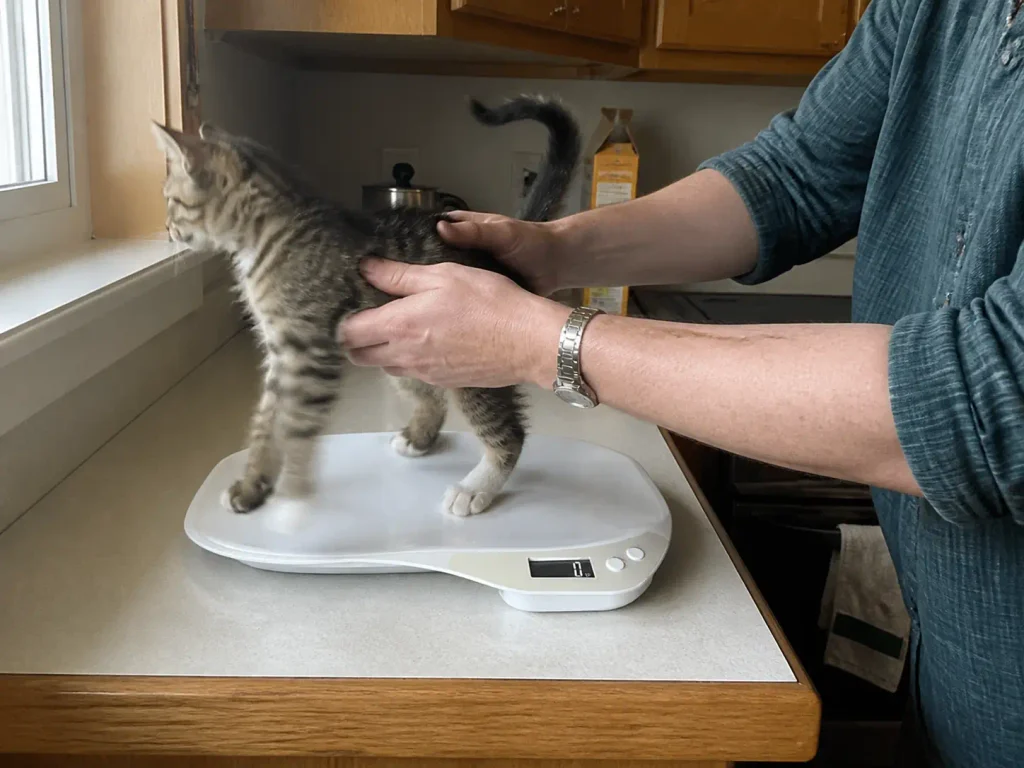
Weigh her before you troubleshoot anything else. The free version first: stand on your bathroom scale, note the number, pick her up, stand on it again, subtract.
And be honest about what that gets you, because most bathroom scales round to half a pound and drift by more than that depending on where your feet land. When the entire decision hinges on whether she is at 2.8 or 3.2, a method with a half-pound error is not measuring the thing you need measured.
A flat-tray unit like the Goldmeet Digital Pet Scale reads across a 0–33 lb range and gives you the same reading twice in a row, which is the only feature that matters here. The catch is that a wriggling kitten will not hold still on a flat tray, so put a towel down and weigh her while she is sleepy rather than at six in the evening.
Weigh her the same day every week and write it somewhere, instead of counting weeks on a calendar. Growth rate varies enough that two kittens the same age can land on opposite sides of the line, and a weekly number tells you roughly how many weeks out you are rather than leaving you guessing.
Why the Published Minimums Disagree Across Brands
Go looking and you will find three pounds, 3.3 pounds, and a recommendation of 3.5 to 4.0 pounds, all stated with equal confidence, plus at least one major brand that does not mention weight at all and simply says kittens adapt easily. Four answers for one kitten on one scale.
They are not contradicting each other so much as answering different questions. The manufacturer number is a can: below it, the sensor stops working reliably, and that is an engineering fact about the load cell.
The behaviorist number, which lands closer to 3.5 or 4 pounds, is a should: it pads the manufacturer minimum by half a pound to a pound because a sensor operating right at its detection floor is a sensor that works most of the time. Those are both true.
If your kitten reads 3.1 and you want to wait two more weeks, nobody sensible will argue with you.
I used to treat the manufacturer figure as the whole answer, on the grounds that they built the thing and would know. What changed my mind is how much of the published safety guidance from behavior consultants pads that same number in the same direction, and that consistency across independent sources is more persuasive than one spec sheet. So: three pounds is the minimum weight the hardware draws the line at. Somewhere near four is the line I would actually switch it on at.
A Scale Is Not a Cat Detector
Here is the part that gets skipped. The sensor is not deciding whether a cat is present. It is deciding whether enough weight arrived and then went away, and those are different claims about the world.
That distinction has consequences above the threshold too. Consumer safety coverage on these units notes that single-sensor systems can misfire, and that sensor failure shows up when a cat exits quickly or when dust builds up on the safety sensor plate, which means weight is not a fail-safe even for a cat who clears the bar comfortably.
A slow, heavy adult who settles in and leaves deliberately is the ideal test subject for a load cell. A kitten who just squeaked over three pounds and moves like a kitten is the worst one. The number is a starting gate, not a guarantee, and treating it as a guarantee is how people end up surprised.
What This Is Not, and Where the Line Sits
People arrive at this question from two directions, and only one of them belongs on this page. Some are asking a hardware question: my kitten is small, my box does nothing, what is the number. Some are asking because something about the kitten’s litter habits worries them, and the machine is the one thing in the situation they can adjust. Those are different questions.
Everything in this article is about the machine and the room. Anything about her body is a vet visit, and not the kind that waits until Monday.
- Straining.
- Blood.
- Going back to the box over and over with nothing produced.
- Hiding to eliminate.
- A habit that was fine on Tuesday and is not fine on Wednesday.
Cornell Feline Health Center treats a sudden change in litter habits as a reason to call rather than a training problem to work through, and that is where this article stops.
It does not tell you what any of those signs mean, because that is not a question a furniture blog gets to answer.
What You Stop Seeing Once the Box Cleans Itself
There is a trade in automation that the sales copy never names, and it lands hardest on a kitten.
The thing that used to make a change visible was the scoop. Doing it by hand every morning, you built a picture without ever deciding to: roughly how many, roughly what size, roughly how the litter looked. You did not track it, you just knew, and on the day something was different you noticed.
A self cleaning litter box removes that. The waste goes into a sealed drawer, you empty the drawer twice a week, and the daily read is gone. You bought back fifteen minutes a week and you spent some of your attention.
That is a fine trade for a settled adult cat in a house where nothing is changing. It is a worse trade in the first weeks with a kitten, which is exactly when you have the least idea what her normal even looks like.
The health monitoring app helps less than it appears to: they report weight and visit frequency, and that is data, not a diagnosis. A visit count going up is a fact about a counter. Reading it as an answer is the failure mode.
If you want the broader version of this argument, the two separate risks a self-cleaning box carries covers the adult-cat side that this page deliberately narrows away from.
Why a Kitten Is a Different Problem Than a Small Cat
A four-pound adult and a four-pound kitten weigh the same and behave nothing alike. Brands write their safety copy around the weight, and the weight is the less important half of it.
An Adult Cat’s Routine Is Predictable; a Kitten’s Is Not
Watch a grown cat use a box. She enters, turns, digs, does her business, covers, leaves, and she does it in roughly that order every time, in roughly the same amount of time. That predictability is not a nice bonus for the engineers. It is the assumption the entire timed cycle is built on: a load appears, a load leaves, wait a set number of minutes, run.
A kitten does none of it reliably. She goes in, comes out, goes back in for something she forgot, sits in the entrance with her back half outside, chases a piece of litter across the floor, comes back, and falls asleep in there because it is enclosed and warm and she is nine weeks old.
Her paws land in places no adult’s would. None of that is bad behavior. It is a kitten doing what kittens do, in a machine that quietly assumes she will not. When the machine’s model of a cat and the actual cat disagree, the cat is not the one that is wrong.
The Lip, the Entrance, and What a Small Animal Has to Climb
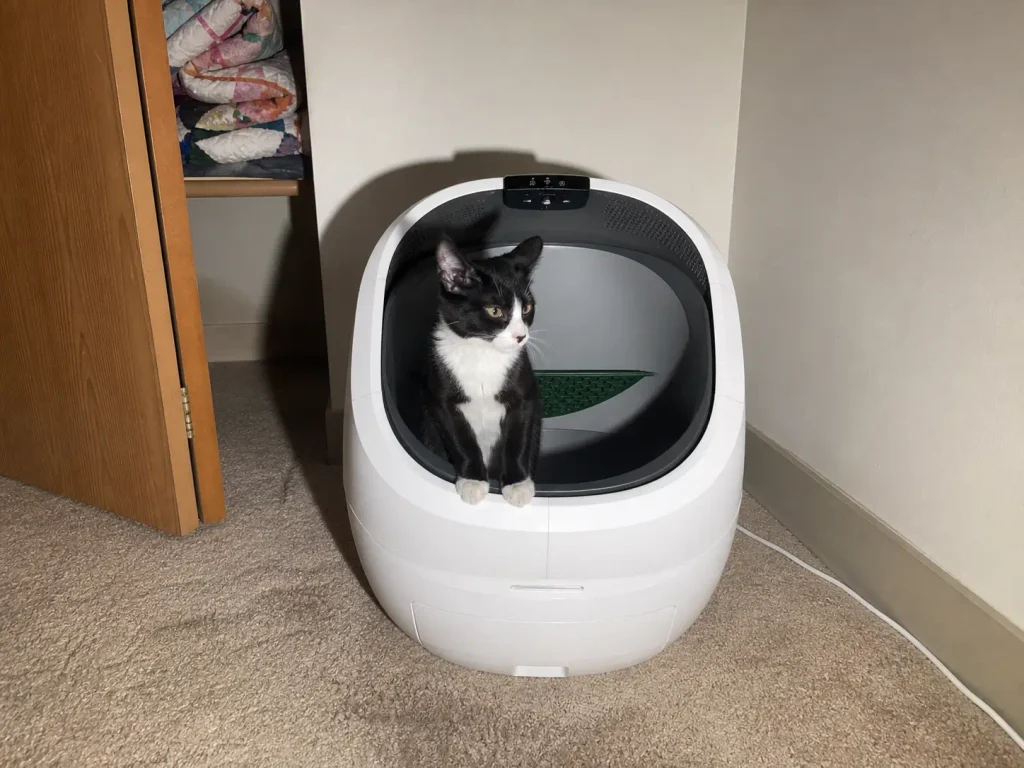
Entry geometry matters as much as weight, and it is easier to see. An enclosed globe has a raised lip at the mouth, and for an adult that lip is a step. For a kitten it is a climb, which means she goes over it with her weight in a heap rather than distributed across four planted feet, and she comes back out the same way.
An open-top design presents a much lower shape to negotiate. The PETLIBRO Luma is built that way, with a lower entry than a globe and an open shape a small animal does not have to haul herself into. That solves a geometry problem, though, not a weight one.
An open-top automatic box still has a weight floor and still runs a cycle, so nothing above changes because the entrance got easier.
Litter continuity belongs in this section rather than the transition one, because the reason is mechanical. Litter eating is a kitten habit and adults mostly grow out of it, which is why clumping litter is a mechanical problem for a kitten specifically and not a matter of texture preference. Whatever she is on now, she stays on through this whole process. You do not change the litter and the box in the same month.
The First Cycle She Hears Decides What She Thinks of the Box
The entrapment risk gets all the attention, and the noise deserves some of it. There is a documented account of a cat present for an unexpected first cycle being visibly frightened by it, described by the reviewer as the kind of event that can wreck a cat’s sense of safety around litter boxes generally. One account, not a chorus, and worth weighing accordingly.
But run it forward. A kitten’s opinion of what a litter box is gets formed in the first weeks she has one, and it is not a considered opinion she will revisit later. If the loudest, most startling thing in her early experience of a box is the box itself moving underneath her, you have not created a training setback or a temporary bout of litter box avoidance.
You have created her baseline. And an avoidance problem you built in week three of kitten ownership is a great deal more expensive than the scooping you were trying to avoid.
Run the first few cycles while you are in the room and she is not. Shut her in the bedroom, press the button, let her hear the noise arrive from down the hallway with a wall in between. She meets the sound as background before she ever meets it as something happening underneath her, which is the whole point.
The Bridge, or Running the Machine Without the Automation
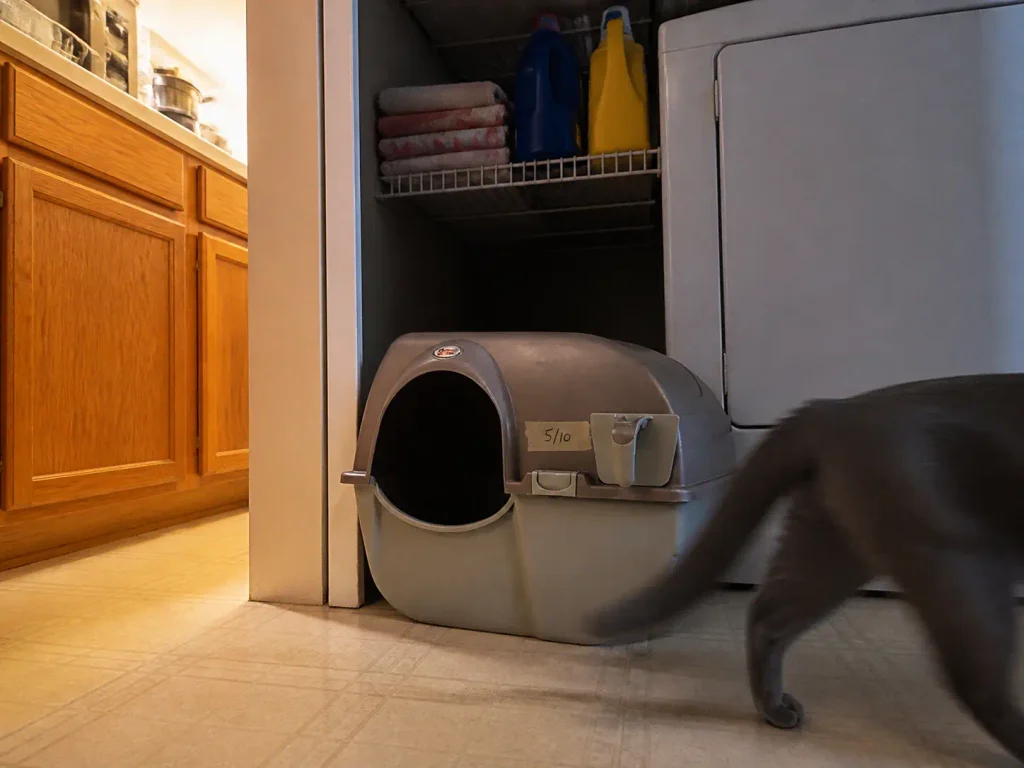
Nobody wants to hear that the expensive thing goes in a closet for two months. It does not have to. It just runs with its brain switched off for a while.
The Manufacturer’s Semi-Automatic Protocol
Whisker’s own published answer for cats under the minimum is semi automatic mode, and the steps are unglamorous: leave the unit powered off and out of auto mode, wait roughly seven minutes after you see her use it, press Cycle by hand, then power it off again. That is it. Notice that this is the manufacturer’s protocol and not a workaround someone invented on a forum. The company that built the machine already knows it cannot see your kitten and has written down what to do about it.
What you get out of it is a box that still clumps and sifts on your schedule while presenting zero risk of running while she is inside, because nothing can start on its own when nothing is powered. The cost is that you have to be around to press a button, which for the first weeks with a kitten you generally are.
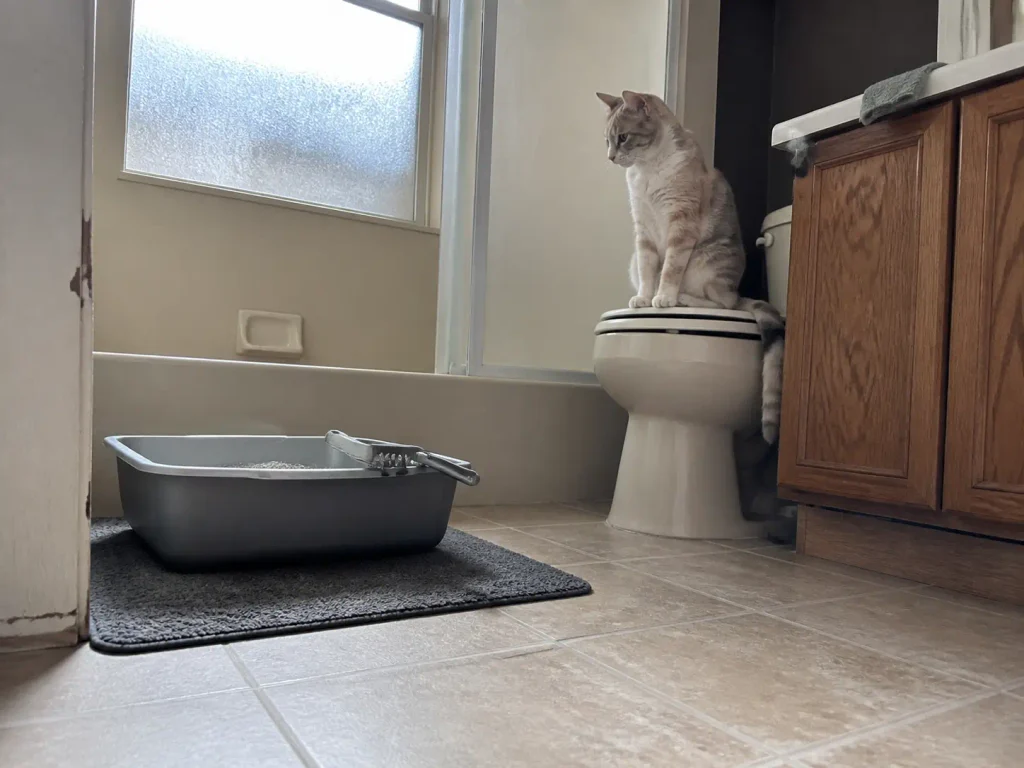
The free move comes before any of that, though. Keep the plain open tray she is already using, in the place she is already using it, and let the machine sit unplugged beside it.
Give it a couple of weeks as an object she walks past. That stretch is the whole acclimation, and it costs nothing. A powered-down machine is furniture, and furniture is the easiest thing in the world for a cat to accept. By the time it starts doing anything, it will have been part of the room for a fortnight.
If the scooping during those weeks is the actual pain point, there is a middle option worth knowing about. The Omega Paw Roll ‘n Clean sifts by being rolled over by hand: no sensor, no motor, no cycle. Which means there is no cycle for a kitten to be inside of, and the weight question never comes up at all. It is a large box, so it wants real floor space, and it does need you to remember to roll it, so it removes the scooping rather than the chore.
Litter Trained First, Heavy Enough Second
Two gates, and both have to clear, and neither is a minimum age you can read off a calendar. The weight one gets all the discussion because it has a number attached. The other one is kitten litter training: she has to be using a plain box reliably and without accidents first, and a kitten who still misses sometimes is not ready for an automatic box no matter what the scale says.
They are genuinely independent. A food-motivated four-month-old can be underweight and completely confident. An anxious five-month-old can clear the weight bar easily and still bolt at the first noise the machine makes.
Weight tells you whether the sensor will register her. It tells you nothing at all about whether she is ready.
What One to Four Weeks Actually Depends On
The transition period takes somewhere between one and four weeks, and the honest version is that the range is that wide because the kitten decides, not you. It is not a schedule you can pick in advance and work backward from.
Change one thing at a time and you will at least be able to read the result. Same litter, same location, same tray still available, and only the machine’s status changes. If you swap the litter and enable the automation in the same week and she starts going behind the couch, you have learned nothing except that something went wrong.
Put a strip of masking tape on the side of the machine and write the date you started the bridge on it. Four weeks is easy to lose track of when the change is this gradual, and the tape means you are counting from a real day instead of from a vague sense that it has been a while.
When Only One Cat in the House Clears the Line
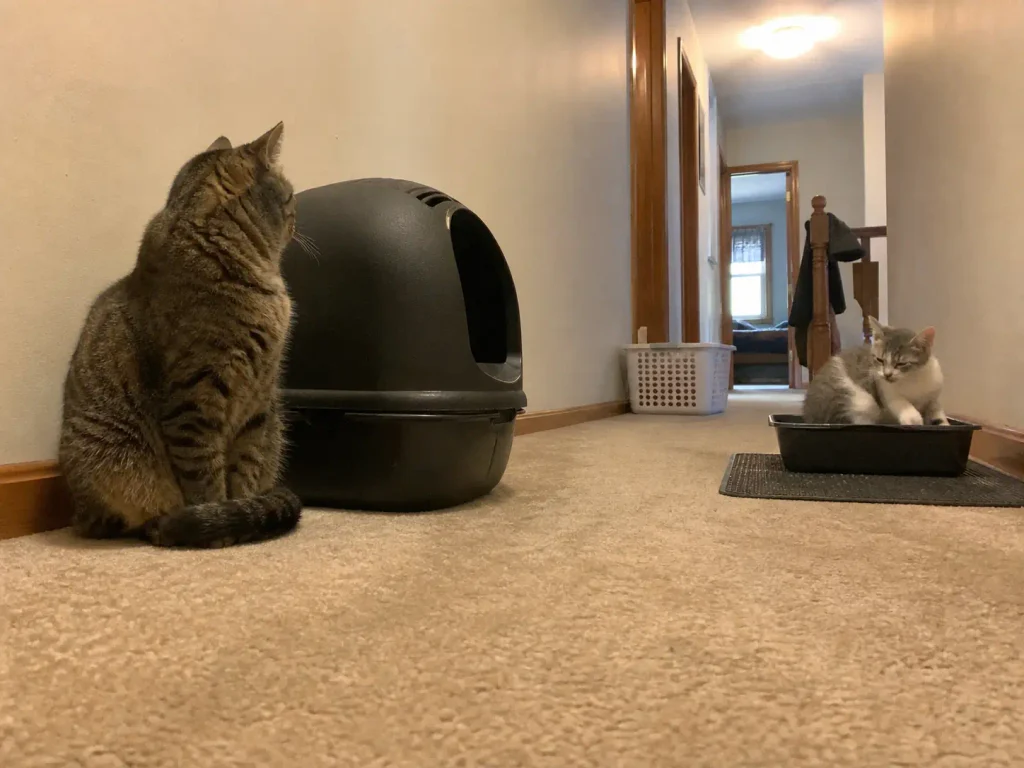
You did not bring a kitten home to an empty apartment. In a multi-cat household there is already a nine-pound resident who has been using the machine happily for a year and now has opinions about the plastic tray that appeared in her hallway. This is the common case, and it is the one nobody writes about.
The Kitten Tray Is an Extra Box, Not a Substitute
The counting rule does not pause because one resident is small. The box count two cats actually need is one per cat plus one, and the kitten’s plain tray is an additional box, not a replacement for the adult’s. Two cats, three boxes, and one of the three happens to be a machine running in manual.
You cannot split the difference on the machine, either, and this trips people up. Automatic for the adult and manual for the kitten is not a setting that exists. The mode is a property of the box, not of the cat using it. Whichever way you set it, both cats get that mode, which is exactly why the interim tray is not optional.
Expect the adult to start using the kitten’s open tray too. That is normal and it is not a regression. An open pan with fresh litter and no moving parts is a perfectly nice box by any cat’s standards, and if she prefers it for a while she is telling you something about the machine rather than about the tray.
Where the Second Box Goes When There Is One Bathroom
Here is where this becomes an apartment problem rather than a cat problem. Two boxes in a one-bedroom with a single bathroom is a floor-plan question, and it has a right answer that most people get wrong on the first try.
The rule that matters: litter box placement decides this, and the two boxes go in different rooms. Lined up side by side against the same wall, they are one box as far as the cats are concerned, and the whole point of the second one was that a kitten should not have to walk past an adult to reach a toilet.
In a one bedroom apartment the realistic pairs are the bathroom and a bedroom corner, or the bathroom and a laundry nook, and both are renter-friendly because neither asks you to move anything you do not own. Under a desk works. Beside the front door does not, because that is the one spot in the apartment with unpredictable traffic and a door that swings. A low-traffic area with an escape route on both sides is what she needs, and a doorway gives her neither.
And leave a clear route out on more than one side of each box. A kitten who can only exit the way she came in is a kitten who will decide the box is a trap the first time the adult appears in the doorway, and she will be right about that.
Littermates Do Not Cross the Line on the Same Day
If you took two from the same litter, they will not hit three pounds together. One clears it, her sister clears it two or three weeks later, and in that gap you have a genuine problem: the machine cannot tell them apart. Automatic Mode is a setting for the box, and the box does not know which cat just walked out of it.
So the household stays on the bridge until the smaller one clears the threshold. Not the average of the two, not the bigger one plus a hopeful shrug. The smallest cat in the apartment sets the schedule for everybody, which is annoying and is also the only version of this that is safe.
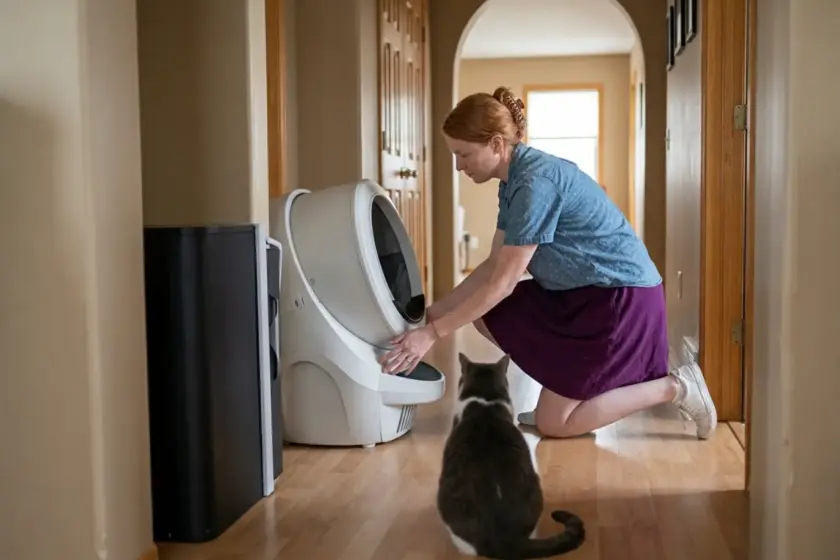
The Litter-Robot 4 is the model most people asking this question already own, and it is the one the three-pound figure belongs to. Its footprint is the honest drawback in a small apartment: it is a tower, and it wants a corner it can keep. If you already have one sitting there doing nothing while your kitten grows, it is not defective. It is waiting, and the waiting is the feature.
The Weeks After She Clears It
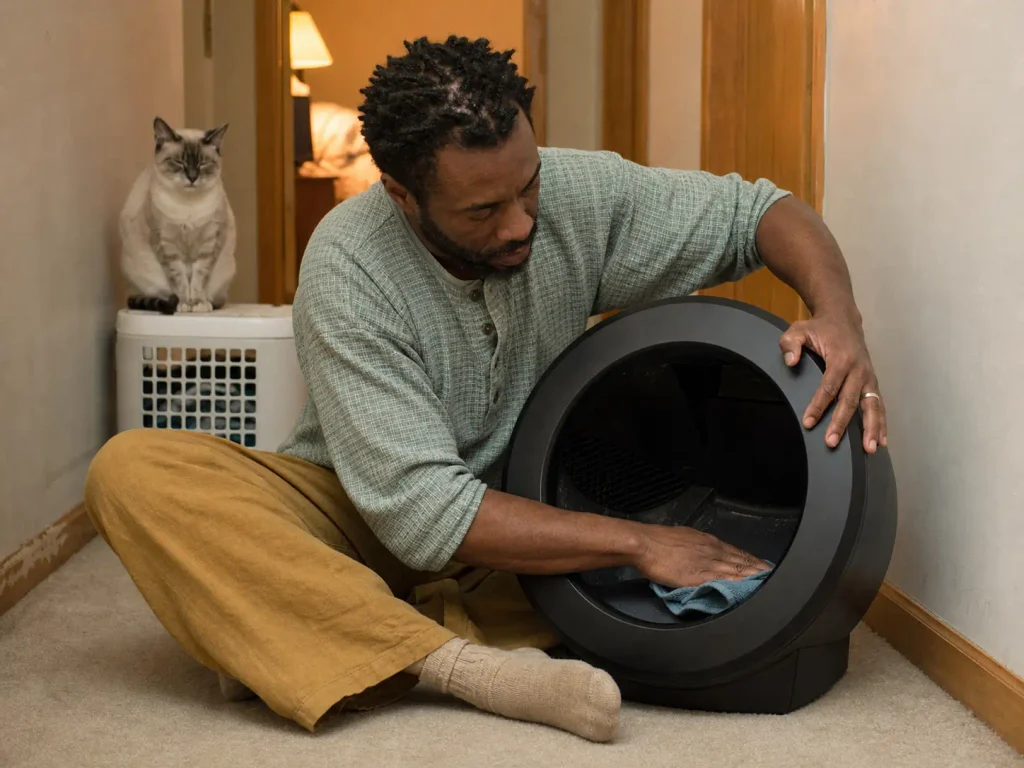
Hitting three pounds is not the finish line. It is the day you start paying attention differently.
The Day to Switch It On Is Not the Day the Scale Hits Three
Two conditions, and the scale is only one of them. She should be over the line with some margin, and she should be using the machine confidently in manual mode: walking in without hesitating, digging normally, not treating the doorway as a decision. If she is over the line but still approaching it like it might move, wait. The number is the permission, not the instruction.
Keep the plain tray for two more weeks after you switch the automation on. Removing the fallback on the same day you remove the manual mode is two changes at once, and if something goes sideways you will not know which one caused it. Two weeks costs you a square foot of floor and tells you whether she has actually accepted the machine or was just tolerating it while the alternative sat nearby.
What Settles on Its Own and What Does Not
Some of what you will see in the first week is normal and resolves without you. She may wait for a cycle to finish before going near it. She may leave immediately after using it instead of hanging around. She may stare at it for a while from three feet away.
All of that settles.
One thing does not settle: going somewhere else in the apartment. That is not adjustment, that is rejection, and waiting it out makes it worse rather than better, because every day she uses the rug is a day the rug becomes more normal.
The fix is to go backward one step. Automation off, manual mode back on, plain tray back if you had removed it, and give it another two weeks before trying again. Moving backward on purpose is not a failure. Waiting and hoping is.
Wipe the Sensor, Because She Is the First Cat It Will Stop Seeing
The maintenance nobody mentions: the sensor plate collects dust, and dust makes the reading drift low. On a twelve-pound adult, drift is invisible. She is so far above the threshold that a bit of noise in the measurement changes nothing.
Your kitten is not. She is the cat sitting closest to the detection floor, which makes her the first cat in the apartment that a dirty sensor stops registering. A box that worked fine for three weeks and then quietly stops cycling for her is very often this and nothing more. Wipe the plate when you empty the drawer, and it stops being a mystery you have to solve twice.
- Sensor plate wiped clean, every time you empty the waste drawer.
- Waste drawer emptied on schedule rather than when it starts to announce itself.
- Kitten weighed once a week, same day, written down.
- Plain tray still in place until she has been on automatic for a solid two weeks.
Conclusion
Weigh her before you troubleshoot anything else. Three pounds is the line on both current Litter-Robot models, most eight-to-twelve-week kittens are under it, and a machine that ignores a two-and-a-half-pound kitten is a machine working correctly.
Run the box in manual mode beside the plain tray she already uses, and change one thing at a time. Same litter, same spot, machine unplugged and boring for a couple of weeks before it does anything at all.
And anything about her body, straining, blood, hiding, an overnight change in habits, is a phone call rather than a settings change. That line does not move.
Re-weigh her and reread the room in three weeks. Either she has cleared the threshold and the bridge is over, or she has not and nothing about the plan changes, which makes it a cheap thing to check. The plain tray you already own does the whole job for another month. The machine is not going anywhere.
Amazon’s Audible — free for 30 days
Your cat won’t let you read. Let someone read to you.
Audible is Amazon’s audiobook library — thousands of titles, read out loud, on your phone. Free for a month, plus one audiobook to keep forever.
Frequently Asked Questions
01Can an 8-week-old kitten use an automatic litter box?
Almost certainly not in automatic mode, because an eight-week-old kitten is usually well under the three-pound minimum the weight sensor needs to register her. She can use the same unit with the automation switched off and the cycle run by hand after each visit.
02What weight does a kitten need to be for a Litter-Robot?
Whisker publishes three pounds for Automatic Mode on both the Litter-Robot 4 and the Litter-Robot 5. Below that the SmartScale does not register the cat and the cleaning cycle will not trigger. Some behavior consultants pad it to 3.5 or 4 pounds for margin.
03Are automatic litter boxes safe for kittens?
The manufacturers’ own answer is that these units are not rated for cats under the weight minimum, which is why a manual protocol exists for kittens. Above the threshold the risk becomes the same one adult cats carry, and that question is covered separately.
04How long does it take to transition a kitten to an automatic litter box?
One to four weeks, and the kitten decides which end of that range you get rather than a schedule you pick. The plain tray stays available the whole time and the litter does not change while the box does.
05Can I use an automatic litter box if I have a kitten and an adult cat?
Yes, with two boxes rather than one. The mode is a property of the machine and not of the cat, so the adult keeps the unit and the kitten keeps a plain tray in a different room until she clears the weight threshold.
Leave a comment