How Much Automatic Litter Boxes Cost to Keep Running
Don't price the box, price the year. Automatic litter box costs stack up in litter, liners + a subscription nobody mentions at checkout.

Alfredo RamsesFounder · August 25, 2026 · 18 min read

On this page8 sections
- 1The Purchase Price Is the Smallest Number in This Decision
- 2Litter Is the Bill That Arrives Every Month
- 3The Consumables Nobody Adds Up
- 4The Subscription That Arrives After the Box Does
- 5The Cheap Tier Costs Something That Is Not Money
- 6How Many Cats Changes the Entire Answer
- 7What Owning One Actually Costs
- 8Frequently Asked Questions
You have a browser tab open with a number in it, and that number is the reason you have not clicked buy yet. Owners who did click describe the same reaction: they now own the most expensive waste receptacle in the house. Nobody warned them the machine arrives with a monthly appetite.
That is the real answer to how much automatic litter boxes cost, and it is missing from the first page of results for a simple reason: nearly every page there is a store, and stores price the box, not the year. What follows is the cost of ownership in full, and the one variable that decides it, which is how many cats live in your apartment.
Here is the shape of the decision before the details.
| Tier | What the money buys | What still costs you after |
|---|---|---|
| Budget open-top | The rake and the sifting, and not much else | Litter, plus parts you may not be able to buy |
| Mid-tier open-top | Better sensors, a real brand behind the warranty | Litter, liners, filters |
| Premium enclosed | Drawer capacity, odor containment, parts availability | Litter, full consumable set, extended coverage |
| Camera and app tier | Per-cat logging and video, on top of any tier above | All of the above, plus a monthly fee |
The Purchase Price Is the Smallest Number in This Decision
The price in that tab is real, and it stops mattering around week three. The person who regrets the purchase and the person who calls it worth every penny usually paid within a few dollars of each other. What separated them was how many cats they had, how often the box was genuinely getting scooped before, and whether the machine survived past its first birthday. If you have not yet settled whether an automatic box is the right answer for your house at all, start there, because the cost question only becomes interesting once the answer is probably yes.
What the Four Tiers Actually Are
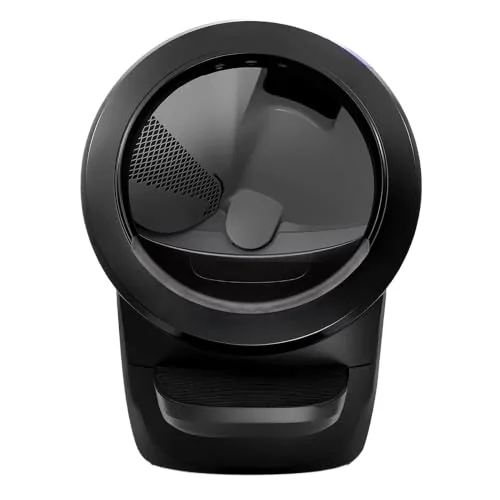
Sort the market by what the machines are rather than what they cost. The budget open-top litter box tier is a raking mechanism in an open pan: waste goes into the waste drawer and that is the feature list. The mid-tier open-top adds sensors more reliable about noticing your cat is standing in it, and a brand that answers email.
The premium enclosed litter box tier buys a bigger sealed drawer, real odor containment, and replacement parts you can still order in three years. And the camera and app tier is a layer sitting on top of any of the others. That last one is where the money gets strange.
The Gap Between the Two Premium Models Is a Feature, Not a Category
The two most-cited premium units sit close together, and shopping guides present the step between them as a step between categories. It is not. The step up buys WasteID (the machine distinguishing urine from feces), not a different cleaning mechanism, a bigger drawer, or a longer life. Same globe, same rake, same sift, so once you are in the premium tier the extra money buys detection, not durability.
The Free Question to Answer Before You Price Anything
Spread across the several years one of these units is expected to work, the device stops being the dominant line on the bill. Litter and consumables catch up faster than anyone expects, which is why the honest version of this question is never “can I afford the box” but “what is my current setup already costing me, in money and in the scoops I keep not doing.” Count this week’s scoops before you compare a single model.
Put a mark on a sticky note by the box every time you scoop, for one week. Then count. The machine only pays for the scoops that were never happening. If the honest number is eleven or twelve, you are buying convenience, and the math has to work on convenience alone. If the honest number is three, you are buying back a routine that already collapsed, and that is a completely different purchase.
And to shave the entry cost without dropping a tier, the move owners keep describing in threads is not buying cheaper: it is buying the same machine reconditioned or open-box, direct from the manufacturer. Read the warranty terms closely and you end up with the unit you wanted instead of a smaller one you will resent.
Litter Is the Bill That Arrives Every Month
Nobody budgets for litter when pricing an automatic box, because they were already buying litter. The trap is quieter: an automatic box changes which litter you are permitted to buy, and that constraint is sometimes the entire cost difference between two machines that looked identically priced.
What You Were Already Spending on Litter
Start with the baseline nobody prints. One cat, scooped by hand, on decent clumping litter is already an annual bill in the low hundreds, and premium clumping litter climbs toward the high hundreds. Two cats roughly doubles the volume without quite doubling the cost.
That is the number the machine has to beat, and almost no competitor states it, which is how “is it worth it” gets argued with one side of the ledger missing. The automatic unit is competing against a real recurring expense, not against free, and against a plain manual box and a bag of clumping litter, which costs almost nothing to keep running.
The Machines That Choose Your Litter for You
Most units run on ordinary clumping clay or tofu litter, so your litter bill stays roughly where it was. Buy one of those and litter is a wash.
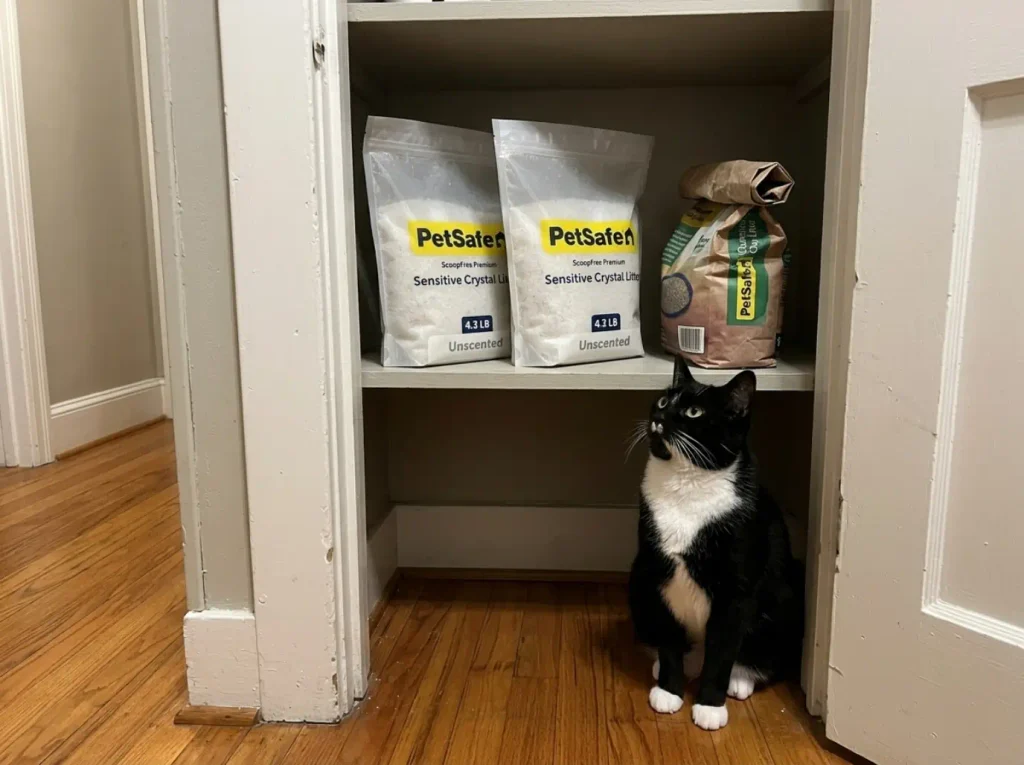
Some units do not work that way. Crystal-based systems require a specific proprietary litter and will not take a generic clumping alternative, because the sifting mechanism is built around the crystals. The PetSafe ScoopFree Premium Crystal Litter refills are what that commitment looks like as a repeating purchase: fragrance-free packs you reorder on the manufacturer’s schedule rather than on a sale you found.
It works, and cats with opinions about texture often accept crystals fine. The caveat is structural rather than about quality: you have traded the ability to shop around, permanently, and that floor is attached to the machine, not to the cat.
Owners describe hitting that realization as the moment the one-time purchase stopped being one.
Switching Litter Before Switching Boxes
Here is the free move, and it belongs before any of this. If your current litter is premium clumping and the reason you are shopping is cost, try a cheaper clumping litter from any store first. It costs nothing beyond what you were already spending and often closes most of the gap between the two machines you were agonizing over.
I used to treat litter choice and machine choice as separate decisions. After enough threads where someone’s “expensive automatic box” turned out to be a mid-priced machine plus a mandatory litter subscription, I stopped separating them. The litter is part of the machine’s price. Price them together.
The Consumables Nobody Adds Up
This is the section that makes people redo their math. Liners, carbon filters, odor-trap refills and cleaner wipes are each cheap and collectively constant, and they are why the machine is never a zero-dollar-a-month appliance the way a plastic pan is once you own it.
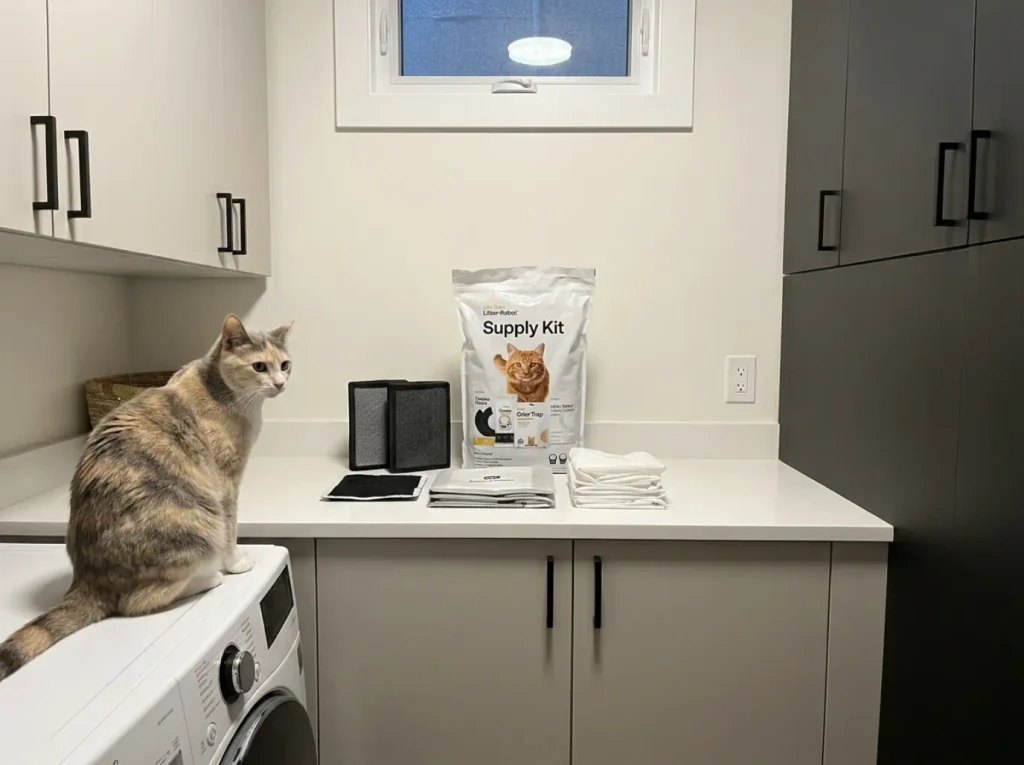
The set is short and predictable: litter liners for the drawer, a carbon filter that saturates, odor-trap refills on units that use them, and wipes for the parts you wash by hand. Each carries a replacement cadence set by the manufacturer, and together they stack a real annual line item on top of litter. It is the number every ownership estimate in the search results leaves out.
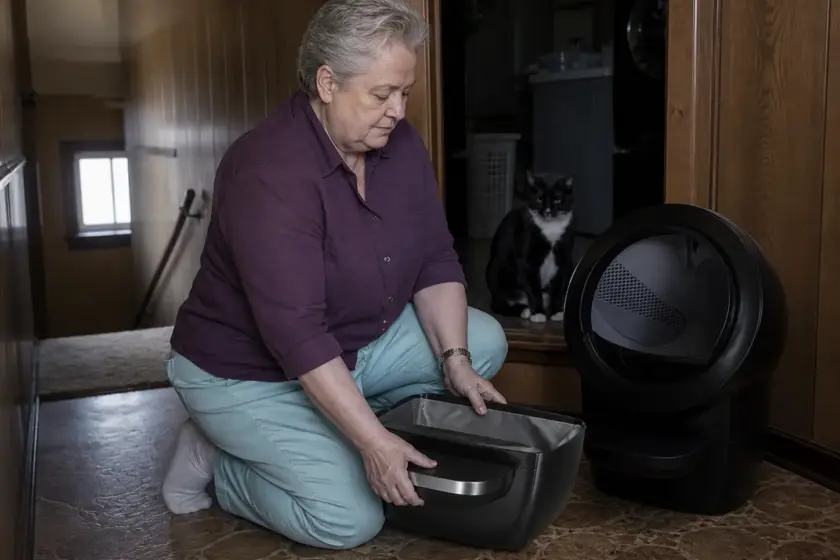
The Litter-Robot Supply Kit by Whisker bundles thirty wipes, ten drawer liners, three OdorTrap refills and two carbon filters into one item, which makes it countable. See how long ten liners last in your house and you have your real replacement rate instead of a vague warning about extra costs. The caveat applies to any bundle: you will not use all four at the same rate, and buying separately is cheaper if you only burn through liners.
None of this replaces the hand work. The six parts you still have to wash yourself run on the same calendar as the consumables, which is convenient in the sense that you only have to remember one schedule.
Skipping them is a real option with a real price. They are optional in the sense that the machine runs without them, and not optional in the sense that it runs worse. The drawer is where the smell moved to, not where it stopped. Skip the liners and you scrub that drawer by hand every time it fills, which is exactly the labor you bought the machine to stop doing.
The Subscription That Arrives After the Box Does
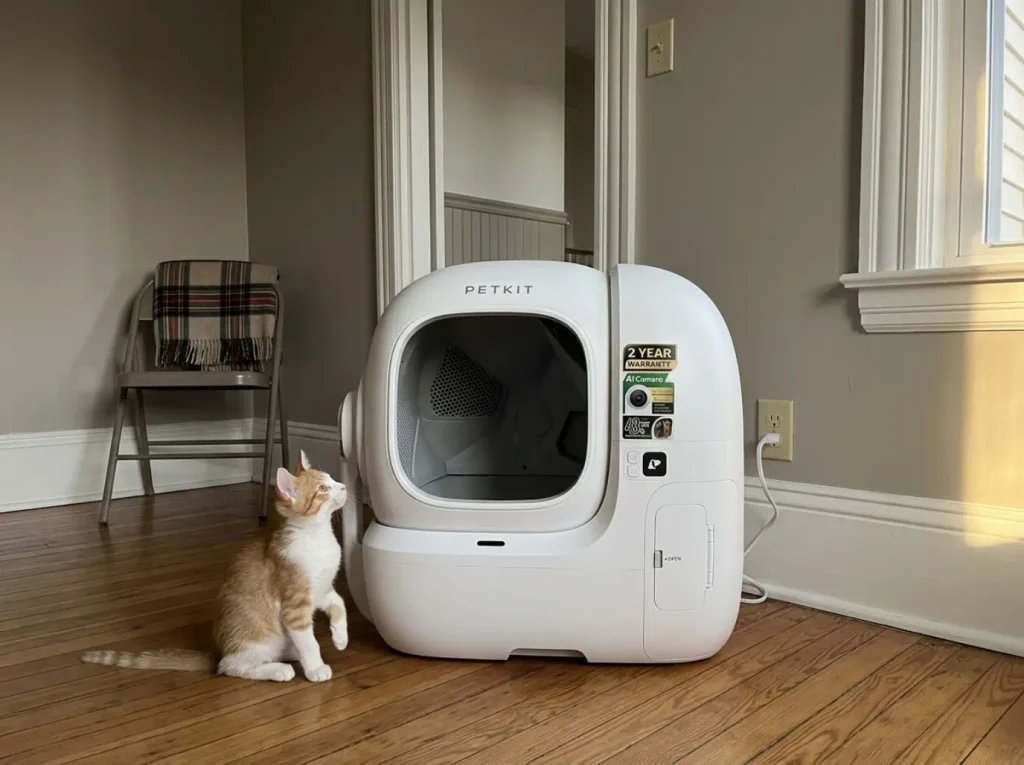
The camera is the feature that makes the app worth opening, and the camera is the feature behind the paywall. The demo that sold someone the expensive tier is frequently the exact thing that becomes a monthly bill once the trial expires.
What the Monthly Fee Actually Unlocks
Camera and health-tracking tiers carry an app subscription for video and history on top of the device, billed monthly, which adds up to a real annual figure no competitor prints anywhere near the sticker price. The PETKIT Purobot Max Pro 2 is the cleanest example: its headline feature is the AI camera that logs who used the box and when, and the cloud video history that makes that log worth reviewing is the part with the recurring fee attached. The monitoring is genuinely useful in a multi-cat house where you cannot otherwise tell who is doing what. The caveat is that the feature you are buying it for is not fully included in the purchase.
One note that belongs here rather than buried: any change in a cat’s litter box habits is a call to the vet, camera or not. The app tells you a frequency looks different. It does not tell you why, and neither does this article.
If the subscription lapses, the box does not brick. The rake runs, the sifting works, and the sensors still halt the cleaning cycle when your cat steps in. What you lose is video history, clip storage and the tracking layer, which is to say the reason you bought that tier instead of the one below it. Worth deciding before checkout, not after.
The Warranty Window, and Why Year Two Is the One That Matters
The other optional recurring cost is extended coverage, and it changes the math more than the subscription does. Standard warranties are short, typically a single year, against a working life measured in several.
The exposure is not year one. It is year two, and the owner framing captures it exactly: after that one year, if it goes wrong, that’s it. A motor or sensor failure past the warranty turns an expensive machine into something you cannot justify repairing. An extended warranty costs a fraction of the unit, and it earns that if you keep the box past year one.
Decide about extended coverage in the first few weeks, not in month eleven. The window for adding it closes while the machine is still behaving perfectly, which is precisely when buying it feels least necessary and is cheapest. Put a reminder in your phone for day twenty and make the call while the option is still on the table.
One more thing about the app tier, and it is about the apartment rather than the money: it assumes reliable wifi and a permanent outlet within reach of wherever the box can physically go. In a rental where the only viable spot is a bathroom with its one outlet occupied, that is not a small assumption.
The Cheap Tier Costs Something That Is Not Money
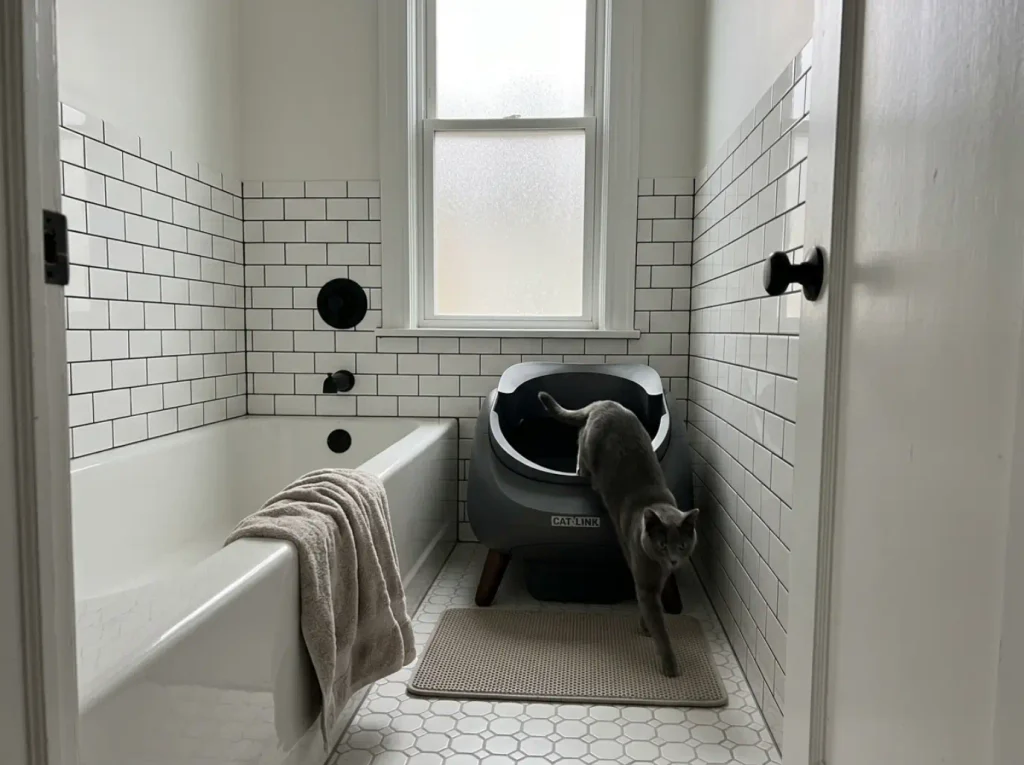
The obvious way to make this cheaper is to buy the cheap one, and that is a reasonable thing to want. What you need is the line between a recognized brand’s entry-level machine and an unbranded import, because those are not the same purchase even at the same price.
What Dropping a Tier Actually Loses
Go down a tier from a real brand and you lose things you can name. Build quality: thinner plastic, more flex, more rattle. Sensor reliability, which matters most, because a weight sensor slow to notice a cat is the difference between a machine that waits and one that does not.
Then replacement-part availability, which sounds abstract until a rake arm cracks in year two and there is nowhere to order one. And support, which is the difference between an answered email and a vanished listing. None of that makes the budget tier a bad choice: it makes it a smaller machine with a shorter tail, which for one easygoing cat in a small apartment can be exactly right.
Where the Budget Line Stops Being About Features
The very cheapest end of the market is a different conversation. Generic unbranded imports, frequently with a rotating or star-shaped entrance, carry a documented pattern of owner-reported safety incidents, and that is where an honest cost article draws its line. For the mechanism rather than the warning, the sibling piece on the two separate risks in a self-cleaning box carries the detail this section only names. It is also worth a minute to check the CPSC’s recall list before buying an off-brand unit.
The translation: a recognized brand’s entry-level open-top unit is the budget answer. A generic import at the same price is a different risk category, not a discounted version of the same thing. And if your cat takes one look at a cheap machine and refuses to go near it, he is not being difficult. A cat will not commit his weight to something that rattles under him, and the rattle is the machine reporting a real problem about itself.
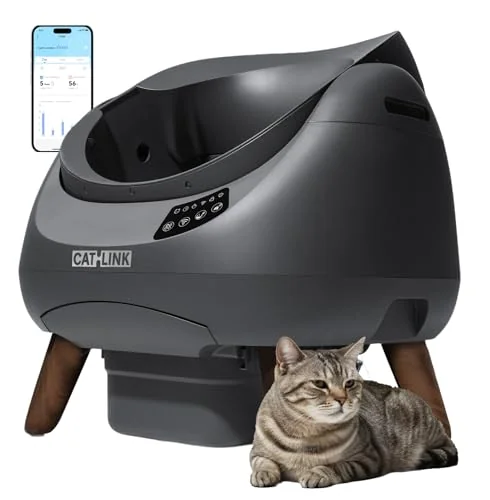
The Free Version of the Experiment
A plain manual litter box with a good scooping habit beats a bad automatic box on every measure that matters, including the ones the cat cares about. Scoop twice a day, deliberately, for two weeks. If the habit holds, you just learned how much machine you actually need. If it collapses by day four, you learned the more useful of the two answers.
How Many Cats Changes the Entire Answer
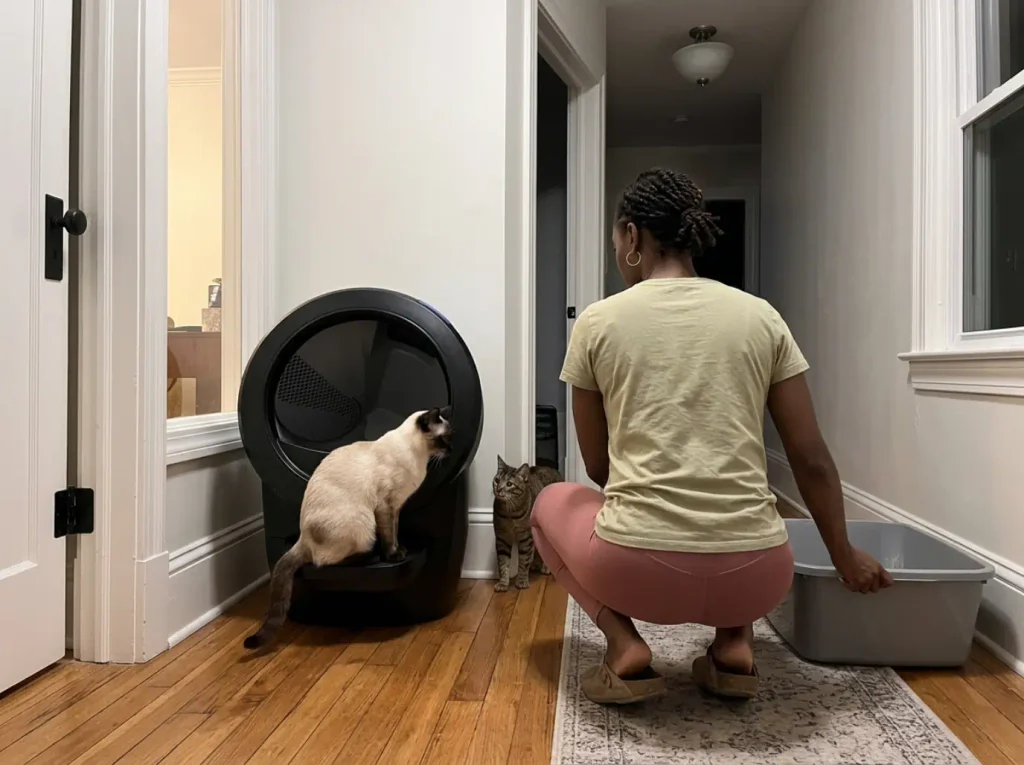
Here is the split almost nobody makes, and it decides whether this machine is expensive or cheap. For one cat it is a convenience purchase and the math is honestly debatable. For three cats it is a labor purchase, and the same machine at the same price reads as a bargain.
One Cat, and Why the Math Stays Debatable
With one cat, the machine competes against a scoop you were mostly using anyway. The break-even sits a couple of years out at best, and it depends on the unit surviving that long. Add the litter you were already buying, subtract the modest savings a good sifting mechanism gives you, and you are buying time and smell control rather than a saving. That is a legitimate thing to buy; it should just not be sold to you as one that pays for itself.
For a one or two cat household that does not need premium drawer capacity, the mid-tier open-top band is where the value sits, and the PETLIBRO Luma is the representative version: open-top, standard litter, AI waste analysis, no enclosure for a cat to be suspicious of. The caveat every open-top carries applies here too. An open design contains less odor than a sealed drawer, so the room it lives in matters more.
Several Cats, and Why the Same Machine Reads as Cheap
With three cats the comparison changes completely, because the machine is no longer competing against a routine you were keeping. It is competing against one that broke months ago. The framing that keeps surfacing in threads from a multi-cat household is consistent: if you have several cats and cannot sit there scooping every few hours, the device is worth every penny.
Nobody says that about a single easygoing cat. That is the whole value case, and it is household load rather than novelty. It has a limit, though: a single unit under three-cat traffic runs into problems that are mechanical rather than financial, and the sibling piece on where a single unit starts breaking down with three cats owns that ground.
The Backup Box Nobody Budgets For
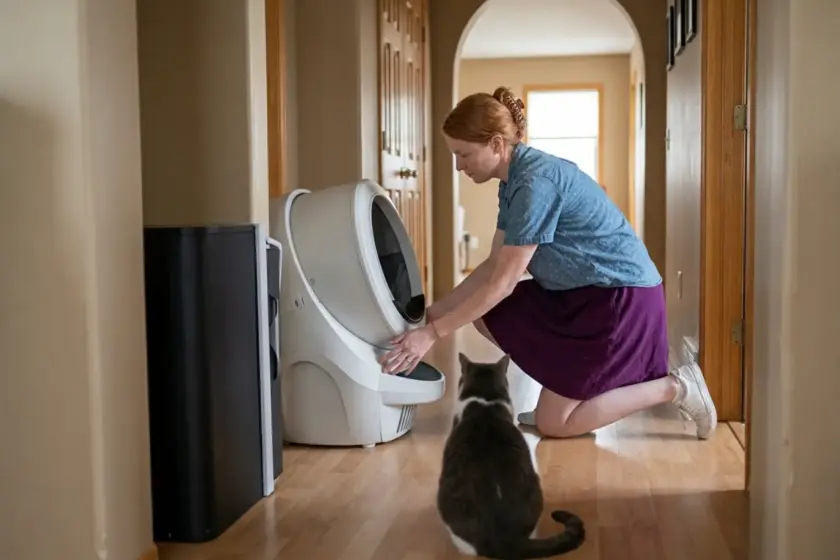
The one box per cat plus one rule does not evaporate because a machine arrived. A single automatic unit for three cats does not exempt the apartment from having enough boxes, and that backup box is a real cost that belongs in this total even though it never appears in anyone’s comparison. It matters for a second reason too, which is why a drawer that fills faster starts to announce itself. A machine at capacity in a three-cat house is a smell problem long before it is a mechanical one.
Footprint is the other cost, and in a small apartment it bites. These units stand roughly two feet tall, need clearance to rotate or rake, and require a permanent outlet. The second box has to go somewhere the first one is not, and in a one-bedroom you have perhaps three viable spots, two of which are wrong for reasons the cat will explain later. Measure before you order.
The cheapest multi-cat setup is one automatic unit plus one plain manual box, not two machines. It is what owners in multi-cat threads keep landing on, it satisfies the box count for a fraction of the cost of a second unit, and it gives you a working fallback on the day the machine jams — which is not a hypothetical day.
What Owning One Actually Costs
Price the year, not the box. The unit is a one-time number attached to a recurring one, and the recurring one decides whether this was a good purchase.
The two costs that surprise people are the litter you are now required to buy and the subscription attached to the feature you bought the machine for. Both are knowable before you check out. And how many cats live in the apartment moves this from a debatable convenience to an obvious one. That is the variable, not the brand.
🗓️ Check back in three months. That is longer than this blog usually recommends, and it is deliberate: consumable and maintenance cadence is slow-wear, and three weeks is too early to see any of it. At the three-month mark, count what you have actually replaced and what the litter bill has done since. That number, not the sticker price, is what owning one costs.
Then do the free thing first. Count the scoops that are genuinely not happening in your house this week. If the box gets scooped most days, the machine is buying convenience rather than rescue, and that is a much smaller purchase to justify.
Amazon’s Audible — free for 30 days
Your cat won’t let you read. Let someone read to you.
Audible is Amazon’s audiobook library — thousands of titles, read out loud, on your phone. Free for a month, plus one audiobook to keep forever.
Frequently Asked Questions
01Are automatic litter boxes worth the cost?
For a single cat whose box gets scooped most days, it buys convenience and the break-even sits years out. For a multi-cat house where the second scoop of the day stopped happening months ago, it replaces labor that was not getting done, and those owners are the ones who consistently call it worth it.
02What is the cheapest way to buy a self-cleaning litter box?
Reconditioned and open-box units bought direct from the manufacturer are the most common way owners cut the entry cost without dropping a tier. Dropping a tier saves more, but it changes what you get, and at the very bottom of the market it changes who made the machine.
03Do automatic litter boxes have monthly fees?
The rake, sift and drawer functions do not. Camera and health-tracking tiers do. Video history and clip storage sit behind a monthly subscription, and that fee is attached to the exact feature that usually justified buying the higher tier in the first place.
04How long does an automatic litter box last?
Owners generally plan around several years of service, which is why spreading the purchase price across that span matters more than the price itself. The standard warranty is far shorter than the expected life, so the real exposure is a failure in year two, not year one.
05Do I still need a second litter box if I have an automatic one?
Yes. The box count is set by how many cats live there, not by how the boxes clean themselves. One machine does not satisfy the requirement for a multi-cat house, and the backup box belongs in your budget from the start.
Leave a comment