Are Self-Cleaning Litter Boxes Safe? Two Risks, Not One
Two risks, not one (and only one gets talked about). What makes a self-cleaning litter box safe & the 5-second habit that replaces scooping.

Alfredo RamsesFounder · August 25, 2026 · 23 min read

On this page8 sections
- 1What "Safe" Is Actually Asking, and Why It Splits in Two
- 2What You Stop Seeing When the Box Cleans Itself
- 3What Actually Makes a Cycle Stop, and What Doesn't
- 4The Cats the Sensors Can Miss
- 5Two Cats Change the Question
- 6The Checks to Run Before You Trust It Overnight
- 7Conclusion
- 8Frequently Asked Questions
You have seen the Facebook post about the cat that did not survive the night next to one of these machines, and you have also seen the Reddit thread where forty people say theirs has run for three years without a single incident. Both are true. They are describing different machines.
But the question of whether self-cleaning litter boxes are safe has a second half that almost nobody asks, and it is the half that leaves no mark: the daily scoop was an inspection, and the machine quietly takes it away. The manufacturers who build the good units document their stop systems in public, and the reported entrapment cases cluster in a very specific kind of product. So here is what makes a machine mechanically safe, what you stop seeing once it cleans itself, and the checks worth running before you let one operate overnight with nobody watching.
Quick Answer
Name-brand units with redundant sensors are mechanically safe for a normal-sized adult cat, and the reported entrapment cases cluster in cheap lookalikes without that redundancy. The risk nobody names is not mechanical: automation removes the daily look at the litter that used to tell you something was off.
What “Safe” Is Actually Asking, and Why It Splits in Two
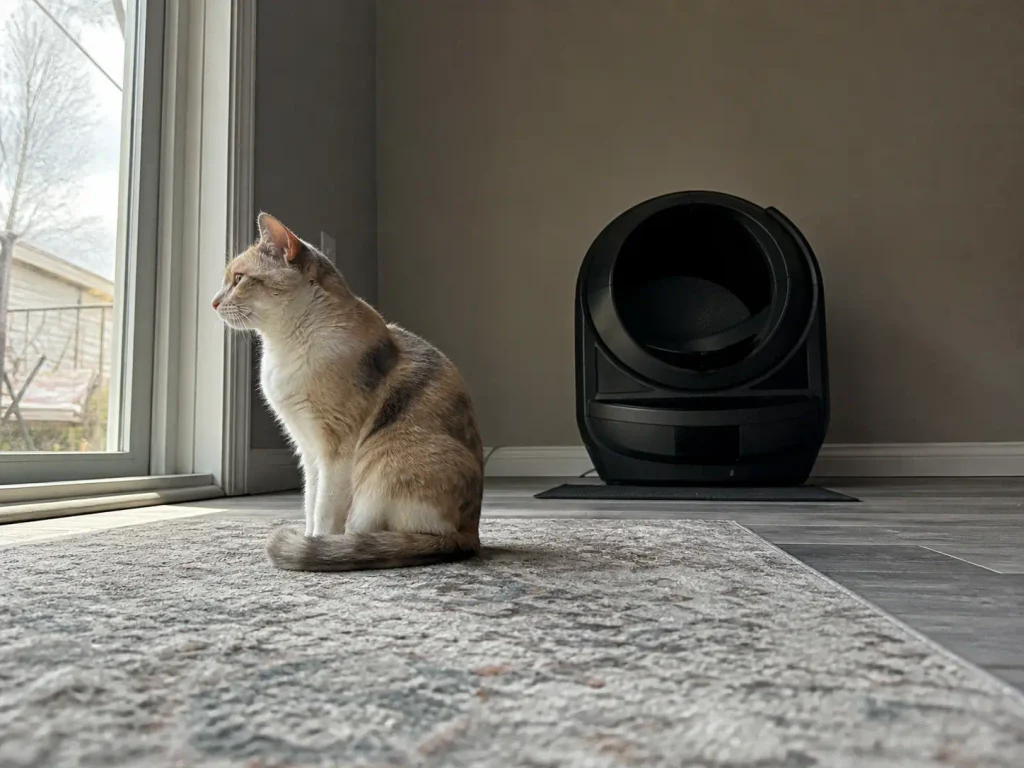
The word carries two entirely different questions and they get answered by two entirely different things. The first is mechanical: can the cycle move while my cat is inside it, or on his way in. That is the one people search for, the one that produces the frightening posts, and the one serious manufacturers document in detail because they know it is what sells or sinks the unit.
The second question is about information, and hardly anyone asks it out loud, because losing information does not look like anything. It just stops.
Here is the part worth settling before anything else: the category is not the variable. Whether a self-cleaning litter box is safe in your apartment depends on which model you bought, where you put it, and how many cats have to share it. That is three specific decisions, and all three are yours. If you have not yet worked out whether you want one at all, what a self-cleaning box actually does and who needs one is the wider view, and it is a better place to start than a safety article.
The mechanical question everyone asks
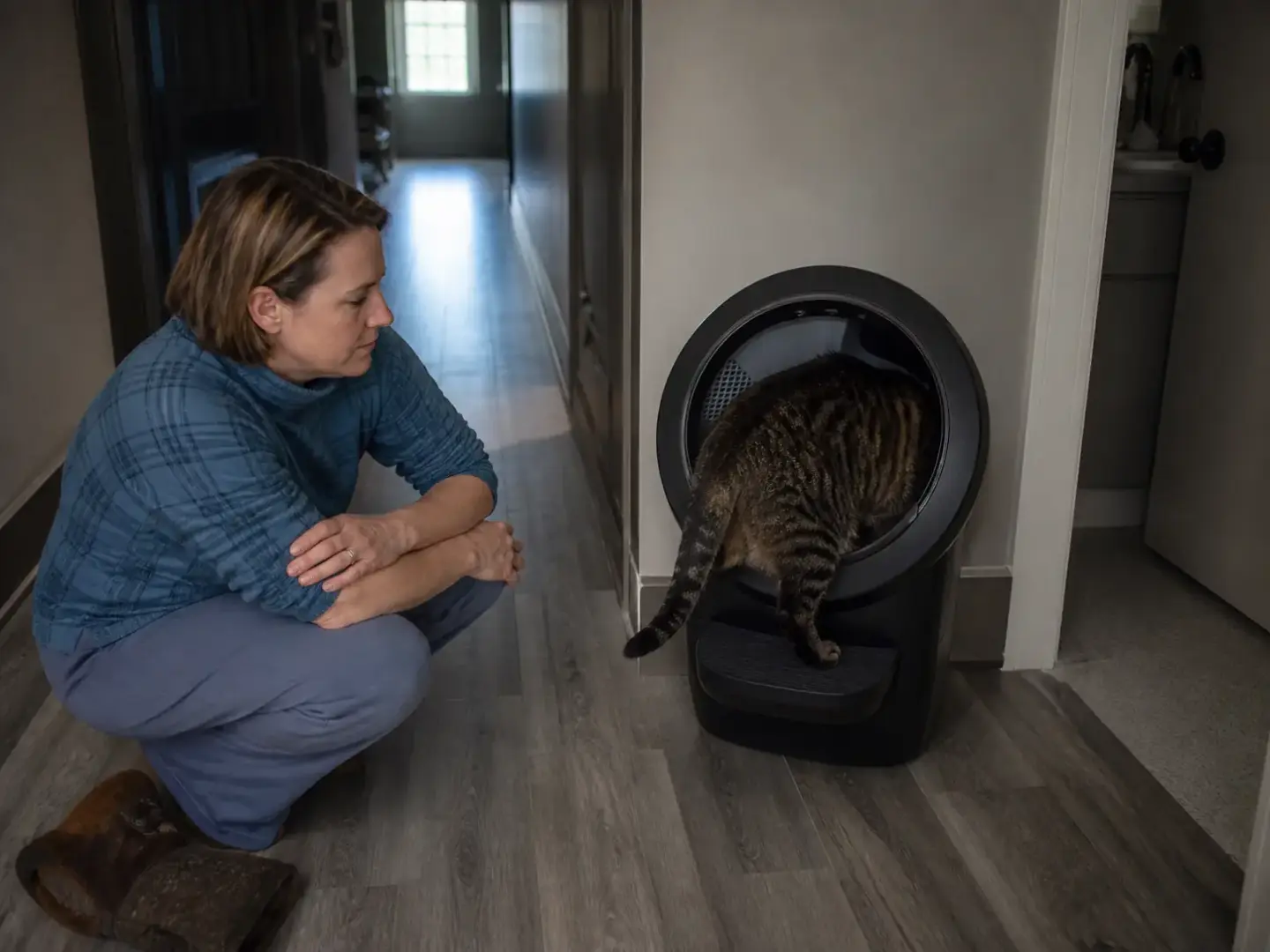
The scenario people picture is precise, and the community has a phrase for it that is more specific than any generic worry about pets and machines: cornered inside a moving unit. Not “my cat might get hurt.” A cat in an enclosed chamber with a rotating mechanism and one way out. It is worth saying that not every unit works that way: some sweep a rake across an open tray instead, which is a different shape of risk and a much smaller one. That precision matters, because a precise fear has a precise answer, and the answer is a set of countable engineering features rather than a brand you decide to trust.
Those features are real, and so are the failures. There are documented cases where cheaper, off-brand units failed badly, most often overnight with nobody in the room. Notice what that sentence does not say. It does not say automatic boxes are unsafe. It says a specific class of unit is, and the reporting is consistent about which class.
The monitoring question almost nobody asks
Nobody buys a machine thinking they will stop paying attention to their cat. It is not a decision anyone makes. It is a two-second habit that simply stops happening, because the thing it was attached to went away. You scooped every morning, and every morning you looked at what was in there without ever calling it looking.
Then the machine does the scooping, and the waste goes into a sealed drawer you open once every couple of weeks. The information did not vanish. It moved into a drawer. What you lost is the frequency.
Why the answer depends on the unit, not the category
Two risks, two completely different fixes, and this is the part that gets blurred everywhere else. The mechanical one you solve by choosing and placing: which unit, facing which direction, with how much clearance. It is a purchase decision and a furniture decision, and once it is made it stays made.
The monitoring one you solve with a new routine, and no product substitutes for it. The best a machine can do is send you a notification about something adjacent.
Which means an article that answers only the first half has told you half of what you needed. Both halves get their own section below.
What You Stop Seeing When the Box Cleans Itself
Joey Lusvardi, an IAABC Certified Cat Behavior Consultant, puts this at the top of his list: one of the biggest problems with these boxes is that they do not let you monitor your cat’s health as well as your own senses do. That is a working consultant naming it as the number one downside, and he is not talking about the mechanism at all. A perfectly built, perfectly safe unit has this problem in exactly the same measure as a badly built one.
🚑 So let us set the boundary here, early, and then keep it for the rest of the article. Any change in your cat’s litter box habits is a call to the vet. How often, how long he stays in there, whether elimination outside the box starts happening. That is a phone call, not a product decision, and this article will not tell you what any of it means, because that is not this blog’s job.
The two-second inspection nobody called an inspection
What you had was frequency, not expertise. You were not analyzing anything. You were standing there with a scoop, half awake, and you noticed what was normal because you had seen normal two hundred times. Nobody would describe that as monitoring. It was just the thing your eyes did while your hands worked.
The machine takes the hands away, and the eyes go with them. That is the whole of what health monitoring meant here, and nobody ever called it that. The honest framing is that the machine did not delete the information, it relocated it. Everything that was in the tray is now in the sealed waste bin under the unit. The difference is that you used to see it daily by accident, and now you see it fortnightly on purpose, if at all.
The weekly drawer check that replaces it
So build the accident back in on purpose. One fixed day a week, you open the waste drawer and look before you empty or reline it. Five seconds. That is the whole routine, and it is free. Pair it with the monthly deep clean the manual asks for and you have replaced most of what the scoop was quietly doing.
The reason it needs a fixed day rather than “regularly” is that “regularly” is what people write down and then quietly stop doing around week three. Pick the day and attach it to something already happening: trash night, the grocery run, whichever Sunday thing you never skip. A new habit with nothing to hang on comes loose, and it comes loose at almost exactly the point where you have started trusting the machine most.
Anchor the drawer check to something that already happens on a specific day, not to a day of the week on its own. Trash night, the weekly shop, whatever you genuinely never miss. A standalone reminder gets snoozed by the third week; a habit stapled to an existing one survives, because you are not remembering it, you are just extending something.
What a camera can and cannot tell you
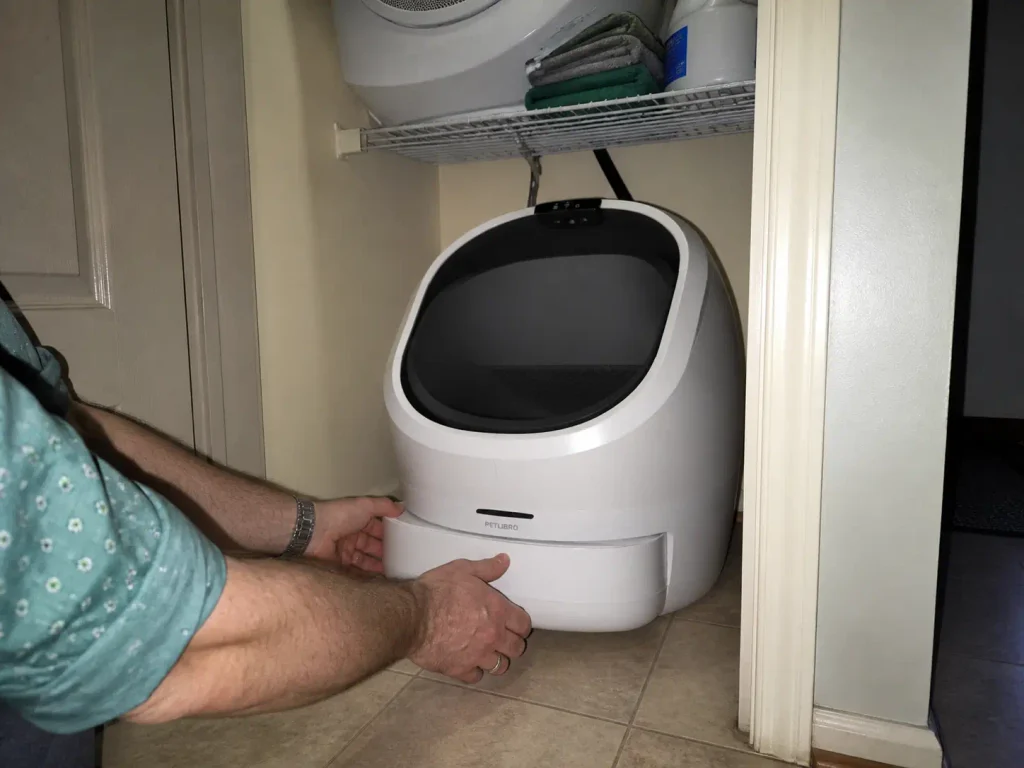
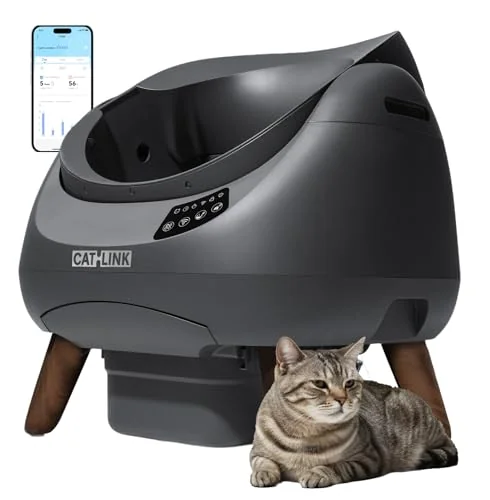
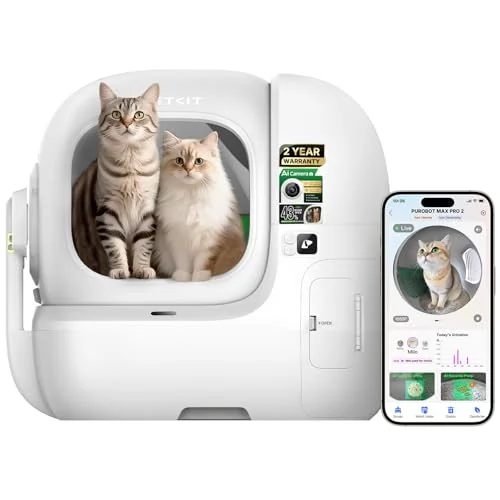
The industry has noticed the gap and is trying to sell you back the signal it took. Units with cameras and waste-analysis features are the closest attempt, and they are genuinely useful for one thing: frequency. The PETLIBRO Luma Automatic Cat Litter Box is an open-top unit with AI waste analysis that logs visits per cat and flags unusual patterns, and some units add weight tracking on top of that. It is a real answer to “am I away too much to notice anything.” What it will not do is show you what is in the drawer, and it is worth being clear about that rather than letting the feature list imply otherwise.
Frequency data and a look at the litter are not the same signal. One tells you something changed in the pattern; the other is the thing you were looking at all those mornings. Get the app if being out of the house all day is the reason you bought a machine in the first place. Do the five-second drawer check anyway.
What Actually Makes a Cycle Stop, and What Doesn’t
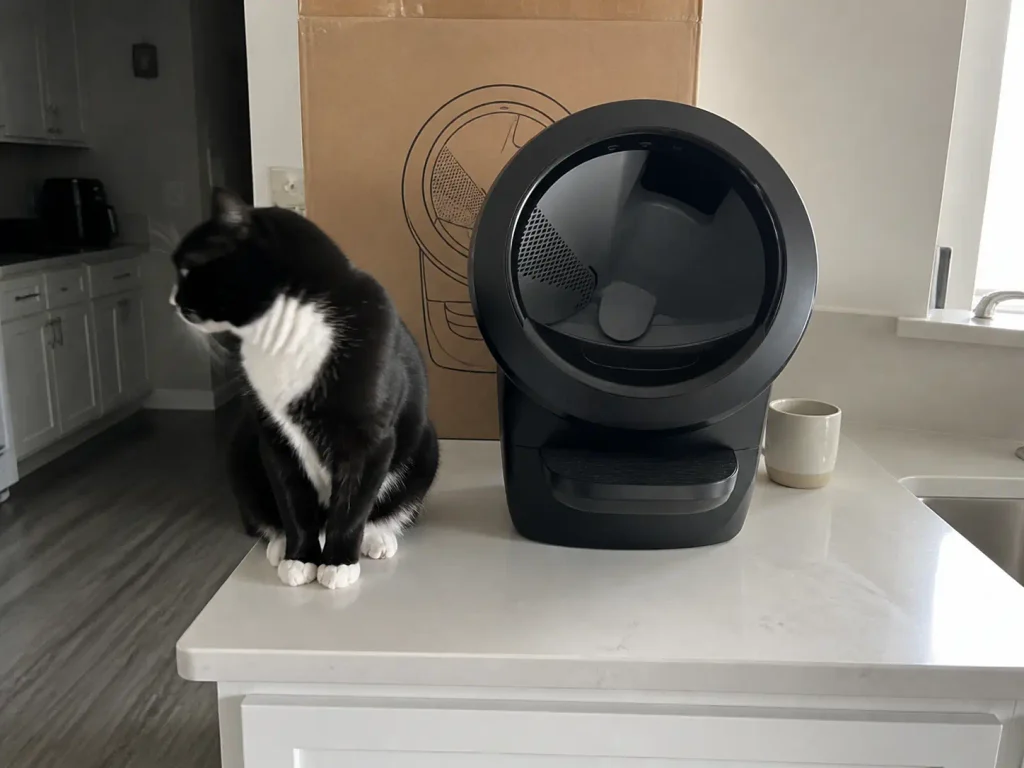
Every product page in this category says “safety sensors.” It is the least informative phrase in the sector, and it appears identically on the unit built by a company with an engineering department and on the unit assembled from a copied mold. What separates them is not whether sensors exist. It is how many independent systems have to fail simultaneously before anything can go wrong.
That is a countable spec, and you can check it before you buy.
Four zones, not “a sensor”
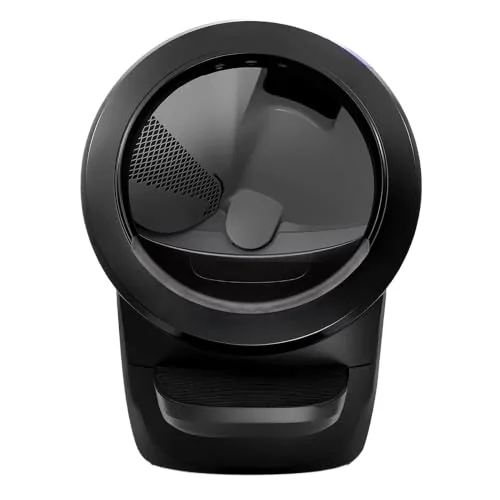
Take the documented example. Whisker publishes the redundant sensor systems built into higher-end units for the Litter-Robot 4, and the breakdown is specific enough to hold a competitor’s spec sheet against: three laser curtain sensors across the bezel plus a weight scale in the base, four detection zones total. Cheaper units typically run a single infrared sensor at the entrance and call that covered. If a cat enters mid-cycle, the cleaning cycle halts, and it will not resume until 15 seconds after the cat is no longer detected anywhere in those four zones.
The cooldown is the part worth noticing, because it is the detail that tells you somebody thought about the actual animal. A cat who steps out and immediately turns around to step back in is normal cat behavior. A machine that restarts the instant the scale reads zero has technically stopped for him and practically ignored him.
The systems that work after the cycle has already started
Detection before the cycle is the easy problem. The interesting engineering is what watches while the thing is already moving. There are anti-pinch sensors on both sides of the waste drawer chute, monitoring continuously through the whole rotation rather than checking once at the start, and if either one triggers, the globe stops and retracts.
Then two more systems that are independent of all of the above. Overload and jam detection: the motor stops, retracts, retries up to three times, then locks out with an error code rather than pushing harder. And over-torque protection, which cuts the cycle the moment resistance exceeds normal rotation force, regardless of what any sensor thinks is or is not in there.
Count what that means. Four detection zones, plus anti-pinch monitoring during movement, plus jam detection, plus torque cutout. Redundancy is the whole specification, and it is the word to look for. One sensor is one point of failure. Four systems reaching the same conclusion by four unrelated routes is a different category of product, and it costs what it costs for that reason.
Why the cheap lookalike has the same spec sheet and not the same machine
Owners and reviewers call them lookalikes or dupes, and the word is exact: they copy the shape and they copy the bullet points. Sensors appear on the listing. Anti-pinch appears on the listing. What does not transfer is manufacturing consistency, which is the boring, invisible, expensive part that decides whether a sensor triggers every single time or almost every time.
Almost every time is fine for a phone screen. It is not fine for something that rotates around your cat at four in the morning. The reported entrapment cases are concentrated in exactly this class of unit, sold at roughly a third of the name-brand price, and the pattern in the reporting is consistent enough that it is the single most useful buying rule in this whole article: the safety features you cannot verify are the ones you are paying the premium to actually have.
And no outside authority checks any of it. No regulation covers automatic litter boxes, no safety certification exists for them, so the only enforcement is whatever the manufacturer chose to build and is willing to publish. Which makes two dull questions worth asking before you buy: what the warranty actually covers, and whether replacement parts are sold separately. A company that sells you a new bezel is a company that expects the unit to still be running in four years.
The Cats the Sensors Can Miss
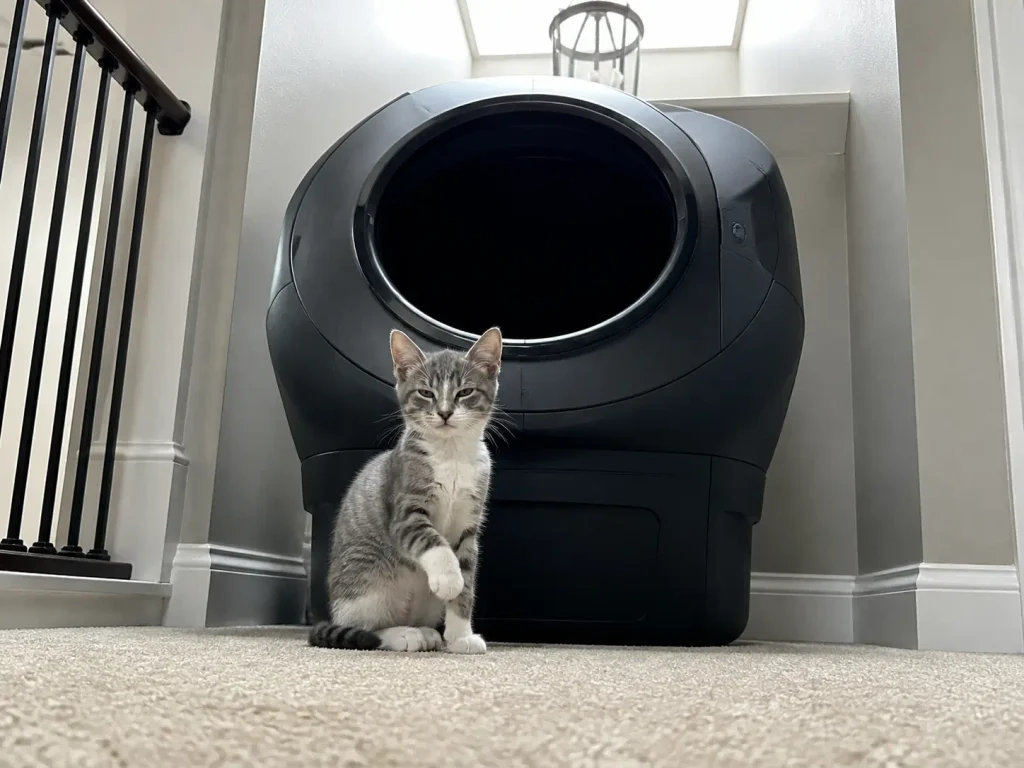
There is one group at real risk even with a well-built machine, and it is not who most warnings suggest. The owner of a kitten reads “weight sensor” and relaxes. But a scale has a threshold, and below that threshold the cat is not light to the machine. He is absent.
The weight threshold, and where to find your cat’s real number
The minimum operating weight for automatic mode clusters around 3 to 3.5 pounds across the major models. Below it, the sensor may not register your cat as present at all, which means every other safety system that depends on knowing he is there is working from bad input. Check that number against the scale at his last vet visit, not against how he feels when you pick him up. Half-grown cats with a lot of fur read heavier in your arms than they do on a scale, and this is the one place where an approximation is worth nothing.
If your cat is anywhere near that line, the fuller answer is a separate conversation about whether a kitten can use one at all yet, because the weight threshold is only the first of several questions at that age.
The weight that counts is the one from the vet’s scale, not the one you estimate by lifting him. A long-haired kitten can look substantial and still sit under the threshold, and the machine reads the scale, not the silhouette. If you do not have a recent number, weigh yourself, then weigh yourself holding him, and subtract. It takes a minute and it settles the question.
Kitten mode is not a marketing tier
Several brands ship a manual-only kitten mode for cats under roughly 2.5 pounds, and it is easy to read that as a soft upsell feature. It is not. It exists precisely because the manufacturer knows the sensor may fail to see a light cat, and the safest thing the machine can do in that situation is refuse to run on its own.
Which reframes the whole risk. This is a weight problem, not a behavior problem. The framing you see everywhere else, that kittens are clumsy or curious and therefore get into trouble, quietly puts the fault on the animal. He is doing nothing wrong. He is standing in a box the machine has been told is empty.
Senior cats fail a different test
The other group at higher risk gets there by another route entirely. Older cats and cats with mobility issues go in and out more slowly, and every design feature that adds a step, a lip, or a closing door taxes that. Class Act Cats’ guidance for these cats is to skip the high-entry and self-closing designs completely and prioritize a low entrance that is easy and boring over any smart feature on the box. Boring is doing a lot of work in that sentence, and it is the right instinct.
🐈🐈 And one wrinkle almost nobody mentions: in a house where one cat clears the weight threshold and another does not, the machine cannot tell them apart. It sees a cat, or it sees nothing. The whole household goes manual until the small one grows into the number.
Two Cats Change the Question
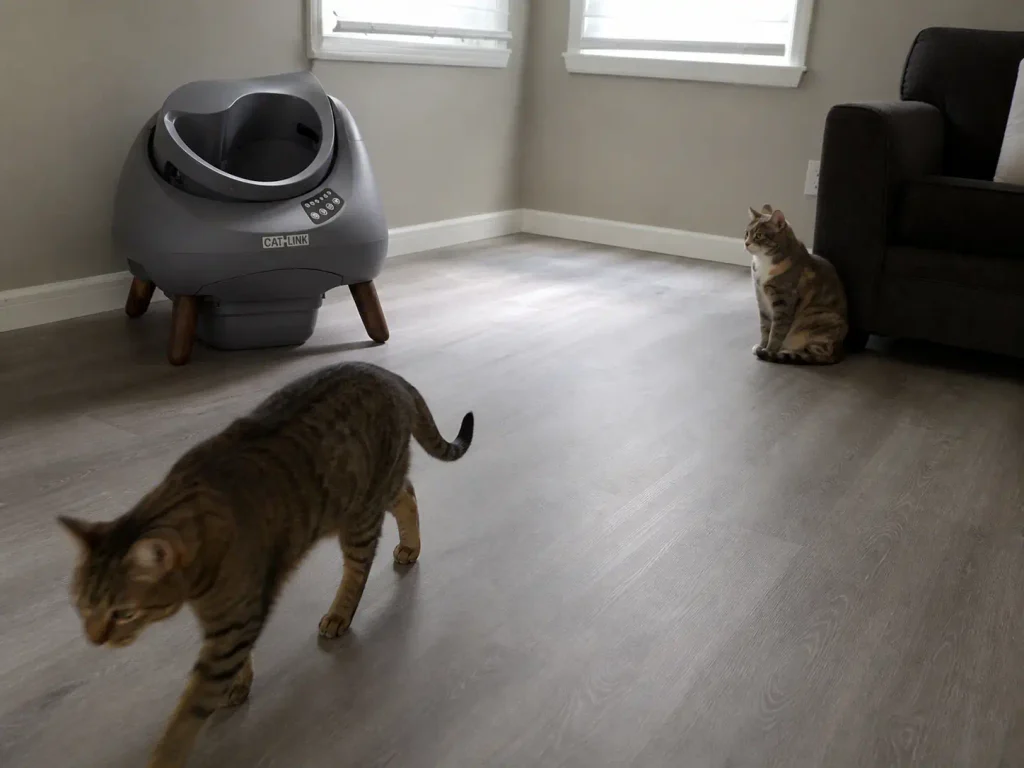
The scenario that genuinely frightens people in a two-cat home is not a sensor failure. It is one cat parking himself in the doorway while the other is inside and a cycle is due. No sensor solves that, because the sensor is doing its job perfectly. It has detected a cat, and it has stopped. The problem is on the other side of the entrance.
The scenario the sensors can’t solve
Which is why the first fix here costs nothing and goes before any product. Put the unit with its entrance facing the largest open area of the room, close to 180 degrees of visibility, and make sure there are two approach paths to it. A subordinate cat who has to squeeze through a single choke point to get in or out will do the math and decide the box is not worth it. He is not being timid.
He is refusing to enter a room with one door while somebody he does not fully trust is in the building, and that is a completely reasonable position.
This is the placement rule that prevents a cat from being cornered, and it is free, reversible, and takes about ninety seconds. Do it before you buy anything, including a second machine.
Where the unit goes, and the two ways out
The mistake that undoes all of this is lining the boxes up. Two units side by side against the same wall looks tidy and reads to a cat as one large box, which means it does nothing at all for resource guarding. The point of a second box was never redundancy of equipment. It was making it possible for two cats to use the bathroom without negotiating.
I used to treat the whole cornering worry as an edge case, the sort of thing that shows up in one household in fifty. Then you read enough multi-cat threads where the box got blamed and the map of the room was the actual problem, and it stops looking rare. Most of them get solved by turning the unit ninety degrees.
One machine is still one box
The n+1 rule does not get canceled by a motor. In a multi-cat household, that means one box per cat plus one, and a self-cleaning box that is always clean is still one box, occupying one location, with one entrance. Cleanliness was never the constraint that rule was addressing. The full box math for two cats works out the same way it always did.
Structurally, there is one design choice that changes this scenario rather than just managing it. An open-top unit keeps the entryway accessible through the entire cycle, so the cat is never inside a chamber that is closing around him. For a cautious cat, or a subordinate one in a household with friction, that is a different proposition altogether.
The Checks to Run Before You Trust It Overnight
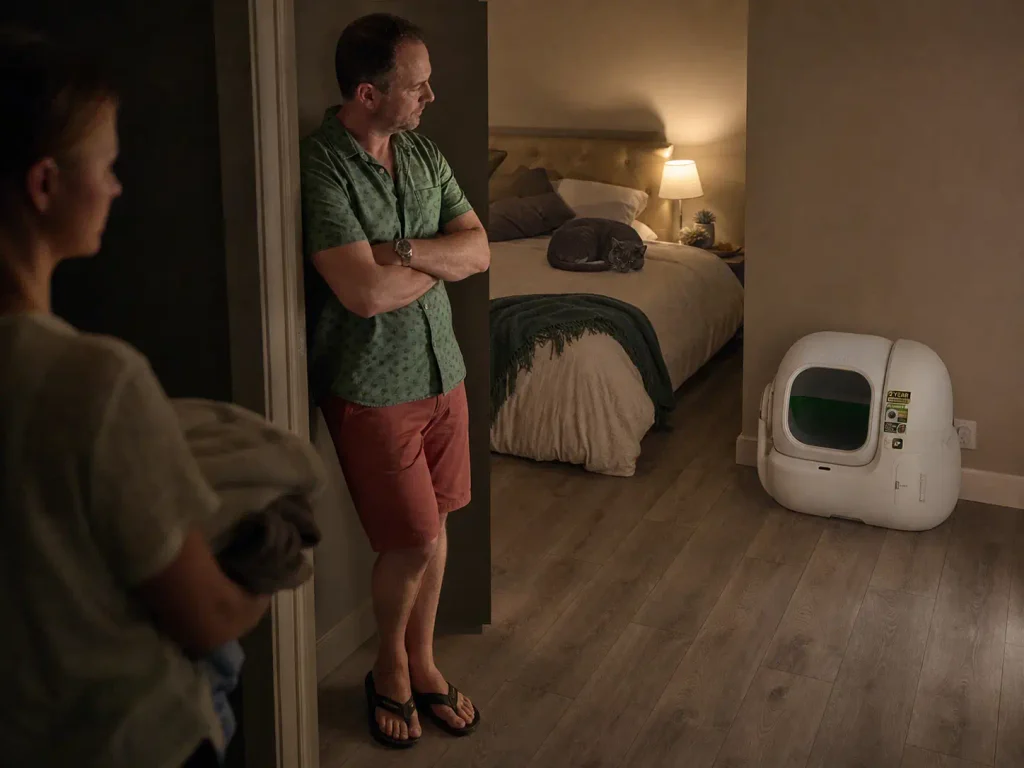
Everything above is theory until the first night you go to bed with the thing switched on. That is the moment this article is actually for. So here is the list, ordered by how much each item reduces real risk rather than by how easy it is to do.
- Confirm the redundancy, not the word “sensors.” Multiple independent detection zones, a cooldown before the cycle resumes, and a separate jam or torque cutout. If the manufacturer will not document how many and what they watch, that is your answer.
- Weigh the cat against the unit’s minimum operating weight. Vet scale, not estimate. Under the threshold means manual mode for the whole household, not just for him.
- Measure the entrance and the interior against your actual cat. Not against the marketing word “spacious.”
- Turn the entrance toward the open room and give it two approach paths. Free, and it is the fix for the multi-cat scenario that no sensor addresses.
- Check the clearance with the mechanism at full travel. The footprint at rest is not the footprint in motion.
- Supervise the first week. Manual mode or a long timer, and watch how he goes in and out before you hand over the night.
Measure the opening against the cat, and remember the litter steals height
Take the documented numbers again, because they show you what to measure. That entryway is 15.75 inches high by 15.75 wide, and the interior globe runs 19 inches wide by 18 deep by somewhere between 15 and 17 tall. That last range is the detail worth carrying with you: the height varies with how much litter is in there.
More litter, less usable height. The chamber your cat stands in is not the chamber on the spec sheet, it is the spec sheet minus your litter depth.
And the sizing rule this site already publishes still governs inside a machine. The litter area size you want is 1.5 times the cat’s length from nose to tail base, and the entryway diameter has to clear his shoulders on the way through. Run the 1.5x sizing rule in actual inches against those interior dimensions before you assume a large cat fits. Most interior chambers are dimensioned for an average adult, and a big Maine Coon at full turn is not an average adult. A cramped chamber is a safety question and a behavior question at the same time, because it puts more of the cat closer to more of the moving parts, and because a cat who cannot turn around comfortably eventually stops trying.
The apartment problem nobody prices in
Here is the constraint no competitor names, and it kills more purchases than any safety concern. These units need three things simultaneously: somewhere out of the way, an outlet within reach, and free space around them for the mechanism to travel. In a lot of small apartments, no single spot has all three. The bathroom has the outlet and no room. The corner of the bedroom has the room and no outlet. The hallway has both and is the hallway.
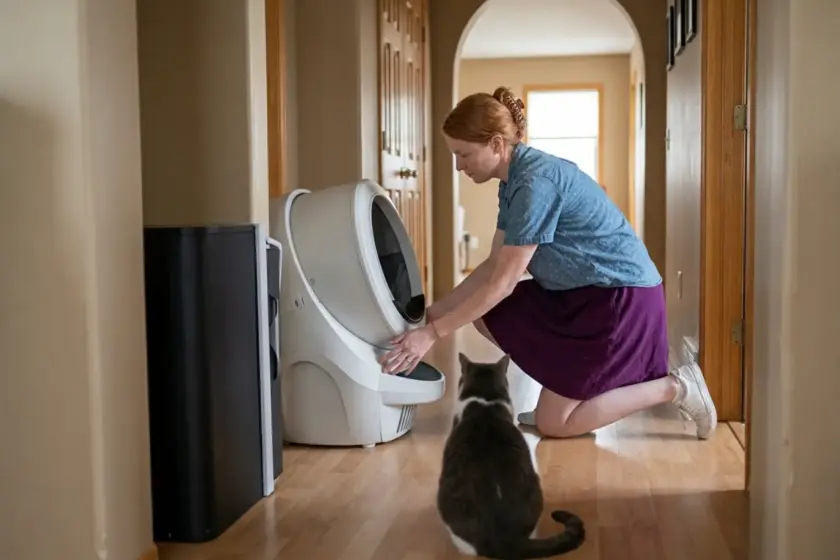
Work that out with a tape measure before the box arrives, not after. Extension cords across a floor where a litter unit lives are their own problem, and finding out on delivery day is an expensive way to learn the floor plan you already had. If you are pushing capacity as well as space, where automatic boxes break down with three cats covers the point at which one machine stops being enough regardless of how well it is placed.
Measure the gap with the waste drawer pulled all the way open and the mechanism at the far end of its travel, not with the unit sitting still. The footprint at rest is not the footprint in motion, and the drawer is the part that catches on a baseboard or a door frame. Mark it on the floor with tape and live with the tape for a day before the box arrives.
The first week is supervised, and week three is when you find out
A cat who dislikes the noise or the movement can stop using the box entirely, and this is the failure mode worth taking seriously, because the aversion sometimes outlasts the machine. Cats have far more sensitive hearing than we do, and a motor that reads as a background hum to you is not background to him. Take it away, put the old tray back, and he still will not go near that corner. That is the reason the first week is supervised rather than installed and forgotten. Use the manual override or a long delay timer, and watch how he approaches, how long he stays, and whether he waits for you to leave the room.
The consultant’s own senior cat went back to a traditional box after repeated rejections. That is worth stating plainly: giving up on automation for a particular cat is a correct outcome, not a defeat. The machine was for your convenience. If it is costing his willingness to use a box at all, it has failed at the only job that matters, and no feature list argues with that.
And if the reason you wanted one is that you are out of the house for long stretches, the monitoring layer is where the money actually earns something, with the limit from earlier still attached to it.
Conclusion
The question was never whether automatic litter boxes are safe as a category. It was which one and where. A unit with documented redundant stop systems, placed with two ways out and a clear line of sight, handles the risk everyone is actually asking about, and it handles it well enough that the reported failures cluster somewhere else entirely.
The risk nobody talks about takes five seconds a week. Open the drawer, look before you empty it, on a fixed day attached to something you already do. No product replaces that, and the camera units accompany it rather than standing in for it. And if your cat says no to the noise, the motion, or the whole idea, moving him back to a traditional tray is a correct answer, not a loss. He gets a vote and his vote is about the room he lives in.
Come back to this in three weeks. That is long enough to know whether he genuinely accepted the machine rather than tolerated it for a few days, and it is roughly when a new human routine either sticks or quietly stops. Both of those get decided in week three, and neither of them takes three months.
Before you change anything else, go turn the unit so the entrance faces the middle of the room. It costs nothing, it takes a minute, and it fixes the scenario that scares people most. If that solves it, you just saved yourself a new machine.
Amazon’s Audible — free for 30 days
Your cat won’t let you read. Let someone read to you.
Audible is Amazon’s audiobook library — thousands of titles, read out loud, on your phone. Free for a month, plus one audiobook to keep forever.
Frequently Asked Questions
01Have cats actually been harmed in self-cleaning litter boxes?
Yes, and the reported cases cluster in one specific place: cheap off-brand units sold as lookalikes of premium models, where the sensors exist on the spec sheet but not reliably in the machine. The incidents happened most often overnight and unsupervised. That is an argument about which unit you buy, not about the category.
02Are automatic litter boxes safe for kittens?
Not in automatic mode until they reach the unit’s minimum operating weight, which sits around three to three and a half pounds on most models. Below that the sensor may not register the kitten as present at all. Several brands ship a manual-only kitten mode for exactly this reason, so use it, and take the weight from the vet’s scale rather than by eye.
03Do self-cleaning litter boxes stop if the cat gets in mid-cycle?
A well-built one does, and it should do it in more than one way. Look for several independent detection zones rather than a single sensor, plus a cooldown before the cycle resumes and a separate jam or over-torque cutout. Redundancy is the specification that matters, because one sensor is one point of failure.
04How do I keep track of my cat’s health if the box cleans itself?
Open the waste drawer once a week and look before you empty it, on a fixed day tied to something you already do. Those five seconds replace the daily glance the scoop used to give you. And this is the honest limit of this article: any change in your cat’s litter box habits is a call to the vet, not something to work out from the drawer.
05Is an open-top automatic litter box safer than a closed one?
Structurally it is a different proposition rather than a strictly safer one. The entryway stays accessible through the whole cycle, so a cat is never inside a closing chamber, which suits cautious cats and multi-cat homes. A closed unit with documented redundant sensors is not unsafe, it just asks the cat to trust something he cannot see out of.
Leave a comment