Introduce a Covered Litter Box Without Losing the Box
Don't pull the old box out yet. Introduce a covered litter box in stages (lid off first) + the sizing rule that decides it before day one.

Alfredo RamsesFounder · August 24, 2026 · 20 min read

On this page8 sections
- 1What a Covered Box Actually Changes for a Cat
- 2Why the Switch Fails Before It Starts
- 3The Staged Switch, and Where the Old Box Stays
- 4Two Cats Change the Protocol, Not Just the Box Count
- 5Where the Second Box Goes When You Have No Spare Room
- 6Day Seven, and Nothing Has Happened
- 7Conclusion
- 8Frequently Asked Questions
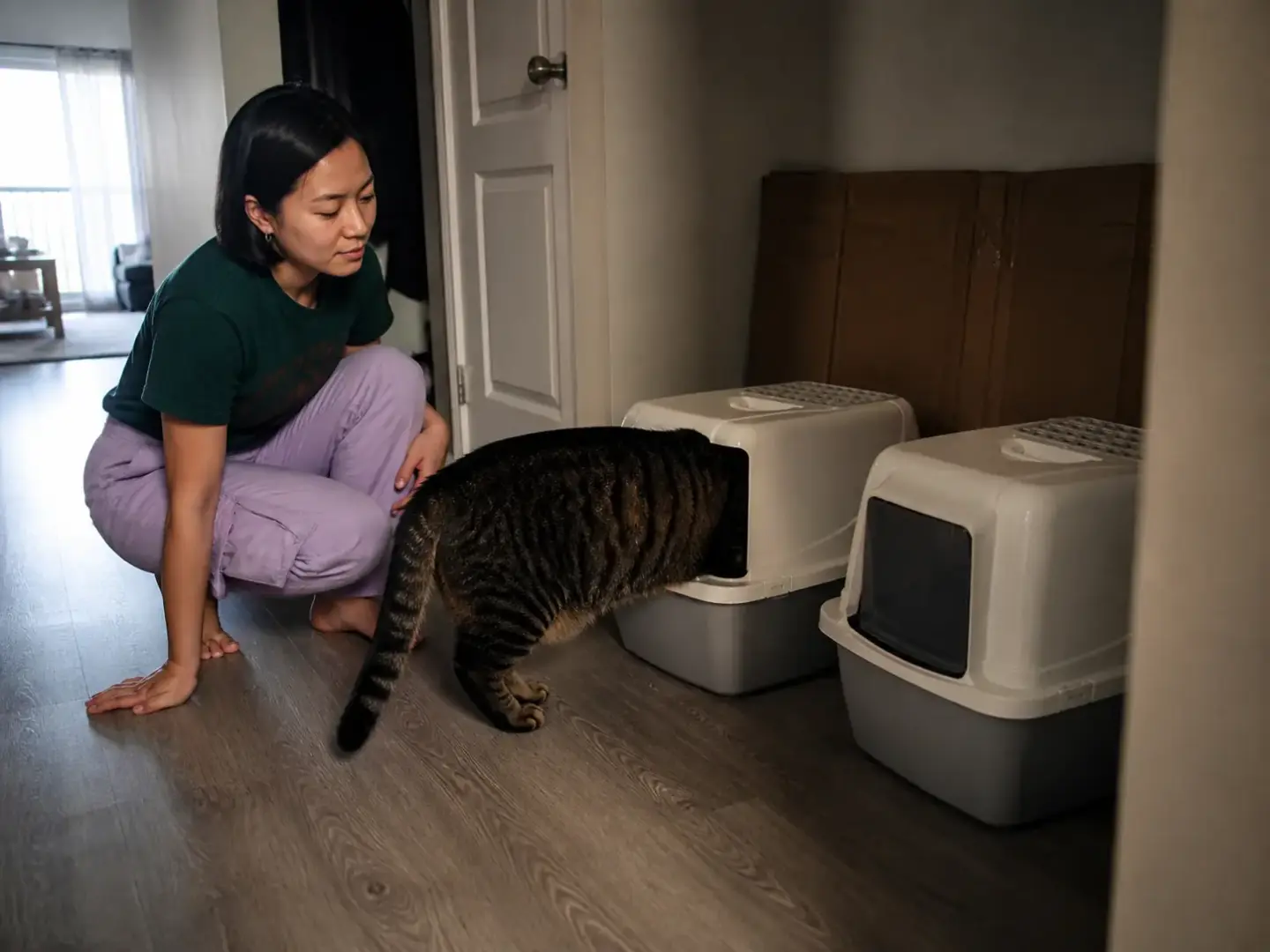
The new box has been in the hallway for four days. He walks past it to the old litter box, and on the bad mornings he walks past both and uses the rug beside them. He is not protesting the lid. He is telling you the box got smaller, darker and harder to leave in a hurry, and all three of those are true at the same time.
The research everyone quotes on this actually agrees with him: in the 2013 Ross University study, 70% of cats showed no preference between covered and uncovered, which means the hood is rarely what fails. The introduction is. So here is what a covered litter box actually changes from his side of the entrance, the staged switch that keeps the old box in play while he decides, and what to do when day seven arrives and nothing has happened.
Quick Answer
Introduce a covered litter box in stages, never as a swap, and let the old box stay the whole time.
- Leave the old box exactly where it is and keep scooping it.
- Set the new box up with no lid, same litter, nearby.
- Add the lid after two days of him using it open.
- Add the door only if the opening clears him without ducking.
- Retire the old box in week three, not before.
What a Covered Box Actually Changes for a Cat
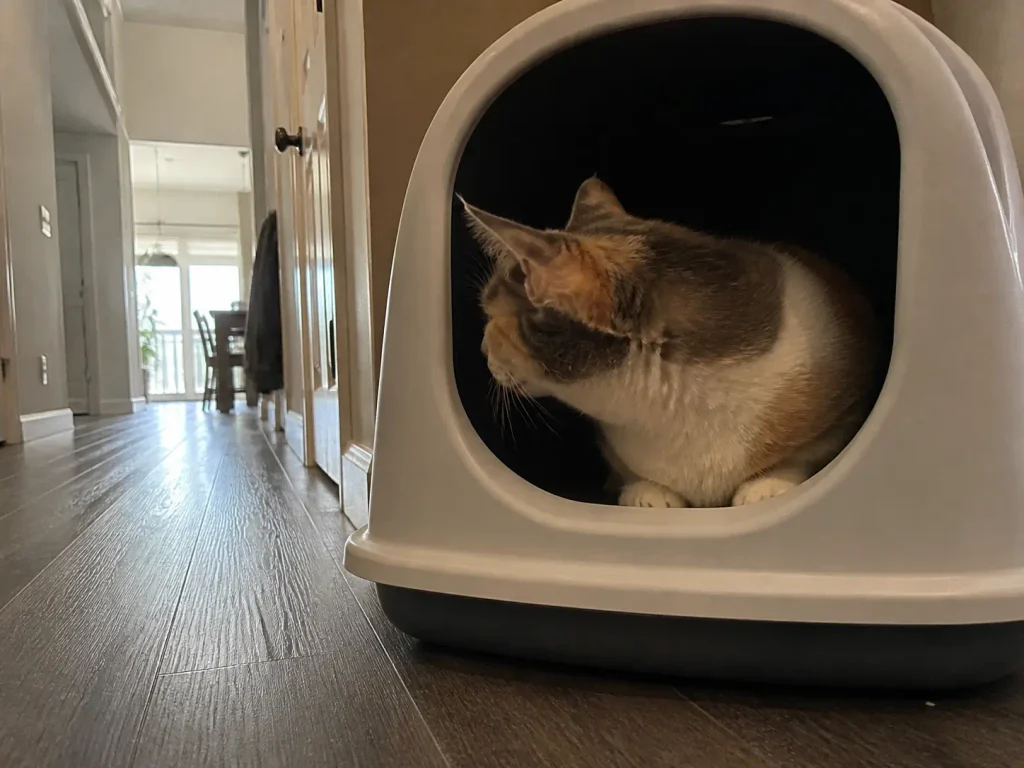
Nobody frames this correctly, including the packaging. The question gets asked as a preference, as though your cat has a taste in architecture and you are trying to guess it. He does not have a taste in architecture. He has a set of requirements for a room he uses several times a day, and putting a lid on that room changes four of them at once.
If you are still deciding what to buy rather than how to introduce what you bought, start with how to choose a litter box by size, sides and entry instead, because the sizing decision underneath this one is where most of these problems get created.
Four Things Change the Moment the Lid Goes On
The usable floor shrinks first, and not by the amount you would guess from looking at it. A hood has walls that slope inward and a rim that eats the perimeter, so the flat area he can actually stand and turn on is smaller than the footprint sitting on your floor. Headroom caps the turn next. A cat squats, then pivots to cover, and if the ceiling is low he does that pivot with his spine compressed or he does it badly.
Then air exchange drops, which is the change that gets noticed last and matters most. In an open box the ammonia lifts and disperses into the room. In a covered one it sits in the enclosed volume at nose height and stays there between visits. The fourth change is the one almost nobody mentions, so it gets its own subsection below: he can no longer see out.
What the 2013 Study Found, and What It Did Not Test
Twenty-seven cats, fourteen days, litter and position held constant: 15% preferred covered, 15% preferred uncovered, 70% did not care either way. That is the finding, and the 2013 study out of Ross University School of Veterinary Medicine found no overall preference is a fair one-line summary of it. Most cats will accept a hood. The lid is not the villain the internet has made of it.
What the study did not test is the box in your hallway. Its boxes were oversized storage tubs, and its households were single-cat by design. Both of those exclusions matter enough that the rest of this article is built around them. The sibling piece runs covered versus uncovered through the actual numbers if you want that argument settled properly; here it is just the premise.
The One Exit, and Why It Beats the Lid
An open box has an exit on every side. A covered box has one, and while he is in it he cannot see the room. For thirty seconds several times a day, a small animal that survives on advance warning has none. That is the blind spot the lid creates.
Most single cats absorb that fine, because nothing has ever come through the door at them. But it is the mechanism underneath almost every covered-box refusal that gets blamed on fussiness, and in a home with a second cat it stops being theoretical. Litter threads have a word for it: the ambush.
Why the Switch Fails Before It Starts
Here is the part where you get to stop blaming your cat and go find a tape measure. There is a decent chance the box you bought was disqualified before he ever looked at it, and that this is measurable rather than a matter of opinion. Nothing in this section costs money. Most of the time it also ends the article.
Measure the Cat, Then Measure the Box Floor
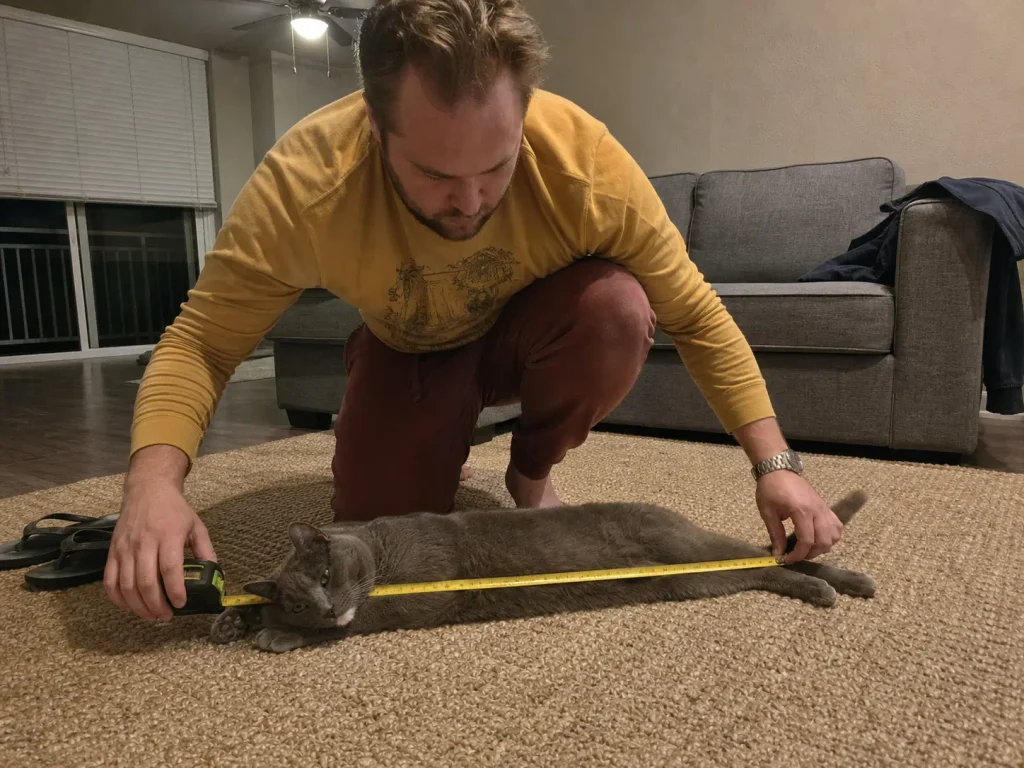
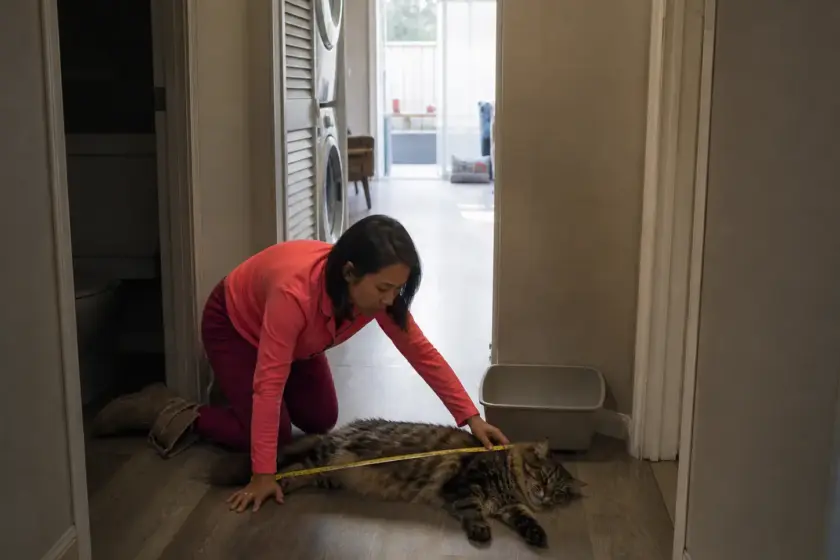
The rule is simple enough to do in a minute: the box floor should run about 1.5 times his cat body length, nose to the base of the tail. Not including the tail. Measure the floor of the box, not its outside dimensions, and in a hooded box measure the flat part he can actually stand on rather than the widest point of the shell.
While you have the tape out, check the litter depth too. About two inches is the standard, and underfilled litter is the second most common false hood rejection there is. A cat that cannot dig a hole leaves. He is not refusing the cover, he is refusing a surface that does not work, and you will read it as the cover because the cover is the thing that changed.
Measure him while he is loafing, not while he is stretched out asleep on his side. A stretched cat gives you a number he will never use in the box, and it flatters a box that is about to fail. The loaf is the posture he actually takes in there.
“Large” on the Box Is Not Large for the Cat
The study’s covered boxes measured 32.5 by 19.75 inches of floor. A typical commercial box sold as a large hooded pan runs closer to 19.5 by 15.25. That is roughly half the floor volume, and it is why “the science says cats don’t mind hoods” keeps failing in real hallways.
The finding is real. It was just demonstrated in a box nearly twice the size of the one you own.
If your measurements come back short, no protocol in this article saves it, and no amount of patience will either. What you need is a bigger hood, and specifically one whose door comes off. The Extra-Large Covered Cat Litter Box with Door is worth a look for exactly that reason: the flap is removable rather than molded in, which is what makes the staged switch below physically possible instead of theoretical. Measure your cat first and check the listed interior floor against your own 1.5× number, because extra-large is a marketing word too and a large Maine Coon will outrun most of them.
The Failure Loop, in the Order It Actually Happens
This is the sequence, and it is remarkably consistent across litter threads. The box is a little too small, or it is being scooped on the schedule that worked for an open box. He uses it for a week or two, because a cat will tolerate quite a lot before he stops. Then he starts going beside it, or on the bath mat, or on the rug that is soft and near his exit.
The owner reads that as a verdict on the hood. The box goes back in the garage, the article gets written that says cats cannot stand covered boxes, and the actual problem, which was a floor measurement and a scoop cadence, never gets identified at all. The execution failed. The hood was just standing nearby when it happened.
The Staged Switch, and Where the Old Box Stays
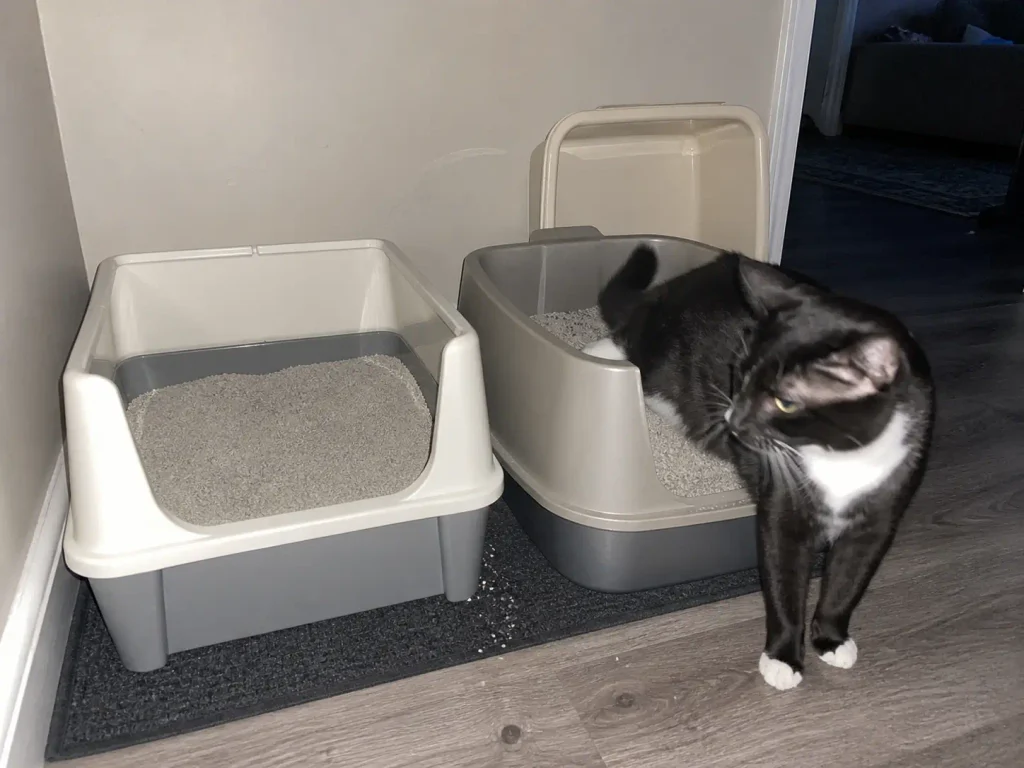
“Be patient” is not a plan. It is what you say when you do not have one, and it is the entire content of most guides on this. So here is what patience looks like on a calendar, with one rule holding the whole thing up: your cat always has somewhere to go that already works. He never has to gamble, which means he never has to improvise, which means the rug stays a rug.
Stage One: Lid Off, Same Litter, Both Boxes Running
- Stage one, days one to four. New box down with no lid, same litter, near the old box. Old box untouched.
- Stage two, after two consecutive days of use. Lid goes on, door stays off. Both boxes still running.
- Stage three, after two more days. Door on, but only if the opening clears him without a duck.
- Stage four, week three. Old box retires. Not before.
Stage one is the free part and the honest part. Two boxes, side by side, same litter in both, and he votes with his feet over several days. The community calls this the litter box cafeteria, and it is the only real test there is, because it asks the question in the only language he speaks. It costs nothing if you already own two boxes.
If your old box is cracked, or two sizes too small, or already went out with the recycling last weekend, you need a plain open one to run as the control. The Amazon Basics Large Cat Litter Box with High Sides does that job with nothing to go wrong, high enough at the sides to hold litter in and open on top so it stays the known-good option in the comparison. The limitation is that it is a plain pan and nothing more, which during a transition is precisely the point.
Now control your variables. Same litter in both boxes, and if you have been meaning to switch litter as well, do not. A new box and a new litter at the same time teaches you nothing about either, and the litter is the one that changes results fastest.
Unscented is the safe default here, and something like Dr. Elsey’s Ultra Unscented Clumping Clay is a reasonable place to land while you are holding everything else steady, since fine-textured and unscented is what most cats read as neutral. It comes as a 40-pound bag, which is worth knowing in advance if you live up three floors without an elevator.
Keep the open box in play the entire time rather than treating it as the thing you are replacing. Cornell’s Feline Health Center notes that most cats prefer simple boxes without hoods, and unscented, fine-textured litter along with it. That is the baseline he is coming from. You are not correcting his preference, you are asking him to accept a second option alongside it.
Stage Two and Three: The Lid, Then the Door
The trigger for stage two is not a date on the calendar, it is behavior: he has used the new box, open, on two consecutive days. Then the lid goes on and the door stays off. Give it another two days at minimum, and watch for one specific thing, which is whether he still turns fully inside before covering. A cat that goes in, does his business and comes straight out without the pivot is telling you the headroom is marginal.
Stage three is the door, and this is the stage to skip entirely if there is any doubt. Watch him walk through the empty opening first. If he ducks, or angles his shoulders, or pauses at the threshold, the opening is already tight, and adding a swinging flap to a tight opening is how you undo three weeks of work in an afternoon.
Plenty of covered boxes run perfectly well forever with the door in a drawer. Honestly, most of them should. And if the entry is the part he keeps objecting to, a top entry box solves the same privacy problem from a different direction, though it rules out kittens, seniors and anyone with stiff hips.
When the Old Box Retires, and How to Tell It Is Time
Week three, and only if he has been using the covered box consistently for several days running. Consistently means both kinds of business, not just one. A cat that pees in the covered box and reliably poops in the open one is not finished; he is telling you the covered box is fine for the quick visit and too tight for the long one, which is a size answer, not a time answer.
When you do retire it, take it out of the room rather than moving it a few feet. And keep the box count honest: the n+1 rule does not pause during a transition, so if one cat means two boxes as a permanent baseline, the old box was never the spare you were planning to remove. It was one of the two.
Two Cats Change the Protocol, Not Just the Box Count
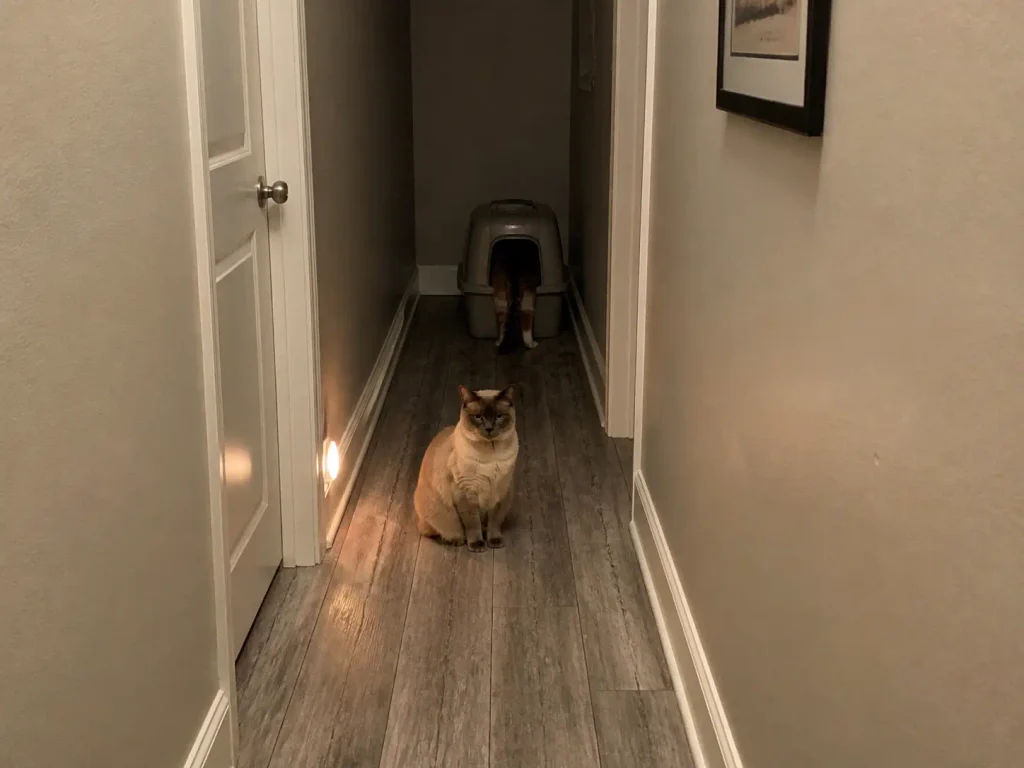
In a one-cat home a covered box is a smaller room with worse air. In a two-cat home it is a room with one door and no window, and the cat inside it knows that better than you do. This is where the study’s own methodology becomes relevant in a way its headline number never conveys: multi-cat households were excluded from the double-box preference testing. The 70% figure was never measured under the condition most readers are actually living in.
Why the Hood Costs a Cat His Warning Time
The mechanism is not vague stress, it is removed information. In an open box he tracks the doorway with peripheral vision the entire time he is in there, and if the other cat appears he leaves early, before anything happens. Take the sightline away and he finds out about the approach when it is already at the entrance, which is one exit and also the only exit. And as certified cat behaviorist Pam Johnson-Bennett explains, a covered box removes a cat’s visual warning time, which is exactly the resource a cat in a shared home is budgeting around.
This produces a tell that is easy to misread. The cat starts eliminating right beside the box rather than in it, sometimes touching it. That is not a rejection of the box, that is a cat who wants the litter area and does not want to be inside a container while he uses it. It is a traffic problem wearing a box problem’s clothes.
Where the Box Goes When Two Cats Share the Route
The placement rules for a covered box in a multi-cat home are stricter than for an open one, and they are all versions of the same idea: preserve what warning time you can. The entrance faces the room’s doorway, so he sees who comes in. Never wedged into a corner with the opening toward a wall, which turns the box into a dead end with a lid on it. Never lined up in a row with another box, because two boxes against one wall are one box as far as territory is concerned.
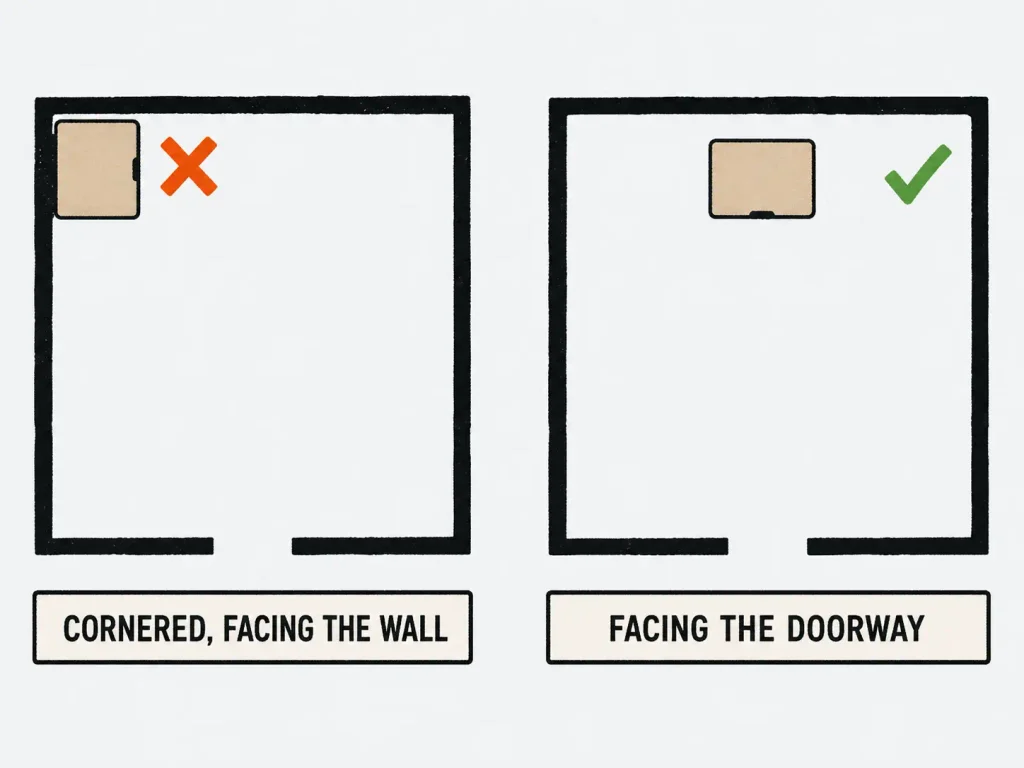
Clear floor on both sides of the entrance helps more than it sounds like it should, because a cat leaving a box in a hurry does not want to negotiate a laundry basket on the way out. And boxes go in different rooms rather than different corners of the same room. That distinction is invisible to us and completely obvious to them.
Keep One Open Box, Permanently
Not just during the transition. Permanently. In a multi-cat home at least one box stays uncovered, because there will be days when one cat wants a box he can see out of, and the cost of not having one is a carpet. This is the single most useful rule in this article for anyone with more than one cat, and it happens to be free.
That also means the transition target is different for you. You are not converting the household to hoods; you are adding a hooded box to a lineup that keeps an open one. Box count follows n+1 as always, and how many cats you have changes the litter answer too once you are buying for two boxes plus a spare instead of one.
Where the Second Box Goes When You Have No Spare Room
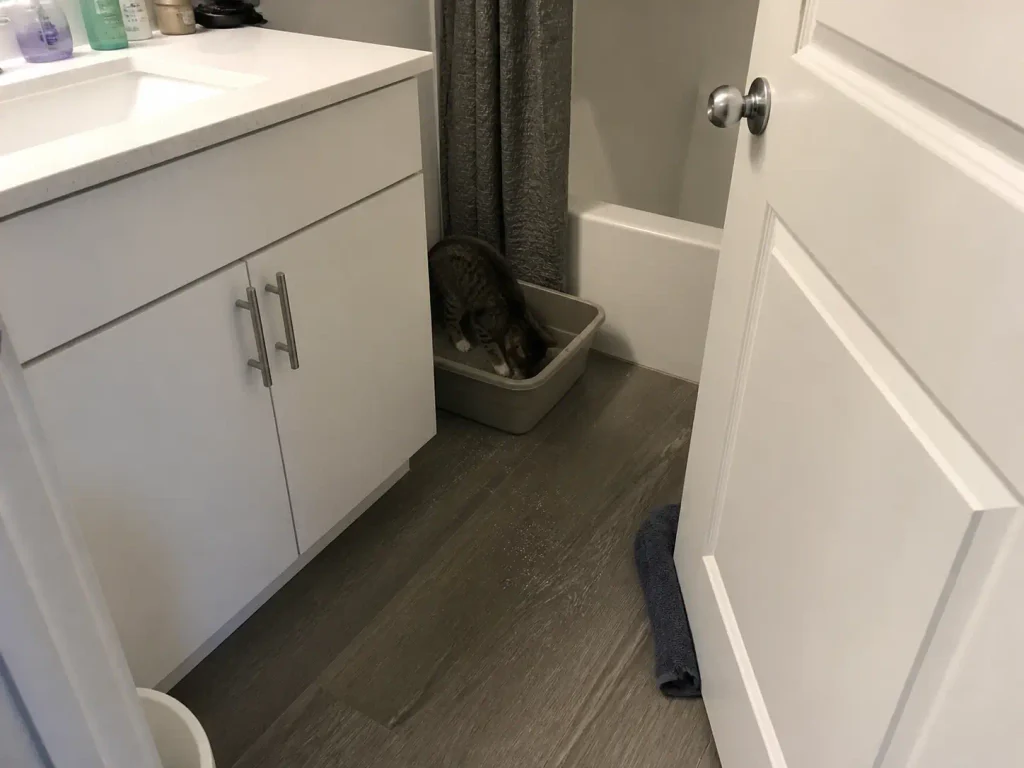
Every guide says keep the old box during the transition, and every guide is picturing a house with a mudroom. In a one-bathroom rental the second box has to go somewhere real, and somewhere real has rules. This is the part of the protocol that quietly stops people from running it at all, which is a shame, because it is a three-week problem being treated as a permanent one.
What the Temporary Spot Has to Clear
Start from the constraint that makes this solvable: it is twenty-one days. A box in a spot you would never accept permanently is completely fine for three weeks, and framing it that way is the difference between running the protocol and skipping it. You are not redesigning your apartment. You are borrowing a corner.
The spot has to clear four things. It cannot be adjacent to the first box, or the cat counts them as one and you have learned nothing. It cannot be a dead end, meaning a spot with a single approach, because that reintroduces the exact problem the hood already created.
It cannot be next to the food and water, which cats decline on principle and which is not negotiable at any square footage. And in a multi-cat home it cannot sit on a route where one cat has to pass the other to reach it.
Four Places That Work in a One-Bathroom Apartment
The bathroom corner diagonally opposite the existing box is the first candidate, and it works more often than people expect, because a bathroom is usually the one room with two usable corners and a door that stays open. The gap beside a washer is the second, assuming the machine is not running during the transition window; the noise is the whole risk there, not the space. Third is under a desk with the chair pulled out and left out, which sounds absurd until you notice it satisfies every rule on the list. Fourth is a closet floor with the door wedged open with a stopper, never a door on a hinge that can swing shut on him.
All four are no-drill and require nothing your lease would care about, which is the point. What does not work: stacking both boxes in the same corner, and putting the second box in a room your cat does not already spend time in. A box in the spare room he never enters is a box that gets used twice. If the placement worries you on the smell side, which box design actually smells least covers the part of that problem you can solve with shape rather than location.
If the only honest spot is the bathroom you also use, put the open box in there and the covered one in the hallway. He gets the quiet room for the box with no lid on it, and you get the lid on the box you have to look at every day. Both of you win the thing you actually cared about.
Day Seven, and Nothing Has Happened
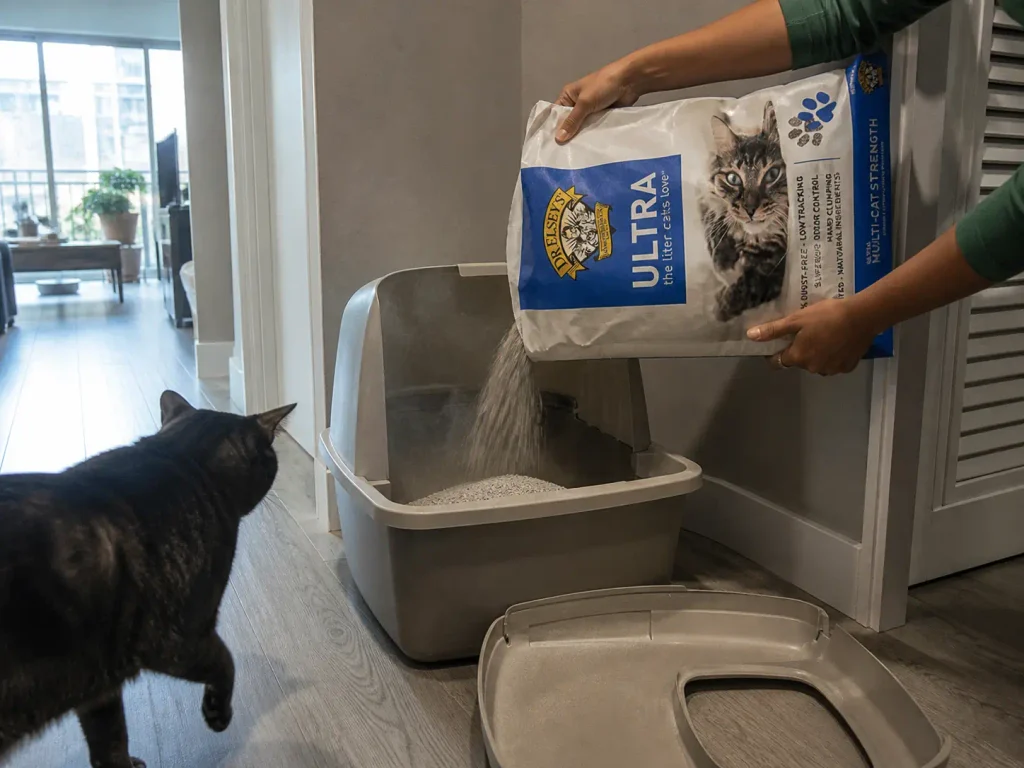
This is the day the box goes back in the garage. It is worth knowing in advance that most people who quit are one variable away from it working, and that the variable is almost always boring.
What Normal Slow Looks Like Versus a Stall
The honest range is wide. Some cats use a new box within 24 to 48 hours. Most land somewhere in the first week. Some take two to three weeks, and nothing is wrong with them.
There is no milestone day, so a cat who has not committed by Thursday is not behind schedule.
But zero use by day seven to ten is different. That is not a slow cat, that is a setup problem, and more patience will not fix a box that is two inches too short. The distinction that matters: partial use is progress, zero use is information.
The Six-Item Checklist, in Order of Likelihood
Work down this list in order, because it is sorted by how often each one turns out to be the answer.
Litter scent first, because it is cheapest and most common. The study had one cat that refused the covered box and started using it immediately once the litter went from scented to unscented; the hood was never the objection, the perfume was.
Second, box floor size against the 1.5× number. Third, scoop frequency, and be strict here, because a covered box holds odor at his nose and the schedule that was fine for the open box is not fine for this one.
Fourth, entry height, which is the ducking test from stage three. Fifth, placement. Sixth, the door flap, which comes off in ten seconds and should be the first thing you try if it is on.
If the litter item is where you land, do it as its own project rather than folding it into this one. Switching the litter without losing the box has its own ratios and its own timeline, and running two transitions on top of each other is how people end up unable to say what worked.
One boundary while you are working the list. A cat who was using a box fine and suddenly stops entirely, or strains, or cries in the box, is a vet visit before he is a furniture problem. Get that ruled out first. Everything in this article assumes he has been cleared and you are working on the furniture.
Change one thing and give it three days. Change two and you have learned nothing, which is exactly how people end up certain the hood was the problem when it was the scented litter that came in the same shopping trip.
Going Back a Stage Is Not Starting Over
If stage three fails, take the door off and stay at stage two. If stage two fails, take the lid off and stay at stage one. You have not lost anything except a few days, and you have gained the single most useful piece of information available: you now know which change he objected to, which is more than most people ever find out.
One more thing about rewards while you are running stages. If you are using treats, the treat has to land as he exits, within a second or two. Praise from the kitchen five minutes later is praise attached to whatever he happened to be doing in the kitchen.
And a cat who enters, turns around and walks out is not rejecting anything yet. He just told you about headroom.
Conclusion
Measure the box floor against 1.5 times his body length before you change anything else. If it fails there, no protocol in this article rescues it and no amount of patience substitutes for two missing inches.
The old box stays until week three. The staged switch works for one reason, which is that your cat is never forced to gamble on an unknown room while the known one is gone.
With two cats, one box stays open permanently. The hood costs a warning that the second cat is quietly relying on, and an open box somewhere in the apartment is what pays it back.
🗓️ Check back in three weeks. Look at one thing: is he using the covered box for both kinds of business, or only one? Only one almost always means the box is still too small for the full turn, and that is a size fix rather than a waiting game.
Before you buy anything else, take the lid off the box you already own and run it open for a week. If he uses it that way, you were never buying the wrong box. You were skipping the stage.
Amazon’s Audible — free for 30 days
Your cat won’t let you read. Let someone read to you.
Audible is Amazon’s audiobook library — thousands of titles, read out loud, on your phone. Free for a month, plus one audiobook to keep forever.
Frequently Asked Questions
01How do you transition a cat to an enclosed litter box?
Run the new box with the lid off and the same litter beside the old one, and leave the old one exactly where it is. Add the lid once he has used the new box two days running, and the door only if the opening clears him without ducking. Retire the old box at week three.
02Are cats okay with covered litter boxes?
Most are. In the 2013 Ross University study, 70% of cats showed no preference between covered and uncovered, and the remaining 30% split evenly both ways. The catch is that the study boxes were roughly twice the floor size of a commercial large hooded box, so the finding holds for a big enough box, not automatically for yours.
03How long does it take a cat to adjust to a new litter box?
Anywhere from a day or two to about three weeks, with most cats landing inside the first week. There is no single milestone day, but no use at all by day seven to ten points to a setup problem rather than a patience problem. Check litter scent and box floor size first.
04Do vets recommend covered litter boxes?
Most veterinary sources lean toward open boxes as the safer default, Cornell’s Feline Health Center included, mainly because an open box is harder to get wrong on size, air and sightlines. That is a default rather than a ban. A covered box that clears the sizing rule and gets scooped daily is fine for most single-cat homes.
05My cat will not use the covered box even after two weeks. What now?
Take the lid off and see whether he uses that same box open. If he does, the objection is headroom, air or the single exit, and the fix is a bigger box rather than more waiting. If he will not use it open either, the box or its location was the issue all along and the hood was never the variable.
Leave a comment