Do Litter Mats Work? Only for the First Two Steps
Do litter mats work? Only for 1-2 steps off the box. Size it to one full body length of your cat + match the material to the cleaning you'll do.

Alfredo RamsesFounder · August 23, 2026 · 20 min read

On this page7 sections
The mat is down. It looks right, it cost real money, and there is still litter in the hallway by Thursday.
Your cat is not defeating it. The mat is doing exactly the job a mat does, which turns out to be a much smaller job than the box it came in suggested. Half the odor and litter tracking testing on this site exists because one of the two residents here has strong opinions about litter texture, and mats are where those opinions get loud. So the honest answer to do litter mats work is yes, inside a window most people have never had described to them, and this article is about where that window opens and where it closes.
Quick Answer
Yes, litter mats work, but only on litter still stuck to the paw in the first one or two steps off the box. Anything flung sideways during digging, or already worked into long fur, never touches the mat no matter what it cost. That narrow window is the whole product, which is why size and placement decide the result long before texture does.
What a Litter Mat Is Actually Doing Under the Paw
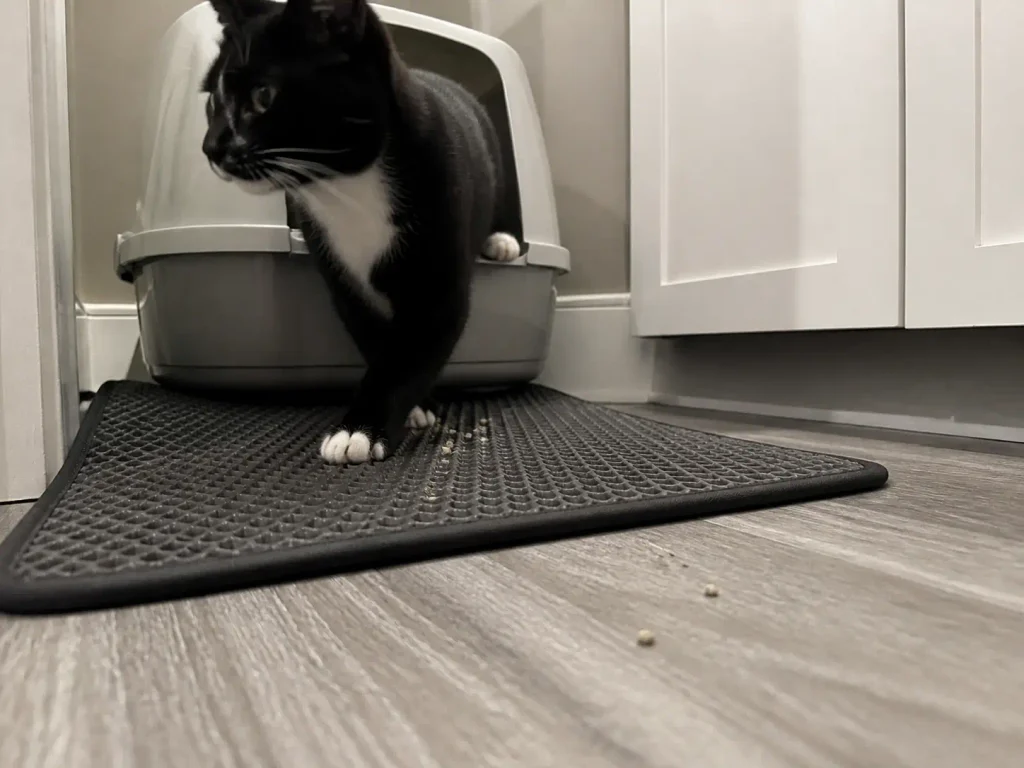
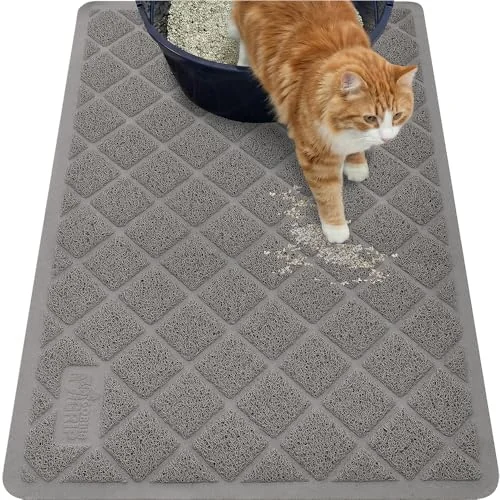
Nothing about a mat pulls litter toward it. The whole device is a scraper: a mesh mat, a groove mat, coils or fibers that catch granules already touching the paw and knock them loose as the foot lands and pushes off. That is the entire mechanism, and the fact that manufacturers describe the mechanism the same way in their own material comparisons should have settled the question years ago.
A mat is a doormat with better texture and a specific job. Once you accept that, every complaint people have about mats stops being mysterious.
Contact, Not Attraction
The litter has to be on the paw at the moment the paw is on the mat. Both conditions, at the same instant. That sounds obvious written down, but it quietly voids about half of what people expect when they buy one. A granule that left the box sideways at high speed during a serious dig never touches paw or mat, so no amount of trapping depth reaches it.
Honeycomb designs are the most aggressive version of the same idea. A top layer of holes lets granules drop into a lower chamber where the cat physically cannot walk them back out. It is genuinely clever and it does trap more per step than a flat surface. But it is still doing contact interception, just with somewhere better to put what it catches.
The One-to-Two Step Window
Here is the part the buying guides skip. Paw transfer is front-loaded.
The first step off the box carries the most loose granules, the second carries what survived the first, and by step three the paw is mostly clean or the remaining litter is wedged somewhere a flat surface cannot reach. The mat is not slowly harvesting litter across its whole length. It is doing nearly all of its work in the first few inches past the box opening and then acting as floor.
That single fact reorganizes the whole decision.
It means a mat that ends before the second step is over has thrown away its own best feature, and a mat that extends four feet past the box is mostly decorative past the halfway point. The skeptic’s framing that tops the search results for this question, “just another thing to clean,” is fair and it is half right. A mat does add a surface you now maintain. What it buys you in return is real, and it is confined to about two paw lengths of floor.
Why Your Litter Changes the Answer
Texture is not the only variable, and it is not even the first one. Fine clay litter and silica gel litter cling to damp paw pads and to the fur between the toes, so they are exactly what a textured surface is good at scraping off.
Standard clumping litter is the worst offender of the lot, because the same moisture-grabbing property that makes it clump makes it stick to a paw. A dust-free litter cuts the fine powder that drifts, but it does nothing about the granules riding out on the feet. That whole family is where mats look brilliant.
Large pellet litter behaves nothing like that. Pellets do not cling, they bounce, and they roll. A pellet that comes out of the box is usually rolling across the floor, not riding a paw, which means the deep-hole honeycomb mat you paid extra for is solving a problem you do not have.
With pellets, footprint and a raised lip matter far more than trapping depth, because your job is containment, not scraping. If you use pellets and your mat is disappointing you, the mat is fine. It was the wrong tool.
Before buying anything, put a dark towel where the mat would go and leave it three days. Whatever is on the towel is what a mat can catch. Whatever is past it is not a mat problem, and no mat you buy will change that number.
None of this makes the mat useless. It makes the mat one lever out of three, and the order you pull them in decides whether any of them feel like they worked. If you want the full sequence this article sits inside, tracking has three fixes and they only work in one order, and the mat is deliberately the last of them.
Scatter and Tracking Are Two Different Problems
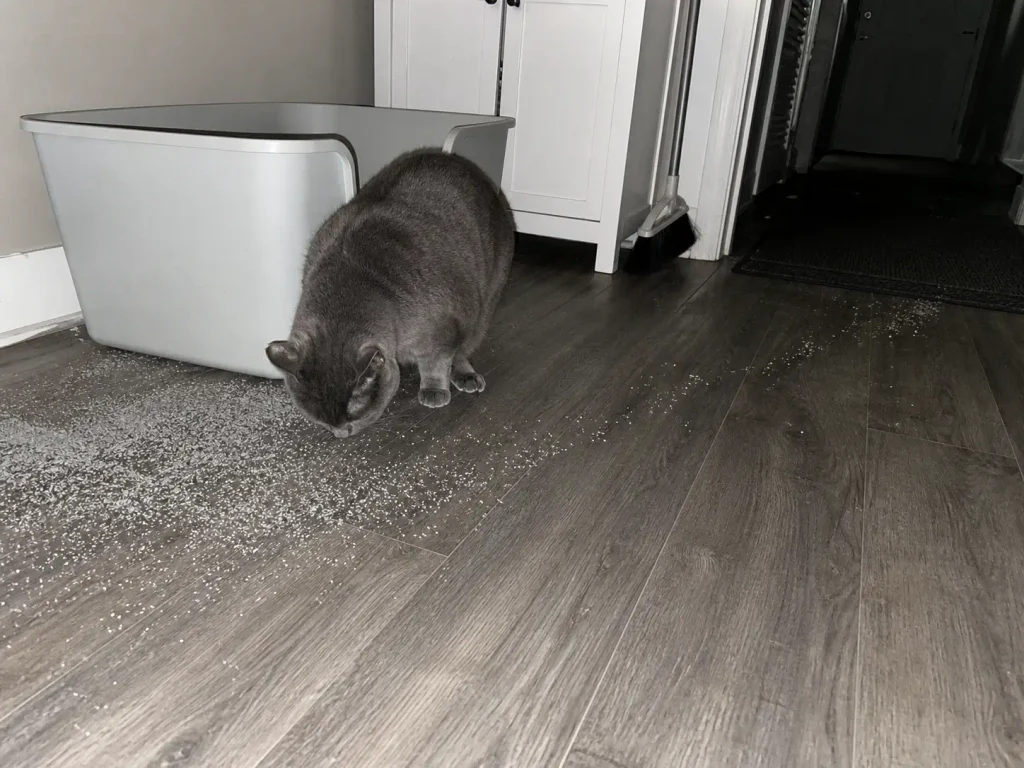
“I bought the highest-rated mat on the internet and there is still litter in every room” is the most common complaint in this category, and it is almost never a mat failure. It is a diagnosis failure. Two completely separate things are dumping litter on your floor, they have different mechanisms, and only one of them ever involves the mat.
Tracking is litter carried out on paws and fur after the cat exits. Scatter is litter kicked over the box wall mid-dig, while the cat is still inside.
The buying guides blend these constantly, which is how readers end up expecting one product to fix both. It cannot. It was never built to.
The Fan Pattern Versus the Trail
You can settle this tonight, on your own floor, for free. Go look at where the litter actually is.
Litter spread in a rough fan beside or behind the box, thickest near the wall the cat digs against, is scatter. It came out sideways and airborne, and it landed wherever gravity dropped it. A mat in front of the box was never in its flight path.
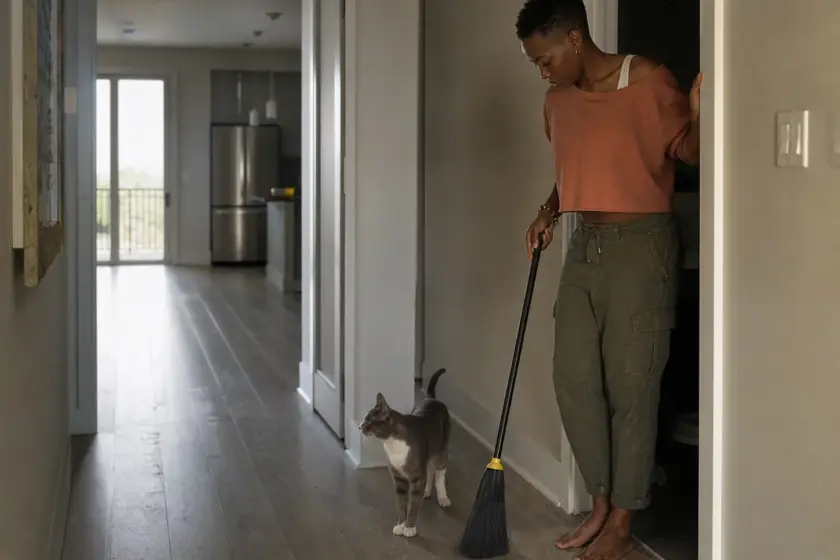
Litter in a thinning trail heading toward the door, the hallway, the kitchen, is tracking. That one rode out on a paw, and that one is the mat’s business.
Most homes have both. The useful move is knowing which one is annoying you more, because scatter is a box-height and box-depth problem with a different fix entirely, and this article is not going to re-derive it. Once you know which pattern you are looking at, the full fix sequence, in the order that actually holds tells you which lever to pull first and how big the mat needs to be when you get to it.
What the Mat Was Never Going to Catch
The story that keeps repeating in litter threads has the same shape every time: top-rated honeycomb mat, installed correctly, and litter turns up three rooms away within a week. That litter was airborne when it left the box, or it was already buried in fur past the point where a floor surface can reach it. Neither one was ever a candidate for interception.
Long-haired cats make this stark. Granules lodge in the fur between the toes and along the belly and the trousers, and they fall out later, wherever later happens to be. No mat surface touches any of that. A long-haired cat with a clean paw pad can still be carrying litter, and the drop-off point is the couch, not the hallway.
I used to treat that as a mat-quality problem and recommend stepping up a tier when someone reported litter far from the box. After enough of those reports turned out to be a fan pattern beside the box or a long-coated cat unloading in the bedroom, I stopped. Now the first question is where the litter is, not which mat is under the box. The upgrade almost never fixes it.
Size and Placement Decide This Before Texture Does
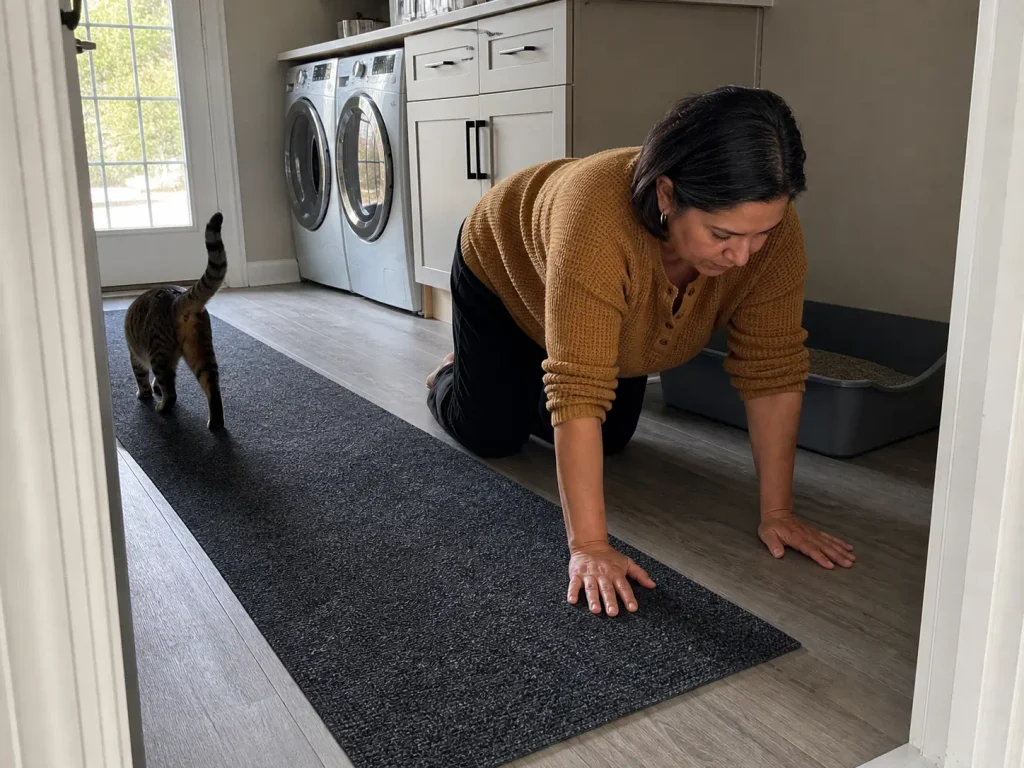
Most mats fail on geometry. Not material, not trapping design, not the specification list on the back of the packaging. The cat clears the mat in a single stride and the expensive texture never gets a second contact, which means you bought a very good scraper and gave it one chance to work.
One Body Length in the Exit Direction
The minimum that matters: the mat needs to cover at least one full body length of your cat in the direction your cat actually leaves the box. Not the box’s length. Your cat’s.
That number moves a lot more than people expect. A large Maine Coon at full stride needs the better part of a foot more mat than a compact shorthair to get the same two steps of contact, and the mat sold as covering a standard box does not know that. Measure the animal you own.
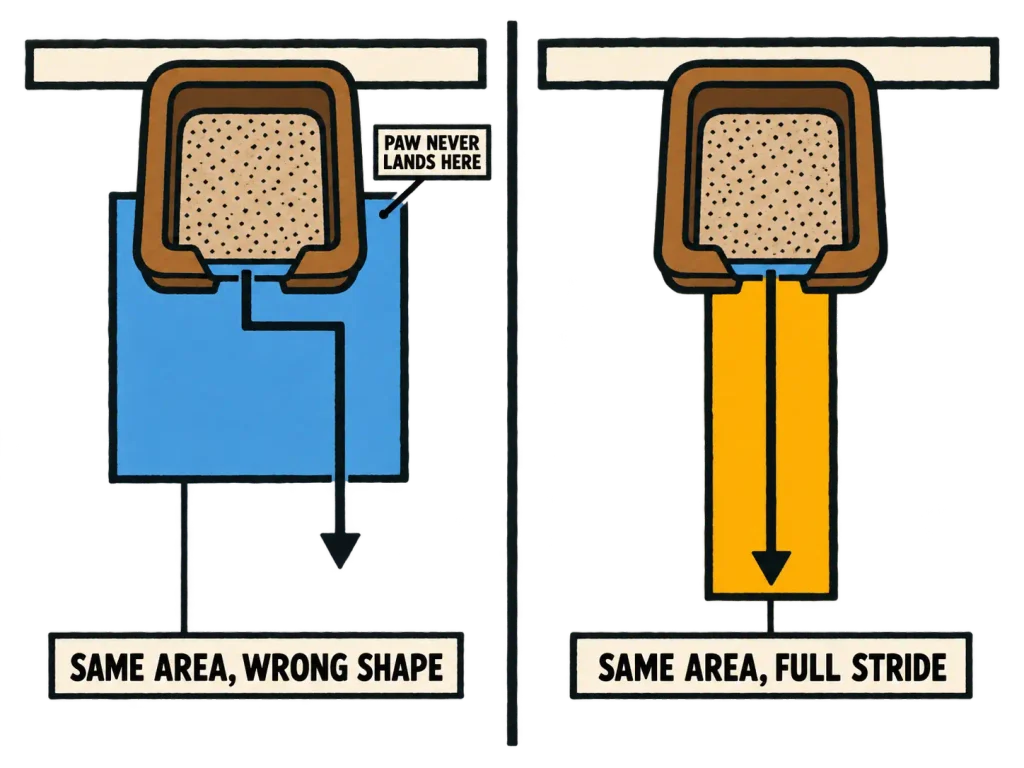
The “jumps over it” complaint is this exact failure, and it is worth noticing that it is usually a compliment to the mat’s construction. A well-built two-step mat that is only one step long is a well-built mat in the wrong size. The cat is not avoiding it out of spite. He is walking normally, and normal clears it.
Measure the Path, Not the Box
A square mat that matches the box footprint spends most of its surface behind and beside the box, where no paw lands. It looks tidy. It is doing a fraction of the work its square footage suggests.
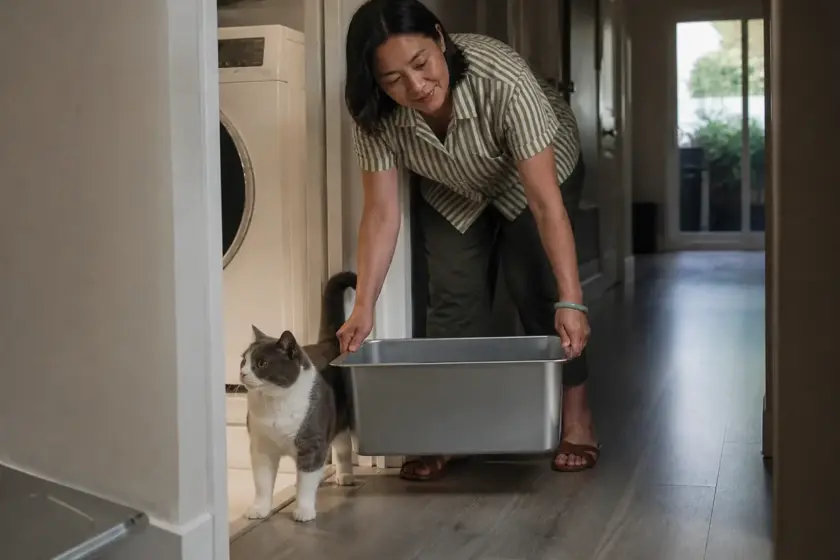
Covered boxes make this sharper. A hooded box has one opening and therefore one exit vector, and every granule that leaves does so through that hole in roughly that direction. What that setup needs is a runner pointed down the exit line, not a square centered under the box. Same money, two very different coverage results.
Measure your cat from nose to the base of the tail while she is standing, then measure the floor from the box opening outward. If the floor number is smaller than the cat number, buy a runner, not a bigger square.
When the Apartment Does Not Have the Floor for It
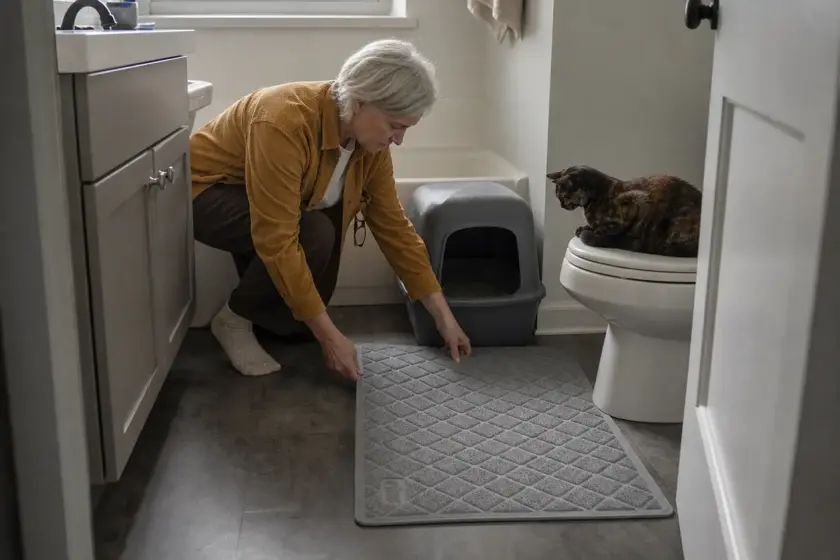
Every buying guide writes as though the box lives in an open room with acres of floor in front of it. In a one-bedroom rental the box is in a bathroom, a hallway, or a laundry closet, and there is genuinely not enough floor for a correctly sized mat plus the box. That is not a failure of planning. That is what a small apartment actually looks like, and the renter-friendly answer is a different shape of mat, not a bigger one.
A narrow runner oriented along the exit direction beats a square mat that fits the box and nothing else, every time, and it costs less. In a bathroom you are usually working with the strip between the box and the door, which is a runner shape whether you like it or not. Work with it.
One rental-specific note worth more than it sounds: if the box sits near a tile-to-wood seam, which is the standard layout in older buildings where the bathroom flooring changes at the doorway, use a mat with a waterproof backing rather than a decorative rug. Litter and moisture migrate into that seam and stay there, and a seam is not something you can clean or replace on someone else’s floor. This is the one place where the waterproof mat feature earns its price for a reason that has nothing to do with tracking. A non-slip backing keeps it from sliding under a departing cat, and the waterproof layer doubles as accident protection: if the box ever leaks or gets knocked over, urine containment is the difference between wiping a mat and replacing a floor you do not own.
And before you spend anything at all, try the free version. Move the box so the exit path runs along a wall instead of into open floor. A cat leaving a box tucked against a wall travels in a predictable line for the first two steps, and a mat you already own suddenly covers the whole stride instead of a corner of it. It takes ten seconds and it works often enough to be worth doing first.
The Trade-Off Nobody Prices In: Trapping Depth Against Cleaning
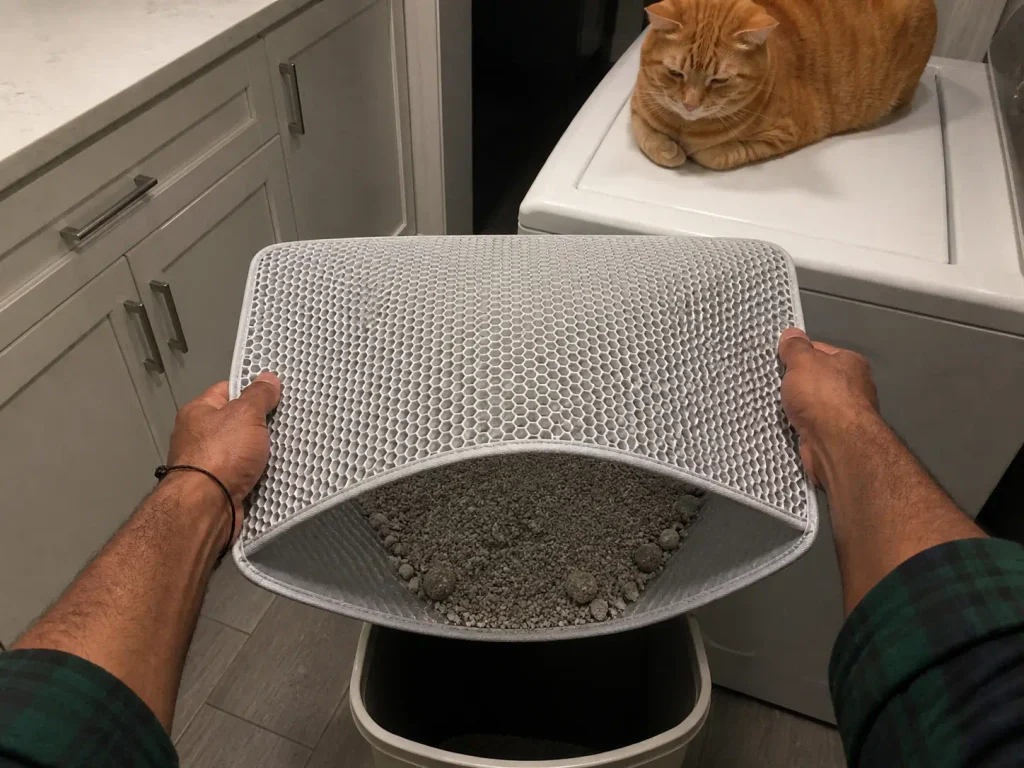
Deep trapping is real and it is not marketing. A dual-layer honeycomb genuinely holds granules where the cat cannot carry them back out, which is a meaningful advantage over a flat surface that just relocates litter to a slightly different part of the floor. The catch is that the design with the best trapping is also the design with the heaviest cleaning ritual, and those two facts are attached to each other permanently.
Here is what maximum trapping physically looks like.
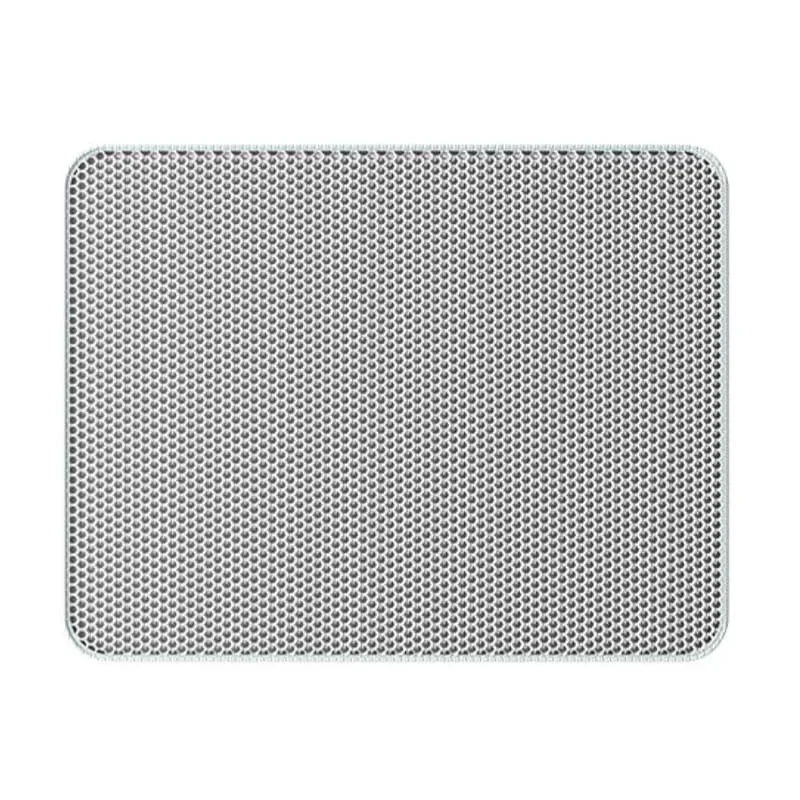
What Deep Trapping Actually Costs You
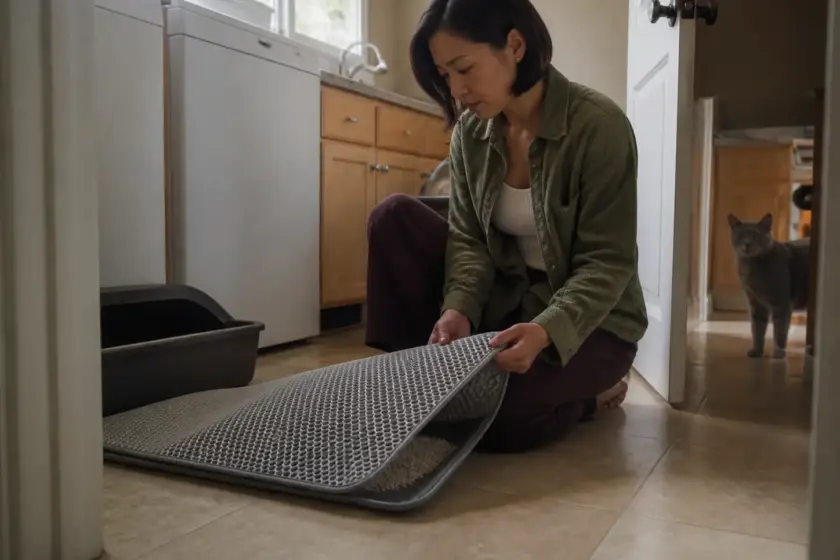
The cleaning is not “wipe it down.” It is a deliberate procedure: lift the top layer, pour the captured litter into the trash or back into the box, and then dry the lower layer completely before you put it back together. Ten seconds of work and a step you have to remember, forever, on a schedule.
Coil and loop mats made the opposite trade on purpose. They hold less per step and they maintain themselves passively, because you shake them out over the trash or run a vacuum over them and you are finished.
Nothing comes apart. Nothing has to dry. The trapping number is lower and the odds you keep doing it are much higher.
The Mat That Fails Quietly
This is the failure mode that catches people, and it is worth the paragraph. Mats do not announce when they stop working. A honeycomb with a full lower layer looks exactly like a honeycomb with an empty one, because the entire design is built to hide what it caught.
Damp litter sitting in that lower chamber smells like a dirty box. Precisely like one, because it is the same material doing the same thing in a warm enclosed space. What happens next is predictable: the room smells, the owner scoops the box that was already scooped this morning, decides the litter must be failing, and buys a different litter. The mat is three feet away holding a week of damp granules and nobody has looked under it.
So if the area smells and the box is clean, a smell that survives a scooped box usually is not coming from the box. Check under the mat before you change anything else.
What the Mat Is Made Of Decides How You Clean It
Trapping shape gets all the marketing attention, but the material underneath it is what determines whether cleaning is a rinse, a vacuum, or a wash cycle. Five show up on almost every listing, and they sort into a short hierarchy.
- An EVA mat or a rubber mat is the durable middle. They take a hosing, dry fast, and survive years of being stepped on. Most honeycomb mats are one of the two.
- A silicone mat is non-porous, which is the property that matters. It cannot absorb moisture, so it cannot hold odor, and a wipe genuinely finishes the job.
- A PVC mat is the budget version of the same idea. It cleans much like rubber and simply does not last as long.
- A microfiber matis the soft one, and it is the one people regret. It is comfortable underfoot and genuinely absorbent, but it is only machine washable, so a deep clean means the machine rather than a tap, and over months it mats down and starts holding smell.
If you want the mat you never replace, silicone or EVA outlast microfiber by a wide margin. The PetFusion ToughGrip Waterproof Cat Litter Mat is the silicone example worth knowing about, at 30 x 23 inches with a quarter-inch lip around the edge. It traps less per step than a deep honeycomb does, and the lip catches the loose granules the surface itself does not. That is the honest version of the trade: you give up trapping depth and you get a surface that never becomes the thing that smells.
The one property worth paying attention to regardless of material is a waterproof backing and a non-slip underside. The backing matters even for a cat who never misses the box, because a box can leak or get knocked, and a mat that stops moisture reaching a hard flooring seam is doing a second job entirely. Older rentals with tile-to-wood transitions are exactly where that second job pays for itself.
The Cat Gets a Vote on Texture
Every specification on the packaging assumes the cat walks across the mat. That assumption is doing enormous work, and it is not always true. A hard honeycomb surface is a strange thing to step on with bare pads, and a fair number of cats respond by placing their feet at the edge, hopping the whole thing, or taking a route around it entirely.
A mat the cat steps around has zero coverage. Not reduced coverage. Zero.
The trapping specification of a surface that never contacts a paw is a number about an object, not about your floor. This is one of those places where the cat and the human are not actually in conflict: he is telling you the surface is unpleasant, and he happens to also be telling you your purchase is not working. Believe him the first time.
Pick the mat that matches the chore you already do. If you vacuum that room weekly, a coil mat maintains itself. If you will not take a mat apart on a schedule, a honeycomb will quietly become the smell you are trying to remove.
Two Cats, One Exit Path
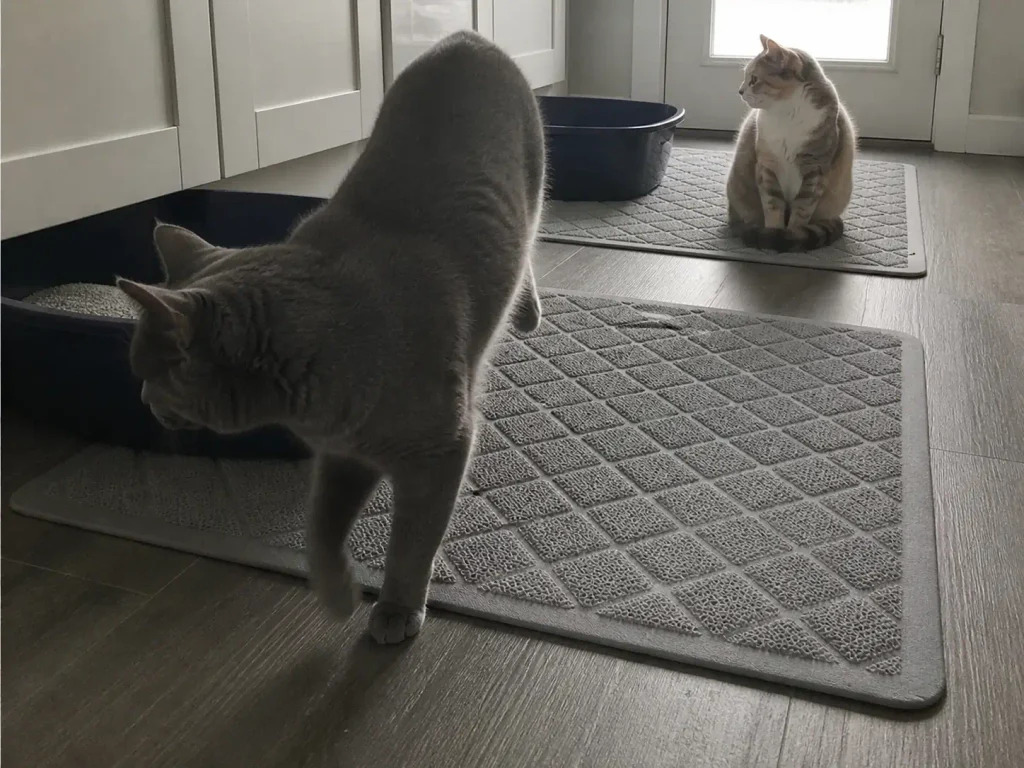
Add a second cat and the mat stops being a trapping calculation and becomes an access calculation. Same square footage, entirely different question, and not one of the major buying guides separates the two cases.
Why Traffic Changes the Size
The reason multi-cat homes are told to size up is not that each cat needs more surface. It is traffic. The strip of floor outside a shared box is a high-traffic area in the literal sense, and the same mat now takes twice the crossings, fills its capacity in roughly half the time, and turns gritty on the surface much sooner. A mat sized adequately for one cat is a mat you are now cleaning twice as often in a multi-cat household, which is the number nobody runs for you.
And gritty matters more than it sounds, because a mat that has gone crunchy underfoot is a mat both cats are now reconsidering. The maintenance interval is not about tidiness. It is about keeping the surface acceptable enough that the cats keep using it.
The Mat That Becomes a Bottleneck
Here is the failure specific to two cats, and it is the one worth planning around. Put a single aggressive-texture mat in the shared corridor between two boxes and you have installed a toll gate.
A texture-averse cat now has to cross an unpleasant surface to reach either box, and what that cat does is wait. Not protest, not act out. Wait, and go later, and sometimes go somewhere closer.
This is not a preference you can overrule with better trapping. The AAFP and ISFM’s joint environmental needs guidelines, which stress that cats need unobstructed access to their core resources, are the documented reason this matters. A litter box is a core resource, and anything a cat has to psych itself up to cross is an obstruction whatever it does for your floors.
The fix is unglamorous: two moderate mats under two separate boxes beats one excellent mat under the busiest one. Access wins over maximum trapping in every version of this, because a moderate mat that both cats walk over catches more litter in a week than a superior mat one of them routes around.
Which makes the boring texture the right first purchase when you do not yet know what your cats tolerate.
Older Cats and the Raised Edge
A thick raised lip at the box exit is a feature on the packaging and a step up in the real world. For a young cat it is nothing. For a senior cat, or one whose back end is stiff, it is one more thing to negotiate at the exact moment of leaving a box, and some cats respond by hesitating at the threshold. A flatter, softer surface trades away trapping power for footing that does not have to be thought about.
That is a furniture adjustment, and it is where this article stops. A cat who used the box yesterday and suddenly stops today is telling you something a vet should hear first, before anyone rearranges a mat. Everything above assumes that call has already been made.
The last variable is material, and it is a durability question rather than a trapping one. Microfiber is soft and absorbent, which is comfortable and also means it holds moisture and, in time, smell. The PetFusion ToughGrip Waterproof Cat Litter Mat goes the other way at 30 x 23 inches with a quarter-inch lip: silicone is non-porous, so it does not absorb anything and it rinses rather than washes. The trade is that a smooth non-porous surface scrapes less aggressively than coils or holes, so you are buying easy maintenance and longevity, not trapping depth, which is the right trade in a two-cat setup that gets crossed constantly and cleaned late.
The Short Version
A mat catches what is still on the paw in the first two steps. Judge it on that job and it earns its place easily. Judge it on scatter, on long fur, on the granules already three rooms away, and it will look like a failure forever, because you are grading it on work it was never built to do.
Measure the exit path before you spend anything. A cheap mat covering a full stride beats an expensive one your cat clears in a single step, and that comparison is not close.
Match the mat to the chore you actually do, not the one you intend to start. Deep trapping you never empty turns into the smell you were trying to fix in the first place.
Then check back in three weeks. Not because a mat wears out that fast, but because three weeks is long enough for a cat to have accepted or quietly rejected the surface, and long enough for a new cleaning habit to have slipped. At that point look at where the litter is now, not at how the mat looks.
Tonight, do the free version first. Slide the box so the exit runs along the wall and put the mat you already own in the stride. If the hallway is clean in a week, you just saved the money.
Amazon’s Audible — free for 30 days
Your cat won’t let you read. Let someone read to you.
Audible is Amazon’s audiobook library — thousands of titles, read out loud, on your phone. Free for a month, plus one audiobook to keep forever.
Frequently Asked Questions
01Do litter mats really work, or are they just another thing to clean?
They work inside a narrow window: the litter still stuck to the paw in the first step or two off the box. That is a real reduction, not a perimeter, and the mat does add a surface you have to maintain. If you will not clean it on a schedule, a smaller mat you actually shake out beats a bigger one you do not.
02Why is there still litter across the room if I have a mat?
That litter was almost certainly never on the mat. Granules kicked sideways during digging land beyond it, and granules worked into long fur ride past it. Both are box and grooming problems, not mat problems.
03Are honeycomb litter mats better than the flat coil kind?
They trap more per step and they cost more effort. A honeycomb has to be opened, emptied and dried, while a coil mat gets shaken or vacuumed. Better depends entirely on which of those two you will keep doing.
04What size litter mat do I need?
At least one full body length of your own cat in the direction it exits the box. Measure the cat and the floor, not the box, and use a runner rather than a square when the exit path is narrow.
05My cat walks around the mat instead of on it. What now?
That is the cat vetoing the texture, and a mat it steps around has no coverage at all. Swap to a softer low-pile surface. The one it will cross catches more litter than the one with the better specification.
Leave a comment