Litter That Doesn’t Track, by Granule Size
Litter that doesn't track, by the numbers [under 1mm tracks worst, over 4mm barely does] + the palm test that reads any bag before you buy.

Alfredo RamsesFounder · August 23, 2026 · 18 min read

On this page8 sections
- 1Why Litter Tracks at All, and What the Cat Is Actually Doing
- 2"Low Tracking" Is Not a Regulated Claim
- 3The Granule Test You Can Run Before You Buy
- 4What Each Material Actually Does Under a Paw
- 5One Cat, Two Cats, and Why the Same Bag Behaves Differently
- 6Switching Without the Cat Quitting the Box
- 7Conclusion
- 8Frequently Asked Questions
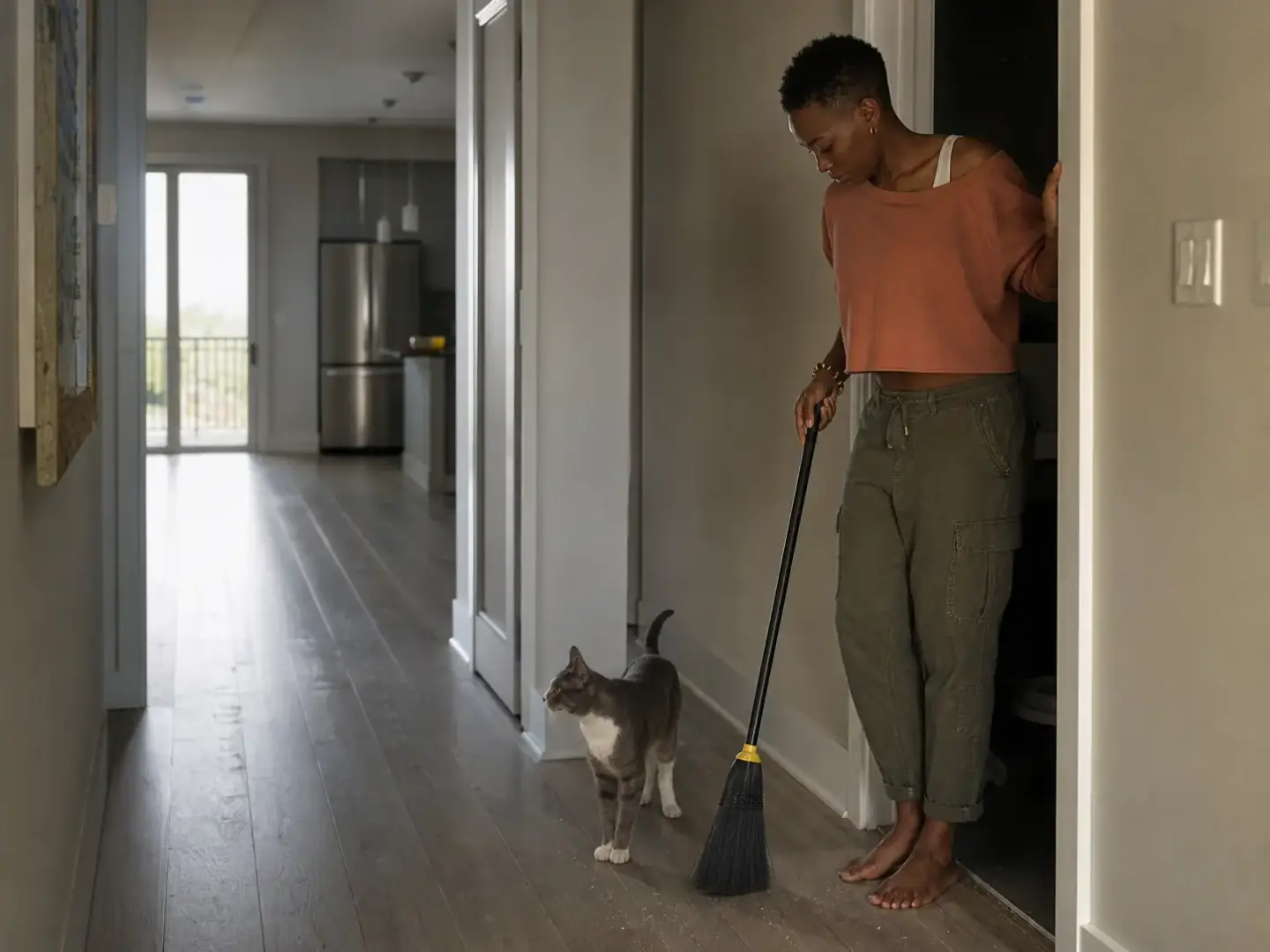
He isn’t dragging litter down the hallway because he’s careless. He is stepping out of a box full of pieces small enough to wedge into the soft space between his paw pads, and every one of them is coming with him. You sweep in the morning, and by evening there is grit under the coffee table again, in the bed, along a baseboard in a room he has no business being in.
Finding litter that doesn’t track comes down to one measurable property of the granule, and no bag on the shelf prints it. Here is what decides how far litter travels, how to judge a bag before you buy it, and how to switch without your cat quitting the box.
Quick Answer
Three physical traits of the granule decide how far litter travels. Nothing on the label does.
- Granule size: bigger than a grain of rice, ideally closer to a pea
- Dust content: the powder travels farthest and lands on furniture, not the visible grit
- Surface texture: smooth and rounded sheds off the pad, jagged and porous grips it
Why Litter Tracks at All, and What the Cat Is Actually Doing
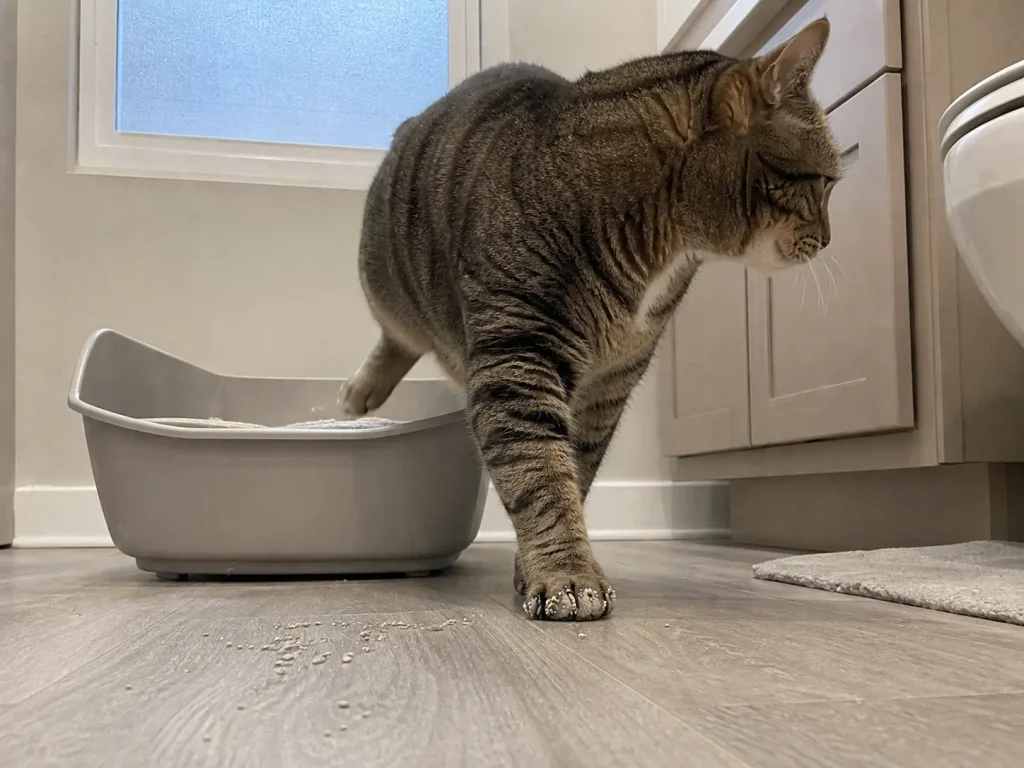
Most tracking advice eventually implies your cat is a messier specimen than average. He isn’t. He runs the same routine every cat runs, and the bag you brought home decides how much of it ends up in your bedroom.
Digging and Covering Are Not Optional Behavior
Digging a hole and covering it afterward — what behaviorists call cover behavior — is not a habit your cat picked up and could be talked out of. It is wired in, and a cat denied a diggable surface finds one, usually the potted plant. The digging stays. What you can change is what he is digging through.
Watch the exit and you’ll see him already trying to solve your problem. He steps up to the rim and shakes a paw, sometimes twice. That shake is him dropping what stuck, and on the right material it works. On fine clay it barely does anything, because the particles are small enough to sit inside the pad rather than on it.
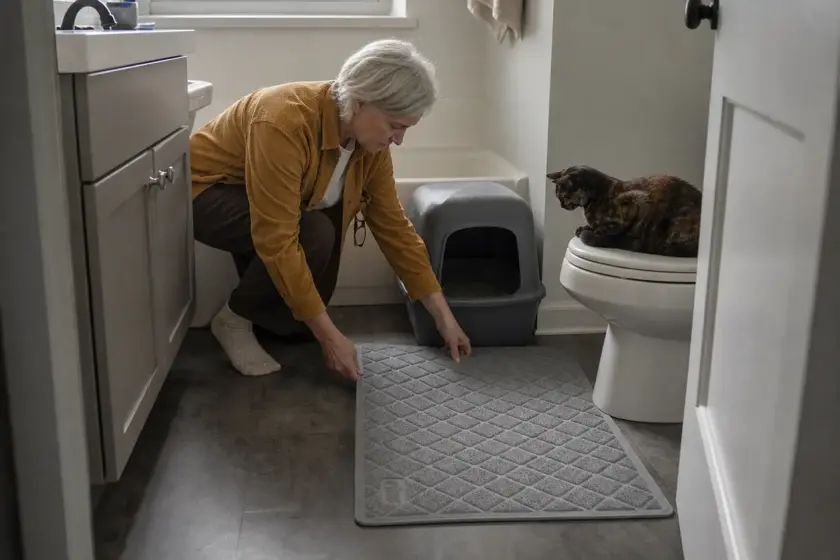
The paw shake only works if the cat has somewhere to do it. A hard, flat surface immediately outside the box gives the grit somewhere to land and stay. Put the box on carpet and the shake accomplishes nothing, because carpet catches the granule and holds it at ankle height until something walks past.
The Grit on the Paw and the Dust in the Air Are Two Different Problems
Here is the part almost nobody separates, and it is why so much tracking advice half-works. There are two mechanisms carrying litter out of that box, both governed by particle size and neither behaving like the other.
The first is the one everybody pictures: granules wedged into the paw, dropped as he walks. That grit travels a few feet, maybe across a room. You feel it underfoot, and it is the easier of the two to fix because you can see where it stops.
The second is airborne dust, and it goes everywhere. According to particle-size testing data on cat litter dust content, particles under 250 micrometers stay suspended in air long enough to drift well past the box before they land. That is the coffee table your cat never climbs on, the top of the bookshelf, the film on the TV screen.
You write it off as apartment dust. A good part of it puffed out of the bag the last time you poured.
Two mechanisms means two fixes, which is why a mat can cut your floor grit noticeably and change nothing about the dusty surfaces. The mat is standing in the path of the first one. The second flew over it.
Coat Length Is the Carrier Nobody Counts
There is a third route out, and it barely touches a short-haired cat. Long-haired cats carry litter in the fur between the toes and on the belly fur that brushes the surface while they dig. The paw shake reaches none of it, so it comes loose later, wherever he settles. Usually the bed.
If litter keeps turning up in your sheets and you have been blaming box geometry, the box was never the problem. Fur is a better carrier than a paw pad and it drops its cargo somewhere soft, which is why a long-haired household gains more from low dust and large granules than from a high-sided litter box or any other accessory. For the whole sequence and the order it runs in, the pillar on the three fixes for litter tracking, and the order they go in covers the system. This page stays inside the box.
“Low Tracking” Is Not a Regulated Claim
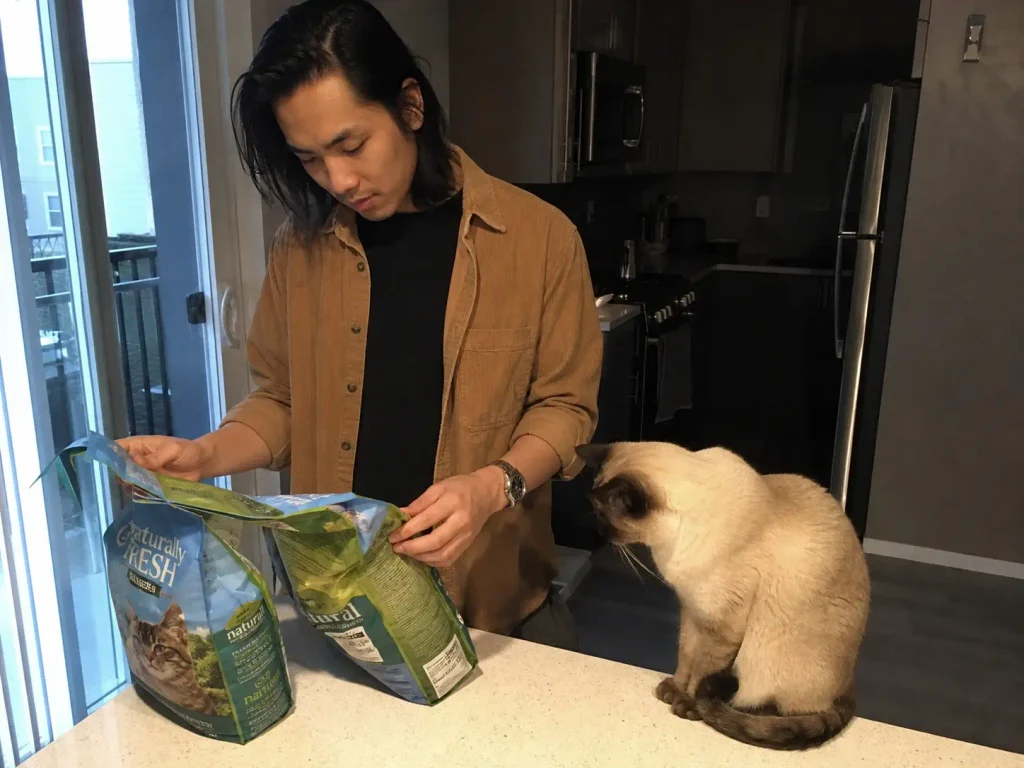
Two bags of non-tracking litter sit on the same shelf. Both say 99% dust-free. You buy one, it coats your hallway, you buy the other and it doesn’t. That isn’t bad luck and it isn’t your cat.
Nobody Has to Prove “99% Dust-Free”
There is no CPSC standard for litter dust and no ASTM test method specific to tracking. Nothing sits between the marketing department and the front of the bag: the manufacturer picks the test, runs it, and prints the result.
Even at face value it measures the wrong thing. Dust-free claims are usually stated by weight of fines removed, which says how much powder came out and nothing about the size of what stayed. Size is the whole question, because a particle over 250 micrometers settles quickly and one under it floats across the room. A bag can be honestly 99% dust-free by weight and still haze your furniture.
I used to treat these figures as directionally useful. Then you read enough threads where two people quoting the same number describe opposite results in the same size apartment, and the honest conclusion is that it isn’t measuring anything you can compare.
What the Words on the Bag Can and Cannot Tell You
Not everything on the packaging is noise. The words that mean something describe the physical object rather than its performance: pellet, large grain, crystal, non-clumping. A pellet is a pellet.
Except when it isn’t. Reviewers of one pellet litter marketed specifically on low tracking say the opposite in plain terms, that it tracks like hell and turns up in pieces all over the house. Those pellets are small and they crumble under a paw. Pellet on the bag is not pellet in the hand.
So the descriptors narrow the field and the photo confirms it. You aren’t shopping for a claim, you are shopping for a particle, and once you are, what each litter material is actually made of is more useful reading than any product page.
The Granule Test You Can Run Before You Buy
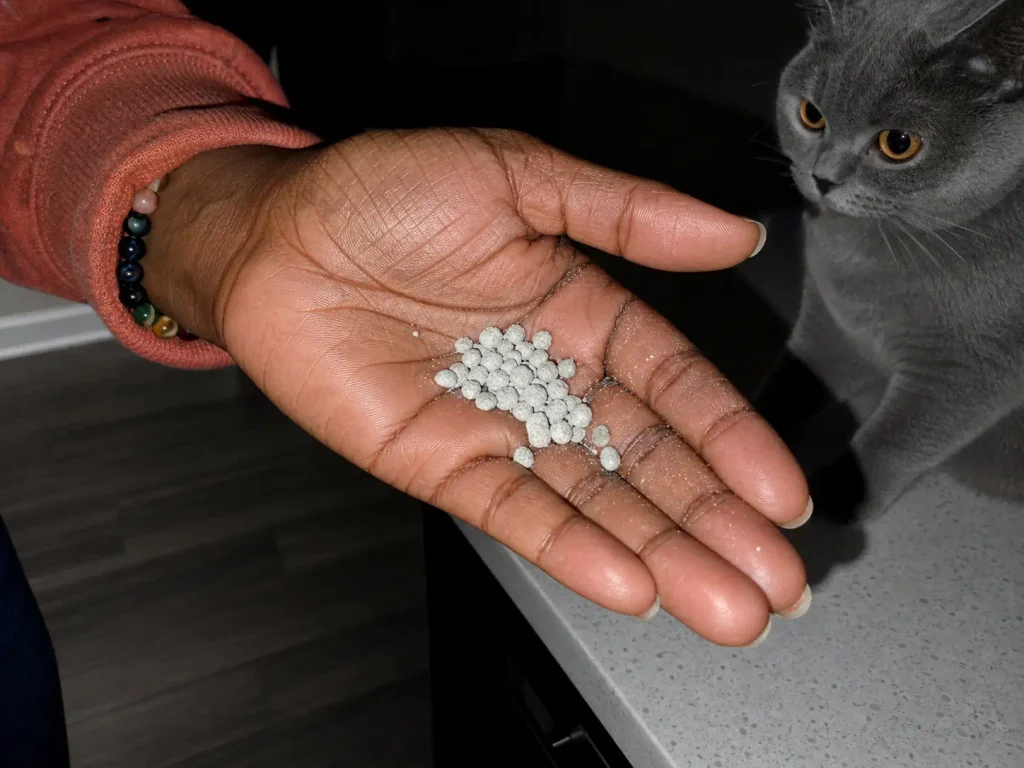
You are standing in the aisle with a bag in each hand, or you’re on your phone looking at two listings. This takes ten seconds and it beats every review you could read.
The Three Size Bands, in Millimeters
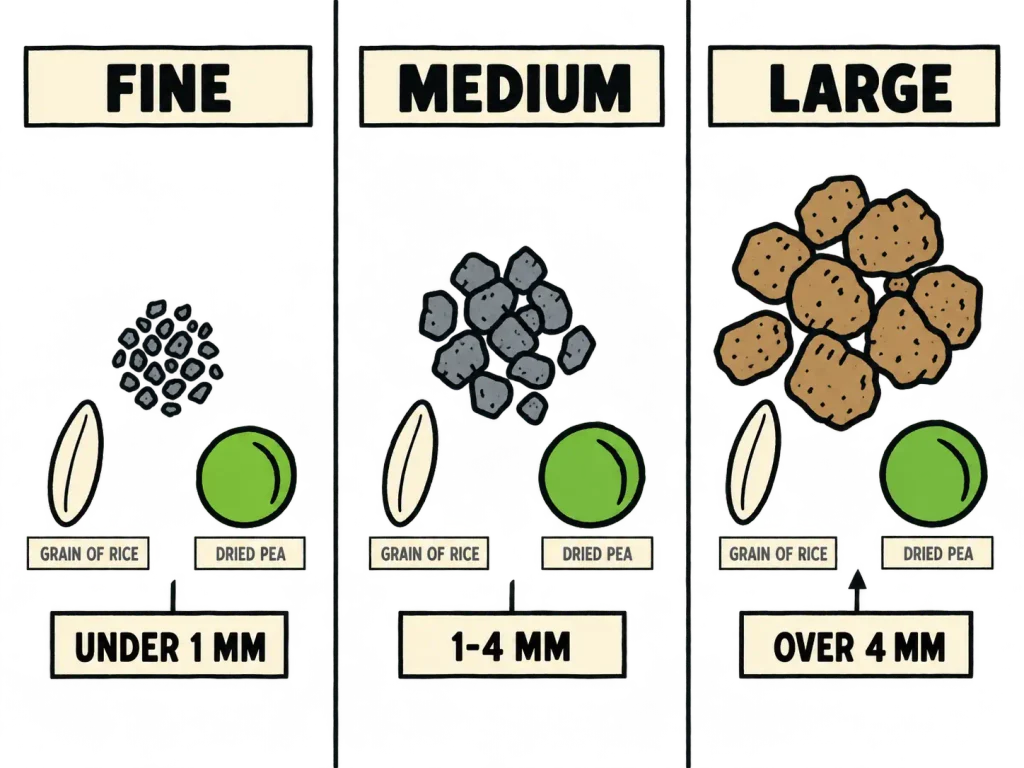
Litter sorts into three bands, and measured particle-size bands across litter types put real numbers on them. Fine is under 1 mm: clumps fastest, absorbs best, tracks and dusts more than anything else. Medium runs 1 to 4 mm, where standard clumping clay and most of the market sit. Large is over 4 mm: tracks least by a wide margin, clumps slowly or not at all, holds less liquid per pound.
Notice the spectrum runs in one direction. Everything that makes litter convenient to scoop lives at the small end. Everything that keeps it in the box lives at the large end.
[CREATOR NOTE] Visual Suggestion: a simple three-band size comparison — fine, medium and large granules shown at the same scale against a common reference object (a grain of rice and a dried pea), with the millimeter band labeled under each. The prose gives the numbers but a reader cannot picture 1 mm versus 4 mm, and this is the one number the whole article turns on.
Rice, Pea, and the Roll-Off Test
Millimeters are impossible to eyeball, so here is the store version. Smaller than a grain of rice and it rides out on the pad. Bigger than a dried pea and it mostly falls off at the box edge, which is where you want it. In between is a spectrum, and closer to pea is better.
The second check needs a handful, so it works with an open bag at home. Pour a little into your palm and tip your hand until it all runs off, then look at your skin. The film of powder in the creases, the pieces caught in the lines of your hand: that is what stays on a paw pad. A palm is rougher and drier than a pad, so the test errs pessimistic, which is the direction you want.
Shopping online, the product photo is the test. Look at what the granules are resting against: a hand, a scoop, the rim of a box. Any of those gives you scale. A tight close-up with nothing in frame for comparison is a listing telling you nothing, on purpose, and you should read it as a soft admission.
What Every Size Gain Costs You
Nobody selling litter will say this, so it goes here. Every step up in granule size takes something away.
Big pieces clump badly or not at all, so scooping becomes sifting, or with pellets, a periodic full change. They also hold less liquid per pound, because absorption depends on surface area and a large granule has less of it than the same pound ground finer. The box needs more attention, not less.
That’s the trade. Less on your floor, more in your routine.
What Each Material Actually Does Under a Paw
With the rule set to big, smooth, and low dust, comparing materials stops being a matter of preference and turns into arithmetic.
| Material | Granule size band | Dust level | Tracking | The trade |
|---|---|---|---|---|
| Clumping clay | Fine to medium, 1–4 mm | High | Worst | Best clumping of any material, and the powder that makes it clump is the powder that travels |
| Pine pellet | Large, well over 4 mm | Low | Very low | Breaks down into sawdust as it absorbs; needs full changes instead of scooping |
| Corn / plant clumping | Medium to large | Low to medium | Low | Keeps the clump at a bigger grain, but softer pieces can crumble in a busy box |
| Silica crystal | Large, smooth and rounded | Very low | Least of any material | Hard, angular feel underfoot that texture-sensitive cats refuse outright |
| Paper pellet | Large | Lowest | Very low | Lightest material, so pellets scatter when kicked; saturates faster than wood |
Clay Clumps Because It Is Powder, and Powder Travels
Clumping clay loses this comparison, and it loses it structurally rather than through lazy manufacturing. The mechanism needs fine bentonite powder to bind around moisture and set. No powder, no clump. The property that makes clay the easiest litter in the world to scoop is the one that puts it on your floor and in your air, and nobody has engineered one out without losing the other.
The Dr. Elsey’s Ultra Unscented Clumping Clay Cat Litter is the fair reference point, a 40 lb bag with a medium-grain formula built to track less than the clay around it. It does. It is still clay, and a good medium-grain clay will not touch a mediocre pellet on this measure. The 40 lb bag is its own consideration up three flights with no elevator, which no review mentions.
Before switching away, ask whether you need the clumping at all. For a single-cat box the answer is often no, and that decision opens up the entire large-granule half of the market.
Pellets: Pine, Paper, and What They Cost You in Absorbency
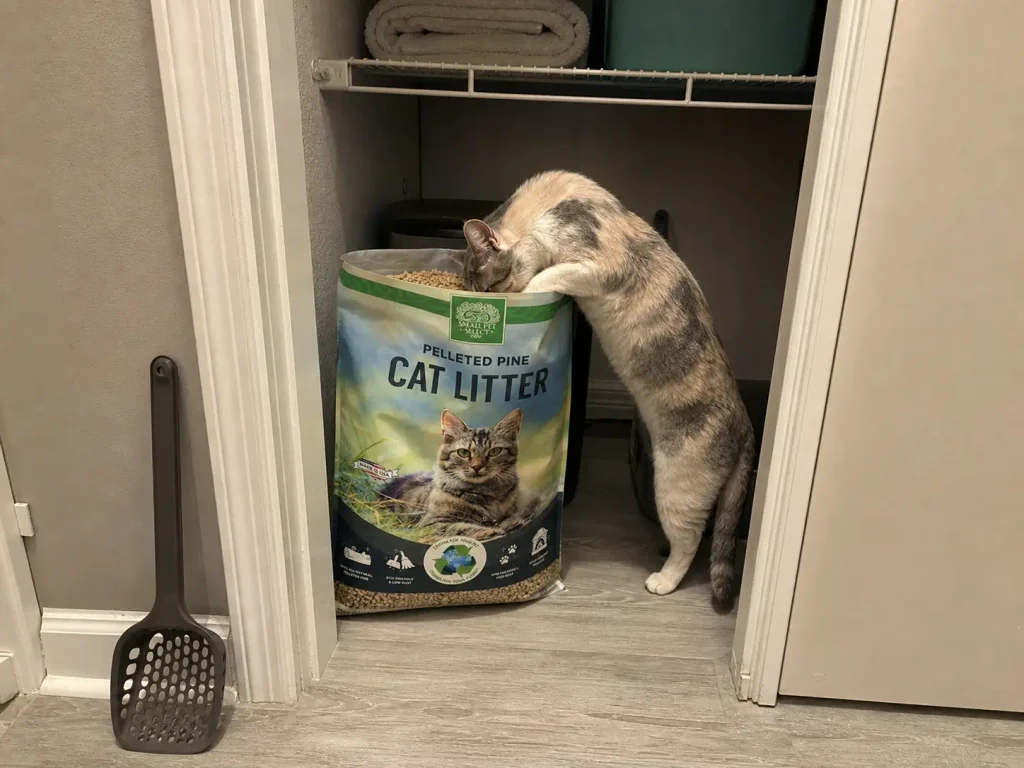
Pine pellet is the textbook version of everything described above. The pieces are large, dense and heavy, they hold almost no dust, and a shake at the box edge drops essentially all of them. The Small Pet Select Premium Pine Pelleted Cat Litter is a 25 lb bag of exactly that pellet, non-clumping, and it is this mechanism made physical.
The catch is real: as pine absorbs, the pellet breaks down into sawdust at the bottom of the box, finer than the pellet was. You sift it out or you change the box.
Before committing to 25 lb of something he has never stepped on, buy less of it. The So Phresh by Petco Pine Pellet Non-Clumping Cat Litter is the same pellet in a 20 lb bag at a lower tier, which makes it the sensible way to find out whether he has opinions about pine. If he walks out and goes to the bath mat, you learned it cheaply.
Crystal Tracks Least and Asks the Most of the Paw
Silica crystal wins the single metric this page is about. The granules are large, smooth, rounded and hold almost no dust, and across sources it lands at the bottom of tracking comparisons. The PrettyLitter Health Monitoring Cat Litter in the original unscented non-clumping formula is a 6 lb bag of this material, and 6 lb of crystal covers more box than 6 lb of clay, because the stuff is light.
Then there is the catch. Multiple sources describe crystal as harsh on sensitive paws, and that is not marketing softening: the granule is hard, faceted and unyielding in a way clay and pine are not. Some cats step in, dig once, and never come back.
If yours has ever shown a preference about paw texture, this is the highest-risk switch on the page, and winning the tracking metric buys nothing if he stops using the box. He isn’t being fussy. He is standing on something that feels wrong to stand on.
The Plant-Based Middle
If clay has the clump and pellet has the granule, corn-based litter keeps some of both. The World’s Best Cat Litter Original Series is a 14 lb bag of whole-kernel corn that clumps like clay at a noticeably larger grain, which is a useful place on the spectrum if you scoop daily and don’t want to give that up. The trade is that a corn granule is softer than a pellet and crumbles under enough traffic, which depends on how many cats you have.
Households that switched from clay to pellet or crystal with nothing else changed report reductions in tracked particles as high as 70%. No mat, no new box, no relocation. Material alone is the highest-leverage single change here, and the cheapest to reverse if you get it wrong.
One Cat, Two Cats, and Why the Same Bag Behaves Differently
Your friend swears by the bag you just bought and her hallway is spotless. She has one cat. You have two, and that changes the arithmetic completely.
Trips Through the Box, Not Cats in the House
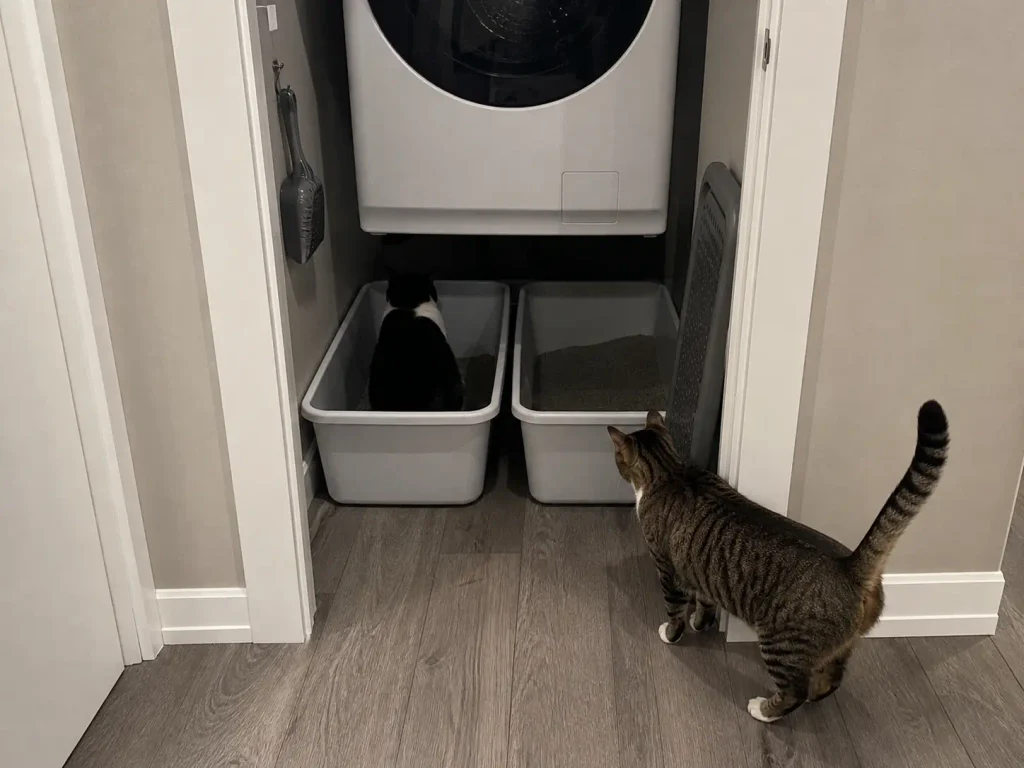
Tracking scales with trips, not with cats on paper. Every exit fires both mechanisms: grit on the pad, dust into the air. One cat makes two or three trips a day. Two cats sharing a box push that to four or six, and the surface never settles between visits.
So a material that performs acceptably at three exits looks like a failure at six, with the same bag and the same granules. That is why one household’s rave review and another’s furious one-star are both accurate. Neither review mentioned how many cats they have.
A Second Box Beats a Different Bag
Before you buy anything, add a box. If you already own a spare, this is free and takes a minute.
The 1+1 rule, one box per cat plus one, usually gets explained as hygiene. The reason nobody states is the one that matters here: more boxes means fewer trips through each box, and fewer trips means less litter carried over each edge. You can cut tracking meaningfully with the exact bag currently annoying you, purely by splitting the traffic. Two boxes in two rooms with the clay you already own will often beat one box with an expensive pellet.
It also fixes something else, which is that two cats and one box is a territory arrangement neither of them agreed to.
What Changes About the Material Math
Multi-cat also flips the clump economics. In a single-cat box a non-clumping pellet is easy: sift the sawdust every few days, full change every couple of weeks. Put two or three cats through the same box and it saturates in a fraction of that time, and non-clumping means you cannot pull the wet part out in isolation. You change the whole box, more often.
The material that was cheaper to run for one cat gets more expensive for three.
The industry has priced this in. World’s Best sells a separate Low Tracking & Dust Control line aimed at multi-cat homes, and brands don’t split a product line over a footnote. If you want to keep the clumping and the daily scoop while cutting the dust, the low-dust clumping options for a multi-cat box is the narrower version of this decision.
Switching Without the Cat Quitting the Box
Here is the risk nobody prices in when they tell you to change litters. The worst outcome is not that the new bag tracks more than promised. It is that he stops using the box, goes on the bath mat, and you have traded grit in the hallway for a much larger problem.
Six Days, Not One Afternoon
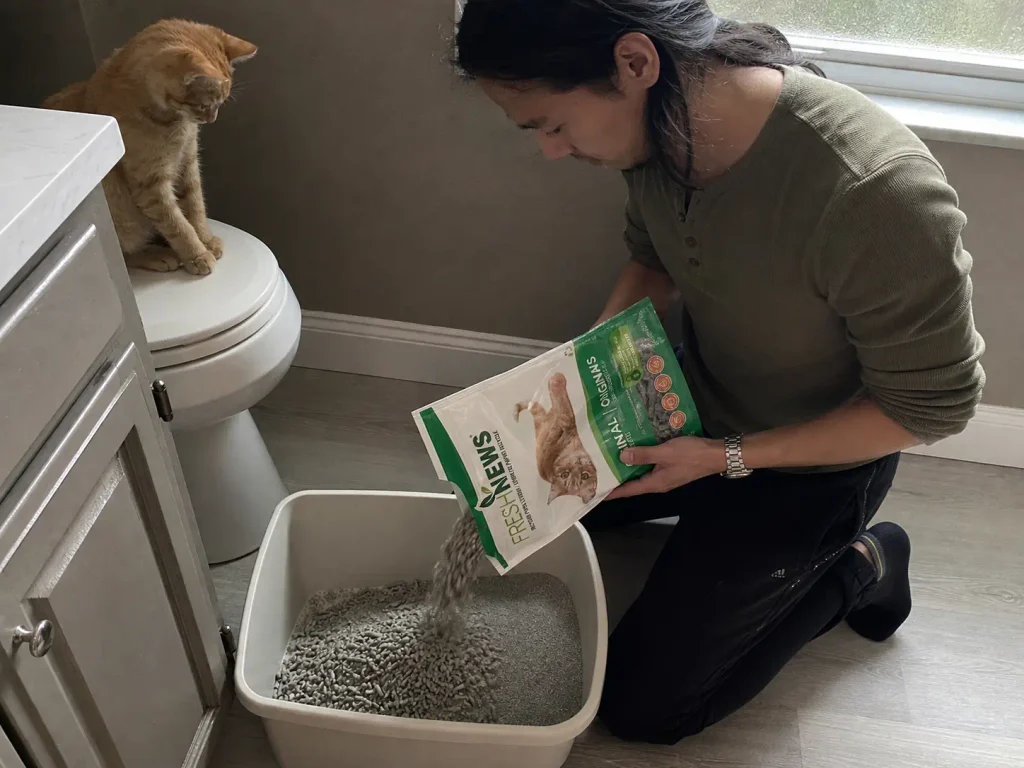
Do not swap cold. Mix the new litter into the old and raise the proportion over about six days: mostly old at first, half and half in the middle, mostly new by the end. Colorado State’s veterinary teaching hospital recommends mixing litters gradually for this reason, and six days is the number that keeps coming back.
Texture is what he votes on, and fine clay to a large pellet is the biggest texture jump available in this category. Sand to gravel. Give that one the full six days and be ready to stretch it, because the bigger the improvement in tracking, the bigger the change under his feet. For the day-by-day version with the failure cases mapped out, the full switching protocol, day by day goes deeper than this section needs to.
One Box at a Time, and What Refusal Looks Like
If you have more than one box, convert one and leave the others exactly as they were. This is the safety net people skip: refusing the new litter stops being the same as having nowhere to go. He votes with his paws, you read the vote, and nothing lands on the bath mat while you work it out.
Change one variable at a time. If you switch the litter and move the box in the same week, a refusal tells you nothing about which change caused it, and you have to undo both to find out.
The community calls the failure mode boycotting the box, and the stories share a shape: someone who did everything else right and moved too fast. If he hesitates at the edge, uses it less, or goes next to it rather than in it, back off to the previous ratio, hold three or four days, and move again in smaller steps. Nothing is lost by slowing down; a litter switch has no deadline.
A cat that stops using the box altogether, or shows any change in how he is urinating, is a vet visit before it is a litter question. Everything here assumes that has been ruled out.
Hard Floors, Dust, and the Deposit
This changes the calculation if you rent, and it gets sold backwards everywhere else.
On hardwood or LVP the two mechanisms do two kinds of damage. The fine dust settles into the seams between boards, where a vacuum doesn’t reach and a mop pushes it deeper. The grit is worse: a hard granule underfoot on a wood finish is an abrasive, and every pass grinds it further in. It shows up as a dull traffic path from the box to the door, and by then it is in the finish rather than on it.
You cannot refinish a floor you don’t own, which makes this a deposit question rather than a housekeeping one. That is the opposite of how low-dust litter gets sold, always as a nicety for people who like a tidy apartment. It is worth more to a renter than to an owner.
For a hard-floor apartment the Fresh Pellet Non-Clumping Paper Cat Litter answers this specifically: a 12 lb bag of recycled paper pellet, the lightest and lowest-dust material of the group. Light cuts both ways, though. Paper pellets scatter further when kicked, so you trade floor grit for less airborne dust and less abrasion, which is right on wood and wrong on tile.
No litter is track-proof, and this page has stayed inside the box on purpose. Once the material is sorted, what a mat can and cannot catch is the other half of the fix.
Conclusion
The label is not the specification. The granule is. Bigger than a grain of rice, closer to a dried pea, low dust, smooth surface, and that rule survives every brand change on the shelf.
Material is the highest-leverage single change available to you. Before you buy a mat, a hood or a bigger box, change what is inside the box you already own. Then add a second box, which costs nothing if you have one.
Switch over six days, one box at a time. The fastest switch is the one you end up undoing.
Sweep the same stretch of floor three weeks from now, at the same time of day, and compare it to what you are sweeping today. Three weeks is long enough for the cat to have settled and long enough for a new routine to have started slipping, so it shows you both at once. If a second box and a coarser bag fix this, you solved a hardwood problem for the price of litter you were buying anyway.
Amazon’s Audible — free for 30 days
Your cat won’t let you read. Let someone read to you.
Audible is Amazon’s audiobook library — thousands of titles, read out loud, on your phone. Free for a month, plus one audiobook to keep forever.
Frequently Asked Questions
01What litter has the least tracking?
Silica crystal tracks least of any material, because the pieces are large, smooth and hold almost no dust. Large pine or paper pellets come close behind and are easier on a cat that is particular about texture underfoot.
02How do you get litter to not track?
Change the granule before you change anything else. A bigger, smoother, lower-dust piece leaves the box less often on a paw. Adding a second box and putting a hard flat surface right outside the exit does most of the rest.
03Does pellet litter really track less?
Usually yes, but only when the pellets are genuinely large and hold together. Small or crumbly pellets track about as badly as clay, which is why owners of certain pellet brands report the exact opposite of what the bag promised them.
04How do you stop a cat tracking litter into the bed?
That is almost always dust and fur-carried grit rather than granules on the pad, so a low-dust material does more than a mat can. Long-haired cats carry litter in the fur between the toes, which no mat at the box will ever reach.
05Is clay litter the worst for tracking?
Clumping clay is the worst-performing common material, and the reason is structural rather than a formulation flaw. The fine powder that binds the clump is the same powder that travels. Even low-tracking clay formulas are working against their own mechanism.
Leave a comment