How to Stop Litter Tracking When There’s One Spot
The conflict nobody names: mat makers warn off high-traffic floors, the exit rule demands one. In a studio that's the same three feet. Here's the fix.

Alfredo RamsesFounder · August 23, 2026 · 18 min read


On this page8 sections
Three in the morning, bare feet, and that unmistakable grit in the hallway between the bed and the bathroom. Which is also the only way out of the litter box.
Learning how to stop litter box tracking in a place this size starts with a number nobody in the search results bothers to say out loud: the average U.S. studio comes in at 440 square feet, and anything under 500 is officially small-apartment territory. Your cat did not get messier when you moved. He is digging, covering and stepping out exactly the way he always did, and there is simply less floor between him and the couch to absorb it.
The three tracking levers are already settled and ranked elsewhere on this site. This is what you do with them when the apartment gives you one usable spot instead of five.
Quick Answer
In a small apartment, stop tracking in this order:
- Count the spots that actually work. Usually one or two.
- Cut the load at the source with high sides and coarse granules.
- Put the mat at the exit, even a narrow one.
- Swap a thick mat for a runner where people walk.
- Sweep the same stretch daily, at the same time.
Small Floor Plans Do Not Make Messier Cats
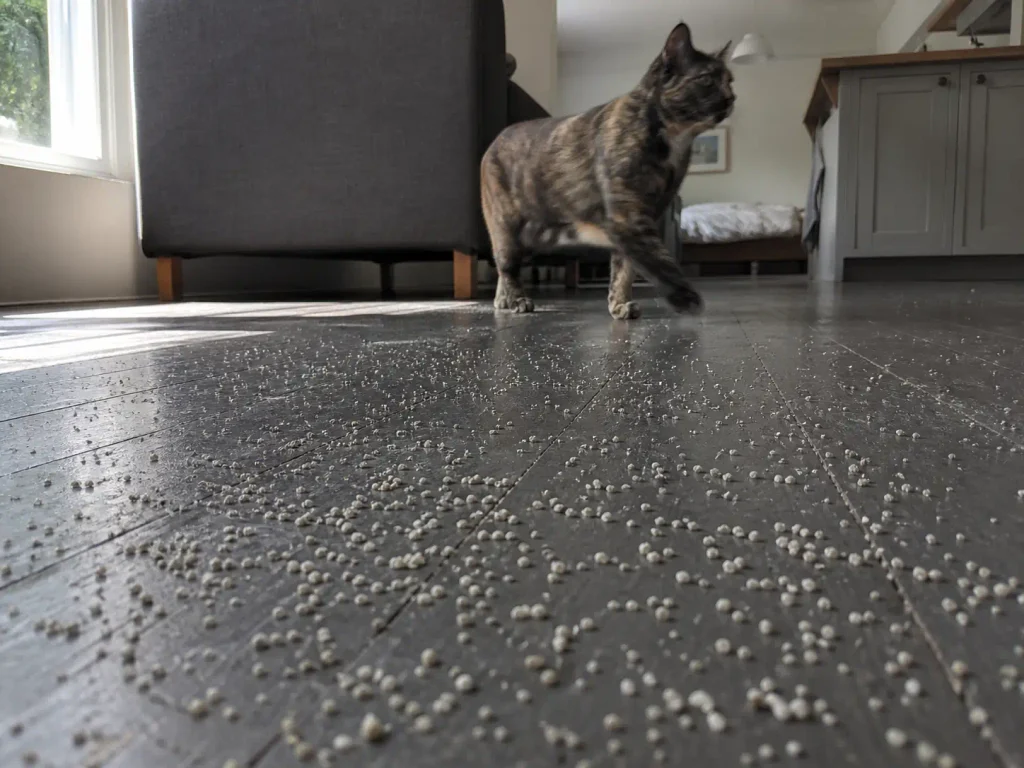
The suspicion almost everyone arrives with is that their cat is unusually bad at this, or that the litter brand is the problem. Neither one survives the arithmetic. Same cat, same box, same litter, different denominator.
A one bedroom apartment averages 804 square feet, roughly 45% more floor than the average studio, and that gap is doing all the work people blame on the animal. In a house, the granules that leave the box scatter across enough square footage that most of them never reach anywhere anyone sits. In 440 square feet they concentrate on the two or three patches of floor that everybody crosses to get anywhere.
The quantity leaving the box has not gone up. The surface that used to hide it has gone away.
What Actually Changed When You Moved
Nothing about the cat. An apartment cat digs exactly like a house cat does. Litter tracking is a transfer problem: granules stick to paw pads, ride out, and drop somewhere. The volume of that transfer is set by granule size, box height and mat placement, and none of those three changed when the lease did.
What changed is that the box, the doorway, the walked path and the seating are now all inside a radius of maybe twelve feet. In a studio apartment, the box and the couch are not in different zones of the home. They are in the same room, sharing the same floor, and the cat’s exit route runs straight through the middle of your living space because there is no other route to run through.
Why It Reaches the Couch the Same Day
This is the part no competitor quantifies, and it is the whole reason a small footprint feels so much worse than it should. Short distance is a multiplier, not just a reduction in room choice.
A granule that lands four strides from the box in a studio gets stepped on within the hour, and every step relocates it a little further. It is on the rug by lunch and on the couch by evening. The same granule in a house lands somewhere nobody walks for a day or two, and by the time anything picks it up it has already been vacuumed.
Foot traffic is the transport system, and in a small apartment the transport system runs over the same three slabs of floor a hundred times a day. Carried litter travels further than kicked litter ever does, and everything in this apartment is within walking distance of everything else. That is why the complaint from people in studios is never “there is more litter.” It is that the couch is right there.
Before you buy anything, spend three days following the granules backward and noting how far out they get. In a small apartment that line runs further than anybody expects, and where it ends tells you which problem you actually have: too much leaving the box, or too much travel after it leaves. Those two need different money spent on them.
What This Section Is Not Going to Re-Argue
Which litter, which box, whether a mat is worth owning at all: settled, and settled somewhere else. If you have not read the three tracking fixes, and the order they go in, start there, because everything below assumes it. Here those levers are inputs, not questions.
Count the Spots You Actually Have
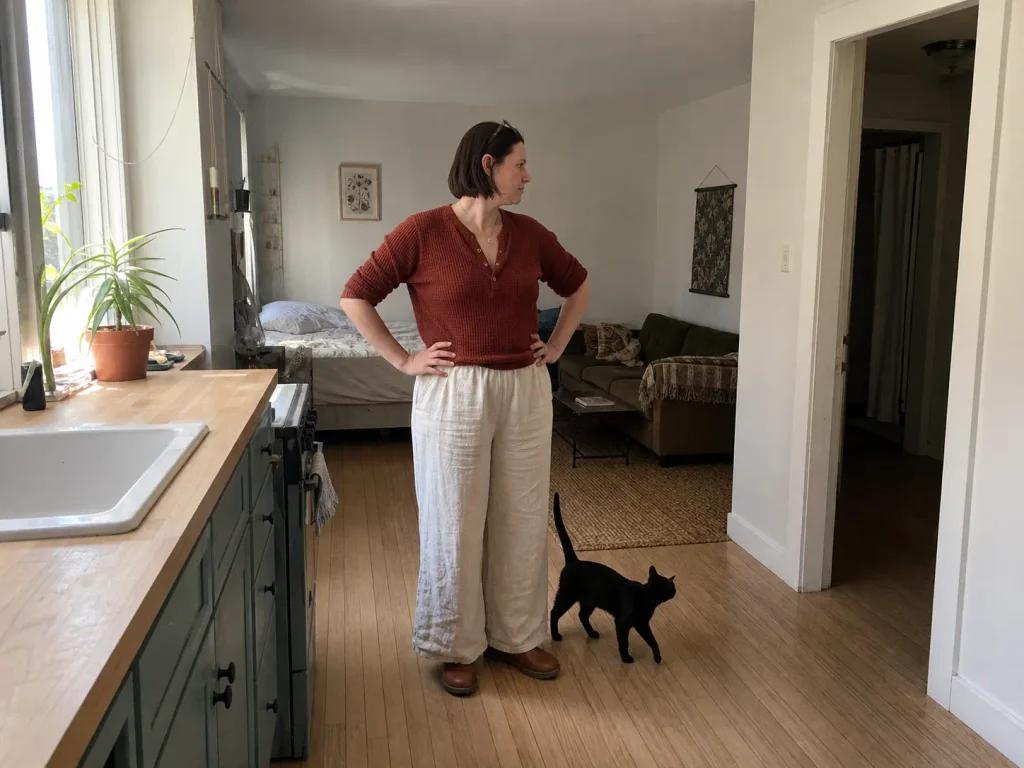
Every article on this topic tells you to choose a quiet, low-traffic corner. In a studio with one bathroom there is no low traffic area, because every square foot of it is on somebody’s way to somewhere. There is a bathroom and a gap beside the refrigerator, and pretending otherwise is how people end up moving the box four times in a month and solving nothing.
So count out loud instead. A spot qualifies only if it clears three conditions at once, and in most small apartments that leaves one or two candidates, not five.
- The cat can reach it without crossing where he eats. Food and box in the same three feet is a rejection waiting to happen, and a rejected box is a much larger problem than a tracked one.
- The box fits with its mat in front of it. Not the box alone. The box plus the landing zone, measured together, because a box that fits in a nook too tight for a mat has not solved anything.
- You can walk past it without stepping on it. If the only way by is over the mat, you have not found a spot, you have found a bottleneck.
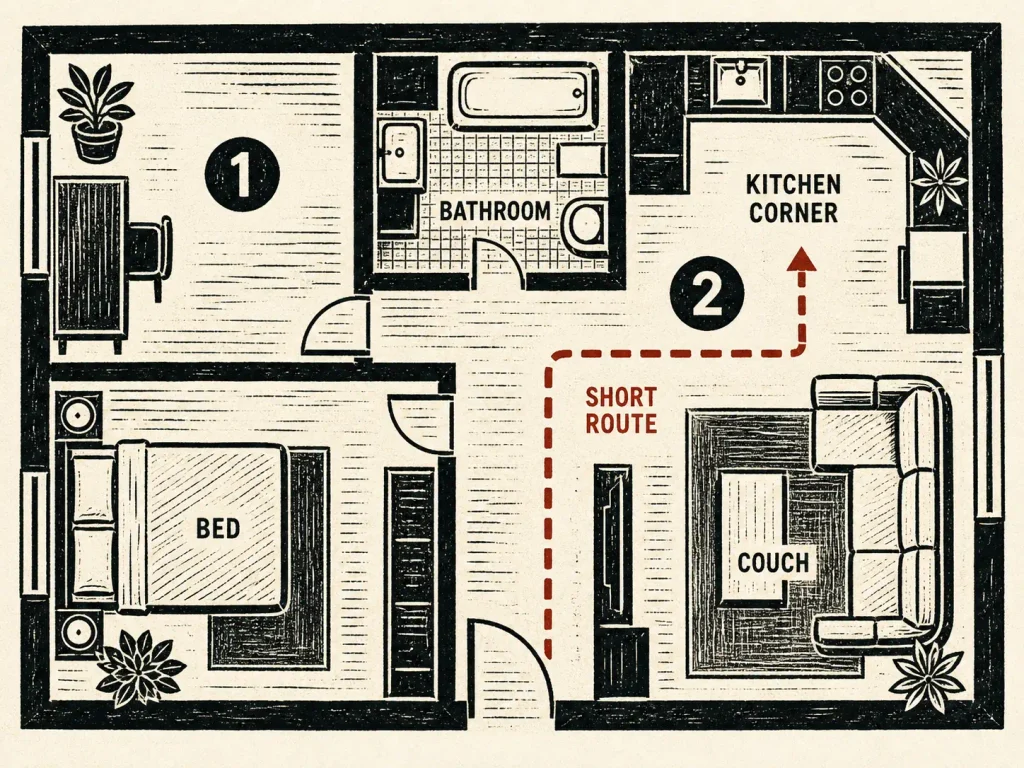
The Three Conditions a Spot Has to Meet
Run them against a real one-bathroom apartment and watch the list collapse. The bathroom passes on food separation and usually on floor surface, then fails the third condition the moment you notice the mat sits across the doorway threshold you use at night. The gap beside the refrigerator passes on traffic and fails on food separation. The bedroom corner passes everything and puts the box where you sleep, which is a trade some people take and most regret by the second week.
That collapse is the useful part. Two candidates and a clear reason why each one is imperfect beats a list of eight generic suggestions, because you can only build a containment system around a spot you have actually committed to.
Layout Beats Square Footage
Two apartments with identical square footage can offer a different number of viable spots, and the difference is hallway width and where the doors fall. An open-plan 500 square feet with one wide wall gives you more usable options than a chopped-up 600 with a corridor you can barely pass someone in. Professional organizers who work in small spaces agree the constraint isn’t the room, it’s what you’re allowed to attach to it, and in a rental that constraint is doing at least as much work as the floor area.
Measure the narrow points before you decide anything. The width of your tightest passage sets the mat you can use, which sets everything downstream of it.
Hiding the Box and Stopping the Litter Are Two Jobs
Worth naming and then leaving alone: litter box furniture solves a visual problem, and this article solves a floor problem, and the two occasionally work against each other. A litter box enclosure that hides the box can also produce a faster, litter-flinging exit. Choose the one you actually care about first, because optimizing for both at once is where small-apartment setups usually go sideways.
Lower the Load Before It Ever Hits the Floor
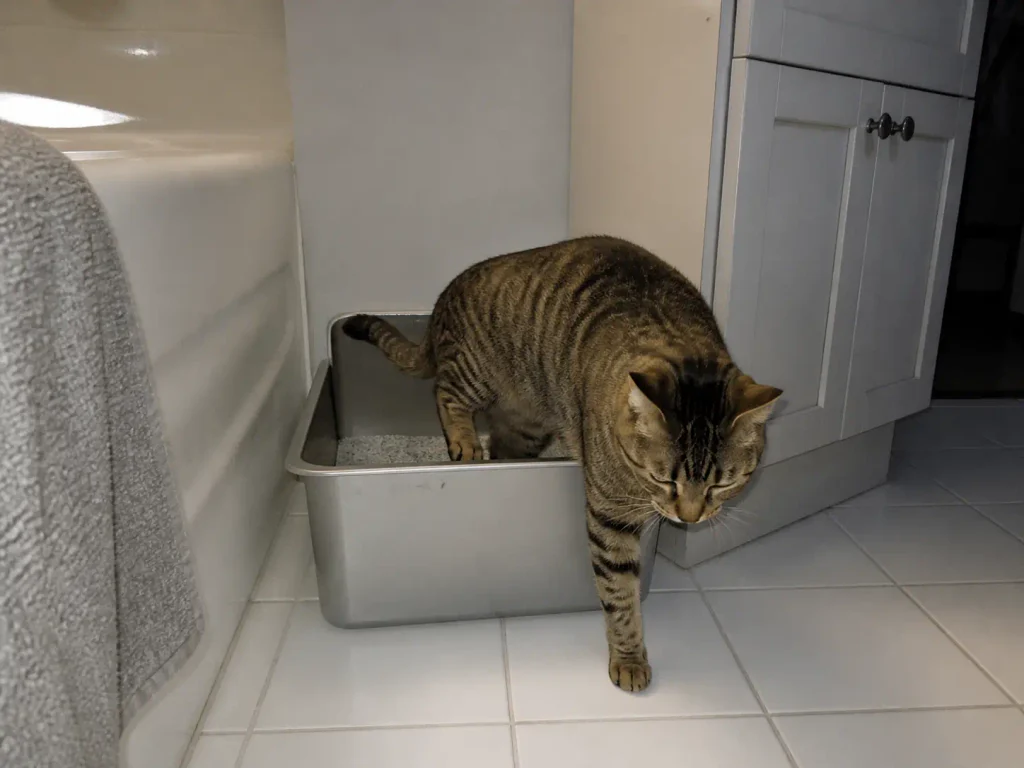
Here is where a small apartment quietly inverts the usual priority. In a normal home, if litter keeps escaping, you compensate downstream by buying a bigger mat. In 440 square feet there is nowhere to put a bigger mat, so there is nothing to compensate with. Every granule that never leaves the box is a granule no mat has to catch, and that arithmetic is worth more here than anywhere else.
The Two Adjustments That Cost Nothing
Lower the litter. A box filled to the brim spills over the rim on the first serious dig, and the depth most cats actually want is a couple of fingers, not a full bag. This is free, takes ten seconds, and in a lot of apartments it ends the problem before anything gets bought.
Then turn the box so the opening faces a wall or into the corner rather than out toward the walked path. Whatever gets kicked out during digging leaves at an angle, and a vertical surface eighteen inches away stops it dead instead of letting it travel the length of the floor. Two free changes, both reversible, both worth doing before the credit card comes out. That is it.
Mark your fill line inside the box with a permanent marker. Of everything on this list, the litter depth is the one adjustment that quietly undoes itself: by week three almost everyone is topping up past where they meant to, nobody notices, and the trail comes back looking like the mat failed.
When Walls Are the Only Variable Left
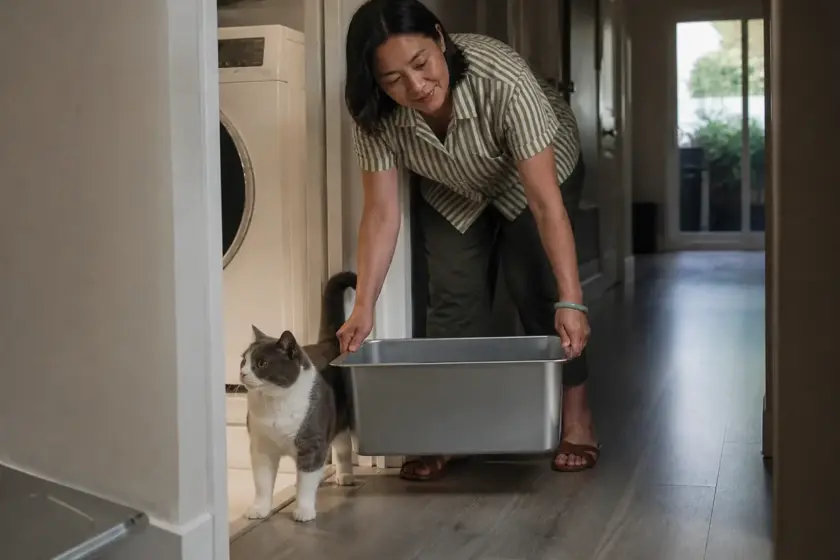
Once the free adjustments are in, the remaining piece is wall height, and in a small apartment it earns its place for a reason it does not have in a house. The Kirecoo Large High-Sided Stainless Steel Cat Litter Box runs 23.6 x 15.7 x 11.8 inches, and that last figure is the one doing the work: nearly twelve inches of wall to intercept what clears the rim mid-dig. The caveat is real, though. Tall sides are harder on an older cat or a short-legged one, and a high sided litter box with no low entry point is a box some cats will simply decline.
Stainless steel is not a style choice at this size either. Plastic scratches, scratched surfaces hold odor, and in a small apartment odor control is not a separate project from tracking — the smell has nowhere to go either. That part gets evaluated properly in why the grade of steel is the part that matters, which is worth reading before spending metal money. And a note on order, because it is the most common expensive mistake in this whole topic: buying the premium mat first and discovering the escape route was over the rim, not through the paws.
When the Mat and the Footpath Are the Same Three Feet
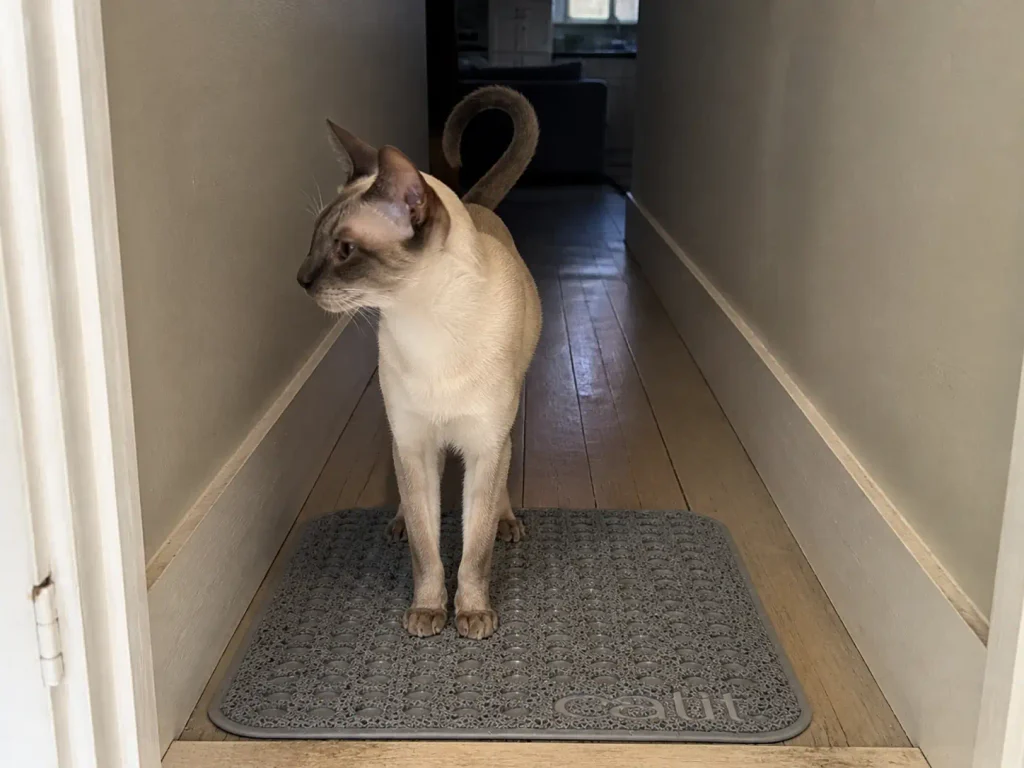
You did what you were told. Correct mat, correct size, placed right at the exit. Four days later it is crooked, half of it is under the cabinet, and it is catching nothing.
You did not place it wrong. You placed it in the only available spot, which happens to be the floor everybody in the home crosses fifty times a day.
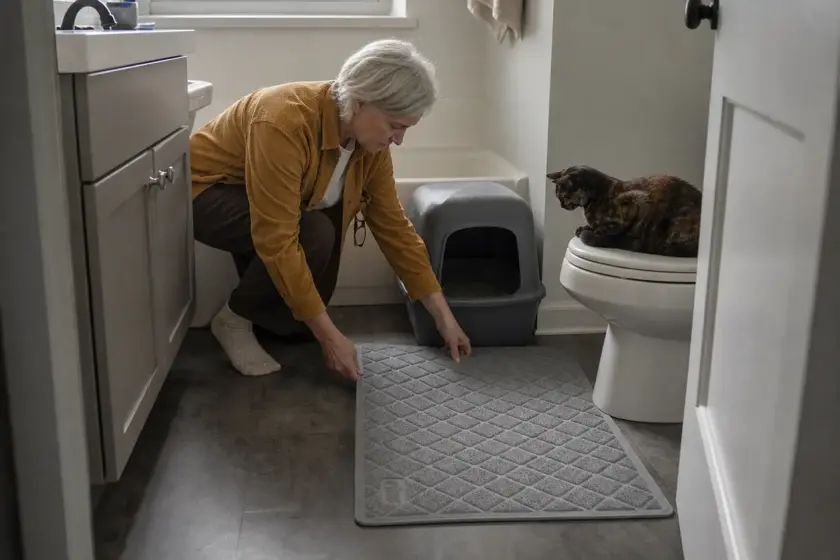
Say the contradiction out loud, because nobody else does. Mat manufacturers explicitly warn against putting their product in a high traffic area. The mat-placement rule says put it directly at the box exit. In a studio, those are the same slab of concrete.
Both instructions are correct on their own and they cannot both be obeyed here, and no competitor even acknowledges the collision exists.
The Rule and the Warning That Contradict Each Other
The exit rule exists because paw transfer is front-loaded, which is the mechanism worked out in what a mat can physically catch, and where it stops. The first two steps carry almost everything, so a mat anywhere except directly under the exit is a rug.
The traffic warning exists because a mat is engineered to be walked on by a nine-pound animal, not by adults in shoes, dozens of times a day. Human feet land harder, push laterally, and catch edges. Neither piece of guidance is wrong. They were just written by people who assumed you had more than one place to put the thing.
Why a Correctly-Sized Mat Still Ends Up Sideways
The mechanism is lateral shove. Each pass nudges the mat a fraction of an inch, and a week of that puts it somewhere other than under the exit. A mat not under the exit is decoration, and it fails silently, because it still looks like a mat.
There is a safety threshold in this too, and it is a documented one. Floor safety guidance is specific about mats over a quarter inch thick: bevel the edge or it becomes a trip hazard, with the bevel no steeper than a 1:2 slope and the mat lying genuinely flat. A thick trapper sitting across the middle of your only corridor, curling at one corner, is not just an annoyance. It is the exact configuration that guidance is written about, and at three in the morning in the dark it matters more than the litter does.
| Your One Spot | What Fits There | How It Fails |
|---|---|---|
| Passage wider than about four feet | Full-size trapper mat, roughly 30 x 23 inches, sitting flat with clearance on both sides | Rarely fails on placement — fails only when the trapping layer fills up |
| Corridor you pass through sideways | Compact mat under the exit only, around 15 x 23 inches | Catches the first step, not the second — expect some granules past it |
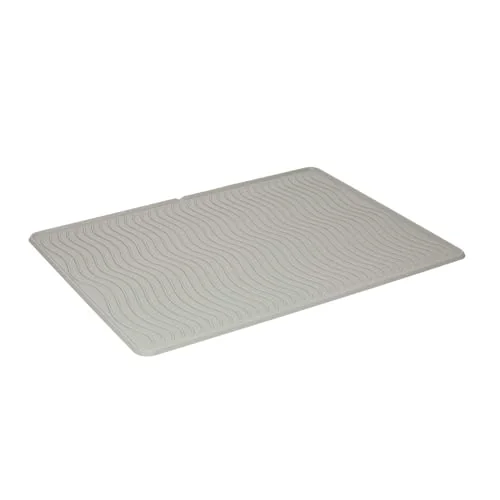
| Doorway that is the only route | Thin cut vinyl or shelf liner, edge-to-edge, no raised lip | Traps less per step, but stays put and cannot be tripped over |
| Full-size mat forced into a narrow spot | Nothing — this is the configuration to avoid | Kicked out of position within days, then catches nothing at all |
The Narrow-Hallway Version
Free first, as always. A leftover piece of vinyl flooring or a length of cheap shelf liner, cut to the exact width of the passage, is thinner than any trapper mat, lies genuinely flat, and costs whatever the offcut cost. It traps less per step. It also stays where you put it and never becomes something to catch a toe on, which in the only corridor of the home is not a small trade.
When you want real trapping in that footprint, the piece is a smaller mat placed correctly rather than a large one placed badly. The Catit Cat Litter Mat Rectangle, Small is 15.75 x 23.5 inches, which slots under the exit in a gap that a full-size mat cannot occupy without blocking the passage. It will not catch the second step the way a long mat does, and that is the honest limitation. A small mat under the exit still beats a big one shoved sideways under the cabinet, every time.
And If Your One Spot Is Actually Wide Enough
Some apartments do have the width, and if yours does, this whole conflict evaporates and you should just buy the full-size mat. No workaround, no compromise.
The Rest of the Walk, Without Drilling Anything
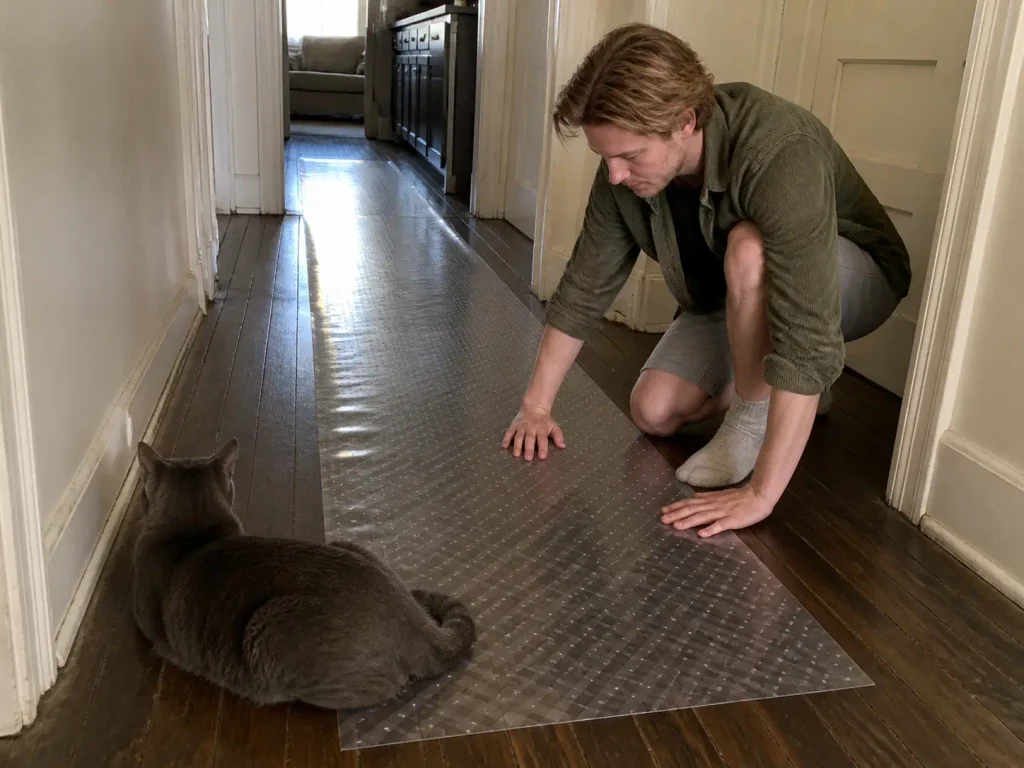
The mat handles the first two steps. In a small apartment the first two steps were never the problem, because from the box exit to where you sit there are only about four of them. Steps three and four are what put granules on the couch, and no mat reaches that far.
Two Cheap Checkpoints Beat One Expensive One
What people in small apartments actually build, once they stop buying single products and start thinking about the route, is a two-piece system: a mat right at the exit, and a wipeable runner covering the rest of the walked path. Two cheap checkpoints on the same route intercept more than one expensive mat that still stops eighteen inches from the box.
The division of labor is clean. The mat does contact scraping while the paw is still loaded. The runner does something different: it turns the rest of the route into hard flooring a broom actually clears, so the granules that got past the mat sit on top waiting to be swept instead of working down into carpet fibers where they stop being sweepable at all.
Before buying the second piece, lay the mat you already own along the real walked line, corner to corner, rather than as a tidy rectangle centered on nothing. Irregular passages rarely match the shape of the products sold for them, and a few minutes of trying it costs nothing.
What a Renter Is Allowed to Put Down
The renter friendly piece is a clear vinyl runner with a gripper backing. The Ottomanson Hallway Rug Protector comes 26 inches by 10 feet and gets trimmed with scissors to your actual corridor length, and it anchors by friction rather than adhesive. No drilling, no tape, no mark on the floor or the carpet when the lease ends.
Why a runner rather than a second trapper mat, which is the substitution most people reach for: a runner is engineered to be walked on by people, and a trapper mat is engineered to be walked on by a cat. In the one corridor of your home, the piece that survives human feet is the piece still doing its job next month. The limitation worth knowing is that vinyl over a thick pile carpet never sits perfectly flat, so on deep carpet you get less than the product promises.
Cut the runner with the corridor swept and dry, and leave a finger of slack against the baseboard. Cut it exactly flush and the first time somebody steps on it at an angle it rides up onto the molding and stops lying flat, which is the moment it starts sliding around instead of staying put.
Two Cats, Same One Route
A second cat in a one-room apartment does not get a second room. He gets the same corridor with twice the traffic on it, and the one-per-cat-plus-one rule does not stop applying because the square footage is small. Where that second box physically goes is a box placement question with its own answer, and it is not this one. What belongs here is only this: plan the mat and the runner around two cats using the same route, not one.
What Holds After Three Weeks
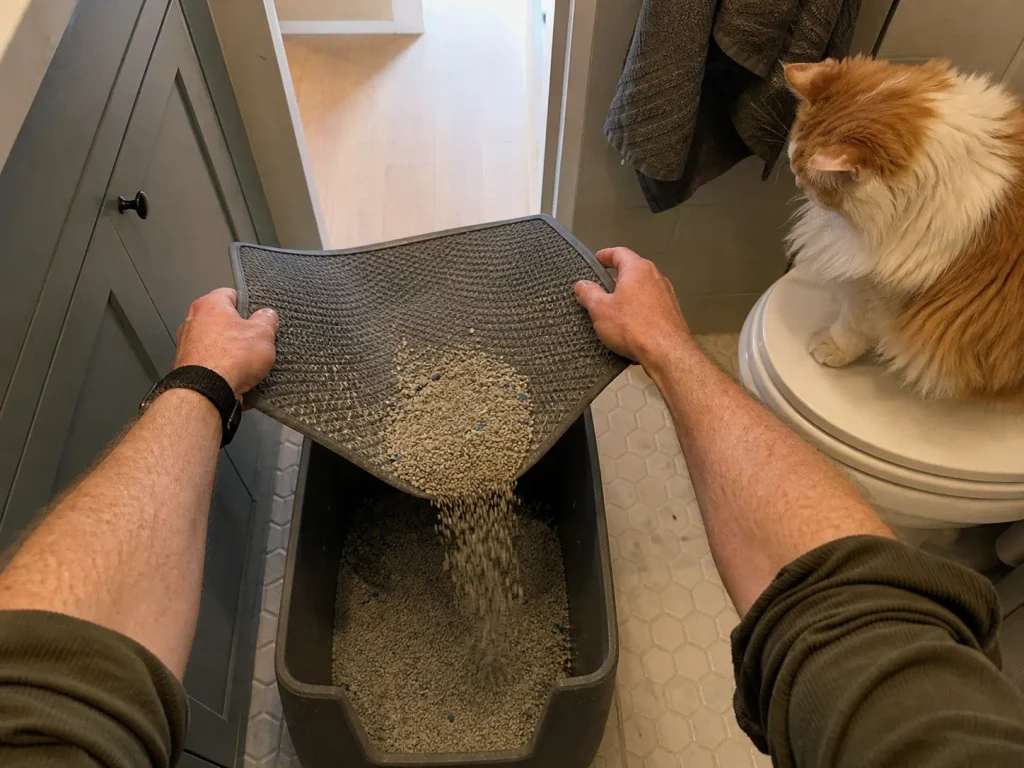
All of this works in week one, because in week one you are watching it. The real question is what survives once you stop paying attention, and in a small apartment you find out faster than you would in a house.
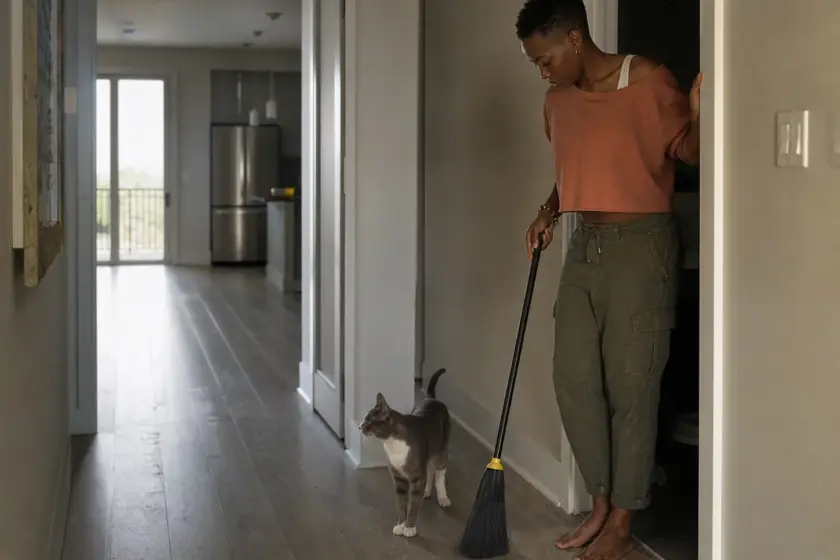
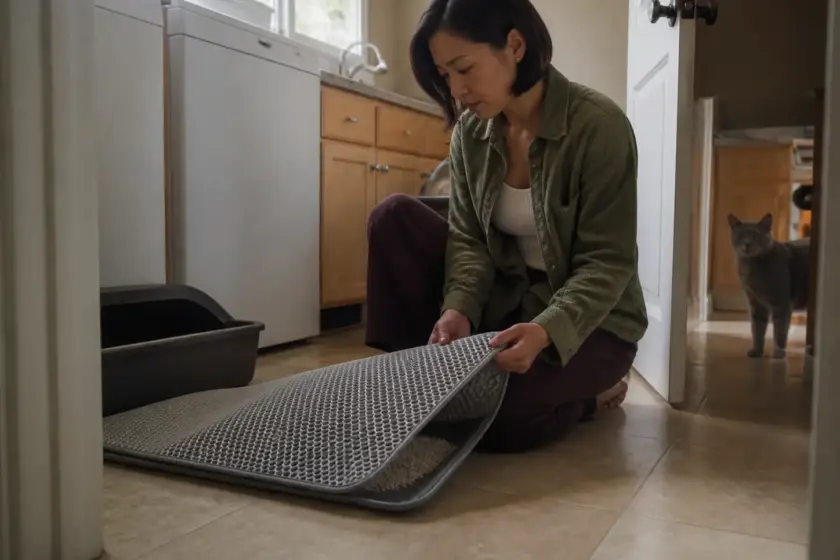
Maintenance here is shorter but more frequent. Scoop daily and sweep the same stretch of floor, every day, at the same time. Sweeping three slabs daily is less total work than sweeping the whole apartment on Sunday, and it never lets the trail get established in the first place. Shake the mat out over the open box rather than over the trash, and the granules go back where they came from at no cost.
Lift the runner and wipe under it every couple of weeks. Being liftable is half of what you paid for in a rental, and it is the half people forget to use.
The Three Signals the System Is Loosening
They arrive in a fixed order, which is what makes them useful. First the mat starts sitting slightly crooked, a couple of inches off the exit, and nothing about that looks urgent. Then granules start appearing past the end of the runner, which means the mat has stopped intercepting the first step. Only last does litter turn up in the bed, and by then all three checkpoints have been leaking for a while.
Catch it at the first signal and it is a ten-second correction. And when the trail comes back at the three-week mark, check the free adjustments before you blame anything you bought. It is almost always the litter depth, quietly creeping back up.
Conclusion
Your cat is not making more mess than anybody else’s. There is less floor between his box and where you sit, and that short distance is a multiplier on how fast the same amount of litter reaches the couch, not just a shortage of rooms.
Count your viable spots before you spend a thing. Almost always one or two, and knowing which one is yours decides every other choice in this article. Then, when the mat and the footpath turn out to be the same slab of floor, back the piece that survives being walked on: a small mat placed correctly at the exit, a runner for the rest of the route.
Check back in three weeks, not three months. This whole system depends on you holding a routine and on the cat accepting the new arrangement, and both of those show their hand within days. At the three-week mark, look at three things: whether the mat is still sitting under the exit, whether the litter level has crept back up on its own, and how far down the corridor the granules are getting.
Lower the litter by an inch and turn the box to face the wall. If the trail stops halfway down the hall, you just saved the money on the mat.
Amazon’s Audible — free for 30 days
Your cat won’t let you read. Let someone read to you.
Audible is Amazon’s audiobook library — thousands of titles, read out loud, on your phone. Free for a month, plus one audiobook to keep forever.
Frequently Asked Questions
01How do you stop cat litter from being tracked everywhere?
Attack it in that order: less litter leaving the box, then a mat right at the exit, then a runner for the rest of the walk. Filling the box less deep and turning the opening toward a wall costs nothing and usually cuts the trail before any purchase does.
02How do you deal with cat litter in a small apartment?
Treat it as geometry, not tidiness. Count how many spots actually work, and there are usually one or two. Then build the containment around that one spot instead of hoping a second room appears.
03Where should the litter box go in an apartment?
That question deserves its own answer about ventilation, exits and which room the box belongs in, and it is not what this article solves. Here the assumption is that the spot is already decided by your floor plan, and the job is stopping what leaves it.
04Is a litter mat a trip hazard in a hallway?
It can be. Floor safety guidance is specific: a mat thicker than a quarter inch needs a beveled edge and has to lie flat, which is hard to guarantee in the one corridor everyone crosses. In a narrow hallway a thinner, smaller mat placed under the exit is the safer version of the same fix.
05Does a second cat in a studio need a second litter box?
Yes. The one-per-cat-plus-one rule does not stop applying because the apartment is small. Where the second box physically goes is a placement question rather than a tracking one, and it deserves its own answer.
Leave a comment