Why Cats Get Mats on Their Back, and What the House Adds
The lower back is where her reach ends: why cats get mats on their back, from spine twist to spring undercoat, plus a 3-week palm check (no tools).

Alfredo RamsesFounder · October 13, 2026 · 15 min read

On this page8 sections
- 1Why Cats Get Mats on Their Back, a Spot the Spine Has to Bend Toward
- 2A Matted Back That Was Clean Last Month Is a Question for the Vet Before the House
- 3Weight, Age and Stiffness Move the Back Out of Reach
- 4The Coat Sheds on a Schedule, and the Back Collects It
- 5What the Spot She Sleeps On Adds
- 6What to Change First, and Where the Comb-or-Shave Decision Gets Made
- 7Palm Checks for Three Weeks Will Show Whether Anything Changed
- 8Frequently Asked Questions
Your hand slides down your cat’s spine and stops on a flat, hard patch just above the tail, on a cat who spends half her day washing. It reads like neglect, and it is nearly the opposite: this is why cats get mats on their back, in the one stretch of her frame that her tongue and paws barely reach. A mat there marks the edge of her reach, not the amount of care she puts in. Below you will find how that reach works, when a matted back goes to the vet before anything else, what weight and age take away, what the coat and the spot she sleeps on add, and what to change first.
Quick Answer
The lower back and the base of the tail are the last places a cat can reach with her tongue and paws, so loose undercoat and skin oil collect there and get pressed flat where she lies. If that spot was clean last month and is not now, ask your vet before changing anything at home.
Why Cats Get Mats on Their Back, a Spot the Spine Has to Bend Toward
She washes everywhere she can, which is exactly the trouble with the one place she cannot. The mats guide for where a cat’s tongue stops reaching maps every spot where the reach fails; this article stays on the back, because the back has its own mechanics and its own share of house in the cause.
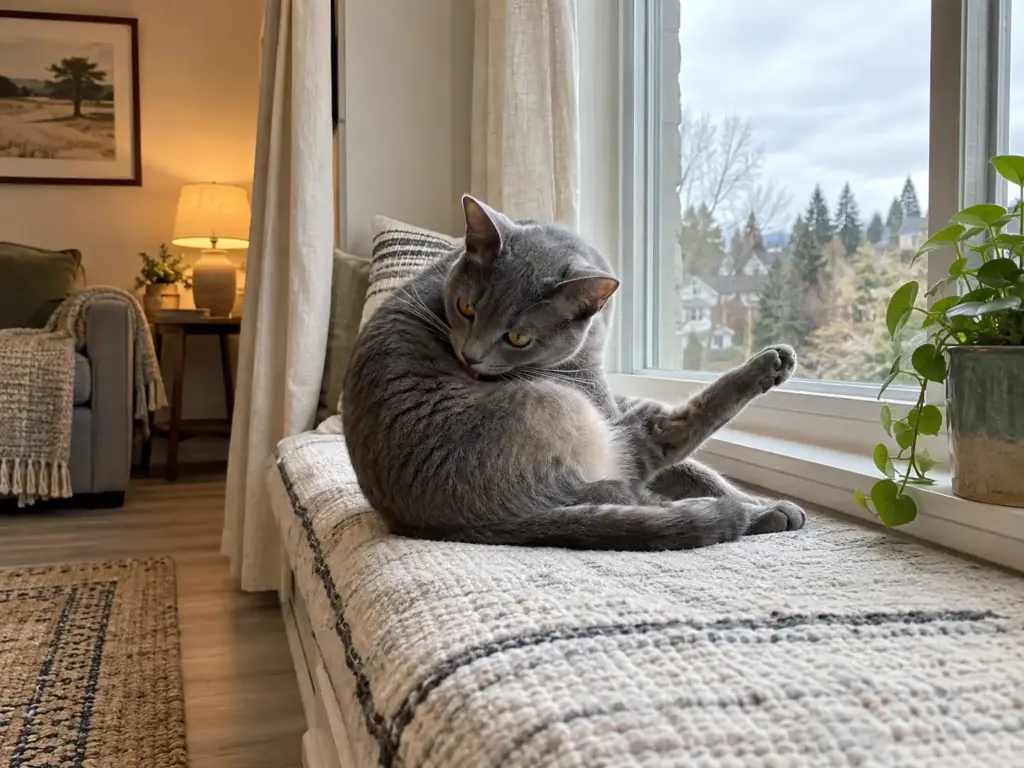
What it takes a cat to wash its own lower back
To clean her lower back, a cat has to bend her spine sideways, lift a hind leg out of the way and get her mouth down to the patch over her hindquarters. You can usually watch it from the sofa. The front half of her back gets long, easy strokes; as the lick travels toward the base of the tail, the twist tightens, the leg comes up, and the strokes get shorter. A big, long-coated cat has more fur to keep clear and more frame to bend around, so she may well run out of reach sooner than a small one does.
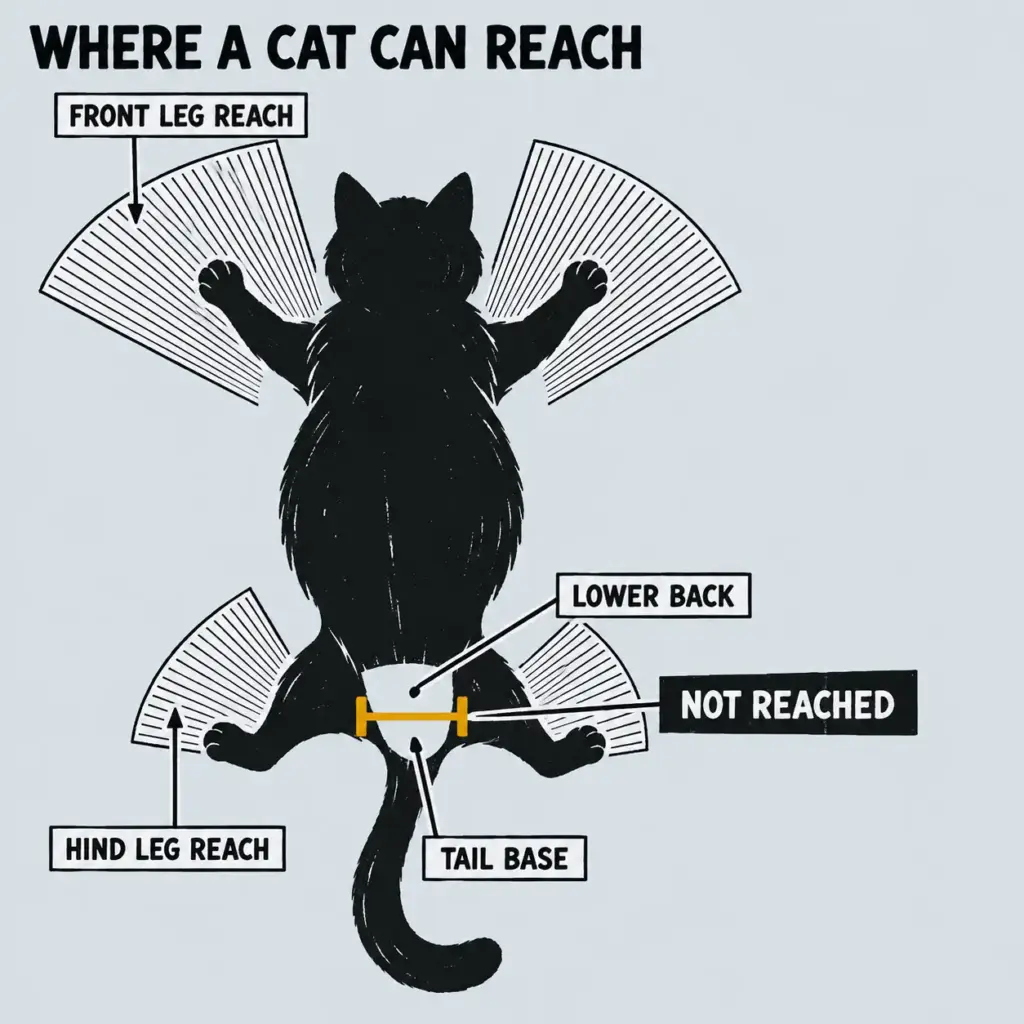
That is how the same cat can have a spotless chest and a stuck patch above the tail. She is not skipping the job. And the patch is simply past where the job can be done.
Lay your palm flat at the base of her tail and slide it up the spine, against the way the fur grows. Notice where the fur stops opening under your fingers and starts to feel like a single piece. That spot is your starting map, and it takes one minute and a cat who does not have to hold still.
What a mat is made of
A mat is not a big tangle. Groomer-to-Groomer magazine describes it as “solid clumps of dead hair stuck together with oils from the skin,” and that explains why it feels like a hard wad under your fingertips instead of a loose snarl. The usual advice says to brush a tangle out from the tip, and that is right for a tangle. On a mat it does nothing, because there are no loose strands left to separate: the clump has to be dealt with as a clump.
She cannot lick her way out of one either. The same magazine says cats are not equipped to remove matting on their own, and that it only gets worse and more painful as it grows. (If the patch seems bigger this week than last, you are not imagining it.)
Short coat or long, the back is on the list
If your cat has a short coat, you may have crossed mats off the worry list. Groomer-to-Groomer’s list of the highest-risk spots on a short-haired cat names the base of the tail, the chest, the sides and along the back. Long coats have the back and the tail base on their lists too. So the back and the tail base belong on the checklist for every coat length, and the difference between coats is how quickly the patch gets hard to part with your fingers, not whether it can happen.
A Matted Back That Was Clean Last Month Is a Question for the Vet Before the House
Picture an older cat, around fifteen, whose owner wrote on a pet forum that he had developed “mats all over his back” over a few months and “never has had them before.” The first reply was short: “Time for a quick vet check up.” The reply got the order right. The mat was the visible part, and the change was the news.
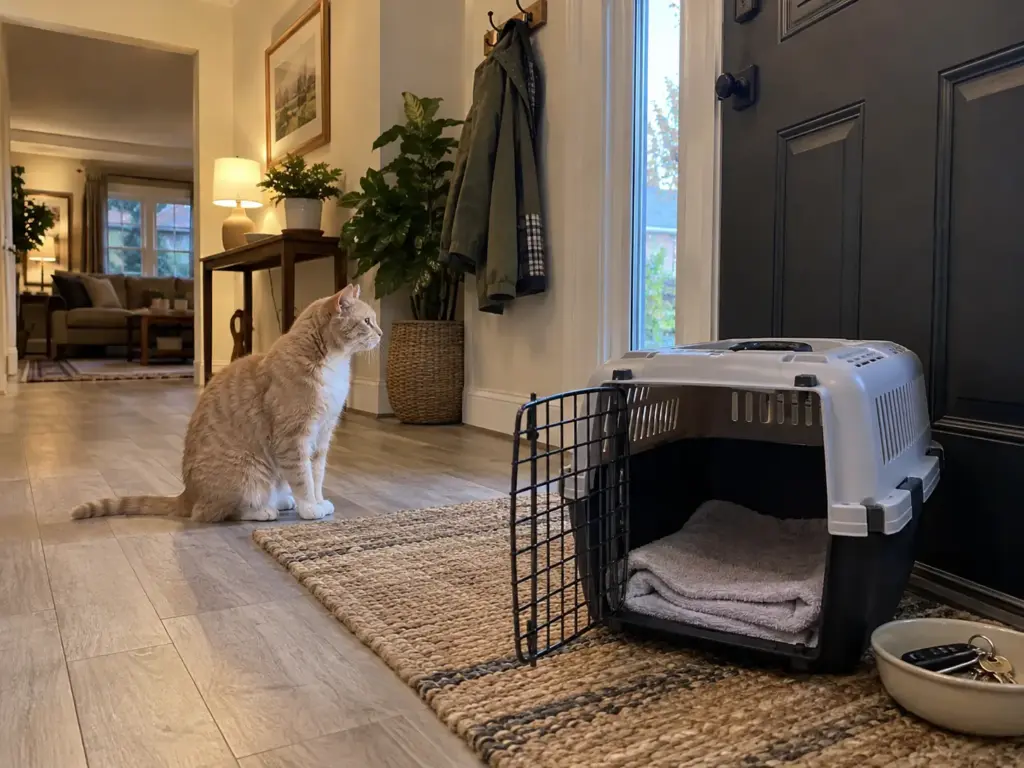
What counts as a change of habit
Three situations move the vet to the front of the line. A back that was clean and now has a patch of matted cat fur. A cat who has stopped washing a zone she reached before. Or a cat who stops grooming altogether.
Any of these comes ahead of every step in this article, including the cheap, easy ones that follow.
The brush can wait a day; the phone call is the first move. Shedding has its own version of this boundary, and when shedding itself is the sign draws it for the coat.
What to show a vet, in plain words
Describe, don’t interpret. Tell the clinic where the patch sits, since when you have noticed it, whether she still washes that area, and anything under the fur that looks different from the skin around it, such as a lump, a sore or fleas. Take a photo in daylight so the picture does the explaining.
Groomers add one more situation: if she does not start washing that area again once a mat is gone, bring that to the vet as a question, not as a guess. Arthritis and weight are the two things they say are worth asking about.
What this article leaves to the vet
Whether a lump, a sore or specks near the tail base are anything at all. Why a cat stops washing suddenly. Anything to put on her skin or in her food.
And what to do when urine or stool is caught in a mat, which is a same-day call to a vet or a groomer. None of that gets answered here, on purpose; the rest of the page is about the house.
Weight, Age and Stiffness Move the Back Out of Reach
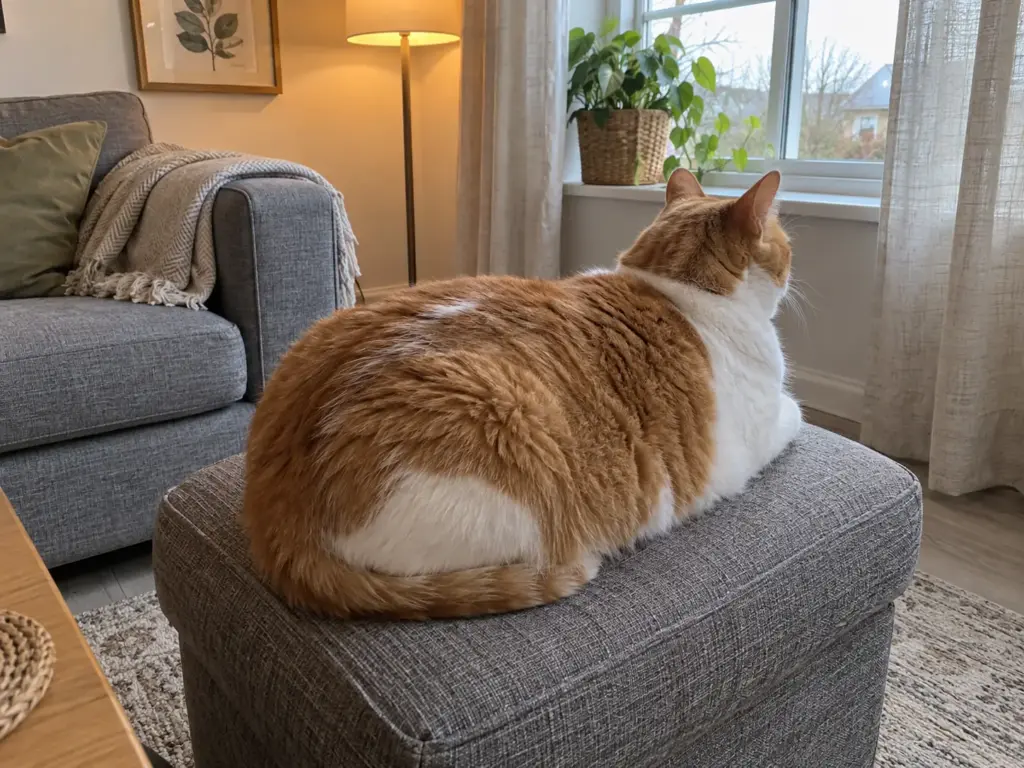
An owner on r/cats described a cat who worked out how to sneak into the cabinet where her food was kept. The weight came on, and with it, in the owner’s words, the cat “was unable to properly groom her lower backside and needed assistance.” Two changes arrived together, and the back was where one of them showed.
Extra weight shortens how far a cat can turn
According to VCA Animal Hospitals’ guide to mats on long-haired cats, “Obese cats often have difficulty reaching their hind end for grooming.” That fits the picture from the first section: the turn that gets her mouth to the lower back needs room, and an overweight cat has less of it. What she weighs and what she should weigh is a conversation for the vet’s scale, not a project for the house.
Age and stiff joints change the same reach
PetMD, writing about senior grooming, says older cats may find it physically harder to groom themselves, and that the first sign most often shows at the base of the tail and leads up the back. The order is worth noticing. It is the same reach map, just shrinking from the tail end inward, and a hard patch right at the tail base on an older cat is the one to mention at the next appointment.
The two stack in older cats
PetMD adds that senior cats are also prone to extra weight, which may further their difficulties in grooming. So the same cat can lose a little range to age and a little more to weight, and the back takes both. Neither is her fault, and neither is yours.
A reach check you can do at home
Watch her wash after a meal, when she is already settled. Does the twist carry her mouth up to the flank, or does the lick stop at the hip? The point is only to see where it stops. Bending is the same question in another room: how a cat’s posture changes at a raised bowl shows how much a cat folds and stretches just to eat.
Once a week, type a dated note into your phone: which part of her lower back she skipped while washing. A week-by-week note is what a vet can work with. An impression that she seems stiffer lately is not.
The Coat Sheds on a Schedule, and the Back Collects It
“But spring & fall – his undercoat really sheds,” one owner wrote on r/cats, and others in the same thread said mats follow when a cat “can’t keep up with coat shedding.” The undercoat is the soft layer under the longer top hairs, and seasonal shedding is when it comes loose in bulk. It has to leave somewhere, and on a cat who cannot reach her lower back, some of it stays.
Spring and fall, when the undercoat comes loose
Loose undercoat plus skin oil is the mixture. Groomer-to-Groomer compares fur that has lost its oil to Velcro, with hairs sticking together and gathering dirt and moisture, which makes matting worse. Spring and fall, when the undercoat blows, are the seasons owners point to, but indoor cats shed all year, not only in two seasons, so treat the seasons as the heavy weeks of a steady process rather than the only ones.
Long and dense coats against short ones
Long and dense coats collect the most, simply because there is more fur to tangle and more of it to keep clear. But short coats are not a safe harbor, and it is easy to get this backwards: short fur gives you less to see, so a hard patch may be easier to miss by eye. With a short-haired cat, feel for it.
What to touch first, before any tool
Use your fingers and your palm first, a couple of minutes a week, only on the lower back and the base of the tail. Slide against the fur and feel for anything that sticks together. Hands are the first tool for a reason: they find the patch while it is still loose enough to part, and they show you how she takes being touched there before a brush is involved.
If something will not part under your fingers, stop there. Harder strokes with a brush will not open a mat; they make the cat stop letting you near her back. A patch that already hangs together belongs to the removal guide, below.
One brush that reaches the surface she can’t
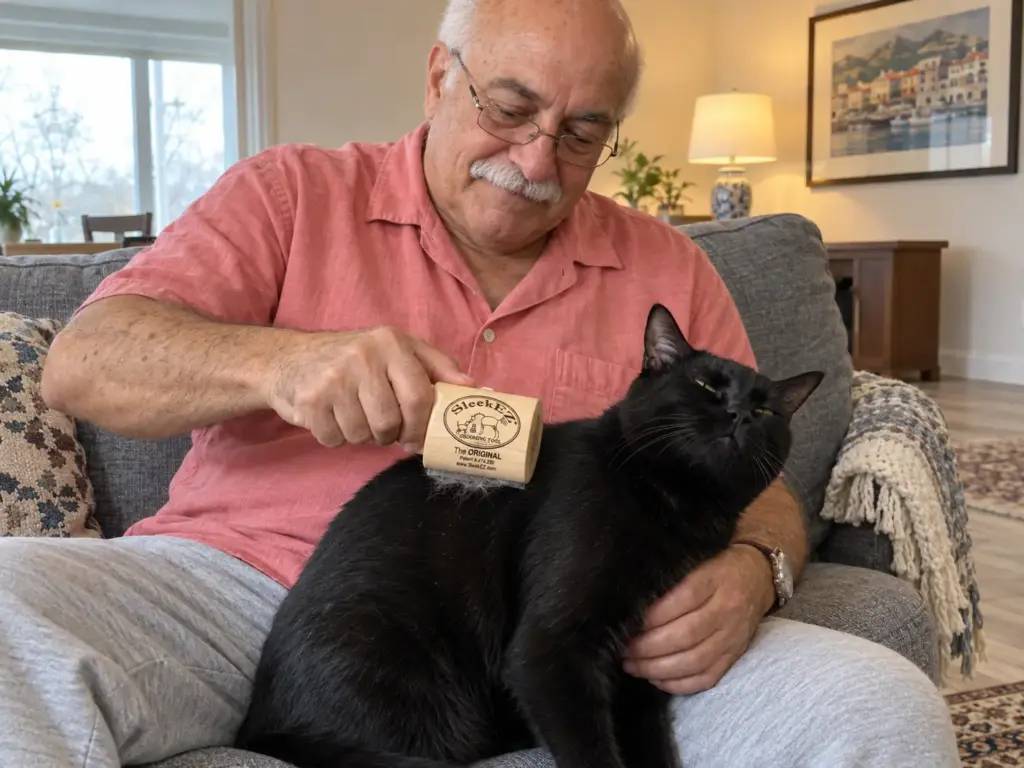
When the fingers find loose undercoat but no clump, a hand-held deshedding tool takes it off before it gets pressed into something harder. The SleekEZ Cat Brush for Shedding measures 5.5 x 3 x 1.5 inches, small enough to hold in one hand and pass over the lower back without a reach she lacks.
Owners on r/cats talk up the same kind of tool: “I use a deshedding comb and now my cat likes to be combed.” Its limit follows from what it is. It works the surface and the loose undercoat, and it will not open a mat that has already formed, so a clump goes to the removal guide.
For when a deshedding tool beats an ordinary brush, which tool pulls undercoat and which only smooths the top layer settles it by coat.
If you would rather spend less, the Mars Coat King Bristle Cat Hair Brush Deshedding Tool is the budget alternative to look at, though you should check the handle length on the listing before counting on it for the back.
What the Spot She Sleeps On Adds
Most people never think of the bed or the sofa corner as part of the cause. It is the one piece of the problem you can change in an afternoon, which is why it gets its own section, and why it is worth being straight about how little is measured. Two sources name the surface; nothing beyond that is established, and the rest is something you can test.
Pressure from lying down
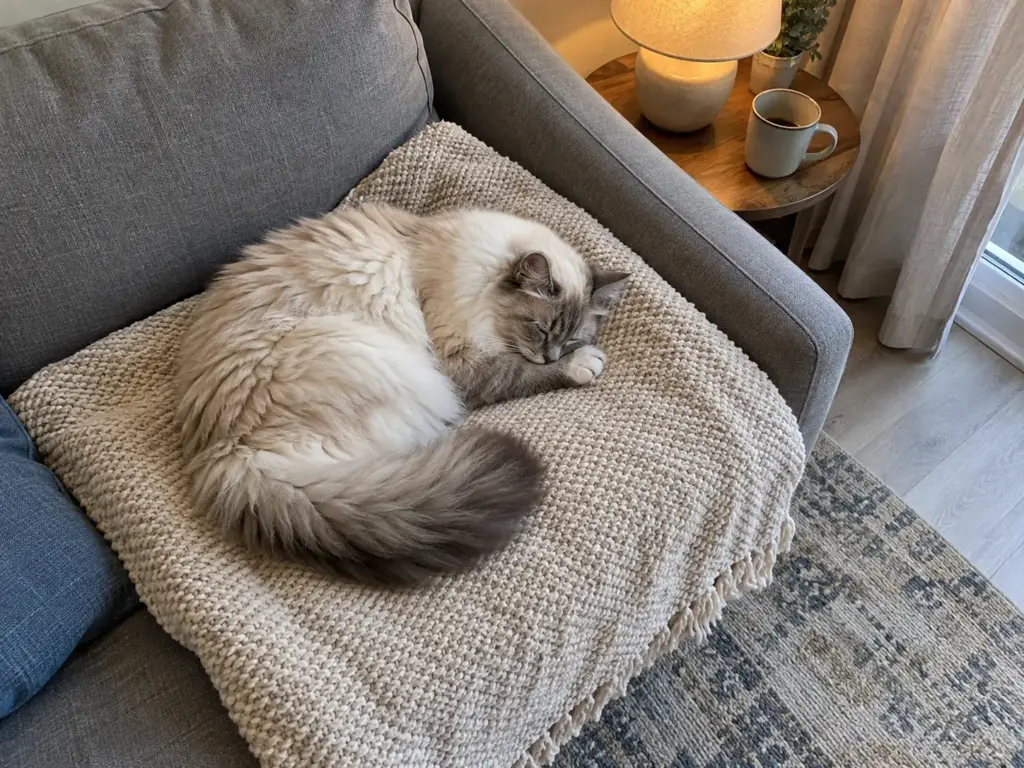
A cat resort’s grooming blog says mats can form on the back, shoulders and sides from the pressure of lying down. A cat who sleeps most of the day presses the same strip of fur flat against the same surface for hours, and loose undercoat and skin oil are right there to be pressed together. That is the plain mechanism, and it needs no special bed to explain it.
The carpet she rolls on
Groomer-to-Groomer points to areas where fur rubs as the cat moves or rolls around on the carpet. The spots that drag along the floor are the spots that felt first. Watch where she rolls on the rug or the sofa arm, and you will often find the patch is on the side that meets the surface.
No source says that one fabric causes mats and another does not, so this article will not rank materials. It just points you at the contact.
One cat or several: whose spot it is
With more than one cat, check each back in its own sleeping place, not all at once from the same spot. The cat who sleeps the most hours on the same rough surface gets looked at first. That is a routine, not a finding: it just sends your hands where the pressure is most likely to add up.
A washable layer on the spot she already uses
Start by leaving her spot where it is. She chose it for reasons that make sense to her, and moving it is the last thing to try, only if the surface itself is rough and she will take to another. Put a washable layer, such as a cotton blanket or a fitted cover, over the surface she already uses. Nothing gets drilled, nothing gets fixed to the wall (a rental will not notice it).
It also catches the hair that comes off her, and where the hair lands once it comes off is a short read for deciding how to wash it.
To see whether it helps, there is no number to borrow, so use your own: the palm pass from the first section, once a week, for three weeks. A patch that stops growing is your answer.
What to Change First, and Where the Comb-or-Shave Decision Gets Made
You know now why the back is the weak spot. Here is the order to work in, from the free steps up to the ones that need a different set of hands.
The order that costs nothing first
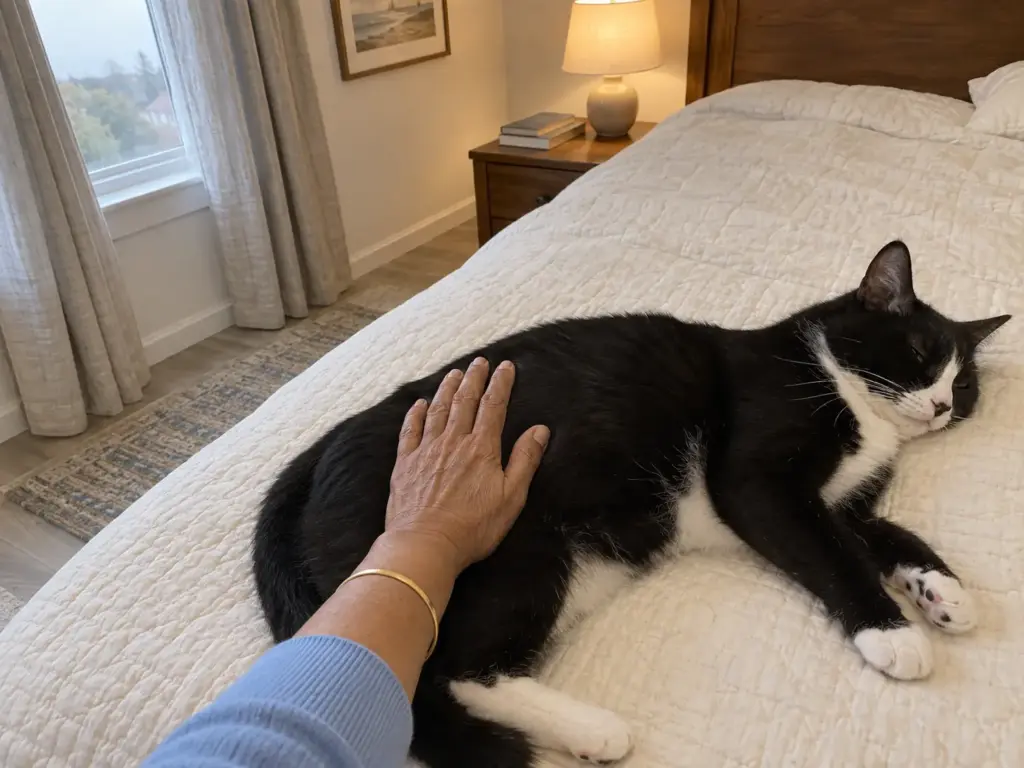
- Run the palm check and write down what you find, with the date.
- Put a washable layer on the spot she already uses.
- Add the hand-held deshedding tool for loose undercoat, if the fingers find any.
- Send a clump that has already formed to the removal guide.
How often the first step repeats depends on the coat; how often to brush by coat splits it for you.
A mat that already exists belongs to the removal guide
Groomers draw the line by size: a mat the size of a nickel or smaller is usually a combing job, and anything larger tends to be shaved. The steps for the smaller kind sit in removing a mat smaller than a nickel at home. This page stops short of the how-to. It is a different job, and it deserves its own page.
When the spot is on skin or the cat objects
If the clump sits right against the skin, or she will not let you near it, hand it over. The r/cats thread says it simply: a groomer or a technician at the vet’s office can take care of it. A cat who pulls away is also telling you something, and what a cat objects to when the brush comes out explains the usual reasons.
Palm Checks for Three Weeks Will Show Whether Anything Changed
Three things are worth keeping. The lower back is where a cat’s reach ends, and a mat there says nothing about how much she cares for herself. A back that was clean and no longer is goes to the vet before any change in the house. And what you can change at home comes in a fixed order: hands, washable layer, tool, then the removal guide for what is already formed.
By week three your palm pass will have run three times, the note on your phone will show whether the same zone keeps getting skipped, and the spot where she sleeps will have told you whether the layer made a difference. If the patch is bigger, harder or somewhere new, that is the signal to call the clinic, not to try a stronger brush.
Today, before you pick up any tool, run your palm against the grain from the base of her tail up the spine, and lay a clean cotton throw over the place she already sleeps. Both steps use what you already have, and the cat has nothing to learn.
Frequently Asked Questions
01Why does my cat keep getting matted fur on her back?
The lower back is the spot her tongue and paws reach worst, and it is also where each season’s loose undercoat settles. If the spot was clean before, ask your vet first.
02How can I treat matted cat fur on my back?
A mat smaller than a nickel can often be combed out at home, and the removal guide walks through it. A patch on the skin, or a cat who will not allow it, belongs with a groomer or a vet.
03Should I cut out my cat’s matted fur?
Usually not. Small mats get combed out, larger ones are usually shaved, and anything close to the skin is a job for a groomer or a vet. The removal guide covers where that line sits.
04Is a matted cat neglect?
No, a mat on the back shows where her reach ends, and her weight, her age and the season’s undercoat all feed into it. A cat who stops washing at all is a question for the vet.
05Why does my older cat have mats on his back when he never had them before?
A back that was clean and now is not is a change in the cat, not in the brush, so the vet comes before any change at home. Bring a dated photo and note where it sits.


Leave a comment