Do Robot Vacuums Handle Cat Hair? Only the Daily Drop
Do robot vacuums handle cat hair? A 5-minute tape-measure test shows what it picks up, what it skips and when the vacuum should stay on duty.

Alfredo RamsesFounder · Updated October 30, 2026 · 18 min read

On this page9 sections
- 1Do robot vacuums handle cat hair? What they take off the floor and what stays
- 2Clear the clumps first: the free step a robot cannot do
- 3The brush roll that wraps and the mop pad that lifts it off the carpet
- 4The reach test: will the robot fit under the bed and sofa where the hair sits?
- 5The verdict by load: one short-coated cat, several cats, a long coat
- 6The dock in a small apartment: bin size, the 60-day claim and the floor it takes
- 7What the robot costs you each week: upkeep and the run schedule
- 8Take the Daily Drop, Keep the Rug, Measure Before You Buy
- 9Frequently Asked Questions
Your cat sleeps where the hair ends up: under the bed frame, at the foot of the sofa, on the rug by the radiator, all low, warm and out of the way, which is why he chose them. A disc that sweeps the open floor on its own is an easy thing to want, and it is built for the part of the room he rarely uses. Spec sheets describe the floor a robot cleans, while the hair collects on the floor it cannot reach.
So, do robot vacuums handle cat hair? On hard floors, for the daily drop, yes, and the rest sorts out by surface, by load and by whether the robot fits under your furniture.
Quick Answer
A robot vacuum handles the daily drop of cat hair on hard floors and little beyond it. Rugs, clumps and the gap under beds and sofas stay with you, and with several cats or a long coat it is a supplement. What changes that is fit: it has to clear the furniture where the hair sits.
Do robot vacuums handle cat hair? What they take off the floor and what stays
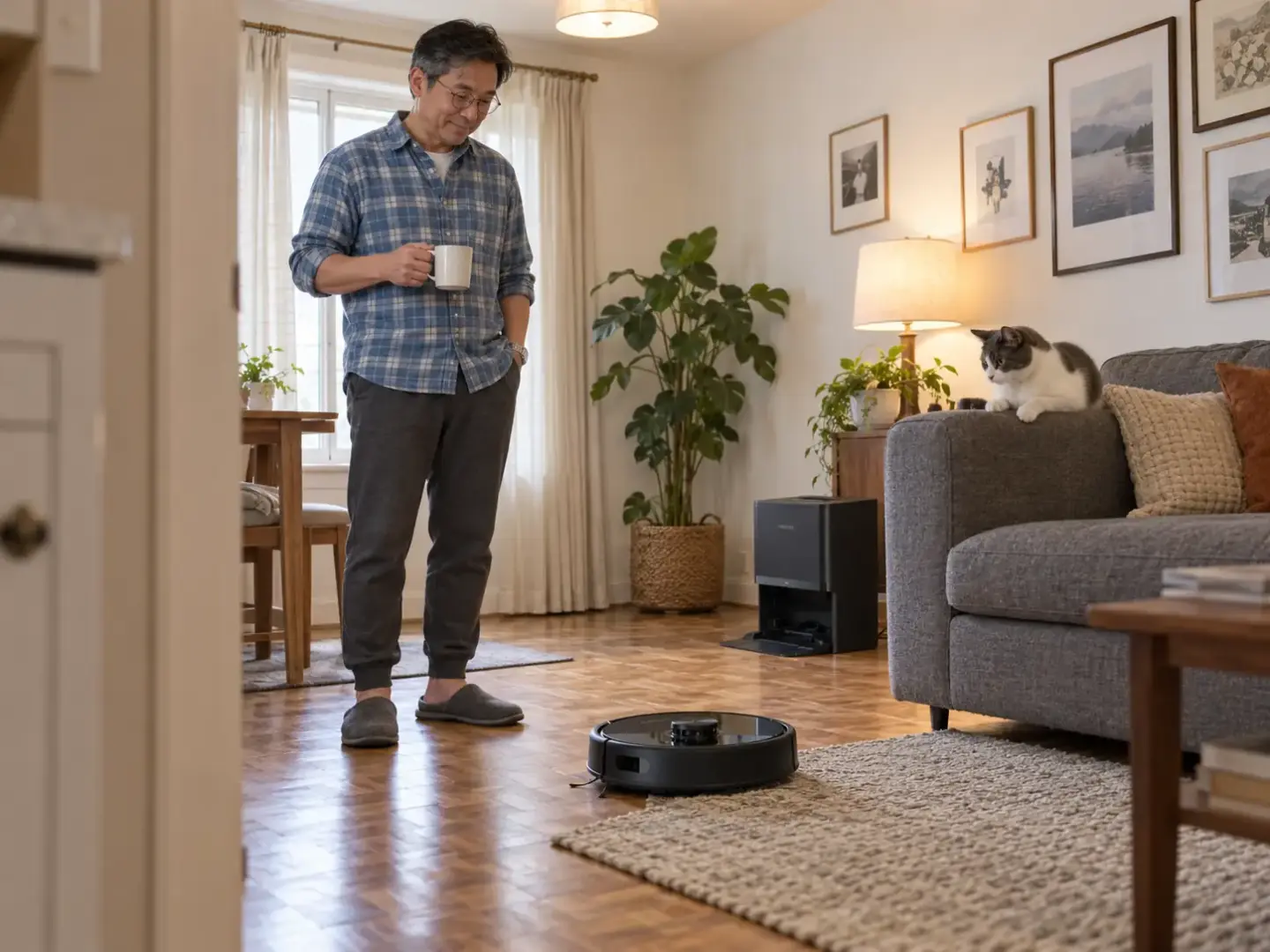
A robot vacuum is a daily routine on wheels, not a small deep cleaner, and that one distinction answers most of the question about robot vacuum cat hair. It lifts what landed on the surface since yesterday. What has worked into the weave of a rug, or sits in a corner a round machine cannot turn into, is still there on day seven, and day seven is when you judge it. His favorite napping spots are simply the places a flat disc handles worst, and that is a flaw of the machine’s shape, not of his habits.
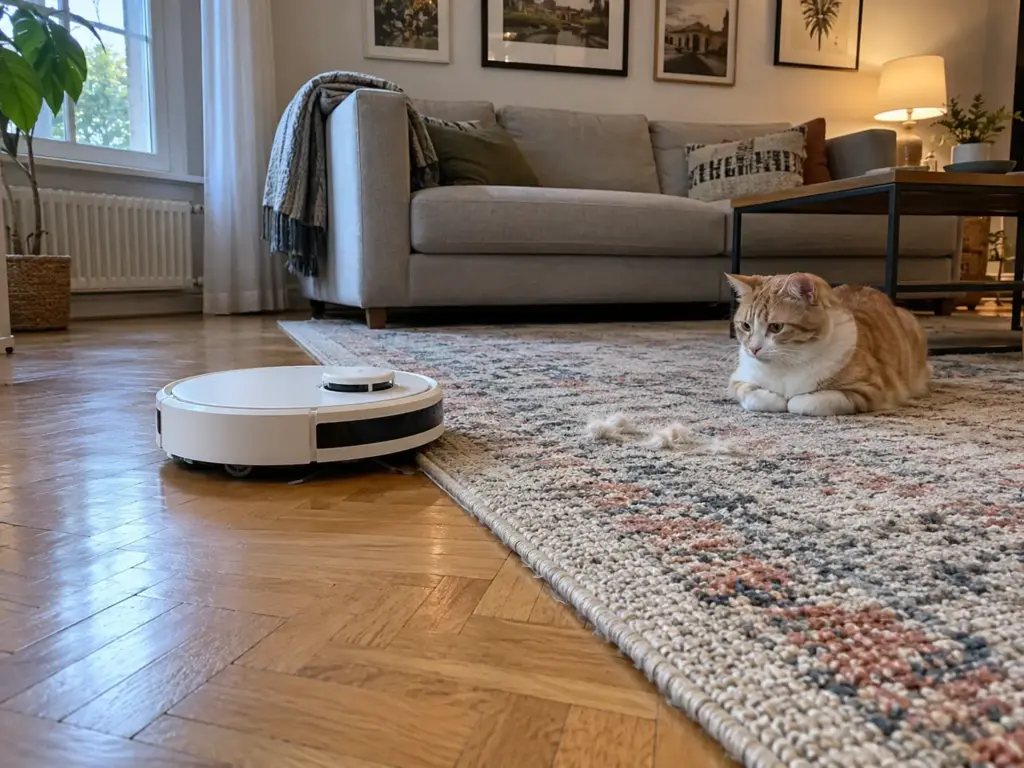
Testers set the bar in grams. According to Consumer Reports, “To test a vacuum’s ability to pick up pet hair, our technicians embed 1 gram of Maine coon cat fur into a medium-pile carpet.” They then weigh what the robot’s dustbin collected, which turns “picks up pet hair” into a number you can compare instead of a line on the box.
Hard floors: the daily drop
A smooth floor gives the brush roll nothing to hide in. Hair lies on the surface, the robot sweeps it into the bin, and the floor looks done. That is the job a robot does well, and it is why one cat on wood, vinyl or tile is the easy case.
Even there, a clean look is not a clean floor. RTINGS tested a rubber-roller robot and found it clears surface strands but “tends to leave behind a small amount of shorter hair.” Short hair that survives one pass is still on the floor for the next pass and the one after, so the result you see on day one is better than the result on day twenty unless something else picks up the leftovers.
Low-pile carpet: where the hair stays
Carpet pet hair pickup is where robots separate. RTINGS found the same rubber rolls do a satisfactory job on pet hair, but they “don’t work well removing pet hair embedded in carpet fibers.” Consumer Reports adds the two failures you will see on the rug yourself: some robots drag strands of hair around instead of suctioning them up, or the hair they do pick up gets stuck in the brushes.
Now put your cat on that rug. He lies in the same corner every day, so that corner gets a fresh layer of hair every day, pressed down by his weight and worked in by his kneading. A robot that crosses it once a day is skimming a spot that is rebuilding itself underneath.
Run a small version of the lab test before you decide anything. Press a pinch of hair from his brush into the edge of the rug where he sleeps, let the robot cross it once, then check the bin and press your palm over the spot. Hair that is still clinging to the fibers is the layer a robot will not reach.
What “handles” means after a week
Cat owners shopping for a robot ask the same questions in different words. One wanted a robot that would survive a roll tangled with cat hair, another with three long-haired cats asked how to schedule the runs, and a third was pleased about not waking up covered in cat hair every morning anymore. That last one is the realistic win: a lighter layer every day, not a hair-free house.
A fair definition of “handles” is short. A robot handles the daily layer on a hard floor, it lowers the load on the rug, and it runs while you are out. It is one of the four machines the vacuuming guide compares, and it shares the failures a vacuum has to get past on a cat-hair floor, only at a smaller scale and with a bin you cannot see into.
Clear the clumps first: the free step a robot cannot do
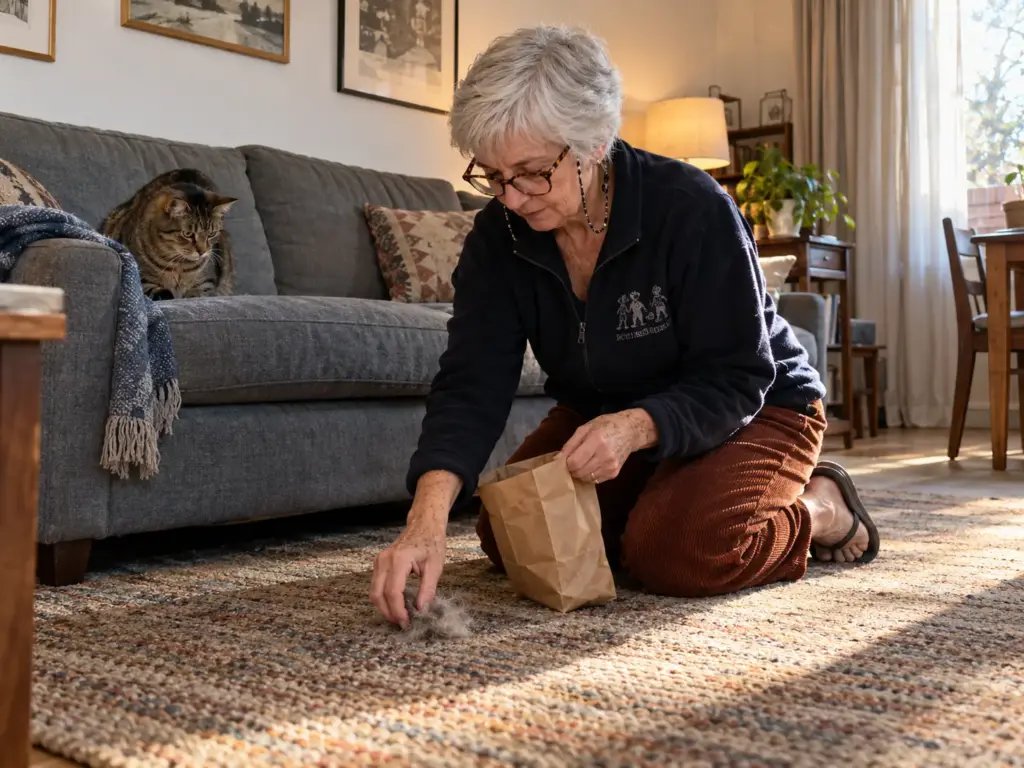
Your cat drops hair in the same place every day, because that is where he sleeps, and over a few days it stops being hair and becomes a clump. That clump is a bad deal for a robot. It is bigger than the intake wants to deal with, so the robot rides over it, pushes it ahead of the roll, or winds it around the roll and stops. The sensible rule is blunt: pick the clumps up by hand before the run, or spend the day emptying the bin and cutting hair off the roller.
Why the robot never sees the clump on the rug
A robot works from a map and a schedule, not from looking at your rug. It has no way of knowing that this corner is where the week’s hair collects, and no hands to lift a tuft out of the weave. The clump sits at the cat’s chosen spot, the robot arrives at its scheduled time, and the two never really meet.
That is also why the cat cannot be asked to change. His bed is where the warm patch is, and moving a bed to suit a machine is a preference of yours against a constraint of his. Work with where the hair lands.
A two-minute pass before the schedule runs
The free order is short, and it comes before any robot does its work. If you want the full version of it, the shedding guide covers fixing where the hair lands in more detail. For a robot household, it comes down to three steps.
- Put a washable layer on the spot he sleeps in, so most of the hair lands on something you can shake out or wash.
- Brush him on a schedule that suits his coat, because every brushful you collect is hair the robot never meets; the guide on how often to brush by coat sets the rhythm.
- Pick up the visible clumps at the rug edge and run a light vacuum or roller over the spot before the robot’s turn.
With one cat that is a quick pass. With several cats there are more sleeping spots and more clumps, so the pass takes longer and covers more of the room. It is still the cheapest improvement on the page, and it makes every robot on the market work better.
The brush roll that wraps and the mop pad that lifts it off the carpet
You buy the robot with the biggest suction figure, and a week later it is stopped in the hallway with a roll wrapped in hair. This is the most common disappointment with robot vacuum pet hair, and it comes from two parts of the machine that sit below the spec sheet: the roller and, on mop combos, the pad.
Rubber, bristle or split: what each does to cat hair
Rollers fall into three families. Bristle and split rolls have gaps and ends that hair winds around; rubber rolls have far fewer places for a strand to catch. Makers sell the rubber and split designs as an anti-tangle roller, so check what the roll is made of rather than the label. RTINGS finds split rollers do worse on pet hair than rubber ones, though rubber still falls short on hair embedded in carpet, as noted above.
The obvious pick is the strongest motor, and for cat hair the roll comes first. Suction is the loudest number on the box, and a roll that wraps stops the machine however strong the motor is. Consumer Reports ties the robots that score well to a turbo or booster mode, so a boost setting on the spec sheet is worth looking for, but treat it as a second filter after the roller design.
Why a mop combo can leave embedded hair behind
A mop combo carries a wet pad, and the pad must stay clear of the carpet. Reviewers who test combos report that the brush sits higher to keep the pad off the floor, which means the brush works the surface of a rug less aggressively and embedded hair stays put. On a hard floor that does not matter. On the rug where your cat sleeps, it matters a lot.
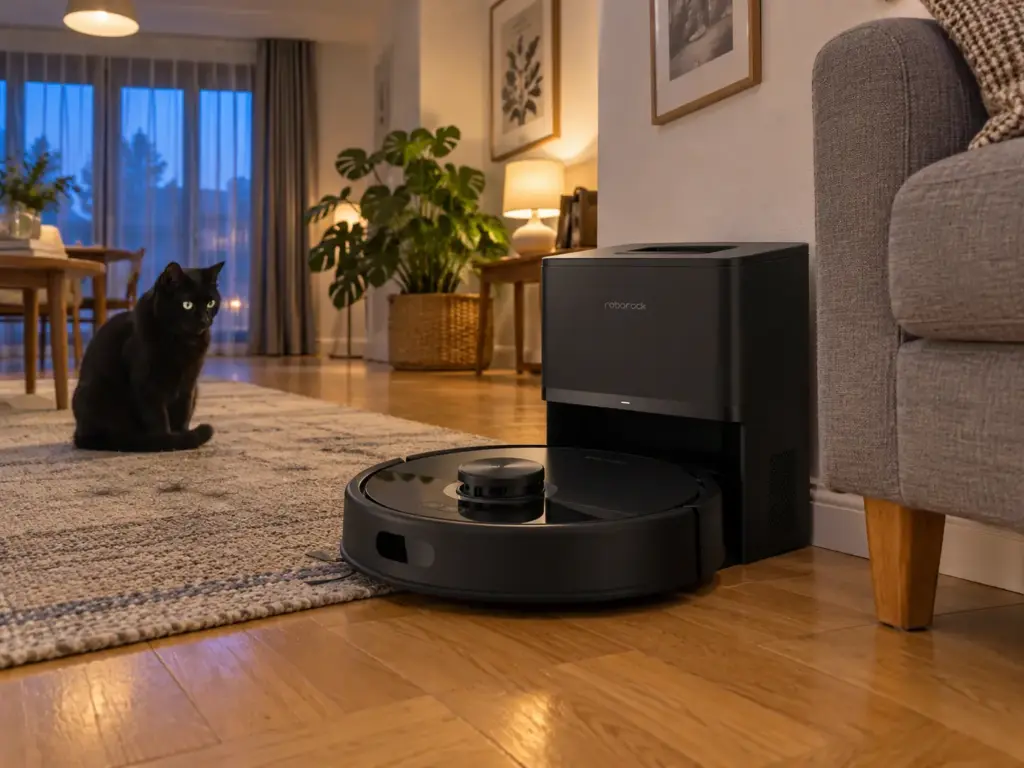
A robot like the Roborock Q7 M5+ shows the type: the listing sells it as a vacuum and mop with a dual anti-tangle system for pet hair and carpet, with 10,000 Pa of suction and a 7 to 9 week self-empty window as its headline numbers. Those are the maker’s figures, and the listing’s spec sheet is also where to read its height before it goes anywhere near your bed. Specialist press puts typical robot suction at 2,000 to 3,000 Pa, so 10,000 is a big number, and it still will not tell you how the roll behaves on a rug.
On a mop combo, keep the pad off any carpet where the hair collects. If the machine cannot lift or remove the pad for a carpet run, treat that rug as the vacuum’s job and send the robot only across the hard floor.
The reach test: will the robot fit under the bed and sofa where the hair sits?
The hair falls where the cat is, and the cat is under the bed, behind the sofa, or curled around the base of his tree. Those are the places with the least clearance in the room, so they are exactly the places a thick robot cannot enter. Before you buy one, you can run an under-furniture clearance test in about five minutes with a tape measure, and no reviewer will run it for you because they do not know your furniture.

Measure the gap, then the robot
Measure the free height under the bed and under the sofa where he likes to lie, then compare it with the height printed on the robot’s spec sheet. Leave a margin: one maker’s guidance is that the clearance should exceed the robot’s height by about 5 mm, a quarter of an inch. If the gap is smaller than the robot plus that margin, the robot will bump the frame and clean around the edge of the space instead of through it, and that space is where the hair is.
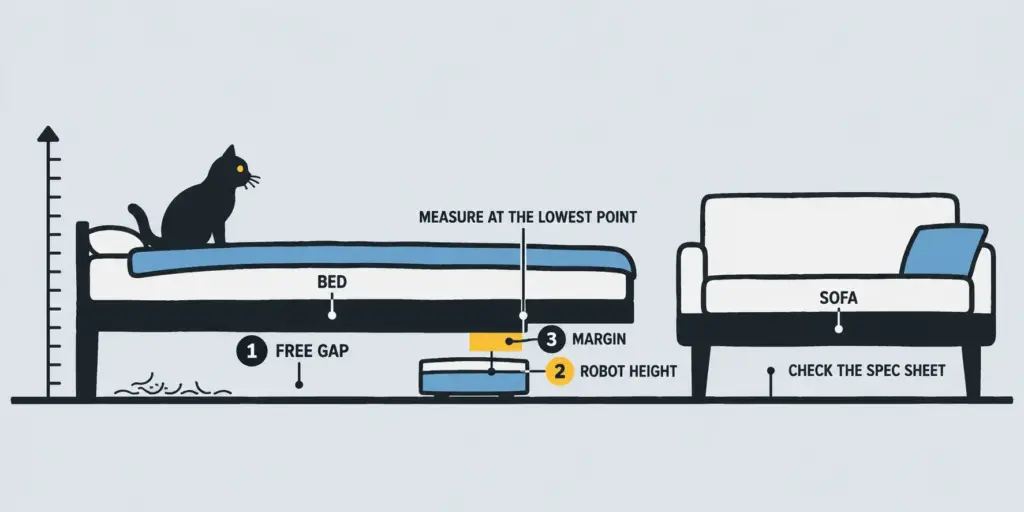
Do the same at the other places he sleeps. A radiator shelf, a window bench and the gap under a console table are all part of the map, and each one may be a “no” for a robot that clears the sofa easily.
Measure the gap at its lowest point, usually a side rail, a slat or a leg crossbar, not in the open middle. The robot has to pass the lowest point to reach the middle.
Rug fringe, cords and the cat tree base
Height is only one way to fail. RTINGS notes that a robot of this class can bump into tasseled rugs with some regularity and may even get stuck, and that the area around cables may need cleaning by hand. Rug fringe, charger cords and the heavy base plate of a cat tree are the spots where a robot stops, turns around or jams, and they are also where his hair tends to settle, because he sits next to them.
Obstacle avoidance, where a robot has it, helps with a stray cord, but it is no substitute for clearing them. So the second pass of the reach test is a walk around the room at robot height. Tuck the cords, fold the fringe under or pick a rug without it, and see what is left at the foot of the cat tree. Whatever the robot cannot get to is yours to clean by hand.
What no robot reaches: corners, stairs and the sofa itself
Most robots are round, and a round machine cannot get into a square corner, so a strip of hair in corners and along the wall edge is normal. They do not climb stairs, and they do not clean the sofa where he sleeps: hair on the cushions, in the seams and under the cushions is a handheld job. When a robot leaves hair behind it is rarely a defect; it is the limit of the shape.
For those edges and corners, which fixes gather hair and which only move it is worth a read, because a robot that pushes hair into a corner is one of the fixes that only moves it. Plan on a short manual pass along the edges every week, in addition to the robot.
The verdict by load: one short-coated cat, several cats, a long coat
“Run it daily” means nothing until you know how much hair is coming in. One cat with a dense short coat on a hard floor is one situation. Several cats, or a long coat, are another, and a rug in the middle of the room changes both. The verdict below is the rule this blog works by, not a measured figure, and it follows the load.

One cat with a short coat on hard floors
This is the case where a robot earns its place. One short-coated cat on a hard floor drops a modest amount of hair, mostly on the surface, and a daily pass takes it before it can collect into clumps. The robot does the routine and you do the edges, so this is the one home where the robot can take over the daily drop outright.
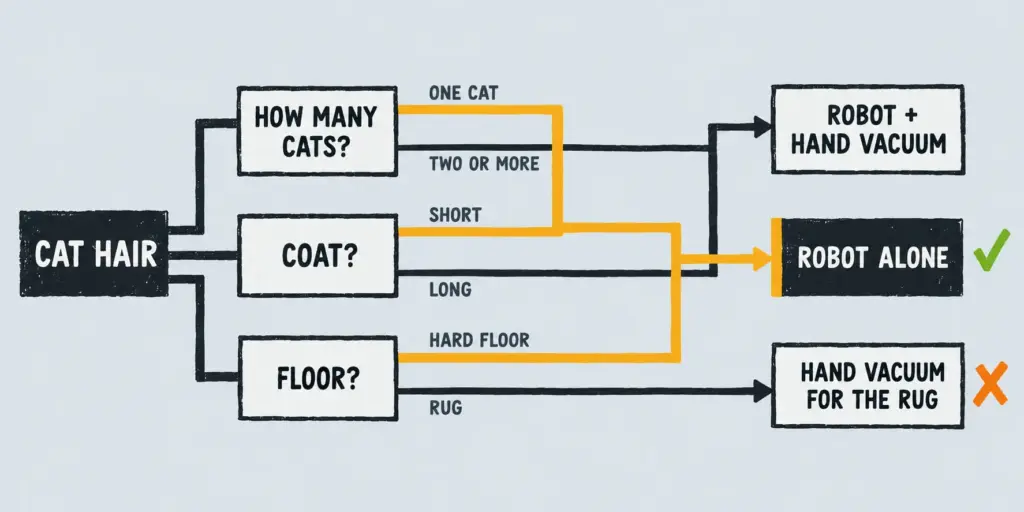
Even here, a single rug can flip the verdict. A home with one short-coated cat and a hard floor everywhere except one big rug in the middle is a robot home that still needs a vacuum for that rug, and the rug is probably where he sleeps.
Two or more cats, or a long coat
In a multi-cat home there are more sleeping spots and more hair, and a long coat means more volume per cat. The coat sets the load in a plain way: a long-coated Maine Coon and a dense short-coated British Shorthair under one roof are two different loads. The robot copes with the short coat and starts to struggle with the long one.
In these homes the robot is a supplement. It still earns its place on the hard floor between vacuuming days, but the bin fills sooner, the roll tangles sooner, and the rug and the furniture stay with the vacuum. The maker’s 60-day figure for a robot’s base is for an average load, so with several cats expect it to fill earlier than that.
One boundary belongs here. If the amount of hair in the house suddenly changes, that is a question for the vet, not a reason to buy or swap a robot, and why a hair count can mislead is a separate question. After the vet has seen him, come back to the floor.
A rug in the middle of the room
A rug is where the verdict turns. A robot skims it, the hair embedded in it stays, and the cat who sleeps on it keeps adding more. Of the three situations, the rug is the one where the vacuum still does the job. Put the three loads side by side and the pattern is simple.
- One short-coated cat on hard floors: the robot takes the daily drop, and you do the edges.
- Several cats or a long coat: the robot is a supplement, and the vacuum stays on duty.
- A rug where he sleeps: the vacuum does the rug, whatever else the robot does.
The dock in a small apartment: bin size, the 60-day claim and the floor it takes
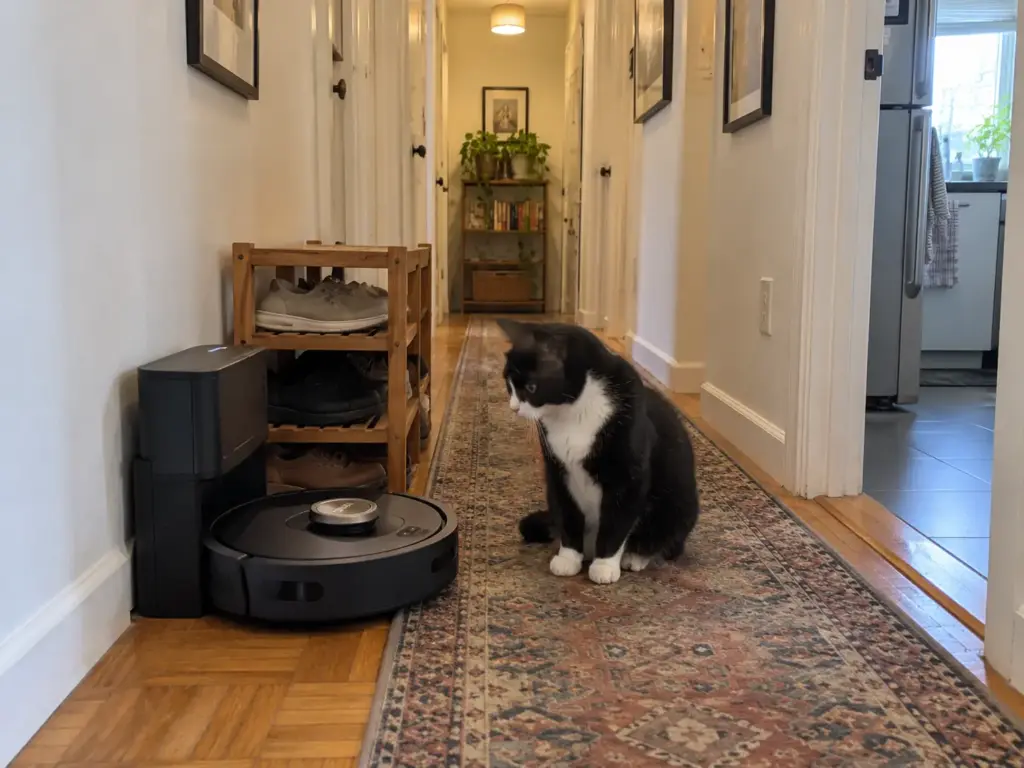
The robot has a small dust bin, and the self-emptying dock is the part that does the work. The dock is also a box that sits on your floor and against your wall, and in a small apartment its footprint is the part you notice every day. A robot you cannot park is a robot you will stop using.
A bin the size of a mug against a week of hair
Specialist press puts a typical robot bin capacity at about 0.3 to 0.5 liters, roughly a mug, and a typical base at 2 to 4 liters. That is the sector’s general range, not a figure for any one model. A bin that size works for a light daily layer and fills quickly when a long-coated cat sheds, and a robot with a full bin simply stops collecting.
The base is what changes that. A self-emptying base moves the hair from the robot’s mug-sized bin into a larger bag or tank, so you empty it every few weeks instead of every day. The “60 days” on the box is the maker’s number for an average load, which tells you the base is large and tells you nothing about your house. Watch the first week to see how fast yours fills.
What a self-emptying base asks of a small apartment
A base needs a free stretch of wall, open floor in front for the robot to return to, and an outlet within reach. In a small apartment that is the part that does not fit. Find the spot before you buy, and borrow the renter’s fit check for closet and stairs, which applies to the space you have to leave for any machine.
A model like the Shark AV2501AE shows the type: it is sold with an XL HEPA self-empty base that the listing rates for 60 days. That figure is the maker’s, and the base dimensions are on the spec sheet, so measure your own floor against them before you decide. If your load is small, a robot without a base and a quick tip of the bin each day is a fair arrangement, and it leaves your wall free.
What the robot costs you each week: upkeep and the run schedule
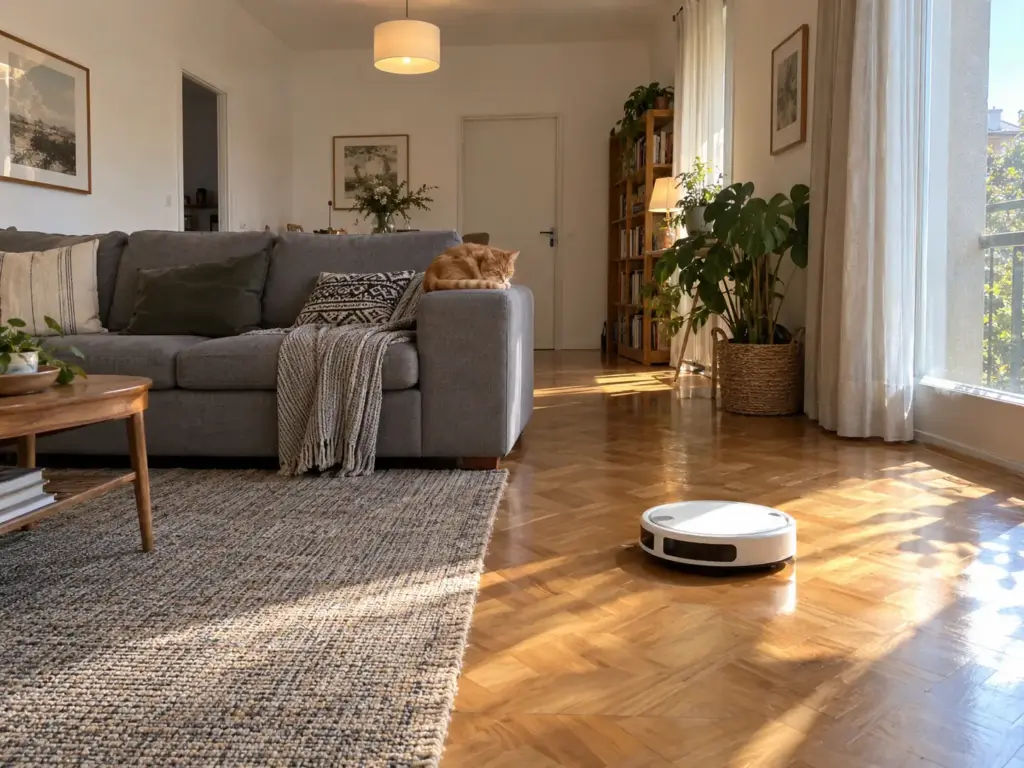
“Hands-free” lasts until the first tangle. The work does not disappear with a robot, it moves from pushing a vacuum to tending a machine, and the tending is smaller but regular. Count the minutes before you buy one.
The weekly chores a robot does not skip
RTINGS gives the schedule for a robot of this class: clear hair from the brush roll and the exhaust filter once or twice a week, and the front wheel every two weeks. Rubber rolls need replacing every six to twelve months, and the exhaust filter every two months. For a long-coated cat the roll may need the upper end of that range, or more, and the first week of daily checks will tell you where your house sits.
None of this is the cat’s fault. Hair wraps on a roll because that is what hair does around a spinning cylinder, and cutting it free is part of owning one. Keep a pair of small scissors where the dock lives.
When to run it, and what to keep it out of
Time the scheduled run for when the cat is out of the zone or asleep elsewhere, so the machine moves through an empty room and he does not have to share it. Set no-go zones around the food and water bowls and around the litter box, where litter kicked out of the box gets dragged across the floor.
For the first week, look at the bin and the roll every day. You will learn the real load of your house faster than any spec sheet can tell you, and you can set the schedule from what you see. With more cats, expect more runs.
Take the Daily Drop, Keep the Rug, Measure Before You Buy
Three things decide whether a robot works for your house. It takes the daily drop on a hard floor, and nothing more. The rug, the clumps and the gap under your furniture stay yours. And the measuring comes before the buying: a robot that does not fit under the bed he sleeps beneath cannot clean it.
By the third week, look at the bin and the roll and compare them with the first few days. If the bin is much fuller than you expected, or the roll is wrapped every time you look, the load is bigger than the robot’s role, and the vacuum should take back part of the job. If both look fine, the arrangement is working.
Today, you can start without buying anything. Pick the clumps off the edge of the rug where he sleeps, and measure the free gap under your bed with a tape at its lowest point. Write the number on the back of your hand or in your phone, because it is the one figure you will need on the spec sheet.
Frequently Asked Questions
01What kind of vacuum is best for removing cat hair?
The best vacuum depends on the surface: a robot covers hard floors every day, while rugs, clumps and furniture need a regular or handheld vacuum. Use the robot for the daily layer and the vacuum for everything it cannot reach.
02What are the downsides of using a robotic vacuum cleaner?
The main downsides are limited reach under furniture, a small bin, hair wrapping on the roll and weekly upkeep. Rug fringe and cords can also jam it, and it does not climb stairs or clean the sofa.
03Which robot vacuum is best for cat hair?
No single robot is best for every home, so pick one that fits under your furniture, has a roll that resists wrapping and a dock that fits your wall. The two models in this guide are examples of the type, not a ranking.
04What is the best vacuum for picking up cat hair?
There is no single best machine, because the answer is a combination: a robot for the daily drop on hard floors and a regular or handheld vacuum for rugs and furniture. The vacuuming guide compares the four types.


Leave a comment