Are Elevated Bowls Good for Cats? Not All of Them
Find out in one week whether a raised bowl does anything for your cat, using two books you already own [and keep your money if it doesn't].

Alfredo RamsesFounder · September 7, 2026 · 18 min read


On this page8 sections
- 1What Changes When the Bowl Comes Up Off the Floor
- 2When This Is a Vet Conversation, Not a Bowl Decision
- 3The Cats It Actually Helps, and the Ones It Does Nothing For
- 4Test It With What Is Already in the Kitchen
- 5One Raised Station Does Not Work for Three Cats
- 6What a Well-Made Elevated Bowl Gets Right
- 7The Short Version
- 8Frequently Asked Questions
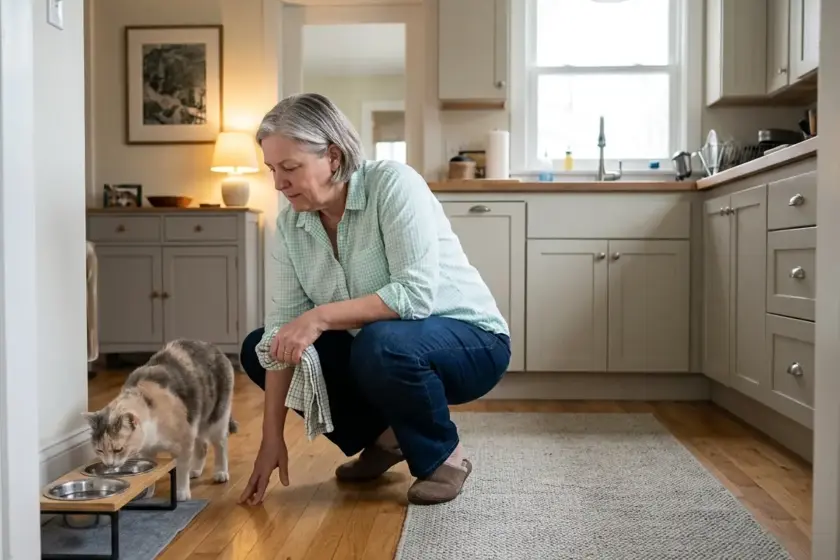
He eats sideways now. Turns his head, takes food from the corner of his mouth, backs off the full bowl, comes back a minute later and does it again, and everybody in the house has quietly filed this under he’s gotten picky in his old age. He isn’t picky. He is avoiding a position, and the food has nothing to do with it.
So the honest answer to are elevated bowls good for cats is that they are good for a specific problem, and the whole question is whether your cat has that problem. Here is what the height actually changes, which cats it changes it for, and how to find out at home before you spend anything.
Quick Answer
For older cats, cats with stiff joints, and cats who bring food back up soon after eating, raising the bowl to elbow height changes something real. For a healthy young cat, crouching to eat is a normal posture that does no harm, and a raised bowl adds nothing. Stack two books under the bowl you own and watch for a week before you buy one.
What Changes When the Bowl Comes Up Off the Floor
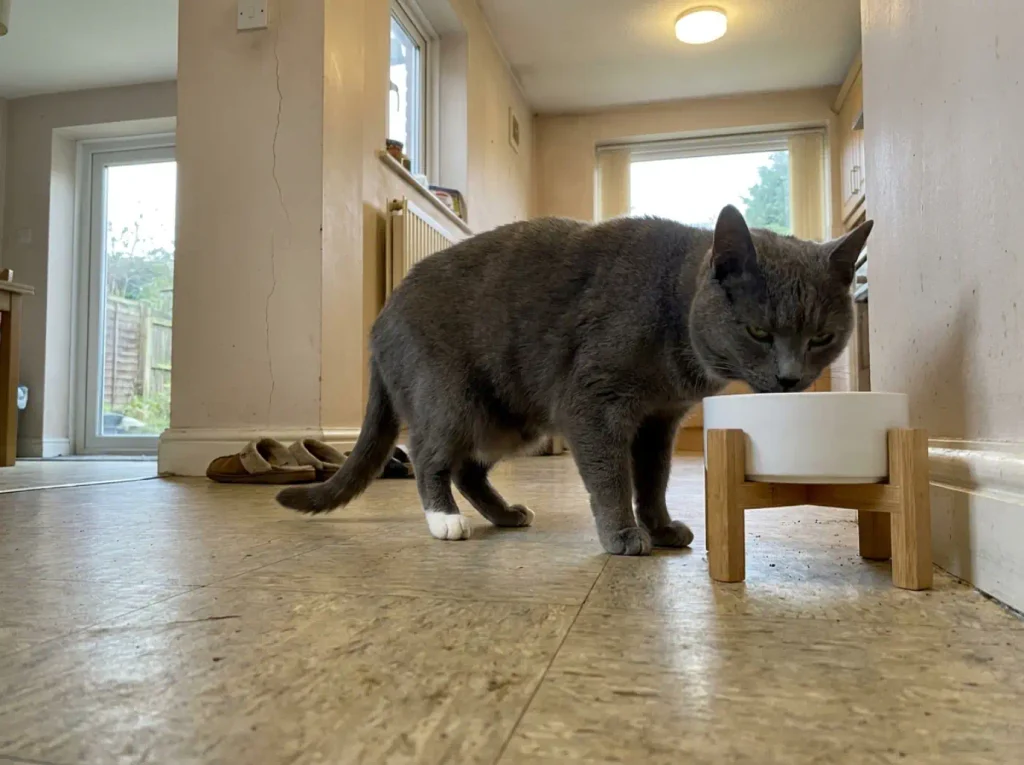
Watch your cat eat from a floor bowl for thirty seconds and you will see the thing nobody photographs. The head goes down and stays down. Not a dip, not a gesture: the neck holds a downward fold for the entire meal, which for a cat working through a full portion of wet food is a couple of unbroken minutes in one position. That is the actual failure mode of a floor bowl, and it is the part every source in the search results skips on its way to the benefits list.
Raise the dish and that fold gets shallower. The head and neck sit closer to the alignment the cat already holds standing up, so the same meal costs less sustained bend and less joint strain through the neck and shoulders. That is the entire mechanism, and it is worth saying plainly because the category gets sold as a general upgrade when it is the solution to one narrow geometry problem. A cat without that problem gets nothing out of solving it, which is why the pillar guide on this topic says the same thing across a wider frame: elevated bowls help some cats and not others, and the split is not close.
The Neck Angle Nobody Photographs
Product photos always show the cat mid-bite with its head level, standing square at a raised dish, and that image is doing quiet persuasive work. Nobody sells the before shot. Go take it yourself with your phone, at floor level, from a few feet back while he eats. You will see how far the head actually drops and, more usefully, whether it stays there or keeps lifting between mouthfuls.
A cat who lifts his head every few bites is resetting something. That reset is free information and it is sitting on your kitchen floor right now.
Elbow Height, Not a Number Off the Box
The measurement people reach for is a number printed on a listing, and it is the wrong number because it was chosen for an average cat who does not live in your apartment. The line you want comes off your own cat: stand him naturally on all fours and find where the front leg meets the body. That is the height the surface of the food is aiming for, not the top of the stand and not the rim.
For most adults that lands somewhere between three and six inches of lift, with small cats and kittens at the low end and big long-bodied cats at the high end. That range is the supporting fact here, not the section. The full method, the failure mode of going too tall, and what to do with bowl depth belong to the height article, and this one is not going to relitigate them.
The Second Thing Height Does: The Swallow
There is a second mechanism riding along with the first, and it is separate. Raising the bowl puts the esophagus on a straighter line toward the stomach, so gravity does a little more of the work of moving food down. For cats who bring food back up shortly after eating, undigested, that geometry is the reason some of them do better at a raised dish. It is a physical path, not a vague improvement in digestion.
That difference matters, because the vague version implies the bowl is doing something medical. It isn’t.
Find the line on the cat you already have, not on a product page. Stand him on all fours and look at where the front leg meets his chest. That line is where the food surface wants to be, which means a deep dish on a correctly measured stand puts the food right back down where it started. Measure to the food, never to the furniture.
When This Is a Vet Conversation, Not a Bowl Decision
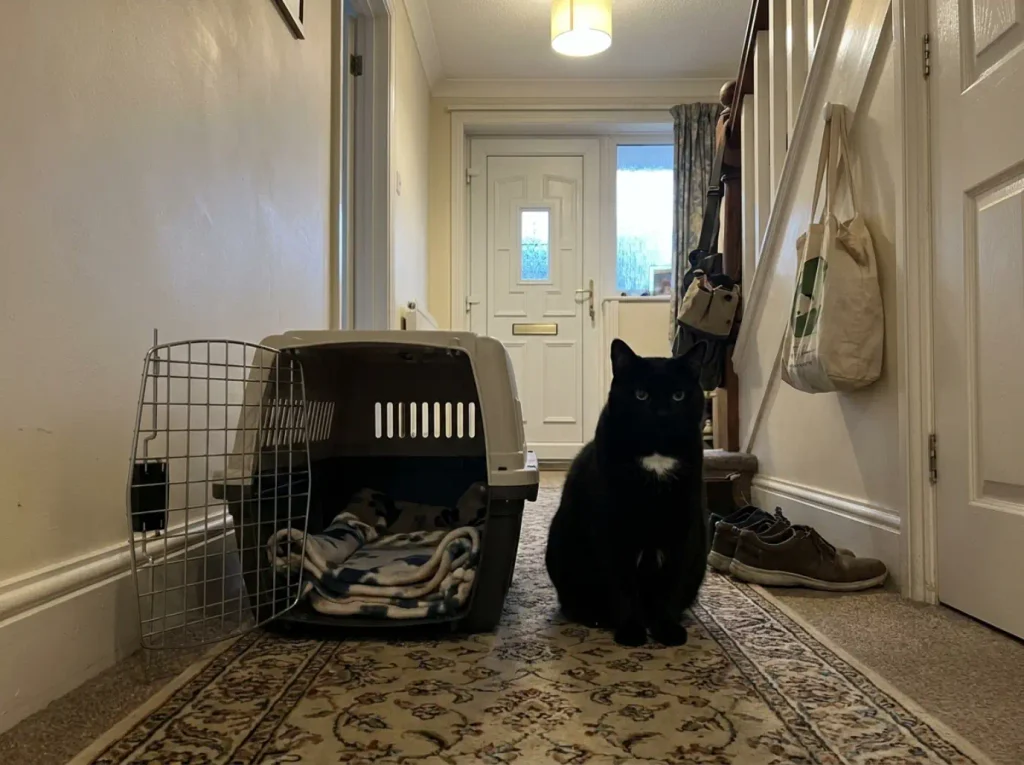
Some readers land on this page because of vomiting after eating and somewhere along the way they read that a raised bowl fixes it. That deserves a straight answer this early, before anyone buys anything believing they are buying a cure: repeated vomiting or regurgitation, trouble swallowing, going off food, or losing weight is a vet appointment. It is not a shopping decision, and nothing on this page substitutes for it. Cornell’s Feline Health Center on feeding your cat treats feeding as part of overall health for exactly this reason, and once symptoms are in the picture the routine belongs to whoever examined the animal.
An elevated bowl is a comfort adjustment. It changes a posture and it changes an angle. It does not treat, prevent, or cure a diagnosed condition, and any page that implies otherwise is selling you a stand.
What “He Doesn’t Limp” Does Not Prove
Here is the number worth carrying out of this section. Up to 90% of cats over twelve show radiographic evidence of degenerative joint disease — arthritis in cats, in the plain word for it — and a large share of them never visibly limp. Cats are extremely good at hiding it, and the way it usually surfaces is not a limp at all. It is a cat who stopped jumping onto the counter, or a cat who started eating sideways.
So “he doesn’t limp” is not evidence that a crouch is comfortable for him. It is evidence that you have not seen him limp. Those are different facts, and only one of them is about the cat. That is a conversation for a vet who can put hands on him, not a conclusion to draw from the kitchen doorway.
The Fast Eater the Height Does Not Help
This is the disappointment that comes up most often, and it is worth naming because it is the single most common reason someone decides elevated bowls are nonsense. A cat inhales his food and brings it straight back up. Somebody buys a raised bowl. Nothing improves, and in some cases it gets slightly worse, because a cat gulping at speed swallows air whichever height the dish sits at, and raising it does not slow anybody down.
That is a slow feeder problem, not a height problem, and the two get confused constantly.
Elevation fixes a posture problem. Wolfing is a speed problem. They look similar from the outside because both end with food on the rug, and conflating them is how a perfectly good bowl gets blamed for not solving something it was never shaped to touch. If the speed is the issue, the shape of the dish is the lever, not its height.
The Cats It Actually Helps, and the Ones It Does Nothing For
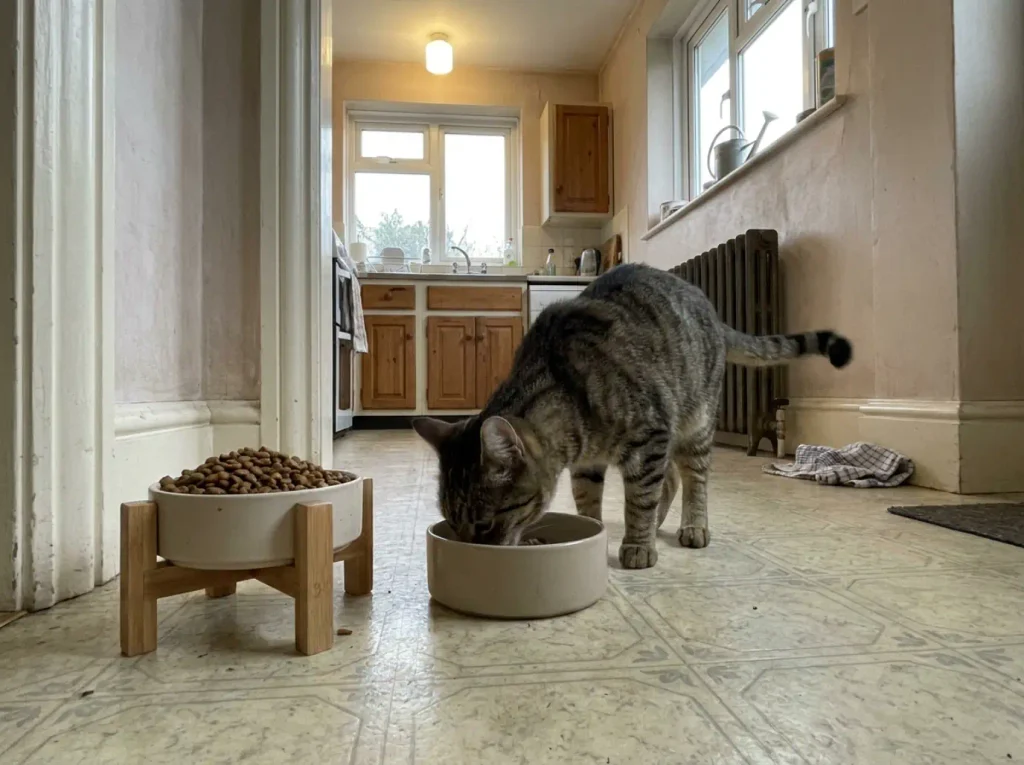
Every page in the search results ends up at “it depends on the cat” and then stops, which is where the reader was standing when they started. The useful version is a filter, so here it is.
Height changes something for a senior cat, for a cat with known stiffness getting up, for a cat who regurgitates soon after eating once a vet has already looked at him, and for a big long-necked cat whose crouch is a longer way down than an average one. Those are the four groups. Everybody else is buying furniture.
The Cats Where Height Changes Something
The clearest case is senior cat feeding, where the change came on slowly enough that nobody dated it. This is the story that repeats constantly in cat communities and it always arrives in the same shape: a cat who “got fussy,” a rotation of new flavors that each worked for a few days, and then someone raised the dish and the fussiness went away. She wasn’t fussy. She had been hiding discomfort in the only way available to her, which is to eat less of the thing that hurt to reach.
Big cats belong here for a completely different reason, which is arithmetic. A large Maine Coon at full standing height has further to fold than a compact cat does, so the same floor bowl asks more of him per meal. Long body, long neck, longer way down.
The Healthy Young Cat Who Ignores It
And then there is the outcome that should be the default expectation. You raise the bowl, and a healthy three-year-old walks over, eats exactly as he did before, and demonstrates no opinion whatsoever. For that cat, crouching is a normal feeding posture that does him no harm at all, and the raised dish is a new piece of kitchen furniture rather than an improvement.
Some of them go further and go back to eating off the floor beside it. That is not stubbornness and it is not a rejection of your good idea. He didn’t have the problem, so he has no use for the solution, and the honest read of that week is that you just got your answer for free.
What to Watch at the Bowl He Already Has
Three things, and they are all about the cat rather than the dish. Does he eat sideways, taking food from the corner of his mouth instead of square on? Does he back off a full bowl and return to it two or three times to finish a portion he used to finish in one go? Is there food scattered on the floor around a bowl he used to eat cleanly from?
None of those is proof on its own. Together they describe a cat working around something, and the bowl is the cheapest thing in that picture to change.
Watch the meal, not the bowl. A cat who eats sideways, pushes food out onto the floor, or works through a portion in two or three short shifts is telling you something about posture or about how wide the dish is. A cat who puts his head in and eats it straight through is telling you nothing needs fixing.
Test It With What Is Already in the Kitchen
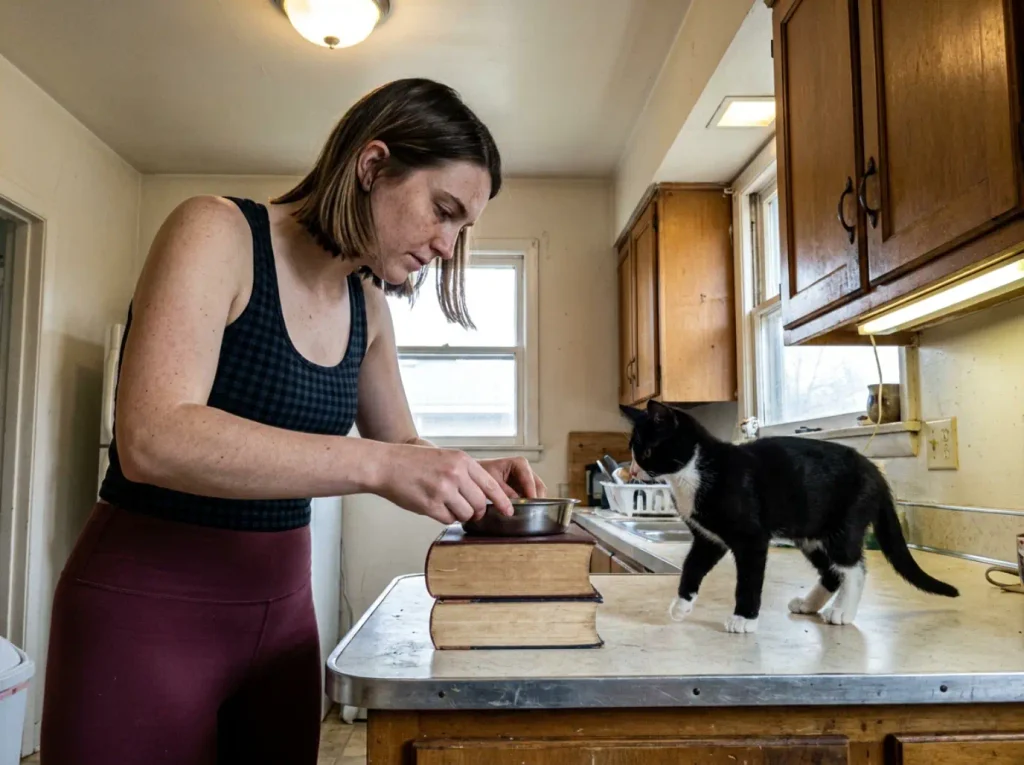
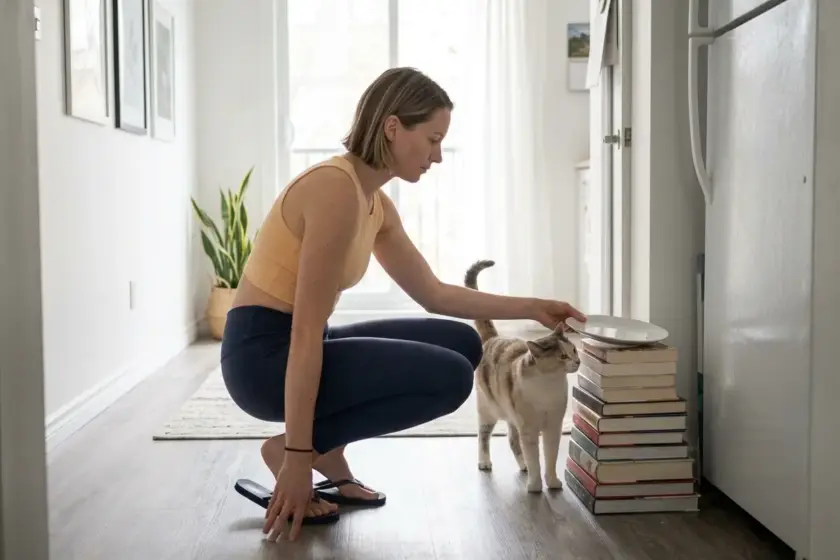
Nobody wants to buy a feeding station to find out their cat ignores it. You don’t have to, because the test costs nothing and everything it needs is already in your apartment. Put the bowl you own on top of something stable and low, and watch.
What to Stack It On (And What Not To)
Two thick hardcover books, a large mixing bowl turned upside down, a sturdy shoe box with something heavy inside it. Any of those works. Stable is the word doing all the work in that sentence, and it is not a detail: if the platform shifts even slightly under a paw, the cat stops trusting the arrangement and you have learned nothing except that he dislikes wobbling, which was already true.
Press a corner of your stack hard with one hand. If it rocks, rebuild it.
Aim for the elbow line from the first section, not for whatever happens to be lying around. A stack that lands two inches too high is running a different experiment than the one you meant to run, and it will give you a confident wrong answer. The same logic applies to the other half of this problem, incidentally: fixing it without buying a bowl is usually where you start with whisker contact and whisker stress too, and for the same reason.
Give It a Week, Not an Evening
Three days minimum, a week is better. Anything shorter than that measures novelty rather than comfort, and novelty is unreliable in both directions: some cats avoid a new object for two days on principle, and others investigate it enthusiastically for one day and then lose interest. Neither of those is about height.
What you are watching for is narrow, and it is not enthusiasm. No cat is going to look pleased about this. A cat who finds eating slightly less awkward looks exactly like a cat eating, which is why most home experiments get read wrong.
Four questions, and they are the ones no source bothers to give you:
- Does he approach without the pause, instead of hesitating before he commits?
- Is he eating square to the bowl rather than turning his head sideways?
- Does the portion go down in one sitting instead of two or three?
- Is there still food scattered on the floor around the dish?
Why This One Is Renter-Proof
Worth flagging, because half the fixes on this site come with a landlord attached. This one has no drilling, no adhesive, no bracket, no hole in anything, and no conversation with anybody who holds your deposit. If it does not work, you take the bowl off the books and put it back on the floor, and the experiment is over with no trace that it happened.
That makes elevation one of the very few feeding changes that is completely reversible. In a rental, that is not a footnote. It is most of the reason this one is worth trying at all before you rule it out.
One Raised Station Does Not Work for Three Cats
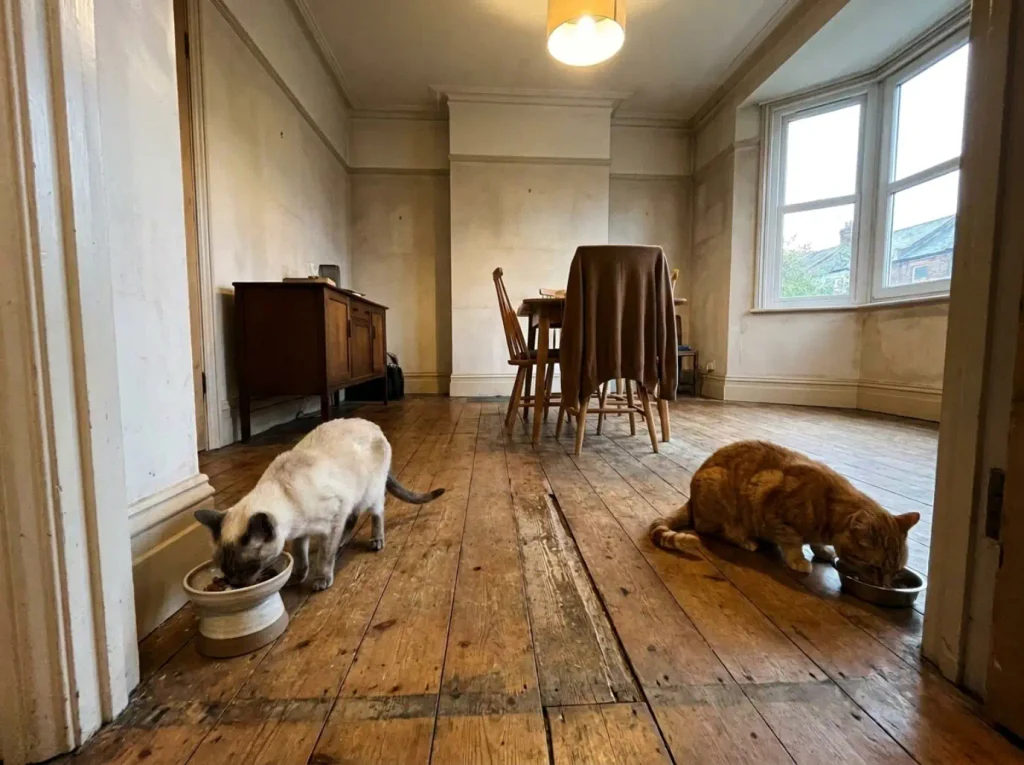
The tempting purchase in a multi-cat home is a single handsome raised station for the whole house, and it is the same mistake as the shared floor bowl, six inches higher. The rule does not change when the dish goes up: one bowl per cat, each in its own spot, because a shared station hides which cat is eating and how much. That is the same argument as two cats, two bowls, plus one, and elevation gives you no exemption from it.
The Shared Bowl Problem, Moved Upstairs
If anything, raising a shared dish makes the guarding slightly easier rather than harder. A bowl on the floor is a spot on the ground with fuzzy edges. The same bowl on a tray is one distinct object with an obvious approach, which is a simpler thing for a confident cat to stand next to and own.
And the failure is quiet, which is why households run it for months. The shier cat eats late, eats less, eats in the gaps when nobody is in the room. Nothing looks wrong from the doorway. There is food, there is a nice station, nobody is fighting, and one cat is quietly getting less than he needs.
Staggered Heights Beat Side by Side
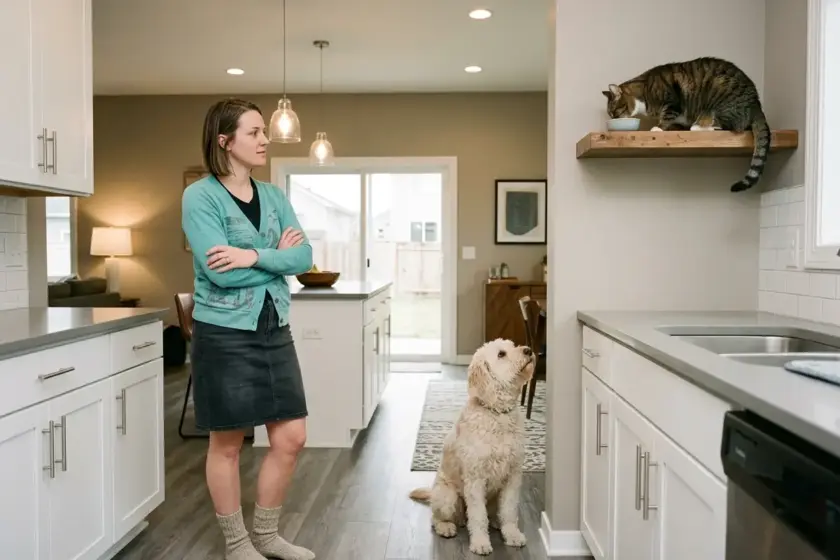
Two bowls, four feet apart, at the same height still puts two cats eye to eye across an open stretch of kitchen floor. Feeding them at different levels breaks that sightline: one on a raised surface and one on the floor, same room, different plane. A cat trying to avoid a confrontation needs an out more than he needs distance.
In a small apartment this is the answer to the space objection too. Two stations feel impossible in a galley kitchen when you picture them side by side on the floor, but one up and one down takes almost no additional floor at all. Separate them by line of sight, not by square feet, because sight is what the cats are actually measuring.
What a Well-Made Elevated Bowl Gets Right
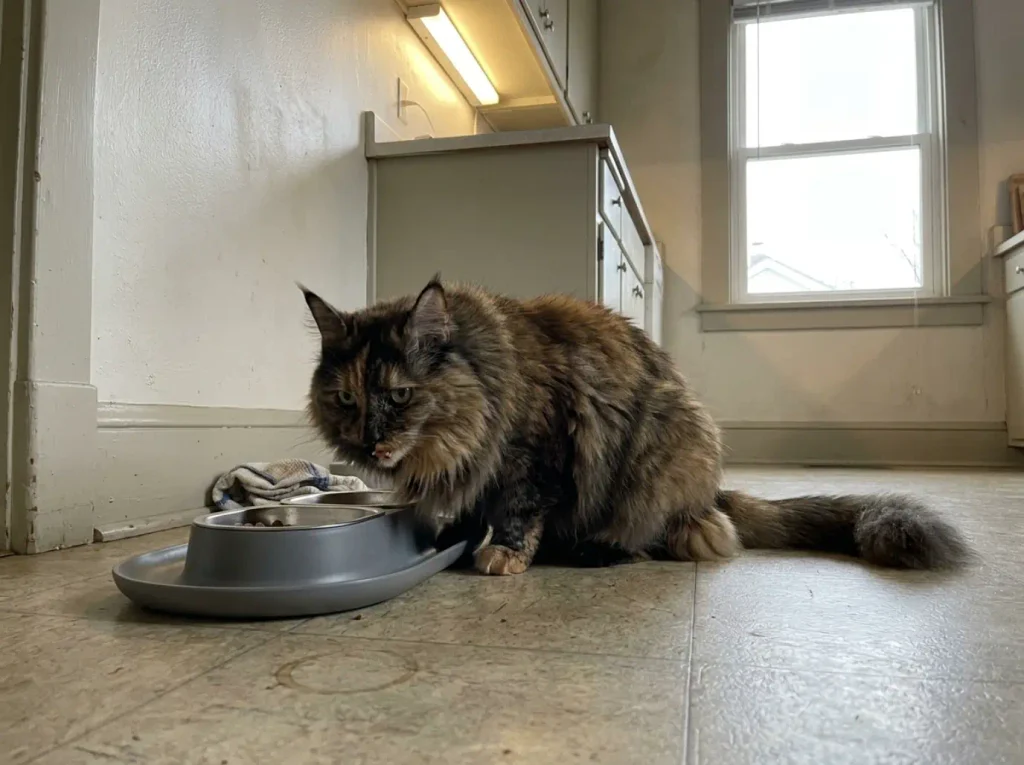
Say your cat is in one of the four groups and the books worked. Now the question is what separates a good raised bowl from a nice-looking one, and it is not the finish.
Stability Is the First Thing, Not the Finish
A raised bowl that slides across the floor or rocks when a cat leans into it is worse than the floor bowl it replaced, and this is the most common failure in the cheap end of the category. The cat commits his weight to the front of the dish, it shifts, and he files the whole object under not to be trusted. He will not come back and tell you why.
Weight and a wide base are what fix it, which is why stainless steel and ceramic dominate the good end of this category while thin plastic dominates the bad one. The Hepper NomNom Spill-Proof Elevated Cat Bowls show the shape: two stainless dishes in a single low raised tray with a rim that catches what gets pushed over the edge, wide enough that it stays put and shallow enough to wipe under. The catch is that a two-bowl tray is a food-and-water setup for one cat, not a solution for two, no matter how many bowls are in it.
Material matters for a second reason that has nothing to do with stability. Stainless steel and ceramic clean completely and hold no smell. Scratched plastic does both badly, and plastic bowl chin acne is the name for what shows up where a cat’s face rests on the rim meal after meal.
Width and Height Are Two Different Measurements
This is the part that gets missed, and it explains a lot of disappointed reviews. A bowl can be correctly elevated and still be too narrow, so the sides brush the cat’s whiskers on every bite and he abandons it half-finished at exactly the right height. Raising a bad bowl gives you a raised bad bowl. Around five and a half to six and a half inches of width, with low sides, is the range to aim for, and there is more on what size a cat food bowl should be once you start stacking the two measurements together.
The CEEFU Extra Wide Elevated Ceramic Shallow Cat Food Bowl is the clearest illustration of the two measurements landing at once: 6.2 inches across, shallow enough that the whiskers clear the sides, and raised. Ceramic breaks if you drop it in the sink, which is the honest tradeoff for the weight that keeps it still.
What the Tilt Does, and When It Does Not Matter
The angled bowls you see everywhere are a third thing again, and it stacks on top of height rather than replacing it. A tilt, typically around fifteen degrees, changes the angle the food sits at inside the dish so the last few pieces gather at the low edge instead of being chased around a level bottom. The Necoichi Ceramic Elevated Cat Food Bowl is that exact fifteen degrees, in extra-wide ceramic, so it happens to cover the width question in the same object. What it does not do is make the tilt mandatory.
Plenty of cats do fine on a straight raised bowl and never notice the angle either way.
The tilt gets treated as the interesting feature in this category, mostly because it is the one that photographs well and gets its own paragraph on every listing. The complaints that keep surfacing say otherwise: almost nobody comes back disappointed about the angle, and almost everybody who is disappointed is describing something that slid, wobbled, or was too narrow. Stability and width are load-bearing. The tilt is a nice extra.
If you want the cheapest honest way to confirm what the books told you, the Y YHY Cat Bowl Anti Vomiting Tilted Elevated Bowl is a five-inch ceramic dish that is both raised and tilted, and it is the low-commitment version of everything above. It is a single bowl, so a two-cat household needs two of them, and the narrower mouth means whisker clearance is tighter than the extra-wide options. For a one-cat apartment where the trial already worked, that is a fine place to land. If you would rather skip straight to the picks, raised bowls chosen by height first does that comparison properly.
Test the stability with your hand before the cat tests it with his face. Fill the bowl, then shove it sideways across the floor with one finger and press down hard on the front edge. If it slides or tips toward you, it will do the same under a cat leaning in, and he will quietly stop using it without ever telling you why.
The Short Version
Height is not a universal upgrade. It is the fix for one specific problem, a neck held in a downward fold for the whole meal, and it only changes anything for the cats who have that problem: seniors, cats with known stiffness, cats who regurgitate soon after eating, and big long-bodied cats.
The book test answers the question before you spend a dollar. A week on a stable stack at elbow height tells you what no listing description can, and if nothing changes, that is a real answer arriving for free rather than a failed experiment.
And anything that hurts goes to a vet. Vomiting, weight loss, trouble swallowing, a cat going off his food: those are an appointment, and an elevated bowl is comfort and posture and nothing more than that.
Check back in three weeks, because this one depends on the cat accepting a change and on you leaving it where you put it. Look at three things: whether he is still eating square to the dish instead of sideways, whether food is collecting on the floor around it again, and whether the bowl is still exactly where you set it or has been shoved a few inches across the kitchen by a paw that has an opinion.
Stack two books under the bowl he already has. If nothing changes in a week, you have your answer and you kept your money.
Amazon’s Audible — free for 30 days
Your cat won’t let you read. Let someone read to you.
Audible is Amazon’s audiobook library — thousands of titles, read out loud, on your phone. Free for a month, plus one audiobook to keep forever.
Frequently Asked Questions
01Do cats prefer deep or shallow bowls?
Shallow, and it is a separate question from height. A bowl deep enough that the sides brush a cat’s whiskers while he eats gets abandoned half-finished even when it sits at exactly the right height. Width of roughly five and a half to six and a half inches, with low sides, is the range to aim for.
02Do cats like eating out of raised bowls?
Some clearly do and some ignore them completely. Cats with stiff joints, older cats, and cats who regurgitate soon after eating tend to settle at a raised bowl. Healthy young cats usually show no preference either way and go back to whichever dish is in the usual spot.
03Should cat bowls be elevated and tilted?
Elevated and tilted do two different things, and neither is mandatory. Raising the bowl changes how far the neck bends; a tilt of around fifteen degrees changes the angle food sits at inside the dish. Plenty of cats do fine on a straight raised bowl with no tilt at all.
04What is the best type of bowl for a cat to eat out of?
A wide, shallow, stable bowl in stainless steel or ceramic. Those materials clean completely and do not hold odor the way scratched plastic does. Height is worth adding on top of that only if your cat is in the group it helps.
Leave a comment