Do Cats Get Lonely When the Apartment Is Empty 9 to 6?
Do cats get lonely at 9 to 6? 8-12 hours is routine for adults, 2-3 for kittens under six months + a chair at the window and a 10-minute play floor.

Alfredo RamsesFounder · November 17, 2026 · 23 min read

On this page11 sections
- 1Do Cats Get Lonely? Some Do, and the Cat's History Decides, Not the Breed
- 2The Habits Worth Watching, and the Ones That Go to the Vet Before the Room Changes
- 3How Many Hours Alone Is Too Many, and Why Age Changes the Answer
- 4Why the Apartment Fails Even When You Are Home
- 5The Window Is the Cheapest Company in a Small Apartment
- 6Short Play at Dawn and Dusk Beats One Long Session You Schedule
- 7Food That Takes Work, Plus Scent and Sound for the Hours You Are Out
- 8A Second Cat Is a New Animal to Negotiate, Not a Refill
- 9Long Days, Trips and the Hours That Need a Visitor
- 10A Chair at the Glass Tonight, a Look at the Bowl Later
- 11Frequently Asked Questions
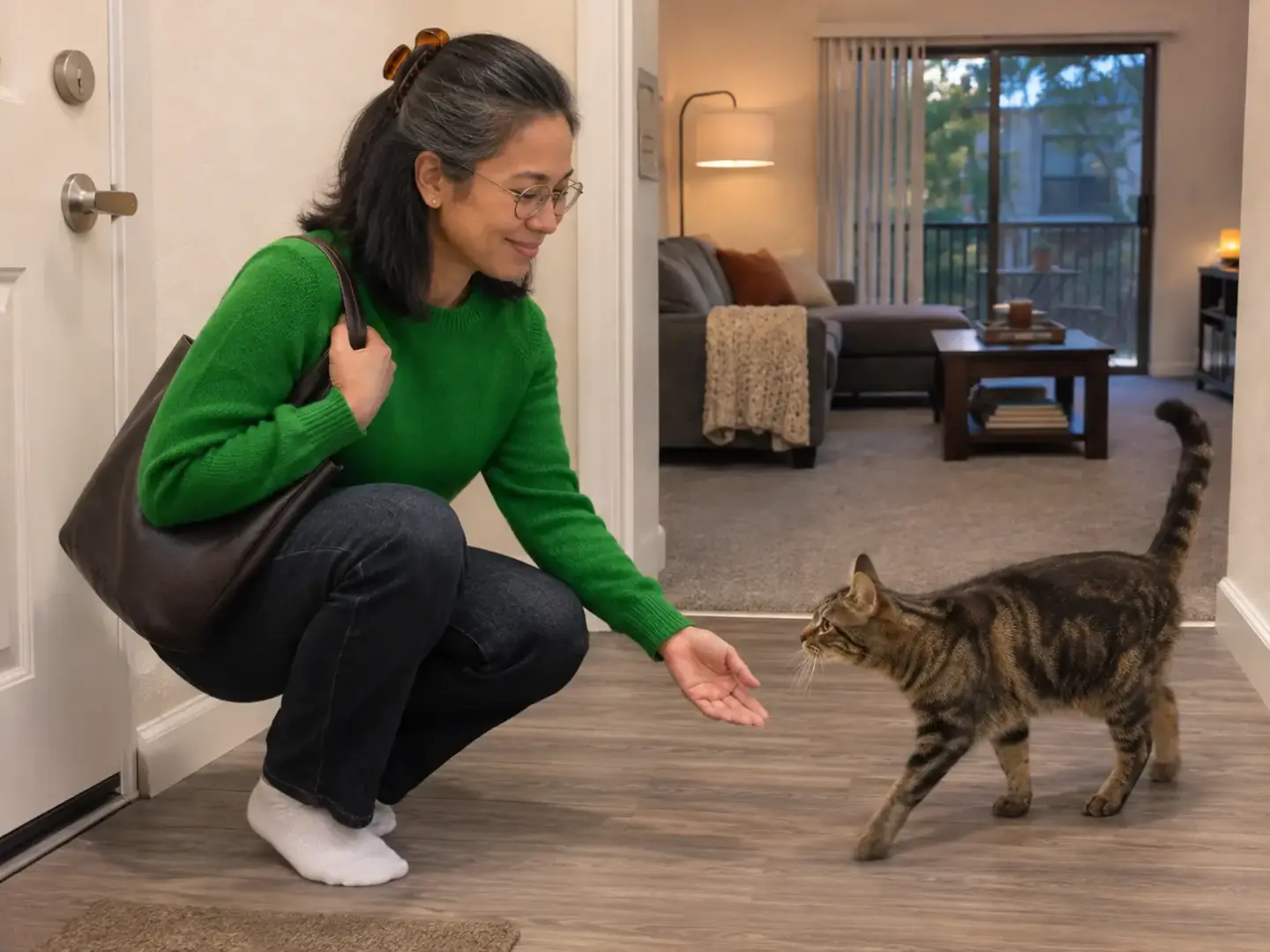
You come through the door after work and he is already waiting, complaining at length, and you translate every sound into one sentence: I left him alone. He has a better reading of the situation. The hours he slept through were his own, and what he has to report is about the hours he spent awake in a room that gave him nothing to do.
Do cats get lonely in an apartment that sits empty from nine to six? Some do, and veterinary guidance already fits a working day inside the normal stretch for a healthy adult, so the answer lives in the room, not on the clock. This guide covers what lonely means to a cat, the habits to watch and the ones that go to the vet first, how many hours each age handles, why a furnished apartment can still fail him, and what to change before anyone thinks about a second cat.
Quick Answer
Some cats do get lonely, and each cat’s history decides it, not the breed. A nine-to-six day fits inside the 8 to 12 hours a healthy adult handles as routine; kittens and seniors have a shorter limit. What an empty apartment usually lacks is something to watch and something to work for, not company.
Do Cats Get Lonely? Some Do, and the Cat’s History Decides, Not the Breed
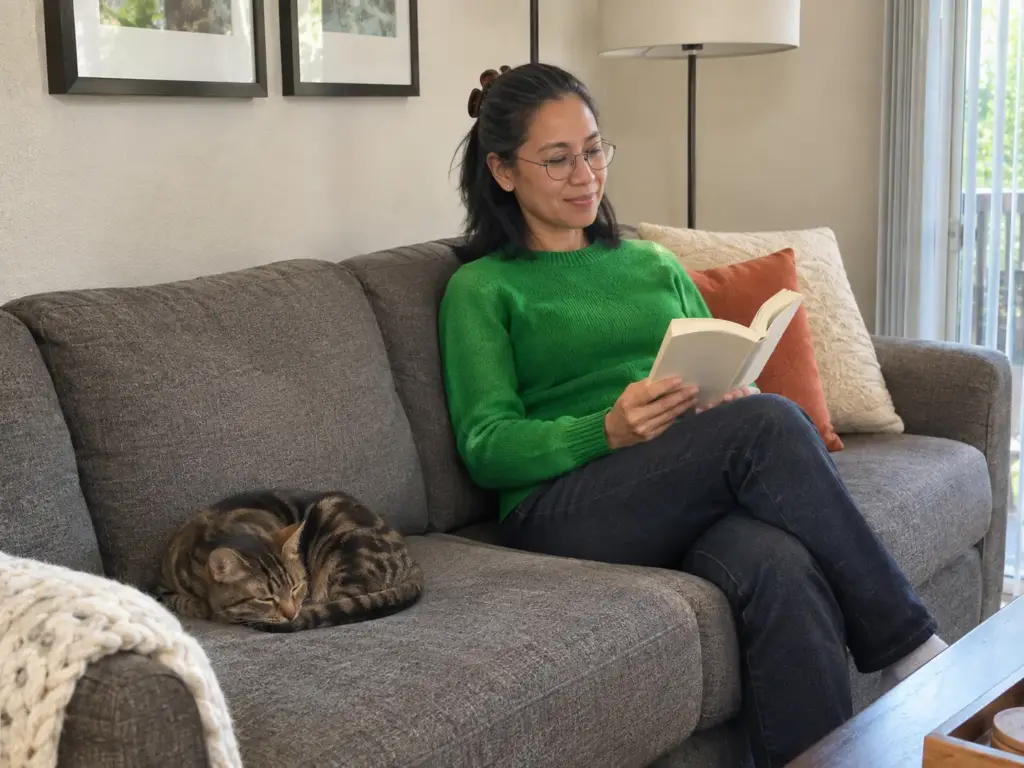
Some cats seek company and feel its absence, and others would pick a solitary life if anyone offered. Which one lives in your apartment is something you can read from how he uses the place, and reading it comes before any purchase.
Social, Solitary and Everything in Between
Sociability varies from cat to cat. International Cat Care on multi-cat households puts it plainly: cats adapt, some choose contact with their own species, and others avoid it when they can and keep a solitary existence. A reputation for independence, or a breed’s reputation for clinginess, predicts little about the cat on your sofa. His history and his routine predict more.
What that means for the room is easy to sketch, because each kind of cat asks the apartment for something different:
- The cat who seeks company needs the day to have anchors: a fixed place to watch from and contact at set times, so the long middle of the day has a shape.
- The cat who prefers his own company needs places that are his alone and a house that stays predictable. To him a second animal is a new tenant, not a gift.
- The cat in between wants you in the evening and the room to himself in the daytime, and he is easy to misread as one of the other two.
Why “Independent” Does Not Mean Fine
Independent describes a cat who does not need walking or entertaining. It says nothing about whether the day he has been handed is a good one. And cats rarely announce a poor one: according to the AAFP and ISFM environmental needs guidelines, “Although cats often do not express overt signs of stress and anxiety, they do experience stress.” An apartment fails him quietly, and nothing looks wrong until a habit moves.
If two cats already share your home, the question changes. Learn how to tell a bonded pair from two cats that simply share a home first, then read what a paired cat loses when its companion leaves. This page follows the cat who is on his own through a working day.
What Lonely Looks Like From the Cat’s Side of the Door
A cat has no word for lonely. What he has is a room that offers nothing to do or watch during the hours he is awake, and a person whose scent thins out of the cushions as the day goes on. A lonely cat and a bored cat look almost the same from outside, and for a cat alone in an apartment the missing piece is more often something to do than someone to do it with. Most of the fixes below start there.
Cat loneliness is not something this page tries to read as a feeling. It measures what the room gives him: something to watch, something to work at, the smell of you, and the hours you are gone.
Look at where he is during the hours you are out, not at the door when you leave or return. The goodbye and the greeting are the two moments you can see, and they are the two that measure least.
The Habits Worth Watching, and the Ones That Go to the Vet Before the Room Changes
A list of signs is only useful if it says which one sends you to the phone before you move any furniture. This one says it early.
Habits the Apartment Can Explain: the Calling, the Following, the Chewing
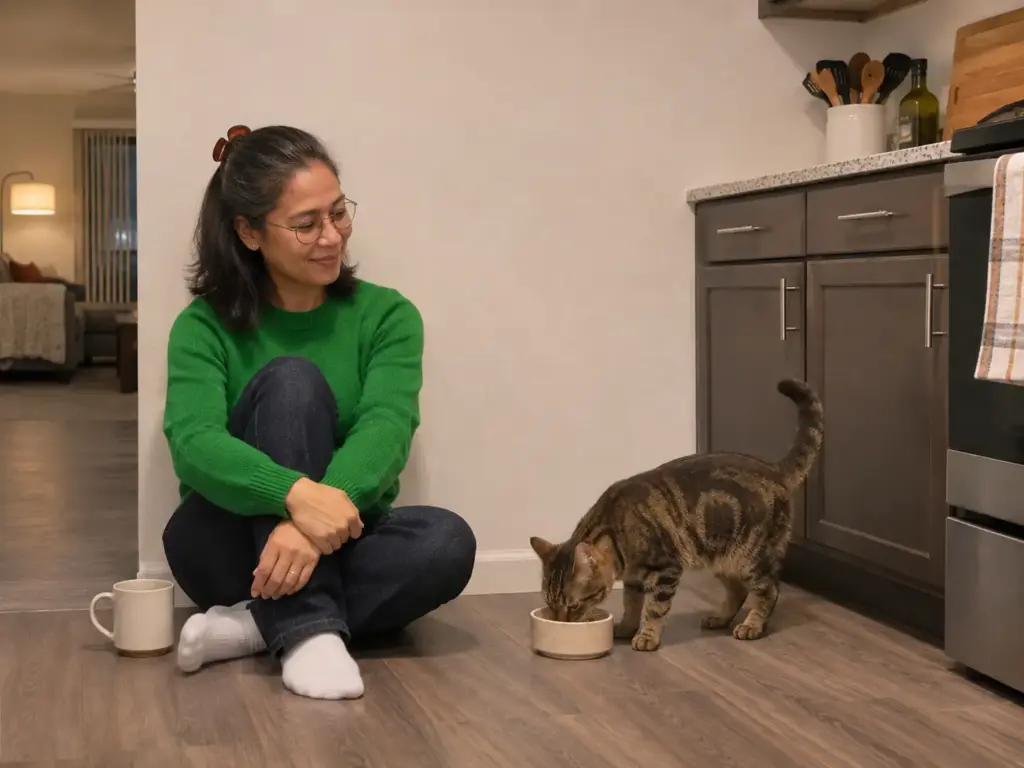
Ohio State lists what a single cat tends to do when he is left alone too long, from heavy calling to the over-the-top greeting (the signs Ohio State lists for a cat left alone too long). It files them under separation anxiety, a label that belongs to the vet and not to a guess from the sofa. The ones the apartment can explain are the ones that move with your schedule: calling at the door around the hour you usually return, following you from room to room, tearing at things he normally leaves alone, and a greeting louder than the moment needs. They rise and fall with the routine, which is how you can tell they belong to the house.
The response to these is to change the room, as the sections below do, and then watch whether the habit follows.
Where the Room Stops Answering
Some habits are not the room’s to answer. A cat who stops eating, who grooms until bald patches show, whose litter box habit shifts, or whose routine flips from one day to the next gets a call to the clinic before anyone moves a chair. Ohio State closes its own list the same way: enrich the environment, set a daily play session, and if the habit stays, see your veterinarian. What these signs mean and what sits behind them belongs to the vet, so nothing below tries to answer it.
Appetite is the habit to watch first, and what a cat guarding its bowl tells you about appetite shows how it reads in a home with more than one cat.
What to Write Down Before You Change Anything
Before the first change, write down two ordinary days of one cat: whether he eats, where he sleeps in a spot you can see, and what the litter box looks like at the same hours each day.
The point is subtraction. After you move a chair or rotate the toys, you can only tell what changed if you know what the days looked like before. It is a household method, not a validated test, so treat it as notes and nothing medical. Eating, sleeping in view and the box are enough; more columns turn it into homework.
How Many Hours Alone Is Too Many, and Why Age Changes the Answer
Hours are the one thing here with a number and an owner, so each figure below says whose it is.
A Nine-to-Six Day Fits Inside the Number
PetMD, in a piece reviewed by Hannah Hart, DVM, and Hill’s Pet, whose guidance is reviewed by veterinarians, both put a healthy adult cat at 8 to 12 hours alone as a routine, with 24 hours as an occasional limit. Past 24 hours, someone should visit at least once a day. A nine-to-six workday is nine hours, and even a long commute leaves you near eleven: inside the number, with room to spare.
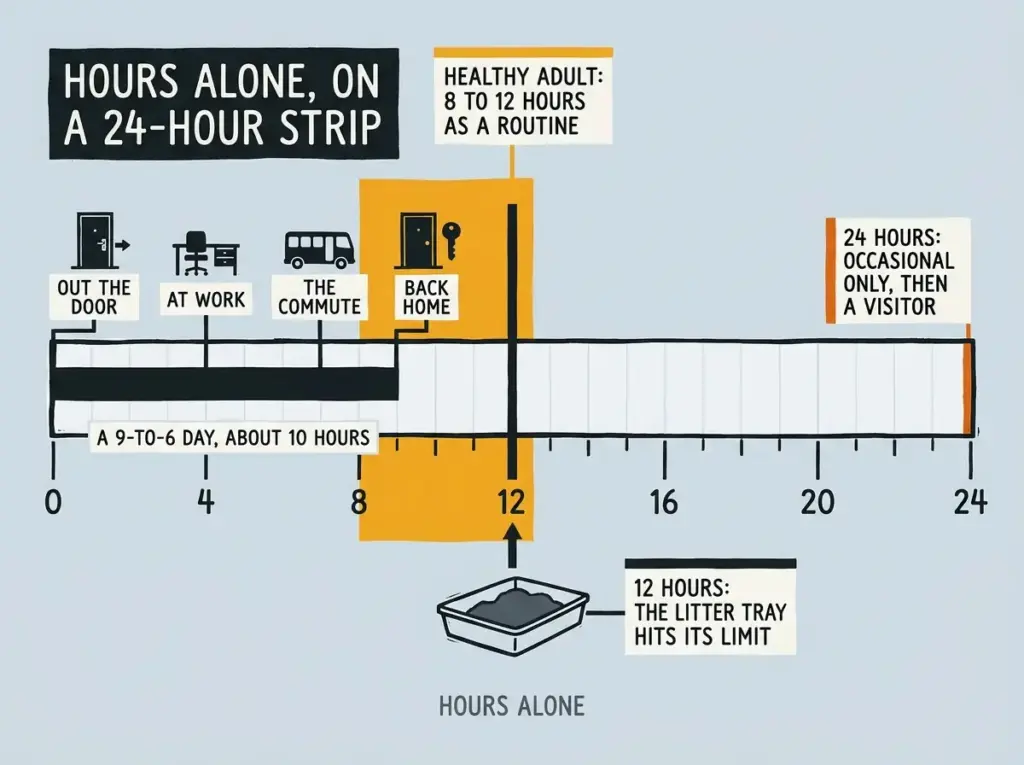
What pushes a cat past the number is stacking: a late night out followed by an early start, or a split shift that turns one absence into two long ones. The workday alone rarely does it. If the long day also stretches the meals, what decides whether an automatic feeder suits a long day sets out how to judge that.
Kittens, Seniors and the Cat on a Medication Clock
A kitten is the one case where the workday simply does not fit. Hill’s Pet puts kittens under six months at two to three hours at a stretch, and four to six hours from six months on, because a young cat eats three or four times a day and the day gets cut into meal-sized pieces.
A senior is where the number turns personal. From about seven, a cat sleeps more and may need medication at set times, and that clock, not loneliness, is what shortens the safe absence. What the medication is and when it is due is a vet’s call. This page only names the clock.
Here are the hours by age, each with its owner:
- Kitten under six months: two to three hours at a stretch (Hill’s Pet).
- Kitten of six months and older: four to six hours (Hill’s Pet).
- Healthy adult: eight to twelve hours as a routine, up to 24 now and then; past 24, a visit at least once a day (PetMD and Hill’s Pet).
- Senior from about seven, or any cat on medication at set times: a shorter absence, set by the vet’s schedule and not by this list.
The Litter Box Sets the Ceiling, Not the Affection
The 12-hour figure reads like a statement about the cat. For a cat who will not use a tray he finds dirty, it is a statement about the tray. International Cat Care says a litter box should be scooped at least twice a day, so a twelve-hour gap already sits at the edge of the box’s own rule long before affection comes into it. With two cats sharing a tray the arithmetic tightens, and the same hours worked out for two cats and one litter box runs it.
And the sleeping tells you nothing.
A healthy adult sleeps 12 to 16 hours a day, Hill’s Pet says, and moves much of that sleep into the hours the house is empty. A cat curled up in midafternoon is on his schedule, not pining. The useful question is not whether he sleeps while you are out. It is what he does with the hours he is awake.
One Test Day Before You Change a Thing
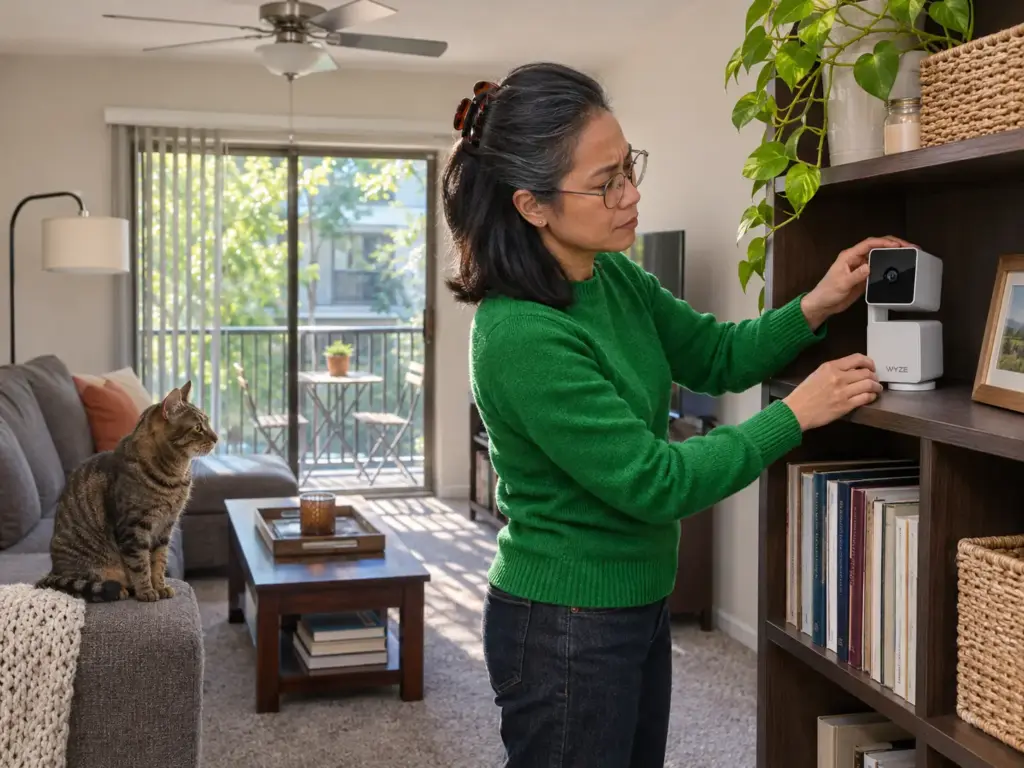
Nine to six stays a guess until you watch one. The free version comes first: leave a cushion where he usually sleeps, put the bowl somewhere you can check when you return, and note what has moved. For footage, the WYZE Cam Pan v3 (2.48 x 2.36 x 4.88 inches, small enough for a bookshelf) pans across the room and shows whether he sleeps through the day or paces. Treat it as a test day, not surveillance: the connection drops at times and the motion alerts miss some movement, so it earns its place for one ordinary day and not as a standing watch.
Run one ordinary workday as a test before you change anything, then set what you saw next to what you assumed. With no camera, a cushion where he sleeps and a bowl you look at twice will do.
Why the Apartment Fails Even When You Are Home
A cat can be bored and alone with you in the next room. A long weekend at home does not change what the place offers him between your visits to it.
Sleeping Twenty Hours Is Not the Same as Being Content
Sleep looks like contentment from the sofa. Cats sleep 12 to 16 hours a day and shift that sleep into the empty hours, so an apartment that offers nothing will only see more of it.
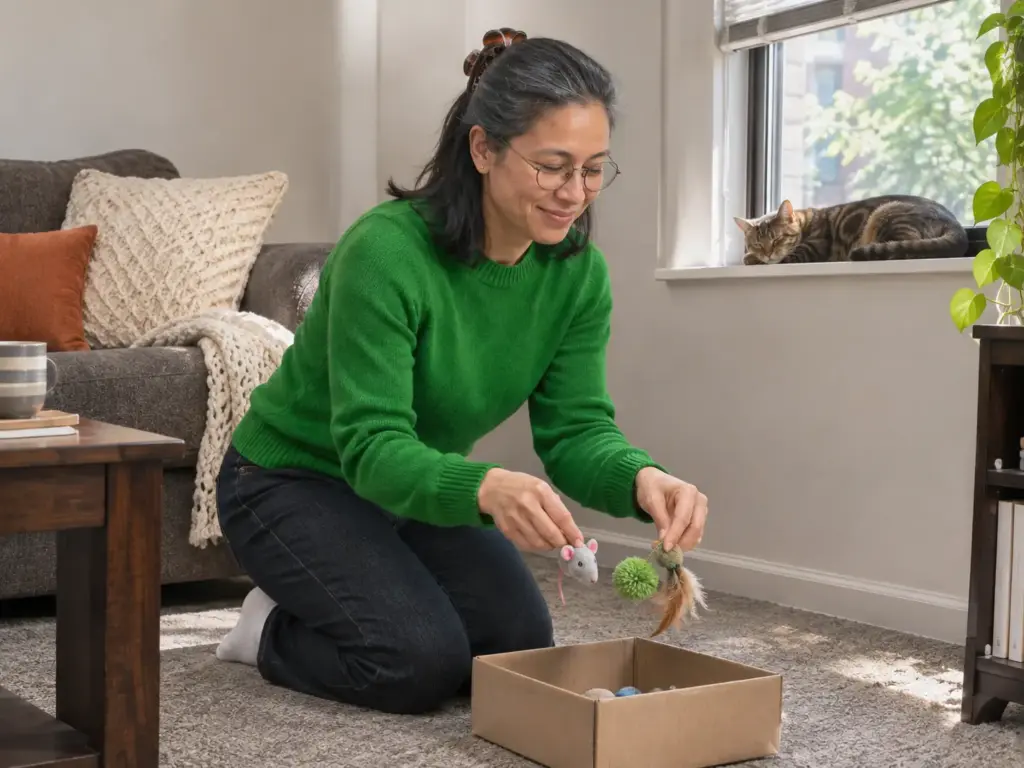
Ohio State’s Indoor Pet Initiative on toys and rotation makes the same point about toys: without rotation, cats get bored and sleep nearly all day. A basket of toys on the floor is a still life. The same three toys swapped every week is something that changes.
Rotation is simple. Put out a few, keep the rest in a closed drawer, and swap them weekly. One more rule belongs to the cat: if he sleeps pressed against a single toy, he has chosen it, and that toy stays out of the rotation.
The Room Furnished for the Human
Picture the usual setup: a tree in the corner where you wanted it, a basket of toys on the floor, and the cat asleep on the one warm windowsill that was never meant to be a bed. The furniture is placed for the person’s eye, and the cat voted with the sill. Three things decide whether he uses what you bought: whether it sits where he already is (the sill, not your corner), whether there is something to do with it (a toy he can chase, a ball that gives food), and whether it changes. A tree in the wrong corner fails all three.
The cat tree is the answer everyone reaches for, and in a small apartment it is the wrong first purchase whenever the only free wall is the one without a view. The sill he has already chosen beats a tower he has not.
Attention That Arrives in One Lump at Six
After a day with nothing in it, the evening arrives as one lump. You come in, he greets you, and every wish he has been saving gets handed over at once. You read it as affection and, a few minutes later, as guilt. He is reporting something else: the middle of the day had nothing in it, and an hour of everything at the end does not pay for eight hours of nothing.
What he wants is something to watch and something to work at while you are gone.
What you want is to feel better when you walk in. They are different requests, and his is the one the room can answer. None of this makes him a bored cat. It describes the apartment, not the animal.
Put out only a few toys each week and keep the rest in a closed drawer. The one he falls asleep against stays where he left it and is never boxed up again.
The Window Is the Cheapest Company in a Small Apartment
In a rental where you cannot drill, the window is the one piece of company already installed. It runs a free show all day, and it came with the lease.
A Chair Pushed to the Glass Is the First Perch
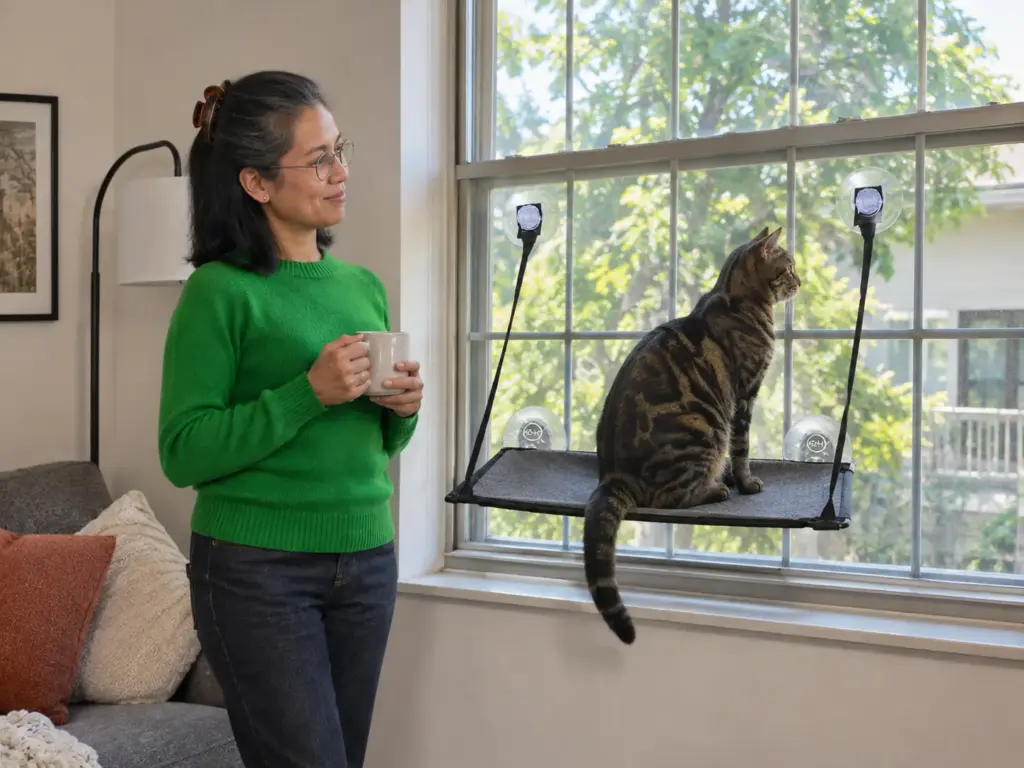
Ohio State’s Indoor Pet Initiative on perches describes a perch as anything that lets a cat lie, sit or sleep and look outside from above, and a couch or table in front of a window counts. So the first perch is a chair or stool pushed up to the glass, which needs no tools and leaves no marks. Leave it there for a week and count how often he climbs on it. For the layout beyond the chair, the one-cat home, zone by zone shows where a single cat’s places belong.
Something to Watch: the View Needs a Subject
A window onto nothing does not entertain. A bird feeder hung outside the glass gives him something to work out, and so does a hedge, or the wall the neighbor’s cat walks along.
Ohio State says a cat with a feeder outside may sit on his perch for hours looking out. The perch is the seat. The subject is the show.
No-Drill Perches for a Rental, Slot or Suction
The window decides what you can use, so look at the window before the product page. A sliding sash with a slot at least 0.5 inch deep takes the hook-on kind. A plain fixed pane takes suction.
For a plain pane, the K&H Cat Window Perch EZ Mount has a 23 x 12 inch bed, is sized for glass around 27 x 23 inches and holds up to 50 pounds, with nothing screwed into the wall. Its soft spot is the suction cups: some let go of the glass, so press them onto clean glass and check the hold before you trust it with a ten-pound cat.
For a sliding window with a slot, the Zakkart Cat Perch for Windowsill (24 x 15 inches, holds 40 pounds) hooks into the slot: no drill, no suction cup and nothing to patch when the lease ends. It only fits when the slot is at least 0.5 inch deep, and on a sealed pane it does not fit at all. Advice to put a perch at the window fails on that pane, which is why the choice between these two comes down to the window you have and not the price.
Push a chair against the window for a week and count how often he uses it. If he does, a perch is an upgrade to a habit he already has; if he ignores the chair, the glass was never what he wanted.
Vertical Space That Does Not Need a Wall
Height does not need a bracket. The top of a wardrobe, a bookcase he can already reach, or a table under the window all count as territory, and the rule is short: the cat picks the spot and you provide the way up. Nothing tall goes in unless he can already get onto it.
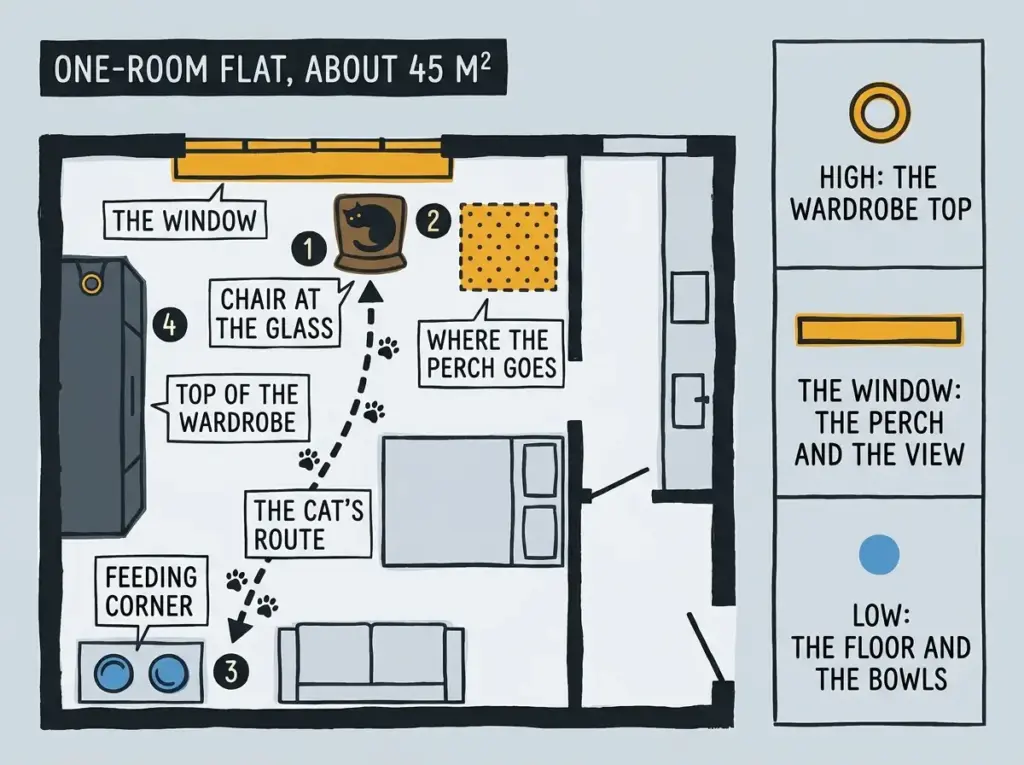
Give him more than one place, at different angles, so the view changes through the day. In a home with more than one cat, a high perch works best with two ways up so it never becomes a bottleneck, and how exits and perches map a small apartment covers that layout.
Short Play at Dawn and Dusk Beats One Long Session You Schedule
Play is the one piece of this that needs a person, which makes the number worth getting right.
Ten Minutes Is the Floor, Not a Debt
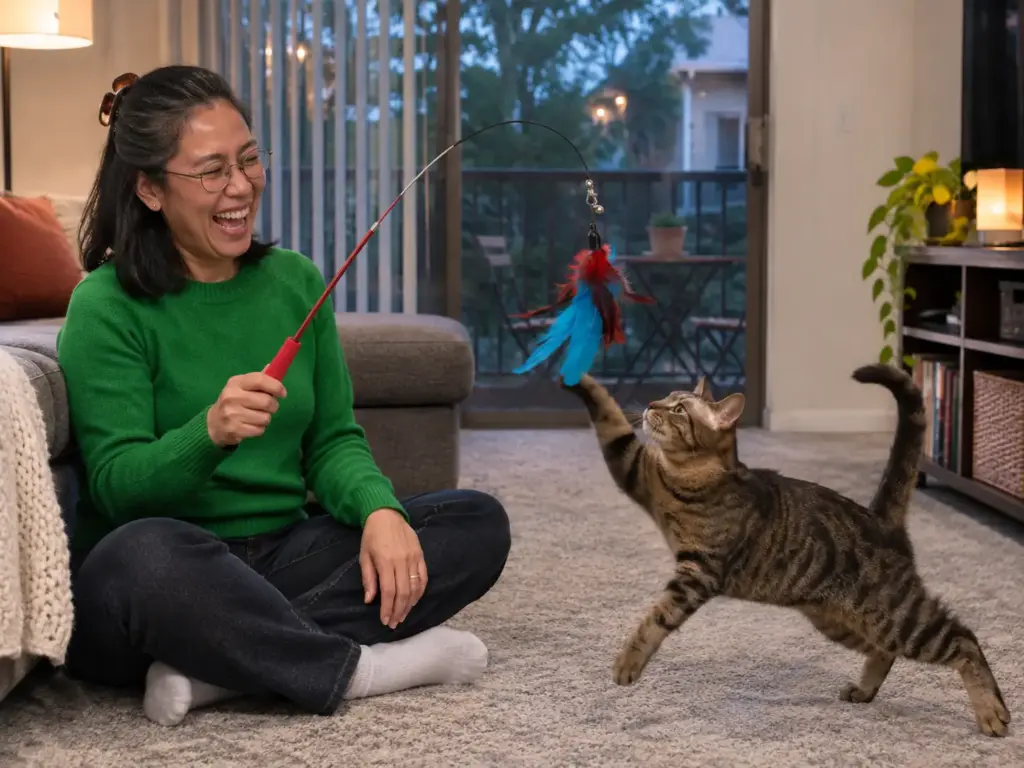
Thirty minutes a day sounds like the rule. The guidance for a single cat who spends long hours alone is lower: Ohio State asks for at least ten minutes of play a day. Ten is a floor, not a debt. A cat does not keep a ledger, and a person who feels behind on one tends to skip the whole thing.
Sprinters, Not Marathon Runners
International Cat Care’s guide to playing with your cat gives the reason: cats “are sprinters rather than marathon runners” at play, and “one minute of frenzied activity is a good result.” They are most active at dawn and dusk. That makes two or three one-minute chases at hours he already picks worth more than a long session you book on a calendar.
A Wand Is the One Toy That Needs You
A wand is the one toy that cannot run without you, so it is the toy that supplies the minutes the guidance asks for. A shoelace dragged across the floor does a lot of the same work, as long as it goes back in a drawer afterward; loose string is not something to leave lying in a room with a cat.
For a purpose-built version, the MeoHui retractable wand set extends to 38.9 inches and folds to 15, and the pack holds two wands plus nine feather refills. The feather tips and string can come loose with a determined cat, so it goes back in the drawer when play ends and never stays out with him alone. The Cat Dancer Rainbow is a single, longer wand (65 inches) for the same job.
Three one-minute chases while he is already awake beat one long session. Put the wand away when you finish, and end on a catch so the last thing he does is win.
Food That Takes Work, Plus Scent and Sound for the Hours You Are Out
When the door shuts, the only things still working are the ones the cat can run himself: what he can smell, what he can hear and what he has to work for.
Free Before Anything You Buy: a Shirt, a Radio, a Cardboard Box
Ohio State’s Indoor Pet Initiative on comings and goings suggests leaving a worn piece of clothing or a blanket that smells of you in the cat’s refuge, and a radio or TV tuned to the station that normally plays. Scent and sound are what the apartment keeps when you leave.
A fresh cardboard box two or three times a week is the cheapest new object going, and a plain paper bag or an egg carton with a few treats inside makes a first food puzzle. When you are home, sit with him while he eats instead of rushing out of the kitchen: a meal with you beside it is a different event from a meal alone.
A Meal That Takes Twenty Minutes Instead of Two
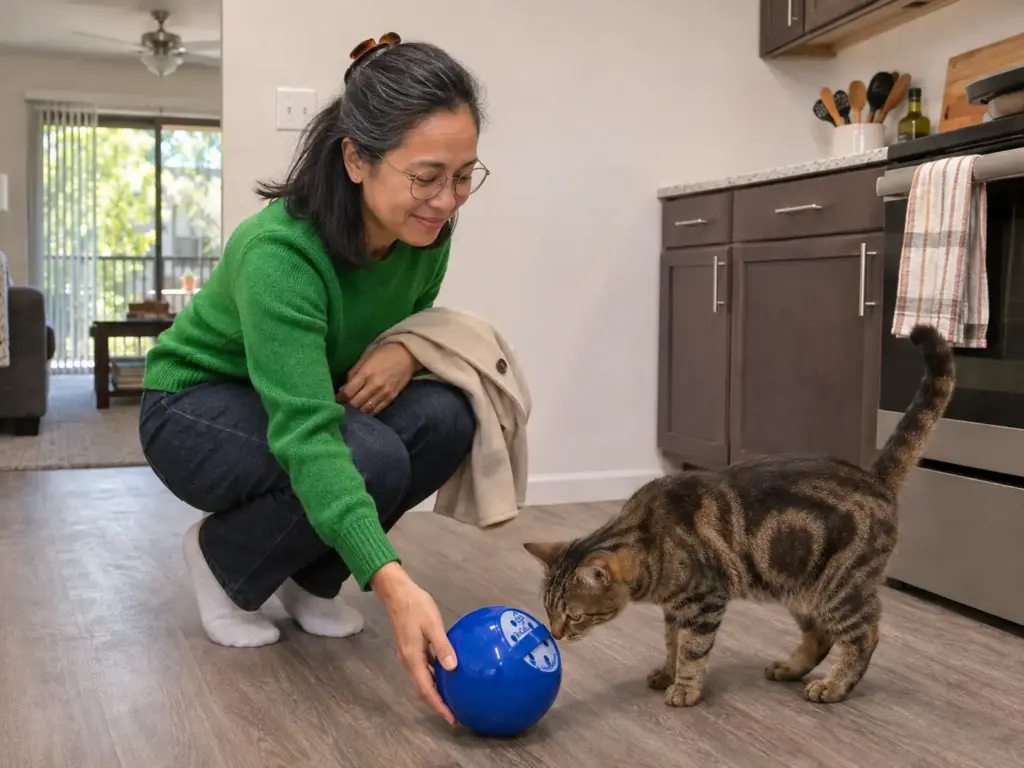
A bowl emptied in two minutes leaves the rest of the day unfilled. Food that has to be worked for runs with nobody home, so it is the one activity that keeps going through a closed door. Ohio State notes that toys a cat can catch, pick up and toss pass the time while you are out, and that food-filled balls make him work for a meal.
The PetSafe Slimcat Feeder Ball (5.8 x 3.2 x 7.0 inches) rolls across the floor, takes no wall space and can stretch a two-minute meal toward twenty, depending on the cat and the opening you set. At the widest setting treats fall out too easily, and some cats are not impressed by it. A flatter puzzle such as the Catit Play Treat Puzzle (16.1 x 16.1 x 3.9 inches) offers a different challenge, but it takes more floor and costs more.
The Bowl Still Full at Six
The hard picture to come home to is a bowl as full as you left it. Take that to the vet gate from earlier before touching anything in the room: a cat who skips meals until you walk back in is a call to the clinic first. What the room can change is the setting of the meal: the shirt by the bowl, food that takes a little work, and your company at the evening meal. None of it replaces the call.
Leave a worn shirt by the bowl or the bed and keep it unwashed until he eats his normal meals through the hours you are out.
A Second Cat Is a New Animal to Negotiate, Not a Refill
A second cat sounds like the cure for guilt. It is a second animal, with opinions of its own about your apartment.
One Cat Is Not Half of a Pair
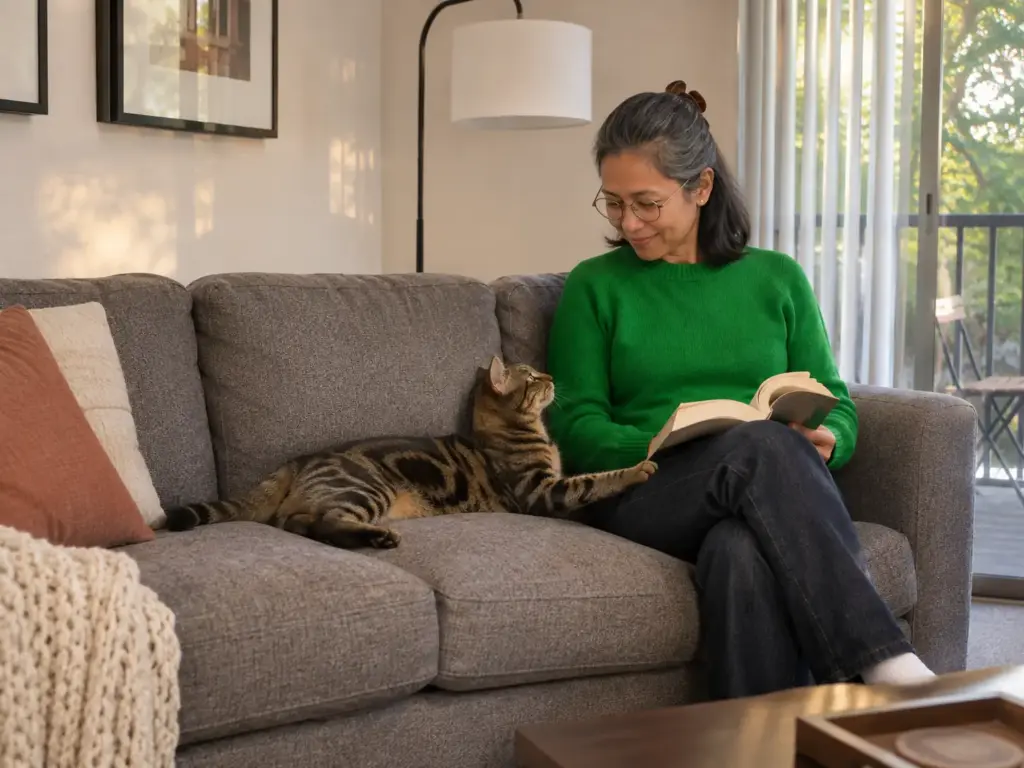
A single cat is not an unfinished pair. International Cat Care notes that some cats opt for a solitary life when given the choice, and that is a legitimate result, not a gap to fill. The line that two cats will keep each other company holds for a pair that has already chosen each other. For two strangers it is a hope.
A second cat comes last in the order of questions: first the window, then play at his hours and food that takes work. If those are covered and the question remains, how to read the cat you already have before deciding is the place to start.
What a Second Cat Adds That the First Did Not Ask For
A second cat doubles the household’s list of needs. The working rule is one of each resource per cat plus one, spread across separate rooms:
- Food: a separate feeding spot in a different room from the first cat’s.
- Water: more than one source, not all in the same corner.
- Litter boxes: one per cat plus one, in different rooms.
- Rest: beds and perches in more than one place.
- High perches: two ways up, so one cat cannot block the route.
Protecting your cat’s territory before anything new arrives covers the preparation. How the two cats actually meet is a separate subject, and introducing two cats in a small apartment, stage by stage walks through it, which this page does not.
A Third Cat Changes the Arithmetic, Not the Mood
A third cat multiplies the resource count and the number of relationships, but it does not lift the mood of the house. A group of cats is made of sub-groups more than of one happy family, and whether three cats can ever be one bonded group goes through how that plays out.
Single Kitten Syndrome and Why It Is About Manners
Single kitten syndrome is the popular name for a kitten raised without other cats who never learned to bite softly or to stop. It describes a kitten’s manners. It is not the loneliness of a grown cat in a one-bedroom apartment, and it says nothing about an adult who has been fine for years.
If a kitten is what you are picturing, a calm adult does not automatically want a playmate who pounces on everything at dawn. Whether the resident accepts the newcomer matters more than the newcomer’s age, and adding a kitten without crowding the resident cat goes through it from the resident’s side.
Before a second cat enters the conversation, check three things on the one you have: does he use the window, does he play at his hours, does he work for part of his food. If not, the apartment is what is failing, and a second animal will not repair it.
Long Days, Trips and the Hours That Need a Visitor
A trip, a double shift or a hospital stay breaks the routine, and the useful question is how many hours pass before someone has to be in the apartment.
Past 24 Hours, Someone Has to Come In
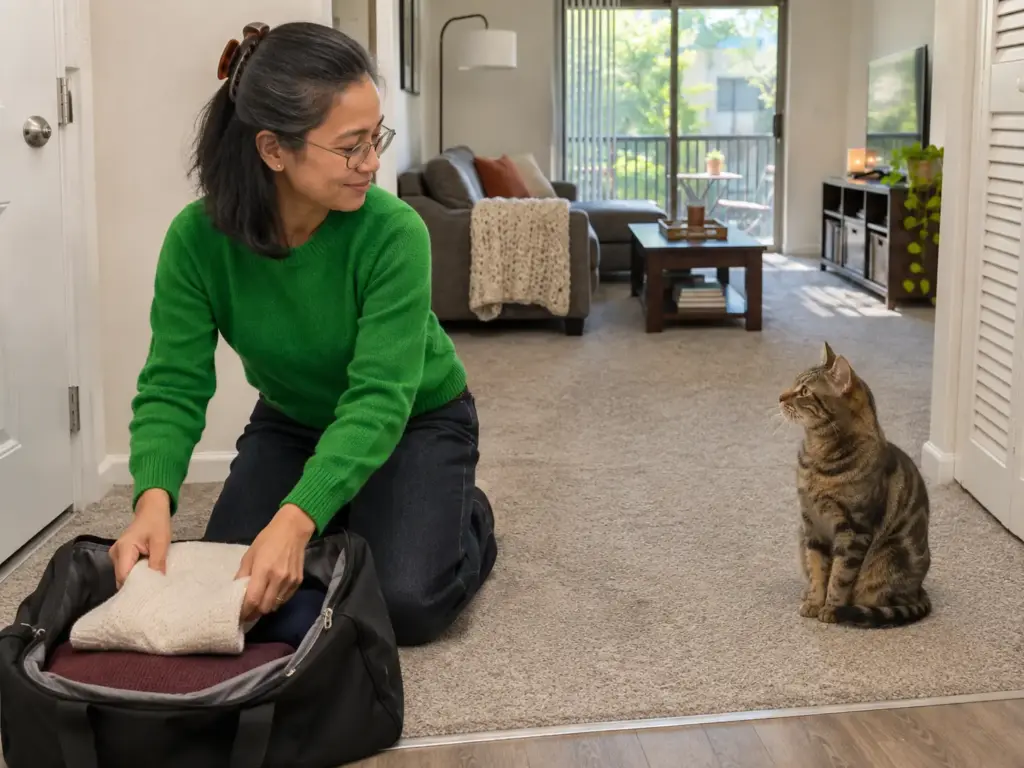
PetMD and Hill’s Pet agree on the rule for a longer absence: past 24 hours, a caregiver comes in at least once a day. It is a caretaker’s rule. It says when a person has to turn up, and it is not a timer on a cat’s stress. Extra food does not replace a visit, because a visit brings fresh water, a scooped box and someone looking at the cat, and a full bowl does none of those.
A single night fits inside the occasional 24 hours of a healthy adult. A kitten, or a senior on medication, does not fit that absence at all.
The Older Cat and the Medication Clock
An older cat, or any cat on medication at set times, cannot take a long absence, as Hill’s Pet notes: the schedule runs the clock. Ask the vet to set the timetable, because this page will not guess at what or when. And an older cat who stops grooming is a question for the vet first; why an older cat stops grooming and what to do first sets out where that line sits.
What to Check When You Are Back
Repeat the test day: eating, sleeping in view, the litter box. Set it against the first one before you call the trip a success. A change that arrives overnight goes to the vet, not toward another toy. With more than one cat, a broken routine can shift the tension between them, and what a routine change does to a pair of cats over the following weeks covers that.
When you are back, run the test day again and set it against the first before you call the trip fine.
A Chair at the Glass Tonight, a Look at the Bowl Later
What a cat alone in an apartment is usually missing is something to watch, something to work at and the smell of you, not another animal. A nine-to-six day fits inside the limit for a healthy adult, while a kitten or a senior needs a shorter one. Any habit that changes overnight goes to the vet before anything in the room changes, and a second cat is the last question, never the fix.
Give the changes days, not months. A cat accepts or refuses a perch, a toy rotation or a food puzzle quickly, so look again over the next week or two at the same things you wrote down: eating, where he sleeps in view, the box, and whether he climbs the perch. Your own routine is the slow part. It loosens over several weeks, so repeat the test day once the new habits have settled in.
Tonight, with nothing bought: push a chair against the glass, put a worn shirt beside the bowl, switch the radio on when you leave, and play one minute of chase at an hour when he is already up. Then notice what he does with the chair.
Frequently Asked Questions
01Does my cat get lonely when I’m at work?
Possibly, and it varies by cat, but a nine-to-six day fits inside the 8 to 12 hours PetMD and Hill’s Pet give as routine for a healthy adult. What an empty apartment usually lacks is something to watch and something to work at. Kittens and seniors have shorter limits.
02How can I tell if my cat is depressed?
Depressed is a clinical label this page does not put on a cat, so the useful thing to watch is habits: eating, grooming, the litter box and where he sleeps in view. If any of them changes overnight, call the clinic before changing anything in the room.
03What is single cat syndrome?
Single kitten syndrome is the popular name for a kitten raised without other cats who never learned to bite softly. It describes a kitten’s manners, not the loneliness of an adult cat living alone, and it is not a medical diagnosis.
04Should I get a second cat so mine isn’t lonely?
Not as a first step, because a second cat is a new animal to introduce with its own resources, and International Cat Care notes that some cats prefer a solitary life. Start with the window, play at his hours and food that takes work.
05Can I leave my cat alone for a weekend?
A weekend runs past 24 hours, so a caregiver should visit at least once a day, according to PetMD and Hill’s Pet. One night fits the occasional 24 hours of a healthy adult. A kitten, or a senior on medication, cannot take that long.
Leave a comment