Why Clumping Litter Is Bad for Kittens, Mechanically
Sodium bentonite swells on contact + a kitten explores by mouth. The 4-month line, the 2-inch depth & the 10-day switch back, all in one place.

Alfredo RamsesFounder · August 23, 2026 · 19 min read

On this page8 sections
Your kitten is not being weird. He is putting the world in his mouth because that is his entire job at nine weeks, and the litter box is part of the world.
That is the piece almost nobody explains: why clumping litter is bad for kittens has nothing to do with the litter being toxic and everything to do with what sodium bentonite physically does when it meets liquid, plus the fact that a very young cat tastes things to find out what they are. The National Kitten Coalition puts the safe age at four months, and it sells no litter at all. Below is what the clay actually does, when the restriction expires, what goes in the box in the meantime, and how to run the house when there is already an adult cat with an open bag of clumping litter under the sink.
Quick Answer
Clumping litter is made of sodium bentonite clay, which swells into a solid mass the moment it touches liquid. A kitten that swallows it while grooming or exploring can form that same mass internally, which is what an intestinal blockage is. That is why the safe age is four months, and why non-clumping litter is the answer until then.
What Sodium Bentonite Actually Does When It Gets Wet
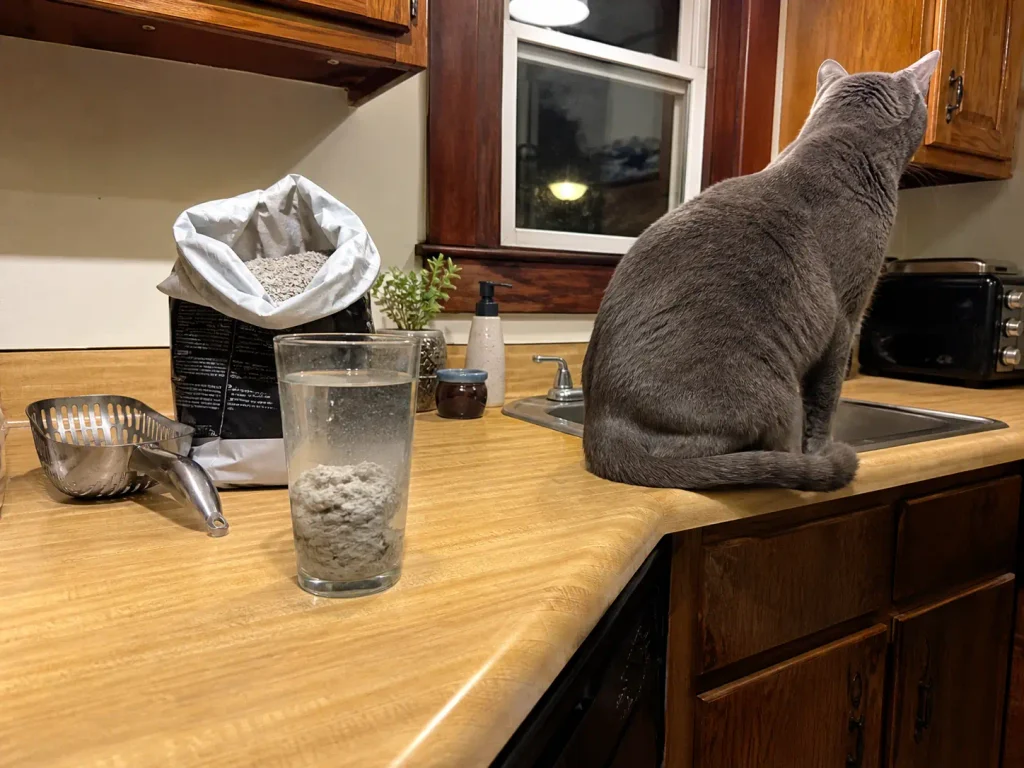
Clumping litter is one material doing one trick, and it is worth knowing which trick before deciding anything else about where each litter material actually belongs. Almost every clumping litter on the shelf is sodium bentonite clay, a volcanic ash clay that absorbs many times its own weight in liquid and, as it absorbs, expands and locks together into a solid lump. Urine goes in, a hard ball comes out. You paid for that.
The reason this matters for a kitten is not chemistry class trivia. It is that the swelling is not a side effect of the clumping. It is the clumping. There is no version of this product where you get a scoopable clump in the box and no expansion anywhere else, because they are the same event described twice.
Why the Clump in the Box and the Risk Are the Same Property
Liquid is liquid.
The clay does not check whether the moisture it just met is urine in a plastic tray or the ordinary wetness of a mouth, a throat, a gut. Webvet’s write-up, reviewed by a veterinarian, puts it plainly: sodium bentonite clumps on contact with liquids, and if it is swallowed there is a risk it absorbs moisture and clumps internally.
Swallowing a little is more often digestive upset than anything worse, and the two are not the same event. An adult cat has room and volume on its side. A nine-week-old kitten is a very small animal with a very small digestive tract, and a solid mass needs to be much smaller before it stops being a mass and starts being an intestinal blockage.
Here is the part the branded pages will not say out loud, because they all sell a bag: you cannot buy your way around this with a better clumping litter. Low dust helps with dust.
Unscented helps with rejection. Neither of them changes what bentonite does with water. And a litter that clumps less is just a litter that scoops worse. The same swelling is the reason clumping litter should never go down a toilet either, which is the same clay solving the same way in a narrower pipe.
Want to see the property with your own eyes and risk nothing? Drop a spoonful of the litter you already own into a glass of water and leave it a minute. Whatever forms in that glass is what the material does. It is the cheapest demonstration in this article, and it ends the debate faster than any page you can read.
What “Non-Clumping” Clay Is Doing Differently
Non-clumping litter is usually calcium bentonite or plain baked clay, and it absorbs liquid without knitting itself together. The tray gets damp and stays loose. That is why you cannot scoop a clump out of it, which is a genuine inconvenience and the reason nobody uses it by choice once their cat is grown.
The same looseness is exactly why it is the recommended option for a young kitten. It soaks, it does not set.
Paper pellets, pine pellets, tofu litter and unscented crystal do the same job by different routes: they absorb, they break down or stay granular, and none of them forms a rigid mass around moisture. The trade is real and it is worth naming before anyone feels tricked. You will be changing the whole box more often. That is the price, and it is a few weeks long.
Why an Adult Cat on the Same Litter Is Fine
This is where a lot of articles quietly panic their readers, so let’s be direct. An adult cat who has used clumping litter for four years without incident is not living on borrowed time. The risk here is not the litter sitting in a tray.
It is litter ingestion, and the ingestion is a developmental behavior with an expiry date. Grown cats do not chew their litter to find out what it is. They resolved that question a long time ago.
So the restriction is about age, not about the product. That distinction is the whole article, and it is also the reason the fix is temporary rather than a permanent change to how your household does litter.
The Line This Article Does Not Cross
If you found this page because you just watched your kitten chewing litter and your stomach dropped, read this section before the rest of it. Everything below this heading is about which litter to buy and where to put the boxes. None of it is about diagnosing or treating anything, and pretending otherwise would be the most useless thing a blog could do to you right now.
If your kitten is vomiting repeatedly, has gone off its food, is lethargic, is straining in the box, or has not used the box in a day: that is a call to your veterinarian today. Not a litter change, not a wait-and-see, not an article. That is the sentence, and this section does not go one word past it.
The honest reason is that nobody can tell those signs apart from a distance, and a vet can rule things in or out in about twenty minutes with the animal actually in front of them. Every page that offers to help you work it out from a screen is offering you something it does not have.
What Changing the Litter Can and Cannot Do
Swapping to non-clumping litter is prevention. It removes the material from the situation before anything happens. What it is not is a response to symptoms already underway. If something is wrong right now, changing the bag in the closet does not address what is happening in the animal, and the hours you spend at the pet store are hours.
With that said, the rest of this is genuinely useful, and it is the part where this blog knows what it is talking about: which litter goes in the box, how deep, which box, and where the boxes go so that a curious kitten never gets the chance to conduct his own research. Furniture, litter, smell, territory. That part is ours.
Why a Kitten Puts Litter in Its Mouth at All
Cat forums call it the taste-everything phase, and that is a better name than anything the veterinary literature offers. Somewhere between the day a kitten becomes litter-trained on his own, around three weeks, and roughly four months (some brands cite 12 weeks, which is the earliest end of a range, not a consensus), his mouth is his primary instrument for cataloguing the world. He does not have hands.
He has a tongue, a nose, and no reason yet to believe the gray stuff in the tray is different from anything else he has investigated today.
Read that way, the behavior stops being a defect. There is no bad kitten in this story. There is an open bag of the wrong material within reach of an animal whose only job this month is finding out what everything is.
Damp Paws and the Grooming Route
There are two ways litter reaches a kitten’s mouth, and they are not the same problem. The first is indirect and easy to miss: he uses the box, granules stick to damp paws, he sits down twenty minutes later and grooms them off. Nobody witnesses this. It looks exactly like a cat cleaning himself, because it is.
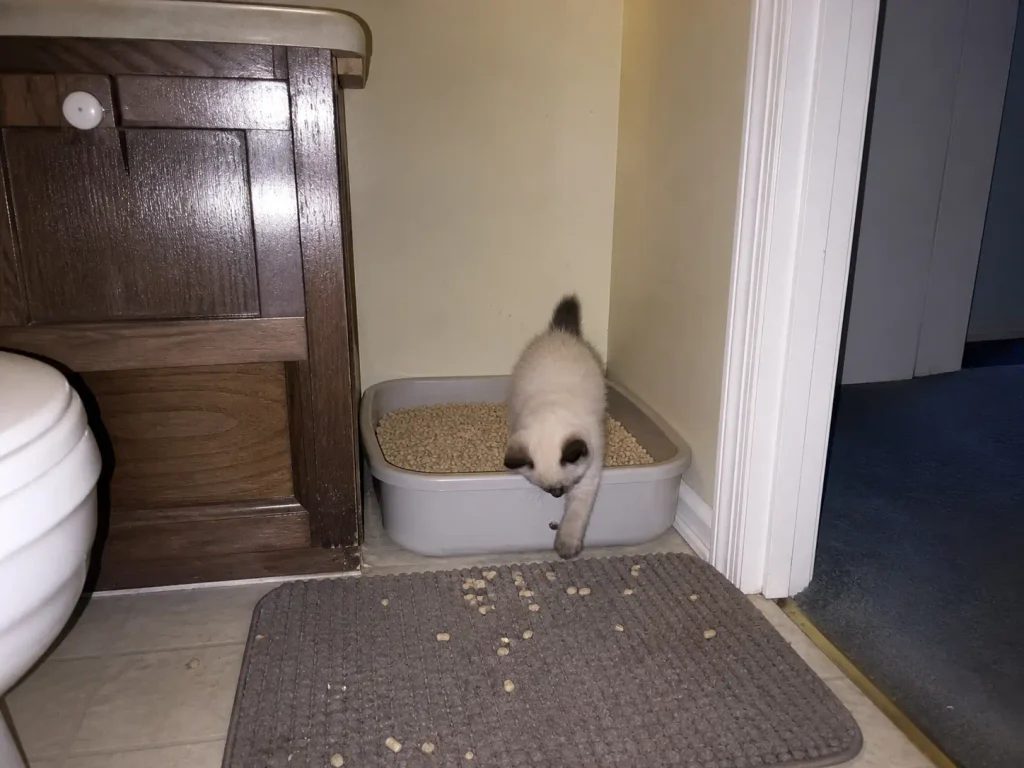
Granule size is the lever here, which is why granule size changes how much litter leaves the box on a paw is not just a tracking question when there is a kitten in the house. Fine clay grains wedge between toe pads and ride out of the box. A pellet the size of a grain of rice mostly does not. Same box, same cat, different amount of material making the trip.
Mouthing as Exploration, Not Appetite
The second route is direct, and it is the one people underestimate because it looks so obviously wrong that they assume it must be rare. The recurring story in litter threads is not a kitten who ate a mouthful once. It is a kitten who keeps coming back to the box to chew, treating it as something between a sandbox and a chew toy, three or four times a day for a week.
That pattern is the one worth designing around. A single accidental grain during grooming is a different scale of thing from a kitten who has decided the tray is interesting. And you generally do not get to choose which kind of kitten you have.
Why This Stops on Its Own
The behavior fades because the developmental window closes, not because anyone corrected it. That is worth knowing for two reasons. First, there is nothing to train here, and trying will only teach him something about you.
Second, it means the restriction genuinely ends. Four months is not a cautious guess that quietly becomes forever. It is a date.
What Goes in the Box Until Four Months
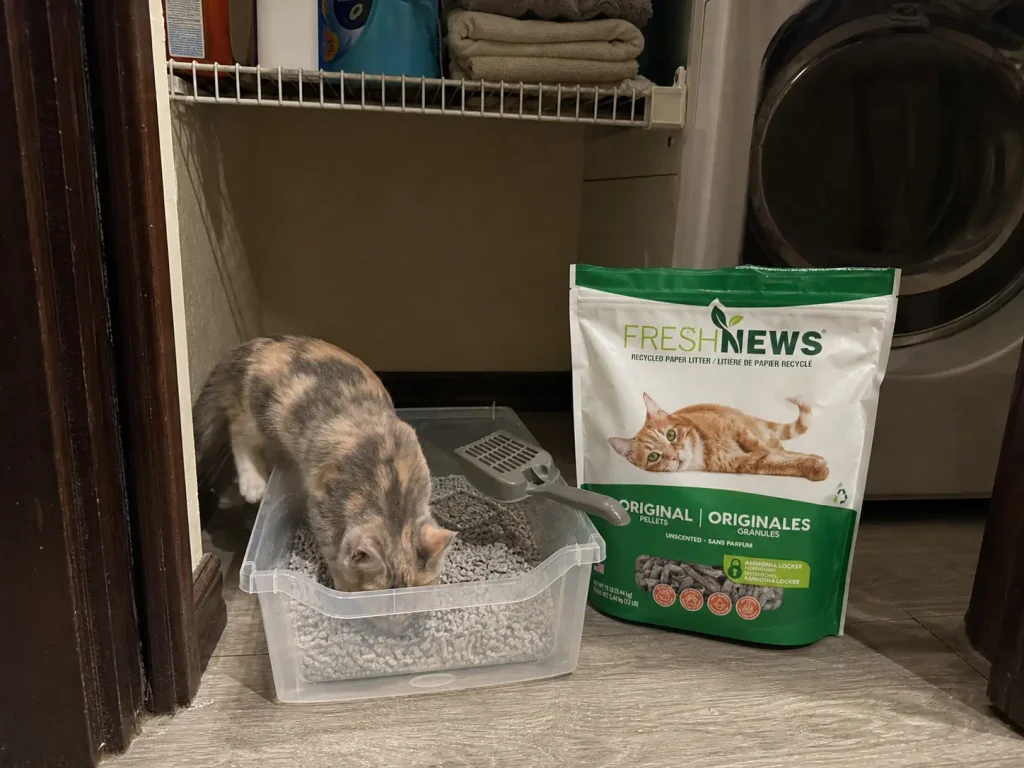
You are now at the practical question, which is what to actually put in the tray tomorrow morning. The short list of kitten-safe litter options that veterinary sources back for kittens under four months, all of them non-clumping: recycled paper pellets, plain pine or wood pellets, tofu litter, and unscented crystal. Any of the four is fine. There is no hierarchy worth agonizing over, and the one you can buy locally on a Tuesday beats the one that is theoretically superior and out of stock.
Two numbers before the materials. Keep the litter around two inches deep — deeper is not better here, it just means more material in play and more of it going over the side. And plan on scooping twice a day, plus a full box change and wash weekly rather than monthly, and keep everything unscented while you are at it, because respiratory sensitivity in a young animal is a better reason than the marketing one, because that is the real maintenance cost of non-clumping litter and you should hear it from someone who is not selling you the bag.
Paper and Pine Pellets, and What They Trade
Pellets are the sane default, and their advantage is physical rather than marketed: a pellet is large enough that it does not stick to a wet paw the way clay dust does, and if a kitten does mouth one, it breaks apart rather than setting. The trade is that pellets do not hide odor as well and they do not disappear the mess — you will see the used litter at the bottom of the tray, because that is the whole point of a material that does not clump.
The Fresh Pellet Non-Clumping Paper Cat Litter comes in a 12 lb bag and is the softest of these under very young paws, with essentially no dust, which matters for a respiratory system that is still small. It goes through faster than clay does, so a 12 lb bag is a starter supply rather than a month of peace. If you would rather buy weight and stop thinking about it, the So Phresh Pine Pellet Non-Clumping Cat Litter runs 20 lb and works out cheaper per pound; pine pellets crumble into sawdust when they get wet, which is untidy at the bottom of the box and reassuring if your kitten is a chewer. The catch is the pine smell itself, which some cats walk away from on day one.
Crystal Litter and the Fragrance Rule
Crystal is the other route, and the rule that comes with it is not optional: unscented, always. Added fragrance is a bad match for a young respiratory system, and it is one of the most common reasons a cat quietly stops using a box that was working fine. You will not get an explanation. You will get a puddle next to the tray and left to work backward from it.
I used to treat crystal as the expensive option you skip. What changed my mind is the granule size argument, which shows up over and over in litter threads once someone has a kitten and a tracking problem at the same time: silica beads are large, they do not wedge into paw pads, and they do not powder. The PetSafe ScoopFree Premium Crystal Litter is fragrance free and comes as two 4.3 lb bags, which is a small volume — this is a supplement to a pellet routine or a single-kitten setup, not the way to fill three boxes. Some cats also dislike the feel of beads underfoot and will tell you so immediately.
The Storage Bin You Already Own
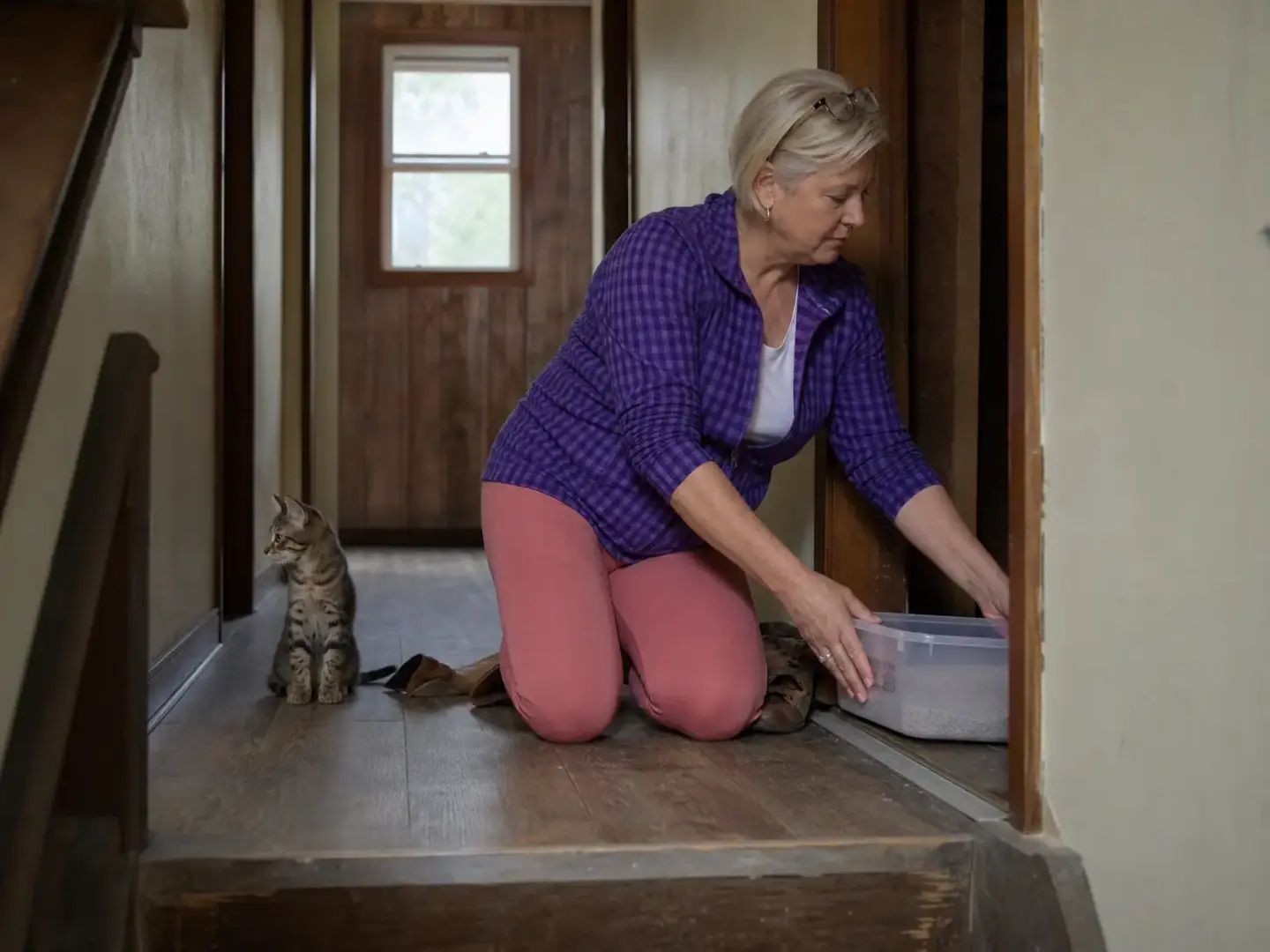
Before buying a box, look at what is already in the apartment. A shallow storage bin, the low-profile kind that slides under a bed, is a better kitten box than most things sold as kitten boxes, because the specification that matters is entry height and nothing else. Cornell’s Feline Health Center recommends a box with a low entry edge for kittens, and most standard adult boxes fail that bar for an eight-week-old by a couple of inches.
Footprint can stay small for now. He is small.
And if you were eyeing the self-cleaning box on the shelf instead, that is its own age question — whether a kitten can use an automatic litter box has a shorter answer than you would like. What cannot be negotiated is the lip he has to clear to get in, because a kitten who has to jump into his own box is a kitten shopping for somewhere easier. That is free, it takes no shipping time, and it is the right first move.
The entry edge decides more than the material does. If a kitten has to jump to get into his box, he will find somewhere he does not have to jump into, and in a house with an older cat that somewhere is usually the adult’s box. Which is the one box in the apartment full of the exact litter you are trying to keep him out of.
When There Is Already an Adult Cat on Clumping Litter
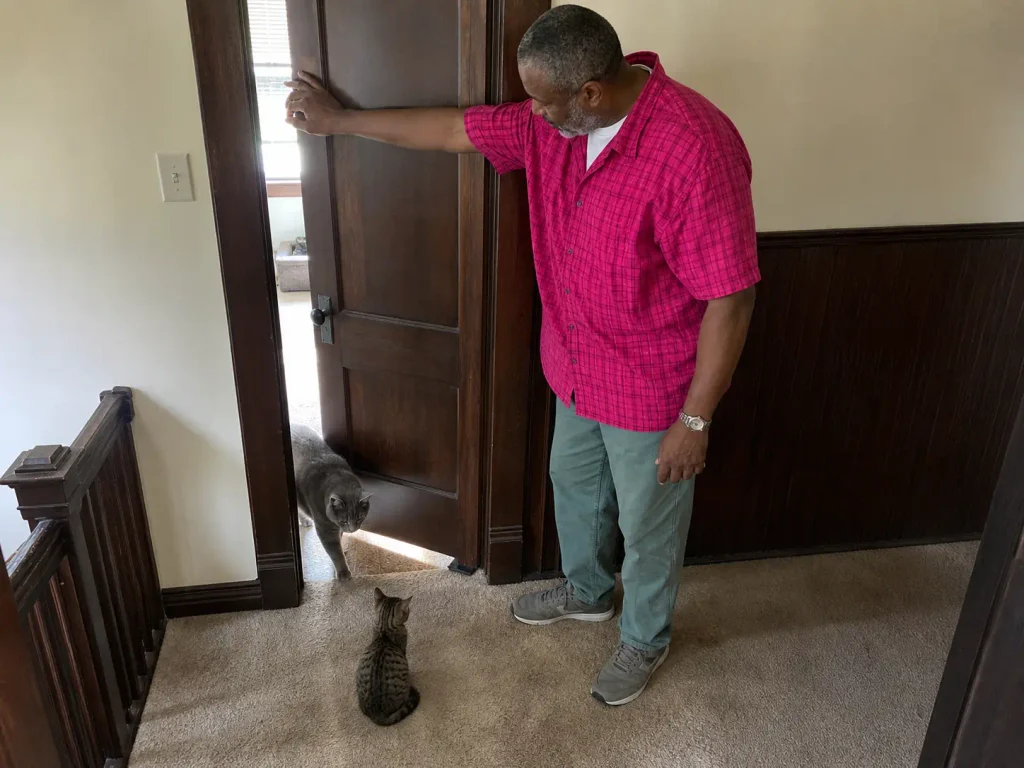
Every article on this search result tells you not to buy clumping litter. That advice is worth nothing to the household that actually searches this, because in that household the bag is already open, it was bought for a cat who has been using it for years, and a new kitten moved in on Saturday. Nothing about the litter changed. Only who is in the room changed.
So the real question was never which litter to buy. It is how to divide an apartment between two cats with two different requirements, and that has a real answer.
Two Setups, Not One Compromise
Do not convert the adult. Running two litters at once is not a messy workaround, it is the supported approach: the AAHA/AAFP feline life-stage guidelines note that offering separate boxes lets a cat show its own litter preference, which is guideline language for something cat households already know. Forcing a settled adult onto pellets to solve a kitten problem tends to produce a second problem next to the box, and now you have two.
The resident cat keeps his box and his litter. The kitten gets his own, with non-clumping in it. For a few weeks the apartment runs two systems. That is all this is.
How Many Boxes, and Where They Go
The n+1 rule applies: one box per cat, plus one. With an adult and a kitten that is three, and three is the number if you want the kitten genuinely uninterested in the adult’s tray. Two is workable when the space honestly does not allow a third, and then the placement rule stops being optional: different rooms, not side by side. Two boxes against the same wall are one box with a divider as far as either cat is concerned, which is the same logic behind the box count for a two-cat household, and the exception to it.
Put the kitten’s box wherever he already spends his time, which in the first weeks is usually one room and a favorite corner of it. Put the adult’s box somewhere the kitten has to work to reach.
Keeping the Kitten Out Without Watching the Door
The failure that keeps repeating in these threads is not a bad decision. It is timing: the second box does not go in until the kitten is already found nosing around the adult’s box, and by then the whole “don’t buy clumping” conversation is several days late. Set up the kitten’s box the day he arrives, not the day something worries you.
For access, use geometry rather than supervision.
Height works, because an adult cat jumps and a nine-week-old does not yet: a box on a low shelf or a raised surface the adult clears easily is a box a kitten cannot casually raid. A door left ajar on a hook works, wide enough for a grown cat, narrow enough to be a project for a kitten. A baby gate works. All of these are more reliable than you being in the room, because you will not be in the room at four in the morning.
A baby gate with a cat-sized opening at the bottom is the cheap version of this: the adult strolls through, the kitten is too round and too uncoordinated to make the same trip for a few weeks. It only has to hold for the exact number of weeks the restriction lasts, and then it goes back in the closet.
The Switch Back, on a Schedule
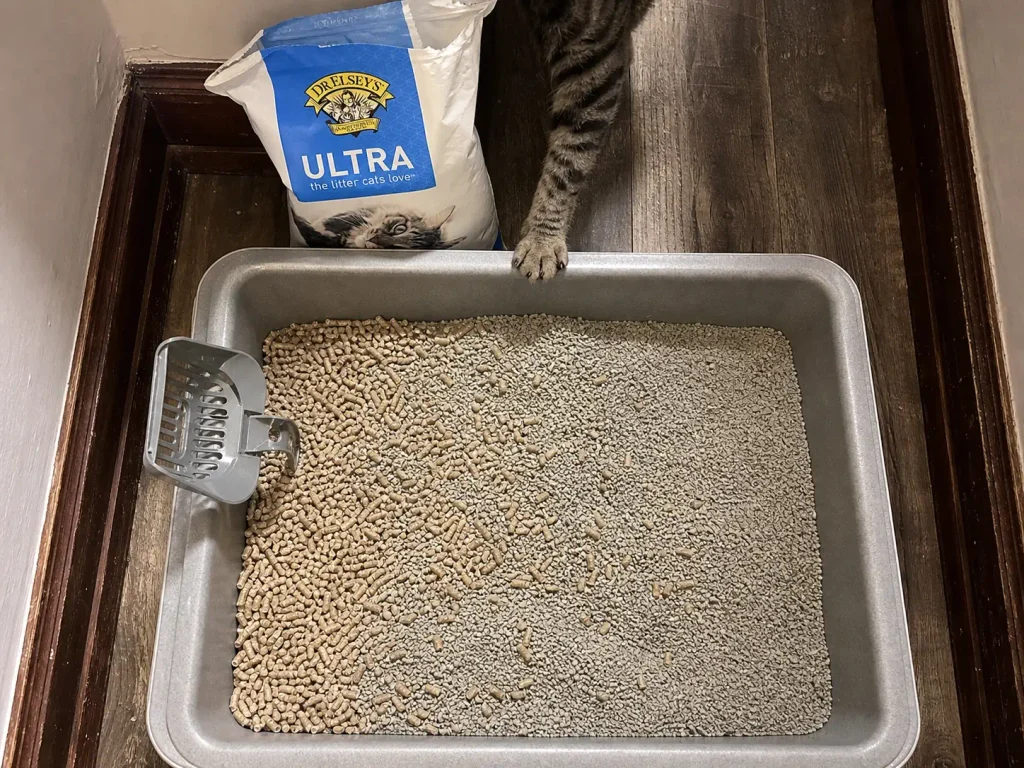
At four months the reason for all of this expires. He is bigger, he has stopped auditing the world by mouth, and clumping litter becomes an ordinary purchase again. What trips people up is the shape of the ending: they treat the four-month mark as a switch to flip, dump the whole tray, refill it with clay, and get a cat who declines the new arrangement.
A cat who has used the same texture under his feet for two months has an opinion about it, and in a multi-cat household you are running that opinion twice. Handing him a completely different one overnight is how you trade a safety problem for a rejection problem. A gradual switch is not politeness, it is the only version that holds.
The Ten-Day Ladder
Mix, do not swap.
Start at about a quarter clumping to three quarters what he is already using and hold it two or three days. Move to half and half around day three. Go to three quarters around day seven, and complete the change around day ten. Ten days is not a magic number, it is just slow enough that no single morning feels different to the cat.
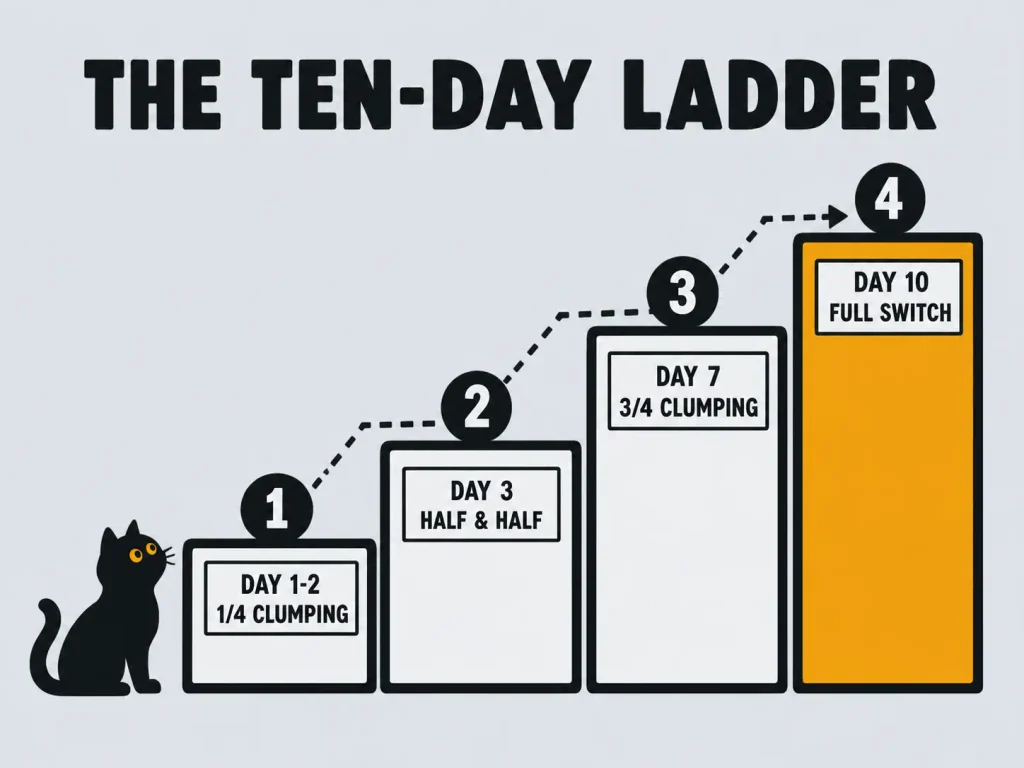
The reason for the ladder is the part every other page skips, and it is not only about palatability. At every rung there is less clumping clay physically present in the tray than there would be after a straight swap. You are ramping the material up while the last of the exploring behavior is ramping down, so the two curves never meet at full volume. That is a safety margin, not just good manners toward a fussy cat.
When you get to the top of the ladder, what you want is low dust and no fragrance, which is most of the argument for Dr. Elsey’s Ultra Unscented Clumping Clay Cat Litter as the destination — it comes in a 40 lb bag, which is the best value per pound in this category and also a bag you have to carry up the stairs. If you live on a fourth floor with no elevator, that number stops being an abstraction.
What Backtracking Looks Like
The signal that you moved too fast is specific and it is not subtle: he starts going right next to the box instead of in it. Not across the apartment, next to it. That is a cat who still recognizes the location and has declined the contents.
When that happens, go back a rung and stay there longer. Half and half for five days instead of three. There is no penalty for a slow transition and there is a real one for a fast one, and if it takes three weeks instead of ten days, nothing is lost.
What Happens to the Non-Clumping Bag You Have Left
Do not throw it out. Keep a few pounds of the non-clumping litter you were using, because it is the thing you reach for whenever a box needs to be somewhere temporary: a carrier setup, a sick-day tray by the bedroom, a second box while you rearrange the apartment. It stores indefinitely and it weighs nothing to keep.
The rest you can hand to whoever in your building just got a kitten, which will happen sooner than you think. And when you are choosing what to run permanently, how the clumping decision changes with how many cats you have is the next thing worth reading, because box count changes that answer more than anything on the bag does.
Conclusion
Clumping litter is not risky because it clumps. It is risky because of the age of the animal standing in front of it, and that restriction has an expiry date at four months. Everything in this article is temporary by design.
If there is already an adult cat in the apartment, nobody has to be converted. Two setups in two rooms, a box the kitten can step into rather than jump into, and one door left ajar solve more than any purchase does. And when the four months are up, the change back takes ten days and four rungs, not one morning and a full tray.
Come back to this in three weeks. That is long enough to know whether the kitten took to his own box, and it is exactly when a new routine like the second tray and the twice-daily scoop starts to slip.
Start with the free move: put the adult’s box in a room you can leave ajar. That costs nothing, and if the kitten stops raiding it, you just solved the whole problem before buying anything.
Amazon’s Audible — free for 30 days
Your cat won’t let you read. Let someone read to you.
Audible is Amazon’s audiobook library — thousands of titles, read out loud, on your phone. Free for a month, plus one audiobook to keep forever.
Frequently Asked Questions
01What age can kittens use clumping litter?
Four months is the line the National Kitten Coalition draws, and it is the one worth following. Some brands market a kitten-specific clumping litter from two months, which sits below the general consensus. When a brand’s own cutoff is earlier than everyone else’s, that is a marketing number.
02Is non-clumping litter better for kittens?
For a kitten under four months, yes, and it is the only part of this that is simple. It costs you the ability to scoop a clump out, so you change the whole box more often. That trade lasts a few weeks, not forever.
03What happens if a kitten eats clumping litter?
A single accidental mouthful is not the pattern that causes problems. The concern is a kitten that keeps returning to chew. If your kitten is vomiting, off its food, lethargic, or has stopped using the box, that is a call to your vet today, not something to work out from an article.
04Can I use clumping litter for the adult cat and something else for the kitten?
Yes, and it is usually the right answer. The AAHA/AAFP guidelines note that separate boxes with different litters let each cat show its own preference, so you are not forcing one compromise on both. Put them in different rooms and keep the adult’s box somewhere the kitten cannot easily reach.
Leave a comment