Best Litter Box Cabinets That Vent, and Ones That Don’t
A Litter-Robot 4 needs 22 x 27 in of floor and 2 in clearance per side. Which litter box cabinets actually give you that (and which don't).

Alfredo RamsesFounder · August 25, 2026 · 24 min read

On this page8 sections
- 1Why a Closed Cabinet Can Smell Worse Than an Open Box
- 2The Clearance Number the Listing Doesn't Give You
- 3What Airflow Looks Like on a Cabinet You Can Actually Buy
- 4One Cat, Two Cats, and the Cabinet That Only Holds One
- 5If You're Putting an Automatic Unit Inside It
- 6Weight, Anchoring, and the Renter Problem
- 7The Short Version
- 8Frequently Asked Questions
The cabinet door is closed, the room still smells, and now the smell has a location: it sits right at the height of the little vent slot, sharper than it ever was when the box was out in the open. That is not a defective litter box cabinet. That is what a box does inside a sealed wooden box, and the fix is almost never a nicer cabinet. What follows separates the ones that move air across the box from the ones that just put a door between you and the problem, using interior clearance numbers most listings never publish.
Quick Answer
Four things decide whether a litter box cabinet works, and only one of them is on the listing.
- Air has to cross it. An entry hole on one side and a vent or gap on the opposite side, not one opening doing both jobs.
- Interior clearance decides, not exterior size. The cat has to turn all the way around inside without touching a wall.
- One cabinet is one box. Two cats still need the count met elsewhere in the home.
- Before buying: move the box you own to a spot with airflow and scoop twice daily for a week. If the smell goes, the cabinet was never the fix.
Why a Closed Cabinet Can Smell Worse Than an Open Box
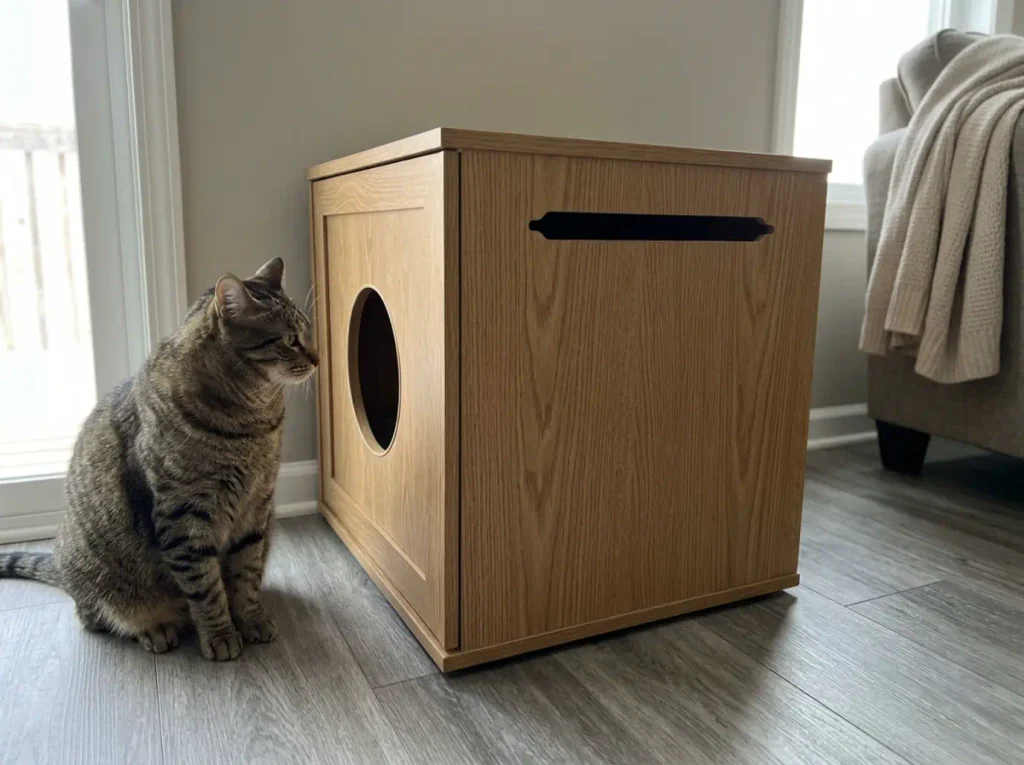
Nothing got dirtier when you closed the door. The amount of ammonia in your home did not go up. What changed is that it stopped dispersing into a whole room and started collecting inside about four cubic feet of enclosed wood, and every time the door swings open it comes out at once.
That is the mechanism nobody selling this furniture explains, and it is the entire reason to read past the product photos. It sits one level down from what an enclosure actually changes about the box inside it, which is the broader question; a cat litter box cabinet is only one shape the answer takes, and it is the shape this article is about.
Ammonia builds where air does not move. A cabinet does not neutralize anything, it holds it in a smaller volume, and a smaller volume means a higher concentration. This is the same thing a lid does to a plain covered litter box, and it fails for the same reason: the box design decides where the smell ends up, not how hard you clean.
The manufacturer-side guidance on this is unusually honest about it. Real odor control in a cabinet is ventilation slots plus a carbon filter, and the filter is a replacement item every four to six weeks, which makes it a running cost rather than a feature you buy once.
Here is the part that decides who is right in the room. You are standing at five and a half feet. The cat has his head at the height of that entry opening, which is where the ammonia smell is most concentrated and where the air is oldest.
When the smell in the living room drops after you install the cabinet, that is real, and it is also not the same thing as the smell going away. You solved your problem and made his worse.
Open the cabinet door and put your face down at the height of the cat’s opening before you buy anything else. If that air is sharp and the room is not, the cabinet is holding odor, and no product on this page fixes that until air can cross the box.
The failure story that repeats in enclosure threads is never a product breaking. It is someone three or four months in reporting that the cabinet “still smells,” and when the details come out, the vent was missing or it was one small slot in the same panel as the door. The cabinet was working exactly as built. It was just built to hide a box, not to ventilate one.
So the free move comes first, and it comes before you spend anything. Take the box you already own, move it somewhere with genuine air movement, and scoop it twice a day for one week. Not once. Twice.
Ammonia does not creep up gradually. It shows up when urine has been sitting somewhere around a day and a half, which is why the smell seems to arrive on a specific afternoon rather than building all week, and why no cabinet on this page changes the fact that you scoop daily. If seven days of that clears the room, you just learned the cabinet was solving a visibility problem you also happen to have, and you can shop for one on looks with a clear conscience.
And if a cat who used the box happily for months suddenly stops going in at all, that is a vet visit before it is a furniture decision. Everything below assumes that part is already cleared.
The Clearance Number the Listing Doesn’t Give You
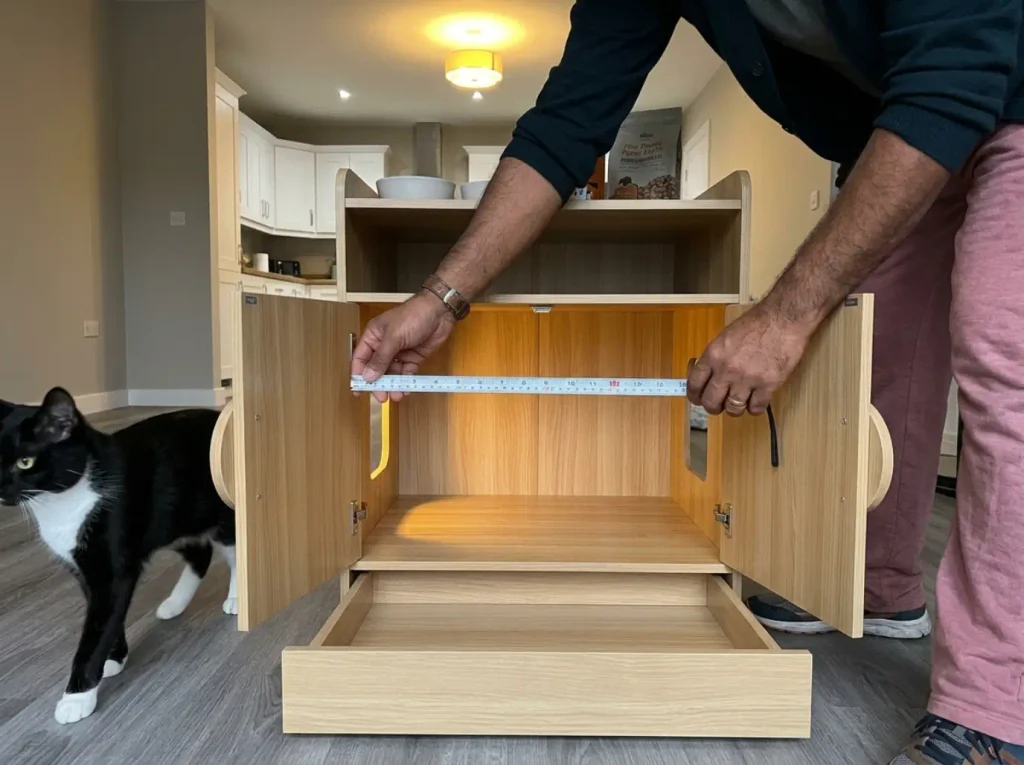
Every listing publishes exterior cabinet dimensions, because exterior dimensions are what has to fit against your wall. The cat lives on the inside, and the inside is smaller than the outside by the thickness of four walls, a door frame, and whatever the hinges intrude.
One thing that makes this harder to shop for: the same piece of furniture is sold under about six different names. A credenza litter box, a litter box console table, a litter box side table, a night stand litter box, a bench litter box cover, a tv stand litter box. These are marketing categories, not different products, and the measuring problem is identical across all of them. Search all six and you will see the same three factories.
The gap between exterior and interior is where this goes wrong. A cabinet technically fits the box, the cat will not walk into it, and the furniture gets blamed last instead of first.
Here is that gap with real numbers, using the one cabinet on this page that publishes its interior. The Hzuaneri measures 31.4 by 19.6 inches on the outside and 20.7 by 18.3 inches in the main compartment, so four walls and a door eat about eleven inches of width and an inch of depth before the cat sees any of it.
Now apply the two inches per side. An interior of 20.7 by 18.3 supports a box of 16.7 by 14.3 and no larger.
The listing’s own compatibility chart offers three boxes: an open pan at 17.5 by 15, a covered box at 18.7 by 15.7, and a large covered box at 19.3 by 16. Every one of them physically fits. Not one of them clears two inches per side. The largest leaves seven tenths of an inch beside the box.
That is not a bad cabinet, and it is not a dishonest chart. Fits and works are two different questions, and the chart only answers the first one. Ask the second one yourself, with a tape measure, before the thing is assembled in your living room.
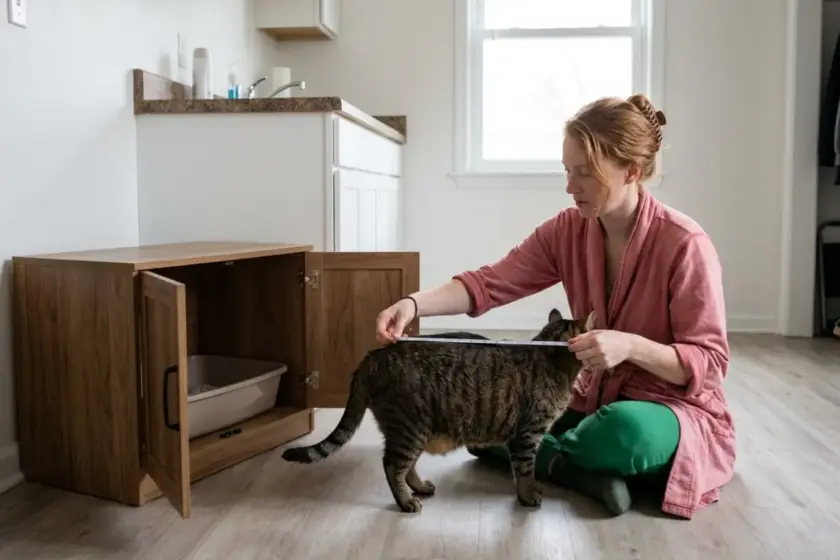
Measure the Box You Own, Then Add Turning Room
The unit of measurement here is not the box footprint. It is the box footprint plus the cat turning radius, the room he needs to rotate. A cat entering a box turns around before he does anything, digs, turns again, and covers, and every one of those movements needs clearance on all four sides. A box that sits flush inside a cabinet gives him a corridor, not a room.
Start from the animal, not the furniture. The sizing math for a box begins at the cat’s own length, nose to tail base, times about one and a half, which is the same math that decides whether a covered box was ever big enough. Then the cabinet has to hold that box with room around it.
A large cat compounds this fast. A big Maine Coon at full stretch needs a box most brands do not sell as standard, and then a cabinet that most brands do not build.
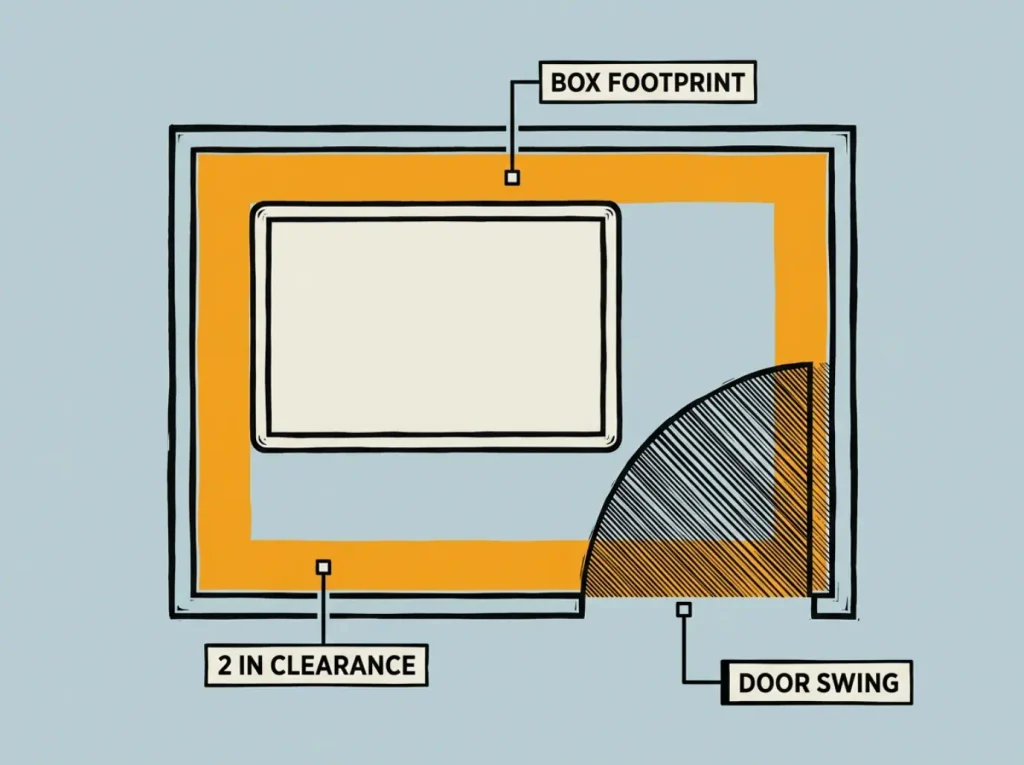
Two Inches of Clearance Per Side Is the Working Minimum
Two inches on every side is the figure the manufacturer side of this category actually publishes, and it is the difference between a box that fits and a box that gets used. It sounds small written down. Held against a tape measure it is the width of two fingers between the box wall and the cabinet wall, which is roughly what a cat needs to walk past without dragging his flank along particleboard on every visit.
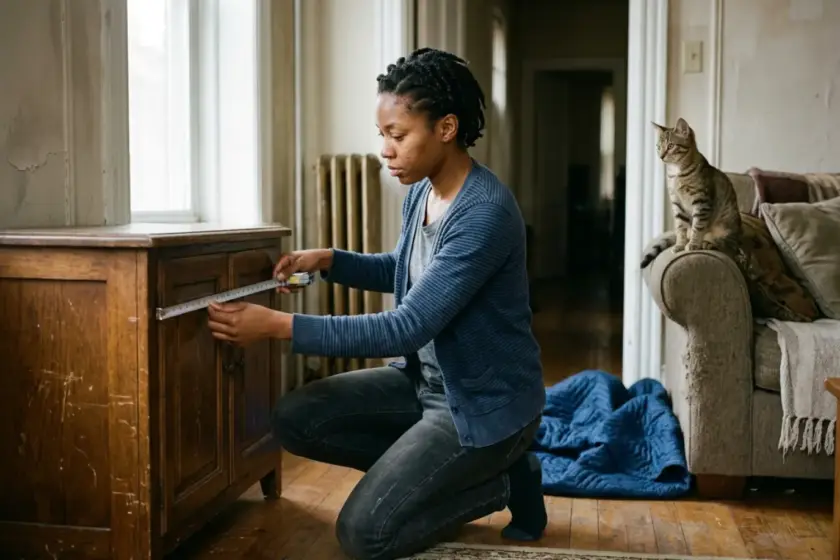
Run the arithmetic before you shop, not after. A box measuring 18 by 21 inches with two inches per side needs 22 by 25 inches of clear interior. That is the number to hunt for on a listing, and most listings do not print it. When one does, it deserves credit for it.
Two pieces of hardware are worth checking at the same time, because they decide what the thing is like to live with rather than what it looks like. A soft-close hinge stops the door from clapping shut behind a cat who is already unsure about the box, and a magnetic door closure is what keeps that door shut against a determined shoulder. Neither shows up in a photograph. Both show up every single day.
And look for waste drawer access specifically, meaning a tray or drawer that slides out with the box on it. The difference between sliding a drawer and kneeling down to reach through a door at floor level is the difference between a two-minute chore and one you start skipping.
Interior Shape Matters as Much as Interior Volume
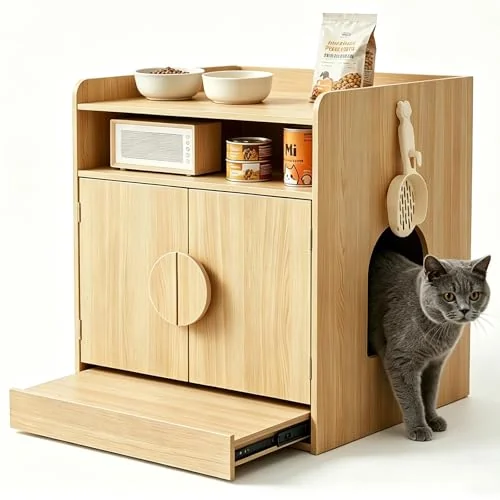
Two cabinets can have identical exterior dimensions and completely different usable interiors, because they were designed around different objects. A drum-style automatic unit is round and tall and wants height in the middle. A tray-style box is flat and wide and wants floor area. A cabinet built for one will waste space on the other, and the cubic inches it advertises will sit in a corner nobody can use.
Then there is the door, which nobody counts. When it swings inward, the inside face of that door is part of the interior the cat walks past. When it swings outward, it stops being a clearance problem and becomes a floor problem in a small room. Either way it eats something.
The complaint that shows up over and over in these threads is not “it didn’t fit.” It is “it fit and he won’t go in.” Those are the same problem wearing different clothes, and the second one is the one people mistake for a behavior issue.
What Airflow Looks Like on a Cabinet You Can Actually Buy
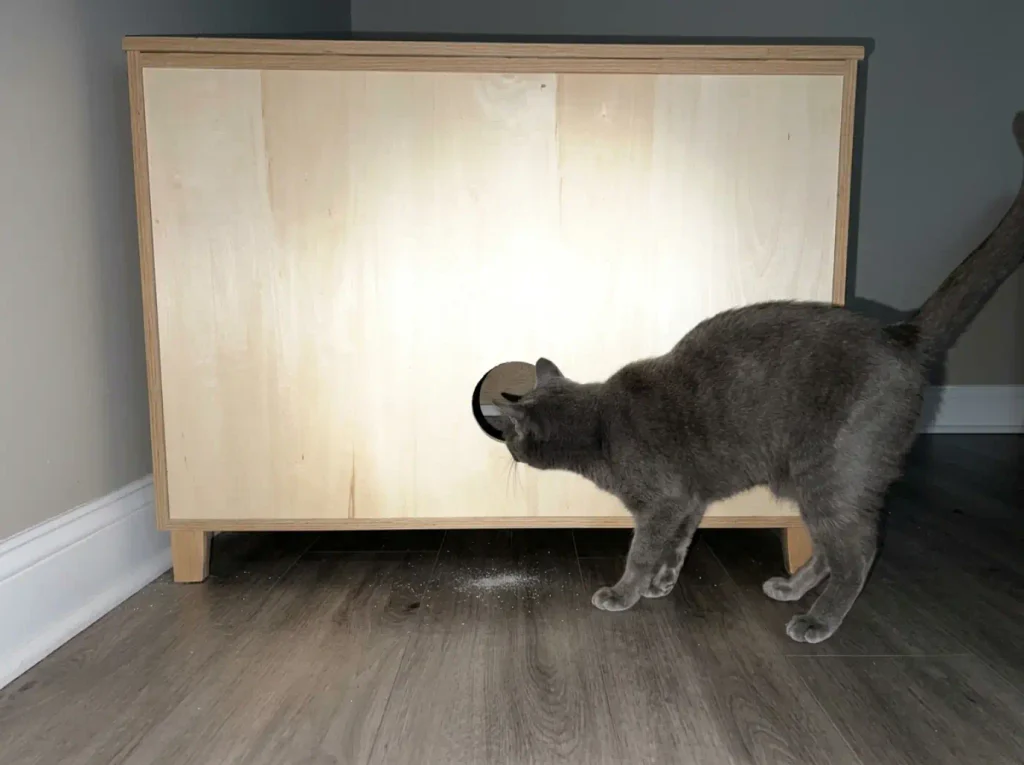
The word “ventilated” appears on listings that have exactly one hole in them, and that hole is the door the cat walks through. You are buying from photographs, so you need to know what a working vent looks like in a photograph. That turns out to be a short checklist.
Two Openings on Opposite Sides, or It Isn’t Ventilation
Air needs somewhere to leave. One opening is an entrance, and an entrance alone gives you a pocket of still air that only moves when the door opens. Two openings on opposing faces give you a path, and a path is what carries ammonia out rather than concentrating it at the threshold.
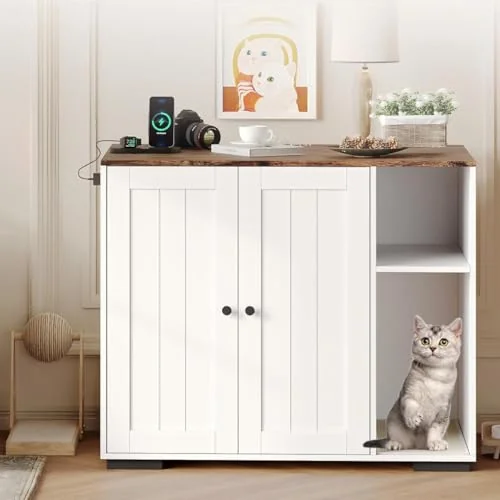
What counts as the second opening is either a ventilation cutout in a side or rear panel, or a mesh panel set into one of the faces. Mesh is the better of the two, because it passes air across its whole area rather than through a slot the size of a mail opening. That is the whole test, and it takes five seconds on a product photo.
On any listing photo, find the second opening before you read the description. If the only opening you can find is the door the cat walks through, the airflow claim is a word, not a feature.
What a Carbon Filter Does and What It Costs You
Carbon filters work. That is not marketing, and this category earns few enough honest claims that it is worth saying plainly. What the listing leaves out is that a filter is consumable. Every four to six weeks it gets replaced, forever, or it becomes a piece of gray felt stapled inside a wooden box doing nothing at all.
That is a small, permanent line item nobody puts on the product page, and it is exactly the kind of thing that gets forgotten around month three, which is also when people start writing reviews saying the cabinet stopped working. It did not stop working. The filter did.
The Features That Look Like Airflow and Aren’t
A sisal-covered door panel is a scratching surface, and it is a nice one, but a mat of woven fiber over solid wood does not pass air. A decorative slot cut above the base looks like a vent in a photo and is often two inches long. And the most common one: a rear vent that works perfectly on a warehouse shelf and stops existing the moment you push the cabinet against the wall it was bought to sit against.
Which is why where the cabinet ends up decides whether its vents do anything more than the vent spec itself does. Pulling the unit an inch off the baseboard is free, takes one push, and reactivates a vent you already paid for.
There is a whole DIY tradition built on this complaint. IKEA-hack communities cut their own openings into Besta units and HOL crates precisely because the commercial cabinets ship under-vented, and some go to metal lockers instead on the grounds that metal does not hold odor and wipes clean. Those people are not being thrifty for its own sake. They are correcting a design flaw the market has decided not to fix.
One Cat, Two Cats, and the Cabinet That Only Holds One
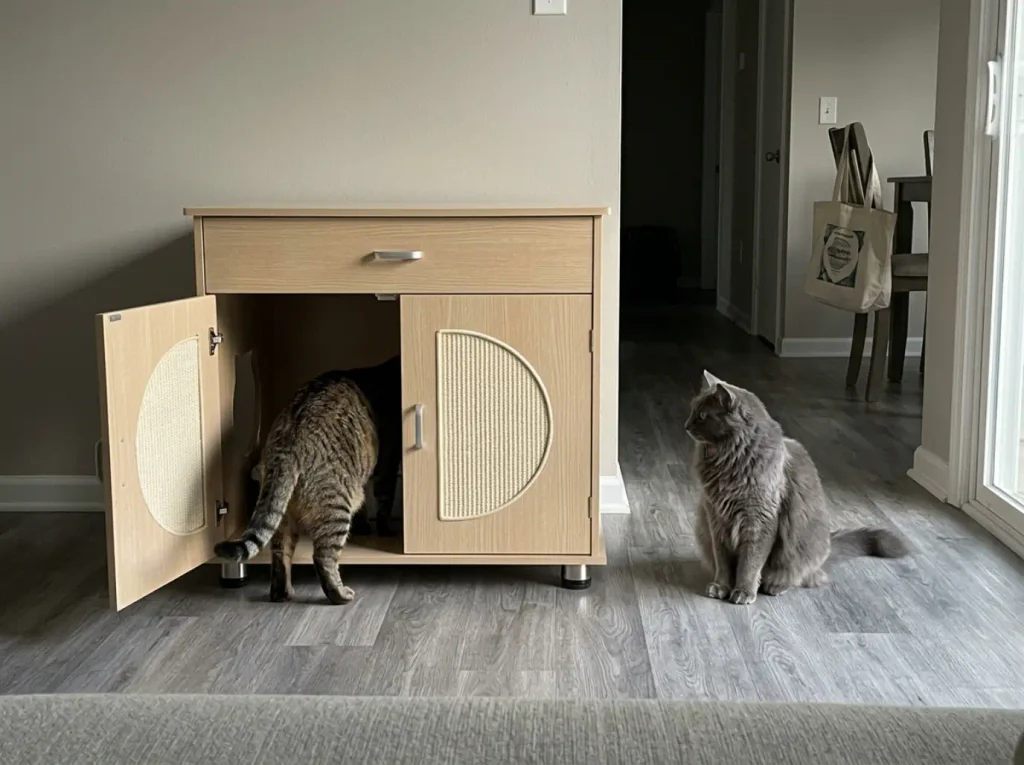
This is the cheapest gap in the entire category, and almost nobody takes it. A cabinet is one box, and cats do not count boxes, they count locations, which is why a multi-cat household cannot buy its way out of the problem with a single nice piece of furniture.
A Cabinet Is One Location, and Cats Count Locations
The 1+1 litter box rule says one box per cat plus one spare, and it does not bend for furniture. Two cats need three boxes, and a cabinet is one of them at most.
People sometimes try to solve this by putting two boxes inside one wide cabinet, which is a reasonable-looking idea that misses the point of the rule. The count is not about litter capacity. It is about not having to meet the other cat at a doorway.
Two boxes in one cabinet is one location with two openings in it. From the cat’s side of the argument, that is still a single spot with a single approach, and the cat who is second in line is the one who starts looking elsewhere.
The Wide Cabinet Is Not Two Boxes
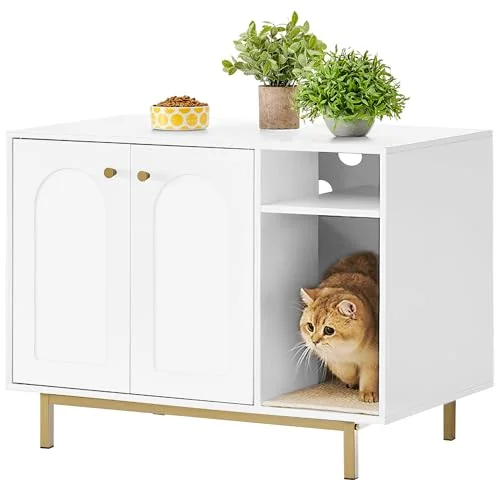
Extra width is worth real money in this category. It buys turning room, and it lets you use a genuinely large box instead of the “large” one that measures fifteen inches inside.
Both of those are true benefits and neither of them is a second station. A forty-inch cabinet is a better one box. It is not two.
I used to think a wide unit was the multi-cat answer and would have said so. Reading enough of these threads changes it: the households that resolve the problem are the ones that put the third location in another room entirely, not the ones that bought bigger furniture. The cabinet handles the box that lives where guests can see it. The rest of the count gets met where nobody is decorating.
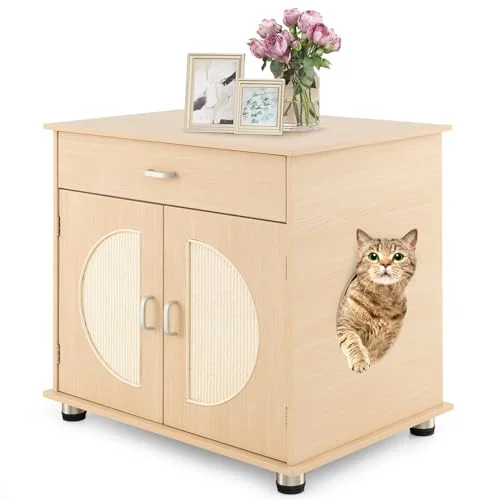
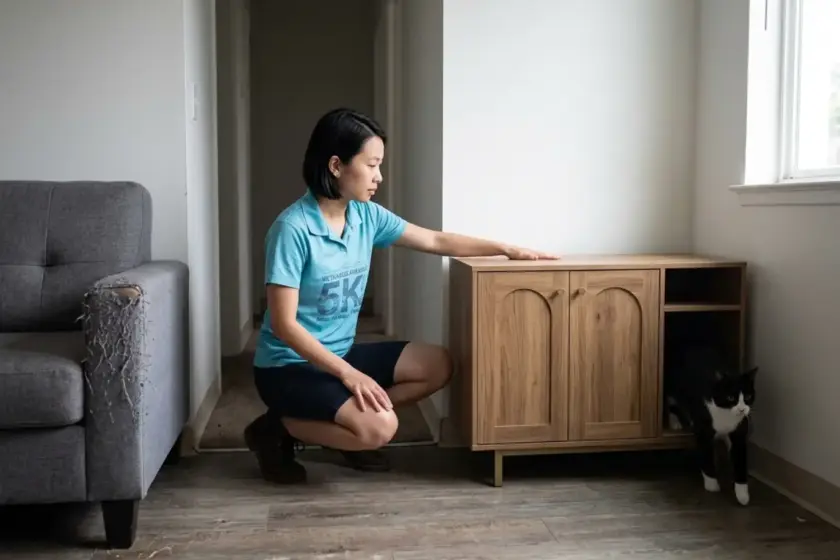
The single-cat version of the same idea gives up less floor, which is the whole argument for it as a small space litter box solution in a one-bedroom where the cabinet has to live in a room people use.
There is a side benefit worth naming here, because it is one of the few things an enclosure genuinely does well. Walls contain litter kicking, so the granules a cat flicks backward hit wood instead of a baseboard four feet away, and an entry mat catches most of what rides out on his feet. That turns litter tracking into a small pile in one known spot rather than a trail through the apartment.
What a Two-Cat Home Actually Needs Alongside the Cabinet
There is a second reason the arithmetic matters here, and it goes straight back to the first section. Two cats in one enclosed volume is double the ammonia load in a space that was already short on air. Whatever the vent was managing with one cat, it is now managing with two, and the concentration climbs faster than the smell in the room tells you.
And watch what the cats do rather than what you would prefer them to do. A second cat sitting outside the cabinet door is queueing, and a cat who has to queue for a resource starts scouting alternatives. The alternative he finds is rarely one you would have picked.
If You’re Putting an Automatic Unit Inside It
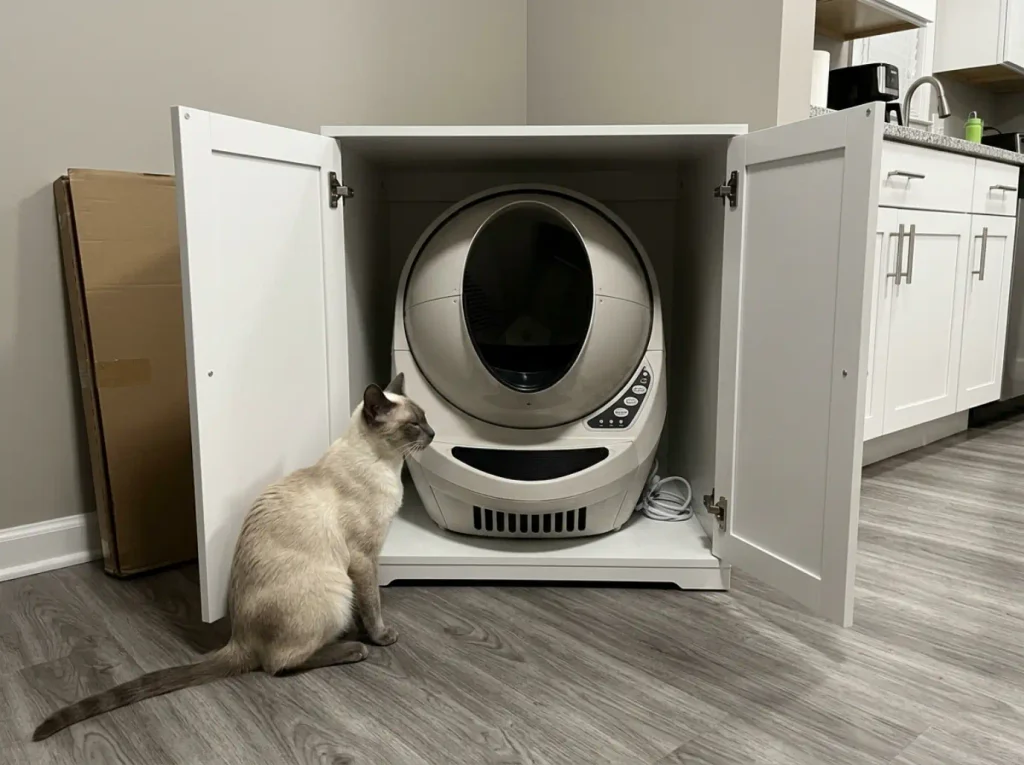
You spent real money on a self-cleaning unit and now there is a large piece of white equipment in your living room. The official furniture made for it is either unavailable or costs about as much as the machine, so you are searching litter robot cabinet and litter robot enclosure and looking at third-party furniture with no way to check the fit. Here are the numbers to check it with.
| Cabinet | Usable interior | Fits a drum-style automatic unit | Cord path | Best for |
|---|---|---|---|---|
| Garvee | 27.75 x 24.8 x 30.3 in | Yes, purpose-built | Built-in outlet, 5 ft cord | Automatic units |
| Tangkula | ~40 in wide, manual box | No | None | Multi-cat, larger manual box |
| JanflyHome | 18.11 x 21.65 x 15.35 in | No | None | Small spaces, daily-clean access |
| Hzuaneri | 20.7 x 18.3 x 18.7 in interior | No | None | One cat, small apartment |
The Footprint You’re Actually Fitting
A Litter-Robot 4 has a 22 by 27 inch footprint on the floor, a 15.75 by 15.75 inch entryway, and a globe running roughly 15 to 17 inches high by 19 wide by 18 deep. Those are the numbers to measure a cabinet against, and then you add the two inches per side from earlier, because the machine having room is not the same as the cat having room. That lands most drum-style units needing something in the region of 28 inches wide and deep inside.
Measure your own unit anyway. Model generations change dimensions, and the phrase “fits most automatic units” on a listing has never once meant anything.
The Cord Has to Go Somewhere
This is the detail no listing addresses and everyone discovers on assembly day. An automatic unit needs power, power means a cord, and a cabinet with no cord channel gives you exactly two options: a door that will not close, or a hole somebody drills through the back panel at nine in the evening with the wrong bit. Neither is a disaster. Both are worth knowing about before the box is opened rather than after.
Noise, Which the Cabinet Does Help With
A cabinet muffles motor noise, and that is one of the very few comfort claims in this category with an actual mechanism behind it: mass between the machine and the room. In a thin-walled apartment that is not a small thing, because a drum cycling at three in the morning twenty feet from a bed is one of the most common reasons these units get returned. If noise is the reason you are here, a cabinet muffles the motor, which matters more in a thin-walled apartment than any of the decor arguments.
A word about the obvious default before the pick. The market-leading brand makes its own cabinet for its own machine, and it has been going unavailable across several versions; on the brand’s own store it sat at 2.9 out of 5 across 27 reviews, with assembly and door alignment as the recurring complaints. The safe-looking choice in this category is not automatically the safe one.
Weight, Anchoring, and the Renter Problem
Everything above treats this as a cat decision. This last part treats it as what it also is: buying a substantial piece of furniture, which comes with consequences the cat pages never mention and the furniture pages take for granted. If you are renting, renter-friendly furniture means something specific here, and it is not about the finish.
A Cabinet Sold on Amazon Was Recalled for Tip-Over Risk
Not hypothetically. A Homfa cabinet sold on Amazon, measuring 29.75 inches high by 31.5 wide by 15.4 deep and weighing 59 pounds, was recalled specifically for tip-over risk. Look at those dimensions again and then look at the cabinets on this page. Same class of object, near enough the same proportions: tall, narrow front to back, heavy, with a door that swings open.
That is the exact shape the CPSC’s mandatory furniture stability standard was written around. ASTM F2057-23 requires units in this family to pass a test simulating a 60-pound child leaning on an open door, and the reason it exists is that tip-overs account for roughly 10 fatalities and 5,300 injuries a year nationally. The fact that a cabinet sold on Amazon was actually recalled for this is what turns this from a generic caution into a spec to check.
The No-Drill Version
The standard fix is a wall anchor, and the standard fix assumes you are allowed to put screws in a wall. Plenty of readers here are not, which is the unspoken catch in most apartment litter box furniture advice. The substitute the renting community actually uses is a clamp-style anti-tip tether, which grips the furniture and a fixed point without a single hole, and it belongs on the shopping list rather than in a footnote.
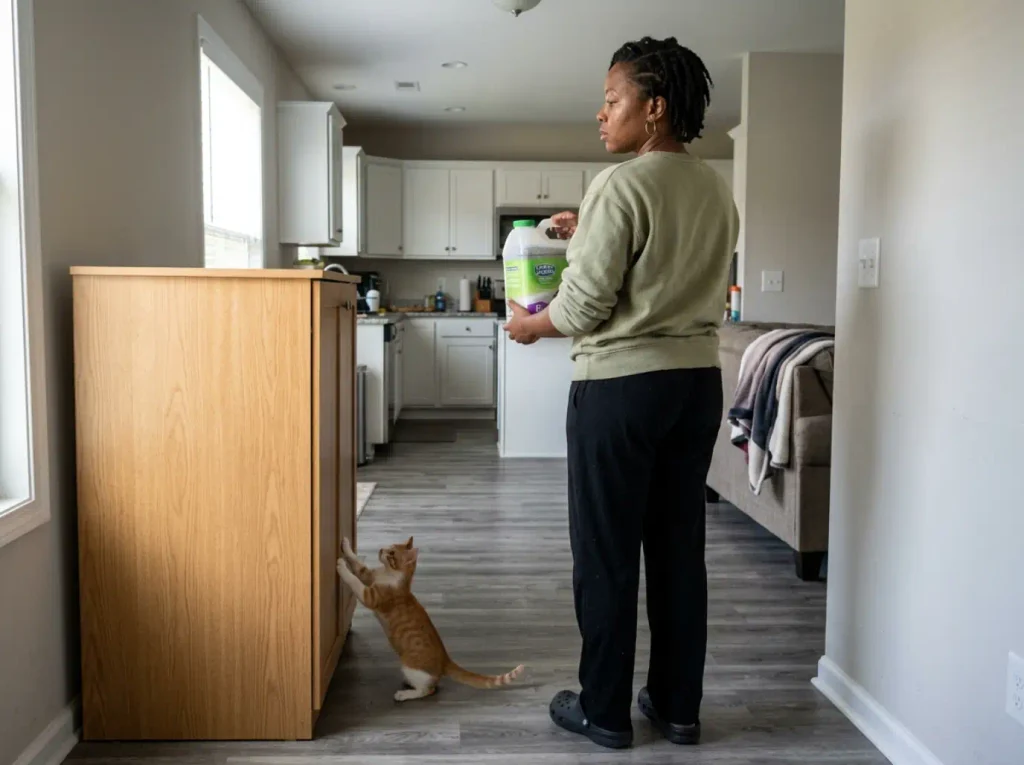
Two free habits do more than any accessory. Keep the top clear, and keep the weight low. The heavy jug of litter goes on the floor beside the cabinet, not on top of it, because anything on top raises the center of gravity of a piece that already wants to tip forward when the door is open.
Before you buy, check the listing for a stated top-surface weight rating. If it does not publish one, treat the top as decoration and keep it clear. The cabinet is tall, narrow, and about to hold a jug of litter somewhere.
Where a rating does exist, believe it. The official cabinet from the leading automatic-box brand rates its top surface at 35 pounds and its interior floor at 60. Thirty-five pounds is a lamp and a small plant. It is not a shelf for stacked storage bins, and treating it as one is how a stable piece stops being stable.
What Assembled Weight Means When You Move
That same cabinet weighs 83 pounds assembled. Read that as a two-person carry down a stairwell rather than a number on a spec sheet, and then read the return policy, because the usual terms in this category are unopened-only. Once it is built, it is yours.
Assembly runs about an hour with real tools in hand, not an unbox-and-done. So the decision genuinely happens before the carton is opened, which is unusual advice to have to give about furniture and entirely accurate here. Measure first. Then cut the tape.
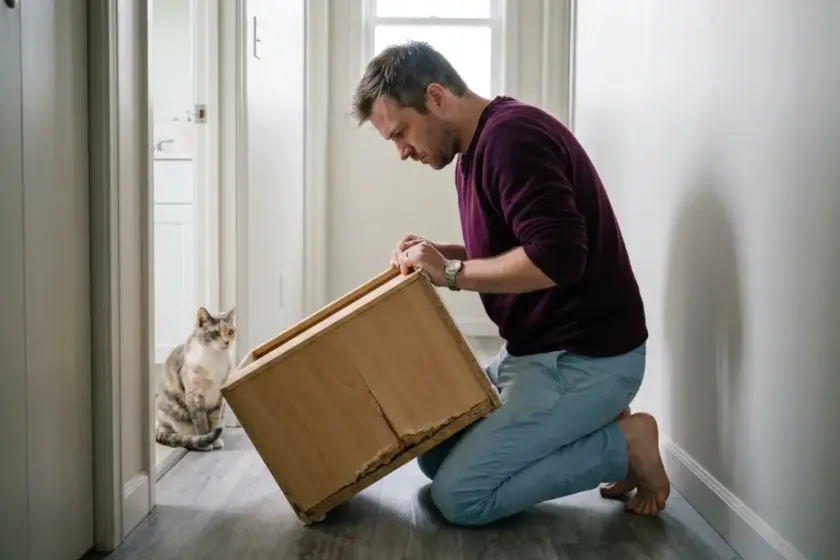
Material is the other thing that decides how long this lasts. Composite or veneer over plywood handles moisture meaningfully better than particleboard, and particleboard is what you get when a listing declines to say. Most of what sells in this category is mdf furniture with a printed surface, and a wiped-clean melamine cabinet shrugs off a spill better than raw board does, so the finish is doing more work than the marketing photograph suggests. That matters most at the seam where the base of a wood cabinet gives out, which is the first place a spill finds and the last place anyone looks.
And if the whole calculation is starting to look like a lot of money for a wooden box with holes in it, that is a defensible conclusion. Building it yourself, where you decide the weight and the base, is the route the hack communities take, and it is the one place you get to choose your own vent size.
The Short Version
Air first, furniture second. A cabinet that cannot move air across the box makes the smell smaller and sharper rather than smaller and weaker, so find the second opening before you look at anything else on the listing.
Measure the inside, not the outside. Interior clearance plus turning room is the number that decides whether the cat walks in, and it is the number the listing does not give you. Take a tape measure to the box you already own tonight.
One cabinet is one box. If two cats live there, the count gets met somewhere else in the home, and the cabinet handles the location people can see.
Three weeks in, open the door and check the air at the opening, then watch whether the cat is still going all the way inside or stopping at the threshold. Those two things tell you whether the cabinet is working before the smell tells the whole room.
Start tonight, and start for free. Move the box you already own to a spot with real airflow and scoop it twice a day for one week. If the smell goes, you just learned the cabinet was never the fix, and you kept the money.
Amazon’s Audible — free for 30 days
Your cat won’t let you read. Let someone read to you.
Audible is Amazon’s audiobook library — thousands of titles, read out loud, on your phone. Free for a month, plus one audiobook to keep forever.
Frequently Asked Questions
01How do you stop a litter box cabinet from smelling?
Give the air somewhere to go. A cabinet needs the opening the cat walks through plus a separate vent or gap on the opposite side, and any carbon filter is a replacement item every four to six weeks. Scooping stays daily either way, because a cabinet only delays when you notice.
02Can a litter box cabinet fit an automatic litter box like a Litter-Robot?
Some can, but you check interior dimensions rather than exterior ones. A drum-style unit like the Litter-Robot 4 has a 22 by 27 inch footprint and needs about two inches of clearance per side, so look for a published interior near 28 inches wide and deep, with a cord path.
03Do cats mind using a litter box inside a cabinet?
Most adapt if the inside is big enough to turn around in and the air is not stale. When a cat refuses one, it is almost always clearance or airflow rather than the idea of a cabinet, which is why the interior measurement matters more than the style.
04Are litter box cabinets big enough for two cats?
One cabinet is one box, so it does not meet the count a two-cat home needs on its own. A wider cabinet buys a bigger box and more turning room, which is worth having, but the second and third locations still have to exist elsewhere in the home.
05Should I anchor a litter box cabinet to the wall?
If there are small children or a cat that climbs, yes. This is tall, narrow furniture, and a cabinet of almost exactly this form factor sold on Amazon was recalled for tip-over risk. Renters who cannot drill can use a clamp-style anti-tip tether, and either way keep the top clear.
Leave a comment