Low-Dust Clumping Litters That Don’t Quit at Cat Three
Stop wiping dust off the baseboard every week. Which clumping litters stay down with three cats (+ where the box has to sit for it to work).

Alfredo RamsesFounder · August 24, 2026 · 23 min read

On this page8 sections
- 1Why Dust Multiplies Faster Than the Number of Cats
- 2What "Low Dust" Is Actually Protecting, and Where the Line Is
- 3The Ten-Second Pour Test, Because Nobody Publishes a Real Number
- 4The Four Materials, Ranked by What Survives Three Cats
- 5Where the Box Goes, or the Litter Choice Stops Mattering
- 6Switching Without Losing a Cat to the New Texture
- 7What to Do First
- 8Frequently Asked Questions
The bag said 99.9% dust-free, and it was telling the truth about one cat.
You have three, and there is a gray film on the baseboard again, four days after you wiped it. The brand didn’t lie to you. The problem is that no one standardizes that number, nobody publishes how it was measured, and dust load in a real house is not a property of the bag at all: it scales with how many cats dig in it, how many boxes you fill, and how often you pour. Finding the best clumping litter low dust households can actually live with means asking a different question than the one printed on the front of the package. Below: what actually makes a clumping litter low-dust (it’s the raw material, not the formula), how to test any bag yourself in about ten seconds, which materials hold up when three cats run four boxes, and where the box has to sit so the dust stays where it lands instead of touring the apartment.
Quick Answer
The material decides the dust. The number on the bag decides nothing.
- Plant-based clumping litters (walnut, wood fiber, corn, tofu) don’t break into airborne fines the way bentonite clay does.
- Walnut-shell multi-cat formulas are the closest direct match: low-dust by material and built for the volume three cats push through a box.
- Staying with clay? A dedicated dust-suppressed line is a different product from a standard clumping clay.
- Test any bag in ten seconds: pour a scoop from waist height against a dark background and time how long the cloud takes to fall.
Why Dust Multiplies Faster Than the Number of Cats
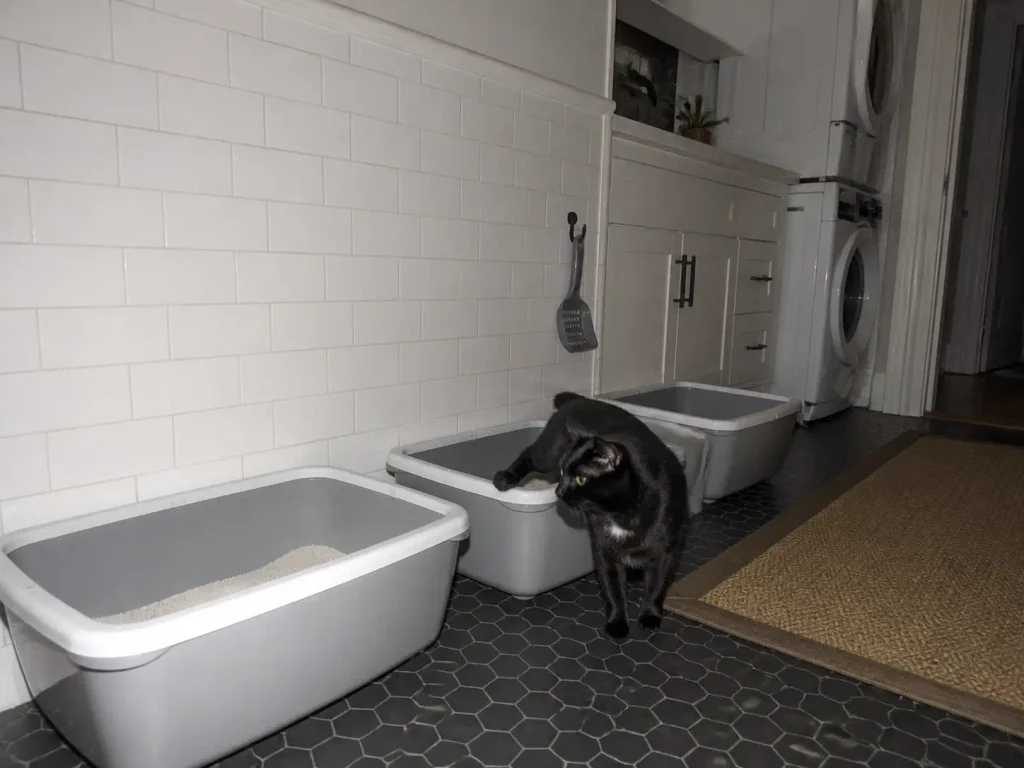
Two cats do not make twice the dust. That would be the tidy answer, and it’s wrong by a wide margin.
Two cats make twice the digs, plus the extra box the n+1 rule adds, plus more frequent pours because you’re going through the bag faster, and every one of those is its own dust event. Dust is a property of the raw material first, which is why choosing which litter type each material actually suits is the decision that comes before every other one on this page. But how much of that dust ends up in your air is a household number, not a bag number.
Here is where the litter that “stopped working” actually stopped working.
Nothing about the bag changed when the second cat arrived.
What changed is that dust enters the room at three separate moments.
And your cat only controls one of them.
There’s the pour, when you tip a bag into an empty or half-full box and the fines that settled during shipping go straight up. There’s the dig, which is the cat’s part. And there’s the scoop, which is yours again, and which happens once or twice a day forever. Multiply the human moments by four boxes and the arithmetic gets loud fast.
The n+1 rule is the multiplier nobody accounts for.
Three cats means four boxes, not three, and four boxes on refill day is four pours. If you’re rotating a full change every couple of weeks across four boxes, that’s roughly eight pour events a month before anyone digs in anything. A litter that throws a modest cloud once is fine. The same litter, eight times a month, in a one-bedroom with the windows shut in February, is the film on your baseboard.
Count pours, not cats. Whatever a bag costs you in dust, multiply it by how many boxes you actually fill on refill day. That number, not the cat count, is what a low-dust claim has to survive.
Why clay does this and plants mostly don’t comes down to the shape of the particle.
Bentonite clay is brittle and small, and handling shears it into fines that hang in the air long enough to travel. Plant fibers are porous and fibrous: they crumble into pieces that are too heavy to stay up, so they fall. That’s the raw material, not a formulation trick, which is why a clay litter that markets itself as low-dust has to engineer its way to a result that walnut shells get for free. It is also why every biodegradable litter on the shelf happens to sit in the low-dust column: the plant fibers that let it break down are the same fibers that refuse to go airborne.
One more thing worth naming before the shopping starts. In litter threads, the reader most often chasing this problem is someone managing a diagnosed respiratory condition across a multi-cat house, and the thing they report over and over is that the “99.9% dust-free” claims are not consistent brand to brand. The same phrase on two bags does not describe the same performance. The number is copy, not a spec.
And dust is not tracking. They get solved separately because they’re caused by separately: dust is about how fine a particle gets when it breaks, while tracking is a granule-size problem, not a dust problem and depends on what sticks to a wet paw on the way out. A genuinely low-dust litter still tracks a little, like they all do. Fixing one does not fix the other, and expecting it to is how people end up disappointed by a litter that’s doing exactly what it promised.
What “Low Dust” Is Actually Protecting, and Where the Line Is
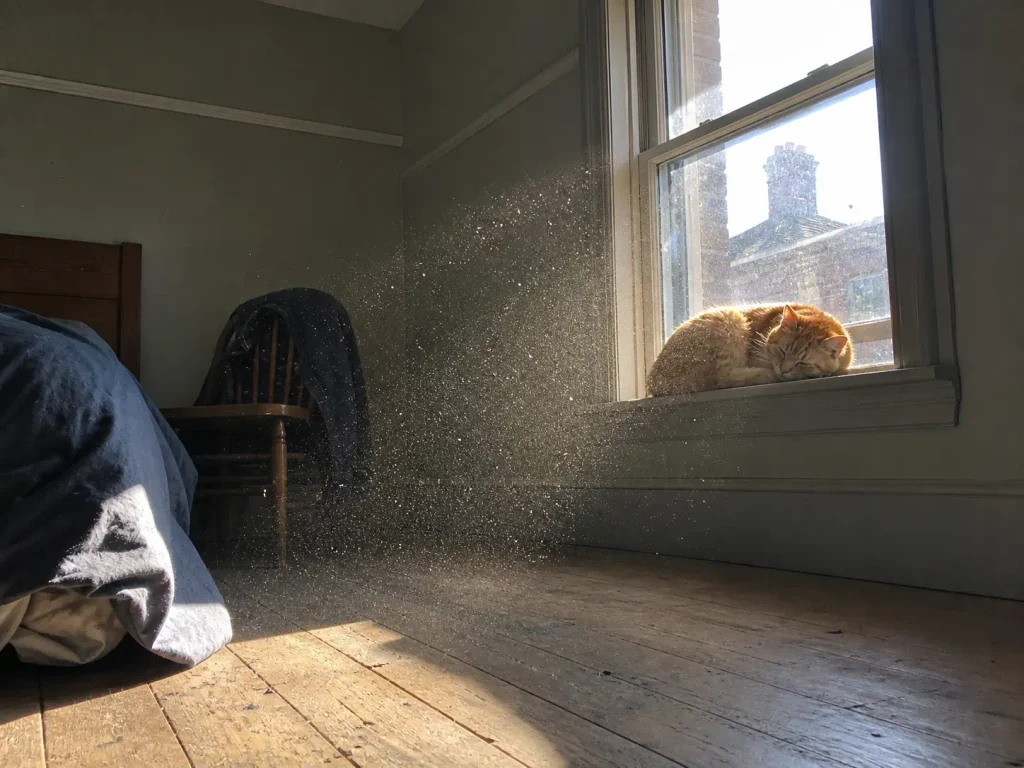
Half the internet says litter dust causes silicosis. The other half says it’s marketing fear and you should relax. Both are answering a question nobody asked, because the real answer is about dose, and the dose part is where it gets useful.
Start with the word that causes most of the confusion.
Two chemically different substances share the name silica.
Crystalline silica has a rigid lattice structure, breaks into sharp respirable dust, and is classified as an occupational carcinogen at high exposure levels. Amorphous silica has a loose atomic structure, is the kind used in crystal and silica-gel litters, and is not linked to silicosis. Those are not two grades of the same thing. They’re different materials that got stuck with overlapping names, and how the CDC classifies crystalline silica dust exposure applies to one of them.
Which means most of the health warnings people repeat about “silica litter” are pointing at the wrong bag entirely. The concern attaches to trace crystalline silica found in some clay litters, not to the silica-crystal litter that has the word in its name. I used to treat that as a pedantic distinction not worth the paragraph. It isn’t: it’s the reason readers throw out a perfectly reasonable crystal litter and buy a clay one, believing they’ve reduced their exposure when they’ve done the opposite.
Now the dose.
The crystalline silica exposure limits OSHA sets for occupational settings are written for someone breathing it for an entire shift, every shift, for years. Pouring a box in your hallway is orders of magnitude below that, and anyone telling you a bag of clay litter is a health emergency is overselling. But the dose is not zero, it’s daily, and in a small apartment it’s concentrated in a room with the door shut. It costs nothing to reduce. That’s the entire argument, and it doesn’t need to be scarier than that to be worth acting on.
🚑 Then there’s the line this site doesn’t cross.
A cat that has started coughing, wheezing, or breathing with visible effort is a vet visit, not a litter change. Switching to a low-dust litter is a sensible thing to do for the room; it is not a treatment and it is not a diagnosis, and the same goes for the human in the house. This article covers the dust. It does not cover lungs.
So back to the furniture, where we’re useful. What you can control is how much of it goes airborne in the first place, and that starts with what the litter is made of.
The Ten-Second Pour Test, Because Nobody Publishes a Real Number
Every bag prints a percentage.
Not one of them tells you how it was measured. There’s no lab standard for household litter dust, no published settling-time test, no particle count from any manufacturer, retailer, or roundup. Comparative marketing language is all that exists industry-wide, which puts you in the odd position of choosing between claims that cannot be compared. So generate your own number. It takes ten seconds and it works on any bag on any shelf.
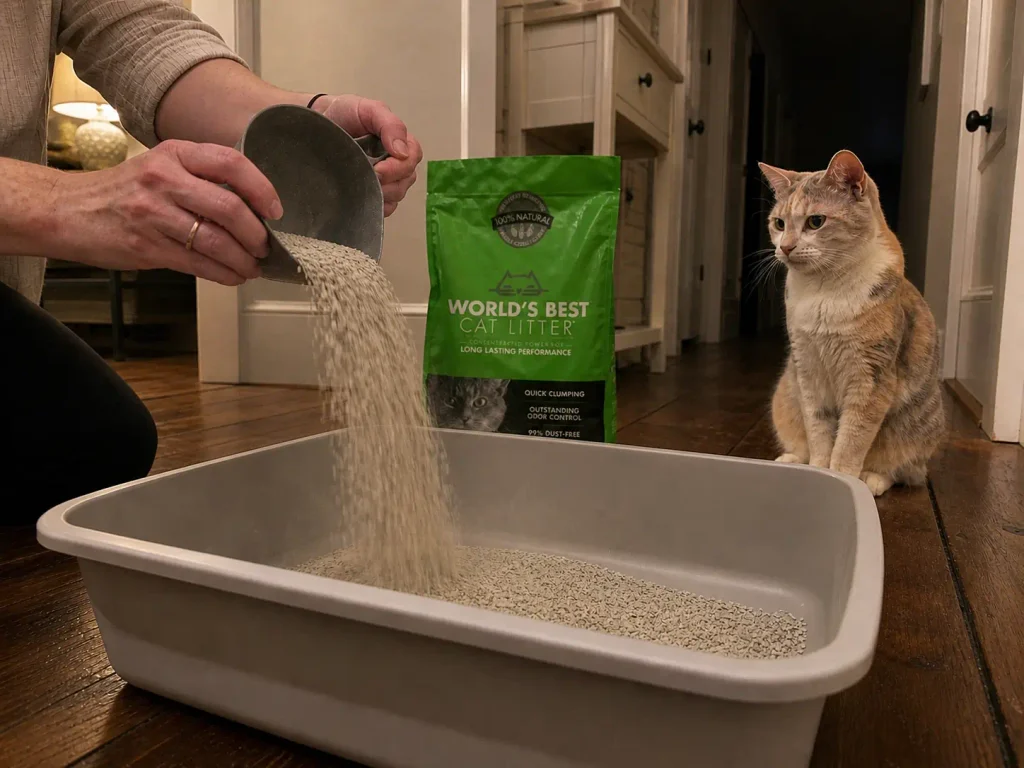
The test: pour one full scoop from waist height into an empty box, against a dark background, with a light source coming in from the side rather than behind you. Then watch the cloud and count. Under two seconds to settle is genuinely low-dust. Four seconds or more and you’ll be seeing it on the baseboard within a week. The side light is the part people skip and it’s the part that matters, because a fine cloud is invisible against a lit wall and obvious when it’s backlit at an angle.
Run the pour test on the bag you already own before you buy anything. If it settles in under two seconds, the dust in your apartment is coming from somewhere else, and the box location or the scoop is the thing to fix, not the litter.
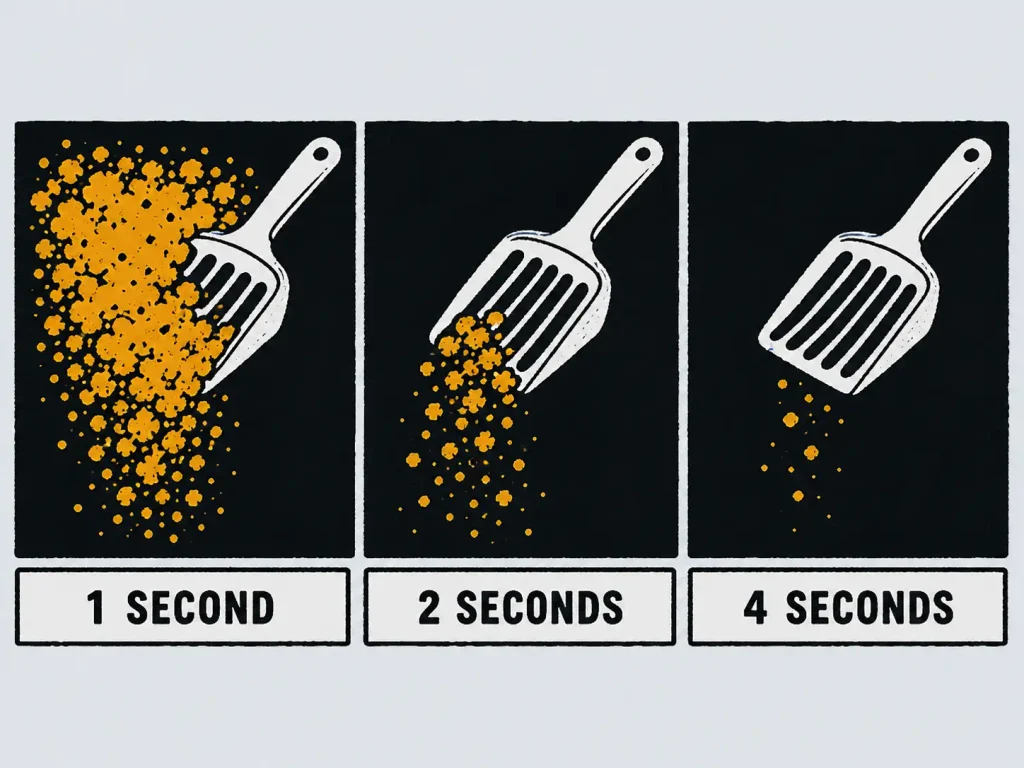
Run it twice: once into an empty box and once into a box that’s already half full. Those are different tests and they can disagree. A bag that pours clean onto bare plastic can still throw a visible puff when the new granules land on existing litter and knock loose whatever fines were already down there. The second version is the one that matches what actually happens on refill day, so if you only have patience for one, do that one.
Do the test before the bag goes into the box.
This sounds obvious and it is the mistake everyone makes anyway, because the natural sequence is buy it, get it home, dump it in, and then notice. An opened bag you’ve decided against is a return you can’t make and forty pounds of litter you now own. Pour a scoop onto a dark towel in the kitchen first. That’s it.
And do it per bag, not per brand. Budget store-brand low-dust picks pull mixed dust reports within the same product line, which is exactly the pattern that makes brand loyalty a bad strategy here. Two bags with the same label and different lots can behave differently, and you cannot tell from the front of the package. Verify the bag in front of you.
There’s also a naming thing worth stealing from the people who actually live with this. Readers call it the dust cloud, not “airborne particulate,” and the plain term is the more honest one because it describes exactly what the test measures: a puff you can see with your own eyes. If you can see it, it’s real. If you can’t see it under side light from waist height, it’s below the threshold that’s going to bother your baseboards or your sinuses.
The Four Materials, Ranked by What Survives Three Cats
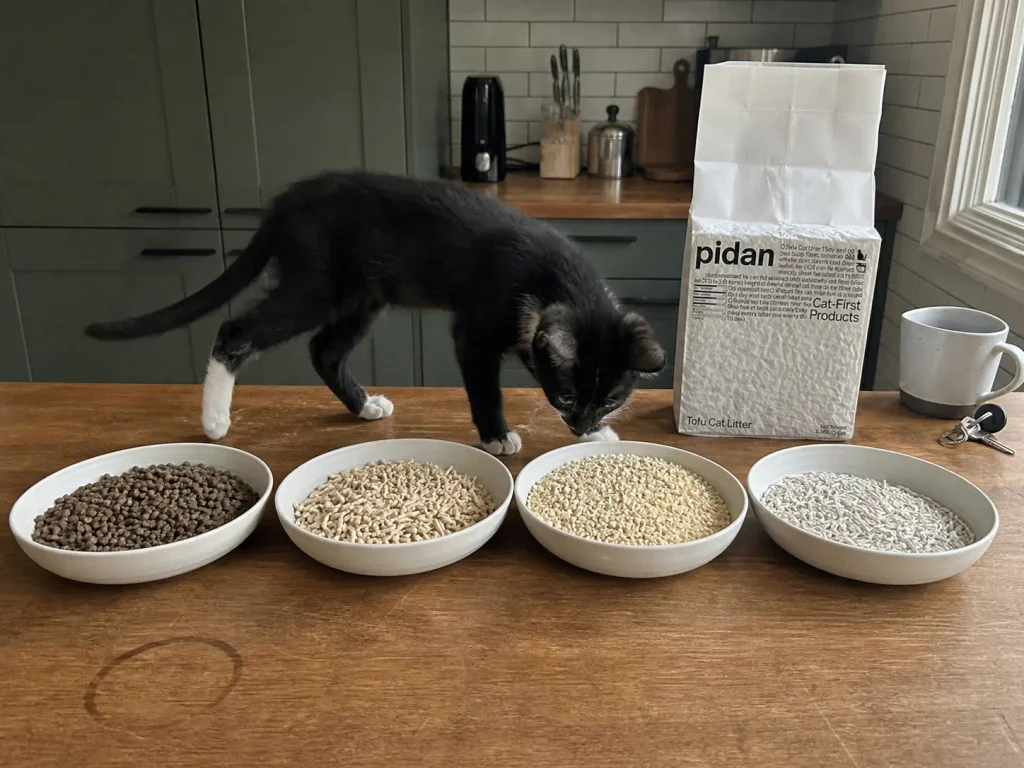
The choice isn’t between eleven brands. It’s between four raw materials, and once you know which material you’re buying, the brand is mostly a detail about bag size and scent. What reshuffles the ranking is that three cats put roughly four times the handling through the same volume of litter, so a material’s failure mode shows up faster and matters more.
| Material | What it’s made of | Dust behavior | How it holds up at 3+ cats |
|---|---|---|---|
| Walnut shell | Ground walnut shells, fibrous and dark | Low by material, crumbles rather than aerosolizes | The only pick here the maker itself labels Multi-Cat |
| Wood fiber | Softwood fiber, no clay content | Markets at 99% dust-free, pours clean | Softer clumps; buy the large bag, you refill often |
| Corn | Compressed whole-kernel corn | Marketed free of silica dust specifically | Mid-size bags; the silica question leaves entirely |
| Tofu (soy fiber) | Compressed soybean fiber pellets | Low dust and flushable in small amounts | Small bags; a trial buy more than a supply |
| Clumping clay | Sodium bentonite | Brittle particles shear into airborne fines | Best clump strength here, worst dust here |
| Dust-suppressed clay | Bentonite with a dedicated low-dust line | Engineered down, not low by material | Clay strength at the heaviest multi-cat volume |
Walnut Shell, the One That’s Actually Labeled for Multiple Cats
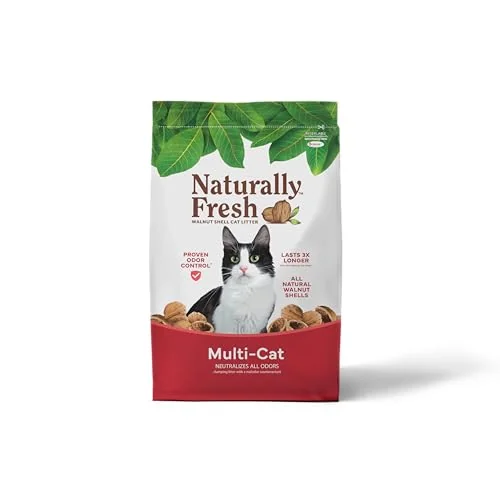
Ground walnut shell is fibrous, dark, and sits solidly in the low-dust plant-based group for the reason the whole category does: the particle doesn’t shear into fines, it crumbles. What separates it from the rest of that group for this article is a label, not chemistry. It’s the only candidate in the set where the manufacturer itself puts Multi-Cat on the bag, which means the absorbency and clump volume are specified against more than one cat’s daily output rather than a single cat’s.
The dark color is a genuine trade-off and reviewers rarely say so plainly. It hides nothing about clump quality, so you can still see what you’re scooping. But on a dark hardwood floor, tracked walnut is close to invisible until you step on it barefoot, and there’s an argument that visible tracking is better because you sweep it.
Wood Fiber and Corn, Low Dust With Different Failure Modes
Softwood fiber is the material that markets hardest on the dust number, usually at 99% dust-free, and in the pour test it earns it. Where it costs you is clump firmness: wood clumps hold together but they’re softer than clay, and a heavy-handed scoop breaks them. That’s a technique problem more than a product problem, though it becomes a product problem at three cats, because you’re scooping four boxes twice a day and technique degrades when you’re tired.
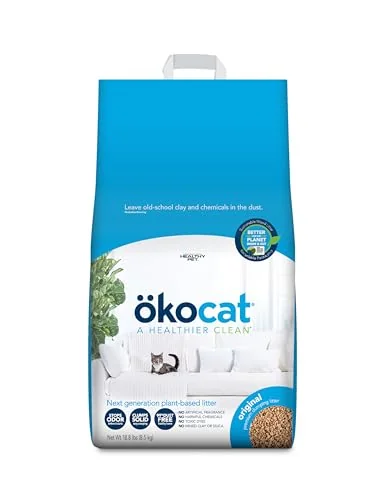
Bag size is the wood-fiber detail worth planning around. ökocat Original Wood Clumping Litter comes in an 18.8 lb bag, and at multi-cat volume you refill more often than the bag size suggests you will, because plant litters are lighter per unit volume than clay. Buying the small bag to try it out is reasonable. Buying the small bag as your supply means a reorder every couple of weeks.
Corn takes a different route to the same place.
World’s Best Cat Litter Original Series is compressed whole-kernel corn in a 14 lb bag, and its specific pitch is being free of silica dust rather than just lower in dust. That’s the pick for the reader who read the crystalline-versus-amorphous section above and decided they’d rather sidestep the entire question than reduce their exposure to it. The trade-off nobody prints: corn is food, and in a warm apartment an under-scooped corn box is more interesting to pantry pests than a clay one. Scoop cadence covers it, and you were scooping daily anyway.
Tofu, the Flushable One, and Why the Small Bag Is the Right First Buy
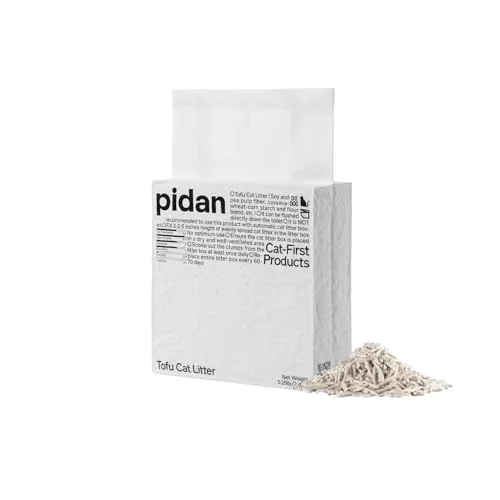
Soy-fiber pellets are genuinely low-dust and they’re the only material here that’s also flushable in small amounts, which is a second differentiator rather than a variation on the first. In an apartment with no outdoor trash run and a shared hallway you’d rather not carry a bag down twice a day, that’s not a small thing. It’s also the reason the comparison matters: clumping clay is not flushable, and tofu is the exception that proves why, and the difference is entirely about what happens to the material in water.
The 5.3 lb bag is the correct first purchase, and that’s a recommendation about your cats rather than about the litter. Tofu pellets feel dramatically different underfoot from clay: larger, lighter, and hollow-sounding when a cat scratches at them. Buy the trial bag, convert one box, and find out whether that lands before you own thirty pounds of an answer nobody in the house agreed to.
Clay, and the Gap Between Clumping Clay and Dust-Suppressed Clay
Standard clumping clay wins on clump strength and loses on dust.
Those are two different axes rather than two ends of one.
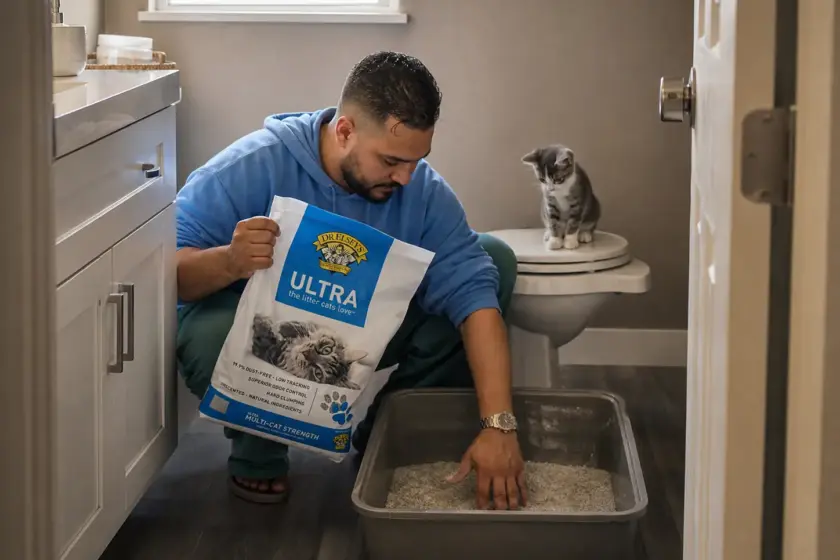
A clay litter can be excellent at the first and unremarkable at the second, and being very good at clumping does not drag its dust number down with it. Dr. Elsey’s Ultra Unscented is the honest example: a 40 lb bag of strong bentonite that a lot of multi-cat homes swear by, that is not a low-dust product and doesn’t claim to be. It’s in this article as the baseline you’re measuring against, not as a pick.
The distinction that actually matters on the shelf is that a dedicated dust-suppressed clay line is a different product from a standard clumping clay, made by the same companies, sitting two feet apart in the same aisle, and looking nearly identical on the front of the bag. That’s the whole reason two clay products appear on this page. And this is where the reader weighing clump strength against dust should also see how clumping and non-clumping split differently once you’re past two cats, because the multi-cat answer is not the single-cat answer.
Where the Box Goes, or the Litter Choice Stops Mattering
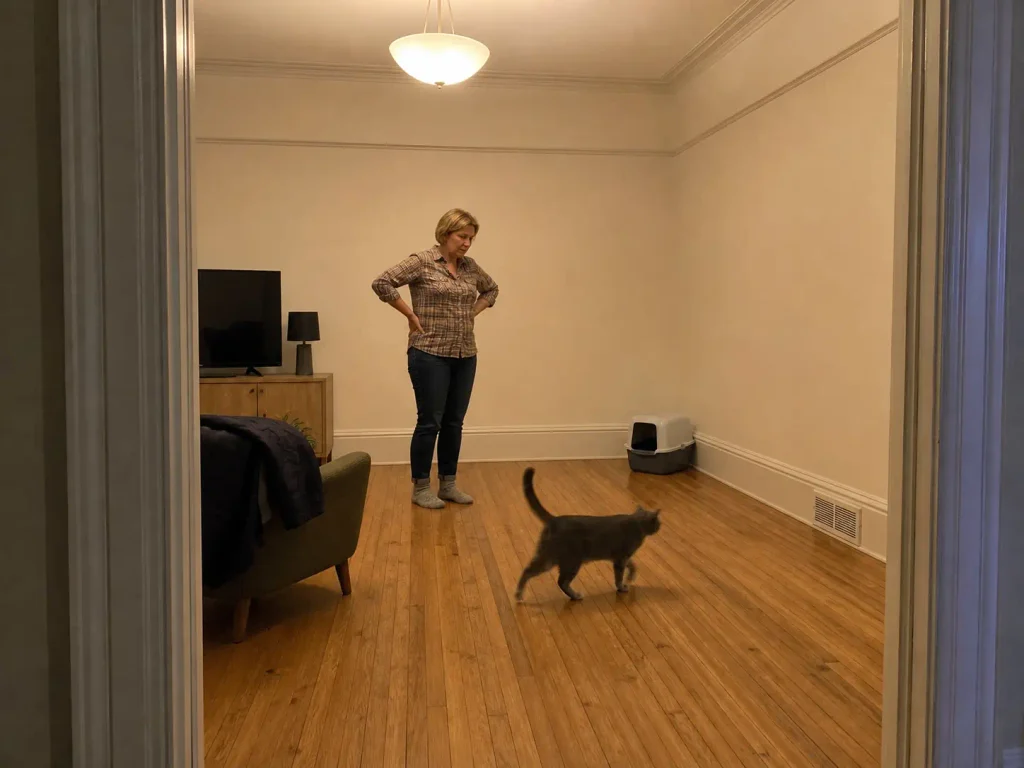
You can buy the cleanest-pouring bag on the shelf and still find dust on every surface in the apartment, because a return air vent three feet from the box is quietly redistributing it through the whole place on a loop. This is the free fix, it takes an afternoon of nothing, and it goes before the purchase.
💰 Move the box before you buy anything. The rule is a minimum of 36 inches between the box and any HVAC return air intake, and the mechanism behind it is straightforward: the return vent’s suction pulls both ammonia vapor and fine litter dust into the ductwork and sends them back out through every other vent in the home. It’s worth keeping the box at least 36 inches from a return air vent even if you never change litter brands, because a vent turns a local problem into a building-wide one.
In a small apartment this is the difference between one room smelling like a litter box and the entire place smelling like one. It applies harder to dust than to odor, and here’s why: odor dissipates on its own, while dust that would have settled on the floor and stayed there instead gets lifted, moved, and dropped somewhere else. Ductwork gives fines a second and third chance to be airborne. That’s how you end up with a film on a bookshelf in a room the cats don’t use.
The multi-cat version of this rule is the part nobody writes down.
More boxes means more chances that at least one of them lands near a return, and people place the “main” box thoughtfully and then put the extras wherever there’s floor. The clearance rule has to hold for every box, not for the one you thought about. Four boxes and one bad placement is not three-quarters solved. The bad one feeds the ductwork and the ductwork services the whole apartment. If you have nowhere obvious to put four boxes and satisfy that, the layout that works when there is no spare room to put a box in is the next thing to read, because the answer is usually rearranging what you have rather than accepting the vent.
Floor surface is the other free variable. Hard floor beats carpet for dust for the same reason it beats carpet for tracking: settled dust on hard floor gets swept up and leaves, while settled dust in carpet pile gets walked on and returns to the air every time somebody crosses the room. Carpet doesn’t collect dust so much as store it and release it on a schedule you don’t control.
Walk the apartment and find every return vent before you decide where the boxes go. It takes five minutes, costs nothing, and it is the only dust fix that works on all four boxes at once.
Ventilation closes the loop.
A closed door with no airflow concentrates the cloud in exactly the small volume where the cat’s face is; a room with a window you can crack two fingers’ width disperses it in minutes. That’s also most of the argument for and against the bathroom, and whether the bathroom is a good place for it turns on whether yours has a window or a working extractor. Neither of these replaces choosing the right material. Both are free, and free goes first.
Switching Without Losing a Cat to the New Texture
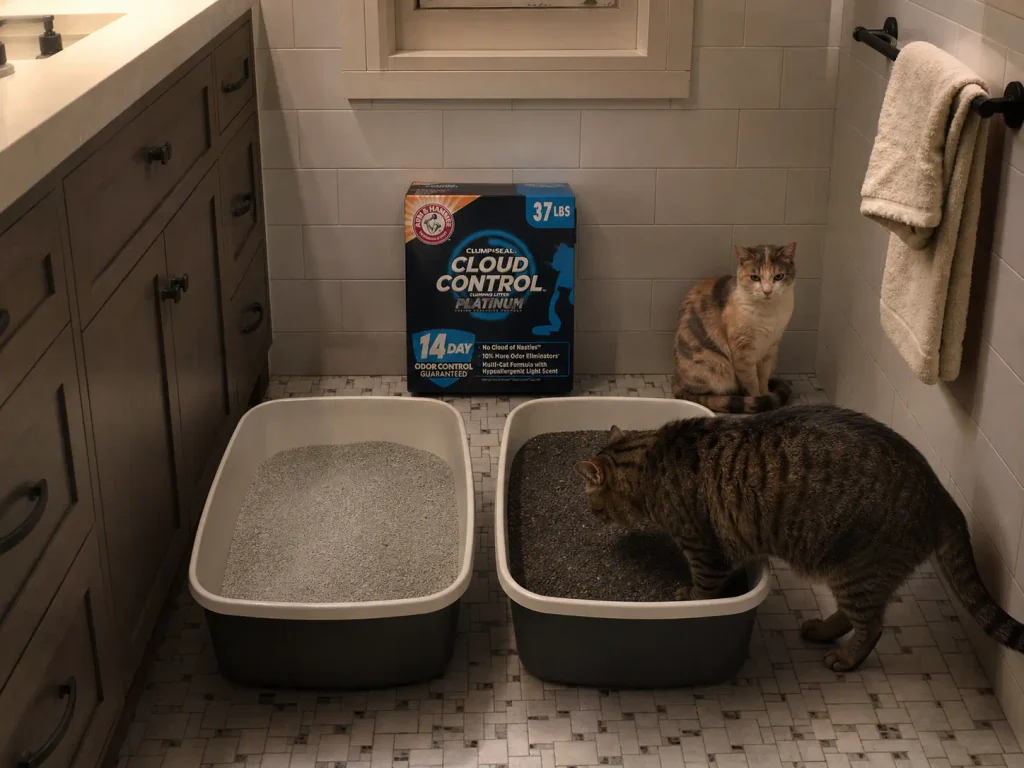
Here’s the part nobody warns you about. With three cats sharing four boxes, you are not asking one cat to accept a new texture. You are asking all three, independently, and one holdout is enough to send the entire household back to the old bag.
⚖️ Name the conflict properly, because it decides how you handle it.
You want less dust. The cat wants the substrate it already knows under its feet. Both of those are legitimate, and the cat’s version is a physical preference about what it’s standing on, not stubbornness. Plant-based litters feel materially different from clay: larger granules, lighter weight, more give, a different sound. A cat that has dug in bentonite its entire life is entitled to notice that the floor changed.
The standard advice is a gradual switch, and it’s correct as far as it goes: mix the new litter into the old at a rising ratio over about two weeks rather than swapping a box outright. Two weeks sounds slow until you’ve done the fast version once and spent a Saturday cleaning a rug.
Convert the box furthest from where the cats sleep first. If there is a holdout, that is the box they will avoid with the least consequence to you.
The multi-cat modification nobody publishes: don’t convert all the boxes at once. Convert one box, leave the rest on the old litter, and spend a week watching who uses the converted one. That gives every cat an opt-out while you find out whether there’s a holdout and which cat it is. Swapping every box simultaneously removes the choice entirely, and a cat with a texture objection and no familiar option left does not file a complaint. It goes on the rug, and now you have a floor problem instead of a preference problem. That is box rejection, and it is far more expensive to undo than it was to avoid.
This is also the strongest argument for having the spare box the n+1 rule already told you to have, and it’s worth knowing how many boxes two cats actually need before you start converting anything. The conversion method assumes a box you can afford to take offline for a week. If you’re running three cats on three boxes, you don’t have one.
A cat who avoids the converted box isn’t rejecting low dust.
It’s rejecting that texture, and those are separable in a way that saves the whole project. Walnut, wood, corn and tofu feel different from each other under a sensitive paw, not just different from clay: walnut is granular and close to sand, wood fiber is soft and slightly powdery, corn is rounded, tofu is pellets. Cats with thin coats between the toes tend to be the ones who register the texture underfoot first, and they are the ones who vote loudest. A refusal of one is not a refusal of the category, so the next move after a rejected bag is a different plant material rather than a retreat to clay.
And if all three cats say no to all four plant materials, that’s a real answer and it deserves a real product rather than a shrug. Clay it is, and the version of clay that has been engineered for dust rather than the version that hasn’t.
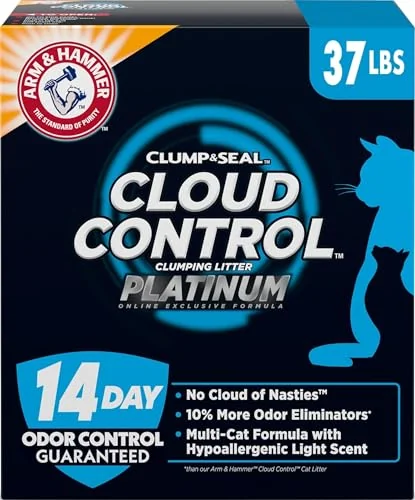
If the vote went the other way and the plant texture landed, the follow-up purchase is a bag size that matches your actual refill rate instead of the one that fit in the cart the first time.
Your scoop cadence doesn’t change because the litter did. Daily is still daily, and the day you skip is still the day somebody finds the rug. What does change is your grip: plant-based clumps are softer than clay clumps, so a lighter hand keeps them intact and a firm one crumbles them back into the bed you’re trying to keep clean. Litter depth matters here too, since depth matters more than volume for whether a clump forms fully or bonds to the bottom of the box, and a clump that breaks on the way out is dust you just made yourself.
What to Do First
The material decides the dust. Walnut, wood fiber, corn and tofu don’t aerosolize the way bentonite does, and no percentage printed on a bag changes what the raw material does when it breaks.
Test the bag yourself before you commit. A scoop poured from waist height against a dark background, with light coming in from the side, tells you more in ten seconds than the front of the package tells you in a paragraph.
And move the boxes before you buy anything. Thirty-six inches from every return vent costs nothing, takes an afternoon, and works on all four boxes at once instead of one bag at a time.
🗓️ Three weeks from the switch, run a finger along the baseboard nearest the box and check who’s been using the converted one. Clean baseboard and every cat using it means you’re done. If one cat is still holding out, the problem is texture, not dust, and the fix is a different plant material rather than a retreat to the bag you started with.
Move the box away from the vent first. If the dust drops on its own, you just learned the litter was never the problem, and you kept the money.
Amazon’s Audible — free for 30 days
Your cat won’t let you read. Let someone read to you.
Audible is Amazon’s audiobook library — thousands of titles, read out loud, on your phone. Free for a month, plus one audiobook to keep forever.
Frequently Asked Questions
01Is there a truly 100% dust-free cat litter?
No, and any bag claiming it is rounding. Every litter releases some fines when it is poured or dug in. The useful question is how fast the cloud settles, and you can test that yourself in about ten seconds.
02Is clumping clay litter bad for cats with breathing problems?
A cat with a breathing problem is a vet visit, and that comes first. Separately from that, reducing visible dust in the room is a reasonable thing to do regardless of cause, and plant-based clumping litters release less of it than bentonite clay by material.
03Does low-dust litter track less?
Not necessarily, because they are different problems. Dust is about particle fineness and how it goes airborne; tracking is about granule size and what sticks to a paw. A low-dust litter still tracks a little, like they all do.
04How much low-dust litter do three cats go through?
More than the bag size suggests, because the n+1 rule means three cats run four boxes and you are filling all of them. Large-format bags exist for this: a small bag that lasts a month with one cat lasts about a week across four boxes.
05Can I mix low-dust litter with the clay I already have?
Yes, and that is the right way to switch: a rising ratio over about two weeks. With more than one cat, convert one box at a time rather than all of them, so any cat that objects to the texture still has somewhere familiar to go.
Leave a comment