Is Clumping Cat Litter Flushable? No, and Here’s Why
Don't flush clumping litter. Bentonite clay swells 15x in water (it's the same clay used in grout) + coats your pipe a little more with every flush.

Alfredo RamsesFounder · August 23, 2026 · 15 min read

On this page7 sections
- 1Clumping Litter Is Clay That Swells, and That Is the Whole Problem
- 2What Actually Happens in the Pipe, Flush After Flush
- 3What the Shared Stack Changes if You Rent
- 4What You Can Flush, and the Fine Print the Brands Actually Write
- 5Two Cats Break the One-or-Two-Clump Rule, and What to Do if You Already Flushed
- 6The Short Version
- 7Frequently Asked Questions
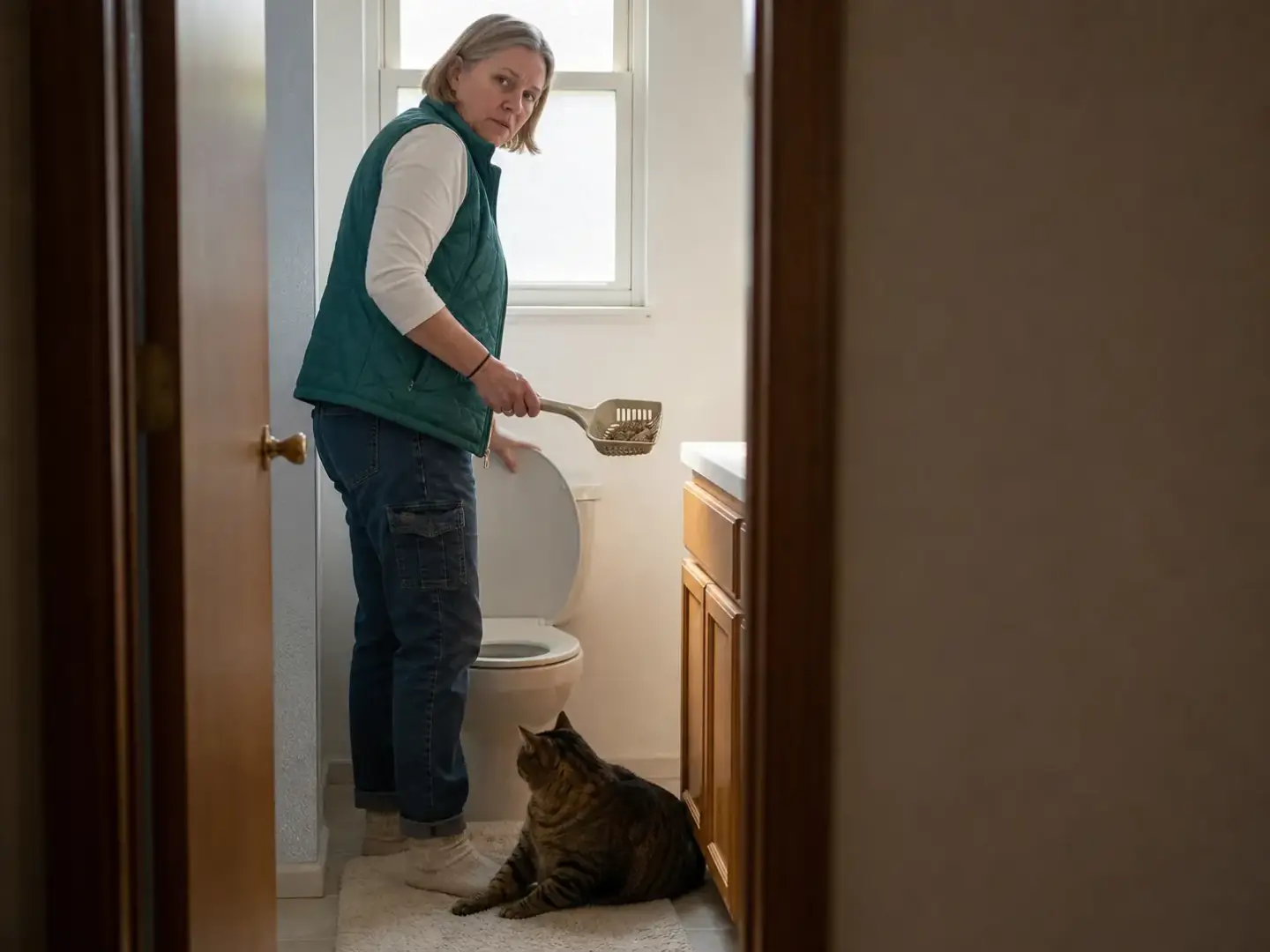
You are standing at the toilet with the scoop already in your hand, a clump the size of a golf ball sitting in it, and the lid is up. It would take one second. The question running through your head is not really whether clumping cat litter is flushable, it is whether this particular flush is the one that finally does something you cannot undo. That is a plumbing question, and it has a plumbing answer, and the answer comes from the exact property the litter is sold for.
Here is the short version, then what actually happens inside the pipe, what you can put down there instead, what to do if you already flushed a few, and how the whole thing changes once there is more than one cat in the apartment.
Quick Answer
No. Clumping litter is sodium bentonite clay, which swells and sticks on contact with water, which is the exact property it is sold for. In a box that is useful. In a pipe there is nowhere for the swollen mass to go. Only plant-based litters are sold as flushable, and even those cap at one or two clumps.
Clumping Litter Is Clay That Swells, and That Is the Whole Problem
You have almost certainly read somewhere that clay litter “sets like cement” in a pipe, and you probably filed it under things plumbers say to scare people. It is not a metaphor and it is not a scare line. Sodium bentonite, the clay in nearly every scoopable bag on the shelf, expands to roughly fifteen times its dry volume the instant it meets moisture. That expansion is not a side effect of the clumping.
It is the clumping. The grains around a puddle swell, lock into each other, and set into a mass solid enough to lift out in one piece.
Which means the litter is not doing anything different in your drain than it does in the box. It is doing the identical thing, in a place where nothing is coming along to lift it out. Same mineral, same reaction, no scoop.
The comparison that settles it: sodium bentonite is the same clay the construction trade uses in industrial grout and sealants, chosen for precisely this behavior. When somebody picks a material specifically because it swells and seals against water, and you then send it into a sealed water channel, you should not be surprised by what it does there.
The bag test takes four seconds. If the label anywhere says clumping, scooping, or bentonite, the answer is no and you do not need to check anything else on the package. And the words natural and biodegradable on a clay bag are not a loophole: they mean the clay is a mineral dug out of the ground, not that it breaks down in water. Clay is as natural as a rock, and behaves like one.
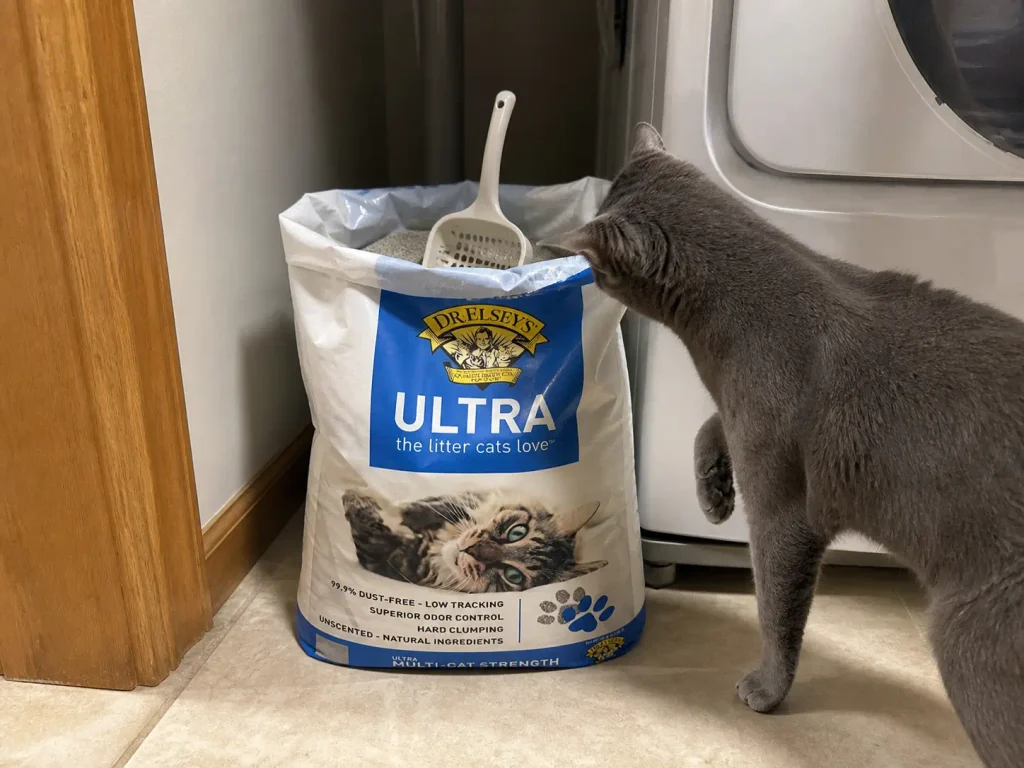
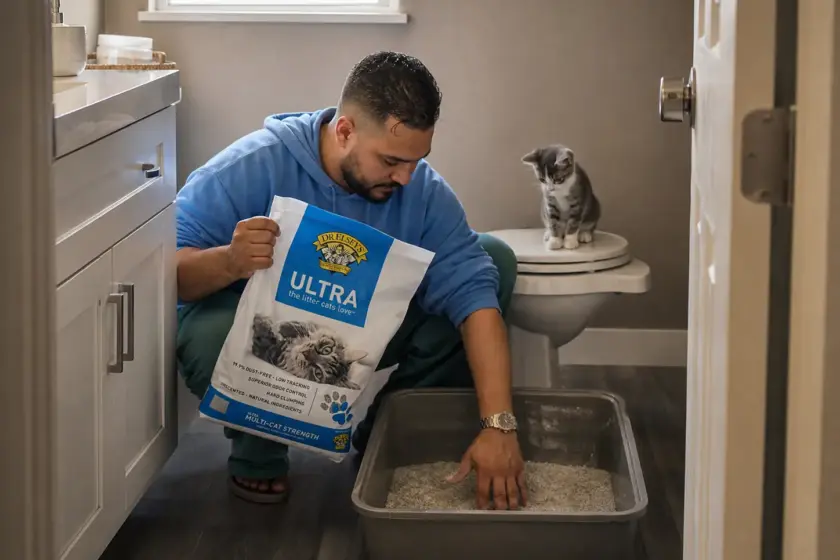
None of this is a knock on the litter itself. Dr. Elsey’s Ultra Unscented Clumping Clay Cat Litter (40 lb bag) is a genuinely good clay litter, hard-clumping and low on additives, and it is exactly the kind of bag this article is telling you to keep out of the toilet. It earns its place beside the litter box and nowhere near the bathroom.
Both things are true at once. Go look at what is in your own utility closet: if it is a heavy bag of clay that forms liftable clumps, this is that bag under a different brand name.
Two more materials people assume are exceptions. Silica litter, sold as crystal litter, is not the safer natural cousin it looks like. It is synthetic, it does not biodegrade, and it does not dissolve in water at all, which puts it further from flushable than clay rather than closer.
And non-clumping litter made of plain clay is not a workaround either. No clay is flushable. The clumping mechanism makes the outcome faster and denser, but plain clay still arrives in your pipe as a pile of wet mineral that has to go somewhere. If you are still deciding what to buy at all, the seven litter materials and who each one is actually for sorts every category by household rather than by marketing claim.
What Actually Happens in the Pipe, Flush After Flush
Here is the part that explains why so many people are convinced this is fine: they have been doing it for months and nothing has happened.
Nothing visible, anyway. One flush rarely blocks anything outright. What it does is leave clay on the interior wall of the pipe.
That thin coating narrows the channel slightly and, being sticky, grabs onto whatever comes past it next. The next flush adds to that coating. So does the one after.
The channel gets a little narrower each time, and every reduction makes the next deposit stick more easily, which is why the process speeds up rather than staying steady.
So “I flushed it for months and it was fine” is not evidence that it was fine. It is a description of the coating phase, spoken from inside it.
Then there is water volume, which nobody in this conversation ever mentions. A standard American low-flow toilet moves 1.6 gallons per flush. That number was set to carry waste and paper through several feet of three to four inch pipe, and it does that job well. It was never sized to push a swelling, sticky clay mass through a bend.
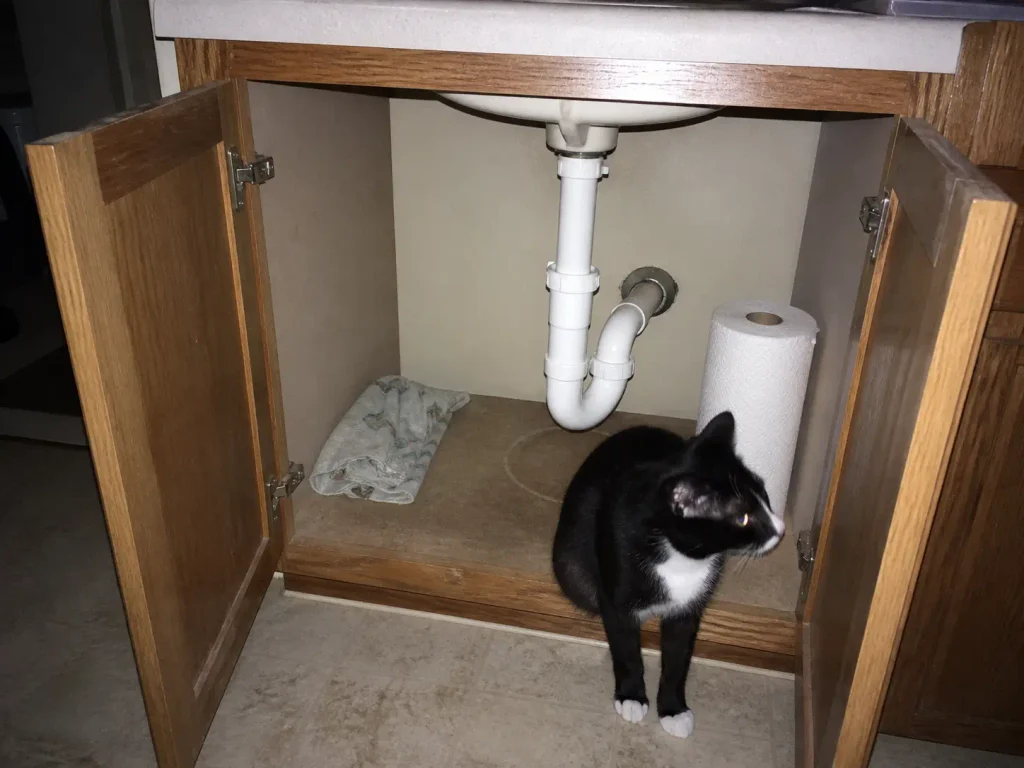
And bends are where this lands: the P-trap directly under the bowl first, then the first elbow past it. The geometry that keeps the sewer system on its own side of your bathroom is the same geometry that catches everything heavy enough to stop moving.
The failure looks sudden and it never is. It announces itself for weeks first, in three ways that are easy to write off individually.
Three early signals, and any one of them means stop flushing litter that day: the bowl draining slower than it used to, a gurgle from a nearby drain when the toilet flushes, and a smell that comes back within a day of cleaning the bathroom. Caught at that stage this is a cheap afternoon with a rented auger. Caught at the backup stage in an apartment building, it is somebody else’s ceiling.
What the Shared Stack Changes if You Rent
Every article on this question is written as though you own a house and the worst case is a bill. That assumption quietly does most of the work, and it does not hold for a lot of the people asking.
Think about where the pipe goes after it leaves your bathroom. In a house it runs to a lateral and out to the street, and it is yours end to end. In most multi-unit buildings it does not.
It joins a vertical stack that also serves the unit above you and the unit below you. Nothing about that arrangement is exotic. It is just how apartment plumbing works, and it changes what a clog costs.
Yours is not an isolated pipe with an isolated consequence.
So the same blockage that means one plumber visit for a homeowner means, for you, a maintenance ticket with your name on it, a couple of days of not having a working toilet, and, if it backs up into the unit below, a conversation about water damage that lands somewhere near your security deposit. That is a different risk profile from a bad afternoon, and it deserves a different level of caution.
You also have less information than a homeowner does. You do not know the age of the stack, you do not know what it is made of, and you do not know what the last four tenants sent down it. A 1970s building and a 2015 building have different tolerances for the same mistake, and neither number is printed on the litter bag.
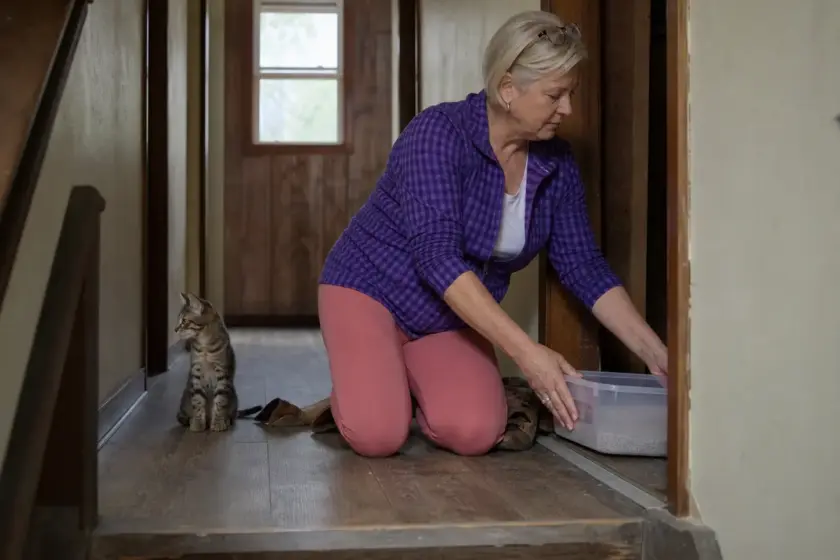
Before any of this becomes a shopping decision, the free fix. A lined pail with a lid, sitting within arm’s reach of the box, ends the question permanently and costs roughly nothing. Do that first, because it works and because the alternative you are weighing is a pipe you cannot see.
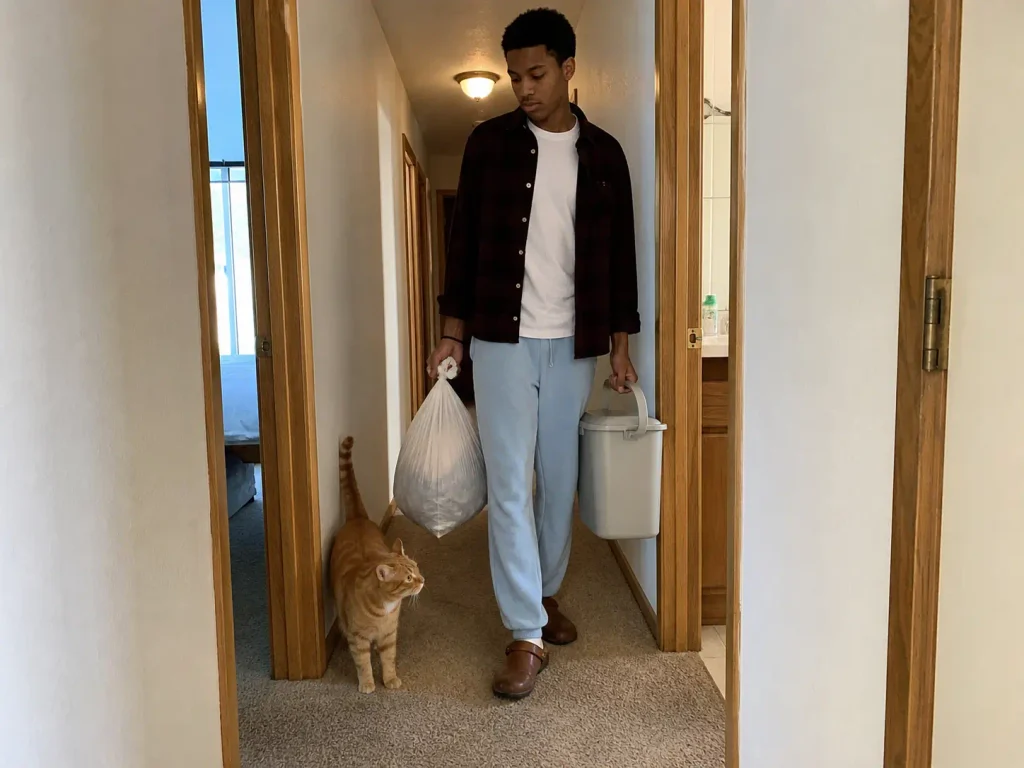
And it is worth naming the real reason people flush in the first place, because it is not laziness. Carrying a bag of used litter down a hallway, into an elevator, and out to a dumpster is genuinely unpleasant, and doing it every day is worse. The toilet is right there. Any disposal setup that ignores that friction is going to be abandoned in a week, so build one that respects it:
- A lidded pail beside the box, close enough to reach without standing up from a crouch. If you have to carry the scoop anywhere, this fails by the third day.
- Liners doubled, so the scoop goes straight in and the bag comes straight out without a second transfer.
- A fixed emptying day pinned to something you already do, like taking out the kitchen trash. Not a reminder, not a rule, just the same trip.
That is the whole setup. The same one-spot apartment problem shows up in a different form with litter tracking when there is only one place the box can go, and the answer there is the same shape: work with the route you actually walk, not the one you wish you had.
What You Can Flush, and the Fine Print the Brands Actually Write
The honest answer to the second half of the question is that flushable litters exist and they are all plant-based. Corn litter, wheat litter, tofu, and some walnut shell litter formulas. Clay is out permanently and silica is out permanently, and no amount of shopping changes that.
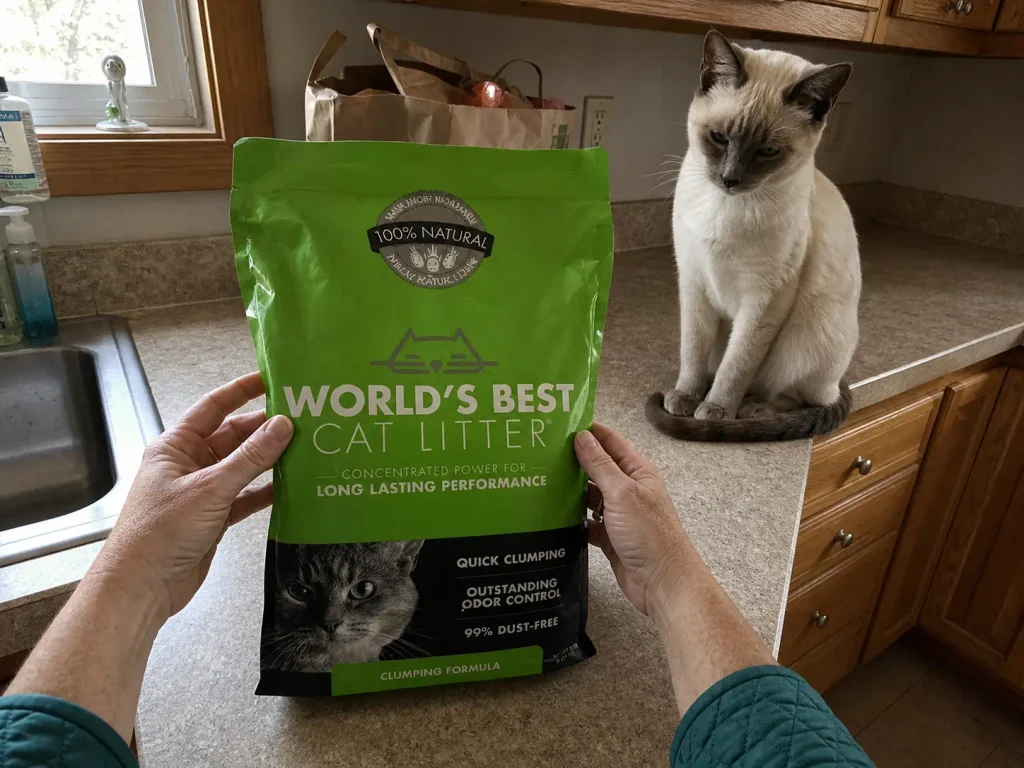
But “flushable” on a bag is a material property, not a permission slip for your building, and the brands themselves say so in type nobody reads. World’s Best Cat Litter (14 lb bag) is the corn-based name most people picture when they hear flushable, and its own guidance is to flush one to two clumps at a time, let them break down first, then flush. That is the ceiling any brand endorses, and it counts litter clumps one at a time, not sessions.
Nobody is telling you to empty a box into a toilet. Read the phrase again with the emphasis where the brand put it, and notice that the entire product claim lives inside a two-clump limit.
Tofu litter is the one that has actually been measured against a toilet rather than just described. An independent German lab tested tofu litter disintegration against a simulated 1.6-gallon flush over 24 hours in early 2025, which is a controlled single-clump pass under ideal conditions. pidan Tofu Cat Litter (5.3 lb bag) is that material in a bag small enough to be a cheap way to find out whether your cat will even accept a plant-based texture, which is the part nobody warns you about. The pellets feel nothing like clay underfoot and some cats decline them on the spot.
Here is where the gap opens, and it is the reason to read past the packaging. A lab pass is a single clump, in clean water, through new pipe, with no elbow full of six years of other people’s decisions. Your building is not that test. The claim on the bag is true and it still does not describe your plumbing, and those two statements do not contradict each other.
Then two exceptions that void the flushable claim outright, regardless of material. The first is a septic system, which breaks waste down through a slower bacterial process than a municipal sewer and gets overwhelmed by the sheer volume of litter even when the material biodegrades perfectly well. The second is California, whose state guidance on litter disposal is not to flush cat waste at all, and the reason is not the plumbing.
The concern is toxoplasmosis. Toxoplasma gondii oocysts survive standard municipal treatment, so wastewater treatment doesn’t remove the parasite and it passes through into coastal water. Of 305 beached sea otters studied on the California coast between 1998 and 2004, 52% carried it. That is a water story, not a story about your cat.
Two questions settle this before you spend anything on a flushable bag. Is the house on septic, and is the address in California. Either yes and flushability is irrelevant to you, which is good news: it frees you to buy on odor control and tracking instead, the two things you will actually notice every day. It is going in the trash either way.
And if this whole exercise has you reconsidering the category rather than the brand, whether clumping is even the right category for your house is the decision that comes before this one.
Two Cats Break the One-or-Two-Clump Rule, and What to Do if You Already Flushed
The two-clump ceiling was written with one cat in mind. One cat produces a couple of urine clumps a day plus solids, and the arithmetic works: a couple of clumps, dissolved, flushed, done.
Now put two cats in the apartment. Or three. The clumps multiply, the ceiling does not move, and following the rule honestly means standing at the toilet running flush after flush over ten minutes, waiting for each batch to break down. Do the water math on that and it is worse than the trash bag by a wide margin, and it is still not safe, because the per-flush limit exists to protect a pipe that does not care how patient you are being.
I used to think the flushable claim was worth paying for on principle. After enough of the multi-cat arithmetic, I stopped: past one cat, flushability is a feature you cannot actually use, and buying for it means paying for something that sits unused while you carry the bag out anyway. Buy for odor control and dust instead. Those you will use twice a day for the life of the box.
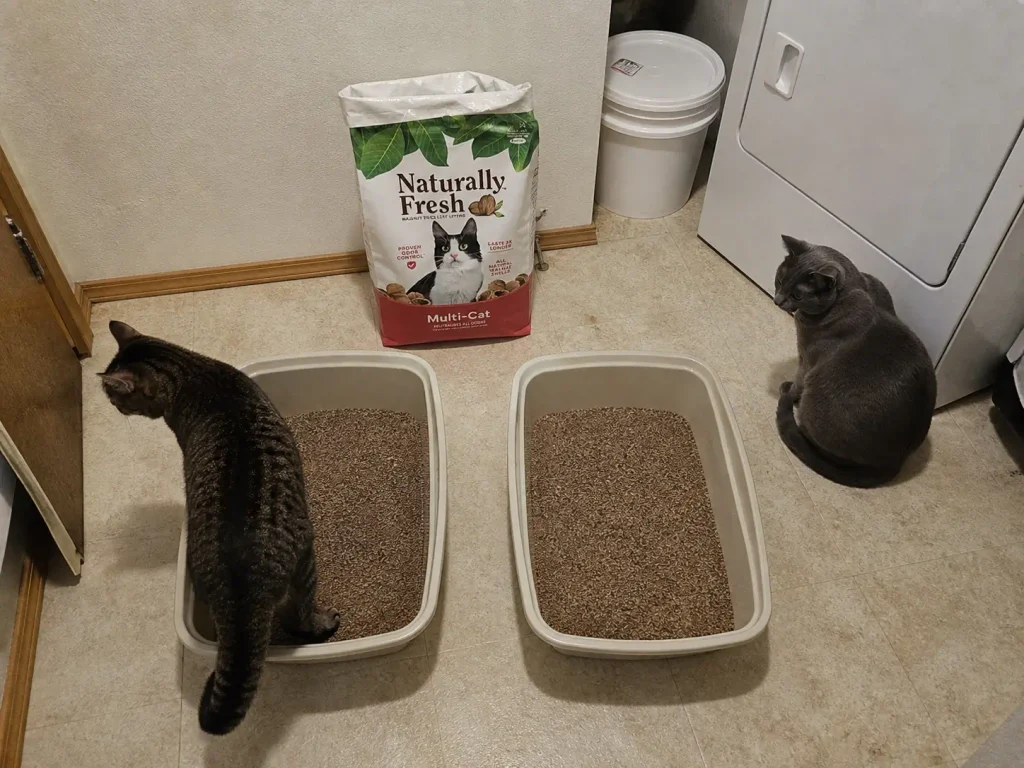
Naturally Fresh Cat Litter made from walnut shells (Unscented, Multi-Cat formula) is the honest pick once flushability drops out of the decision, since it is built for households with more than one cat and leans on odor performance rather than a disposal claim. The caveat is texture again: walnut is darker and coarser than clay and it shows on light flooring, so if tracking is already your main complaint this trades one problem for another. When there are several cats and one box routine holding it all together, odor control is what actually decides a multi-cat litter, not what the bag says about toilets.
Now the other half, for the reader who found this article too late. You already flushed. Maybe once, maybe every day for a year.
If nothing has backed up, nothing is on fire. Stop flushing litter today, and watch the drain for the next few weeks for the three signals from earlier: slower draining, gurgling, a smell that returns fast after cleaning. Most people who stop early enough never hear from that pipe again. The coating does not keep growing once you stop feeding it.
If it has already backed up, the order matters more than any single step, and the instinct almost everybody follows is the wrong one. The urge after a bad flush is to flush again and push it through. That extra water is what swells the clay further, so the most common reaction is also the one that makes the blockage denser.
- Stop flushing. Not one more, not to check. Every additional flush adds water to a mass whose defining property is that it swells when wet.
- No drain chemicals. They are formulated for hair, grease and soap, they do nothing at all to clay, and they can damage pipe seals while you wait for a result that is not coming.
- No plunger. Plunging works by pressure, and pressure on a clay mass drives it further down the line toward the part of the system you have even less access to.
- Then a snake or auger, which is the tool that physically breaks the mass up and pulls it back. Boiling water can loosen a softer, newer blockage, and it is worth one attempt before the auger.
If you rent, make the call to maintenance earlier than feels necessary. The ticket you open on day one is a smaller conversation than the one you open after it reaches a neighbor.
The Short Version
Clumping litter is bentonite clay, clay swells and sticks on contact with water, and that is what you are buying it for. It belongs in a trash bag. The only litters sold as flushable are plant-based, and even those cap at one or two dissolved clumps at a time, a limit that stops being usable past one cat and that a septic tank or a California address voids entirely.
If you have already been flushing and nothing has backed up, stop today and watch the drain. If it has backed up, do not flush again and do not reach for the chemicals.
Give it three weeks and check one thing: whether the pail is still where you put it, or whether you have started walking the scoop somewhere again. This is a human routine, not a piece of hardware wearing out, and human routines slip around week three. The setups that get abandoned are always the ones you have to walk to.
A lined pail next to the box settles this permanently and costs almost nothing. Buy that before you buy a different litter.
Amazon’s Audible — free for 30 days
Your cat won’t let you read. Let someone read to you.
Audible is Amazon’s audiobook library — thousands of titles, read out loud, on your phone. Free for a month, plus one audiobook to keep forever.
Frequently Asked Questions
01Is there any cat litter you can flush down the toilet?
Plant-based litters, meaning corn, wheat, tofu and some walnut formulas, are the only ones sold as flushable. Even those are meant to go one or two dissolved clumps at a time, never a whole box, and the claim does not hold on a septic system.
02What happens if you flush clumping cat litter once?
Usually nothing you will notice that day, which is exactly the problem. A single flush leaves a thin clay coating on the pipe wall rather than blocking it, and the blockage builds from repeated flushes. Stop, and watch for slow drainage or gurgling over the next few weeks.
03Why do shelters use non-clumping cat litter?
Mostly because of kittens, who investigate litter with their mouths, and because non-clumping is cheaper to change in volume across many boxes. It is not a flushability decision, since non-clumping clay is no more flushable than clumping clay.
04Is flushable cat litter safe for a septic system?
No. A septic tank breaks waste down through a slower bacterial process than a municipal sewer, and litter volume overwhelms it even when the material itself biodegrades. On septic, everything goes in the trash.
05Can I flush cat feces without the litter?
In most places you physically can, but California’s guidance is not to flush any cat waste, and the reason is the parasite rather than the plumbing. Toxoplasma oocysts survive standard wastewater treatment and pass through into coastal water.
Leave a comment