How to Switch Cat Litter Without Losing the Box
How to switch cat litter in 4 steps [25/75, 50/50, 75/25, all new]. Why day 4 is where most cats object, and the 2-week version for pellets.

Alfredo RamsesFounder · August 24, 2026 · 21 min read

On this page9 sections
- 1What a Litter Switch Actually Looks Like to a Cat
- 2Mix It, Never Layer It
- 3The Switches That Need More Than Ten Days
- 4Switching When There Is Only One Box
- 5More Than One Cat Changes the Whole Plan
- 6Reading the Refusal, and When to Go Back a Step
- 7The Three Weeks After the Switch Is Finished
- 8Conclusion
- 9Frequently Asked Questions
You brought home a different bag, poured it in, and by the third day someone was peeing on the bath mat. He is not protesting the brand, and he has not read the reviews. He is reporting that the floor of the one room he is required to use changed overnight without anyone telling him.
Cornell’s Feline Health Center puts litter box aversion at up to a quarter of cats at some point in their lives, so this is not your cat being odd. Here is how to switch cat litter on a schedule that works, why the slow version works at the paw rather than in the nose, and where it breaks in a small apartment or a house with more than one cat.
Quick Answer
Mix the new litter through the old one over seven to ten days, in four steps. Mix it, never layer it, and go back a step at the first refusal instead of pushing on.
- Days 1 to 3, stir 25% new litter through 75% old.
- Days 4 to 7, move to half and half.
- Days 8 to 10, go 75% new and 25% old.
- Day 11 on, all new if every step was used normally.
What a Litter Switch Actually Looks Like to a Cat
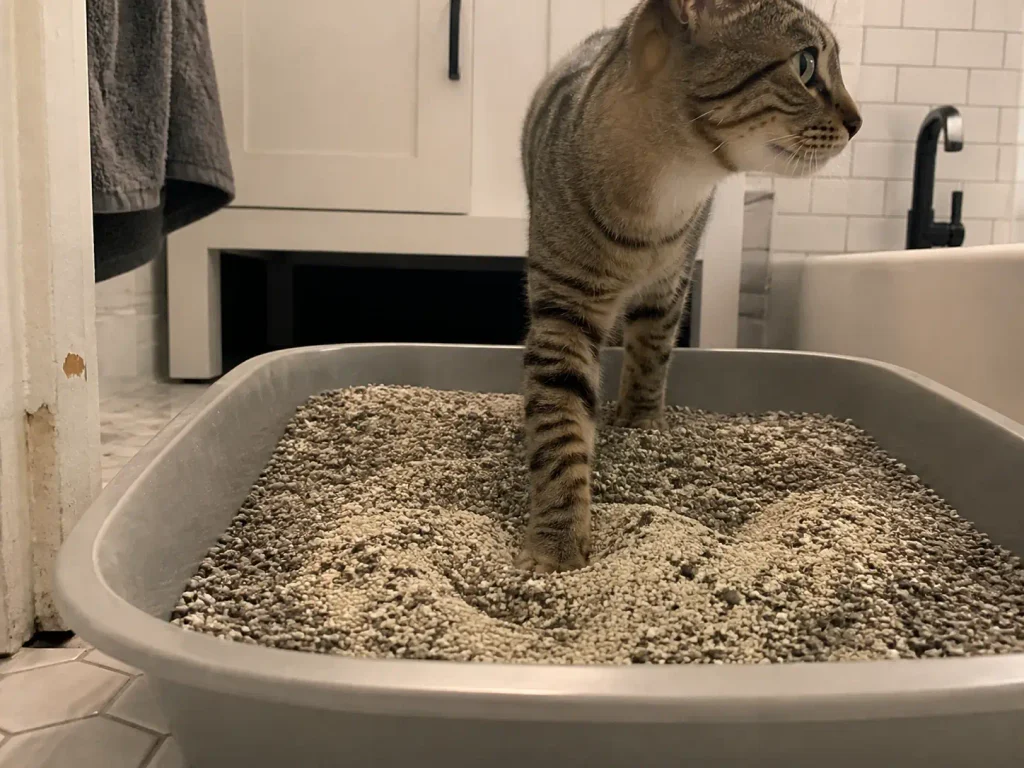
Every article on this tells you to do it gradually. Almost none of them tell you what gradually means in scoops, and none of them tell you why the cat cares in the first place. This page is about the transition itself, not about picking the destination — which litter type you are switching to changes how hard the switch is, and that decision belongs upstream of this one. If it is already made, you are standing in front of two open bags right now, so the schedule comes first.
Days one through three, the box is a quarter new litter and three quarters old, stirred together. Days four through seven, half and half. Days eight through ten, three quarters new. Day eleven, the box is all new litter, assuming the cat used it normally at every step before that.
If your cat has ever refused a change before, or is heading for a material that feels nothing like what he has now, stretch those same four steps across two weeks instead. The steps do not change.
The clock does.
Measure the transition in scoops, not in percentages. One scoop of new to three of old is the whole of days one through three, and a ratio you can count beats one you re-estimate at seven in the morning with the bag between your knees.
He Reads the Box With His Feet First
Here is the part nobody publishes, and it changes how the schedule makes sense. A cat’s paw pads carry a dense supply of nerve endings, and cats show strong individual preferences for litter texture on contact. He steps in, and before the smell has done anything at all, he already knows the floor is different.
Scent matters, but it arrives second. The switch is a tactile event.
That is why a litter transition is built on a mixing ratio instead of on days. A quarter of new material scattered through three quarters of the old one barely registers underfoot, which is exactly the point of starting there.
Fifty-fifty is different. At half and half, the new stuff stops being a minority of what he is standing on, and it becomes the surface. That paw sensitivity is also why an older cat deserves the slower version by default: a senior cat with stiff joints is already negotiating the step into the box, and a surface that gives differently underfoot adds a second thing to negotiate. Uniform, medium-sized granules also lodge between toes less than very fine, dusty ones, so two litters can read as nearly the same floor or as two completely different ones depending on how they are milled.
The Day Four Cliff
The story that repeats in litter threads is always shaped the same way. Nothing happens for three days. The owner relaxes, decides this cat is easy about it, and then on day four or five the cat starts hovering at the rim, or goes once and does not come back. The owner reads that as the cat suddenly turning difficult halfway through a process he had already accepted.
He did not turn difficult. Day four is when the ratio crossed. The first three days were quiet because there was nothing there to object to yet, and the objection arrived the moment the mix became mostly new.
That is the schedule working exactly as designed, and the correct response is to hold, not to hurry. The box, its location and the litter depth stay identical for the whole transition. One change at a time, and this week the change is the material.
The one thing you should change is how often you scoop, and only upward. An unfamiliar surface plus a box that is not perfectly clean is two reasons to walk away instead of one, and you only control the second. Scoop twice a day for the ten days if you can manage it, once a day at minimum, because litter box ammonia starts building well before you can smell it and he can smell it long before you can.
And do not add a scented product to the mix while you are at it. A new litter scent on top of a new texture is two changes wearing one bag, and cats detect scent at a level people cannot judge for them. Give him nothing to object to except the litter itself, which is enough for him to be going on with.
Mix It, Never Layer It
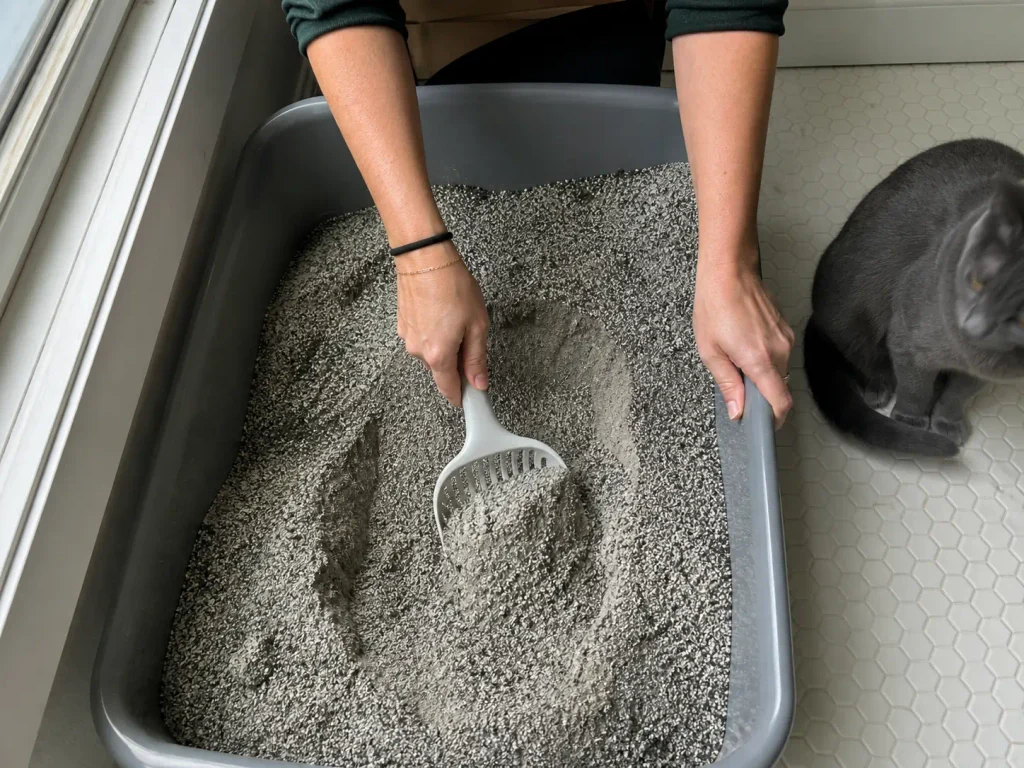
Pouring the new litter on top of the old looks like the same job and takes about a tenth of the effort. It is also the version most people actually do, and it is why a correct schedule turns into no transition at all.
A layered box gives the cat a way out. He digs through the fresh two inches on top, hits the familiar material underneath, and does his business standing on the old litter. Every visit for ten days confirms that nothing has changed, because from where he is standing nothing has.
Then on day eleven the old litter is gone, and what you have built is not a gradual switch. It is a cold swap with a ten-day delay in front of it. The litter box boycott people describe with “I did it gradually and he still stopped using it” is almost always a layering story rather than a schedule story.
Mixing means turning the whole depth over with the scoop until the box holds one material instead of two strata. It takes about thirty seconds. There is also a mechanical reason beyond the behavior one: clumping litter and non-clumping litter mixed together interfere with each other’s clumping, and you get soft clumps that fall apart when you lift them, which makes the box worse at the exact moment you need it to be at its best. If those are the two families you are moving between, know that going in, because clumping and non-clumping are not interchangeable halfway through a transition.
And watch the depth. Adding the new litter on top of an already full box raises the fill level as well as changing the material, and now you have made two changes and can only undo one of them. For the entire ten days, the depth you started with is the depth you keep.
- The box stays the same box. Not a new one, not a bigger one, not the covered one you have been meaning to try.
- The location stays the same. Same room, same corner, same wall.
- The depth stays the same. Scoop out to level before you stir the new litter in, not after.
The Switches That Need More Than Ten Days
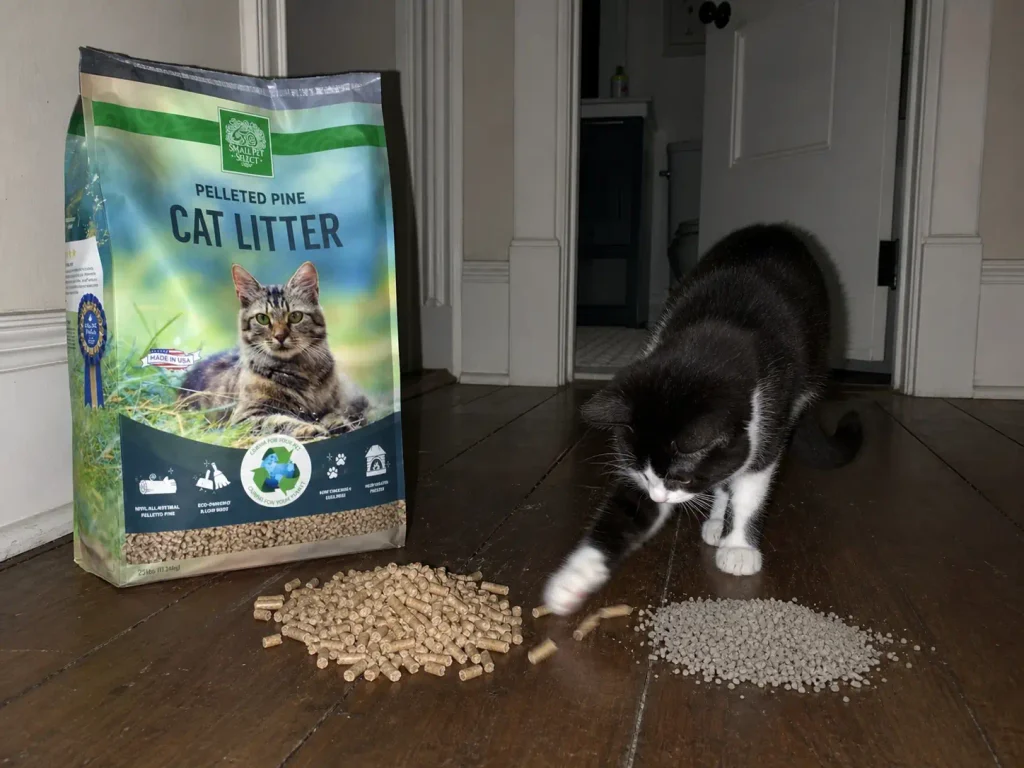
Swapping one clumping clay for a different clumping clay is not the same job as going from clay to pine pellets, and both get handed the same ten-day calendar. The real difficulty of a switch is proportional to how far the new material sits from the old one underfoot, so grade the pace by that instead of by the box on the wall calendar.
Same-texture switches are the easy case. Clay litter to clay, one clumping litter brand to another, one unscented litter of fine grain to a different one. The granules are a similar size, the surface gives the same way when he digs, and a lot of cats clear the schedule early.
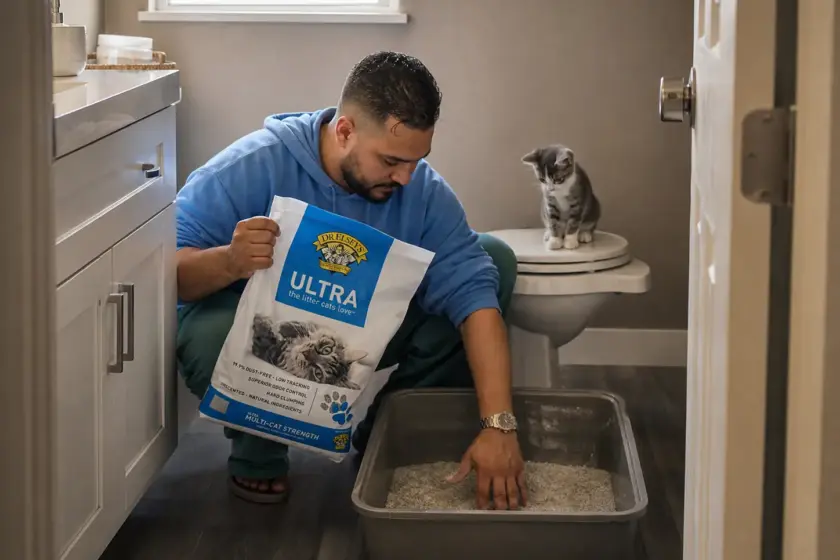
The Dr. Elsey’s Ultra Unscented Clumping Clay Cat Litter is the reference point most of these moves start from or land on, in a 40 lb bag that is genuinely economical per pound and genuinely awkward to carry up three floors without an elevator. That weight is the honest caveat, and it is not in any review.
The middle of the ladder is where the material changes but the format does not. pidan Tofu Cat Litter comes in a 5.3 lb bag and still clumps, still gets scooped the same way, but tofu litter is a plant-based pellet-ish granule rather than compressed clay, and it feels lighter and drier under a paw. Crystal is the other common mid-risk destination and it is different in a different direction.
PetSafe ScoopFree Premium Crystal Litter ships as two 4.3 lb bags of fragrance-free silica litter, and silica is larger and noticeably harder underfoot than clay. Cats that dig enthusiastically tend to have the strongest opinion about it, in both directions.
Then there is the top of the ladder. Clay to pine litter pellets is the biggest jump on the shelf, because granule size and the way the surface gives under the paw both change at the same time. Small Pet Select Premium Pine Pelleted Cat Litter is the cheapest per pound of anything here in its 25 lb bag, and it is also the switch that most often needs the full two-week version of the schedule rather than the ten-day one. A pellet does not compress under a paw the way clay does.
It rolls. For a cat who has spent four years on fine clay, that is a completely new floor, and the price advantage means nothing if the transition fails.
| The switch | What changes underfoot | Schedule to budget |
|---|---|---|
| Clay to clay | Almost nothing. Similar grain, similar give when he digs. | 7 days, often less |
| Clay to tofu | Lighter, drier granule. Still clumps, still scoops the same. | 10 days |
| Clay to crystal | Bigger and harder. Digging feels different immediately. | 10 to 14 days |
| Clay to pine pellets | Grain size and surface give both change at once. Pellets roll. | 14 days, no shortcuts |
Buy the Small Bag First
The advice that keeps coming back in litter threads is the least glamorous one available: buy the smallest bag of the new litter before you buy the big one. A transition that fails on a small bag costs you a small bag. A transition that fails on a 40 lb sack costs you a 40 lb sack that you now have to store, carry back down, or give away.
And before you commit to any of this, check whether you actually need a texture change at all. If dust is the reason you are switching at all, or tracking, or the smell, then a low-dust litter inside the same family usually fixes it without asking your cat to relearn the floor of his bathroom. That is free in the sense that it costs one bag either way, and it takes the hardest variable off the table entirely. Most of the switching pain in this niche comes from people who jumped two rungs up the ladder to solve a problem that was sitting on the first one.
Switching When There Is Only One Box
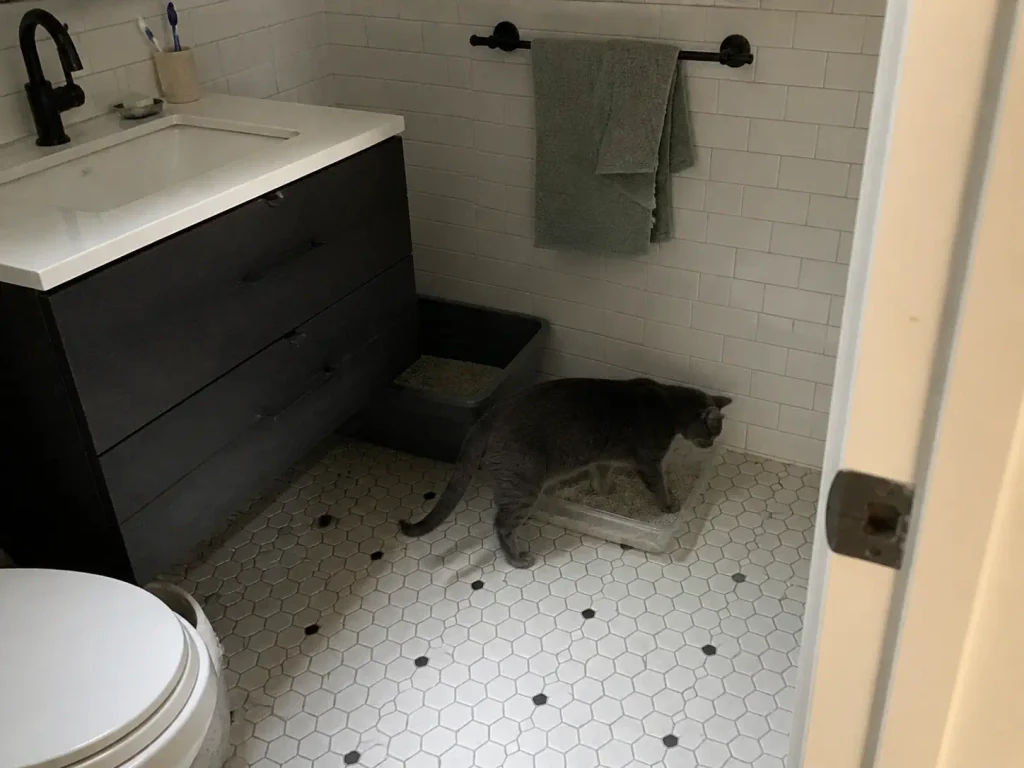
Every article on this subject eventually tells you to put the new litter in a second box beside the old one and let the cat choose. It is genuinely the gentler method. It is also written for a house with a spare corner, and if your entire litter setup is one box wedged between the toilet and the radiator in a one-bathroom apartment, that advice is for somebody else’s home.
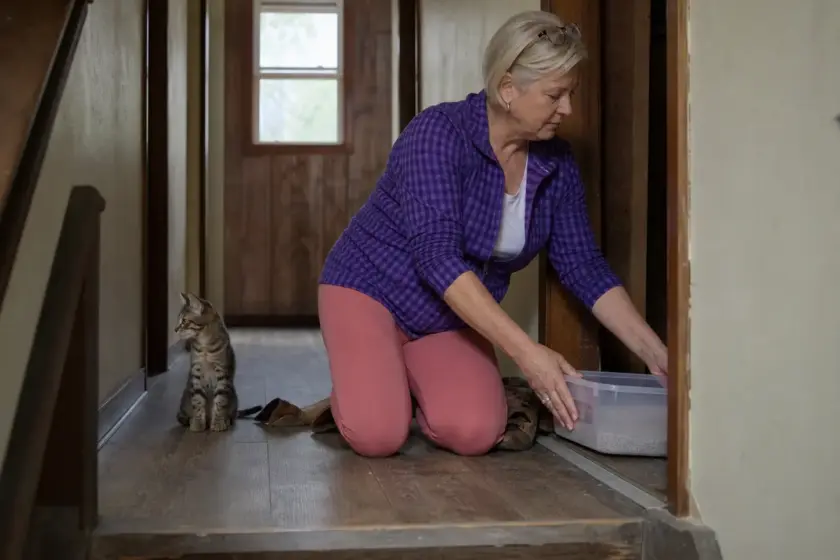
The two-box method works like this when you do have room: old litter in the current box, new litter in a second box placed nearby, run it for one to two weeks, and let the cat vote with his feet before you remove the old one. Nothing gets mixed, nothing gets forced, and the cat is choosing rather than being moved. If you have the floor space, it is the lower-stress route and it is worth the awkward fortnight.
Without room, mixing in the single box is not a compromise. It is the method, and the thing you spend instead of floor space is time. Stretch the same four ratio steps across two weeks rather than ten days, and move up a step only once he has used the box normally for a day or two at the current one. Slower single-box beats faster two-box every time, because the variable that matters is his acceptance, not your tidiness.
Run the shoebox-lid test before you commit to a bag. Put a shallow tray of the new litter beside the box for two days and watch whether he steps in it at all. A cat who will not put one paw in the tray is not going to accept that material at half and half either, and you just learned it for free.
A shoebox lid, an under-bed storage tray, a baking dish you no longer use. None of these are litter boxes and none of them need to be, because you are not asking him to use one. You are asking whether he will stand on the stuff. That is a two-day question with a yes or no answer, and it costs nothing.
If you want to run two real boxes and the problem is purely floor area, the geometry has an answer. The renter-friendly version of the two-box method is narrower than it looks. Two top-entry boxes fit side by side in roughly the footprint one open box needs, because the entry point is vertical rather than horizontal. That turns “no room for two boxes” into “no room for two open boxes,” which is a much smaller problem.
Worth knowing too that a smaller apartment makes granule size, and so litter box tracking, matter more rather than less, because whatever gets kicked out of the box in a studio has fewer places to go before it reaches your bed.
One more rule, and it is the one people break most often. Never combine the switch with a change of litter box location. The AAFP and ISFM’s feline environmental needs guidelines treat each resource as something to keep isolated from other changes, and the reason is practical rather than theoretical: a cat who gets a new floor and a new room in the same week has two things to reject and no way of telling you which one he means. You will spend a fortnight guessing.
More Than One Cat Changes the Whole Plan
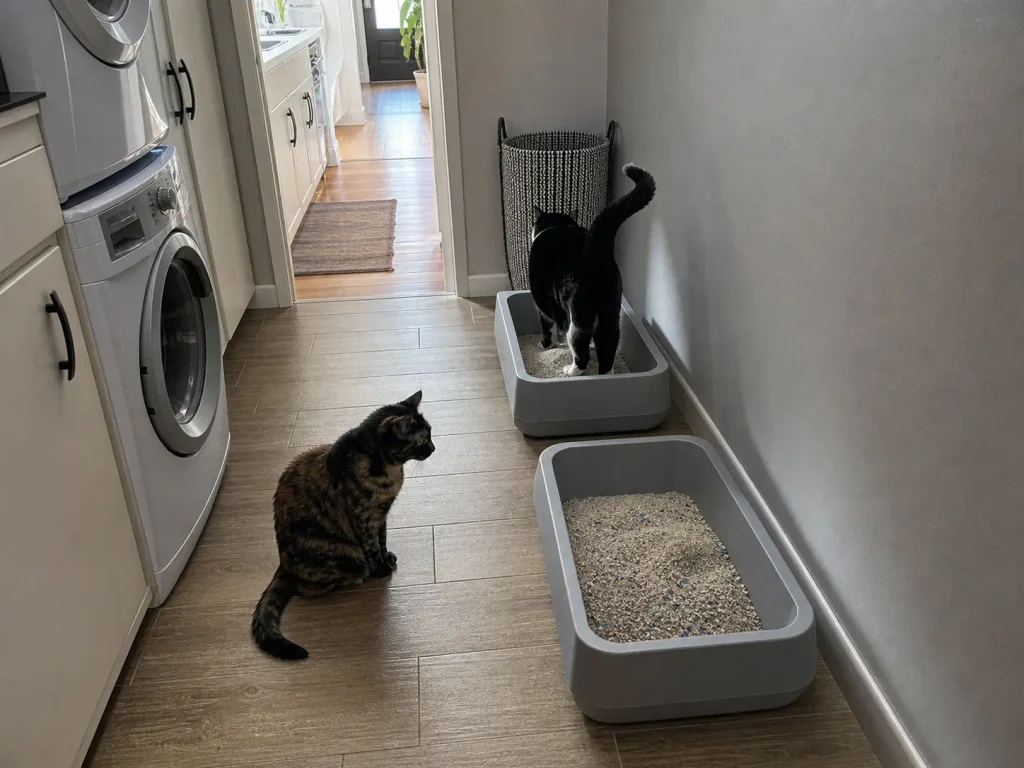
You have three cats and three boxes, and every guide you have read was written for one cat and one box. So you converted all three trays on the same Sunday afternoon, which felt efficient, and it removed every familiar surface in the house at the same moment. Now something is going wrong and you cannot even tell which cat is objecting.
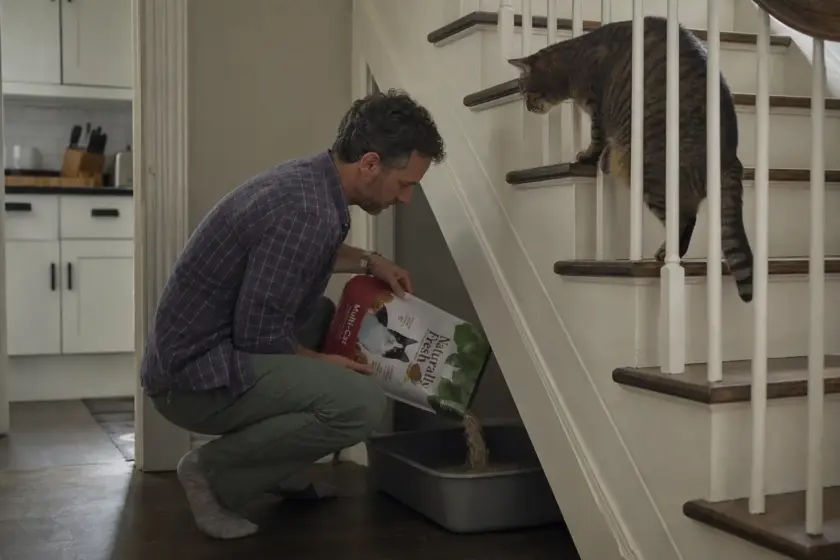
Stagger it. One box moves to the new ratio while the others stay entirely on the old litter. That single decision does two things at once, and both of them matter.
It guarantees that a cat who does not like what he finds in box one still has a box he already accepts, so a refusal never means he has nowhere acceptable to go, which is the difference between a hesitation and an accident on the rug. And it isolates the objection: if one cat stops using the converted box and keeps using the other two, you know it is the litter and you know exactly which cat has the opinion.
- Box one starts the ratio schedule. Boxes two and three stay 100% old litter.
- Box one finishes and is being used normally by everyone. Only then does box two start.
- Box two finishes. Box three starts. Box three finishes when it finishes.
That takes considerably longer than ten days, and it is meant to. A three-box home running this properly is looking at three to five weeks from first scoop to last, and the alternative is a faster process with three cats and no fallback. The box count itself does not change during any of this. The 1+1 litter box rule — one box per cat plus a spare — is the floor you were already meant to be at, and a transition is the worst week of the year to drop below it. Taking a box away to simplify the logistics removes the exact thing the method depends on.
The earliest sign of friction in a multi-cat household is quieter than people expect, and it is not a puddle. It is one cat waiting for an occupied box instead of walking to the free one, because the free one is the converted one.
That is a preference being expressed at some cost to himself, and in a house where boxes are already contested it can tip into resource guarding around the one tray everybody still trusts. It is worth more information than a mess on the floor would give you. Worth knowing as well that several boxes at different stages of a transition also smell different from each other, which is a real effect during the weeks when your house is running two litters at once.
Reading the Refusal, and When to Go Back a Step
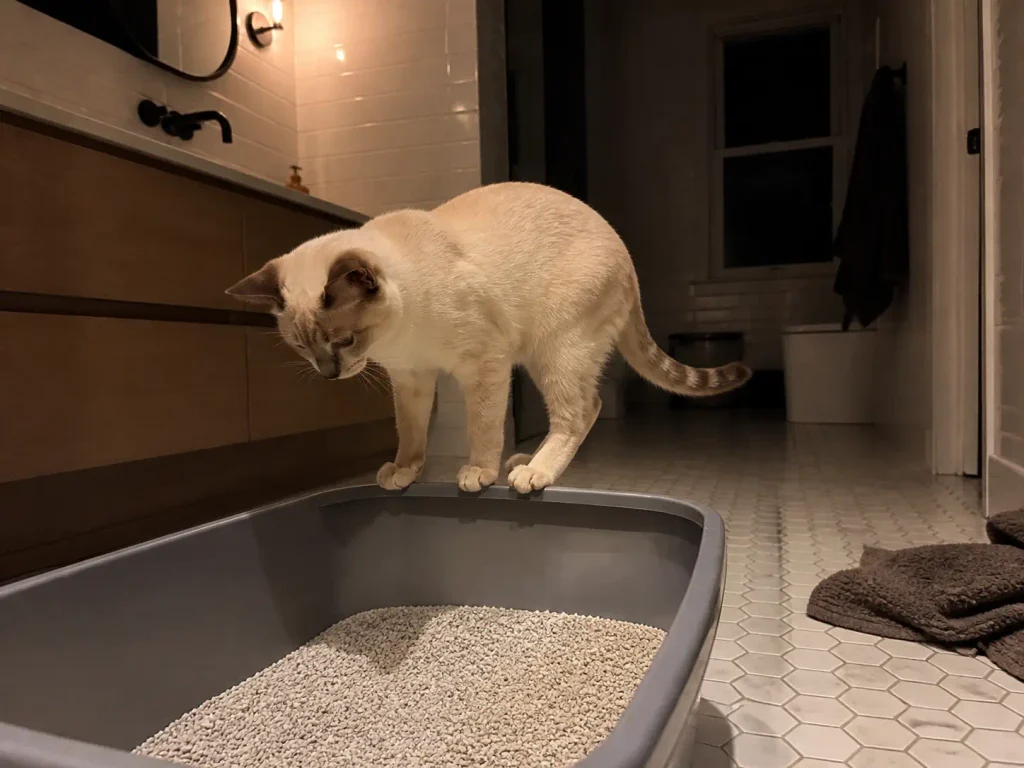
Your cat did something slightly odd yesterday and you cannot tell whether it was a signal or a coincidence. Every source on this says “watch your cat” and “slow down if he resists,” and not one of them tells you what resisting looks like. Here is the graded version, weakest signal first.
Litter box rejection does not start with a puddle. It starts small, and in this order. He hesitates at the rim before stepping in. He digs less than he used to, or stops covering. He stands on the plastic edge with his back feet instead of standing in the litter. He shakes his paws off on the way out, more than the usual once.
His visits get shorter. And at the far end of the scale come accidents outside the box — peeing outside the litter box rather than in it. The top of that list is a comment. The bottom of it is a decision he has already made.
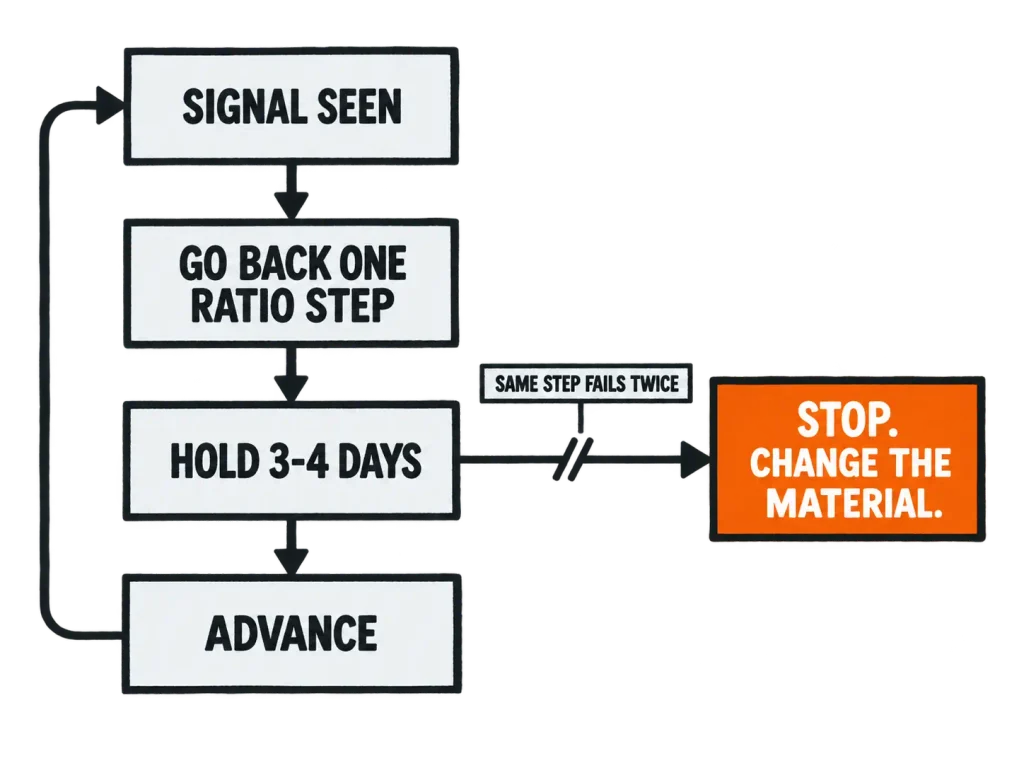
The rule is simple and most people ignore it because it feels like going backwards. At the first clear signal, return to the previous ratio and hold there for three or four days before advancing again. Not the same day, not two days.
Three or four, long enough that his last several visits were uneventful. The day count in the schedule is a default, not a deadline, and there is no prize for finishing on time.
Write the date and the ratio on the side of the bag with a marker every time you step up. When something goes sideways on day nine, the first question is always what day you moved to half and half, and nobody ever remembers.
The Rule for Stopping Entirely
This next part is our own editorial call rather than something you will find in a study, and it is stated as such. If the same ratio step fails twice after a full retreat, the switch is not going slowly. It is failing. Stop the transition, go back to 100% old litter, and change the destination material instead of the pace. A cat who will not accept pine at half and half on two separate attempts is not going to accept it at 75/25 because you waited longer in between.
That distinction is worth holding onto, because “be patient” is the advice that keeps people grinding for six weeks on a material their cat has already answered about. Patience is the right response to hesitation. It is the wrong response to a clear, repeated no.
The pace is a variable you control; the material is a variable he gets a vote on, and he already voted. A kitten is the one case where the destination matters more than the schedule, because kitten litter carries a constraint the pace cannot fix. The same goes for a new cat who arrived last week: he has not accepted anything yet, so there is no old surface to transition away from, and you start on the litter you intend to keep.
Missing the box once during a swap is information. Missing it repeatedly, or elimination habits changing in a way that does not line up with your ratio steps at all, is a vet visit and not a litter problem.
Community shorthand for that is the switch not tracking the litter, and it is a good phrase because it names the test exactly: does the behavior move when you move the box, or is it doing its own thing? If it is doing its own thing, that goes to a vet first, and everything on this page waits until he has been cleared. Then you come back to the litter.
The Three Weeks After the Switch Is Finished
An article that ends on day eleven ends a week early. Hitting 100% new litter is not the finish line, it is the start of the only test that counts, because a litter that behaves well as a quarter of a box does not necessarily behave well as the whole thing.
Clumping strength, litter box odor control and how often the box needs scooping only reveal themselves at full strength. And here is the part that catches people: a new material often needs a different scooping rhythm than the old one did. A litter that works when you hold it to the old routine is not the same thing as a litter that works.
If the previous one forgave you skipping a day and this one does not, then the box degrades on your schedule, the cat starts avoiding a box that has become genuinely unpleasant, and everyone blames the litter or the cat. It was the routine. Worth checking one more thing while you are here: if the new litter is sold as flushable, that claim deserves its own check before it goes near a drain.
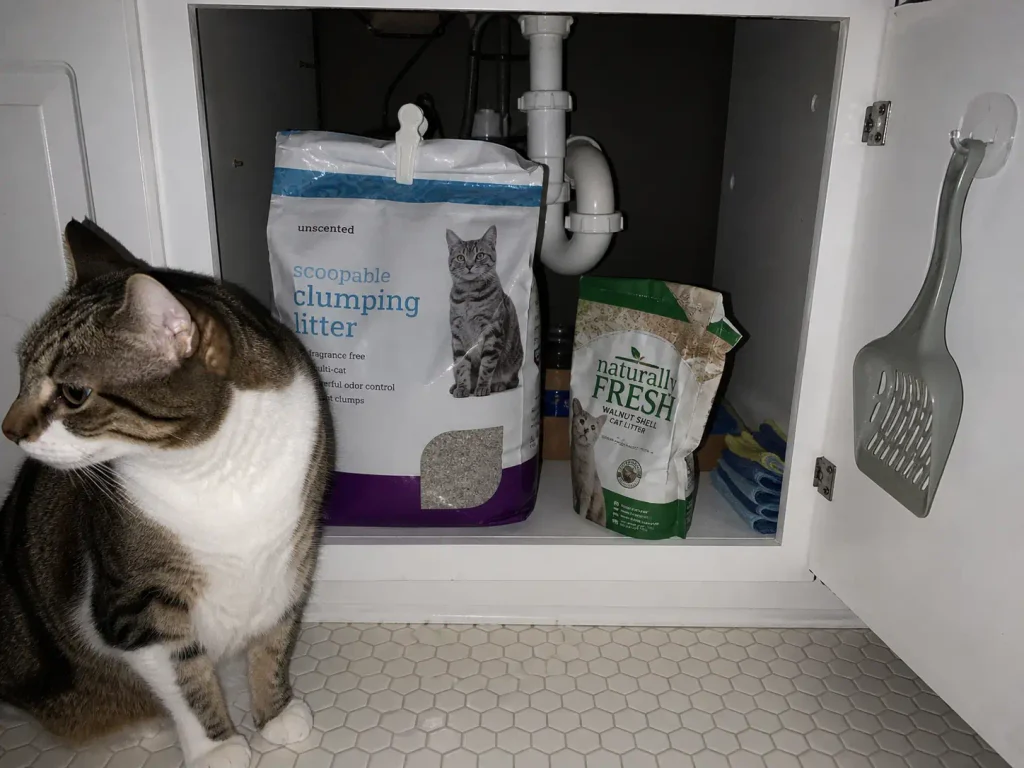
Do not throw the old bag out on day eleven. Keep a small amount for two or three weeks, and if the whole thing unravels in week two, going back is a ten-minute job with a scoop instead of an evening and a store trip.
Two or three weeks of overlap with the old bag is the cheapest insurance in this entire process. It costs you a shelf and it saves you the one evening where everything has gone wrong and the shop is shut.
Settled looks like this: he digs for his normal amount of time, does not pause at the rim, does not shake his paws on the way out, and uses the box at the same times of day he always did. Four small things, and none of them are dramatic. That is the point. A settled cat is a boring cat.
Only when the new litter has held for three full weeks does buying the big bag make any sense. Buy it on day eleven and you are betting on a result you do not have yet.
Conclusion
Mix it through the whole depth, never pour it on top. Layering is the failure that gets blamed on the schedule, and it is the single most common way a correct plan produces a cold swap on day eleven.
Grade the pace by how far the new material sits from the old one, not by a calendar somebody else wrote. Clay to clay is a week. Clay to pine pellets is a fortnight and a small bag first.
Going back a ratio step is the method working, not the method failing. But two failed attempts at the same step means the destination is wrong rather than the pace, and no amount of extra patience fixes a material your cat has already answered about twice.
Three weeks from the day the box goes fully over, check three things. Is he still using it at the same times of day. Is the scooping rhythm this litter actually needs the one you are actually keeping. And have you thrown the old bag out yet, because if the answer to the second question is no, you are going to want it.
The small bag, the shoebox-lid test and going back a step all cost nothing. Most switches that fail did not fail for lack of the right litter.
Amazon’s Audible — free for 30 days
Your cat won’t let you read. Let someone read to you.
Audible is Amazon’s audiobook library — thousands of titles, read out loud, on your phone. Free for a month, plus one audiobook to keep forever.
Frequently Asked Questions
01How Long Does It Take for a Cat to Adjust to New Litter?
Seven to ten days for most cats, and up to two weeks for one who has refused a change before or is moving to a very different texture. The clock runs from the first mixed box, not from the day you opened the new bag.
02Can I Put New Litter on Top of Old Litter?
No. The cat digs through the top layer to the old material underneath and never actually stands on the new litter. Mix the two together through the full depth of the box instead, so every visit happens on the blend.
03How Do I Switch Cat Litter if My Cat Is Already Picky?
Slower, and with a way out. Stretch the same four ratio steps over two weeks, and if you have the floor space, run a second box of the new litter beside the old one so he is choosing rather than being moved.
04Is It Bad to Change Cat Litter Brands?
Not in itself. The harm comes from changing overnight rather than from changing at all. A brand switch inside the same material family, one clumping clay to another, is the easiest kind of transition there is.
05What if My Cat Stops Using the Box During the Switch?
Go back to the previous ratio and hold there for three or four days before advancing again. If the changes do not line up with your ratio steps, or continue well past the transition, that is a vet visit rather than a litter box problem.
Leave a comment