Best Carrier for Two Cats That Won’t Sag or Unzip
Best carrier for two cats, measured: 19.5 in per cat in a 39 in double vs 22.8 in in a hard box (+ Delta's 18 x 11 x 11 in cabin limit for the plane).

Alfredo RamsesFounder · November 10, 2026 · 21 min read

On this page10 sections
- 1Best Carrier for Two Cats Starts With a Tape Measure, Not a Label
- 2Which Cats Ride Alone, and When the Call Comes Before the Carrier
- 3One Box Per Cat: The Free Fix and the Vet's Checklist
- 4Two Boxes, One Pair of Hands: The Door, the Footwell and the Waiting Cat
- 5The Double Carrier, Measured: 19.5 Inches Per Cat
- 6The Move and the Hotel Night: When a Cage Beats a Bag
- 7The Plane, in Numbers: One Adult Per Kennel
- 8Where the Carrier Lives Between Trips
- 9Measure Both Cats, Then Pick the Boxes
- 10Frequently Asked Questions
The listing for a double cat carrier (some say dual cat carrier) reads 39 inches, built for two cats, with a carrier weight limit that looks generous. Then you lay a tape beside your own two and find that each would get less floor than a single cat gets in a plain hard box. Choosing the best carrier for two cats starts with that gap between what the label promises and what a cat’s length demands. The vet’s standard is an action (stand, turn around, lie down) and airlines allow one adult per kennel, so the usual answer is two boxes instead of one bag, with a few exceptions worth testing at home.
Each way of carrying two cats gives something up, and the table puts the floor each cat gets next to the trip it suits.
| Setup | Floor per cat | Best for | Its limit |
|---|---|---|---|
| One hard box per cat | 20.7 to 22.8 in | The car, the vet and moving day; two handles for one pair of hands | Two boxes to carry and two to store |
| Soft double, 39 in | 19.5 in | A short car trip for a pair that has already ridden together at home | The floor sags and the center zip opens |
| Folding cage with litter pan, 31.8 in | 31.8 in shared | A move or a hotel night with both cats and a pan | A room you set down, not a bag you lift |
| Divided cabin bag, 18 x 12 x 12 in | One shared 18 in bag | Two kittens of the same breed and size, 8 weeks to 6 months | Adults outgrow it |
| Compressing cabin single, 22 in | 16 in compressed, 22 in open | One adult per kennel under the seat | One kennel per cat |
Best Carrier for Two Cats Starts With a Tape Measure, Not a Label
A home with two cats can be counted in stations (boxes, bowls, perches, water points), a count that how many cats a home can serve, counted in stations rather than square feet walks through. The carrier is the one container that falls outside that count, because it is the only one that leaves the apartment with a cat inside. It gets sized once, for one moment, and the number that sizes it is not printed on the box.
The Standard Is an Action, Not a Size
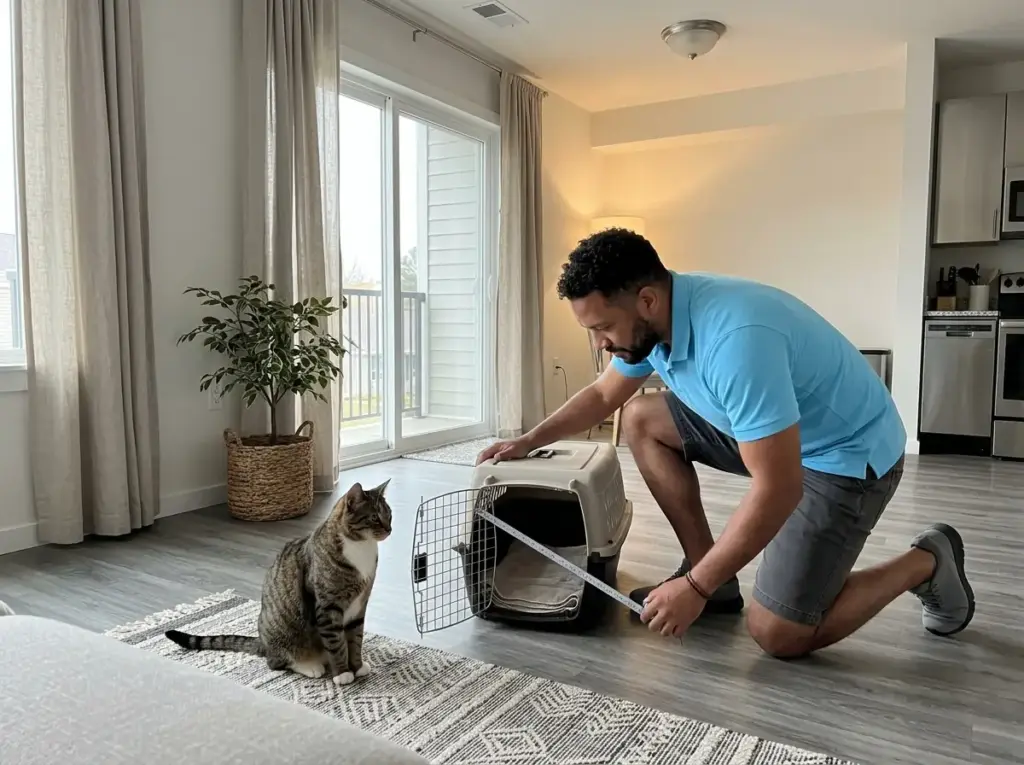
The vet’s test is something your cat does. Inside the carrier he has to be able to stand up and turn around, then lie down, which is the standard in the AAFP handout on getting a cat to the veterinary practice. A label can print a length and a weight. It cannot print whether a particular cat does those three things, and a cat who cannot turn around will spend the trip pressed against one wall.
Measure Each Cat on the Floor
Do the measuring with the cat on the floor, at his own pace, with a flexible tape laid beside him (no lifting, no holding him still). Take two numbers for each cat separately: nose to the base of the tail, and standing height at the shoulder. Read a carrier’s interior length against the first number, leaving room to swing around, and its interior height against the second, plus room for the head. Two cats rarely match, so two cats means two sets of numbers, and the larger set sets the minimum for any box they share.
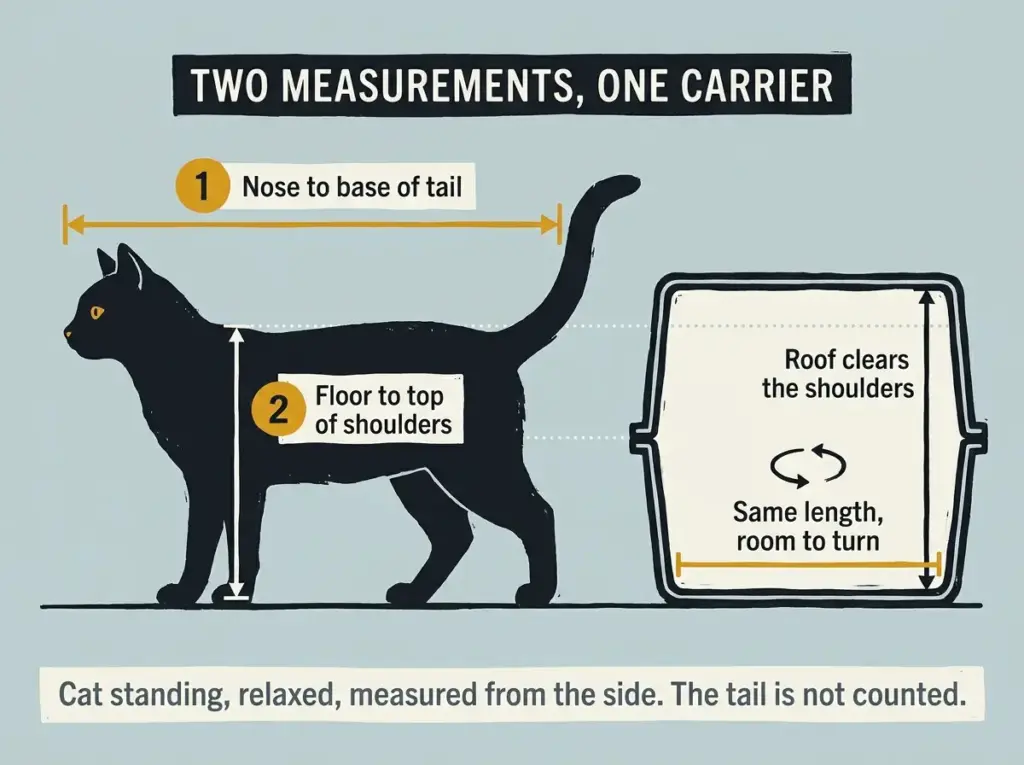
Use the interior carrier dimensions, not the headline size. Call it a 22 in carrier, then read the fine print: 20.7 in of actual floor once the walls are counted.
Take the measurements once the cat is calm and standing on the floor, then save both numbers in your phone’s notes. They are the ones you will want in your hand when two listings look the same.
Why a Weight Limit Says Nothing About Fit
An average adult cat weighs around 10 or 11 pounds and a big one 15 to 20, and plenty of doubles list somewhere between 10 and 17 pounds per cat. Two 11-pound cats sit comfortably inside the rating of a carrier labeled for 25 pounds and still cannot turn around in it. The rating is an average dressed up as a limit. It says what the seams and the floor can hold, never whether the cat fits.
Too big fails the same trip as too small. A 39 in double bought for two medium cats is a large empty room for either one, and a cat with nothing to lean on slides into every turn and braces against the sides. The ceiling needs the same attention as the floor.
Now put numbers on it. In a 39 in double each cat has 19.5 in of floor. A standard single hard box gives one cat 22.8 in, and even the budget MidWest keeps 20.7 in of interior. The double buys one handle, not more room.
Which Cats Ride Alone, and When the Call Comes Before the Carrier
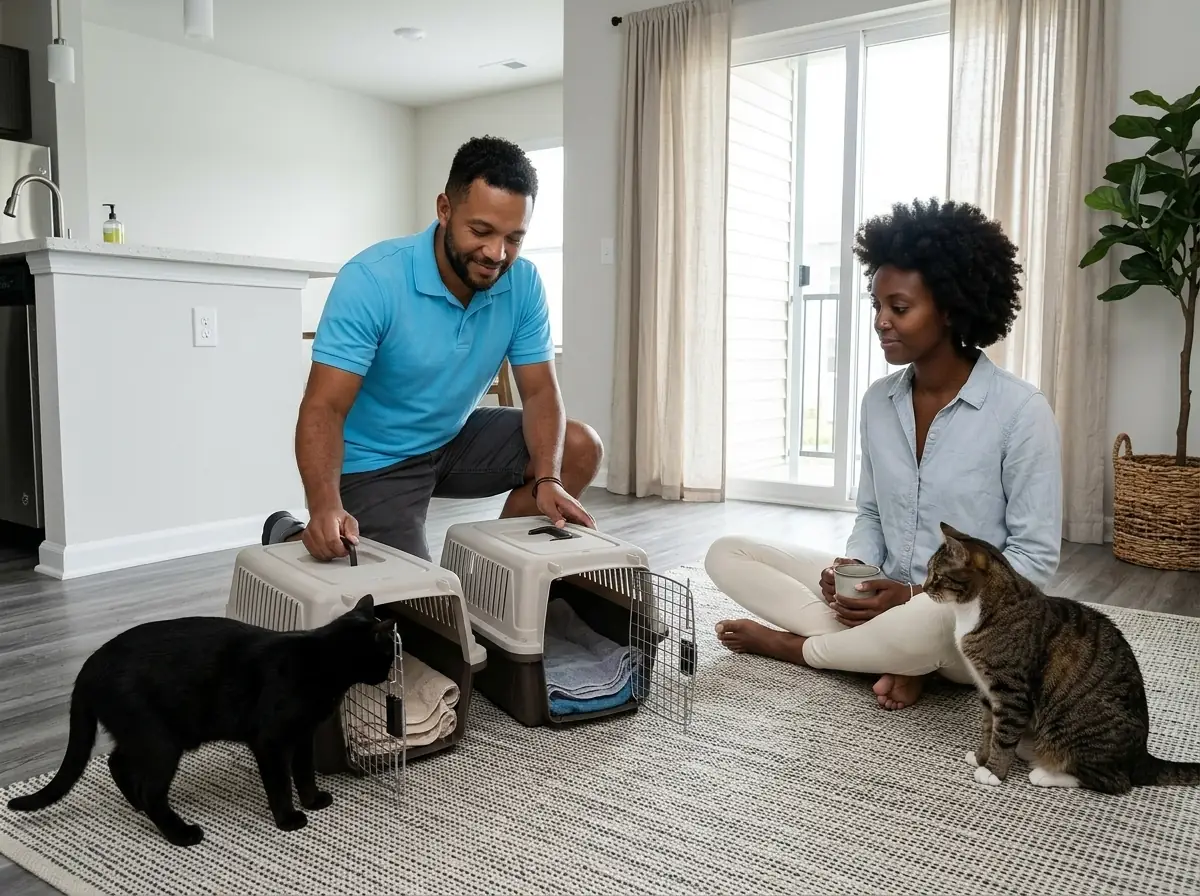
Picture two sisters, nine pounds each, asleep in the same old soft bag on the bed. They look like the pair that will share a box without any trouble, and a moving car is where that assumption is weakest. The answer that holds up is one box per cat, with a double kept as the exception you try out first.
The Days Two Cats Must Not Share
Some days settle the question before any measuring. The day after surgery, a contagious skin or respiratory problem, a recent fight, a known history of carsickness, a large size gap between the two cats, a senior cat who needs a low front door, and a kitten traveling with an adult all mean the same thing for the trip: each cat gets his own box, with no shared smell and no contact. These are conditions of the journey, not puzzles for this page to solve, and the clinic is where anything past that gets answered. A size gap matters in a shared bag for the reason it matters in any shared space, which is that the smaller cat has no exit.
Even Cats Who Sleep Together Prefer Their Own Space in Motion
A bonded pair sleeping in a heap at home is two cats choosing company in a room with exits. Inside a closed bag at highway speed there is no exit and no way to open anything, and the closeness that comforts them on the bed turns into a risk that one cat’s nerves get paid out on the nearest cat. A shared bag is the smallest version of the situation behind why one pair in a bigger household can stop getting along, a space that only works while both cats can leave it.
Separate carriers placed beside each other keep the company and remove the contact. Each cat can still smell and hear the other, and neither has to share a floor.
A Hurt Cat or a Sudden Change Is a Call, Not a Packing Question
A cat who has hurt himself, or whose habits changed overnight, is a phone call to the clinic before he is a question about boxes, and nothing here replaces that call.
Once the clinic has the cat, the box matters in one particular way. A top that comes off lets the exam happen with the cat still sitting in the bottom half, in a box he already knows, so nobody has to tip the carrier or pull a frightened cat out through a zip. A lid that lifts off beats a bag that only unzips for exactly that reason.
One Box Per Cat: The Free Fix and the Vet’s Checklist
One hard box per cat is the default, and the first move involves no purchase at all. It starts with a carrier that is probably sitting in a closet.
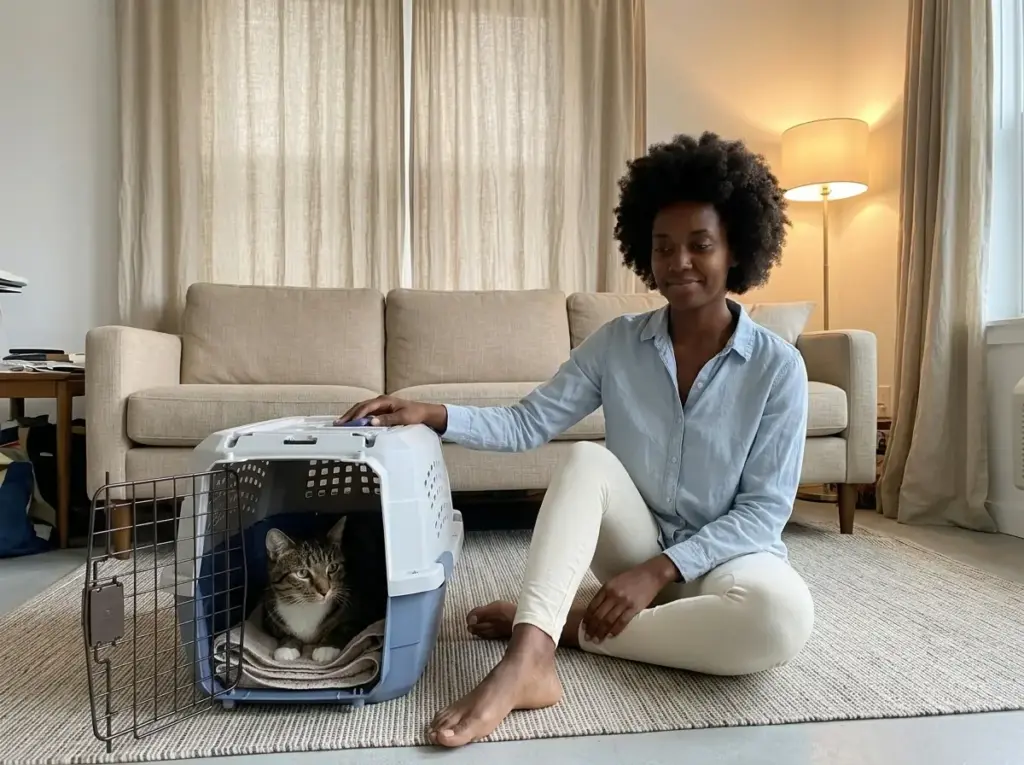
Leave the Carrier You Already Own Out and Open
If there is a carrier in the closet or on top of a wardrobe, bring it out, open the door and set it in a corner of a room with a door that shuts. Put a towel inside that smells of both cats and leave it unwashed between trials. According to Ohio State’s indoor cat program on giving a cat a refuge, “The refuge is a place your cat can retreat to when she needs quiet time alone.” A carrier left out as a den in a corner can be that place, provided the cat can walk in and out whenever he likes, and the box stops being the thing that only appears before the vet.
Give it a week or two of being seen before it becomes a trip. Some cats approve in hours and some take weeks, and that is a decision only the cat can make. A second box enters the picture after that, and by then you know which of the two walks in alone and which one needs a door on top.
Skip washing the towel between trials. Once it carries the smell of both cats, the box smells like theirs, and that is the whole point of leaving it out.
What the Vet’s Checklist Looks Like in a Box
The checklist is short. A front door, because a cat who walks in on his own is a cat you do not have to lift. A top door, because the one who plants his feet at the entrance can be lowered in. A removable top that unscrews and lifts, for the exam.
And a hard floor that holds its shape, which is the first thing a soft-sided carrier loses. Add a latch and screws that stay put when a cat shoves the door from inside, and that is the list to check before color or handle.
Hard Floor, Lid That Lifts, Door in Front and on Top
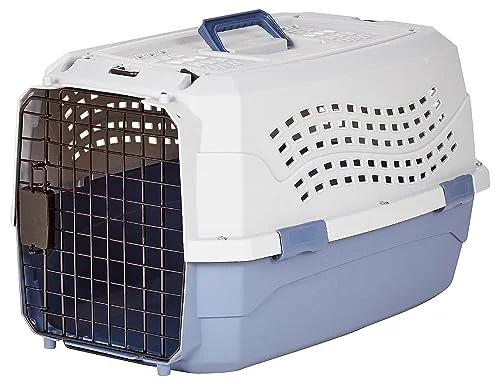
The Amazon Basics 2-Door Top-Load Hard-Sided carrier is a top-loading carrier that carries all of it in one shell, at 22.8 x 15 x 13 in and 4.5 lb, rated for 12 to 20 pounds. The top door is the weak point: it is stiff to open and can come unhooked, so work the latch with the box empty before the first trip.
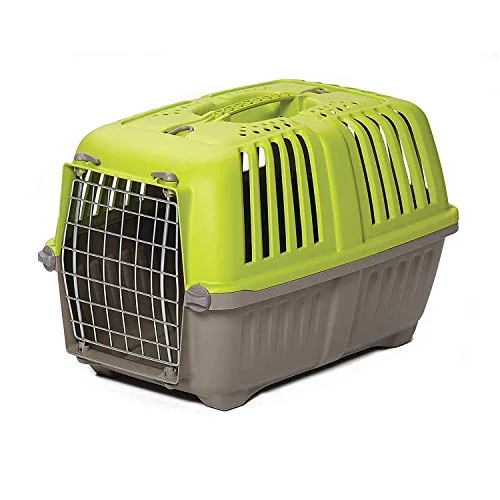
Where a lighter, cheaper box will do, the MidWest Spree 22 in still lifts its top off. It has 20.7 x 13.22 x 14.09 in of interior, weighs 2.14 lb and is rated up to 15 pounds, which makes it a box for a medium cat and not a heavy one. The door is awkward to work and the plastic feels thin. Two of them sit one behind the other in the footwell, and each cat keeps 20.7 in of floor and a door of his own, which is more room per cat than a soft double gives.
Two Boxes, One Pair of Hands: The Door, the Footwell and the Waiting Cat
Choosing the boxes is the easy half. The harder half is that there is one person, one door and one car, and carrying two rigid boxes is a question of order, not strength.
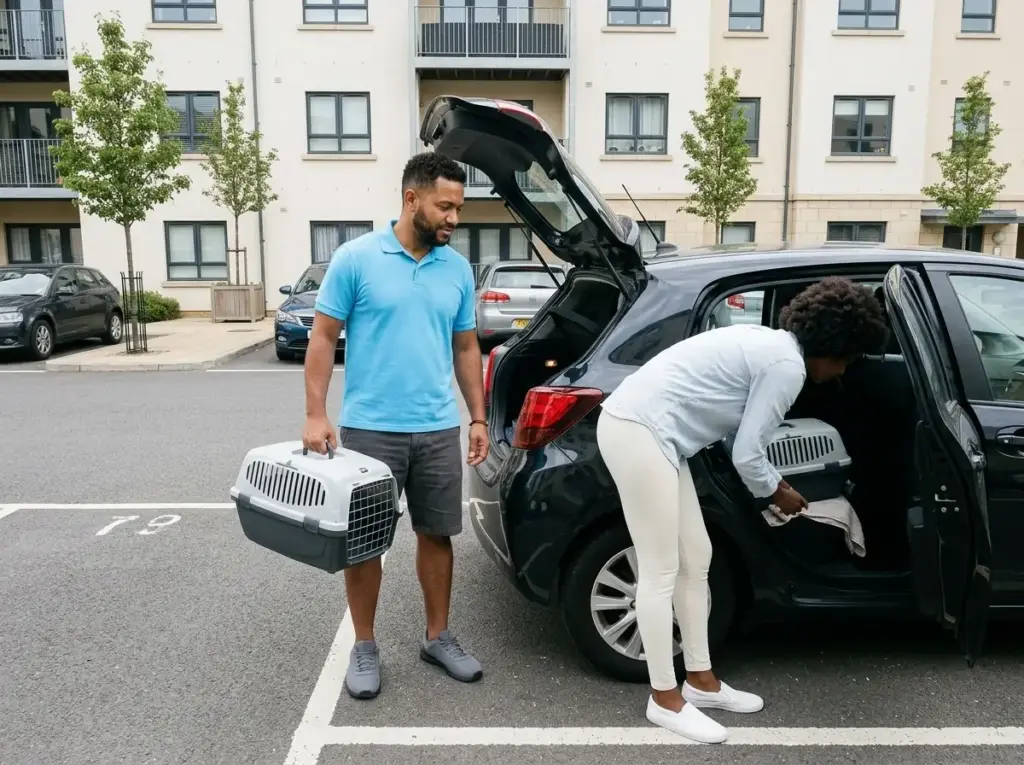
The Sequence at the Door: One Box, Back for the Second
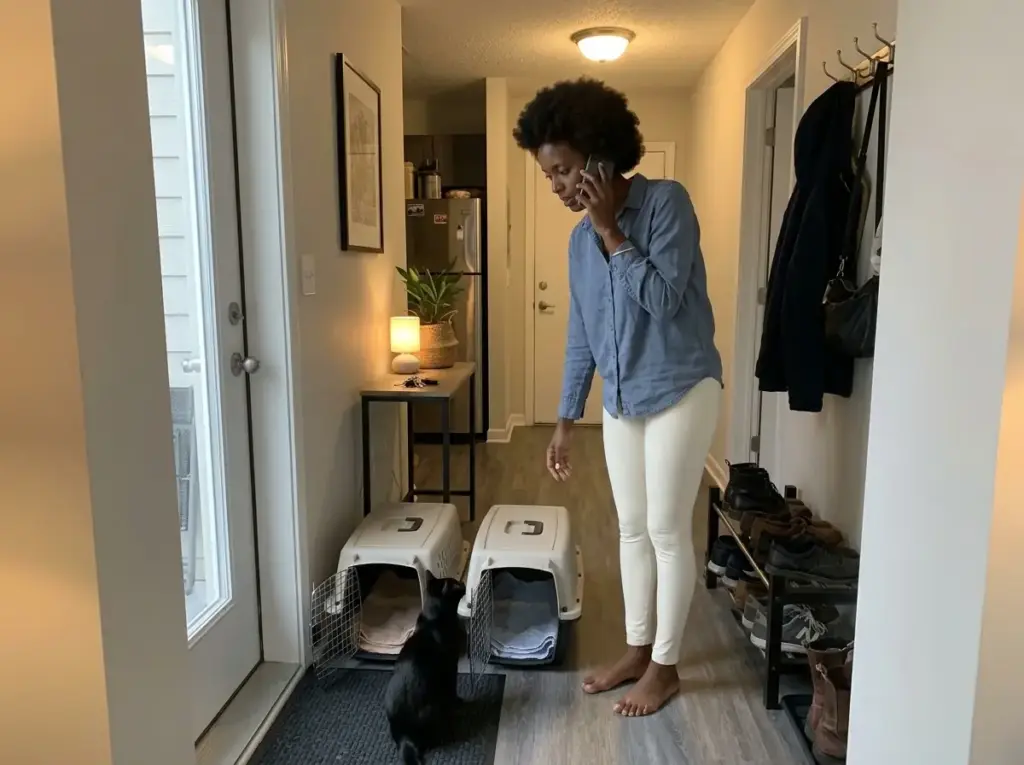
Take one box to the car, settle it, and come back for the second. The second cat waits upstairs with his box beside him until the first one is in place. Carrying both at once down a stairwell is how a latch catches on a railing, so do not try it. A 39 in double was bought to avoid this exact shuffle, and the cost of avoiding it is the whole back seat.
Check the latches on both boxes at the apartment door, not in the parking lot, and set both beside the door before the first one leaves. The trips stay short because nothing is left upstairs except the second box.
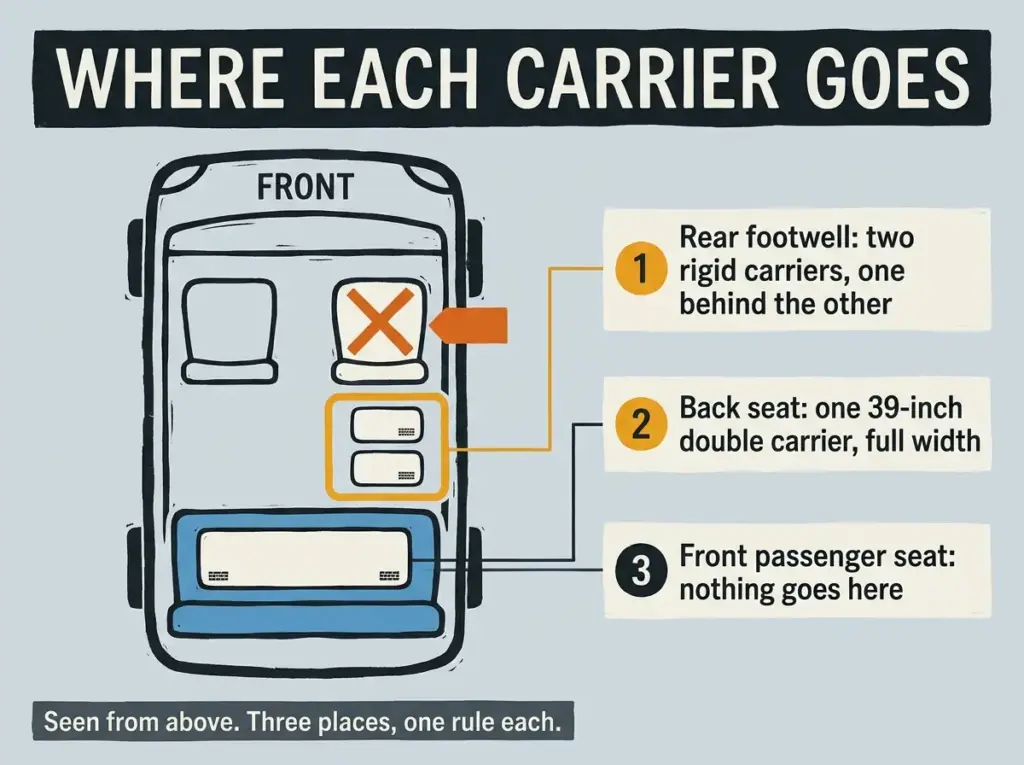
Where the Box Rides: Footwell or Back Seat, Never the Front Passenger Seat
Two hard boxes of about 22 in fit one behind the other in the footwell behind the passenger seat, or along the back seat. A 39 in double fits only across the whole back seat, so it takes the room a second box or a second person would have used. Run the seat belt through or around each box so it cannot slide in a stop. The front passenger seat is out whenever the passenger seat airbag cannot be switched off, because that bag is built to meet an adult chest, not a 12-pound cat in a carrier.
The AAFP’s position on transporting cats in a car treats the trip as part of the visit. The statement puts the duty this way: “Veterinary professionals working with cats are charged with educating clients/caregivers on what is an appropriate carrier (size and material) for the cat.” In other words, the box, the spot it rides in and how well the cat knows it all belong to an appointment that starts at your front door.
The Cat Who Waits While the Other Is Seen
At the clinic, the second cat waits while the first is seen. His box stays on the floor beside you, not in your arms and not on a waiting-room chair where it can tip. A towel over the top gives him the dark, quiet corner that an open waiting room does not.
The Double Carrier, Measured: 19.5 Inches Per Cat
A double is a good answer to a question about handles. It is a poor answer to a question about room.
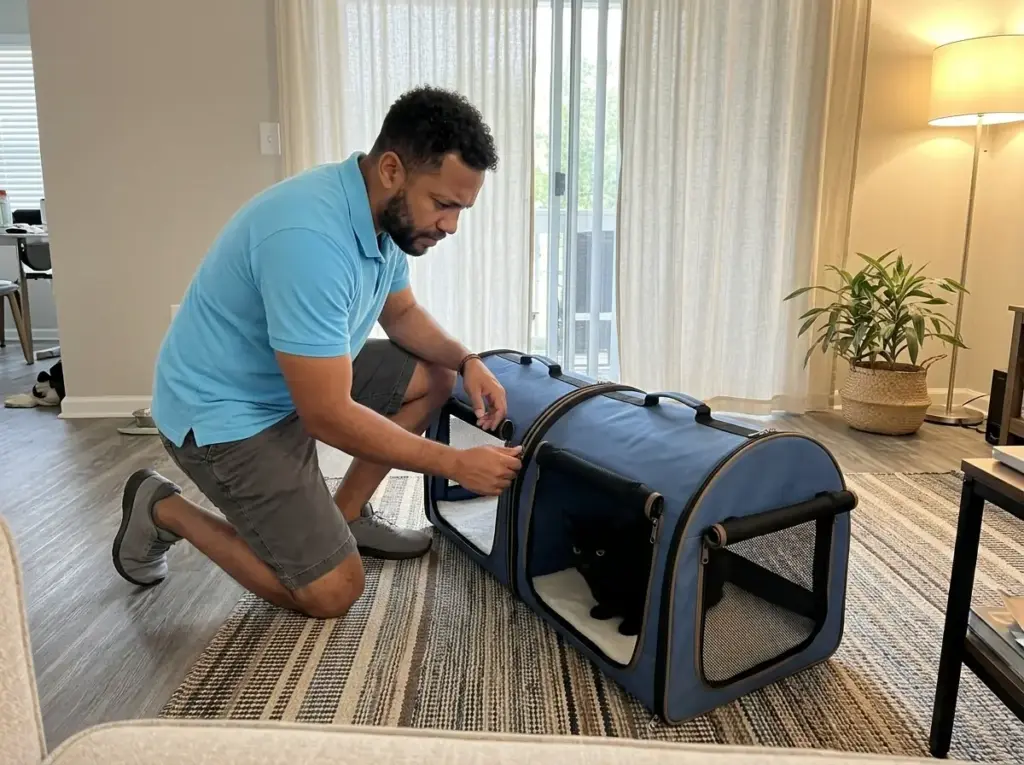
Two Cages With One Handle, Not One Big One
The numbers on the listing do the work. A 39 in double measures 39 x 20 x 20 in overall, which splits into 19.5 x 20 x 20 in for each cat.
That is less length than a standard single hard box gives (22.8 in) and less than the 20.7 in of interior in the MidWest. You are buying one handle and one strap. If the handle is the point, that is a fair trade. But it is not extra space.
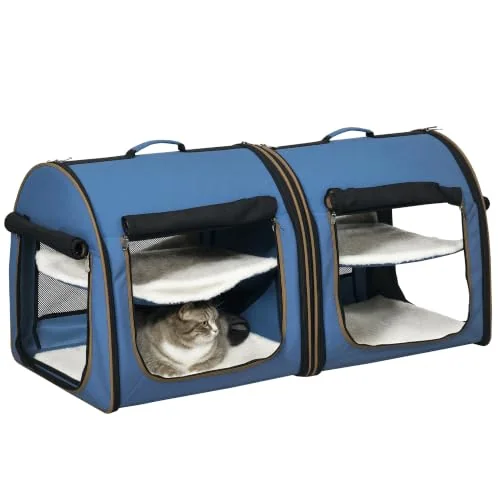
The PawHut 39 in Portable Soft-Sided Cat Carrier is the double that splits into two independent compartments and zips back into one piece, with seat-belt straps built in. It weighs 11 lb and folds to 2 in thick. Its own listing recommends cats under 10 pounds, which shows where the maker thinks it stops. The zip that joins the two halves can open by itself, and the floor gives under a 15-pound cat.
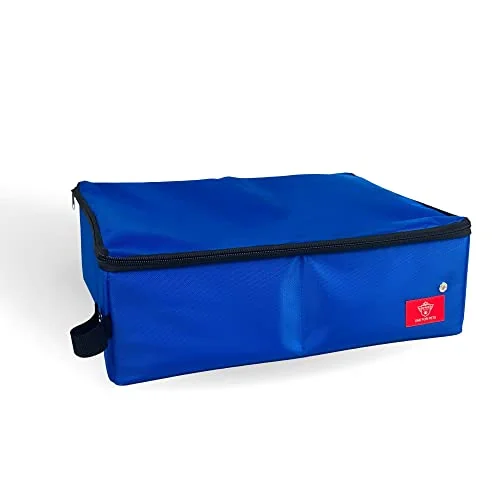
The One for Pets Portable 2-in-1 Double Pet Kennel has the same 39 x 20 x 20 in footprint, but each half is a complete square kennel and not a tunnel, and the whole thing weighs about 8.8 lb. The zips can open by themselves, which leaves it exposed at the same seam as the PawHut. It does not publish a weight limit per cat, so the tape is your only guide.
The Floor Sags First, the Center Zip Opens Next
What fails first on a soft double is mechanical, and it fails inside the weight rating. The floor buckles under a 15-pound cat, droops under a 14-pound one and gives again under a 20-pound one. The cat rides in a hammock, braced against the sides for the whole trip. The repair is a rigid board cut to fit under the pad, or a hard box.
The next weak point is the center zip that joins the two halves, the seam nobody inspects on a bag bought precisely so the cats could be separated. None of these doubles has lockable zippers, and none of the zips is an escape-proof zip, so a cat that has learned zips works the seam he can reach. The bag that was meant to keep them apart is then one cat’s escape route.
Where a Double Still Earns Its Place
A double still makes sense for a short car trip, for a pair that has already ridden together at home, with none of the restrictions that put cats in separate boxes (surgery, a fight, a size gap). Test it before the first drive. Put both cats in with the room door closed and the zip left open a few inches, so an unhappy cat can step out into a room with nowhere to go.
A bag with a single exit is the extreme version of the dead end described in why a space with one exit works against a cat, so keep the trip short. A double-decker backpack runs the same arithmetic one floor above the other and hangs both cats from one pair of shoulders, which keeps it in the caution column here.
Run the double through a rehearsal at home with both cats inside, a closed room door and the zip left slightly open, before the first car ride. If either cat heads for the center seam, you have your answer without leaving the apartment.
The Move and the Hotel Night: When a Cage Beats a Bag
A move or a night away adds a problem no bag solves: the cats need somewhere to go. The cheap answer comes first. Use the hard box you already have for the drive, and at the other end give the cats a room with the door shut and a litter pan inside. The bag stays in the car and the cats go in one at a time.
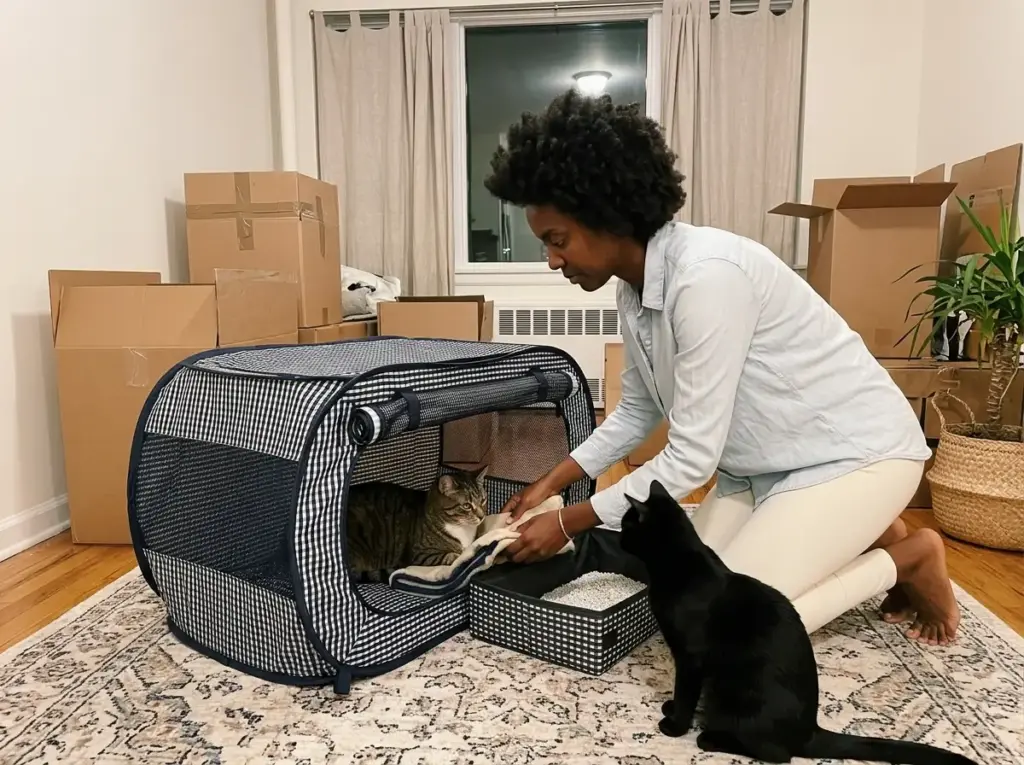
That covers a hotel night and the first hours in a new apartment.
When no spare room exists, a cage is the same thing in portable form. The Necoichi Stress-Free Enclosure Cat Travel Carrier Cage measures 31.8 x 20 x 20 in, folds to 14 x 14 x 4.5 in and weighs 3.7 lb. It is the one container here that holds two cats and a litter pan at once. It feels unstable, it is hard to fold, and the pan that comes with it is small.
That pan is the real constraint. One pan for two cats is fewer than the rule of one per cat plus one calls for, as why two cats usually need three boxes at home lays out, and it carries a pair through a night, not a week. A cat will often hold it through a six-hour drive and then pick the first corner the hotel room offers once the door shuts. The cage gives him a corner that was meant for it.
Folded to 4.5 in, it stands on edge behind a wardrobe or slides under a bed, and in an apartment with no storage room that counts for a lot.
The Plane, in Numbers: One Adult Per Kennel
The question here is whether “two cats, one bag, in the cabin” is possible for adults. It is not, and the arithmetic is short.

One Pet Per Kennel, and the Kitten Exception
Delta Air Lines allows one pet per kennel for adults. The exception is two kittens of the same breed and size between 8 weeks and 6 months, who may share. That rule turns a tight fit into a category error: two adult cats are two kennels, and each under-seat kennel needs its own space under a seat. Other airlines set their own rules, so read the page of the airline you are flying before reserving anything.
The Under-Seat Ceiling Sets the Length
Delta’s recommended maximum for a soft kennel in the cabin is 18 x 11 x 11 in. A bag that meets it is 18 in long, shorter than a 22.8 in hard box and a tight fit for any adult. It is a kitten bag by arithmetic. And a growing cat leaves it behind.
(Treat that 18 in as a recommendation, not a promise: an airline approved label on the bag does not settle how the airline measures soft carriers.)
What the Divided Bag and the Compressing Single Are For
The SturdiBag Divided Large Pet Carrier is 18 x 12 x 12 in, weighs 3 lb, is made of 600 denier polyester and is rated to about 30 pounds for the whole bag. It is the one divided bag sized near that ceiling, which makes it a kitten carrier for a pair and nothing more. The openings are small, getting a cat who resists inside takes effort, and it is not made for large cats. At 12 in tall and wide it also sits an inch over the 11 in figure, so the soft sides and the airline’s own measuring decide whether it passes.
For a single adult the Sleepypod Air in-Cabin Pet Carrier works from the other direction. It is 22 x 10.5 x 10.5 in and compresses to 16 x 10.5 x 8 in for the space under the seat, weighs 4.5 lb and is rated up to 17.5 pounds. The top and the ends open without taking the cat out. The zipper is frustrating to use, and the carrier suits smaller cats better.
For a car as the only trip, two hard boxes do the job. For an adult on a plane, count one kennel per cat.
Weigh and measure the bag with the cat inside it the evening before the flight. A number that comes out wrong at the counter leaves no time to fix anything.
Where the Carrier Lives Between Trips
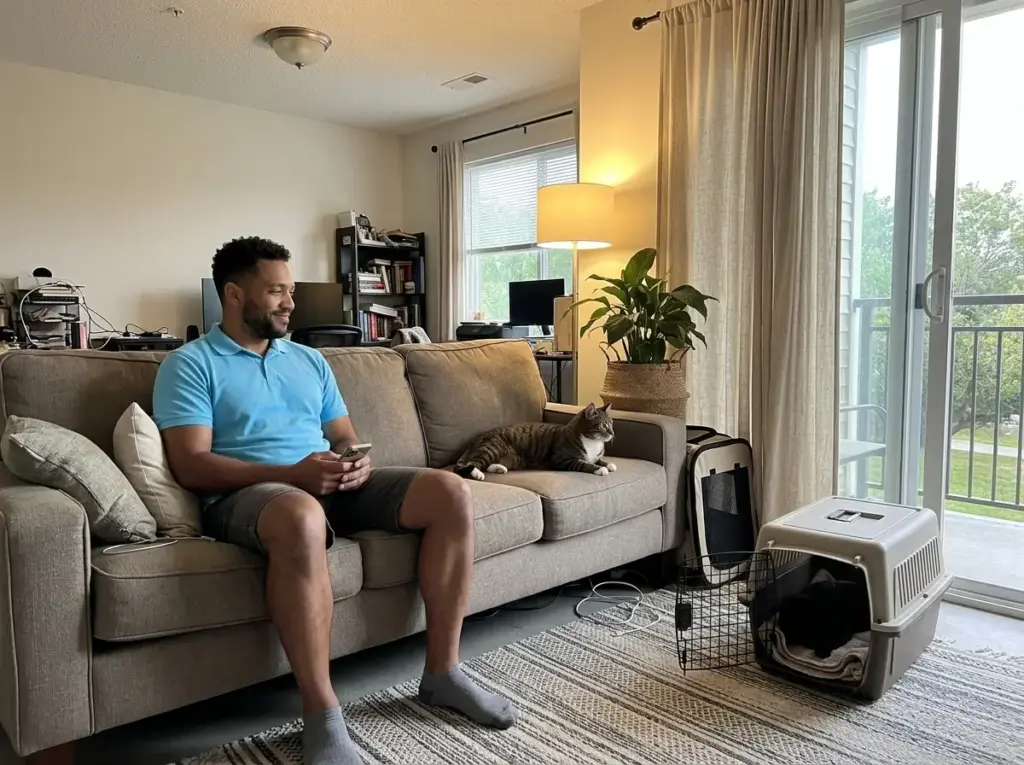
A carrier that sits in a back closet and appears on the day of the appointment becomes a signal. One that lives in the room, open, becomes furniture. In a small apartment the real question is where it fits.
Keep One Out, Fold the Other Flat
Two hard boxes can both live out, one in each cat’s corner, if the room allows it. When it does not, keep one out with its towel and tuck the other away where it needs a footprint but no ladder.
Every container in an apartment with no storage room has to earn that footprint, the same arithmetic that decides where a litter box actually fits in a small apartment. A collapsible soft double folds flat to about 2 in thick and a folding cage to 4.5 in, thin enough to stand on edge behind a wardrobe or slide under a bed. Nothing goes on a high shelf.
What to Check Before the Next Appointment Is Booked
When the next appointment goes on the calendar, look over the box: the latch and the lid screws on a hard one, the floor for cracks, the zips on a soft one, and the towel for the smell of both cats. Do it then, not the morning of the trip. The clock on the cat’s side is short. A few days is enough to see whether either of them avoids the open box in the room, and a slipping routine takes a few weeks to show.
The Smell After a Trip Out
Both cats come home from a vet visit smelling of the clinic and the car, and to each other that reads as a change. Put them back in the same room and give it a while before they share space again. If a pair that got along starts quarreling afterward, what to look at when two cats who got along start fighting more lists where to look.
Measure Both Cats, Then Pick the Boxes
The tape beats the label. A cat’s length from nose to tail base and his height at the shoulder decide which box works, and a weight rating only says what the seams can hold. One hard box per cat is the default, a double is a short calm trip for a pair that has already ridden together at home, and an adult cat does not share a kennel on a plane.
For the check later, watch over the next few days whether either cat walks into the open box without being asked, and look over the latch, the screws, the floor and the zips before the next appointment is booked.
Today, pull the carrier out of the closet, open the door, lay a towel that smells of both cats inside, and measure each cat on the floor with a tape. Write both sets of numbers in your phone so they are in hand the next time a listing says “double”.
Frequently Asked Questions
01Is it okay to put two cats in one carrier?
Sometimes, but one box per cat is the safer default, and a double is the exception you test at home first, for a short and calm trip. Even cats who sleep together prefer their own space in motion. A cat who is hurt or has changed habits suddenly is a call to the clinic first.
02What is the best way to transport two cats?
Two rigid carriers, one per cat, riding one behind the other in the footwell behind the passenger seat or on the back seat. Skip the front passenger seat when the airbag cannot be switched off. Carry one box to the car, come back for the second, and let the second cat wait beside his box.
03What cat carriers do vets recommend?
Vets care about features, not brands: a hard floor, a front door, a top door and a lid that lifts off. That lid lets the exam happen with the cat still in the bottom half. A box the cat already knows from the room beats a new one on the day.
04Can two cats fly in one carrier?
Adult cats cannot share a carrier on a plane: Delta allows one pet per kennel, with an exception only for two kittens of the same breed and size. The kittens must be 8 weeks to 6 months old, and other airlines set their own rules, so check the airline’s page before booking.
05How big does a carrier need to be for two cats?
Each cat needs a box where he can stand, turn around and lie down, so measure each one from nose to base of tail instead of trusting the weight rating. In a 39 in double that works out to 19.5 in of floor per cat, less than a single hard box of 22.8 in.

Leave a comment