Should I Get a Second Cat? Read the Cat You Already Have
Should I get a second cat? Run a 3-day window, wand & camera read, then check age gap, grief and zones (not square feet) before you adopt.

Alfredo RamsesFounder · November 10, 2026 · 16 min read

On this page9 sections
- 1Should You Get a Second Cat? Run a Three-Day Read First
- 2A Change in Habits Is an Appointment, Not an Adoption Question
- 3Bored Is Not Lonely, and the Difference Decides the Answer
- 4Age Gap, Male or Female, and Littermates Predict More Than "Cats Prefer Pairs"
- 5Grief Runs on the Surviving Cat's Baseline, Not on a Calendar
- 6A Second Cat Needs a Second Zone, and a One-Bedroom May Not Have One
- 7The First Weeks, and a Way Out If They Don't Go Well
- 8A Week of Play, a Second Look at the Camera, and the Right to Say No
- 9Frequently Asked Questions
You leave for work, he sits by the door, and by Friday you have decided he is lonely and that a second cat would fix it.
That conclusion is a premise, and almost nobody tests it before adding a second cat. A settled resident cat already holds a complete territory, and a newcomer has to be handed half of it. The AAFP and VCA point the same way: behavior we call a problem is usually a need nobody met. So this starts with the cat you have.
Quick Answer
Work down the list in order; a no at any step is a complete answer.
- Watch the cat you have for three days: window, wand and an empty-house camera.
- Call the vet first if a habit changes overnight and stays changed.
- Try a week of daily play and a window seat first.
- Check the newcomer’s age and kinship: young cats and littermates settle most easily.
- Hold off while the cat at home is still grieving a lost companion.
- Count zones and doors, not square feet; no second zone means no.
Should You Get a Second Cat? Run a Three-Day Read First
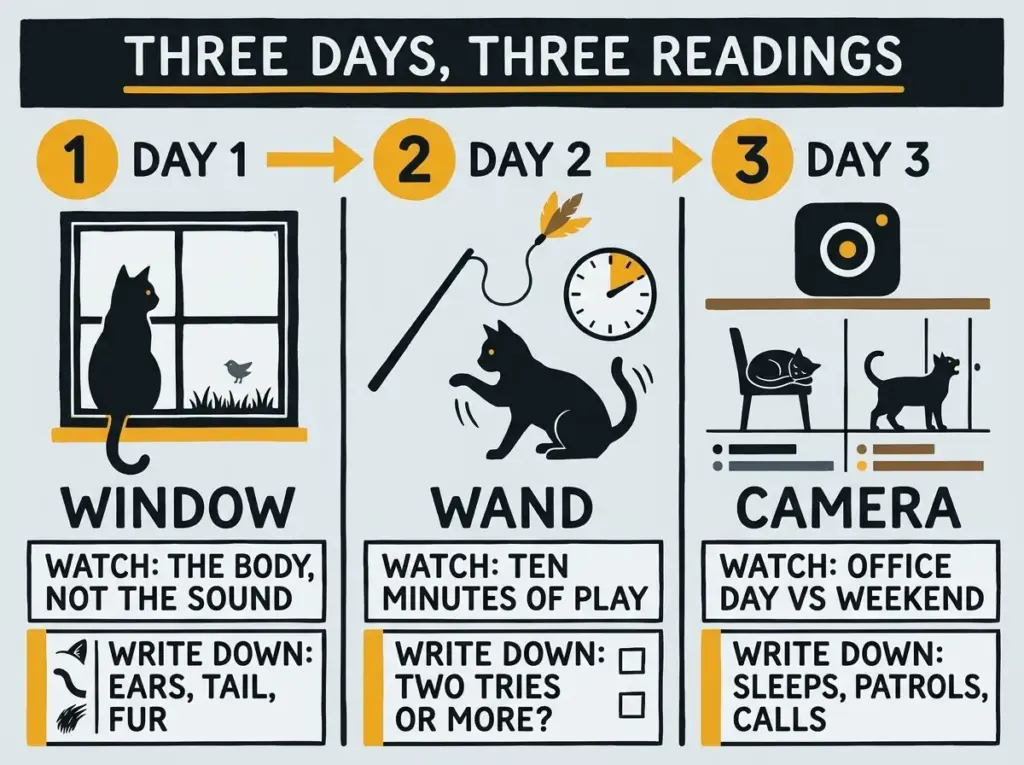
Whether a home should hold one cat or two gets decided by looking at the cat first, and only then by how many cats a home can hold, counted in stations rather than square feet. The looking has three tests: what he does at the window when something moves outside, whether he takes a feather wand for ten minutes (at least two real attempts), and what a camera shows while the apartment is empty. The window and the wand take an afternoon each, and the camera runs three days that include a workday and a weekend day. What you gather is evidence about this cat’s history with creatures that are not his people, and no verdict on a cat who does not exist yet.
The Window: Posture Counts, the Hiss Doesn’t
Put him where he usually watches and wait for something to cross the yard: a neighbor’s cat, a dog on a leash, a delivery driver carrying a box. Read the posture and ignore the soundtrack. Ears forward, tail loose, maybe a chattering jaw: that is a cat studying a rival from a safe spot.
Flattened ears, a bottlebrush tail, pacing the sill or bolting to another room is a different answer. A single hiss decides nothing, so note how long he takes to settle.
The Wand and Ten Minutes of Play
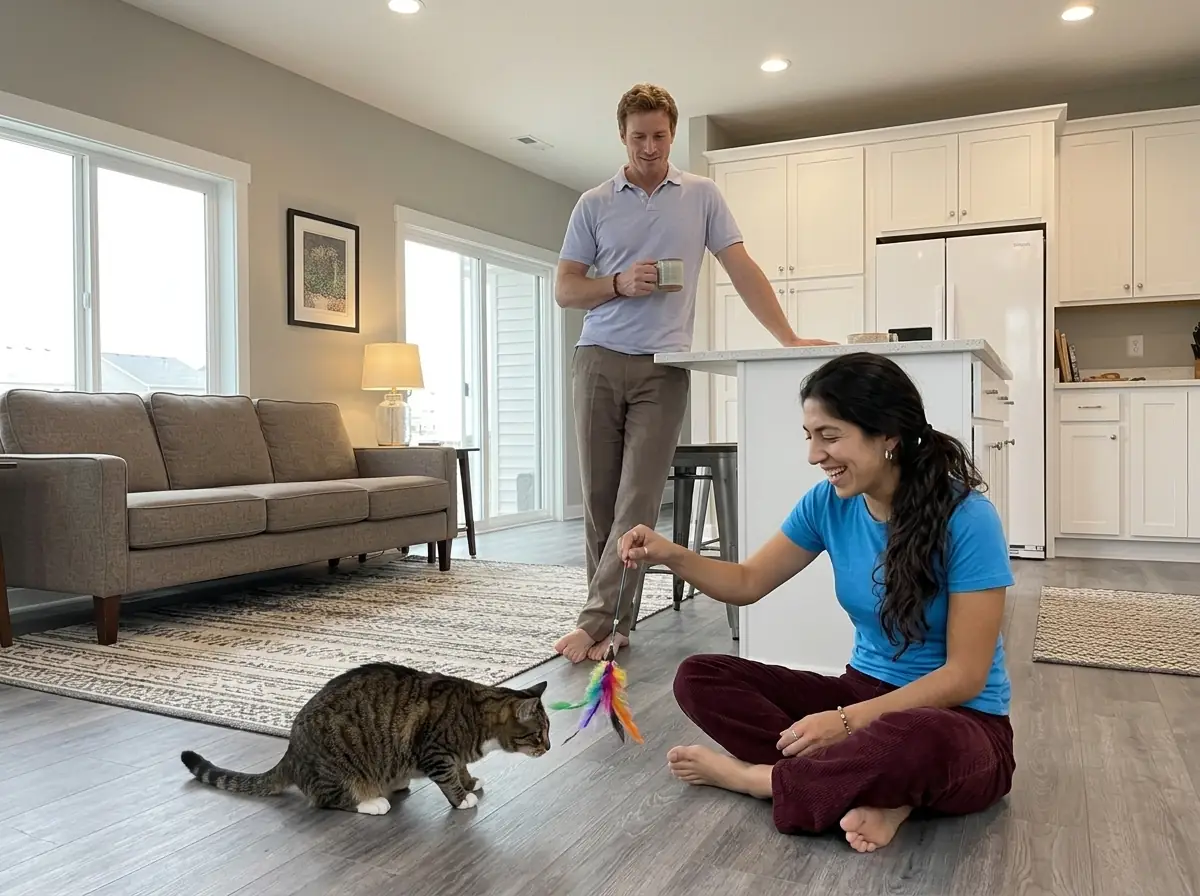
Ten minutes with a wand, held low and moved like something that does not want to be caught: along the floor, around a chair leg, then out of sight behind a blanket. Count whether he takes it at least twice. A cat who stalks, pounces and then flops mid-floor is spending his drive well, while one who plays hard and then trails you wanting more shows that the supply is short.
A cat who played last month and will not now has changed a habit, which is the next section’s business, not a reason to open adoption listings.
The Camera and Three Days of an Empty House
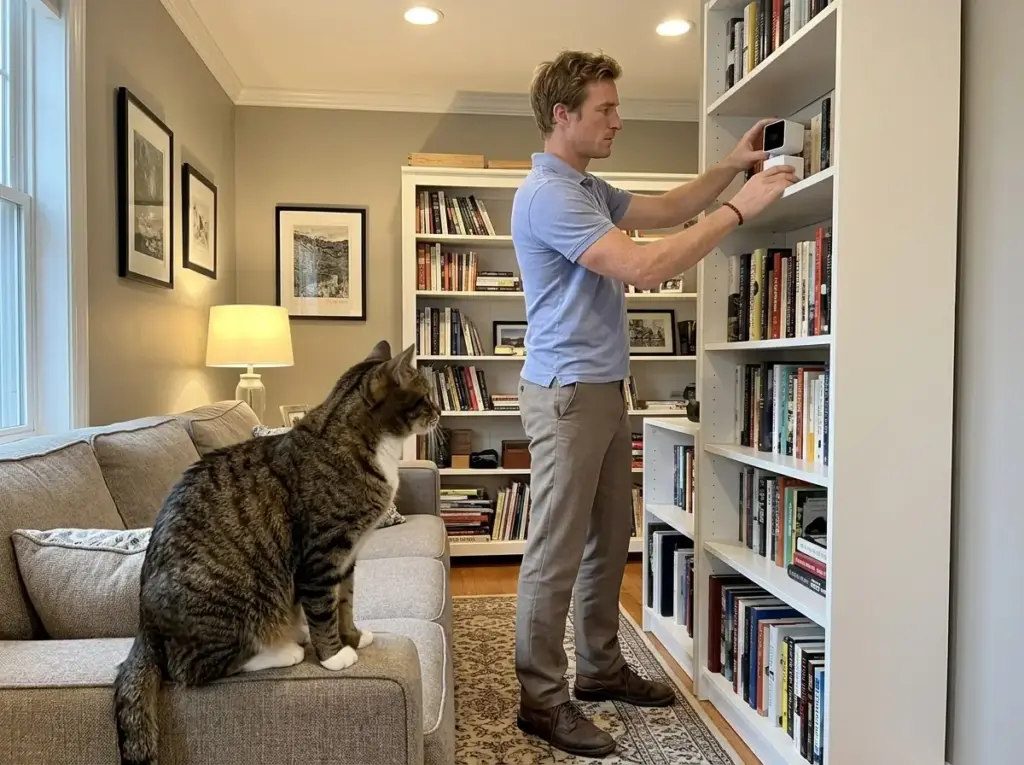
A phone propped on a bookshelf or a baby monitor you already own will do. To cover a whole room from one spot, the WYZE Cam Pan v3 measures 2.48 x 2.36 x 4.88 in, sits on a shelf with no drilling, pans a full 360 degrees from one spot, and does not charge for live view. Its flaw is the connection: the Wi-Fi drops now and then and motion alerts get missed, so a quiet phone proves nothing about a quiet apartment and you open the live view yourself.
A cat asleep in the same chair from nine to five is one result; a cat who patrols, calls and checks the door is another. One who patrols only while you are out is describing the empty hours, which is not the same as describing loneliness (bored cats do exactly this too).
Leave the camera running across three days that take in a workday and a weekend day, and watch the two together. The hours that differ between them are the ones that carry information: a cat who behaves the same either way is a different result from one who only patrols when the apartment is empty.
A Change in Habits Is an Appointment, Not an Adoption Question
Say the camera or the wand showed something odd: he eats differently, uses the box less, hides for days, or has stopped grooming. Filing that under loneliness is tempting; it belongs first with someone who can examine him.
When the Read Shows a Change That Isn’t About Company
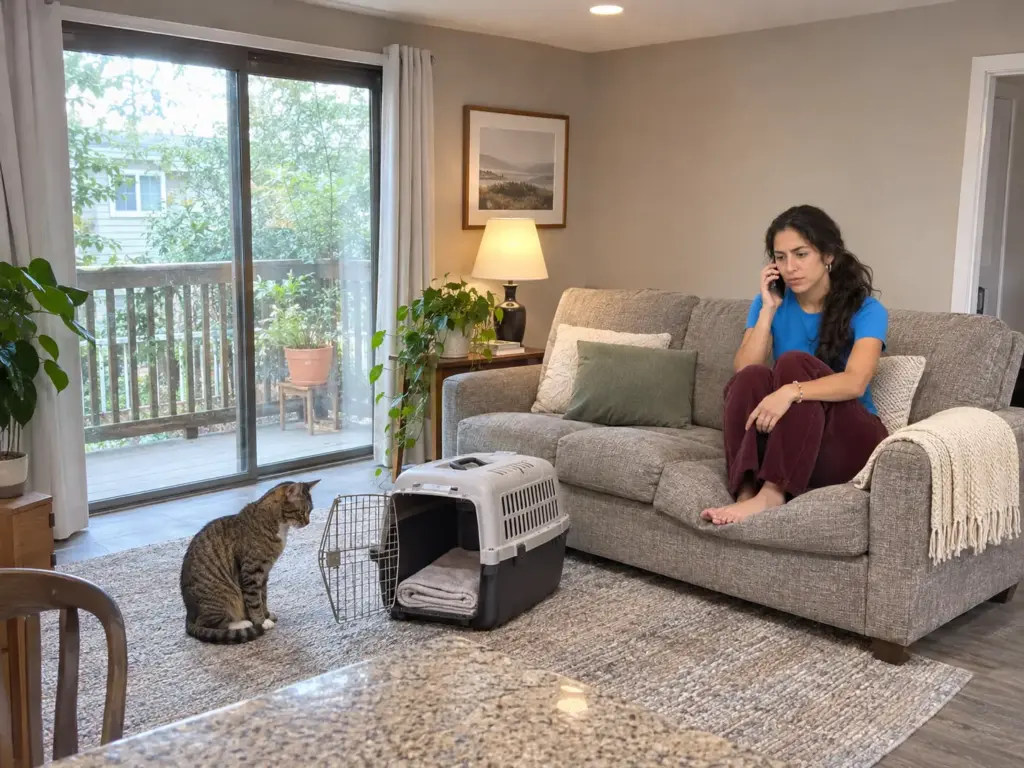
A habit that shifts and stays shifted (eating, drinking, litter box use, grooming, days spent hidden) is a vet check before it is an adoption question, whatever you suspect behind it. This article names no cause and reads no symptom, because that call belongs to the vet. Ohio State’s indoor cat program on life stressors describes cats as animals of routine who rely on their people to keep the home steady and safe, and a new cat is a change to the home before he is anything else.
The same rule holds weeks after a newcomer arrives: a resident whose habits change and do not return goes to the vet first.
The Newcomer’s Record Before the Threshold
If the answer turns out to be yes, the cat on his way carries a history you do not know yet. Ask the shelter or rescue for the record of his tests and vaccinations (FeLV and FIV will be on it), and let your own vet read it before he crosses your threshold. What the record means is the vet’s call; your part is to ask before the carrier comes home, because once he is inside the door the question has been answered by default. Until then he can wait in a quarantine room of his own.
Bored Is Not Lonely, and the Difference Decides the Answer
On a camera, boredom vs loneliness looks identical: the patrolling, the calling, the checking of the door. They ask for different things, and only one of them is answered by adopting.
Boredom Is a Supply Problem You Can Fix This Week
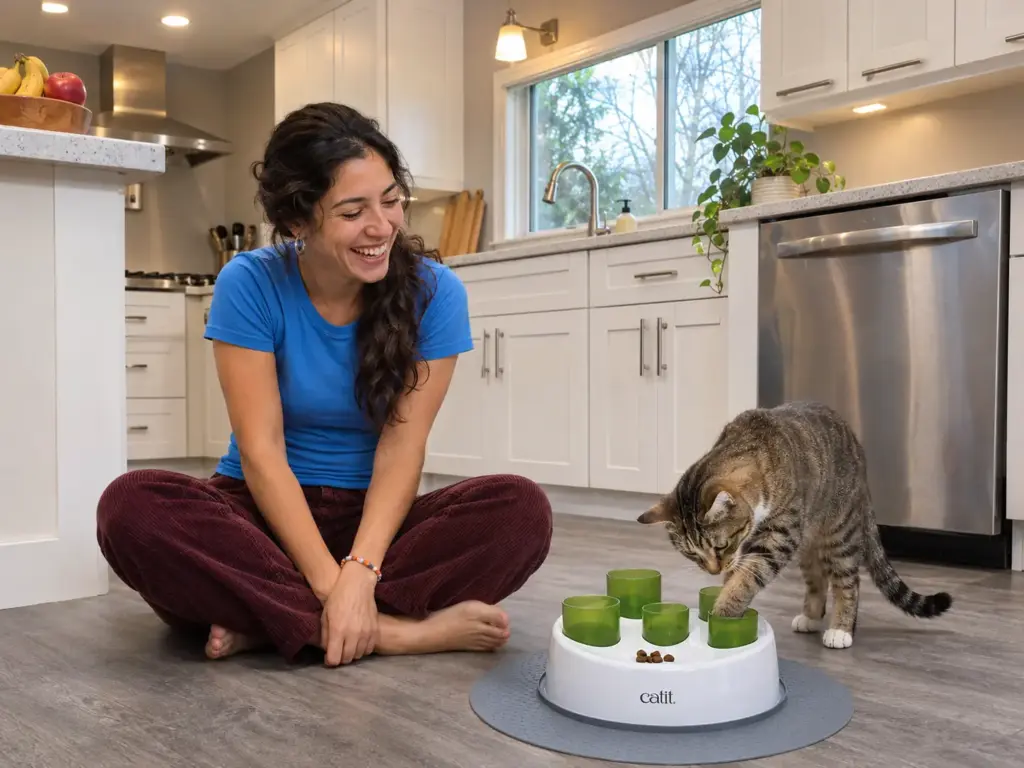
A bored cat is describing a house that has too little to do in it, and that can be remedied this week for nothing. Two play sessions a day with the wand, each ending on a catch so the hunt finishes. A window perch with a view. A cardboard box on its side, the cheapest hiding spot there is.
Behavior is how an unmet need shows up, and the AAFP’s own environmental needs guidelines put it this way: “When cats’ needs are not met, there is an increase in abnormal behavior, or normal behavior considered undesirable by the caregiver.”
If a week of that moves the footage, a food puzzle makes him work for dry food he already eats.
The Catit Senses 2.0 Digger (5.7 x 9.5 x 9.5 in) has three digging cups on a rubber base and suits a cat who paws at things. Some cats ignore it, and the base can come loose. The cheaper test is the PetSafe Slimcat Feeder Ball (5.8 x 3.2 x 7.0 in), whose openings adjust so the food drops out as he bats it across the floor. Treats can spill too easily for some cats, and others walk past it.
Pin the two play sessions to fixed points in the day, one before you leave and one in the evening, and keep them up for a full week before judging anything. Then repeat the camera and put it next to the first run. That comparison is what tells you whether the question is still open.
Loneliness Is a History, Not a Mood
Loneliness, in the sense a second cat can answer, is a history. A cat raised in a group has one, and so does a cat who lost a companion; a lonely cat of that kind is the case another cat answers, and it still runs into age, kinship and grief. A cat who has always been an only cat, in a home sized for him, with a person around, has no group to miss. The line that cats are social animals is half the picture: he is a solitary hunter whose company is usually the cats he grew up with.
Whose Preference Is the Second Cat?
The cat describes a constraint: nothing to do, or no one to do it with. You describe a preference, which is to see him accompanied. Adopt to satisfy the preference without checking the constraint and the common result is a pair that shares an apartment for years and still hisses at the corner. Tolerating a cat is not wanting one.
What changed in the home before a cat started acting jealous shows the same split played out over a lap and a schedule.
The slogan of two cats better than one is a rule about people. A single cat with play, a high spot, a window and your time is not a second-class cat, and the house stays his.
Age Gap, Male or Female, and Littermates Predict More Than “Cats Prefer Pairs”
If the answer is yes, three facts about the newcomer move the odds more than anything about companionship in general: his age against the resident’s, whether he is male or female, and whether he is related to anyone.
Younger, Mixed-Gender and Related Cats Are Accepted More Readily
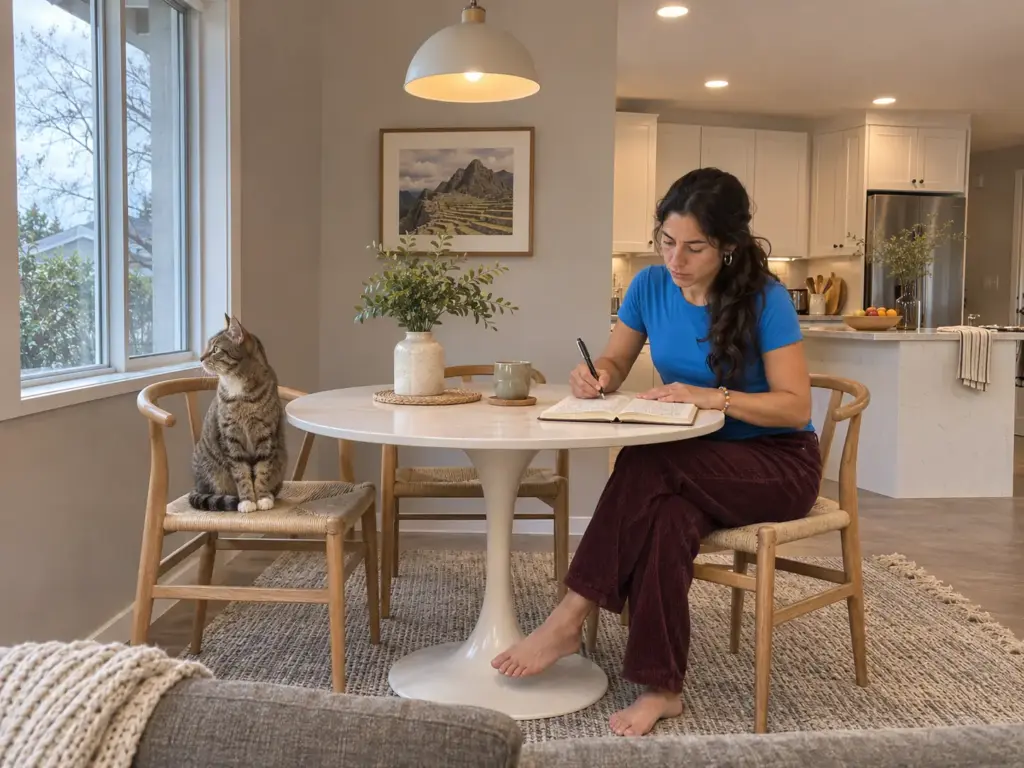
A Swiss study, cited in a veterinary guide from the Humane Society of Missouri, found that an adult cat accepts a younger cat sooner than one his own age or older, accepts a cat of the other gender sooner than one of his own, and that two males run slightly ahead of two females. These are odds that tilt, not a rule. Kitten vs adult cat is the easy case at the door, and what changes once a new kitten grows into the age gap is worth reading before you choose one.
The Seven-Week Window Closes Before Most People Adopt
Kittens brought together before seven weeks accept each other with the least effort, and littermates are the easiest pair there is. That window closes long before most people adopt a second cat. A bonded pair means you adopt both or neither.
Two Adults Is the Case That Runs Into a Season
Two adults are the hardest case, and VCA’s veterinary guidance on a second cat says it in plain terms: “Even with great care, some adult cats never accept another adult cat into the home.” The veterinary behaviorist Dr. Jeff Nichol sees his best results when every cat is under twelve months at the move-in. A resident handed a cat his own age sits, on these numbers, in the hardest seat, because it is his territory they are asking to split.
Personality counts inside those odds, and a temperament match, a sociable resident with a mellow newcomer, is a different pairing from two cats who both guard the window.
Grief Runs on the Surviving Cat’s Baseline, Not on a Calendar
You lost a cat three weeks ago and the one who remains drifts from room to room. It is natural to think another cat would lift the house, but a newcomer arriving during his grief is the case where an introduction fails most often.
Back to Baseline Means Eating, Grooming, Sleeping and Seeking You
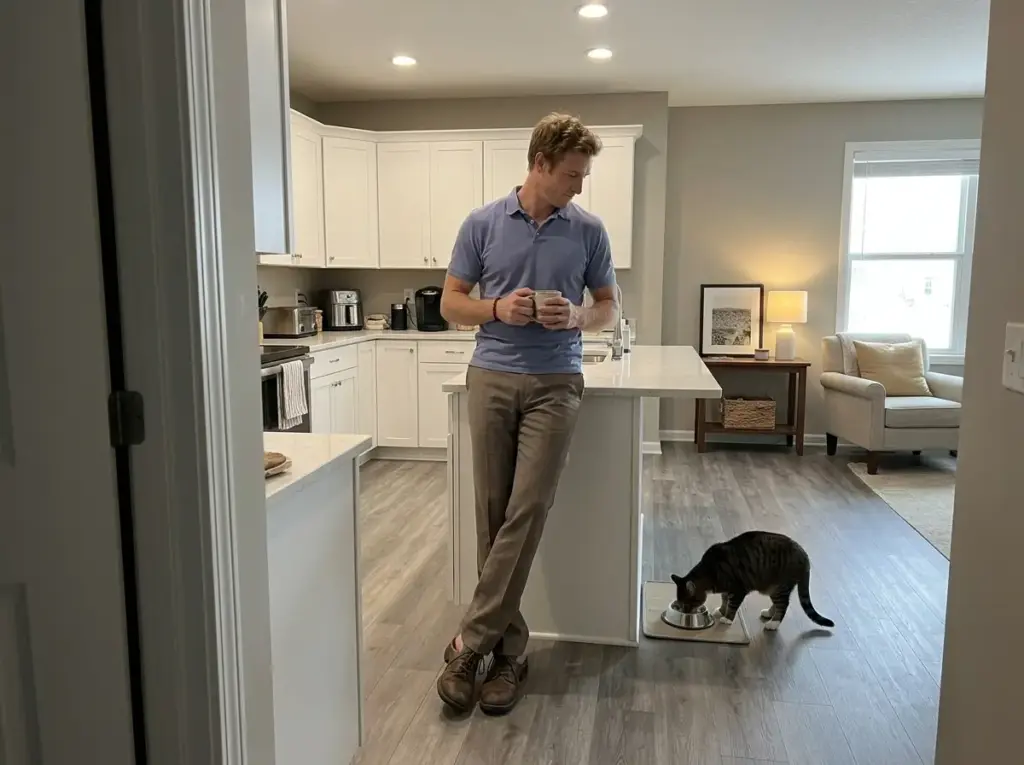
VCA’s rule is to wait until the surviving cat’s behavior has returned to its baseline before adding anyone. Baseline means four things, each back at his own normal: eating, grooming, sleeping where he used to, and seeking your attention. The rule is not a number of weeks, but that after the loss of a companion he is the cat he was before.
You cannot compare against a baseline you never wrote down. A one-page baseline sheet written the week before anything arrives takes ten minutes to start and gives you something to hold his behavior against. If eating or grooming does not come back, that is an appointment.
The Humane Society of Missouri’s veterinary guide adds the hard part: grief commonly lasts months, and a new cat who arrives during it often meets intense hostility. Nichol documents an owner who replaced a littermate within weeks; the resident went for the newcomer on sight, and getting the two into the same room took about six months. Wanting a cat in the house again is not a mistake, but waiting protects the next cat as well, who deserves to arrive at a house that has settled.
A Second Cat Needs a Second Zone, and a One-Bedroom May Not Have One
A second cat doubles every station, and the stations have to sit in two zones the cats can reach without walking past each other. That is the real limit of a one-bedroom, and it has little to do with floor space.
A Second Cat Doubles Every Station
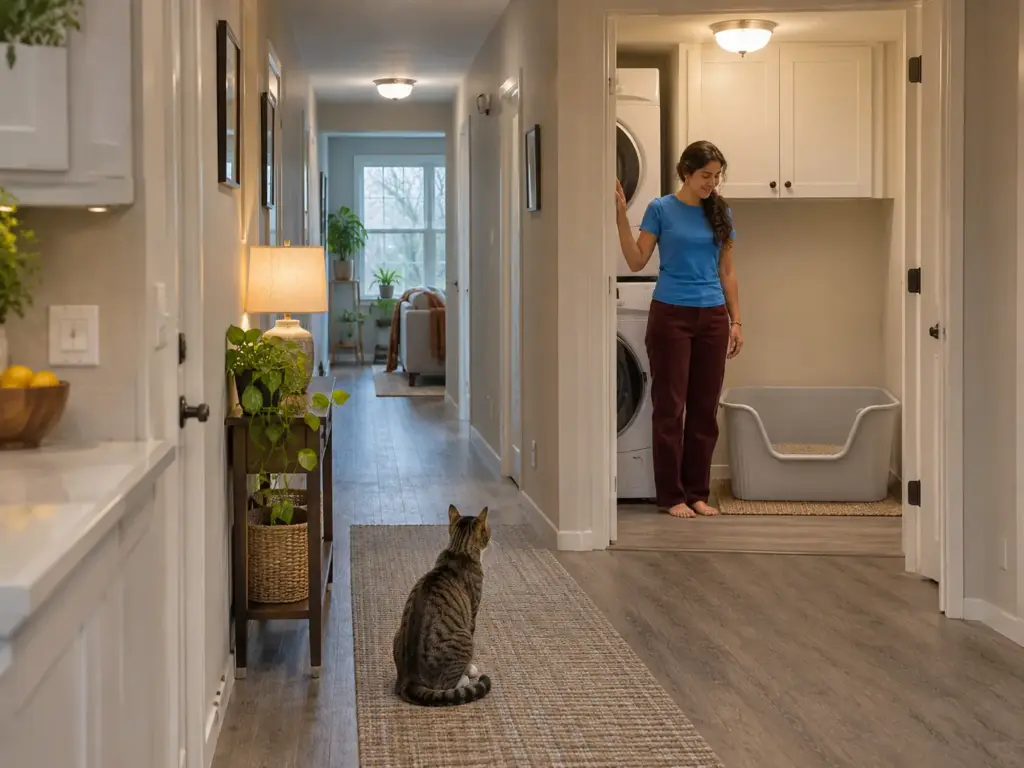
Two cats means three litter boxes (the one litter box per cat plus one rule), separate feeding stations, two water bowls, and beds and high places to match. The arithmetic fails the moment all three boxes line up in the bathroom, because three boxes in one place is one zone with three doors. Why N+1 fails when every station sits in one spot works through the sightline check on resource distribution, and how many litter boxes two cats need, and the pair that shares one covers the exception.
A one-cat home is furnished for one, and when it is split the resident is the one who gives something up. A cat tree or a shelf gives him vertical territory, which helps, but only if there is also a high route and an escape route that do not run through the other cat’s spot.
Count Zones and Doors, Not Square Feet
The count that matters is doors and lines of sight. An open plan with a hallway to the bedrooms has several places to pass and to retreat. Two rooms and a hallway can hold two cats, and a studio with one door cannot, whatever its area.
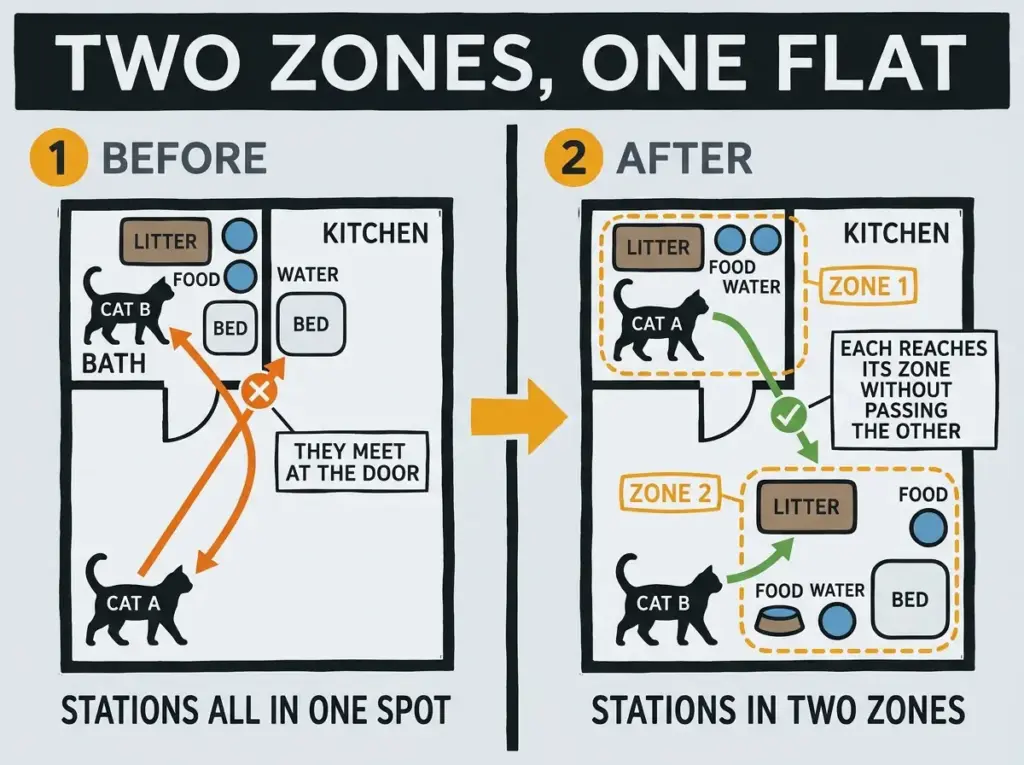
Move the box you already have into the second zone and watch for a few days whether the resident reaches it by his usual route. If a new one turns out to be needed, the size is set by the cat: about one and a half times his length from nose to the base of the tail, and the usual “large” box rarely gets there. The TownTime Extra Large Litter Box with High Sides runs 25.27 x 17.83 x 13.11 in, so its 25 in of length clears that rule for an average cat. The entry sits low for some, and the value for money is debatable.
The Studio Case, and the Answer That Is No
In a rental with no spare room, the second zone does not have to be a room. It can be a corner with a box and a high spot that the other cat reaches by a different route, and how a small apartment’s territory comes down to exits and loops explains why. If the apartment truly has no second zone, the answer is no, and that is a good answer for the cat who lives there.
The First Weeks, and a Way Out If They Don’t Go Well
If the answer is yes, expect weeks, not days, and sign an exit before the carrier opens.
Weeks, Not Days
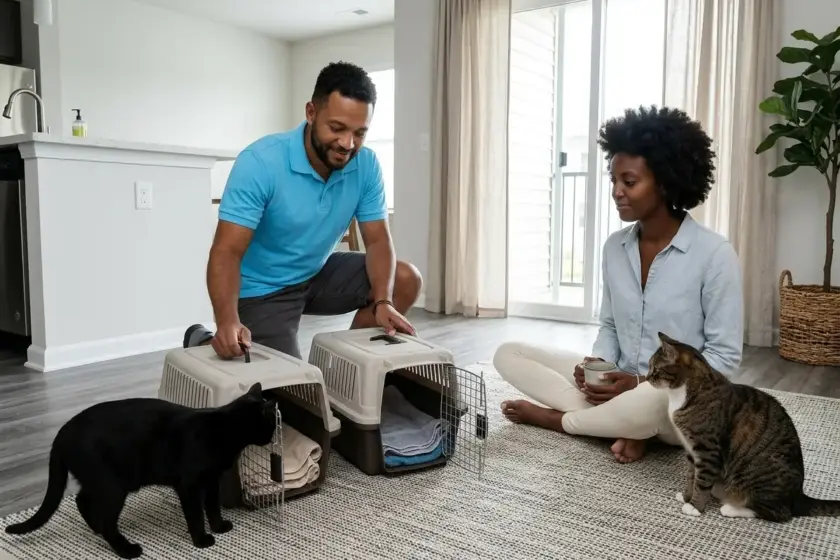
VCA gives an introduction as days, weeks or months. A slow introduction starts with the newcomer in a base camp room, moves through scent swapping and space swapping, and only then reaches eye contact across a barrier; how to introduce cats in a small apartment, stage by stage covers every step. Watch both cats for hiding, hugging the walls, a puffed tail, dilated pupils, ears back, hissing, growling and swatting. Those are things to look at, not to interpret, and a habit that changes and does not return is the appointment from earlier.
The Barrier and the Scent Before the Meeting
The barrier you already own is a closed door: feed each cat on his own side, swap blankets between them, and wipe a cloth along each cat’s cheeks and give it to the other. Everything below only makes that same barrier and scent more comfortable.
Shut the door you already have and feed each cat on his own side, a little closer each day. Do it before ordering a barrier: the door and the meal teach the same lesson and need no purchase.
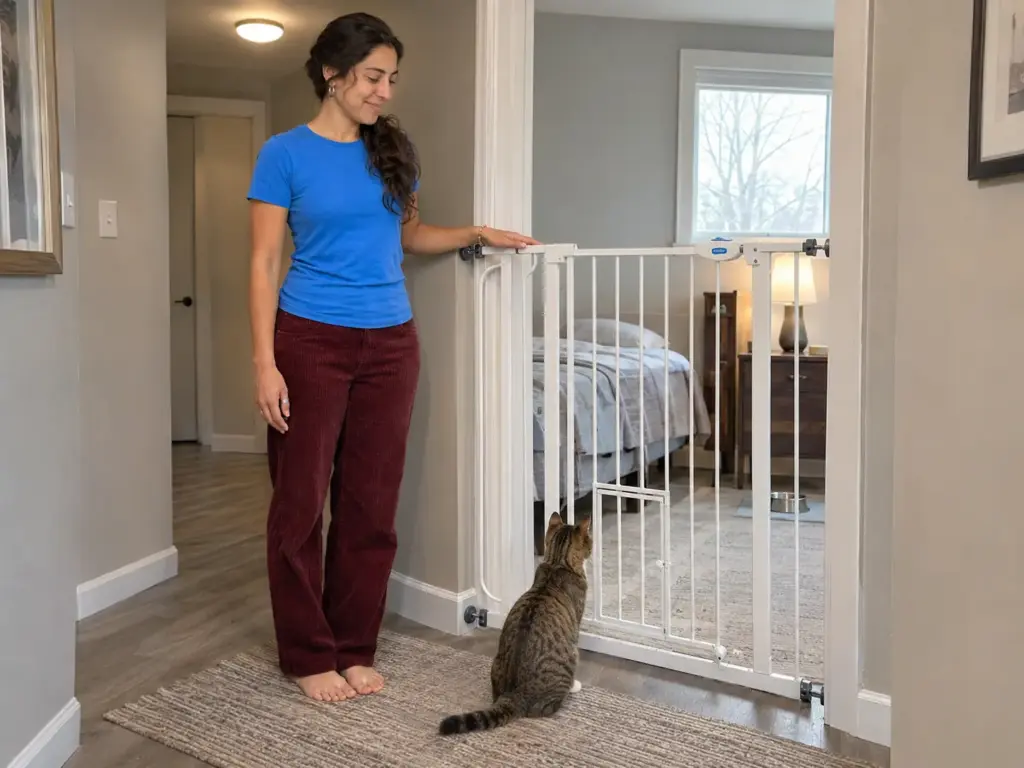
A baby gate does what a door cannot, which is let them see each other while you control the distance. The Carlson 36 inch Extra Tall Walk-Thru Gate stands 36 in tall and fits openings from 29 to 36.5 in without drilling, which matters in a rental, and a walk-through door lets people keep using the frame. The walk-through opening is narrow for some, though, and the build is uneven. Pet gates with a cat door that fit a rented doorway compares others.
For the first week the closed door is the better call, since it blocks sight and sound together, and the gate belongs to the stage after it.
A plug-in diffuser is the paid version of the cloth.
The FELIWAY MultiCat Diffuser Kit measures 4.5 x 2.5 x 5.0 in and lasts about 30 days. Treat it as a room scent for the household, not a treatment. It does not always last the 30 days, and it can leak oil onto the floor. Pheromone diffusers compared for the weeks of an introduction sets it against the others.
Foster First and Sign the Way Out
A foster-to-adopt arrangement, a few weeks with a shelter cat, lets the resident answer the question with his behavior before you sign for a cat the house has never met. And the way out gets signed before the carrier is opened: the shelter’s return clause, a backup plan, and a place the cat can go if you have to rehome him. The signs that show up between sessions when an introduction is failing are written in behavior, not opinion, and the no stays available halfway through.
A Week of Play, a Second Look at the Camera, and the Right to Say No
Decide on the cat who lives with you, not on a photo of one who does not yet. If his habits have changed, the vet comes first. If he is bored, this week fixes it. If he is lonely in the real sense, age, kinship and grief move the odds, and the apartment answers the rest in zones and doors.
After a week of two play sessions a day and a window seat, run the camera again over the same stretch and set it against the first run. If the footage has changed, boredom was the answer and the adoption form can stay closed; if it has not, his history and the apartment decide. Today, drag a chair to the best window, set a cardboard box on its side beside it, and do the first ten-minute wand session before dinner. And if the read, the vet, the zones or the grief say no, take the no.
Frequently Asked Questions
01Are cats happier with a second cat?
Not always, because the answer depends on the cat already living there and his history with other cats, and some adult cats never accept another adult. A cat on his own with play, a perch, a window and your time lives well. A habit that shifts overnight goes to the vet before anything else.
02How do I tell if my cat needs another cat?
Start by watching him, not assuming: a window test, ten minutes of wand play and three days of camera footage show what this cat actually does. A bored cat changes after a week of daily play; a cat who lost a companion or grew up in a group is the case another cat answers.
03Will two cats eventually get along?
Many do and some never do, and no date settles it; VCA describes introductions taking days, weeks or months, with adult pairs the hardest case. Tolerating each other is not the same as being friends. Agree an exit with the shelter before the carrier opens.
04How long should you wait before getting a second cat?
After a loss, wait until the cat who stayed is back to his own normal in eating, grooming, sleeping spots and seeking you, not until a calendar date. Grief often runs for months. With no loss, wait until the three-day read, any vet visit and the zone count are done.
05Is it cruel to keep just one cat?
No, a cat whose play, high places, window and person are covered lives well, because the idea that two cats beat one is a rule about people. What he needs is a look at whether anything is missing, which is the three-day read described above.
Leave a comment