Separating Bonded Cats Starts With a Two-Hour Trial Split
Separating bonded cats: a 2-hour trial, a night, a full day, then 48 hours in one closed room with the other cat's blanket (+ when to call the vet).

Alfredo RamsesFounder · November 17, 2026 · 24 min read

On this page10 sections
- 1What Separating Bonded Cats Does at Home, in Signs You Can Count
- 2Where the Plan Stops and the Phone Call Starts
- 3Temporary or Permanent, the Fork Before Any Plan
- 4A Two-Hour Trial Split, Before You Commit to Anything
- 5Who Moves and Who Stays Comes Down to Attachment, Not Fairness
- 6The First 48 Hours in One Closed Room
- 7Easing It: the Blanket, Short Play and a Pace for the Absences
- 8The Reunion Across a Door Gap, and the Pair That Needs Longer
- 9What Stays the Same Whether the Split Lasts Two Weeks or Forever
- 10Frequently Asked Questions
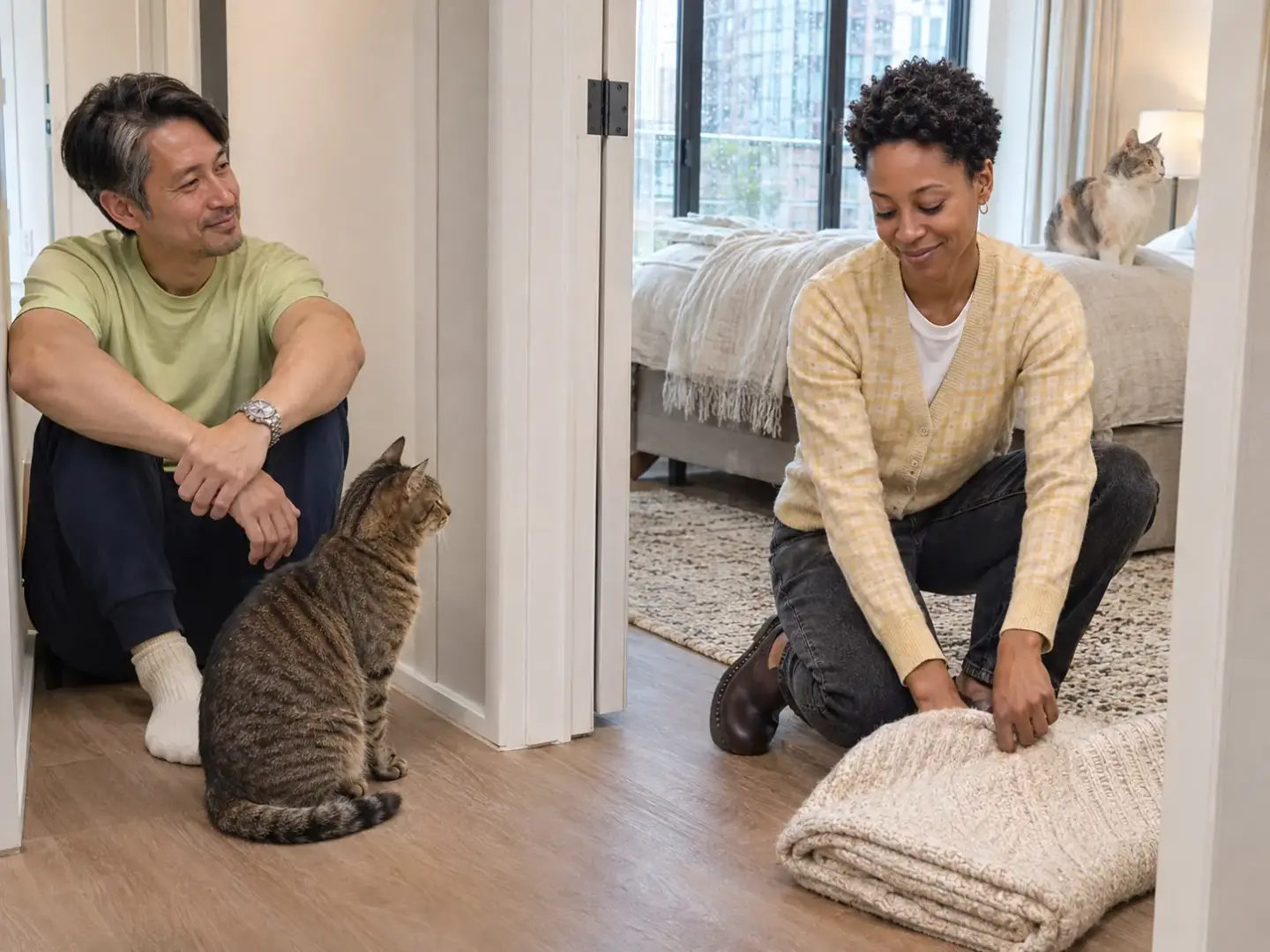
You are standing in the hallway with a lease that allows one cat, or a roommate whose boxes are already half taped, and two cats are asleep on the same blanket as if nothing were about to change. Separating bonded cats feels like a verdict you are handing down, but the cats are working from something simpler: an apartment where the other one’s smell is about to go missing. That makes the first week a problem of rooms, scent and pacing before it is a problem of feelings, and anything medical belongs to a vet from the very first line. Below, you will find how to tell a temporary split from a permanent one, how to test the bond in hours, who should move, what the first 48 hours look like in one closed room, and how to bring the pair back together if you can.
Quick Answer
Treat the split as an operation and run it in this order, letting what the cats do set the pace.
- Decide whether the split is temporary or permanent.
- Measure the bond with a trial in hours, not a hunch.
- Pick the cat who depends least on the other to move.
- Give that cat one closed room with the other cat’s blanket.
- Space the absences in small steps and play in one-minute bursts.
- Stop and call the vet for blood, mounting, or a cat that stops eating.
What Separating Bonded Cats Does at Home, in Signs You Can Count
The first thing a split changes is the cats’ daily round, long before anything you would call a mood. Written down, it reads as a short list of behaviors, and that list doubles as the score sheet for the trial further down.

The Search Phase: the Door, the Spots and the Shadow
Start from the assumption that the pair is real. If you are still weighing whether yours is a bonded pair or two cats who share a couch by default, what makes two cats a bonded pair and what only looks like one settles that first, and this page picks up where it stops. The cat who stays keeps walking the old route: the bed, the shelf by the window, the end of the sofa, and then the door. The cat who leaves does the same thing in an apartment that smells of nothing, which is a cat doing his job, checking the places where the other one should be.
What you will see, and what each behavior is looking for:
- Calling for the other cat: he walks to the closed door and ends up crying at the door, testing the one exit that leads to the other cat.
- Checking the old spots: he visits the other cat’s bed, shelf and corner in the same order each time, like stops on a route.
- Following you from room to room: you are now the only thing in the apartment that moves like company.
- Sleeping where the other cat slept: the spot still holds the missing cat’s smell.
- Restless evenings: he patrols the hallway after the lights go down, covering ground the pair used to cover together.
- Scratching or chewing at the door frame or at the other cat’s things: the places and objects that smell most like him.
Count them for a day and you have a baseline to compare against once the cats are in separate rooms.
What the Other Cat’s Smell Is Holding Up
International Cat Care explains that cats use scent to tell who belongs to their group. In a multi-cat household, the proof of belonging is everywhere: on every doorframe a cheek has rubbed, in the bed they shared, along the sofa arm. Take one cat out and that proof begins to fade from the places the other cat keeps checking. Scrubbing the missing cat’s bed out of the apartment on day one removes the one thing the cat who stays is looking for, so the blanket with that familiar scent does more work than anything on a pet-store shelf, and the plan below holds onto it.
The Signs That Mean the Cat Is Settling
Two lists in International Cat Care’s introduction guidance work as a score sheet. A cat settling into a room rubs against your legs, rests with his belly exposed, plays, rubs his face on furniture, and eats, drinks, uses the tray, scratches and grooms as normal. A cat for whom the door is the problem paws or scratches at it, meows for several minutes at a stretch, paces beside it, stands up against it, or swipes at you as you leave.
Keep both lists handy. Eating less and grooming too much appear on neither as moods, because both go to the next part of this article as reasons to call, and nothing here treats them.
Where the Plan Stops and the Phone Call Starts
The plan in this article covers rooms, scent, pacing and play. It does not cover a cat’s health and never will, so the places where the plan hands over come before the plan itself.
Blood, Bites and Mounting Come First
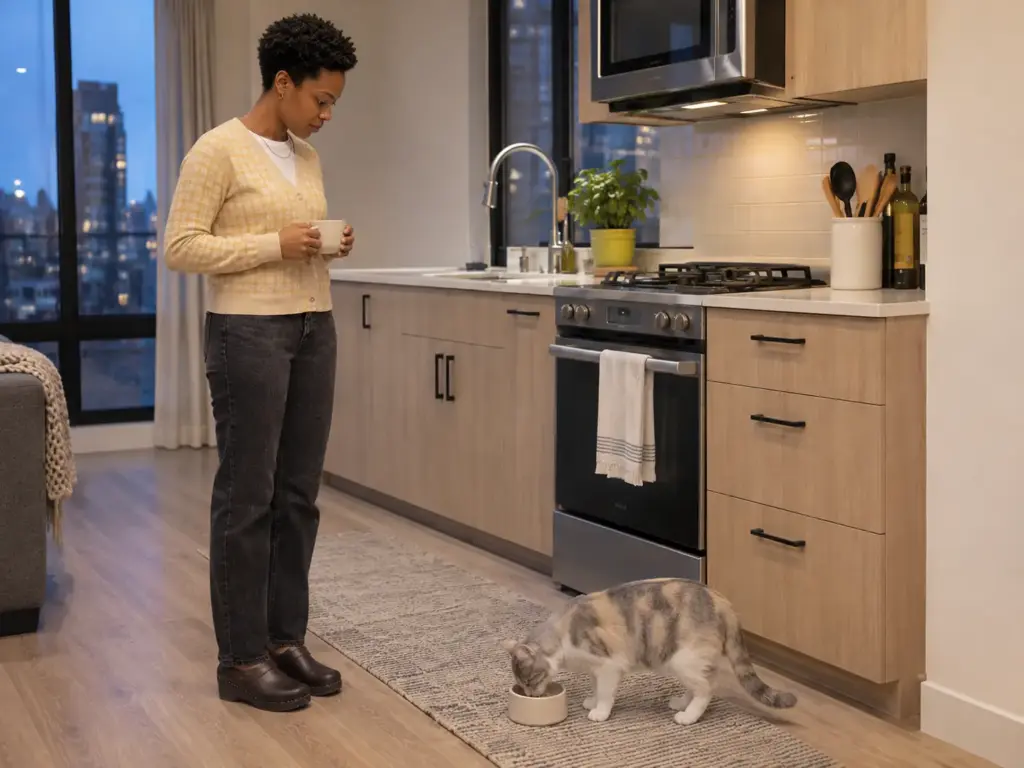
Blood, a bite to the neck, one cat mounting the other, clumps of fur from both cats on the floor, or a cat who stays hidden to get away from the other: any of these goes to a veterinarian or a clinical animal behaviorist before anything in the apartment changes. If a fight is happening right now, what to do in the ten seconds of a real fight, with a barrier and not your hands covers those seconds. After that the house waits: no room changes, no diffuser, no new schedule until a professional has heard what you saw. The call is not a defeat, just the part of the plan that was never the house’s job.
A Cat That Stops Eating or Grooms Past Comfort
A cat who is not eating, shows appetite loss, or grooms until the fur thins or the skin shows (overgrooming) is a phone call, and it ends the trial that day. This page does not give a number of days or hours that count as too long. That answer belongs to the clinic, and a call that turns out to be unnecessary costs far less than guessing. Set aside the cost of a visit before you start, and keep the clinic’s number where you can see it.
The Two-Day Rule After a Fight
After an intense fight between two cats who share a home, International Cat Care’s guidance on separating cats after an intense fight is to put them in different rooms for 24 to 48 hours and then contact the vet. Two days, not two weeks, and it opens with a phone call. The plan picks up after that.
Temporary or Permanent, the Fork Before Any Plan
Before you pick a room, decide whether the cats will live together again. The answer changes what stays in the base room, how much attention goes to a reunion, and what you tell yourself while you do it.

The Splits That Are Forced: a Move, a Breakup, a Lease, a Stay
A trip, a short stay with a relative, a medical stay with a return date, a staggered move or a lease about to change makes it a temporary separation. A breakup, a roommate moving out, a one-cat limit or a rehoming makes it a permanent separation. The work below is the same either way, and only the ending moves. For a temporary split you keep the base room and the blanket, because the reunion starts there; for a permanent one you choose who goes (that comes down to attachment, covered further down) and help the cat who leaves settle somewhere that smells of nothing.
Guilt decides more of these than the cats do. The cat whose name is on the adoption papers, or the one a person feels more responsible for, stays by default, and the pair’s actual attachment rarely gets a vote. Shelters treat the pair as a unit for a reason: the Humane Society of Loudoun County says apart, one or both cats “can become stressed, anxious, or even depressed without the other around.” That is a shelter describing pairs it has seen, not a diagnosis of yours, and if your cat stops eating it is a phone call.
The Pair That Started Fighting After a Move
Nine years together on the same bed, then a move, and then one cat starts cornering the other: hair from both on the floor, the quieter one living in the bedroom. A pair fighting after a move is a different case from a split you chose, and here time apart is rest, not loss. A move rewrites the map of the home, with new exits, new sight lines and old spots that smell different, and two cats who used to share all of it now disagree about who gets which parts. The one doing the cornering is not the villain of the story; he is working from a map that stopped making sense.
Blood, mounting or bites to the neck go straight to the vet or behaviorist, as above. Why two cats that lived together for years start fighting after a move goes through that pattern in full, and the way back, in stages, is in the reunion section at the end.
Kittens at the Adoption Counter, the Split You Can Still Skip
The only split that is still avoidable is the one at the adoption counter. A bond can form at any age, so a kitten pair’s age does not decide how they take being apart, and the Humane Society of Loudoun County’s reasons for adopting bonded pairs together include that it is easier to adopt a pair than to introduce a new cat later. NoCo Humane, another shelter, places bonded pairs together whenever it can, which is the whole logic of bonded pair adoption.
Before you stand at the counter, ask the landlord about a second cat. It is often a single conversation, and a question left unasked at the counter turns into a decision at the door.
Pairs That Should Stay Together, Even When It Costs You
Sometimes the reason to split a bonded pair is a cost you can still remove: an apartment that admits only one, a roommate who would take both, a relative’s house with room for two. Weigh the real cost. An extra tray and a spare room are smaller than a split.
A pair that stays together never needs the plan below, and nobody has to rehome bonded cats to save a corner of floor. If it cannot be done, the plan is there. If it can, do that first.
A Two-Hour Trial Split, Before You Commit to Anything
Instead of trusting a hunch about how bonded the pair is, measure it. The trial separation below uses two rooms, a closed door and the cats’ own blankets, and it requires no purchase. A pair that has never been apart has no baseline, so the trial gives you one.
Two Hours in Two Rooms
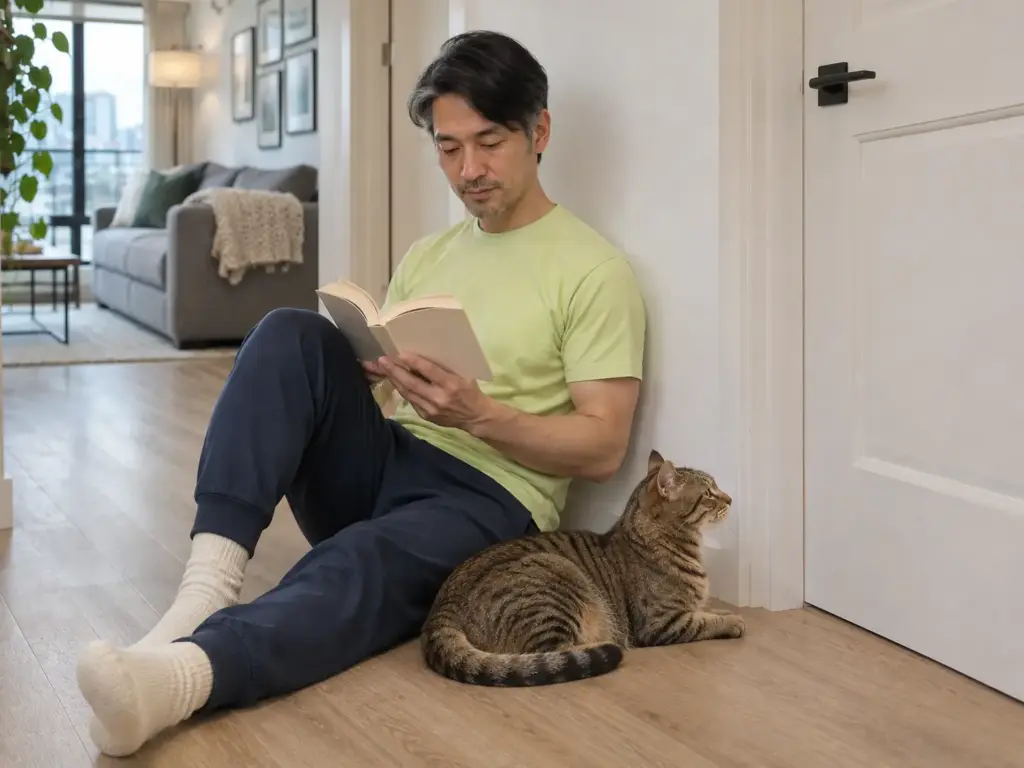
The trial has three clocks: two hours in two rooms of the same apartment, one night with the door closed, and then a full day. Each cat keeps his own tray, bowl and blanket, and the other cat’s blanket goes in with him so the room still carries the smell. Score each stretch with the two sign lists from earlier, one column per cat.
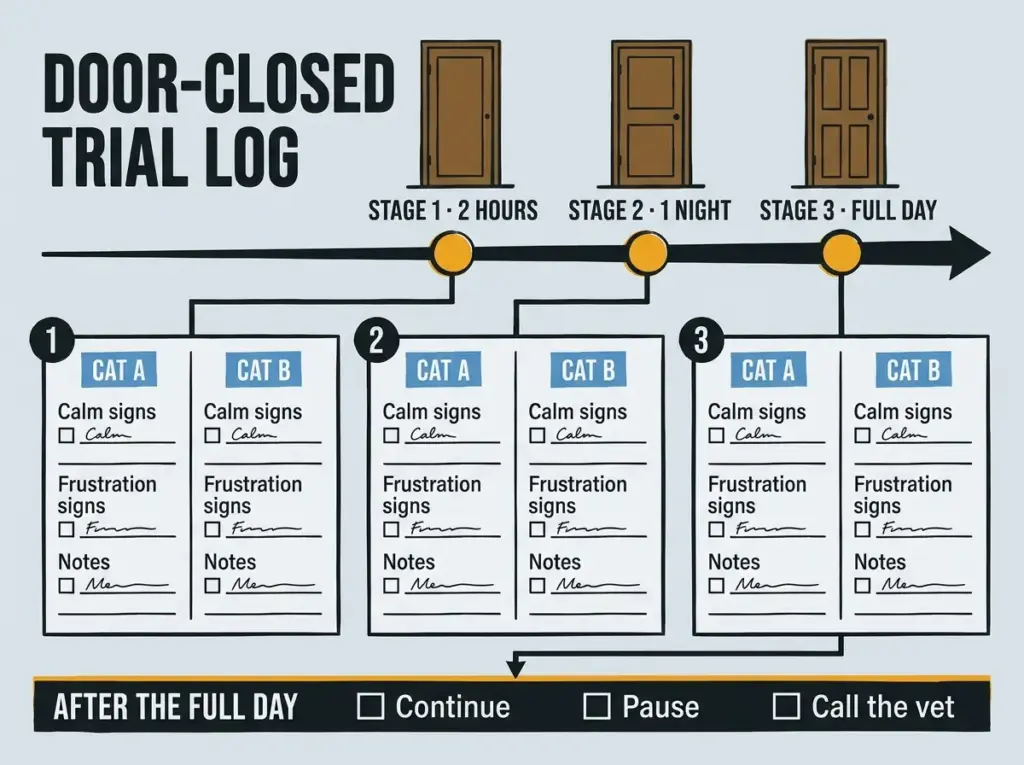
Two hours is long enough to see the first reactions and short enough that you can stop at any minute. Watch for calm signs (rubbing, play, eating) and frustration signs (pawing at the door, long calling, pacing). Treat this as a test of your own design and not a veterinary protocol; its job is to let you read both cats safely before anything becomes permanent.
One Night With the Door Closed
The night is where the round shows itself. Door closed, cats in separate rooms, blankets swapped.
Listen for calling that runs for minutes at a stretch, and in the morning look at whether the tray was used and the food eaten. A cat who skips a meal ends the trial and gets a phone call. A cat who calls for a while and then settles is giving you a useful reading of the pair.
A Full Day, and What to Do With the Sheet
A full day behind a closed door shows what the other two stretches cannot: whether the calm signs hold once the novelty fades. If both cats keep eating, using the tray, playing and resting, the split can go ahead with the plan in the pages below. If one stays in the frustration column the whole day, do not push through. Ask whether the problem is the split itself and reread the fork above, because the answer may be a different plan.
When the cats see each other again at the end of the day, watch the first minutes closely; how to tell a chase that ends in a nap from a fight that does not is the check to use.
Run each stretch at the hour of day when the real separation will happen. If the cat who leaves will go out the door on a weekday morning, that is the morning to rehearse. A trial on a quiet afternoon measures a different day.
Who Moves and Who Stays Comes Down to Attachment, Not Fairness
The easy rules are the ones easiest to defend: the cat you adopted, the one on the paperwork, the smaller one. None of them asks the cats.
Four Things to Watch for a Week: Where Each Sleeps, Who Eats First, Who Hides, Who Follows Whom
Use the trial notebook and add observations over several days: where each cat sleeps in the middle of the night, who eats first, who hides when the doorbell rings, and which person each cat follows. The cat who always sleeps pressed against the other, eats only after the other has finished, or hides until the other appears is the one who leans harder on the pair.
International Cat Care suggests drawing house maps, marking which rooms each cat uses and which he avoids, to see who owns what. Draw one for the cat who is leaving first (no, for both at once, on the same page, so the overlap is visible). A cat who uses the whole apartment on his own has more to fall back on than one whose map is a single bed and the space beside the other cat.
The rule that falls out of it: the cat who depends less on the other goes, and not the one who matters less. He leaves with a blanket that smells of the other cat, while the cat who stays keeps the apartment, the routes and the smell of both, which is more of the old world to lean on.
The Roommate and Breakup Versions
When two roommates split an apartment, the roommate cats usually get split by whoever argues harder. Take the same observations and let the cats’ evidence settle it, including which person each cat trails through the apartment, because that following is a vote.
A breakup uses the same rule with one extra step: keep the argument off the cat. If the evidence says the cat who leans less is the one you love most, that cat is the one who leaves with you. The sheet has no opinion about who deserves a cat, and that is its use.
The Lease Version
If the lease pet limit is one cat allowed, ask the landlord before deciding anything. A request for an exception for a pair is often one conversation, and an extra tray and a corner of floor usually cost less than a split. Put the request in writing and mention that the two cats already live together without trouble. If the answer is no, the plan stands, and if it is yes, you skipped the split.
The Car Trip, With a Carrier That Fits One
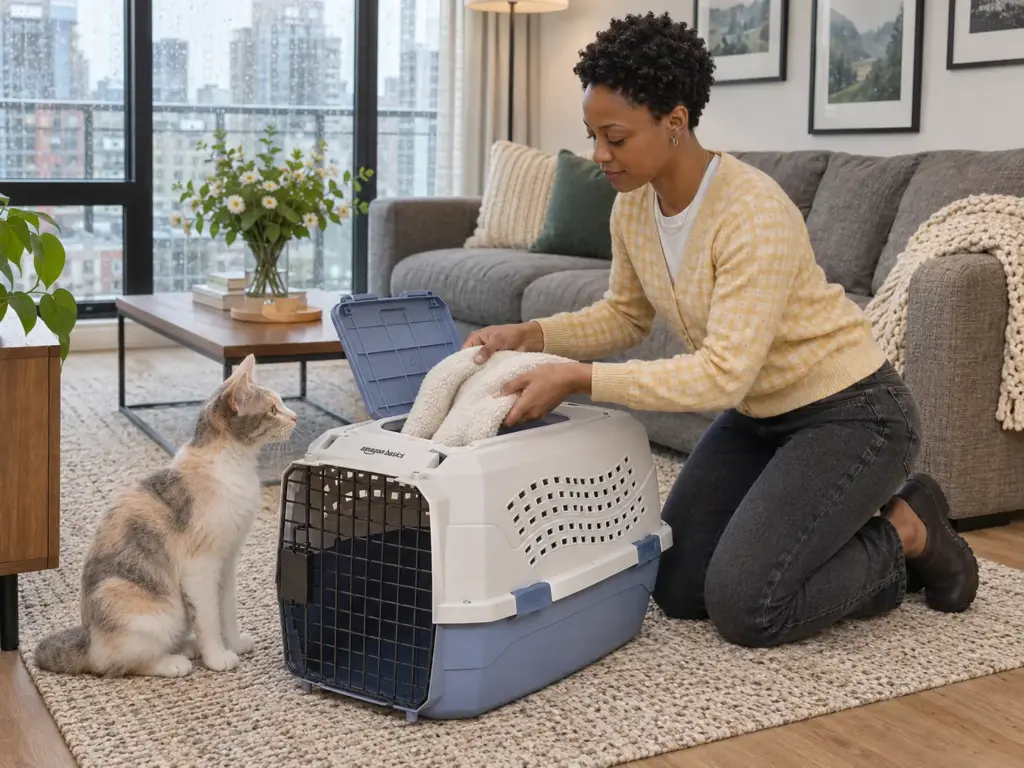
A cardboard box with a blanket over it will get a cat across a room. It will not survive a car. For the trip itself, International Cat Care says the carrier goes under a light blanket in the rear footwell or on the back seat held by the seatbelt, never in the trunk or the cargo area of a van, and the other cat’s blanket goes inside.
The Amazon Basics Sturdy Portable 2-Door Top-Load Hard-Sided Pet Travel Carrier measures 22.8 by 15 by 13 inches, weighs 4.54 pounds and is made for pets between 12 and 20 pounds. The top door is the reason it is here: a frightened cat can be lowered in from above instead of pushed in nose first. That door is stiff to open and can pop loose, and the secure fit is uneven, so test the latch with the carrier empty. If the pair travels together, carriers that hold two cats without sagging or unzipping, for the pair that travels together is the better route.
The First 48 Hours in One Closed Room
The first two days decide how the rest goes, and they go best in the smallest room you have, a base camp the cat can come back to.
Why the Whole Apartment on Day One Is the Mistake
A cat who has just lost the other cat’s smell and walks into an apartment that smells of nothing does not explore. He searches. Every open door is another room to search with nothing in it he recognizes.
One small safe room is the opposite: everything in it is his, and the closed door keeps the unfamiliar part of the apartment from piling onto him at once. The generous move, opening everything, is the stressful one.
International Cat Care also asks for the cat to stay indoors for at least two or three weeks after moving house with a cat, for small, frequent meals, and for one room at a time if stress shows. None of that is hard in a single room.
What Goes Into the Room
International Cat Care’s moving-day guidance for the cat describes one room with the door and windows closed, holding the carrier, bed, blanket, bowls, scratching post and tray. That is also the shape of a good base room for these first two days.
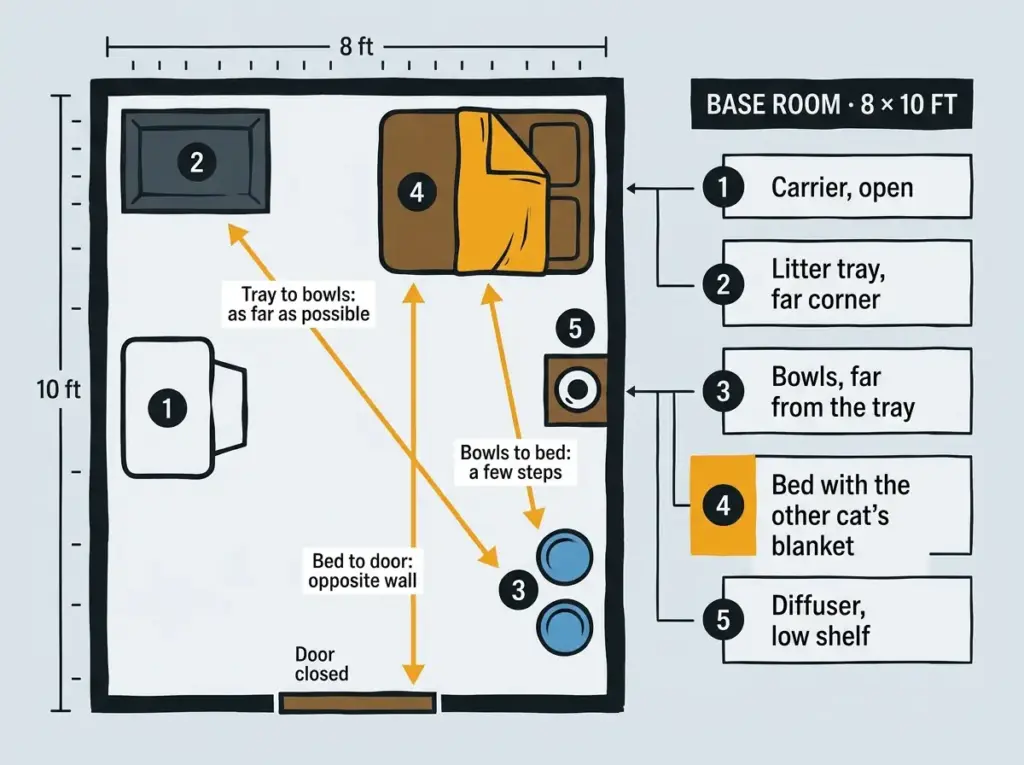
Free things first. The blanket that smells like the other cat goes in unwashed, with worn clothing of yours, a T-shirt, beside it, since International Cat Care suggests something with your scent if it helps a cat feel secure. A wedge under the door stops a cat who leans on it from swinging it open. The tray is the first purchase worth thinking about, and if the split is temporary the base room becomes the pair’s shared room later, so the count matters now: how many litter boxes a pair needs, and the exception for a bonded pair sorts it out, and scooping at least twice a day keeps the tray usable.
Then the object he will touch. The FELIWAY Classic Cat Calming Spray, 60 mL is the form that goes on the carrier, the blanket and the car seat before the cat gets near them, where a diffuser works on a room and the spray works on a thing. Never spray the cat himself.
It is short-lived (each application lasts about four to five hours, and a bottle gives around 50 uses), the pump does not always cooperate, and some people dislike the smell. International Cat Care says synthetic facial pheromones can have a useful calming effect in stressful situations such as moving house. Can, not will.
The Room With No Free Socket
Some rooms give you nothing to plug into. The only socket may sit at chest height where a cat can pull the diffuser out, or the only one in the apartment is behind the sofa. International Cat Care puts a plug-in diffuser in a floor-level socket several hours before the cat enters, which means the diffuser arrives first and the cat second.
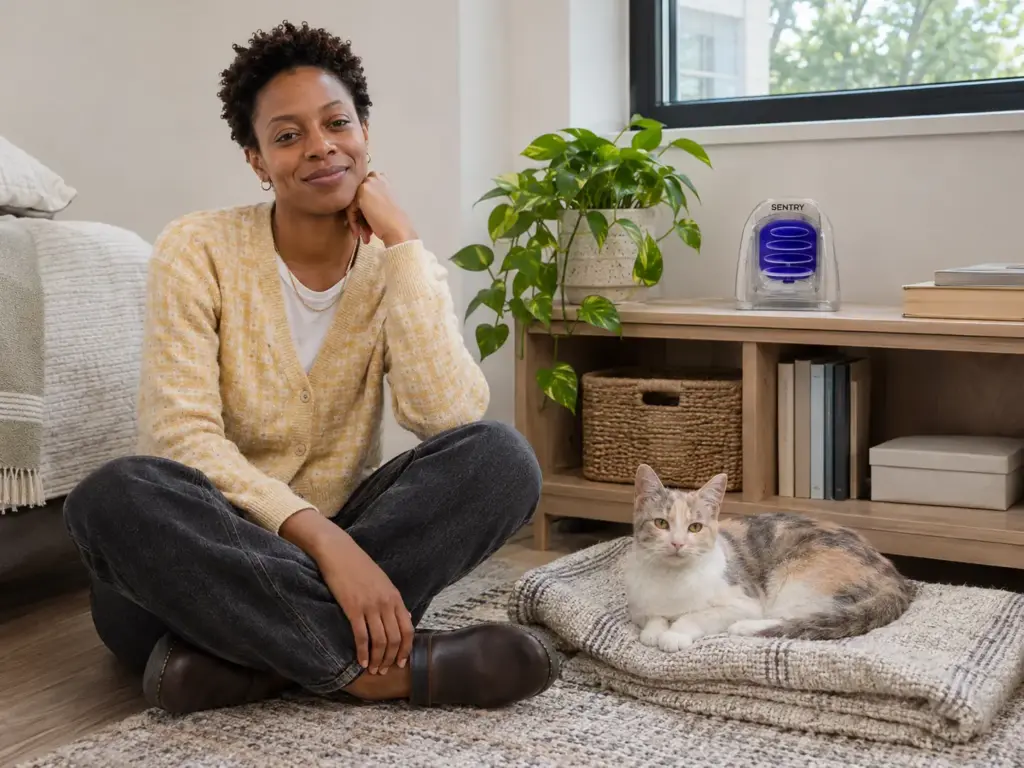
For the room with no usable outlet, the Sentry Portable Calming Pheromone Diffuser runs for 30 days without a plug or batteries and covers up to 700 square feet. It is also the only diffuser here that can ride in the car with the cat. Results are uneven, and in some homes nothing seems to change.
Put the diffuser in place, or spray the carrier and the blanket, before the cat goes into the room. Scent applied after he arrives lands on a cat who is already searching.
When the Door Opens
Open the door when the calm signs have appeared and the frustration signs are gone, and not before: the cat sets the timing, not the calendar. Settling into a room often takes several days to a week or two. If a cat is still unsettled after that, it is a consultation, not more hours behind a closed door.
With no spare room, the base room is the bathroom or a closet emptied enough to hold a bed and a tray. How a small apartment’s territory is decided by its exits, not its square feet helps you choose where the door goes.
Easing It: the Blanket, Short Play and a Pace for the Absences
What softens a split is mostly smell, rhythm and play, and the apartment already has all three.

The Blanket That Still Smells Like the Other Cat
Do not wash it. The blanket, bed or worn shirt that holds the other cat’s smell is the familiar scent and the strongest comfort in the plan, and it works in both directions, since each cat gets something that smells of the other. Swap in a blanket of his own gradually and keep the last one until the cat is eating, using the tray and playing in the new room. Scent swapping as a method has its own rules, and they belong to the reunion.
Keep the other cat’s blanket out of the wash until the cat who left has settled. A blanket is only useful for its smell, and one hot cycle ends it.
Absences in Small Steps, and the Cat Left Alone
This is a plan and not a protocol. Before the move, build staged absences, short ones, for the cat who leaves or for you, each a little longer than the last, so both cats have met an apartment with one fewer in it. It promises nothing about reducing harm. It is simply what a door and a clock can do.
A cat left alone in the apartment for the first time is on the same clock as any cat left alone: the tray and the water set the limit, and the hours two cats can be left home alone, and what the litter box allows works that clock out.
Play in One-Minute Bursts
Cats are sprinters, and according to International Cat Care’s play guidance one minute of frantic activity is already a good result, while an indoor cat needs hunting-style play at least once a day. Don’t plan half an hour. Plan several one-minute play sessions and let the cat end each one. In a split, a burst replaces part of the interaction the other cat provided, a chase partner, so a wand moving along the floor and then slipping out of sight gives a cat who just lost his partner something to stalk.
Where a Diffuser Fits, and Where It Does Not
A diffuser is one item in this plan, not the plan. The Comfort Zone Multi-Cat Calming 1 Room Bonus Kit comes with one diffuser and two 30-day refills, so 60 days for one room, and measures 4.5 by 2.5 by 7 inches and weighs 0.38 pounds. It goes in the room where the cat spends the day, not in the hallway. Synthetic pheromones might also decrease conflict between cats, according to the Merck Veterinary Manual, and the verb there is might, not will.
Refills can run dry in about two weeks, the oil leaves streaks up the wall, and the value for the money is uneven. A diffuser makes a small, uncertain difference and only after the blanket, the room and the play are in place.
The Reunion Across a Door Gap, and the Pair That Needs Longer
Once the separation ends, whether they remember each other matters less than what they smell like. Cats find each other by smell, and opening the door on day one turns a reunion into a meeting between strangers.
Treat Them as Strangers, Scent First
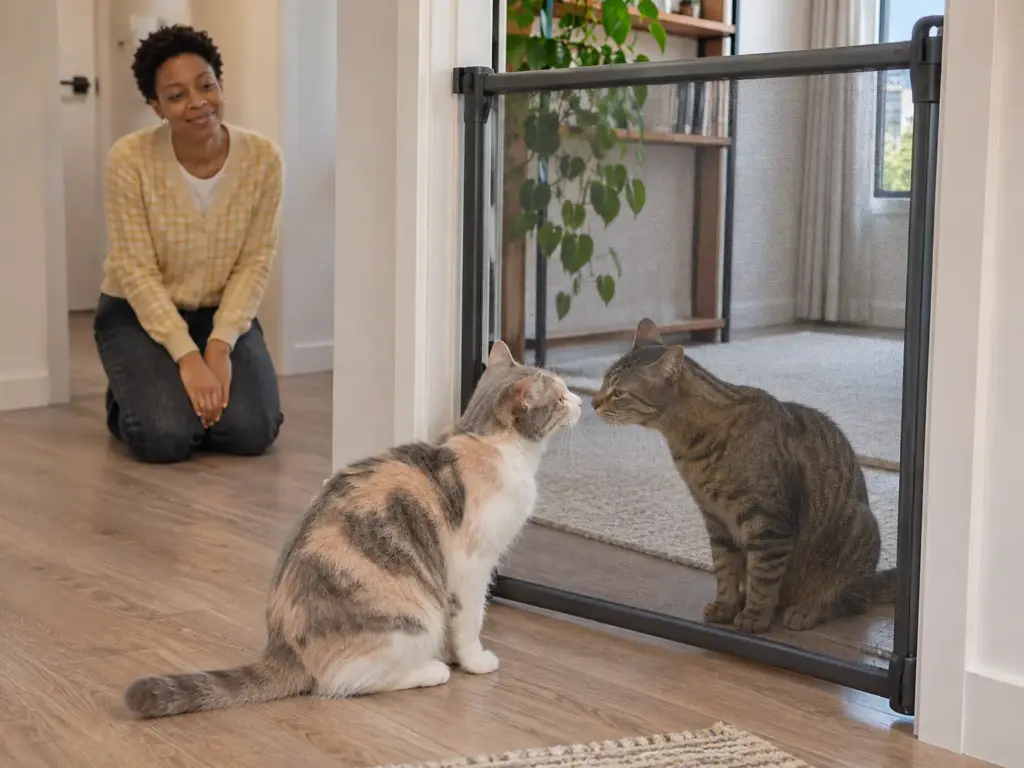
According to International Cat Care, “If a reintroduction is to be tried, it may be necessary to treat your cats like complete strangers meeting for the first time.” Apply that to this pair even though they know each other. The route is scent first, with bedding swapped between rooms, then sight through a barrier, then supervised access, and last a few minutes unsupervised, as International Cat Care’s step-by-step introduction of two cats lays out.
How two cats are introduced in a small apartment, stage by stage fits that route into a home with no spare room, and why swapping scent backfires and where the item goes covers the first step, including what not to do with the blanket.
Sight Through a Gap, Then Supervised Time
The barrier can be a glass door or screen door left ajar, a baby gate or a mesh panel. The cats sniff through it and do not pass. For free, a wedge under an interior door holds it open a crack, and the closed room is the rest of the barrier, so no glass door is required.
The calm and frustration lists set the pace, not a calendar: no new stage until the calm signs are the ones both cats are showing. How long to wait between the stages, set by gates and not by days explains how the gates work.
For a while, the gap in a door held by a wedge is all the reunion there is. Move to the next stage only when the calm signs are showing in both cats, not just in the one who is easier to read.
When tension climbs at the gap, a diffuser made for conflict between cats can sit in the reunion room. The FELIWAY MultiCat Cat Calming Diffuser Kit comes with one 48 mL refill, good for 30 days, and FELIWAY makes it for friction between cats rather than for one anxious cat. It is a support for the room, not a treatment. It is pricey for a single refill, and the value for the money is the uneven part; the Comfort Zone kit above is the other route.
The Pair That Fought After the Move
If a reunion keeps ending in an active fight, International Cat Care says the cats may need to stay apart for longer, with a clinical animal behaviorist involved. For the pair with nine years together that broke after a move, the paragraph reads differently. The split was the relief, and the reunion has to be earned in stages, not granted because it has been a few weeks. Blood and mounting are not treated here; they go to the vet, as above.
When Together Is Not the Answer
In some cases cats cannot live together. International Cat Care says plainly that rehoming should not be ruled out when a relationship has broken down, as it could be the kindest option for everyone, the cats included. A bond can form at any age, and relationships between cats change over time, so a cat who goes on as an only cat is not locked out of company for good. That is a clause, not a promise.
What Stays the Same Whether the Split Lasts Two Weeks or Forever
The operation does not change with the ending: a trial that reads the pair in hours, the cat who leans less on the other leaving, and one closed room with the other cat’s blanket for the first stretch. The trial tells you more than a hunch does, and a hunch is usually where guilt does its talking.
Look again at two points. In a few days, see whether both cats are eating, using their trays and playing in short bursts. In a week or two, see whether the calm signs still hold now that the novelty is gone. If either is missing, it is a call, not more of the plan.
Today, with what is in the apartment: close one door, put each cat in a separate room with his own bowl and tray and the other cat’s blanket for two hours, and fill in a sheet with two columns, one per cat, a line for calm signs and a line for frustration signs. Then watch where each cat ends up when the door opens.
Frequently Asked Questions
01Is it cruel to separate bonded cats?
Separation is a real loss for the pair, which is why shelters keep bonded cats together whenever they can. Apart, one or both can become stressed, and International Cat Care adds that rehoming can be the kindest option when a relationship has broken down. If a cat stops eating, call the vet.
02What happens when you separate bonded kittens?
A bond can form at any age, so age alone does not predict how kittens take a split, and the one split you can still avoid is the one at the adoption counter. Ask the landlord about a pair first. If they are already apart, follow the same order: trial, one room, paced absences.
03Can a bonded cat bond with another cat after losing its companion?
A bond can form at any age and relationships between cats change over time, so a new bond is possible. A new cat comes in by the same route as a reunion: scent first, then sight through a barrier, then supervised time, as the stage-by-stage introduction guide sets out.
04How long can bonded cats stay apart before they stop recognizing each other?
Plan any reunion as a reintroduction, whatever the gap, because cats recognize each other by scent and a pair that fights is handled like strangers meeting. Go scent first, then sight through a barrier, then supervised time, and leave the door closed on day one.
05What are the signs of separation anxiety in cats?
What you can see and count is calling or pacing at the door, following you from room to room, and checking the other cat’s spots. A cat that stops eating, grooms until it hurts or shows any sign of illness needs a vet, not a plan.
Leave a comment