Before Getting a Second Cat, Protect Your Cat’s Territory
Get your apartment ready for a second cat: a baseline page, the vet visit, a room to give up & a doorway barrier (all done before day one).

Alfredo RamsesFounder · November 10, 2026 · 21 min read

On this page10 sections
- 1What Your Cat Already Has to Lose Before Getting a Second Cat
- 2The Baseline Sheet to Write the Week Before
- 3The Vet Gate Comes Before the Door
- 4Choosing a Second Cat the First Cat Can Live With
- 5Build the Stations Before the Door Opens
- 6The Room You Give Up, Chosen by Your Cat's Route
- 7Put the Barrier in the Doorway Before Anything Else Happens
- 8Sign the Exit Plan Before the Carrier Opens
- 9Do the Free Work a Week Before You Adopt Anything
- 10Frequently Asked Questions
Before getting a second cat, most people pack for the newcomer: a bed, a carrier, a bowl with the new name on it. The cat who already lives with you is the one about to hand something over, and he has spent years arranging the apartment to suit him, one box, one window and one route at a time. The feline veterinary guidelines are plain about how a cat takes a stranger in his territory, and he is entitled to the reaction. What follows is the preparation that belongs on the resident’s side of the door, in the order it pays off: the page to write a week ahead, the vet call, the room to give up, the stations, the barrier in the doorway and the exit plan you sign before the carrier opens.
Quick Answer
Do this in order, starting a week before anything is adopted.
- Write one page on your cat’s weight, sleeping spots, meals and box habits.
- Book the newcomer’s vet visit before the carrier crosses your threshold.
- Pick a base camp room your cat can lose: off his route, not his bed or bowl.
- Build the stations early: boxes, bowls, beds and high spots in separate rooms.
- Hang the barrier in the doorway before the newcomer arrives.
- Get the shelter’s return terms in writing before opening the carrier.
What Your Cat Already Has to Lose Before Getting a Second Cat
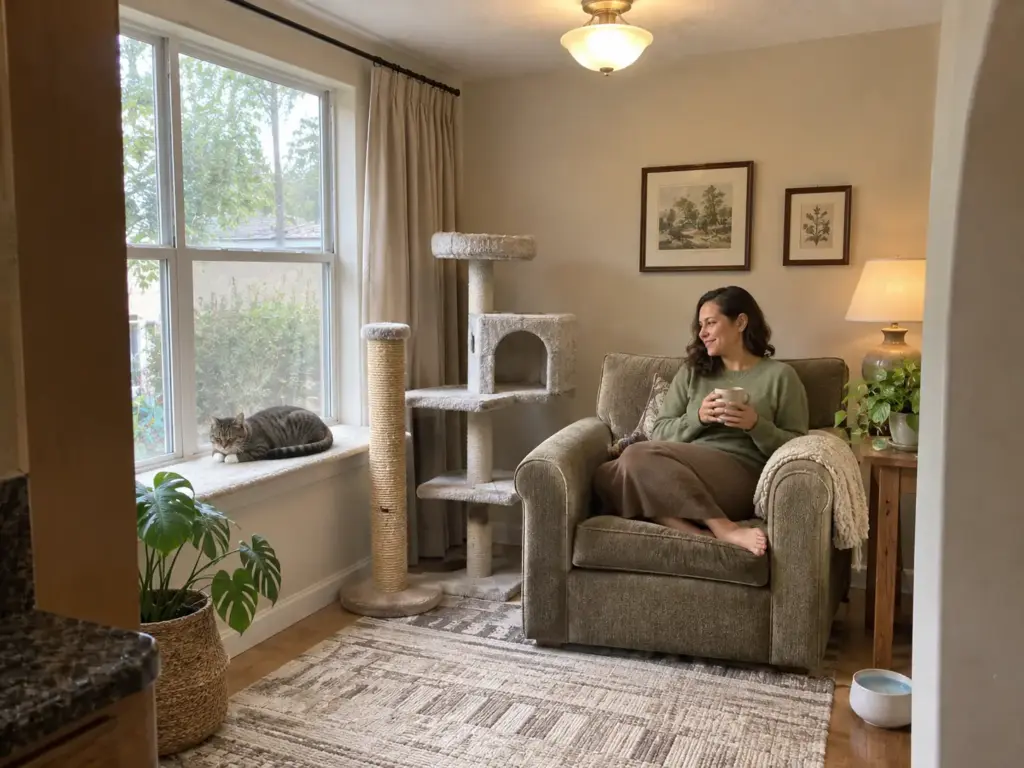
Walk the apartment as if you managed it for a single tenant. Every box, bowl, bed, window and scratching surface answers to him, and he reaches each one without passing another cat. Nothing in the place has ever been shared, so nothing in it has ever needed a rule.
A One-Cat Home Is a Fully Furnished Territory
According to the 2013 AAFP and ISFM Feline Environmental Needs Guidelines, “Cats do not welcome unfamiliar cats into their territory, and usually show aggression towards these strangers.” Read that as an inventory, not a verdict on character. The day a second cat arrives, every resource in the apartment is divided by two, and the cat who was there first is the one who gives up his half.
The count under everything in this article is in how many cats a home can hold, counted in stations rather than square feet: an apartment holds as many cats as it has separate stations a cat can reach without meeting another. For the map of who owns which corner, read how a cat’s territory splits up zone by zone, then stand in each zone and ask what he would lose. The answers are the first things to move.
The Cats Who Should Wait, and Who Decides
Write the resident cat’s file in a few lines: his age, whether he has lived with other cats, how he reacts to a cat seen through the window, and whether he is a cat who watches or a cat who leaves the room. A senior who has had the place to himself for a decade and a two-year-old raised with a litter face different changes.
Some files say not yet. A cat who has just lost a companion needs time to return to his own baseline before another cat arrives, and VCA’s veterinarians say to wait for exactly that. A cat who is ill or in treatment is the vet’s call, not a household one.
And a cat who already shows urine marking when he sees an unfamiliar cat through the glass needs a vet first and, if the vet finds nothing, a behavior specialist. None of this is a ruling. It tells you whom to ask.
When he starts avoiding a room or guarding a chair, the apartment changed first, and the account in what changed in the home before the cat started to look jealous keeps the reading on the house instead of on his feelings.
Why Living With One Cat Is Not Cruel
A single cat with a window, a high place, daily play and your attention lives a complete life. The second cat is a preference of the person, and the house can honor it if it is prepared; the cat has not asked for anything. A lonely cat and a bored cat look alike from the couch, and boredom or play aggression aimed at your ankles can pass for loneliness; more play with you is the first thing to try, and it costs nothing. If you have already decided, the rest of this article assumes the decision is made and gets the apartment ready for it.
The Baseline Sheet to Write the Week Before
Picture the third week. Your cat has stopped using the hallway and naps in the bedroom closet, and you cannot say whether that began with the newcomer, a new bag of food, a cold snap or one bad weekend. Nobody wrote down what normal looked like, so the newcomer takes the blame for all of it.
What Goes on One Page
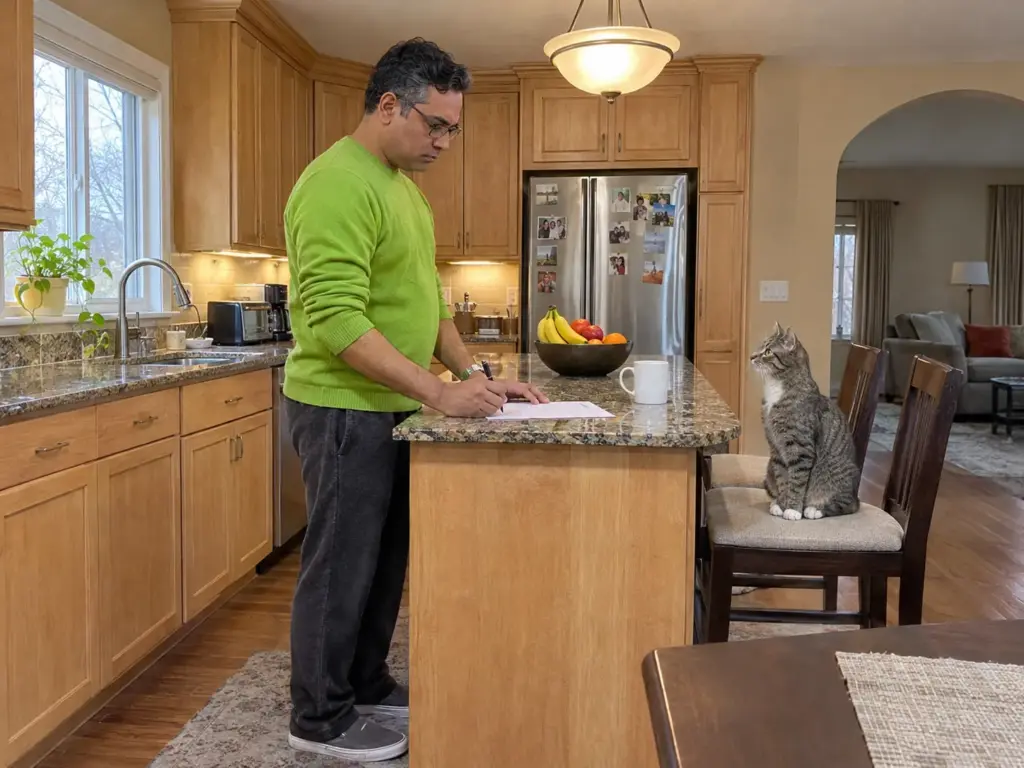
The page is written the week before anything changes, and it interprets nothing: it records. Veterinarians who write about adding a second cat tell a grieving household to wait until the surviving cat is back to his baseline, and VCA’s veterinarians on adding a second cat make that point for exactly that case. A baseline only works if it exists on paper, and any arrival deserves one. The page holds:
- His weight, taken the same way each time
- Where he sleeps by day and where he sleeps by night
- When he eats and how much is left in the bowl
- How often he uses the box, and which box
- Which rooms he uses after dark
- One line a day for anything that was different
Where It Lives So Both People Write in It
Put the page on the refrigerator or in a shared note, never in one person’s memory. Two people who scoop to different standards are describing two different cats, and a sheet only one of them fills in will quietly record that person’s standard.
Each of you fills in the page alone, on the same template, and you compare afterward. Wherever the two versions disagree, one of you has been guessing, and learning that a week before the newcomer arrives beats learning it during week three.
How Week Three Reads Against It
Now week three has something to be compared against. A change of route or place, such as the resident no longer entering one room, shows up against the sheet and gets solved with the apartment: move a bowl, add a perch, reopen the path. A change of habit, such as eating less, drinking differently, skipping the box or hiding for days, is a call to the vet that same day, before a single piece of furniture moves.
The sheet tells you which of the two you are looking at. The whole kit is a page, a pen and seven days.
The Vet Gate Comes Before the Door
A cat out of a shelter run, a barn or the street arrives with a history nobody knows in full, and the cat who lives with you has no say in what walks through the door. Health gets settled first, and the furniture waits its turn.
What to Ask the Shelter Before You Say Yes
Ask, in writing, what the shelter has already done for this cat: the FeLV test, vaccination (the FVRCP shot is the core one), deworming, flea treatment, and spay and neuter surgery. Take that paper to your own veterinarian for the vet check. What is missing and what to do about it are the vet’s decisions, and nothing in this article stands in for them.
Seven to Fourteen Days Apart Until a Vet Has Seen the Newcomer
The first separation is not there so the cats can get used to each other. It is a quarantine in the plain sense: it lasts until a vet has seen the newcomer, usually seven to fourteen days, and the base camp described further down does the work. Dishes, litter and bedding stay on their own side of the door until then; the scent swapping that opens the slow introduction waits for that visit. A kitten changes the details but not the order, as what changes when the newcomer is a kitten and the vet comes first shows.
Seven to fourteen days is a rule of thumb that gives way to the vet’s calendar. If the earliest appointment is on day nine, the separation is nine days.
Where a Room Problem Becomes an Appointment
A cat who changes habits from one day to the next goes on the vet’s calendar that day, ahead of any furniture decision, whether he is the resident or the newcomer. That covers the box, the food bowl, the water dish and hiding for days. Everything else here is the apartment: the box, the route, the station, the gate.
If the resident already marks the house or avoids a room after catching sight of a strange cat, the order is vet first and, once the vet finds nothing, a behavior specialist. Nothing in this article can tell you whether a particular cat is healthy enough to meet another, and the visit keeps you from improvising an answer.
Choosing a Second Cat the First Cat Can Live With
You fall for a photo of a young cat who runs laps before breakfast, and your own cat sleeps sixteen hours a day and owns exactly one window. The newcomer is chosen for the resident, not for the person holding the phone.

Kitten or Adult, and What the Resident Loses Either Way
The kitten vs adult cat choice is a choice of what the resident loses, because each takes something different from the cat who was there first. The kitten takes the high spot, the quiet and the nap that used to be undisturbed, and it adds play at hours nobody asked for. An adult takes territory and rank, which are harder to give back. And a kitten does not stay one: it grows into an adult sharing the same territory, a change that what changes in the home as a kitten grows into an adult measures in facts of the house.
Matching Energy, Not Looks
A personality match and an energy match count for more than coat color or whether the newcomer is male or female. A resident built for sleeping and window-watching will not share a hallway with a newcomer built for forty minutes of sprinting. A pair of littermates or an already bonded pair arrives with a relationship of its own and comes through the door together, which changes the station count.
A pairing of a male and a female is a smaller question than it sounds when both cats are spayed or neutered. Match on age and temperament first.
Let the Shelter Match You Instead of a Photo
Shelter matchmaking works because the staff has watched its cats for weeks. A cat picked from a photo arrives with nobody knowing how he lives alongside other cats. Ask what he did with the cats he has already met, and ask it before the photo has had time to work on you. A meet and greet in the shelter’s room shows how the newcomer handles a stranger, not how he will handle your hallway.
Say the hard part once, without drama. As VCA’s veterinarians put it, “Even with great care, some adult cats never accept another adult cat into the home.” That sentence is the reason the exit plan further down exists, and VCA’s veterinarians on adding a second cat say it in the same breath as everything else they recommend.
Build the Stations Before the Door Opens
You buy an extra-large box and set it flush against the first one. That afternoon the apartment still has one station, because to your cat two boxes in the same corner are a single place to be ambushed.
Move What You Already Own First
The free work comes first. Carry a bowl to another room, a bed to another corner, a post to the far end. Then count stations by what the resident can reach without walking past the spot where the other cat will be. A spare bowl set in the same corner counts for nothing under the one-more-than-cats rule for every resource and why a spare in the same corner fails, because he would still pass the same place to get to it.
A bowl in a shared corner is also the setup for resource guarding, one cat standing over it while the other waits.
The Third Box, Sized for a Full-Grown Cat
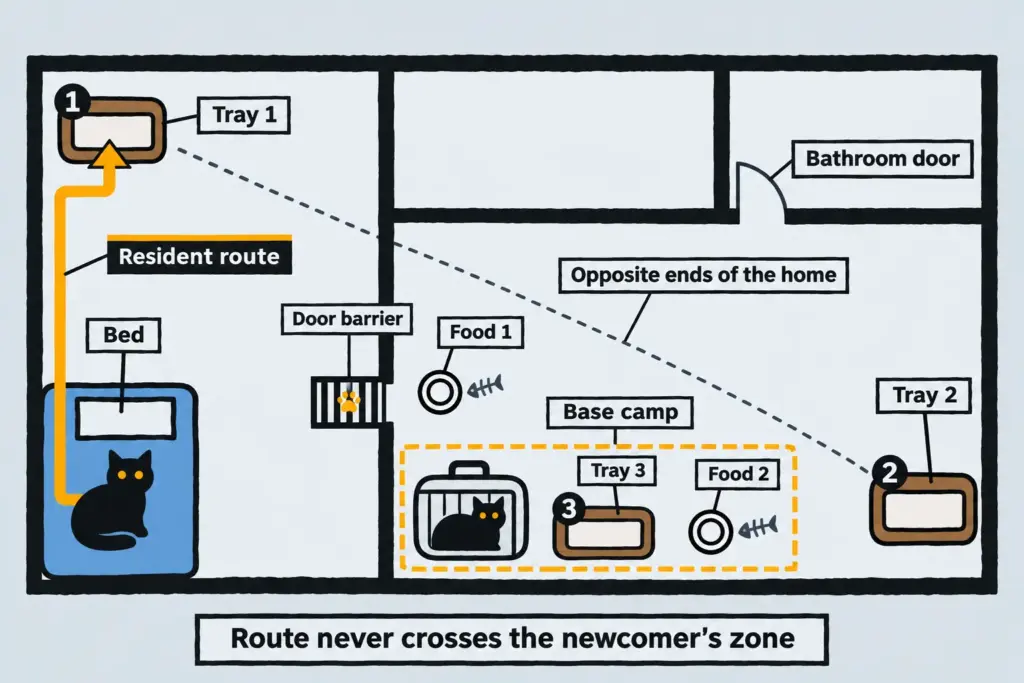
The usual guidance for multi-cat homes is three boxes for two cats, with two of them at opposite ends of the home so neither cat can hold both, and three boxes for two cats, counted room by room walks through the placement. The shorthand is the 1+1 rule, one litter box per cat plus one (n+1), so two cats get three. The extra litter box only counts when the boxes sit in different places; two side by side register as one.
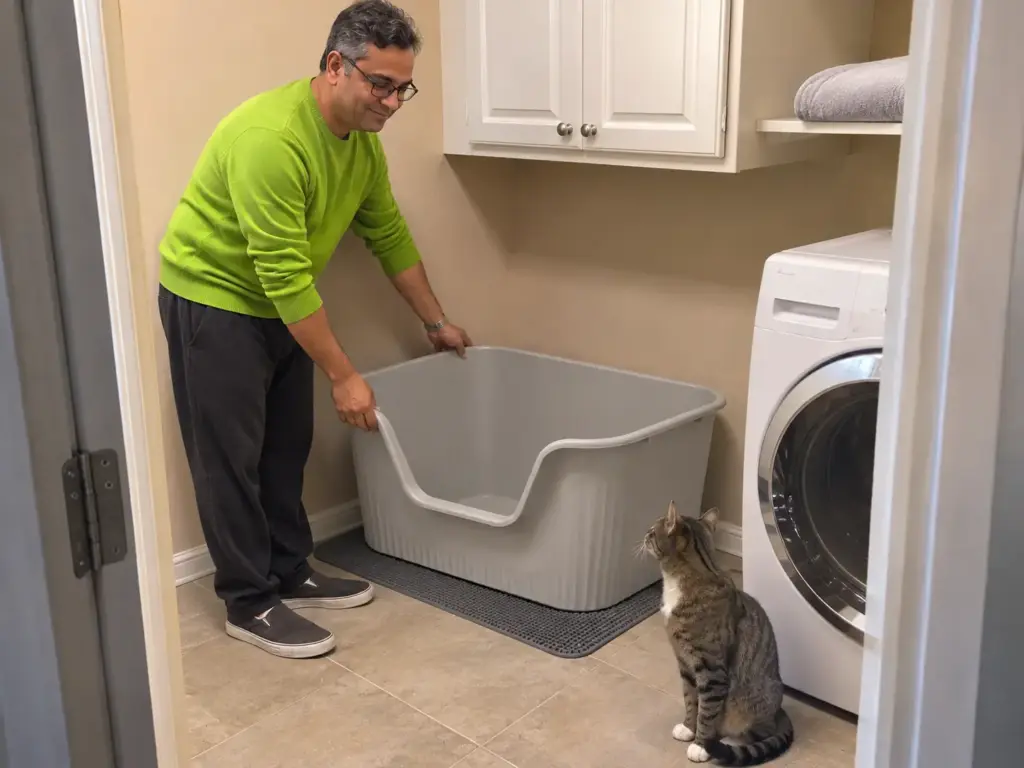
Litter box size comes next. A box that serves a full-grown cat runs about one and a half times his length from the nose to the base of the tail, around 22 inches for an adult, and most boxes sold as “large” measure about 15. Fill it 2 to 3 inches deep, leave the lid off, and keep the entry low for a senior; choosing a litter box by size, sides and entry goes through the sizing in full.
The TownTime Extra Large Litter Box with High Sides is 25.27 inches long, 17.83 wide and 13.11 tall, which clears that 22 inches with room to turn, and the high sides hold in what a cat who stands to pee sends over the edge. It goes together without tools. Its flaws: whether it is worth its place in the budget is a fair question, and the side entry sits lower than some households want.
Put the far-end box down a week before adoption day and watch whether your cat reaches it without passing his other stations. If he walks around it, the spot is wrong, and you found out while moving it is still free. Don’t be surprised if his first verdict is to sit beside it and stare.
For a kitten or a small adult newcomer, the lower-cost second station is the Amazon Basics Large Cat Litter Box with High Sides, Open Top, 19 by 15 by 11.75 inches with the front lowered so a nervous or older cat can see before stepping out. At 19 inches it only fits a cat of roughly 12 to 13 inches from nose to tail base, so it runs short for a big-framed one.
Bowls, Beds and a Second Way Out
Food and water go in separate places, with two to three water bowls in different spots and two separate feeding stations in different rooms, never shoulder to shoulder; the spacing is worked out in why two cats need two bowls plus one, set well apart. The AAFP and ISFM guidelines ask for a minimum of two resting areas, two feeding areas and two toileting areas in every home.
Beds follow the same logic. Each cat needs a hiding spot sized for one cat, and in a shared home that spot should have more than one way in, a built-in escape route, so another cat cannot block it. A box with two holes does the job.
Height is vertical territory, and a small apartment has little floor to spare: add a window perch, a cat tree or shelf as a second high spot, and a scratching post tall enough for his full stretch, 30 to 32 inches for an adult. Put at least one high spot where the resident has a clear sightline to the door, so he watches what comes through it instead of meeting it at floor level.
The Room You Give Up, Chosen by Your Cat’s Route
The bathroom is the only room that locks, so the bathroom gets picked. Then you notice it is also the only door between your cat and his litter box.
Three Tests a Base Camp Room Has to Pass
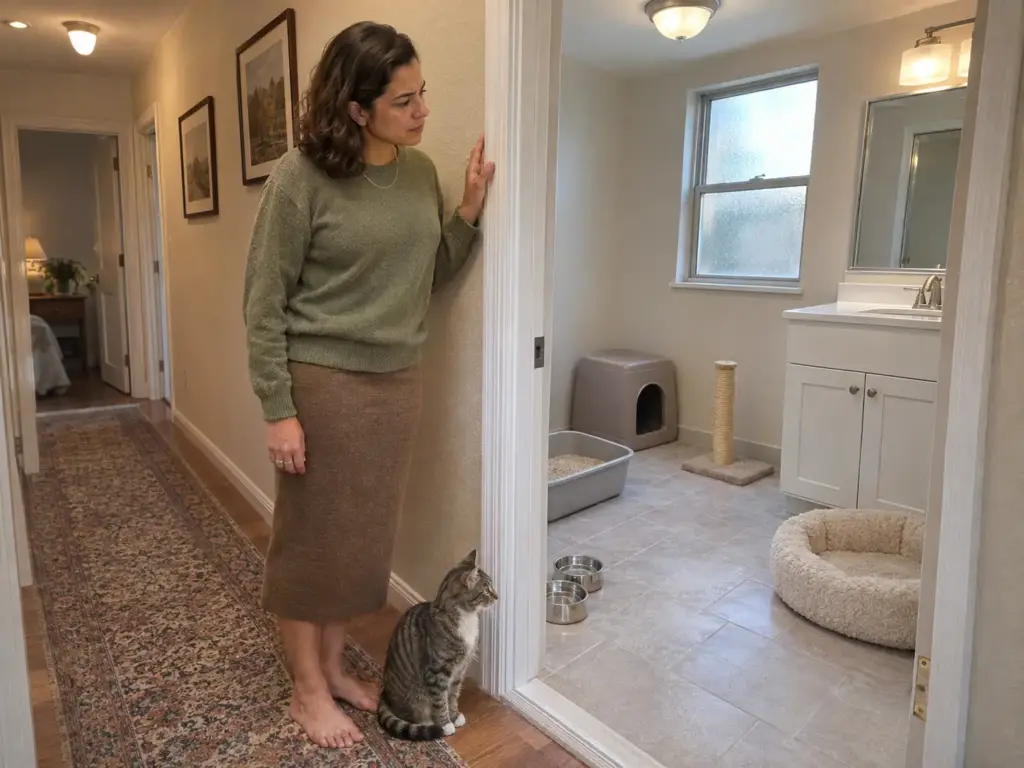
The base camp is a safe room, the sanctuary room where the newcomer lives until the introduction is ready to begin. It passes three tests, and all three come from the resident’s route, not from which room is emptiest.
It sits off his usual paths. It is not where he sleeps or eats. And it is not the only door between him and his box. Skip the spare room that happens to be free; a free room can still be on his path.
In a one-bedroom of about 500 square feet the bathroom often passes all three at once, but not always, so watch where he actually walks for a few days. The footprint needed is small: about 4 by 6 feet of floor, the size of a small bathroom. A studio has no spare door at all, so the bathroom is the base camp or there isn’t one. In a small apartment the choice usually narrows to one door, and how a small apartment’s exits decide what a cat can give up shows how to read the exits.
What Goes Inside, Not Just a Bed and a Box
VCA’s guidance calls for bedding, food, toileting and exercise in the newcomer’s area, and that last item is the one people skip. A base camp with no post and nowhere to climb is a waiting room. Give the newcomer two safe places the size of one cat each, with two ways in.
The box in that room is open, scooped at least once a day, and emptied and fully cleaned every two weeks with mild soap, per Best Friends Animal Society, who also say to avoid strong-smelling detergent and ammonia. The full change belongs on the calendar, not on the day the smell wins.
The Diffuser Works Only While the Door Stays Shut
Free first: a closed door, and, once the vet has cleared the newcomer, used bedding and a scoop of used litter moved between the boxes. A diffuser is an addition to that, not the plan. The FELIWAY MultiCat Cat Calming Pheromone Diffuser Kit is the formula made for tension between cats who share a home.
It measures 4.5 by 2.5 by 5.0 inches, with a 1.62 fl oz vial that lasts about 30 days. Plug it into the base camp’s outlet for the days the door stays shut.
Not every cat changes at all, and the vial can run short of its 30 days and leak. It is not a treatment for anything and it does not replace the vet. Comfort Zone’s multi-cat kit gives more refill for the money, and which pheromone diffuser fits an introduction in an apartment compares them for anyone who wants to go further.
Put the Barrier in the Doorway Before Anything Else Happens
You cleared the weekend to introduce them. The sequence is measured in weeks.
Scent First, Then Sight Through a Barrier
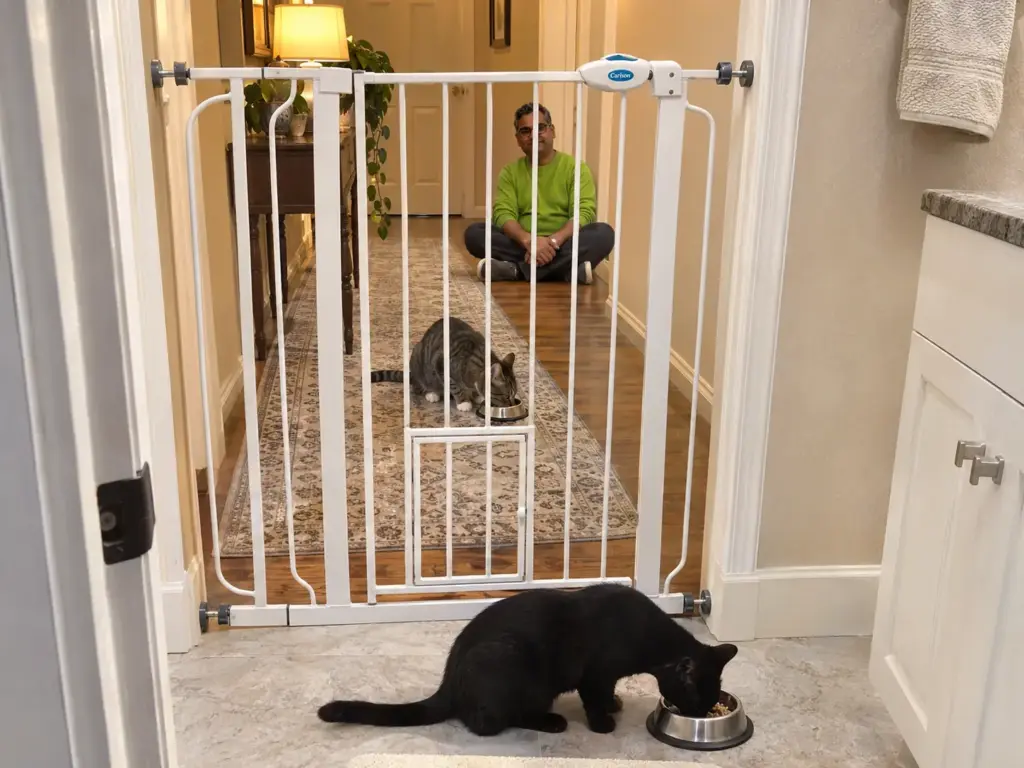
The barrier goes up in week zero, not on the night the cats meet. A gate that has stood in the doorway for a week is furniture by the time it matters. A standard baby gate is the version most closets already hold, and a cat clears it, which is why this calls for a tall barrier.
The Carlson 36 inch Extra Tall Walk-Through Pet Gate with Small Pet Door is 36 inches tall, fits openings from 29 to 36.5 inches and is tension-mounted and no-drill, so it works in a rental, and how to measure a rented doorway for a tall gate with a cat door covers measuring the frame. Its 7.5 by 7.75 inch pet door is what lets it stay up for months, not a weekend. The latch could be better, and that pet door is small for some cats.
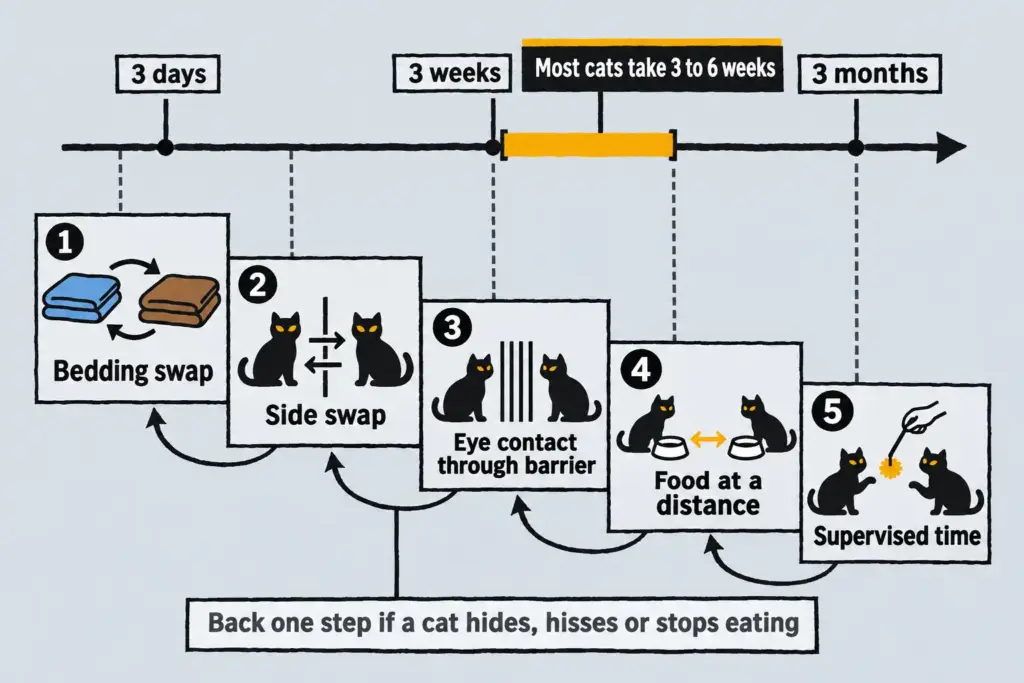
The slow introduction VCA repeats starts with bedding rotation for several days, then space swapping, where each cat uses the other’s side of the home, then visual contact through a tall gate, a mesh screen or a pen, with food on both sides, and only later the supervised introduction in the same room. Each step gets several days or more. A net or screen over an open doorway lets them see and smell each other without a solid slab between them. The first step, with where the swapped item should go and why the pair rule matters, is the one most often done badly, and the full sequence that starts the day after this article ends is in how to run the introduction stage by stage in a small apartment.
Feeding at a Distance That Closes a Foot at a Time
Feeding on opposite sides of the door begins with the bowls 6 to 10 feet back from the gate on each side, and they come one foot closer only after both cats have eaten calmly through a session. Distance turns one way. The pace belongs to whichever cat shows more stress, even when the other one shrugs the whole thing off and the resident does all the hissing.
Move a bowl closer only when both cats finished a calm meal in the session before. If one stops eating or backs away, return it to where it was and stay there until a session goes well.
A staged introduction usually runs three to six weeks and can take up to a year to settle, and VCA’s guidance allows for days, weeks or months. Whoever booked the weekend booked the wrong weekend. The calendar that results is explained in why the timeline depends on gates, not days, and “a week” is not a rule in it.
What Sends You Back a Step
Read the signs of stress off the cat in front of you instead of grading him against a list. Hiding, crouching low along the walls, avoiding contact, dilated pupils, hissing, growling, swatting, yowling beyond a soft meow, a puffed tail and ears turned back are all reasons to go back one step. Any one of them is enough.
If what changes is a habit (he stops eating, litter box avoidance, urine marking or spraying, hiding for days), that call goes to the vet, and the gate waits.
Sign the Exit Plan Before the Carrier Opens
The paperwork is the dull part, so it is the part that gets skipped. You sign the adoption without reading the return clause, and in week five you have nobody to call.
Read the Lease Before the Shelter Paperwork
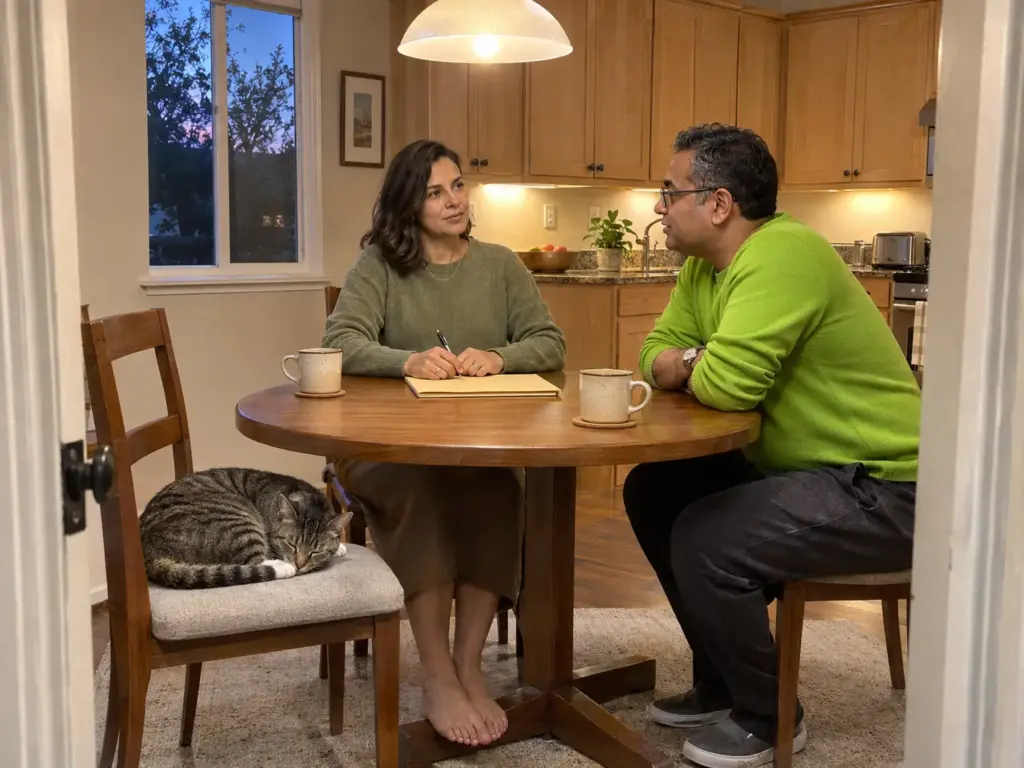
A lease or pet addendum can cap the number of pets or add a deposit for a second one, and finding out after adoption day leaves you choosing between the lease and the cat. Read it first and ask the landlord in writing, because a spoken yes does not survive a change of management. The tension-mounted gate and the plug-in diffuser leave no holes in the walls.
Foster First, and the Return Clause in Writing
Adopt a Pet’s guide to return policies puts the usual return window at two weeks to 30 days, and says most contracts carry a take-back clause, many of them for life. A trial adoption usually runs two to three weeks, and a foster-to-adopt trial of up to two weeks is common. Ask the shelter for all of it in writing, because a promise you cannot show later does nothing.
Who Takes the Cat If It Fails
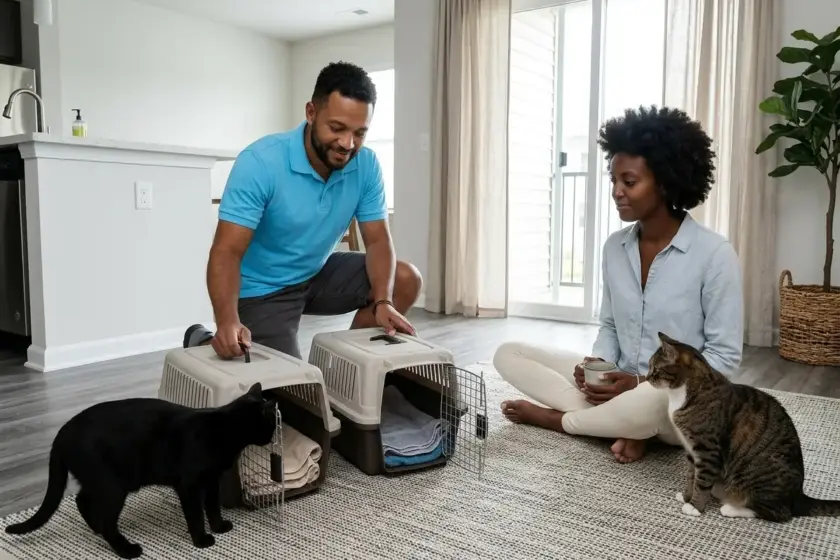
Decide before the carrier opens who takes the cat if the introduction fails, whether that is the shelter’s return clause or a plan to rehome him, and where he waits meanwhile; the base camp is the obvious answer. When an introduction fails, the resident stays. In a five-year shelter analysis, 21.5 percent of animals came back over incompatibility with pets already in the home, one return in five, and the plan exists so that the resident’s vote can be absorbed without a crisis.
Week Three Is Not the Verdict
Adopt a Pet, citing ASPCA Pro, describes decompression as the 3-3-3 rule, three days to settle, three weeks to learn the routine and three months to feel at home. Week three is the middle of the first act. Two weeks is the shortest honest test of whether this works, and three months the shortest honest test of whether it has settled.
What reads as not working: the resident has not returned to his baseline sheet after weeks of steps backward, the steps keep going backward instead of forward, or either cat has changed a habit. That last one goes to the vet first and a behavior specialist next, before any decision about the pair. the signs an introduction is failing between sessions separates week three from a real failure, and if the resident keeps giving up rooms and does not recover, what to do when cats fight and there is no second room is the plan for that case.
Do the Free Work a Week Before You Adopt Anything
The apartment gets ready before the cat does. The baseline page and the vet appointment go first; the stations and the base camp room follow, chosen by the resident’s route; and the gate and the signed exit plan are in place before the carrier opens. Every one of those decisions is about what your cat keeps, because he is the one who gives up the most.
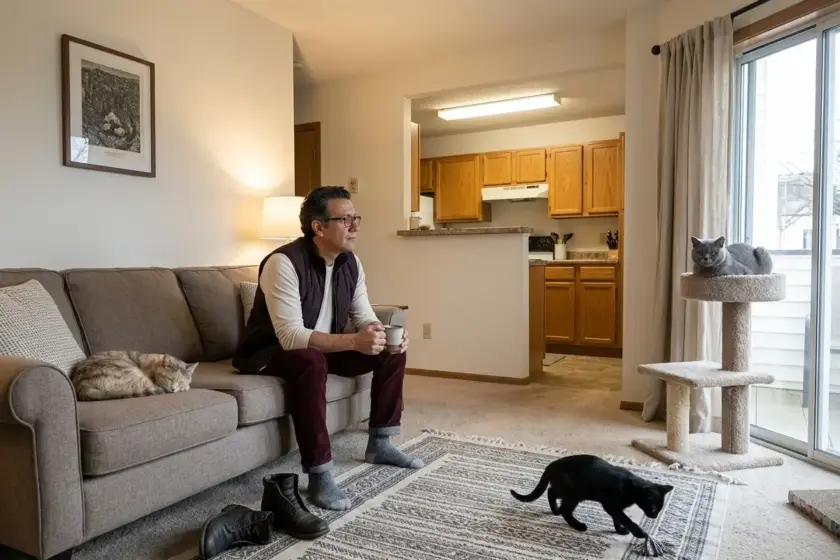
The check for later is plain: after a few days with the gate up and the base camp ready, is he still using his own box and his own spots along his usual routes? Hold the sheet against him at day three, again at week three, and at the three-month mark only if the pair has settled. A line that has moved sends you back to the stations before you take another step forward.
Tonight, write down his weight, where he sleeps and what he eats, and carry one bowl to another room. Both are free, and both do more for the second cat’s chances than any purchase on this page.
Frequently Asked Questions
01Are cats happier with a second cat?
Not always, because it depends on the cat already living there, and some adult cats never accept another adult even when the introduction is handled with great care. A single cat with play, a high spot and your time lives well. If he changes habits overnight, call the vet before you shop.
02What should I consider before getting a second cat?
Start with health and the apartment: a written baseline for your cat, the newcomer’s vet visit before they meet, and a room your cat can afford to lose. Then add three litter boxes for two cats, a barrier in the doorway and a signed exit plan.
03How do I tell if my cat will accept a new cat?
You cannot know in advance, but you can check his history with other cats and how he reacts to an unfamiliar cat seen through a window. Any change of habit goes to the vet. The rest shows during the staged introduction.
04Will two cats eventually get along?
Many do and some do not, and there is no date: a staged introduction usually takes three to six weeks and can need up to a year. That is why the exit plan is signed first and each week is compared to the baseline sheet.
Leave a comment