Why Three Cats in an Apartment Work Until One Pair Doesn’t
Don't count square feet for three cats in an apartment. Count exits, four litter boxes and the weakest of the three pairs (+ your lease).

Alfredo RamsesFounder · November 10, 2026 · 21 min read

On this page10 sections
- 1Three Cats in an Apartment Is Not a Square-Footage Question
- 2When the Apartment Seems to Answer Back, Sort the Signs First
- 3Three Cats Means Three Pairs, and One of Them Sets the Weather
- 4The Fourth Box Is a Floor-Plan Question, Not a Shopping One
- 5Three Feeding Points and Water That Isn't Next to Any of Them
- 6Paired Perches Beat One Tall Tree
- 7What Three Cats Cost in Scooping, and What a Machine Changes
- 8What Your Lease and Your Building Say About Three
- 9Start by Moving One Station and Watching Who Gives Way
- 10Frequently Asked Questions
Picture the apartment on an ordinary morning: one cat on top of the refrigerator, one under the bed, and the third planted in the doorway of a room the other two have stopped using. Nobody has fought. The cat in the doorway is describing a route that does not exist, and the layout lost, not the cat. The AAFP and ISFM environmental guidelines and the AAHA/AAFP litter box rule both count in cats, not in square feet, and that is the count this guide applies to three cats in an apartment: where the floor-space rules break, which signs belong to the layout, the three relationships, the fourth litter box, food, perches, and what your lease has to say about all of it.
Quick Answer
Three cats fit in an apartment when the weakest of the three pairs has somewhere to go. Two cats are one relationship; three are three. Spread boxes, food and perches so no cat must pass another to reach them. A sudden change in habit is a call to the vet before any furniture moves.
Three Cats in an Apartment Is Not a Square-Footage Question
A third cat does not become too many at some number of square feet, and the hunt for that number is where most of the confusion starts. What a home can carry gets settled by counting stations, and the full station count for a multi-cat household lays out that audit for any household. This guide keeps to the number that only appears at three: the point where no cat has a single partner to fall back on.
The Two Rules of Thumb That Disagree by Eleven Times
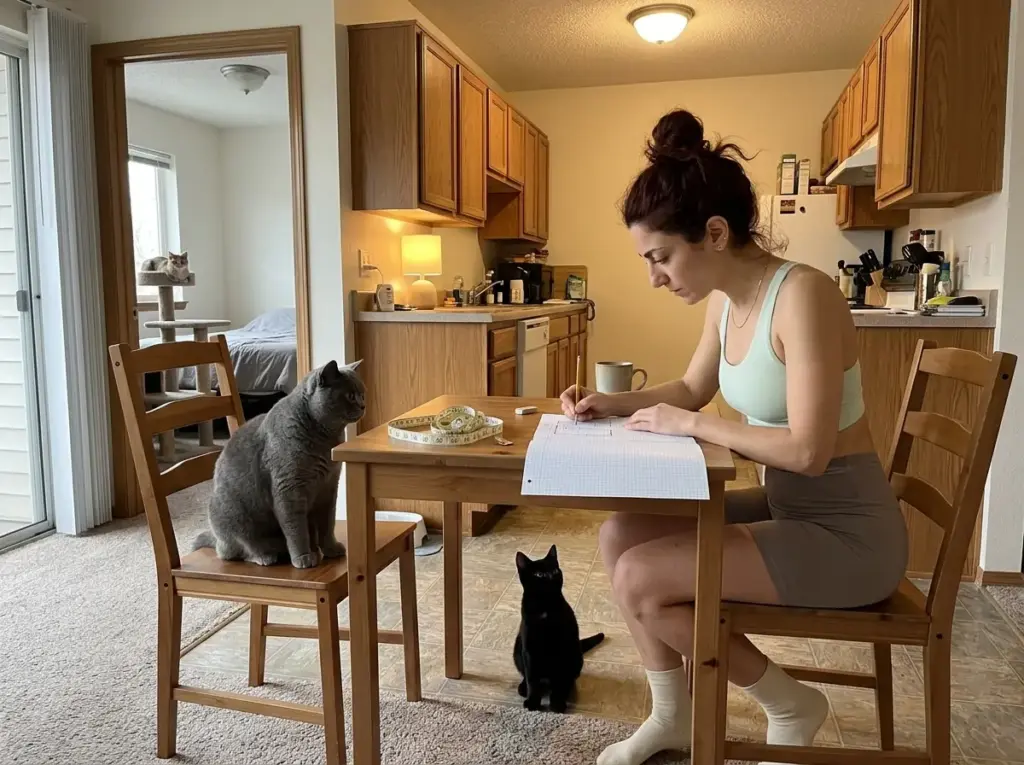
One rule gives each cat 18 square feet of territory. Another asks for 200 square feet for the first cat and about 100 for every cat after that. At one cat the two sit eleven times apart, 18 against 200, and at three they are still about seven times apart, roughly 54 square feet against 400. Whichever one you trust, you still do not know where the fourth litter box goes or which cat is losing the hallway.
Neither figure can be walked. You cannot stand in your living room and see 18 square feet of territory, and 200 does not tell you whether the hall between the bedroom and the kitchen is a corridor or a trap. A rule you cannot check against your own floor cannot settle anything, and the argument over it never ends.
Why Floor Feet Are a Human Number and Exits Are a Cat’s
Square feet measure what the person is paying for. A cat measures exits, loops and sightlines: how many escape routes a room has, whether he can circle through two doors and come back without passing another cat, and which cats can see each other from where they sit. A big room with a single door is a trap for whoever is inside when someone else takes the doorway, and a studio apartment is that room with a bed in it, while a small apartment with a loop through bedroom, hall and living room gives three cats a way to stay out of each other’s path. Territory in a small apartment measured in exits walks that measurement room by room.
What “It’s Fine” Is Really Counting
Households with 3 cats are doing well in apartments of about 550 square feet and in homes of about 1,400, and a claim that stretches that far has answered nothing. What separates the households is routine: frequent cleaning, more toys than seems reasonable, and a station for every cat. “Three is my limit” is always one household’s ceiling, set by its own routine, and never a rule that carries over to yours.
The verdict, then, costs a paragraph. Three cats can live well in a small apartment and badly in a large one, and what decides it is whether the weakest of the three pairs has somewhere to go. Everything below measures that.
When the Apartment Seems to Answer Back, Sort the Signs First
Some of what a cat does in a crowded apartment is the layout talking, and some of it belongs to a vet. Sorting the two comes first, and it takes no diagnosis.
The Signs That Belong to the Layout
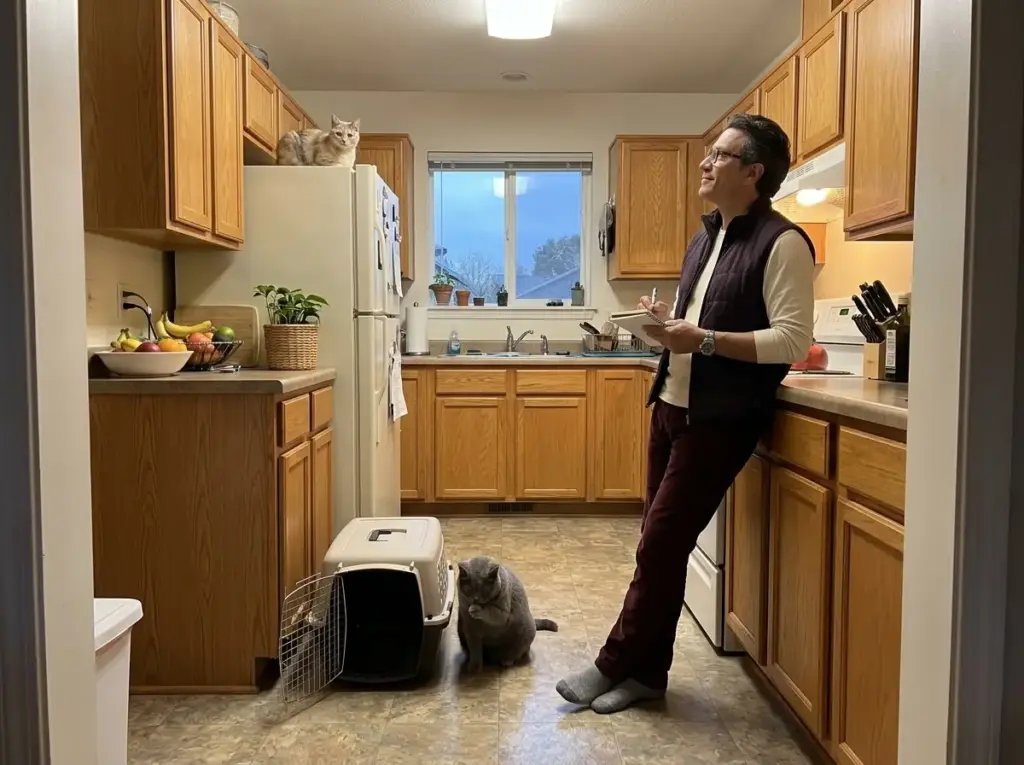
A staring contest in the hallway. A cat that has stopped crossing the living room when anyone is in it. One that always eats last or waits until another cat leaves the kitchen, one that spends the day anywhere but the shared room, a doorway that is always occupied by the same cat, and a traffic jam at the one door everyone needs. Each of these is a route, a station or a perch that is missing, which makes it something you can fix by moving furniture.
Start with a week of notes, since they cost nothing: who eats first, who yields at a door, who has stopped passing through. A log kept the way seven days of notes that separate play from the real thing describes it tells a trio that is settling from one that is not, and it makes every later move of a bowl or a tree easier to judge.
A Change in Habit Is a Phone Call Before a Furniture Move
Some signs belong to neither list, and no layout fixes them: a cat licking until skin shows (over-grooming), hiding for days, a lasting change in how he eats, drinks or uses the box, urine outside it, an ammonia smell that appears out of nowhere. Those get a call to the vet, whatever you suspect is behind them, and the furniture stays put until that call is made.
The question that splits the two lists is short: did the cat change overnight, or did the apartment? If the cat changed, call. If the apartment is the same and a route or a station has become a bottleneck, it is the layout’s to fix. When the answer is that nothing changed and the trouble began anyway, when cats start fighting more and nothing seems to have changed covers that case, and its first step is the same call.
Three Cats Means Three Pairs, and One of Them Sets the Weather
One Pair at Two, Three Pairs at Three
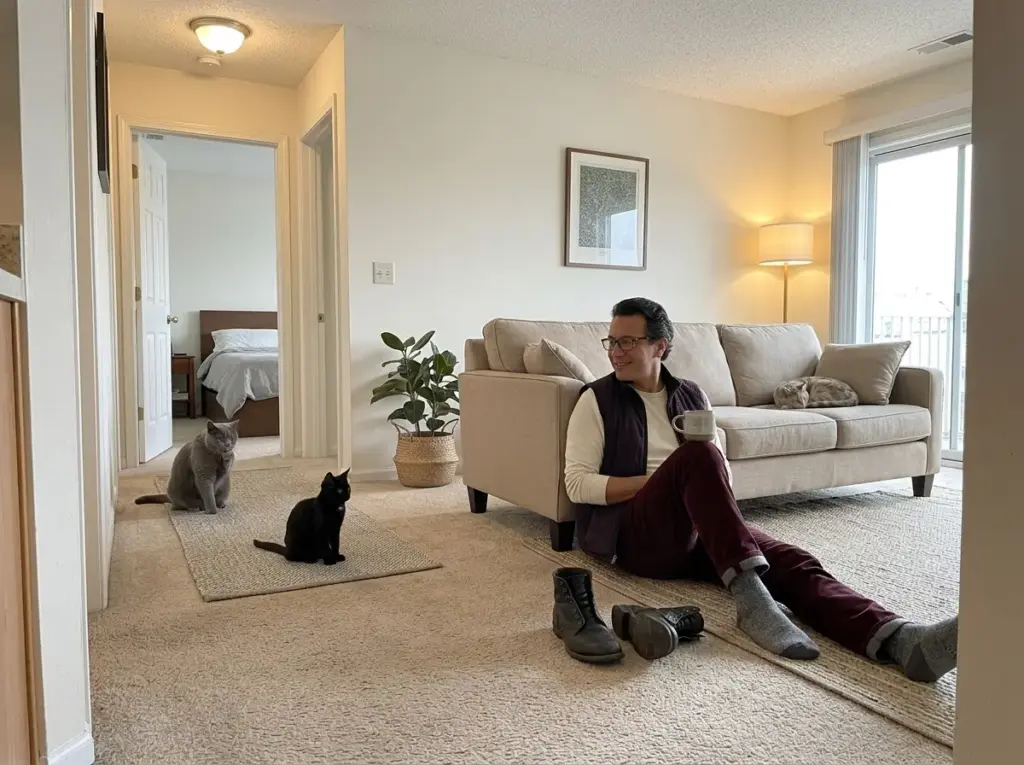
Two cats are one relationship. Three cats are three: A with B, B with C, and A with C. Two of them can drift into an alliance and leave the odd cat out.
In the review of how cats organize themselves into social groups, Crowell-Davis, Curtis and Knowles write that “certain cats fail to form strong affiliative relationships with certain other cats.” At three, that sentence stops being general and becomes arithmetic, because the trio does not need three good pairs; it needs the weakest one to be tolerable.
Most trios begin as a second-cat decision that was followed by a third, so the odds of that weakest pair start with how well the first two cats read each other. Reading the cat you already have before a second one arrives covers that reading, and it is worth doing again before a third.
How the Weakest Pair Shows: the Doorway, the Dish, the Perch
The weakest pair rarely shows as a fight. It shows as one cat blocking the doorway while another will not cross it, a dish somebody waits beside until the eater leaves, a perch that changed hands without a sound, and a cat who no longer walks through the living room when people are there. Rooms the cat on the losing end of a one-sided pair stops entering maps those avoided rooms, and each one is a room the apartment has quietly subtracted for one of the three.
A cat’s size does not decide compatibility. A large cat, a medium one and a small one can share an apartment, whatever the advice to match cats by size and build, because what counts is whether the pair that needs to avoid each other has somewhere to do it.
For seven days, write down three things for each cat: who eats first, who yields at a doorway, and who no longer crosses the living room when someone is in it. Then read the three sets of notes together, because the pair that is not friendly shows up in the gaps between them.
Why the Oldest Cat Keeps a Room and Not a Rung
When the oldest cat plays for a while and then walks to the bedroom and the tree that belongs to her, she is not rejecting the household. The peace of the apartment depends on her being able to do that whenever she wants, so a trio can rest on one room or one cat tree that is hers. Every cat wants a hiding spot and a lounging spot nobody else can take, and her bedroom is the quiet zone that does both jobs; it is the one thing to leave exactly where it is when everything else gets rearranged.
History matters too. A cat raised in a large house does not settle into a one-bedroom apartment on the same timetable as a cat who never knew anything else, and in a mixed trio it can be the youngest who struggles. That describes what the apartment is asking of each cat; it is not a forecast for yours. Before you move anything, let the notes show which pair is the weak one.
The Fourth Box Is a Floor-Plan Question, Not a Shopping One
Four litter boxes for three cats is the normal count, and in a one-bedroom apartment the count is rarely the problem. The trouble is where a fourth box can legally sit and whether the ones you have are long enough for the biggest cat.
Counting the Legal Spots in a Real Apartment
The veterinary guidance is plain. According to the AAHA/AAFP litter box guidance, “The rule of thumb is one litter box for each cat plus one additional box.” For three cats that makes four, the n+1 rule.
A version counted per social group exists for bonded cats who sleep in a pile, and a trio is rarely that. Where the litter box actually fits in a small apartment works through the candidate spots one room at a time.
A spot is legal when all five questions get a yes. Is it in a quiet zone? Does it have two ways out, so an ambush at the box has no corner to work with?
Is it away from the food and the water? Is it outside the one room you could never give up? Is it out of the corner that already holds another box?
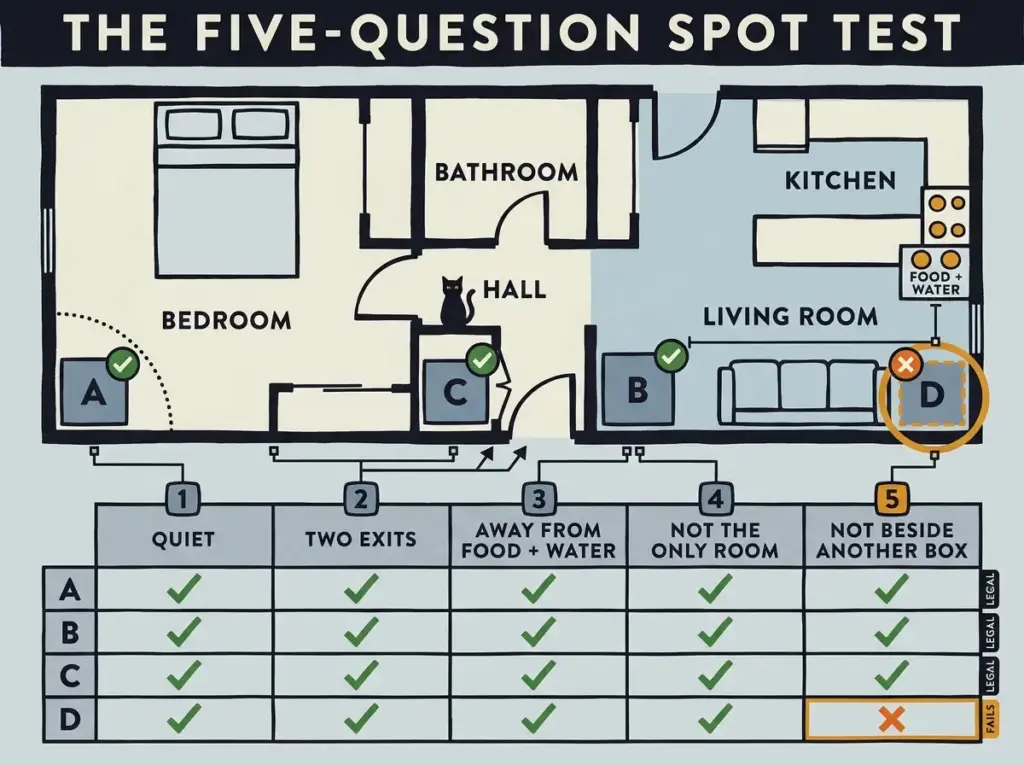
If the count stops at the third box, the apartment has answered you: the fourth box is not a purchase, it is another room. Four boxes in a one-bedroom tend to fail one of the five questions, most often the one about food and water, long before they fail on cost.
Measuring the Box Against the Biggest Cat
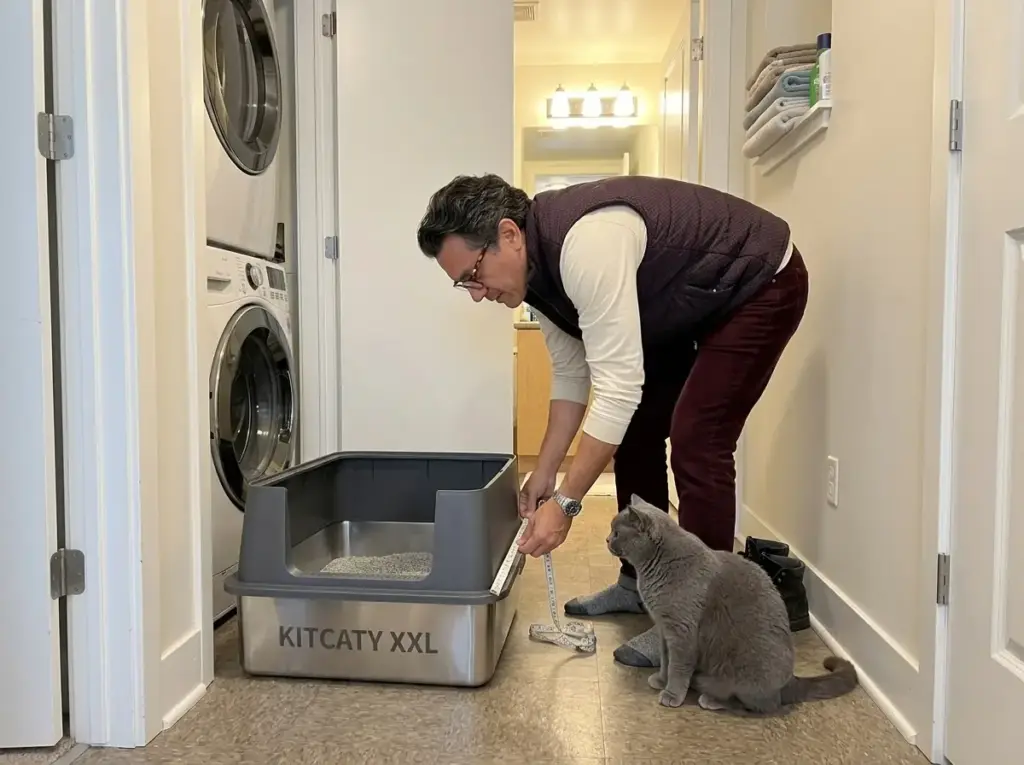
Put a tape measure on the floor beside the biggest cat and take his length, the distance from his nose to the base of his tail. The same AAHA/AAFP guidance asks for a box at least 1.5 times that length. A cat of 20 inches needs a bit over 30, and almost no pan sold as extra large gets there. The 1.5 times rule in inches for every size of cat turns the multiplication into a chart.
Lay the tape on the floor next to the cat, read nose to the base of the tail, and multiply by 1.5 before you look at a single product label. That number is the box length you are shopping for, and it will be longer than most of what the labels call large.
What the extra length buys is not a straight line. In a choice trial reported in the Journal of Veterinary Medical Science (Iwabuchi-Inoue and colleagues, 2025), cats used a box of about 15.7 inches 16.9 percent of the time and one of about 19.7 inches 35.5 percent of the time. A box of about 23.6 inches added nothing, at 35.9 percent. Going from small to large paid off; going from large to enormous did not, which fits a rule built on the cat rather than the label: the box has to fit the cat, and length beyond that fit is floor given up for nothing.
The free version comes first. A plastic storage box of 24 × 48 × 13 inches with the lid left off clears the 1.5 times rule for any cat up to 32 inches, and it is the cheapest way to pass the rule. Its 13-inch walls make it a high-sided box, a climb for an old cat, which matters in a moment.
If you would rather buy a pan, the KITCATY XXL measures 28 × 20 × 12 inches in 304 stainless steel. That clears the rule for a cat up to about 18 inches from nose to tail base and falls two inches short for a 20-inch cat. Steel is non-porous, so it holds less smell than plastic, and in a small air volume that counts. Durability is where it is mixed: scratches along the bottom are where the wear shows.
The oldest cat in a trio, once she is a senior cat, is the one most likely to find a foot of wall a climb, and a box sized for the biggest cat can read as a barrier to her. The KittyGoHere Senior is 20 × 20 × 5 inches with a 3-inch entry, the pan to get for access when the oldest or the smallest cat needs it, because a box that fits one cat in a trio seldom fits all three. Its low walls give less protection against litter spreading, so expect some on the floor around it.
The Honest Counter-Case: One Big Box, Scooped Often
The count is not magic. One large box with scooping three times a day has carried a trio whose cats got along, and it works for two reasons: somebody is home to scoop at those hours, and nobody in the trio needs to avoid anybody at the box.
It also explains a failure that looks like a count problem and is really a size problem. The biggest male cannot turn in a small pan, soaks the outside of it, and the pan leaves the apartment; the trio ends up sharing the one large box that is left.
The reverse holds too. A trio that does not get along is not saved by a fourth box. If the weak cat cannot reach any box without passing the strongest one, another box in the same hallway changes nothing, and the better move is a box in a neutral zone, a different room none of the three claims, with a second way in.
Three Feeding Points and Water That Isn’t Next to Any of Them
Three Feeding Points Out of Each Other’s Sight
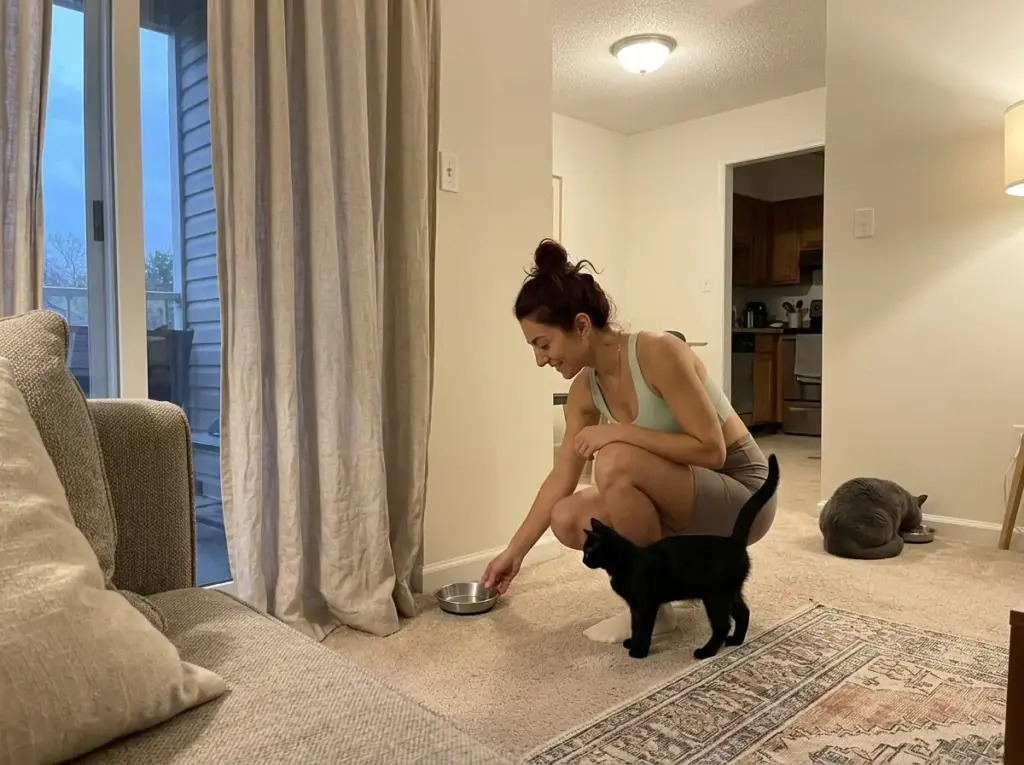
Picture three bowls in a neat row on the kitchen floor. One cat hovers over the others in what is called resource guarding, one gulps, and the third walks away after two bites, and it is easy to decide the third cat is fussy. He is under feeding pressure, and the row of bowls is the reason. Counting finished meals for a week when one cat guards the bowl shows whether the walking away is a pattern.
The AAFP and ISFM guidance puts each resource in its own location, separate from the others, so individual cats can avoid seeing each other.
For three cats that means separate feeding areas, not three bowls in one. Three bowls in a row are one feeding point seen from three angles. The sightline is the resource, not the distance: a corner between two bowls beats six feet of open floor in the same view. Why a spare resource fails the two-question sightline check gives the test.
Start with free moves. Carry a bowl you already have into a different corner, and serve wet food in two or three rounds instead of one, with dry food left out, so fewer meals happen with all three cats at the table at once.
When the third station needs a dish, the WROSWT 2-Pack in 304 steel measures 5.9 × 5.9 × 1.18 inches and holds 13 ounces each. The dishes are shallow for whiskers, heavy enough not to travel, and there are two in a pack, so the third station is one order. The limit is size: a 5.9-inch dish holds a can of wet food, not a big cat’s full meal.
Move one feeding station to a different corner and leave everything else alone for a week. Note which cat reaches a bowl first and which one walks away early; that order tells you more about the trio than any amount of guessing.
Water Away From the Food, and What Three Cats Drink
Cornell’s Feline Health Center on hydration puts a cat’s daily water at about 4 ounces for every 5 pounds of lean weight, which makes a 10-pound cat about one cup. Three average cats come to roughly 24 ounces a day. The water station goes away from the food, and not into the corner that holds a litter box.
A ceramic bowl rinsed and refilled every day is the free answer, and for many trios it is enough. A fountain earns its place when one bowl cannot serve three, and the PetSafe Drinkwell Stainless 360 holds 128 ounces with one to five streams, more than five days of water for three cats. Capacity is never its limit. Washing is: how much work that is swings from easy to a chore, and a fountain nobody scrubs is worse than a bowl rinsed daily.
When Separating Is Physically Impossible
Some apartments do not have three places out of each other’s sight. When that is the case, separate the stations by time-sharing instead of space: one cat eats while another is out of the room or behind a door, on a schedule you set. For the cat that waits behind a shared bowl until the others finish, a microchip feeder for when one cat waits behind the lid is the way out.
Paired Perches Beat One Tall Tree

Why One Tall Tree Is One Contested Spot
Imagine buying one very tall tree for the trio and watching the top level run on a turn system. Vertical space only counts in places, and a cat tree with three levels is not three places to rest: the top is one place, and it has a queue below it.
The count is in the AAFP’s environmental needs guidelines: at least as many safe places, each sized to hold a single cat, as there are cats in the household. In a home with several cats each safe place should have more than one entry, so another cat cannot easily block the way in. A shelf with a single route up turns into a dead end the moment somebody sits at the bottom of it.
Width, Spacing and Two Ways On and Off
A platform for an adult cat runs about 12 × 18 inches, and a large breed wants 18 to 20 inches of width, according to the sizing guide from Cita Interior. For a run of wall shelves, Catastrophic Creations spaces the steps 12 to 18 inches apart vertically and 12 to 16 inches apart horizontally for adult cats.
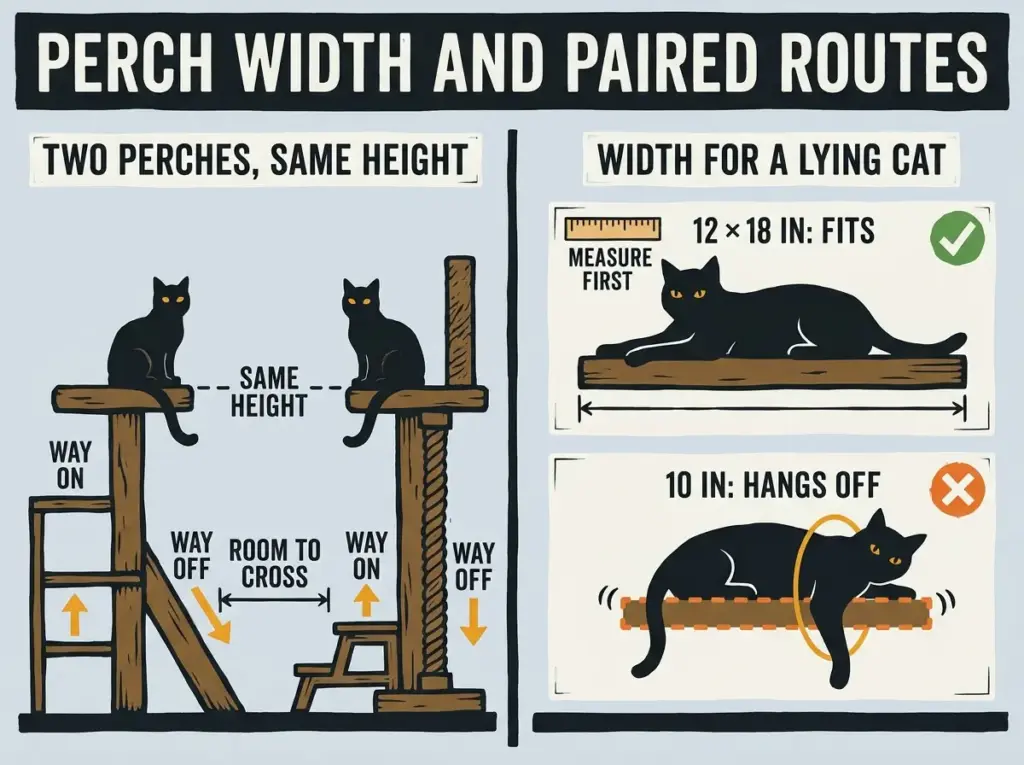
Hold a ruler beside the cat while he lies down. A 10-inch perch leaves a 16-pound cat hanging over both edges, so he slides off and stops using it.
Take the ruler to the cat while he is lying down, not standing, and hold it against the platform you are considering. If any part of him hangs over an edge, the perch is too small for him whatever the label says.
Pairs of perches beat thrones: two perches at the same height, each with two ways on and off, and a run of shelves long enough for two cats to pass each other. The free move is to carry the cat tree you already have to another wall, or to give one cat a window perch, which adds vertical territory without using any floor.
Standing Trees for Renters, Two and Two
If you cannot drill, the pairs go on the floor: cat trees split between the living area and the bedroom, two and two. The oldest cat’s tree belongs in the bedroom, because her having it there is what keeps the peace. A small footprint is the point, since it fits into a corner.
The Yaheetech 54 inch measures 19.5 × 19.5 × 51 inches, and two of them beat one taller tower: two platforms at the same height, two ways up, and a footprint that fits a bedroom corner. Stability is its weakness. The tower wobbles even when secured to a wall, and the hanging ball works loose, so push it with your hand before the heaviest cat tries it and keep that cat’s perch on something that does not move.
What Three Cats Cost in Scooping, and What a Machine Changes

Scooping at Three and the Odor in a Small Air Volume
Smell builds faster where there is less air to dilute it, and an apartment with three cats has very little. A trio notices a missed scoop sooner than a pair would, and the jump from two cats to three is felt in the box before anywhere else, because the amount to scoop climbs with every cat. An apartment that stands empty all day makes it harder, since nothing gets scooped for hours; the litter arithmetic when the apartment is empty all day sets out those hours.
The free fix comes first: scooping three times a day, on a clock, in a box that does not hold smell. A trio on one big box and that routine has held, provided somebody is home to do it.
What a Self-Cleaning Box Fixes and What It Doesn’t
An automatic litter box fixes one thing, the frequency of scooping. The Whisker Litter-Robot 4 measures 27 × 24.25 × 29.5 inches with a 24 × 24 inch footprint on the floor, so it takes real space, and it costs more than almost any other automatic box. One waste drawer for three cats cuts the interval between emptyings roughly in half, and where an automatic box breaks for three cats walks through those intervals and why the fourth box survives the machine.
What it does not fix is a weak pair. If a cat cannot reach the box without passing the strongest cat in the house, the machine does not change the floor plan. It does not change the tape measure either: the biggest cat still needs a box 1.5 times his length, and the fourth box of the count stays on the list.
The Free Version Is a Schedule
Three fixed scoop times a day does for a trio what the machine does for the cadence, as long as somebody is there to do it. How often to scoop a litter box for each cat turns it into a count per cat per day, which makes the schedule something you can plan around.
Pick three fixed scoop times and tie each to something that already happens every day, such as the first coffee or locking up for the night, so the schedule never depends on remembering.
What Your Lease and Your Building Say About Three
The Pet Addendum and the Building’s Limit
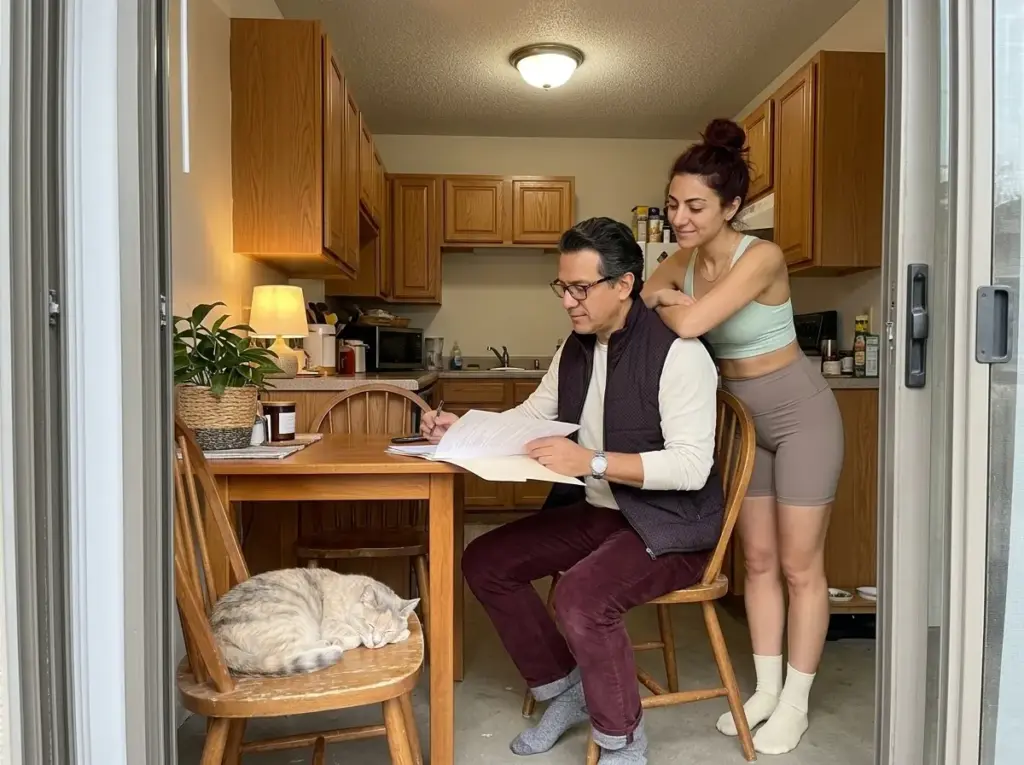
The limit on how many cats you may keep often comes from the building and the city, not from the cat: the pet addendum, the building’s pet limit, and sometimes a local ordinance. All three sit in documents you can read today, so read them before the third cat is chosen, not after. A trio that is making it work can still end the day the lease does, which makes the lease the clock in many apartments. If yours asks for notice, give it before the third cat arrives.
Renting With Three: What Goes on the Floor and Not the Wall
Everything in this guide is a no-drill setup, with no hole in the wall: floor trees, floor boxes, bowls moved between corners. That is the version of the advice that assumes you cannot drill, and in a rental you cannot. When a pair does fall out and there is no second room, the split is a door or a timetable, and how to stop cats fighting when there is no second room covers both.
Start by Moving One Station and Watching Who Gives Way
Three cats fit in an apartment when the weakest of the three pairs has somewhere to go, and floor area does not tell you that. The fourth litter box is a question for the floor plan before it is a purchase, food points are separated by sightline, and perches go in pairs with two ways on and off. Your lease sets the ceiling over all of it.
Leave the moved station alone for a week, then look at who eats first and who crosses the living room. If the order shifted, move the next station and watch again; if nothing changed after another week, put it back and try a different one. Boxes, perches and a fountain can wait until the notes say which pair is the weak one.
Today, move one thing: a bowl to another corner, or the tree you already have to a different wall, and write down which cat goes to it first. And if a cat’s routine breaks overnight, or one starts licking down to bare skin, call the vet before you touch any furniture at all.
Frequently Asked Questions
01Is three cats in an apartment too many?
There is no universal number: three cats can live well in a small apartment and badly in a large one, depending on whether the weakest pair has somewhere to go. The two square-footage rules that circulate sit seven to eleven times apart, and neither can be walked. A cat whose habits change overnight goes to the vet first.
02What is the rule of three with cats?
No rule of three sets how many cats fit in a home; the real counts are one litter box per cat plus one, and a safe place for every cat. So three cats means four boxes. The 3-3-3 rule is a separate idea: it describes how long a newly adopted cat takes to settle in.
03What are the benefits of having three cats?
Three cats give each other company and a playmate when one of the others declines, but they also bring three relationships to look after instead of one, and not all of them will be good. A trio that works usually has a station for every cat and a place each can retreat to.
04How many cats can you have in an apartment?
Your lease, your building and your city set the limit before the cat does, through the pet addendum, the building’s cap and sometimes a local ordinance. Check them before you adopt. After that the apartment decides in stations, not square feet: boxes, food points and perches for each cat.
05Is having three cats harder than two?
Yes: with two cats there is one relationship, with three there are three, and the weakest pair decides how the apartment feels. It also means four boxes, three food stations, more perches and more scooping. A routine that breaks overnight is the vet’s to look at before the furniture is.
Leave a comment