Do Bonded Cats Miss Each Other? It Depends How Long Apart
Do bonded cats miss each other? A clinic night, a week, a rehoming and a loss each ask different things. Blanket, 4-number sheet + a clinic rule.

Alfredo RamsesFounder · November 17, 2026 · 21 min read

On this page10 sections
- 1What "Missing" Looks Like in an Apartment, and What It Is Measuring
- 2Where the Apartment Stops Answering and the Clinic Starts
- 3The Length of the Absence Changes the Answer
- 4A Two-Day Baseline, Written Down Before the Absence
- 5Scent Goes Missing First, and the Carrier Is Where It Goes
- 6What Helps at Home While It Lasts: Routine, Short Play and One Room of Calm
- 7The Pair That Does Not Miss Each Other, and Why That Is Not a Verdict
- 8One, Two or Three Cats, and Whether Another Cat Fixes It
- 9The Blanket, the Dinner Hour and a Blank Sheet Come First
- 10Frequently Asked Questions
The cat who stayed behind is walking the hallway, stopping at the end of the sofa where the other one slept and calling at the front door as if it might answer. Do bonded cats miss each other? They react, and the reaction has a shape: International Cat Care describes a loud, searching stage followed by a quiet one, with no set length for either.
What the cat is checking is the apartment, because the smell and the daily route that told him where his companion was have stopped adding up, and what he needs from you shifts with how long the absence runs. Below: what the reaction looks like, the point where it becomes a clinic call, what each length of absence asks of the house, and what to write down and set out before it starts.
Quick Answer
Yes, a bonded cat can react when the other is gone: calling, checking the old spots, sleeping where the other slept. What looks like missing is scent, routine and a warm cat at the end of the sofa, and how long it lasts follows the length of the absence. A cat who stops eating is a call to the clinic.
What “Missing” Looks Like in an Apartment, and What It Is Measuring
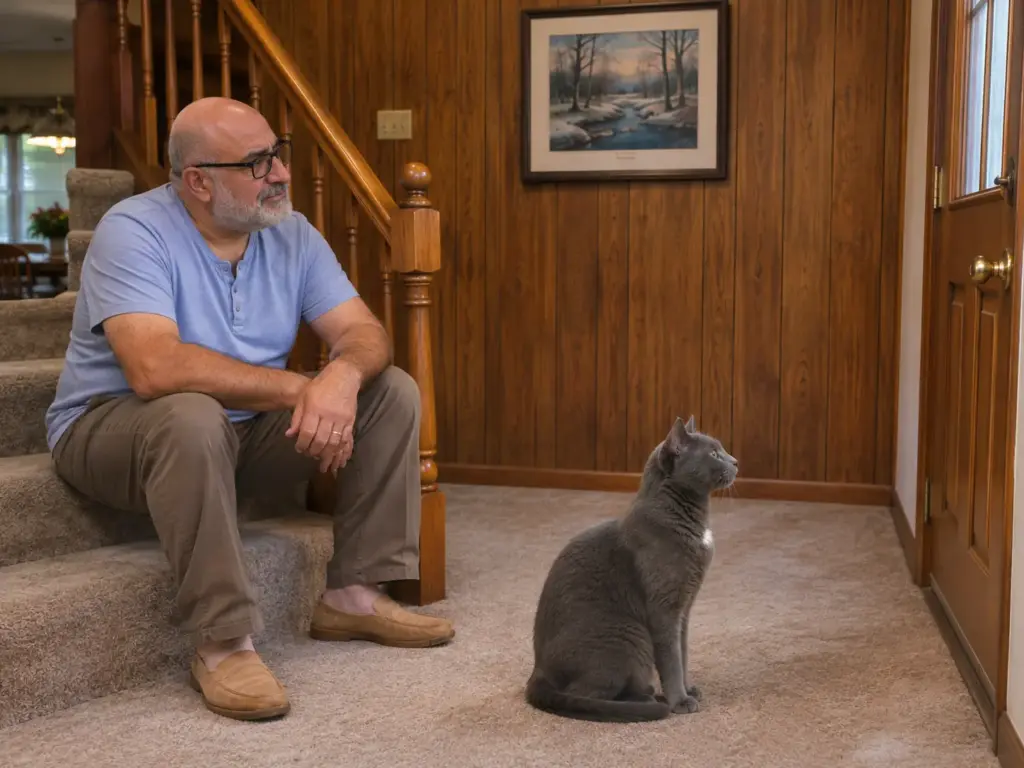
The hour the pair used to meet in the hallway comes around, and the cat who stayed walks it alone, calling into an apartment that does not call back. None of it is theater. He is checking, in order, the places where the other cat should be, and every one of them comes back empty.
The Search Round: the Door, the Spots and the Shadow
If you are still weighing whether yours is a real pair, how to tell whether two cats are a real bonded pair or just tolerating each other settles that first, and this page starts where that one stops. International Cat Care’s guidance on feline bereavement names the first stage after a loss as a vocal one, and its list of behaviors makes a fair checklist for any long absence, because a searching cat searches the same way whatever the reason. In a hallway it reads like this:
- Calling for the other cat at the door or down the hallway: he is testing the one route the other cat used to come back by.
- Walking the old round: the bed, the window shelf and the end of the sofa, in the same order each time, like stops on a line.
- Sniffing from room to room: he is mapping where the other cat’s smell is thinnest.
- Asking for more of you: the clinginess shows as following you from room to room and taking the lap he used to share.
- Sleeping in the other cat’s bed or spot: the cushion still holds a trace of the smell and the shape of the cat who slept there.
Later the picture can flip. The same cat goes quiet: he hides under the bed, shows little interest in play and sleeps less than he used to. That is the second stage of the same separation distress and not a relapse, and the response the guidance gives for both stages is the same: keep the household routine and stay available without forcing comfort on him. Offer your hand and let him decide whether to take it.
Jot down what he does at the hour the other cat usually turned up: the spot on the sofa, the door, the call. That one hour becomes the yardstick for the day, and it is far easier to compare than a general feeling that he seems off.
Scent, Route and a Warm Cat on the Next Cushion
“Missing” is a human word, and what the cat is tracking is more concrete. A cat recognizes his companion by smell, so the first thing to go is the familiar scent trail on the bed, the doorframes and the sofa arm. The second is the route: the order in which the two visited the window, the bowls and the bed. The last is the warm cat asleep at the other end of the sofa, who was part of how he slept.
Scent and route can be held in place with a blanket and a feeding hour. But the warmth is the piece nobody can fully replace, so expect a gap there for a while.
Cats do not show emotion as openly as people do, and International Cat Care notes that the signs tend to be subtle: withdrawing, going quiet. So you will rarely see drama. You will see a cat who stopped doing the thing he did at that hour, and a bowl still full at bedtime. Read it as a comparison with a normal day, never as a mood or a label like separation anxiety.
What Settling Looks Like When It Goes Well
A cat who is settling eats his meals, drinks, uses the box, plays a little and grooms himself as usual, and he starts sleeping in open spots again instead of under the bed. No single item means much, and the list is a score sheet more than a verdict. It feeds the written baseline further down, where each of these becomes a number you can compare.
Not every pair reacts alike, and the weight sits in how the two actually lived. International Cat Care points to how long the cats lived together and how much friendly behavior they shared: resting pressed together, grooming each other, touching noses, rubbing against each other. The pair who slept in one lump for years is the one to watch closely. Behavior researchers call the cats one cat habitually stays within three feet (one meter) of his preferred associates, and the pair who only shared a sofa are another case entirely, whatever the photos on your phone suggest.
Where the Apartment Stops Answering and the Clinic Starts
Everything else on this page is furniture, scent and routine. This part belongs to the clinic, and it comes early because it changes what you do with everything after it.
A Cat That Skips Meals Is a Phone Call, Not a Mood
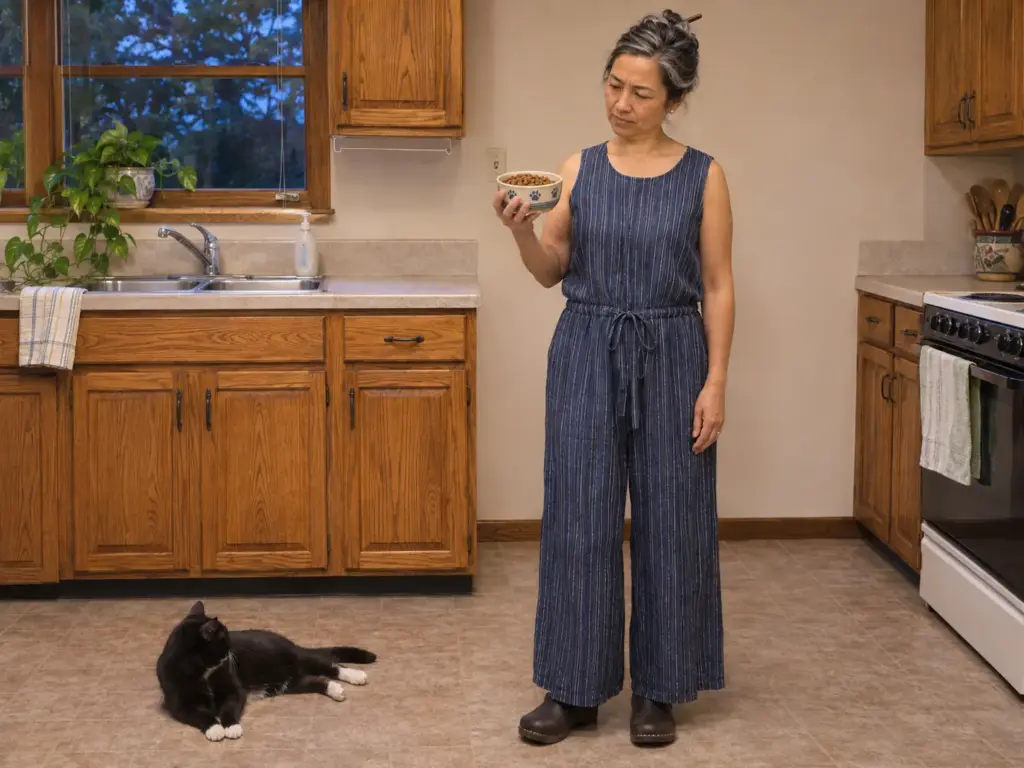
A cat who has stopped eating, or who shows any sign of illness, needs the veterinary team as soon as possible, and International Cat Care is explicit that such signs should not be assumed to be emotional. VCA’s guide to anorexia in cats says the same about appetite loss: a drop in appetite or in how much he eats is an outward sign that should be taken seriously. Appetite is the measurement, and “he is too sad to eat” is the sentence to stop saying out loud. How many days of skipped meals are too many is a number the clinic sets, so make the vet call and ask.
Hiding, Hissing or Grooming That Changes Overnight
Sudden hiding, or growling and hissing at the cat who is still in the house, goes to a veterinarian or a veterinary behaviorist before it goes to any change in the furniture. So do abrupt shifts in how he eats, grooms (or overgrooms) himself or uses the litter box. The signs of stress International Cat Care lists show up as patterns in those habits, and a pattern is something a clinic can read and a hallway cannot.
What the Apartment Can Still Handle
The scent, the routine, the rhythm of the absences and the place where each cat sleeps are the apartment’s to manage. A cat who stops eating, a cat whose habits flip from one day to the next and a scuffle that injures someone are not. Keep the clinic’s number where you can see it and the carrier assembled before anyone needs it. What follows is the part the house can do, and it starts after that call has been made, if the call was needed.
The Length of the Absence Changes the Answer
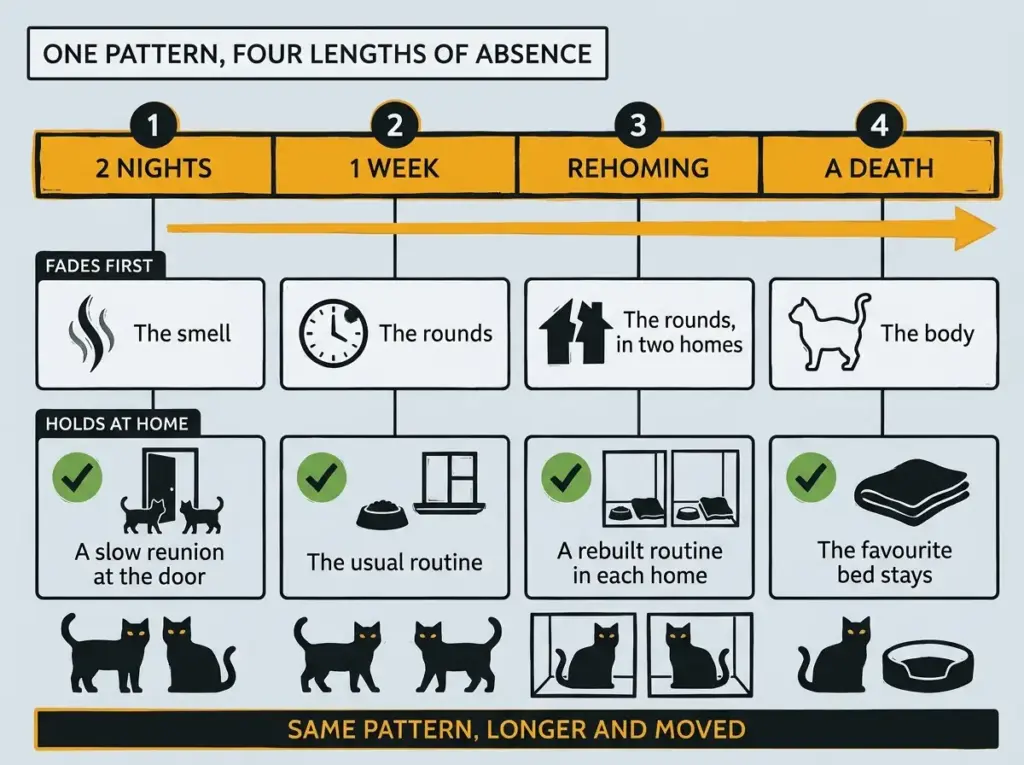
Most people want a number of days, and there is none to give. What exists is a length of absence and a smell that fades, and four lengths ask four different things of the house.
Two Nights at the Clinic: the Smell Is the Problem, Not the Grief
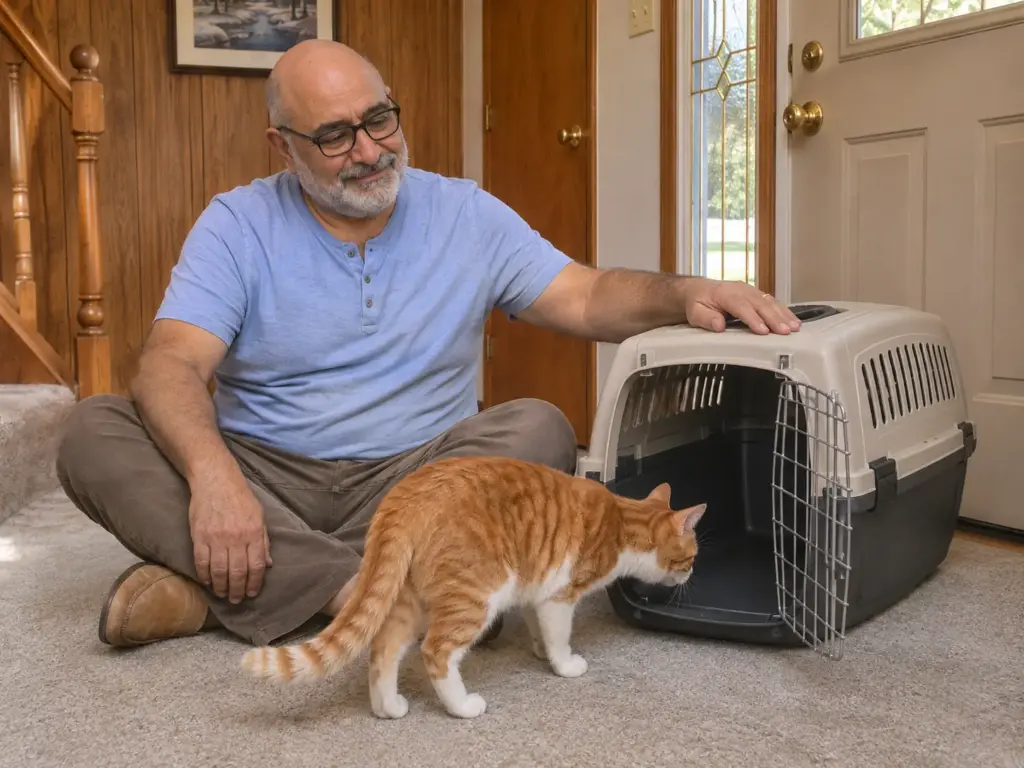
The cat who comes home after two nights at the clinic smells of the clinic. Disinfectant and other animals sit on his coat, and the cat who stayed may treat his own companion like a stranger at the front door. That is a smell problem measured in hours, and you will see it at the first meeting in the hallway, not in some later week.
A pair that lived together for years can start spitting at each other at the door after a trip like this, and why two cats that lived together for years start fighting after one has been out walks through that case. For now the useful part is that the cat who left and the cat who stayed are each correct about what they smell.
When the absence is one you can see coming, plan the reunion in the same breath as the departure: where the carrier will land in the hallway, which blanket goes down for each cat and who is in the room. The reunion is the first thing to look at, not the last.
A Week Away, or a Hospital Stay for a Person
In a temporary separation of seven days the scent is no longer the main issue, and the daily round takes over. If it is the cat who is away, or the person who normally runs the evenings, nobody does the usual feeding hour or sits down at the usual end of the sofa, and whoever steps in keeps different hours. The pattern is the same as with two nights, only longer, and the unwashed blanket earns its place. Put the schedule on paper for whoever covers: feeding hours, where each box sits, which door stays open.
A Rehoming or a Split That Stays
A permanent split is a different job, because the length is now “for good” and the round has to be rebuilt in two apartments instead of one. The trial, the base room and the blanket are laid out in how to split a bonded pair in hours, rooms and scent, and none of it is repeated here. What matters for this question is that both cats lose the whole shared map at once, so each needs its own routine and something that still smells of the other.
When One Cat Has Died, and There Is No Clock
After the loss of a companion, according to International Cat Care, “There’s no set period for grieving in cats.” Some pass through it in days, some skip the quiet stage, a few stay unsettled for several weeks or months, and some show no response at all. A quiet cat in week three is not behind schedule, and a cat who never changed is not cold.
One rule from the same guidance is worth following on the first day: do not remove the favorite bedding in a hurry. A scent that fades in steps tells the surviving cat the other one is no longer around, and a laundry load does that in one go. A bouncy young kitten is not usually a good stand-in for a long, predictable companion, which the last section of this page picks up. Two of these four lengths can be seen coming, a clinic night and a trip, and for those there is something to do beforehand.
A Two-Day Baseline, Written Down Before the Absence
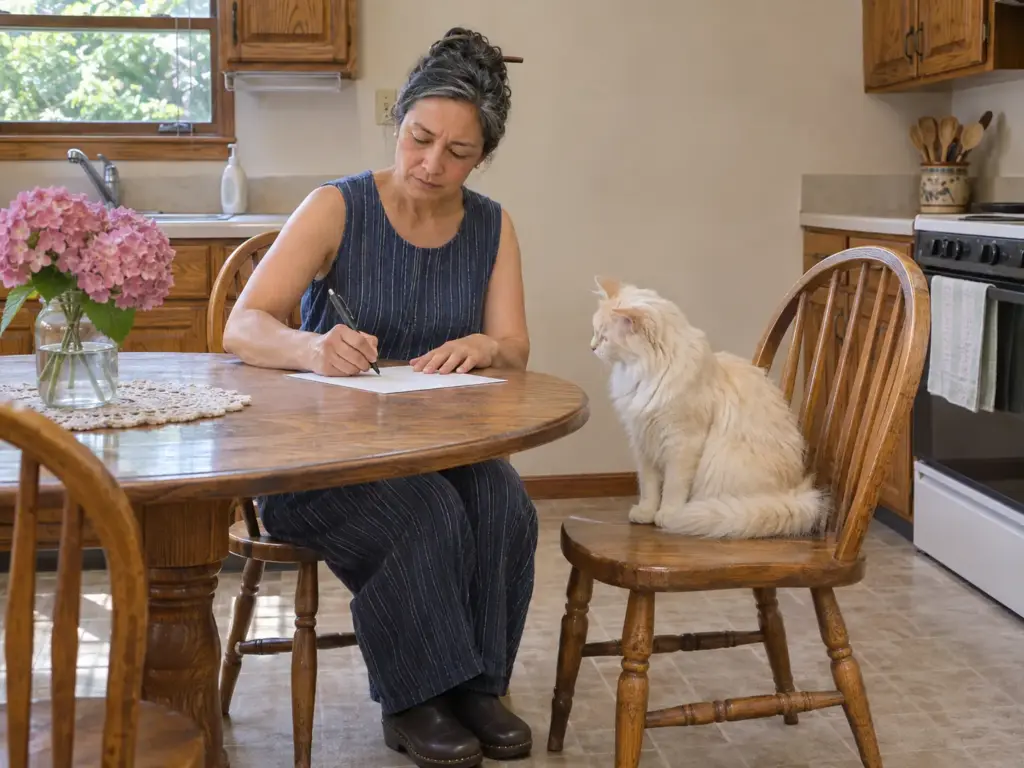
Everything above comes down to comparing a cat with himself, and for that you need his normal on paper before it moves.
The Four Numbers: Meals Finished, Open-Air Sleep, Play, Litter Visits
Take two days before the absence and, at the same hours each day, write down how many meals he finishes, how many hours he sleeps in plain view instead of hidden, how many minutes of play he accepts and how many times he visits the litter box. This is a household measurement and nothing more: it is not validated, it is not a diagnosis, and it simply turns “he’s not himself” into a subtraction.
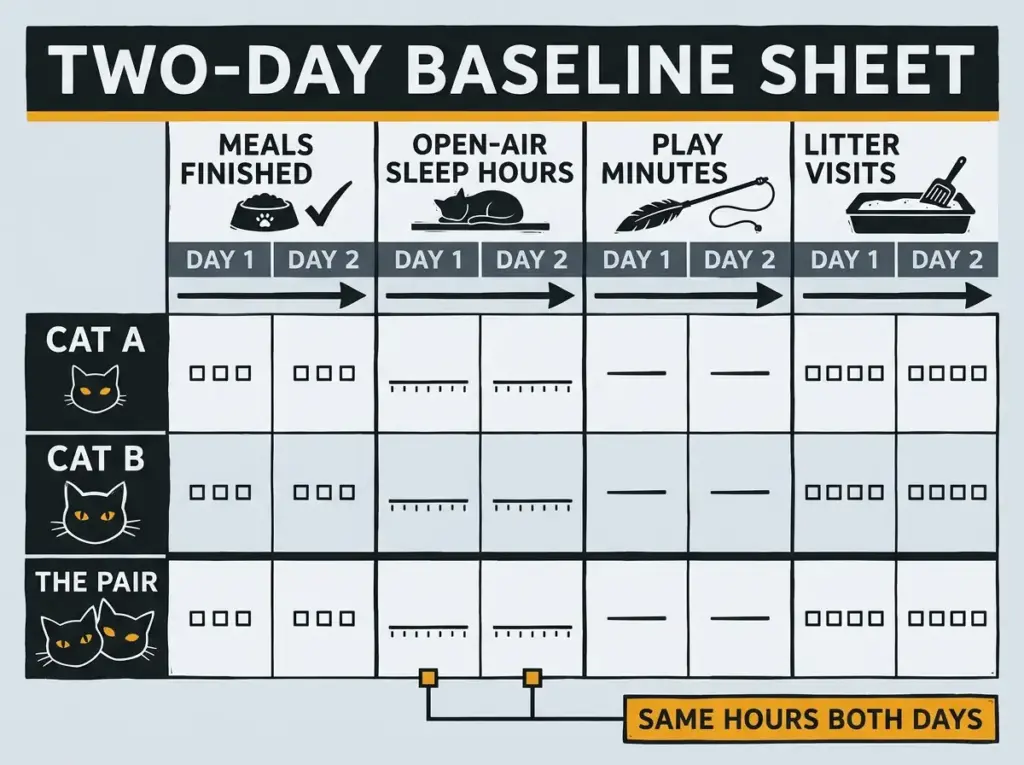
Write the clock time next to each meal. A sheet with real times beats a summary typed from memory, and a clinic can actually use it.
Reading the Sheet Afterwards, Without Reading the Cat’s Mind
Compare each column with its own baseline. The direction of the numbers matters more than any single day, and no number on the sheet says “normal”: the only normal that counts is his. A cat who finishes less than his baseline and leaves the evening meal half-eaten has moved the question to the clinic, as the earlier section said, and the sheet is what you take with you.
When the Absence Is Already Here and You Have No Baseline
Start today. Write last week from memory and mark it as an estimate, and trust the trend of the next two days more than the reconstructed past. A sheet with two columns per cat and one line for what changed in the apartment that day (a closed door, a visitor, a noise) is enough, and no chart is needed. With three cats the sheet grows to one per cat and a row for each pair, since the third cat changes the arithmetic of the whole house.
Scent Goes Missing First, and the Carrier Is Where It Goes
The most common mistake on the day the other cat is gone is cleaning. The sofa gets scrubbed so the apartment smells right, and the cat who stayed loses the only proof he had. The smell of a companion is not dirt. It is information.
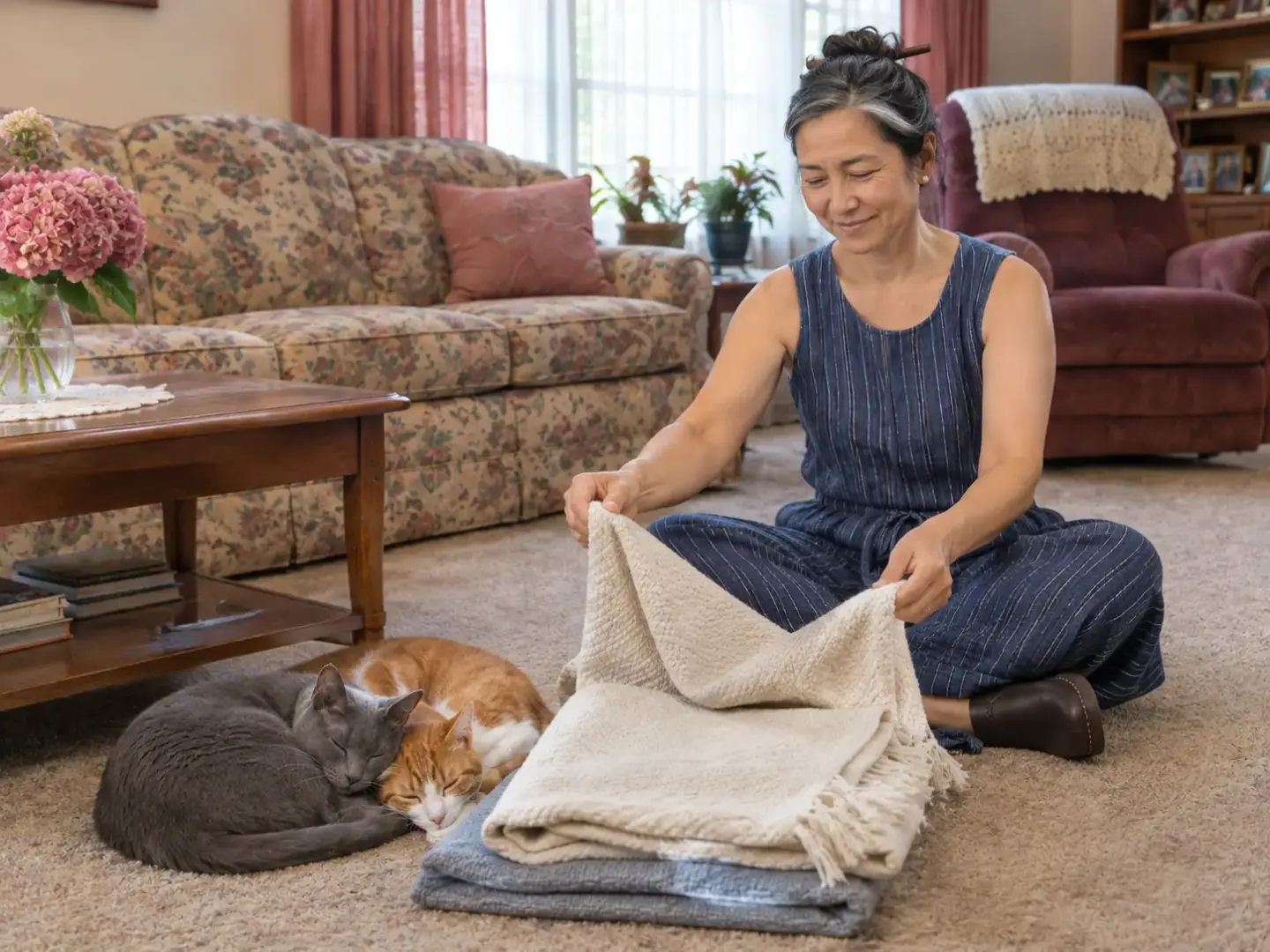
What the Unwashed Blanket Is Doing
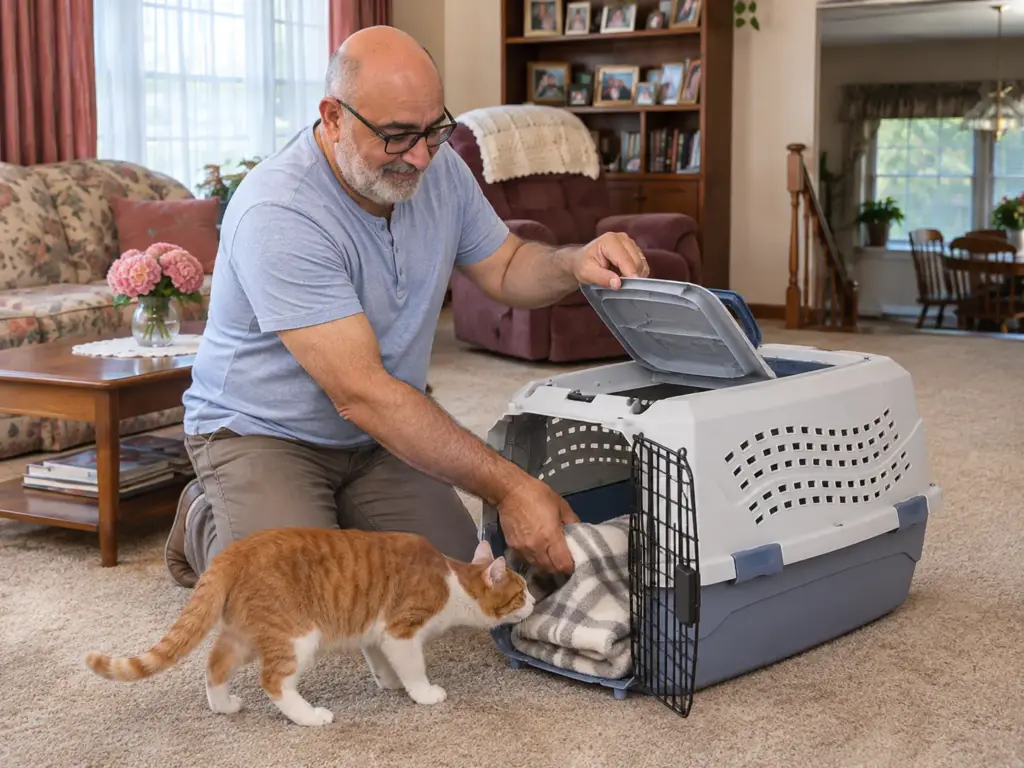
The free move comes first: leave the other cat’s blanket or bed unwashed and in plain sight. Keep it that way until the cat who stayed eats his meals, sleeps in the open and plays again; he sets that date, and a laundry timer does not. When both cats are alive and apart, swapping scent between them is a separate job with separate rules, and why swapping scents between two cats can backfire and where the item should go sets them out.
Hold the washing until he is eating, sleeping in the open and playing again, all three on the same day. Fold the blanket back into the laundry only after that.
One Rigid Carrier Per Cat, So the Clinic Smell Stays in the Box
A single soft bag or a single carrier shared on the way to the clinic puts both scents into the one object each cat will check afterward. At home a cardboard box with a blanket over it is the free version, and it works fine in the hallway but will not survive a car ride. For the trip itself, Amazon Basics Sturdy Portable 2-Door Top-Load Hard-Sided Pet Travel Carrier measures 22.8 x 15 x 13 in and is rated for cats of 12 to 20 lb, and one hard shell per cat keeps the clinic smell in its own box.
The top door lets you lift out a frightened cat without tipping the carrier. The top door can be stiff to open, and on some units the lid works loose, so work the latch before the appointment, not in the parking lot.
The MidWest Spree 22 inch is the more modest alternative, and carriers for two cats that will not sag or unzip compares the options.
The Reunion at the Door, and the Cat That Checks the Carrier
The cat who sniffs the carrier and walks past the bed is following the smell, and the smell left the apartment in a plastic box. Let him check it. At the door the cat who returns smells of the clinic and the cat who stayed may not know him, so settle it with blankets, not an open door: the returning cat lies on something that smells of home, and the cat who stayed gets the blanket the other one slept on, so the two scents meet on fabric before they meet nose to nose.
What Helps at Home While It Lasts: Routine, Short Play and One Room of Calm
Wanting to do something is how most people end up at a checkout before they have moved a single object. The first moves are free, and the diffuser everyone names first comes last here.
Hold the Routine, and Offer a Hand Instead of Picking Him Up
Keep the feeding schedule (the same hour, the same bowl), keep the litter box where it stood and keep the window where he watches the street. International Cat Care puts it plainly: predictability matters at any time and more so after a loss, and the way to be there is to be available without forcing comfort. The hand held out is that, and the arms around a surprised cat are not.
A loss also turns the box, the bowl and the window shelf into a one-cat negotiation, so count them. The one per cat plus one figure everyone quotes assumes the spares are out of sight of each other, and the one-per-cat-plus-one rule and why a spare in the same sightline does not count explains the count. If you work outside the home, the hours he is alone get their own attention, and what two cats need from the hours you are out covers the litter and feeding side of that stretch.
Short Play on a Schedule, Not More Love
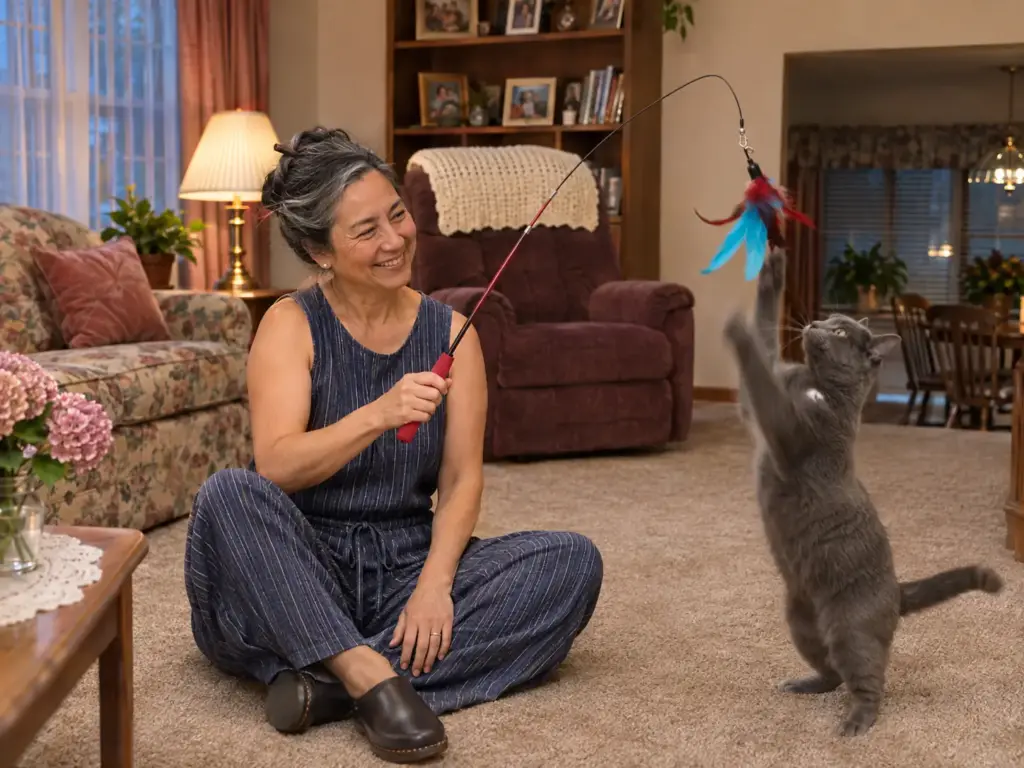
The usual advice says more play and more attention. The better call is a smaller thing at a fixed time: the same hour, the same room, one short play session of a few minutes of wand and then a treat (plus a few crumbs on the floor, which is the price of the appointment). The cat adopts that appointment because it carries no memory of the other cat. Short bursts can add up to fifteen or twenty minutes across the day, and a minute of frantic hunting still counts.
For the wand toy, MeoHui Retractable Cat Wand extends from 15 to 38.9 in, weighs 0.06 lb and comes with two wands and nine feather refills, so one is always usable while the other is put away. It breaks easily: the string and feather ends can come apart under a determined cat, and the listing itself says never to leave the cat alone with it. Put it back in the drawer after each session. A crumpled paper ball rolled down the hallway is the zero-cost version, and Cat Dancer is the other wand-style option.
Play at the same hour and in the same spot every day, wand first and treat last. A new appointment belongs only to the two of you, and that is why he takes it up.
A Diffuser Covers One Room, Not an Apartment
If you try a plug-in pheromone diffuser, say it to yourself plainly first: no veterinary guideline recommends a diffuser for a cat who has lost a companion, and the maker’s own study is small, scored by the owners and paid for by the maker. Treat it as part of the room’s environment and not as a treatment. FELIWAY MultiCat Cat Calming Diffuser Kit with one refill gives a 48 mL refill that lasts 30 days in one room, and it needs about 4 ft (1.2 m) clear above vents and furniture. It covers only the room where it is plugged in, and the refills are the running cost that never stops.
Plug it in where the pair used to spend time, a comfort zone for the cat who stayed, and treat the single refill as the honest test: if the sheet from the baseline section has not moved after those 30 days, you have your answer without a second purchase. Which plug-in diffusers are worth trying in a multi-cat home, and what the evidence is goes through the field.
The Pair That Does Not Miss Each Other, and Why That Is Not a Verdict
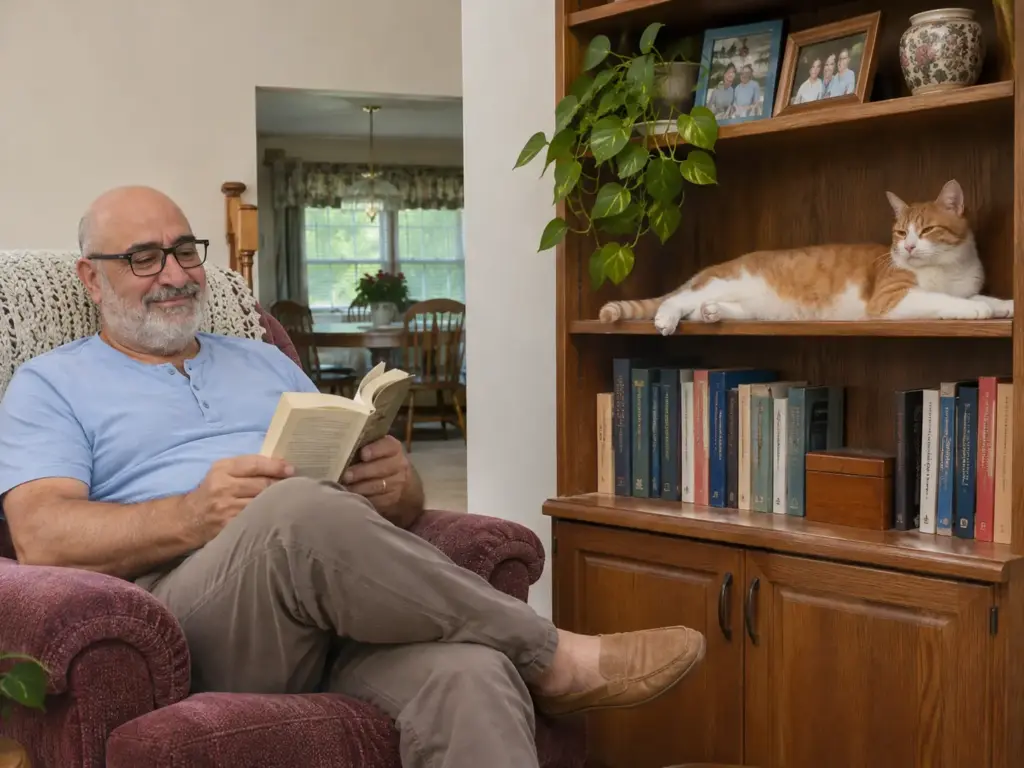
The guilt often comes from a good mood. The cat who stayed sleeps better, eats more and finally owns the window shelf, and you are the one feeling bad about it.
The Tolerant Cat and the Lopsided Bond
In cats who lived together without a strong bond, International Cat Care says the remaining cat may “blossom”: become more friendly, more vocal and more active after the loss. It is not a rule, and it is not a reflection on you.
A tolerant pair is two cats who only share an address. What weighs is shared friendly behavior: resting pressed together, grooming, nose touching. A lopsided pair, one who pursues and one who puts up with it, is the case most often mistaken for a bonded pair.
The Old Pair That Quietly Drifted
Two cats of fourteen who once slept in a pile now growl at each other across the room, and the owner reads a breakup. What looks like a breakup can be a drift, tolerance wearing thin over the years in a house that did not change. A sudden change in how an older cat behaves is a question for the veterinarian, so ask it first. After that, give each of them a sleeping spot of their own and count the resources again.
When the Quiet Cat Is the Relieved One
A bond that never existed cannot go missing, and a cat who is calmer is not an accusation. Neither scold the good mood nor reward it. Check it against the baseline sheet: if the new calm sits inside his usual numbers, you have a home with one fewer negotiation, and if the numbers move out of his range, treat it like any other change. What changed in the home before you decide a cat is jealous or relieved is the place to look before assigning him a feeling.
One, Two or Three Cats, and Whether Another Cat Fixes It
Which cat misses which is a different question in a house of three, and a new cat does not answer it. The answer is arithmetic.
The Third Cat Changes the Arithmetic, Not the Grief
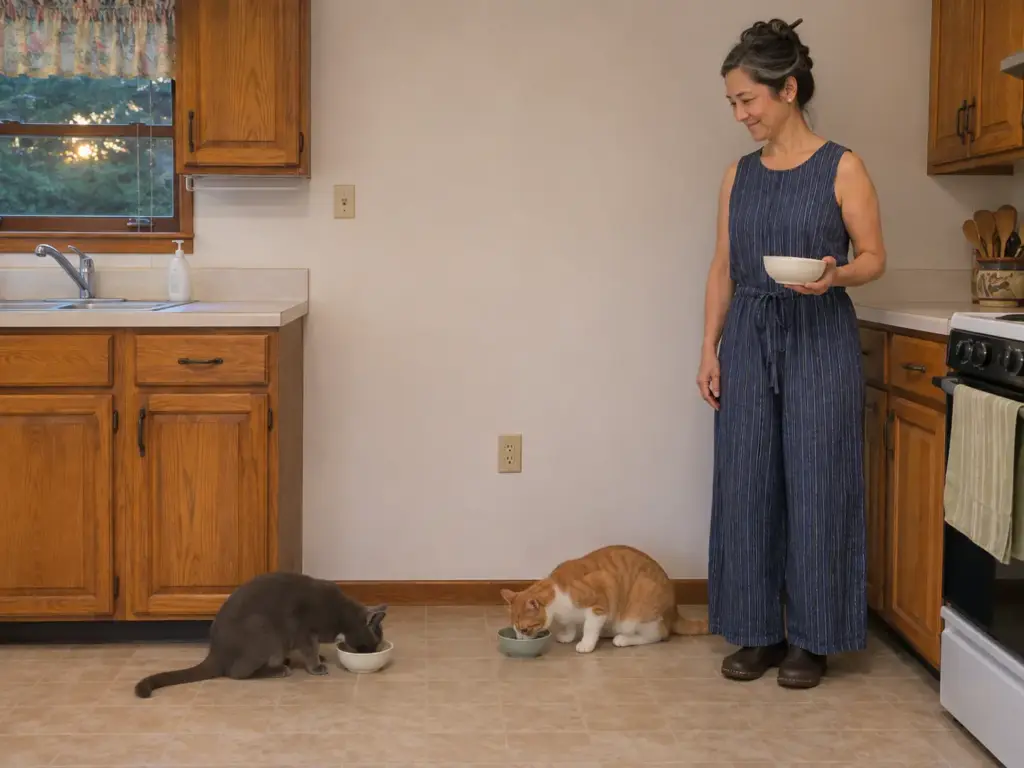
In a multi-cat household of three the count is resources, one of each per cat and one extra, and the weakest of the three pairs decides how the house runs. The cat who loses a companion is not made whole by the third cat, who has his own pair, his own routes and his own claim on the shelf. Why three cats work until one pair does not shows how that plays out in a small apartment.
Why a New Cat Is a New Animal to Negotiate, Not a Refill
International Cat Care’s view is that a young, boisterous kitten is not usually an appropriate replacement cat for a long, predictable companion, although some cats who depend on a partner may benefit. So there is no single answer, and neither “you should” nor “you shouldn’t” fits. Before deciding, measure what the cat you have already has, using the baseline sheet and the blanket still unwashed. How to read the cat you already have before adding another and what to protect in your cat’s territory before another cat arrives cover both checks.
Foster Before You Adopt, and Let the House Settle First
The low-risk way to test whether a second cat helps this cat is to foster to adopt: bring one in for a stretch, watch the sheet and decide with real numbers, without tying yourself to a mismatch that lasts for years. Let the house settle first. Why the timing of an introduction depends on gates, not days explains when a newcomer fits. And that moment comes later than most people want.
The Blanket, the Dinner Hour and a Blank Sheet Come First
Missing, in a pair of cats, is made of scent, route and warmth, and the length of the absence decides how much of each the house has to hold. The unwashed blanket and the unchanged routine come before any purchase, and a cat who stops eating is a call to the clinic whatever the cause looks like.
Look again after a few days at whether he eats, sleeps in the open and plays against his own sheet, and again after a few weeks at whether the round has rebuilt itself around the new spots. Some cats settle in days and a few stay unsettled for weeks, so a slow cat is not a failing one.
Tonight, leave the other cat’s blanket where he can see it, feed at the usual hour and start a sheet with four columns. Then notice where he chooses to sleep tomorrow afternoon.
Frequently Asked Questions
01Do bonded cats miss each other when they are separated?
Yes, a bonded cat can react to the other’s absence by calling, searching the house and sleeping in the other’s spot. International Cat Care notes that close pairs react more strongly, and what is being measured is scent, route and a warm cat nearby, not a human sorrow. A cat who stops eating needs a call to the clinic.
02How long do bonded cats miss each other?
There is no set period: International Cat Care says some cats settle in days, a few stay unsettled for weeks or months, and some show no response at all. A written baseline of meals, sleep, play and litter visits shows which way your cat is heading.
03Do cats know when another cat in the house has died?
A cat’s response to the loss of a companion runs through a calling and searching stage, then a quiet stage, then acceptance. International Cat Care adds that a scent fading gradually confirms the other cat is gone, so the favorite bed stays unwashed for a while.
04Should I get a new cat when one half of a bonded pair is gone?
A young, boisterous kitten is not usually a good substitute for a long-term, predictable companion, according to International Cat Care, though some cats that depended on the other may benefit. Trying a foster before adopting tests the match without a permanent commitment, and the house should settle first.
05What should I do the first night a bonded cat is alone?
Leave the other cat’s blanket unwashed and in sight, feed at the usual hour, keep the litter box where it was and offer a hand instead of picking him up. If he stops eating or shows any sign of illness, call the clinic.
Leave a comment