Best Pheromone Diffuser for Introducing Cats in an Apartment
Feliway MultiCat vs Classic vs Sentry for introducing cats. Facial or appeasing pheromone, and 30-day vials that give out in 3 weeks (+ where to plug in)

Alfredo RamsesFounder · Updated November 1, 2026 · 20 min read


On this page8 sections
- 1Facial or Appeasing: Which Pheromone Diffuser Fits Cats Meeting
- 2The Shared Air in Your Apartment, Measured With the Door Closed
- 3Why a Diffuser Fails Here, and What Both Trial Groups Got Anyway
- 4One Newcomer, Two Residents: How Many Units and Where
- 5The Three Picks, by Zone
- 6Vial Life Beats the Label, So Count Vials per Room
- 7Count Zones and Vials, Not Square Feet and Days on the Box
- 8Frequently Asked Questions
You have one door between the newcomer’s room and the living room, one outlet in a useful spot, and a resident cat who has taken to sitting in the hallway, staring at the gap under that door. Someone told you a pheromone diffuser would settle the whole thing, and it is a reasonable first move, because introducing cats puts a stranger’s smell into air she has always owned and her objection is a fair one.
Whether a plug-in helps depends far more on where it sits and what else is happening around it than on the brand. A published pilot trial in 45 multi-cat homes gave both groups the same behavior coaching, and that one detail changes what you should expect from a plug-in. The sections below sort out which pheromone fits two cats meeting, how far one unit reaches behind a closed door, why plug-ins disappoint, how many to buy, three picks by zone, and how long a vial really lasts.
At a glance, these are the three kinds of unit an introduction can use and the job each one has:
| Kind | Pheromone | Best for in an introduction | Needs an outlet |
|---|---|---|---|
| Plug-in, facial (Feliway Classic) | Facial (FFP) | The newcomer’s own room, where one cat settles alone | Yes |
| Plug-in, appeasing (Feliway MultiCat) | Appeasing (CAP) | The zone both cats will end up sharing | Yes |
| Plug-free cartridge (Sentry Portable) | Not named on the label | The one corner with no outlet, by the door or the carrier | No |
Facial or Appeasing: Which Pheromone Diffuser Fits Cats Meeting
Most people buy “a cat pheromone diffuser” and find out afterward that the shelf holds two different pheromones with two different jobs. Either one comes after the doors and bowls of the introduction and never in place of them, which is the order laid out in the stage-by-stage plan for introducing cats in an apartment. The plan does the work. The plug-in only changes what the rooms smell like while it happens.
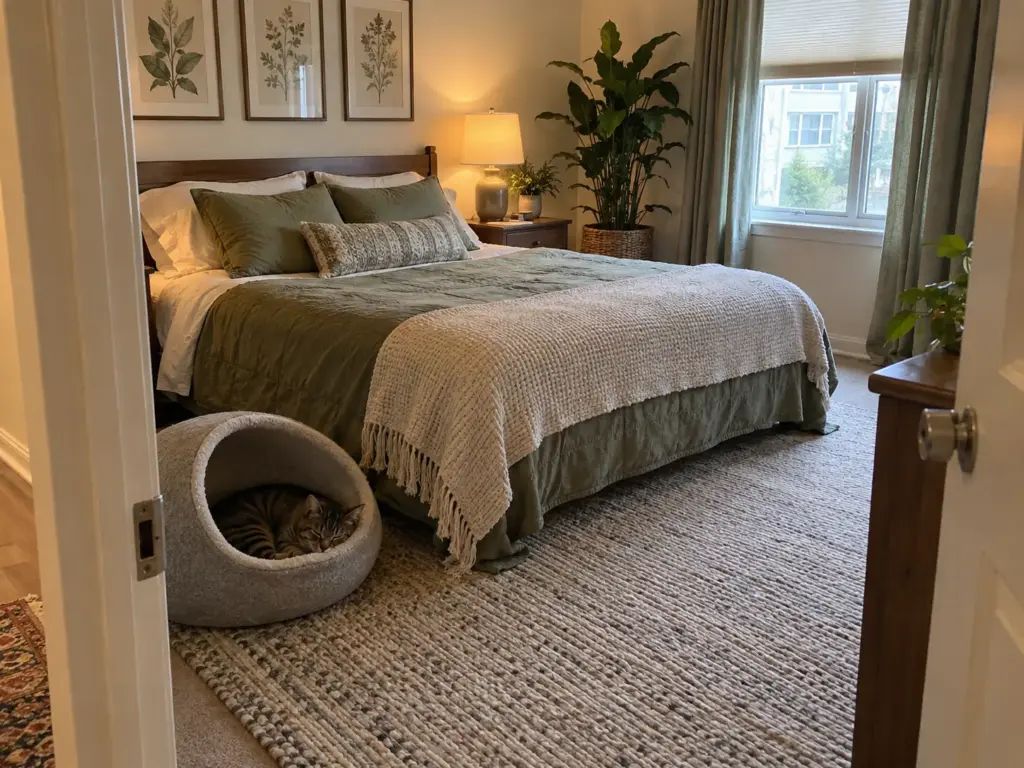
Facial for one cat’s own stress, appeasing for cats who must share the air
The facial pheromone (FFP) is an analogue of the scent a cat leaves when she rubs her cheek along a corner, and Feliway Classic is the best-known plug-in built on it. Its job is one cat’s unease in a place that is turning familiar, which describes the newcomer alone in the spare room better than it describes anyone else. The cat-appeasing pheromone (CAP) is an analogue of the one nursing mothers give off, and it is sold for cats who share a home: the residents now, the newcomer later. In the US that product is Feliway MultiCat, which a UK review site, Cat Mum Journal, says is the same one the pilot trial tested under the name Feliway Friends.
So the sorting question is who shares the air, not which brand. A cat alone behind a closed door is a facial question. Two or more cats who will pass each other’s scent every day are an appeasing question. An introduction has both, in different rooms and at different moments, which is why the next sections count zones of air instead of cats.
What “2-in-1” means on the label, and why it varies by brand
A “2-in-1” claim sounds like one thing and is not. Beaphar’s CatComfort Excellence lists 2% facial plus 2% appeasing pheromone, so it carries both. TheraPetMD’s “2-in-1” is, by the brand’s own answer to cats.com, one pheromone plus the inert carrier. Sentry’s package gives 3% pheromone and 97% inert ingredients and does not say which pheromone, and Cat Mum Journal reports the same silence from Feliway Optimum.
That silence matters in an introduction because the two pheromones do different work, and a label that cannot tell you which one is inside leaves you guessing about the job you bought. Check three lines on the box before you pay: the pheromone it names (facial or appeasing, or the letters FFP and CAP), the percentage, and how many days the vial is rated for. A brand that prints only the percentage has left the most important line blank, so use that kind of unit as a fallback for a spot where nothing else fits, never as the one the plan leans on.
Read the pheromone’s name on the box, not the front-of-pack promise. If the label gives a percentage but never says facial or appeasing, you cannot tell which job you are paying for, and that is reason enough to put a different unit in the shared zone.
Plug-in, gel, spray, collar: which one an introduction actually needs
A plug-in diffuser runs all day, which suits a process that takes weeks. A pheromone spray wears off in four to six hours, so it fits a single event, such as the first carrier ride, better than a month of hallway meetings. A collar travels with one cat, which helps the cat who leaves the house and does nothing for a hallway two cats share. A gel diffuser skips the outlet, but one gel reviewed on cats.com cannot be closed again once it is unsealed, so its clock starts the day you open it.
A reed diffuser and a stick diffuser skip the outlet too, and each one still needs its label read for the pheromone and the days.
That leaves the plug-in as the kind that fits an introduction, and the plug-free cartridge as the exception for a room that has no outlet. Both come back in the picks.
The Shared Air in Your Apartment, Measured With the Door Closed
The number on the box describes a room that has no door in it. Even a one bedroom apartment has at least one, and for the first stretch of an introduction it is shut.
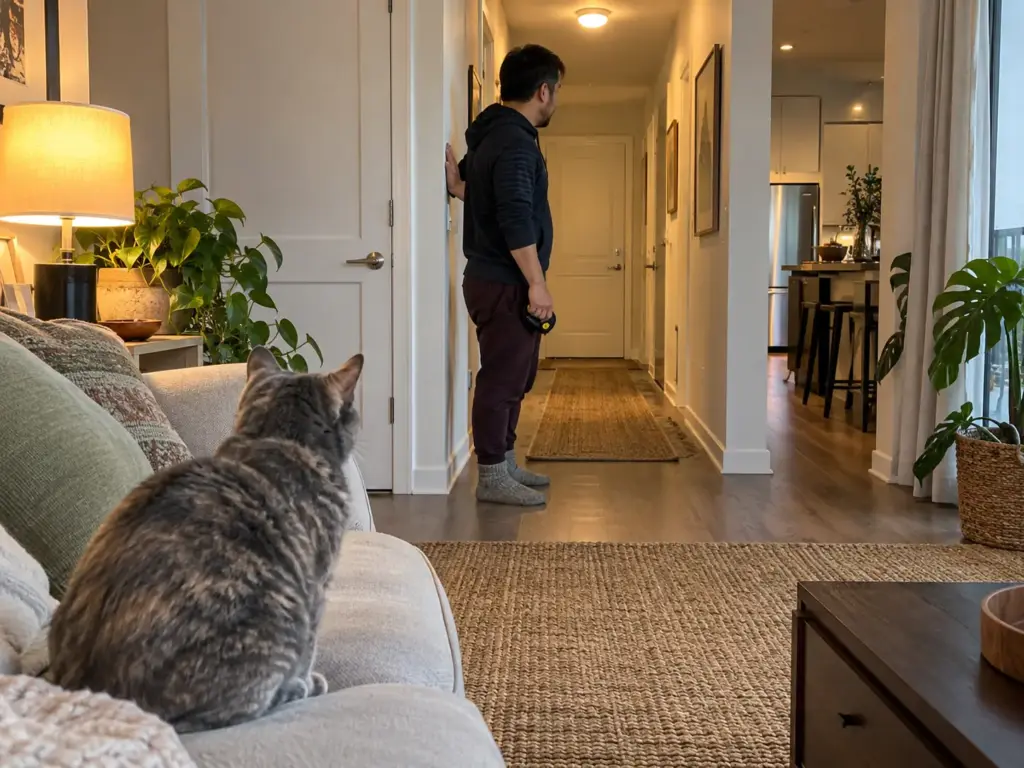
What 700 square feet means when the claim comes from an open-plan space
The maker rates MultiCat to work “continually for up to 30 days in a 700 square foot area,” according to its own product page. Seven hundred square feet is roughly one small apartment, so the claim reads as one plug-in for the whole home.
It is an open-space figure, though, and nothing in it accounts for a wall or a shut door. A cat-training business, Cattitude Adjustment, uses a tighter rule of one unit per 500 square feet, and cats.com notes that plug-ins do worse in large open spaces. Three sources give three answers, and none of them describes a home with a closed door in the middle.
Treat 700 as a ceiling for one open room. Walls and doors can only shrink it.
One door, two air zones, one outlet
Say the newcomer is in the spare room and the door is closed. The apartment now has two zones: the room behind the door, where one cat is alone, and everything in front of it, where the resident lives. The cats share only the strip of air at the gap under the door, which is the one spot where the smell of each reaches the other.
Later the door opens, and the two zones merge into the one the label was written for. The question the box cannot answer is which of those zones holds the air the two will end up sharing, and whether the only useful outlet is anywhere near it.
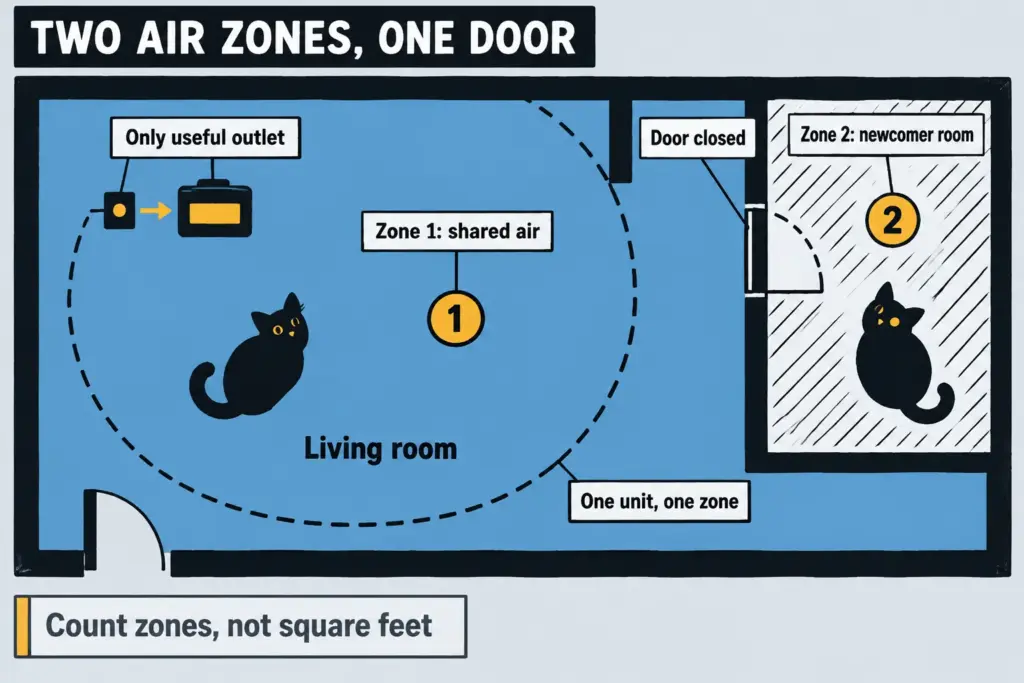
An outlet usually sits where the electrician put it, not where the cats gather. If the only outlet in the living area is across the room from the spot where the resident actually sits, a plug-in there covers a corner nobody uses. Moving a unit is easy and moving an outlet is not, so mark the outlets on your drawing before you decide which zone gets which pheromone. Draw the zones first and place things second, the same way the floor-plan method for two cats in a small apartment places a bowl.
Before you buy anything, close the door, walk the apartment, and write down which rooms the cats will share at each stage of the plan. That list tells you how many zones you have, and it is free.
The no-outlet corner by the door or the carrier
Often the first place the cats meet each other’s scent is the entry or the spot where the carrier landed, and neither has an outlet. A plug-free portable diffuser exists for that corner, and it is the one case where the plug-in logic bends. It also has its own trade-off, covered in the picks, because the label does not say which pheromone it holds.
Draw the apartment with the newcomer’s door closed and count how many zones the cats will share. The label counts square feet and you count zones, and the zone count is what tells you how many units you can use.
Why a Diffuser Fails Here, and What Both Trial Groups Got Anyway
A plug-in rarely fails on its own. It fails in a home where the sequence broke first, and the two are easy to confuse because the plug-in is the only part of the plan you bought.
The trial: two groups, the same training, and a P of 0.06
According to the authors of a pilot trial in 45 multi-cat households, published in the Journal of Feline Medicine and Surgery, “Aggression and social tension among housemate cats is common and puts cats at risk of injury or relinquishment.” Their homes had two to five cats each. Twenty homes got the appeasing plug-in and 25 got a placebo, with the units running from day 0 to day 28.
One detail changes how to read it. On day minus 7, before any plug-in went in, both groups attended the same training meeting: classical conditioning, and redirecting the cats with positive reinforcement and no punishment. The aggression score went down in both groups.
The pheromone group’s extra improvement was reported at P = 0.06, which sits above the usual 0.05 cutoff for calling a result significant, and the test materials were supplied by Ceva, the company that makes the product. It also tested housemates already in conflict, not a newcomer in a spare room.
The plain reading is that the plug-in may be part of the picture, and that homes doing the behavior work improved either way. A pilot of 45 homes cannot settle more than that, and nobody should buy a plug-in as if the trial had.
The best-tested Feliway plug-in was tested on the couch, not about two cats hissing across a hallway. It comes from a placebo-controlled study of Feliway Classic for scratching, run with the manufacturer’s staff, which followed 1,060 cat-and-caregiver pairs for 28 days in single-cat households, and three of its authors are Ceva employees. Good evidence for a scratched sofa does not carry over to a pair who cannot cross the hall.
The launch room, early free mixing, and the “false sense of security”
Plenty of owners follow a plan like this: a launch room, swapped scents, treats during the meetings, and everything going well. Then, in their own words, they were “lulled into a false sense of security” and let the cats interact freely too early, and the male chased the female “as soon as they aren’t occupied.” The diffuser came after that, as the next thing to try, not as the thing that had been missing.
Early mixing is the failure that looks like success, because for a few days a newly settled pair behaves. The early free mixing that makes a new pair look settled is its own subject, and it is the usual reason a plug-in gets blamed for what the sequence did. The scent step that comes before any diffuser belongs earlier in the same plan, and a scent swap is what the diffuser’s smell is meant to sit on top of.
Credit is hard to assign even when things improve. Credit is hard to assign because some owners can’t tell whether the diffuser or the cats getting used to each other made the difference. Cat Mum Journal says something close from the other direction: many people who use Feliway Friends when introducing new kittens to existing cats see no success, but that may be down to skipping the proper introduction process. Nobody has tested which it was, so the safest reading is that the process comes first and the plug-in is an addition.
The free options go first. Hiding spaces made from old shirts and blankets that smell like the people in the home cost nothing, and so do shared meals, which can make a difference.
Run it before the arrival, but never count it as a stage
The advice on timing disagrees with itself. The trainer Cattitude Adjustment says to start the unit before the new cat comes home, and Cat Mum Journal suggests running one at least 2 weeks before stressful events. The practical reason is simple: it takes some time to fill the room. The plan, on the other hand, puts the diffuser after the doors and bowls.
Both are right once you separate the smell from the sequence. A unit can run from before the newcomer comes home, in the shared zone and in the room behind the door, so the air is already in place on day one. What it cannot do is count as a stage or move a gate. The pace of the introduction is set by gates, not days, and a plug-in that has been running for a month has not earned the cats one extra minute together.
When it is a vet question before it is a product question
A cat who stops eating, or who goes under a bed and stays there for days, has changed a habit abruptly, and that earns a call to the vet before it earns a plug-in. A diffuser is part of the room’s smell. It is not a treatment for stress or for conflict, and nothing in this guide treats it as one. Back to the apartment.
Before you decide the plug-in failed, check whether the cats were mixing freely before they passed the gate of their current stage. If they were, the sequence broke first, and a second or stronger unit will not fix it.
One Newcomer, Two Residents: How Many Units and Where
The question arrives as “do I buy one or two?”, and the answer depends on how many cats share which air. Units follow zones, not cats.
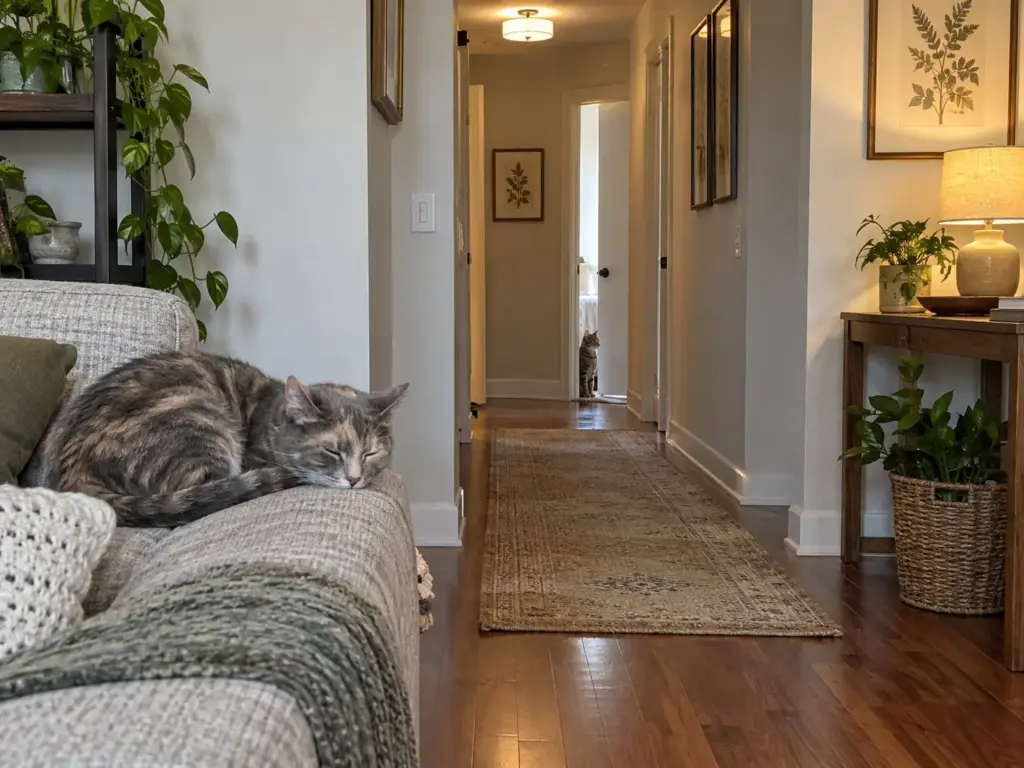
One newcomer and one resident: the holding room and the shared zone
With one newcomer and one resident there are two places and two pheromones. The newcomer room gets the facial unit, because that is one cat alone in a place that is becoming familiar. The zone where the two will end up sharing air gets the appeasing one. Both can be running before the first meeting, and neither counts toward moving a gate.
One newcomer and two residents: when a second appeasing unit makes sense
Three cats do not need three units. The appeasing plug-in in the shared zone covers all of them, and the newcomer’s room still wants its own facial unit for the time the newcomer is alone there. A second appeasing unit makes sense only when the residents’ ground splits in two, as in a long apartment with a turn or a door between the living room and a back bedroom where one resident spends the day, and the cats cross both. Buying one per cat doubles the vials you count in the last section and reaches no new air.
The plug-in also leaves every resource count where it was. The litter boxes still follow one box per cat plus one, which makes three for a newcomer and one resident and four for a newcomer and two residents.
The kitten case, where the mixed feedback lives
The mixed reports cluster around kittens. Cat Mum Journal records owners who used the appeasing unit with a new kitten and saw no change, and the reviewer’s own guess is that the introduction process was skipped. No one has tested the plug-in against the process, so the reasonable reading is that a kitten changes the sequence more than it changes the product. A kitten has no off switch, and the resident cannot hold the line alone, which is why how to add a new kitten without crowding the resident cat starts with a pet gate and a high refuge, not with a pheromone.
The Three Picks, by Zone
Three units, one for each zone, each with its flaw written next to it. Skip any of them if your drawing says that zone does not exist.
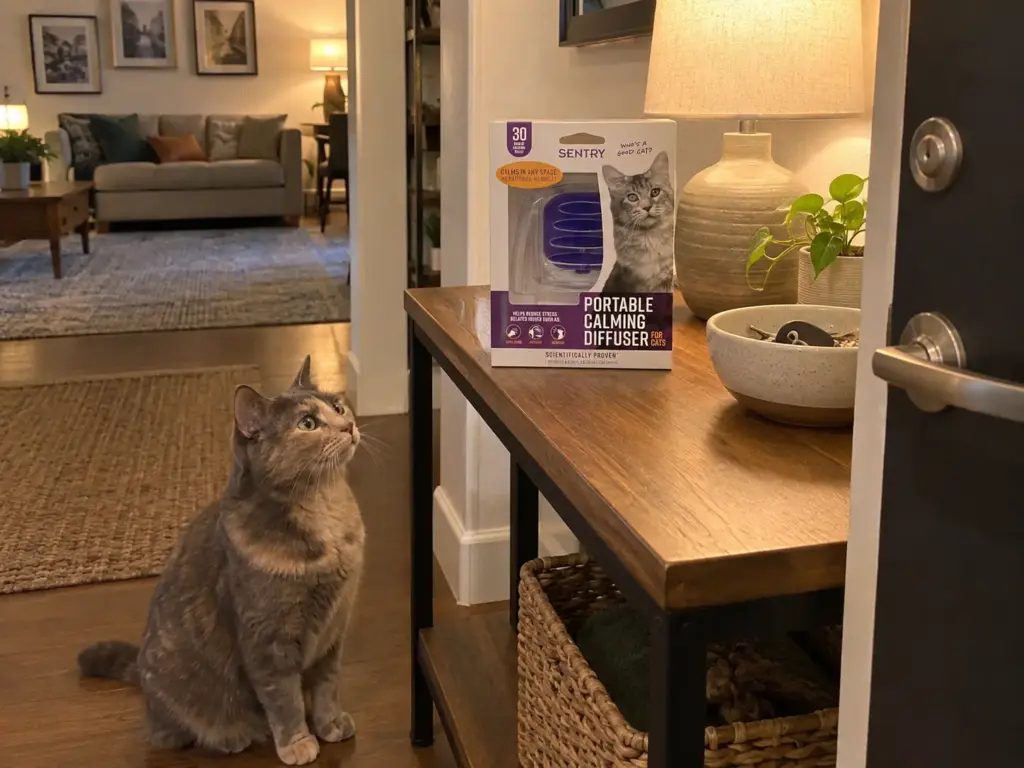
The shared zone: Feliway MultiCat
The appeasing pheromone goes where two cats must breathe the same air, and Feliway MultiCat is the plug-in for that job, sold as a diffuser kit with a refill. It is the same family the pilot trial tested as Feliway Friends, so the evidence discussed above, thin as it is, is evidence for this one. Plug it into the outlet in the zone your drawing marked, and not in the room behind the closed door.
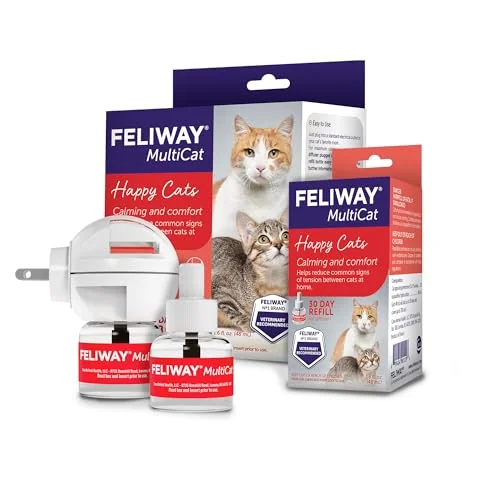
The holding room: Feliway Classic
Behind the closed door, the newcomer is one cat in a room that smells of nobody, and that is the facial pheromone’s job.
Feliway Classic is the plug-in for that room, a diffuser kit with a 48 mL vial rated by the maker for 30 days.
Cat Mum Journal describes it as aimed at problems such as hiding, spraying, scratching and overgrooming, and in this plan you buy it for one narrower reason, which is to give the spare room a familiar-feeling air while the newcomer settles. Its flaw is written into the reviews that the same site summarized: some customers say it did not work or made their cats worse. Put it in the room only if the newcomer will be alone there for days, and run it from before the arrival if you can.
The corner with no outlet: Sentry Portable
The entry or the carrier landing spot is the corner your drawing may have marked with no power at all, and Sentry Portable Calming Pheromone Diffuser for Cats, 30-Day is a plug-free cartridge built for that gap. It releases for 30 days and carries 3% pheromone, and cats.com calls it a convenient choice for homes with limited outlets. Of the three it is the easiest on the budget, and it leaves the wall alone.
Its flaw is the one the earlier label section predicted: cats.com notes that the package does not say which pheromone it contains or what the inert ingredients are. Since you cannot match it to the facial or appeasing job, give it the corner nobody else covers and keep it away from the zone your plan depends on.
Vial Life Beats the Label, So Count Vials per Room
The label says 30 days, and the people who timed it say it varies. In one reviewer’s words, a Comfort Zone vial “only lasted 3 weeks instead of the 30 days as stated” over a summer, so the number on the box is a starting point and not a schedule.
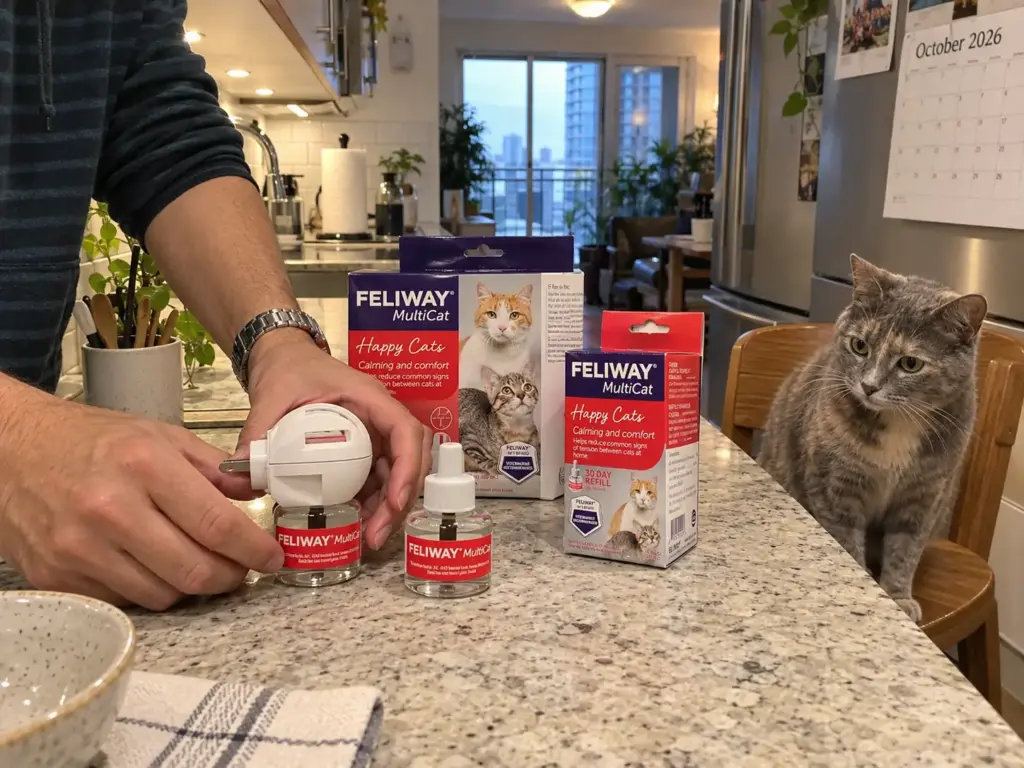
Thirty days on the label, three or four weeks in practice
Cat Mum Journal’s reviewers measured several brands against their labels. Comfort Zone ran out at three weeks in summer. TeddyDo gave about four weeks against the 35 days it states. One Beaphar vial lasted as little as two weeks, and Feliway Optimum came in “just short of” its 30.
None of this was a lab test, but the pattern is the same: the box is optimistic and a month is the most you should plan on.
Here is the arithmetic, and it is ours, not a source’s. At a 30-day vial, one room uses about 12 vials a year. At three weeks, it uses about 17.
A second zone doubles both numbers. Count in vials per room per year, never in money, and decide how many rooms actually need a unit before you subscribe to the habit.
Three clocks for “when does it work”, and what to do while you wait
Time to work is the widest gap in this category. The maker says the effect can arrive in “as little as 14 days.” Cat Mum Journal says it can show “as early as 1 week” and tells you to allow up to a month.
Real-world accounts run longer still: a couple of months of continued use before it takes effect, if it does at all. The three clocks disagree by a factor of several, and a vial lasts three or four weeks, so on the longest clock you would be on your second or third vial before anything happened.
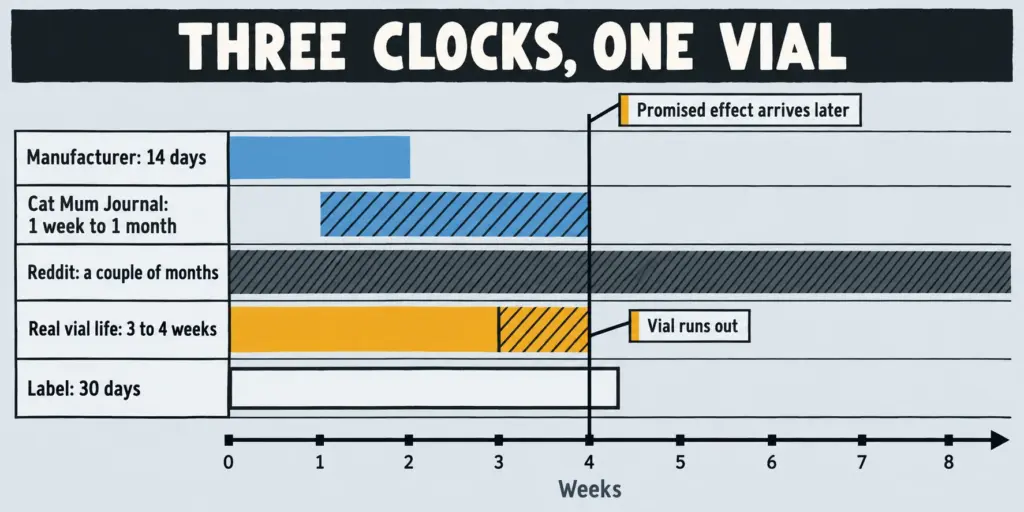
Pick the calendar before you buy, and choose the shortest one you can defend. Some pairs of a young cat and an older resident take close to a year before they settle. The plug-in did not set that pace. The doors did, and how long the whole introduction takes is a count of gates, not of vials.
While you wait, run the free things. Leave a hiding place with a shirt that smells like you, keep the shared meals going, and do not move a gate because a vial has been in for two weeks.
The refill that ran out and the cats that started fussing
A refill that runs out can show up as cats fussing at each other more. Treat that as a calendar cue, not a diagnosis. If tension rises around the end of a vial, swapping it is cheap, and if the swap changes nothing, the cause is more likely the sequence than the smell.
Write the day each vial goes in on the calendar, and check on day 21, since that is where the shortest measured vial gave out.
Write the date on the calendar the day you plug in each vial, then check it on day 21. If it has stopped smelling, or the cats are starting to complain, you have a reason to swap it that does not depend on the label.
Count Zones and Vials, Not Square Feet and Days on the Box
Three decisions carry the whole purchase. Choose the pheromone by who shares the air: facial for the newcomer alone behind the door, appeasing for the cats who must share the rest. Count zones with the door closed instead of trusting a square-footage claim. Count vials per room per year, because a 30-day label can mean three weeks in a warm month.
Today’s step needs no purchase. Close the newcomer’s door, draw the apartment with the two zones shaded, mark the outlets, and leave a shirt that smells like you in a hiding spot inside the newcomer’s room. Then notice whether the hallway gets quieter before any vial goes in, since that tells you how much of the tension the sequence can handle alone.
Look at the hallway again on day 21, when the shortest measured vial runs out. A calmer hallway then is a good sign for the plan, and it still cannot say how much of it belongs to the plug-in and how much to two cats getting used to each other.
Frequently Asked Questions
01Do pheromone diffusers actually help cats?
They can help as an add-on to a plan, but the evidence for cats who must share a home is thin. In the one pilot trial, both groups got the same behavior coaching and the pheromone group’s extra gain came in at P = 0.06. Treat a plug-in as a complement, not a treatment.
02Does Feliway work for cat introductions?
Feliway can help as an add-on to an introduction, but it never replaces a stage, a door or a bowl. Owners report mixed results with new kittens, and nobody has tested whether the plug-in or the introduction process explains the difference.
03What pheromone can help cats get along?
The appeasing pheromone (CAP) is the one sold for cats who share a home, and the facial pheromone (FFP) is aimed at one cat’s own stress. Read the label, because 2-in-1 means two pheromones on one brand and one pheromone plus carrier on another.
04How long does a pheromone diffuser take to work?
Sources range from 14 days to a couple of months, and a vial can run out before the longest estimate. The maker says as little as 14 days, one review site says one week to a month, and real-world accounts run to a couple of months, if at all.
05Where should the diffuser go in an apartment with one door?
Put the appeasing unit in the zone where both cats will end up sharing air, not in the closed room. Add a facial unit there only if the newcomer is alone in it. With no outlet nearby, a plug-free cartridge fills the gap.

Leave a comment