How Long Before Introducing Cats Depends on Gates, Not Days
How long before introducing cats? A week apart at the least (SDHS), six gates with done-tests, and real timelines from 2 days to 8 months.

Alfredo RamsesFounder · Updated October 30, 2026 · 16 min read

On this page8 sections
- 1How Long Before Cats Can See Each Other, at the Least
- 2Where the Clock Stops and a Vet Comes First
- 3The Gate Counter: What Each Step Has to Show Before the Next
- 4Why the Same Steps Run Two Days in One Home and Six Weeks in Another
- 5Adding the Gates Up Into Three Real Timelines
- 6Your Date Versus Their Pace in a Small Apartment
- 7Start at the Floor, Count the Gates, and Write the Dates Down
- 8Frequently Asked Questions
You have a new cat behind a closed bedroom door, a date circled in your head, and a resident who has spent two days hissing at the gap under that door. How long before introducing cats has two answers, the wait before they first see each other and the total time before they share rooms, and both are counted in gates passed, not days on the calendar. The resident’s hissing is a reasonable reply to a stranger’s smell inside his territory, and the newcomer is still working out where the room ends. Below you get the floor, the point where the clock stops, a counter with a done-test for every gate, why the spread runs from days to weeks, three real totals, and what to do when your date and their pace disagree.
Quick Answer
Keep the newcomer behind a closed door for a few days, or a full week by the stricter shelter guide, before any sight contact. After that, count gates, not days: the total is the sum of the steps that held, from a few days to a few months. If either cat stops eating or using the box, the clock stops.
How Long Before Cats Can See Each Other, at the Least
The wait before the cats first see each other has a floor, and the sources do not put it in the same place. The floor is not a forecast for your pair. It is the least time the newcomer needs to learn one room before the rest of the apartment arrives, and the stages those days lead into, plus the rule for when to stop, are laid out in the full stage-by-stage walkthrough. This guide covers the clock.
The Floor the Shelters Give
San Diego Humane Society’s introduction steps set the strictest floor: “Keep the cats completely separated without access to each other for at least a week.” The American Humane Society’s guide to introducing cats to cats asks for a few days of separation, and Calgary Humane Society says the entire process can take as little as a couple of days or as long as several weeks.
Three floors, and they answer slightly different questions. The week is the wait before any sight contact, the few days is the shorter version of that same wait, and Calgary’s couple of days is the floor of the whole process for the fastest pairs. Plan for the week. Read the shorter numbers as what a pair does when every gate goes quickly, never as a target.
Why a Calm Door Does Not Shorten It
Day two arrives and the resident is sitting quietly by the door, which feels like permission. It isn’t, because his calm is only his half of the first gate.
The other half belongs to the newcomer: the American Association of Feline Practitioners says to remain in the transition room “until the new cat is not hiding all the time and explores the transition room confidently,” and Jackson Galaxy puts the newcomer’s first walk out of base camp at “anywhere from a few hours to a few days,” set by the newcomer and not by your calendar. A week is the number people quote, and it is the wrong one for a newcomer still under the bed on day seven. The count that matters is the gate, and the week is only the least you wait before you check it.
The opposite mistake is moving too fast. One rushed introduction starts when the cat runs out of the room: a door opened before the room was the newcomer’s own, and the newcomer answered the way any cat answers an open door. Another, on day 3, had a resident “hissing and growling constantly through the door starting on day 2.” A resident who hisses at a closed door while a stranger’s smell sits on his side of the wall is doing a sensible thing, and the door exists so he can do it with a barrier in the way.
The One-Room Version When You Rent
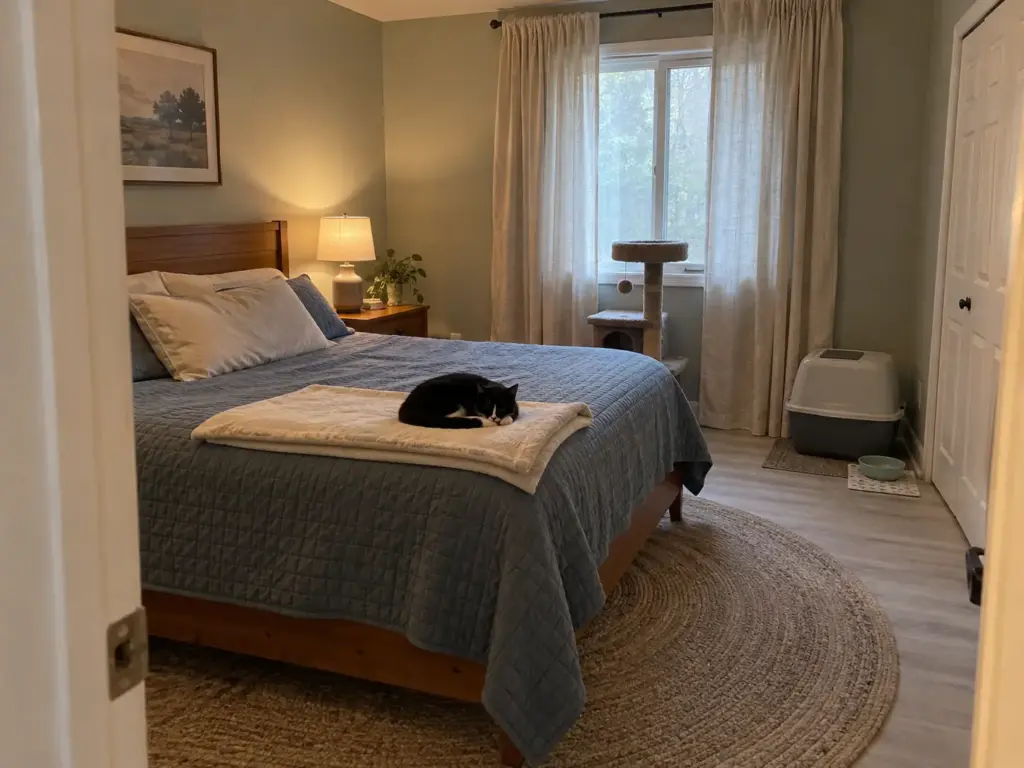
One closed room and one door is enough, and nothing about it needs a drill. Jackson Galaxy’s base camp can be a spare bedroom, an office, or “even the bathroom when there is no other option,” which is the answer for a one-bedroom where no room is spare.
Once the floor is over, the cheapest first barrier is whatever already hangs in the home. One workable setup is to keep feeding the cats near the door so they get used to each other’s scent, and to move a mesh screen already used on a balcony door onto the bedroom door, so the cats can see each other and not touch. Another draped a blanket over baby gates and lifted it a little more at every meal. Neither needed a purchase, and both do the work of a barrier before a cent has gone to a store.
Look at what is already hanging in the home before you buy a barrier: a screen from a balcony door, a spare blanket, a sheet. The door is the barrier, and the smell coming under it is the first introduction.
Where the Clock Stops and a Vet Comes First
Ask your vet about the move before the newcomer comes through the door; that conversation sits ahead of any count. After that the count has one hard stop. If either cat stops eating, stops using the litter box, or has a wound, the clock does not slow down, it stops, and the next call is to the clinic, not the next gate. From the hallway a slow cat and an unwell cat can look alike, and you cannot sort them out from there.
Some pauses do have a house explanation worth fixing first: a bowl set too close to the door, a box in the wrong spot. A change that arrives overnight in a cat who was eating and using the box fine the day before is not in that group, and the clinic is where it goes. Once the vet has weighed in and both cats are back to their usual routine, restart the count at the gate where the pause happened, not at the top and not one gate ahead.
The Gate Counter: What Each Step Has to Show Before the Next
A step does not come with a day count; it comes with a done-test, and the cats are the ones who take it. According to the American Association of Feline Practitioners’ step-by-step guide to introducing a new cat, “This process can take anywhere from a few days to a few months, and sometimes longer.” That spread lives inside six gates, and each one has something the cats must show before the next opens.
Gates One and Two, the Room and the Smell
Gate one is the transition room, the newcomer’s safe space. The newcomer passes it when hiding stops being the all-day habit and the room gets explored with confidence, which the AAFP puts at “a few days, and longer for some cats.”
Gate two is scent swapping: bedding or a rubbed cloth builds a shared scent by carrying each cat’s smell to the other, and the AAFP’s rule reads, “Repeat this step daily until the cats do not respond with tension to the new scent.” The daily repeat is itself the clock. A stiff walk away from the blanket, flattened ears or a hiss at a piece of cloth means gate two did not pass today, and tomorrow you do it again.
Gates Three and Four, Meals at the Door and a See-Through Barrier
Gate three is feeding on either side of the door, a meal on each side of the closed door. San Diego Humane Society’s test is plain: both cats comfortable, with no hissing, growling or puffed fur, and only then on to the next step. No top source puts a number on it, and Calgary Humane Society’s fastest version is a couple of days. Where the two bowls sit in a small home is mapped out in how to lay out two feeding stations in a small apartment.
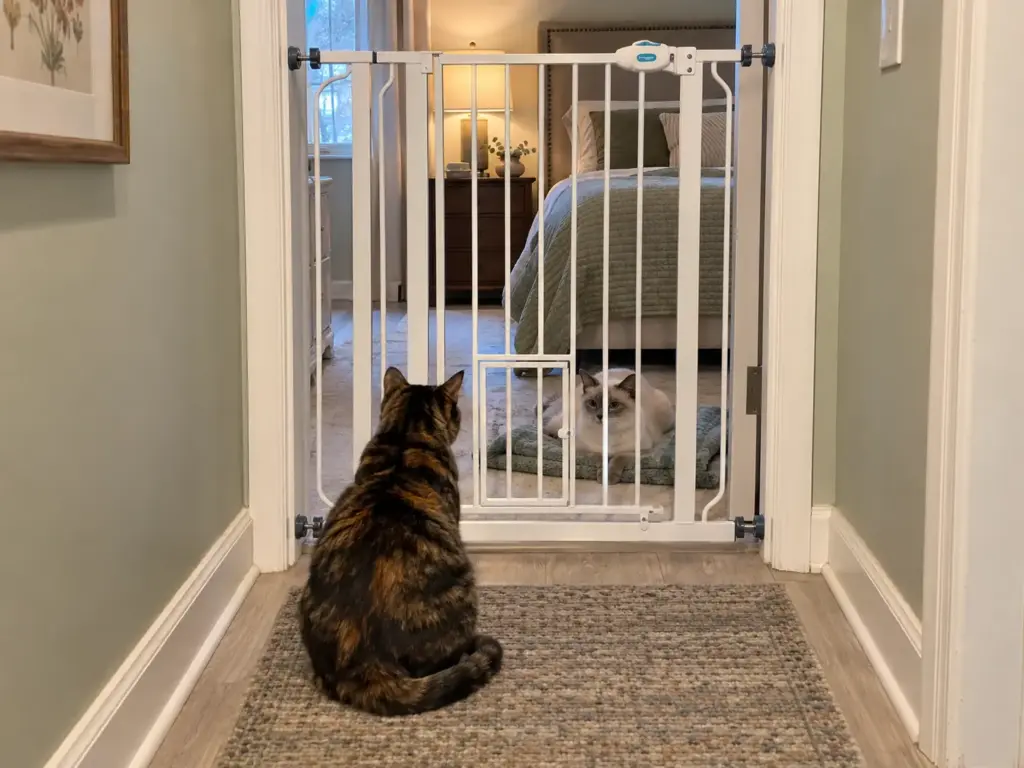
Gate four lets the cats see each other and not touch, with both calm as the test, and again no time given. The free version is the mesh screen door or the draped blanket from the renter section above, lifted a little more at each meal. Sometimes cats look at each other across a barrier for hours while eating and are friendly by the next day. That is proof the test can pass fast, never a number to copy.
A standard baby gate is what most people reach for, and the American Humane Society warns it is usually not high enough for cats, so you may end up stacking two. If you will walk through that doorway a dozen times a day, the second choice is the better one.
Jackson Galaxy prefers a pet gate because it is high and has a walk-through door, so nobody takes the barrier down to pass. The American Association of Feline Practitioners names an extra tall pet gate for this step, and the Carlson Extra Tall Walk-Through Pet Gate with Small Pet Door is listed at 36 inches wide, under the name of a dog gate. Its limit is the doorway: it is sized for that width, and the height on the product page is the number to hold against your own cat’s full stretch before you order.
A wider opening is the case for the Carlson Extra Wide Dog Gate with Small Pet Door, listed for openings from 29 to 36.5 inches.
Gates Five and Six, the Open Door and the First Shared Room
Gate five opens the door under supervision, and over a few days, per the AAFP, the exploration time is stretched gradually. Open it on purpose. In one account the newcomer slipped out of isolation at the 72-hour mark and the resident gave her a sniff; that is one escape ending well, not a method, and a reason to plan gate five instead of waiting for the door to do it.
Gate six is the first supervised meeting in a shared room. San Diego Humane Society’s instruction reads, “Repeat this step many times, gradually extending the length of the sessions, before letting them interact unsupervised or for long periods of time.” The AAFP puts the repeating at several days.
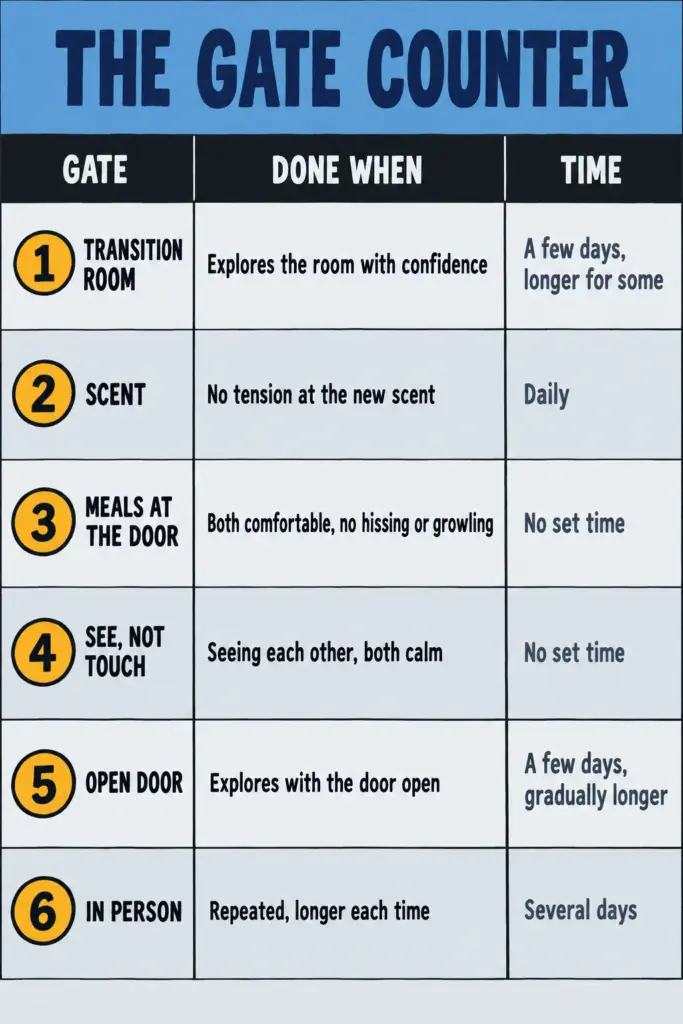
Keep the six gates somewhere you pass every day and count gates passed, not days elapsed. Two pairs can be the same stretch of days into this and stand on different gates, and the gate is what tells you where you are.
Stick a sticky note on the newcomer’s door and write the date each gate passed. When the cats stall, you restart from a written place and not from memory.
Why the Same Steps Run Two Days in One Home and Six Weeks in Another
Timelines for how long this takes scatter: about 2 days, 3 days, about 5-7 days, about a week and a half, about 6 weeks, and in some homes 8 months. It is easy to start panicking after seeing so many accounts of it taking months.
Nobody on either end of that range is doing it wrong. They are comparing different homes, and the AAFP’s own range, “a few days to a few months, and sometimes longer,” is wide for the same reason. Four things move the number.
The Resident’s Recent History With Other Cats
Take a resident who is an anxious, territorial 6-year-old female who had lived with other cats but had gone about two years without regular contact with one. The whole introduction took about 6 weeks. It is one case with its numbers, not a measurement, but it is the shape to expect: a resident who is out of practice at sharing may need gates two and three taken slowly.
Bonded Pair or Strangers
The AAFP splits this cleanly. Bonded cats can share one transition room and go through the steps together. “If they are not bonded, then each new cat needs their own transition room and must go through the steps separately.” A bonded pair is one clock; two unbonded cats arriving together are two, each in a separate transition room.
With two newcomers who are not bonded, open a second room instead of sharing the first. Each one gets a count of its own, and a stall in one room does not hold up the other.
A Calm Newcomer and a Nervous One
Temperament counts too. In the six-week case, the newcomer was an outgoing 5-year-old male who loves everyone and everything he meets, and that temperament gets the credit for how smoothly it went. Smooth and short are different things, and that case was smooth at six weeks.
Some cats feed off their person’s energy quite a bit, which puts your own mood on the list. Both are community observations, not measurements.
One Newcomer, or Several
The AAFP’s line on more than one newcomer reads, “Some may be introduced more quickly and others may take much longer.” Count it as one clock per unbonded newcomer. A home with two residents and one newcomer is two relationships to clear, not one, and the slower of the two sets the date for the shared room.
Adding the Gates Up Into Three Real Timelines
You want one number. Here are three real ones, built from the same six gates, so you can find your own pair among them.
Three Weeks of Scent, One of Sight
A six-week introduction can break down like this: the first 3 weeks go to getting her used to his scent, site swapping, and the door feeding ritual. Week 4 is getting her used to seeing him, week 5 is letting both cats explore the house together, and by week 6 they are out together full time!
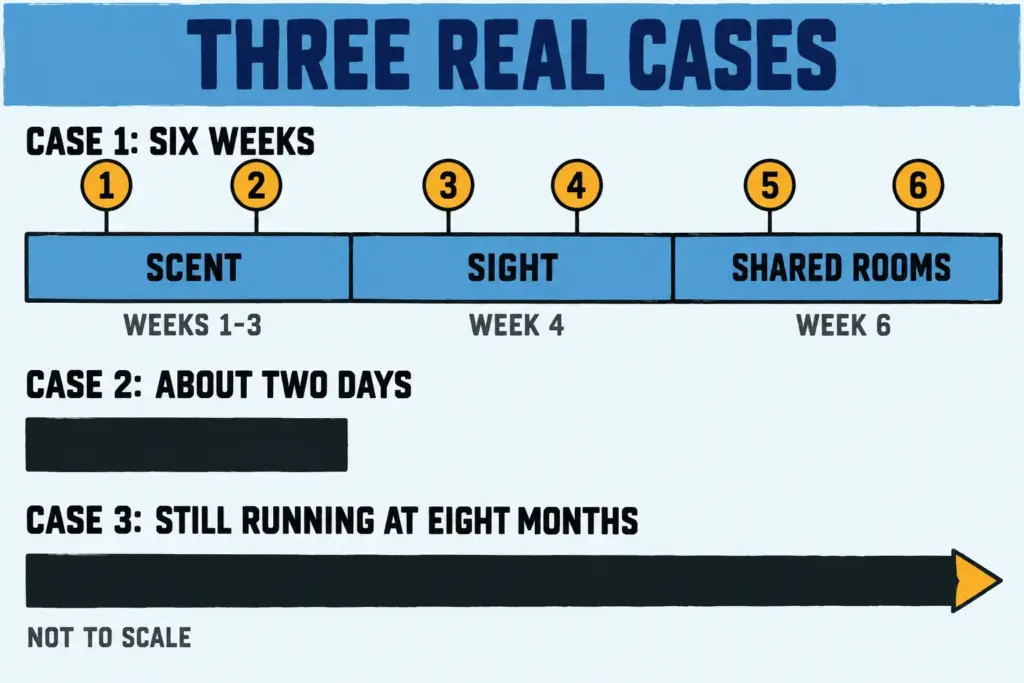
Read as gates, the first three weeks held the room, the smell and the meals at the door, week four was the see-through stage, week five the open door, and week six the shared house. The long stretch sat at the front of the ladder, where the smells were doing their work, and the back half moved a week per gate.
The Fast Case and What Made It Fast
At the other end, some pairs are comfortable in about 2 days, or even 48 hours, and others in 3 days. The posts rarely list what each gate looked like, so the useful read is arithmetic: two days is a total, and a total that short means every gate’s test was passed quickly. It does not make a six-week pair slow, and it does not mean gates were skipped.
The One Still Running at Eight Months
Then there are pairs still working through it at 7 or 8 months. The count is gates passed, not months, and this guide will not guess why a given pair is still on its gate. What the thread offers is the reassurance that actually worked for the person who started it: “Two weeks is still okay, mine was still hissing and growling at that point.”
If a pause comes with a change in eating or box use, go back to the section on where the clock stops. If it comes with nothing but hissing at the door and time, the walkthrough’s stop rule is what decides when an attempt ends.
Your Date Versus Their Pace in a Small Apartment
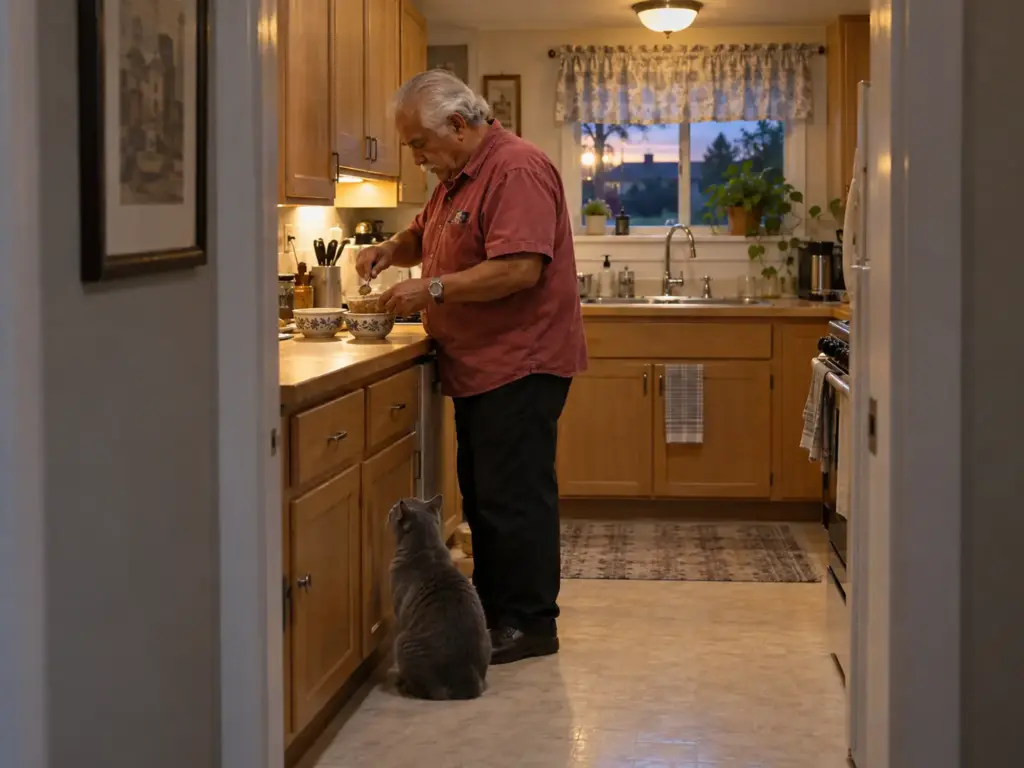
A trip, a visitor, the end of a holiday week: the date on your phone is real, and it is a human preference. The gate the cats have not passed is their constraint, and when the two collide the cats are right about the constraint.
When the Date Is Yours and the Pace Is Theirs
Move the date, not the gate. If the trip lands in the middle of gate three, the cats have no way to know and no reason to care, and pushing them through gate four early to be done by Friday sends the cost back to their side of the door. If the date truly cannot move, use it: hand the sticky note to whoever covers for you, with the gate you are on and what the cats have to show to pass it.
Two Weeks Behind a Closed Door, With Everything the Newcomer Needs
A closed room needs its own resources. The rule of thumb is one litter box per cat plus one extra, which is why the box count for two cats lands on three, and where those three physically fit in one apartment has its own answer in a litter box in a small apartment, where it actually fits. The box matters to the count before the cats ever meet. With the new kitten in another room, the smell of the kitten’s litter box alone can send a resident into a fury of meows, growls and hisses.
A second box in the newcomer’s room is not a luxury, it is gate one: a cat that does not feel at home in the room does not explore it.
Meals follow the same logic. Two stations, one on each side of the door, and why two cats get two bowls plus one explains the count.
The Days Nothing Moves
Some days nothing moves. Keep the daily scent step, keep the meals on both sides of the door, write the date, and do not escalate to make the day count. A stall is a stalled gate, not a failed attempt and not a setback; a scuffle at the door is a different case, and the walkthrough’s stop rule covers it. And before you buy anything, rearrange what the home already has: a chair against the door, the gate you already own, a blanket.
Start at the Floor, Count the Gates, and Write the Dates Down
Wait out the floor first, a few days at the least and a week to be safe, with the newcomer in one closed room. Then count gates passed instead of days elapsed: the total is the sum of the steps that held, and it can come in anywhere from about two days to many weeks. Stop the count the moment either cat stops eating or using the box, and let the clinic answer that one. The date on your phone is yours; the gate belongs to the cats.
Three weeks after the cats first share a room, reread the dates on the door and watch the last gate again: how each cat reacts when the other walks in, and whether eating and box use look the same as before. A wobble sends the count back to the gate where it showed up.
Today, put a note on the newcomer’s door with the date and the gate you are on. Before the next meal, pick which free piece of the home covers your next gate, the door for gate three or the mesh or draped blanket for gate four, and write down any hissing, growling or puffed fur you see at that meal.
Frequently Asked Questions
01How long should a new cat stay in a separate room?
At least a few days, and a full week by the stricter shelter guide, before the cats see each other. That is a floor, not a date: the newcomer stays until hiding stops and the room gets explored with confidence.
02Can I just put two cats together?
No, not at once. The shelter and veterinary guides all start with a closed door or swapped scent, then feeding at the door and a see-through barrier. The gate counter above walks through those steps in order.
03Is it okay to introduce cats right away?
No, not right away: the shelter guides above set a floor of a few days to a week of separation before the cats see each other. Nothing in them argues for skipping to a shared room.
04Do bonded cats need their own rooms?
Not always: bonded cats can share one transition room and go through the steps together, according to the AAFP. Cats that are not bonded each need their own room and take the steps separately, so each has its own count.
05How can I tell if my cat will accept a new cat?
Look for three progress signs at the current gate before moving to the next one: calm body language, normal eating and normal litter box use. If eating or box use changes, the clock stops and the question goes to your vet.


Leave a comment