Can You Introduce Cats Right Away? Only After a Day-One Test
Know before you open the door if you can introduce cats right away: a four-check test, the escape route to measure & what to do when the door fails.

Alfredo RamsesFounder · Updated October 30, 2026 · 16 min read

On this page8 sections
- 1What Introducing Cats Right Away Takes Out of the Plan
- 2Where a Meeting Ends and a Call to the Vet Starts
- 3Skipping Isolation Works for Some Pairs, and the Claim Never Says Which
- 4The Day-One Test Before Any Door Opens
- 5Measure the Escape Route Against the Biggest Cat in the House
- 6When the Door Does Not Hold in a Rental
- 7Settle the Escape Route and the Test Before the Door Opens
- 8Frequently Asked Questions
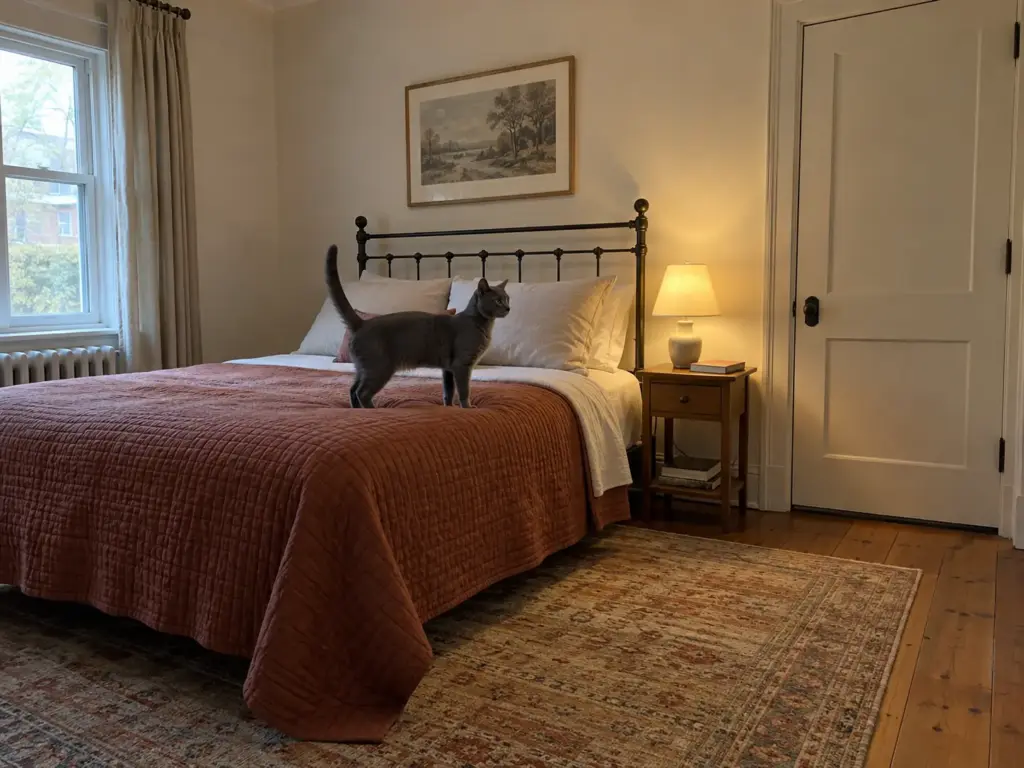
The carrier is on the floor, the newcomer has gone quiet inside it, and the hall door is right there, so it is tempting to open it and let the two cats sort things out. Can you introduce cats right away? Not by default: the resident cat is negotiating the whole apartment, and a closed door is how he gets time to do that before a stranger is standing in the middle of it.
A door and a blanket that smells of the other cat are not a delay, they are the first meeting, held at a distance both cats can manage. Below are one test to run before the door opens, a way to measure the escape route against your biggest cat, and what to do when the plan breaks in a rental.
Quick Answer
Not by default. Skipping the closed-door stage is defensible only if a short test passes first: the resident is at ease with other cats, the newcomer can leave the shared space, and both eat and use a box at the door. Any trouble sends the pair back behind the door.
What Introducing Cats Right Away Takes Out of the Plan
On day one the newcomer goes straight to a room of her own and the resident keeps the rest of the apartment. Three things happen behind that door, and a same-day meeting removes all three at once, so each gets one idea here; the order of the stages, room by room, is laid out in our walkthrough of introducing cats in a small apartment.
Scent Arrives Before the Faces Do
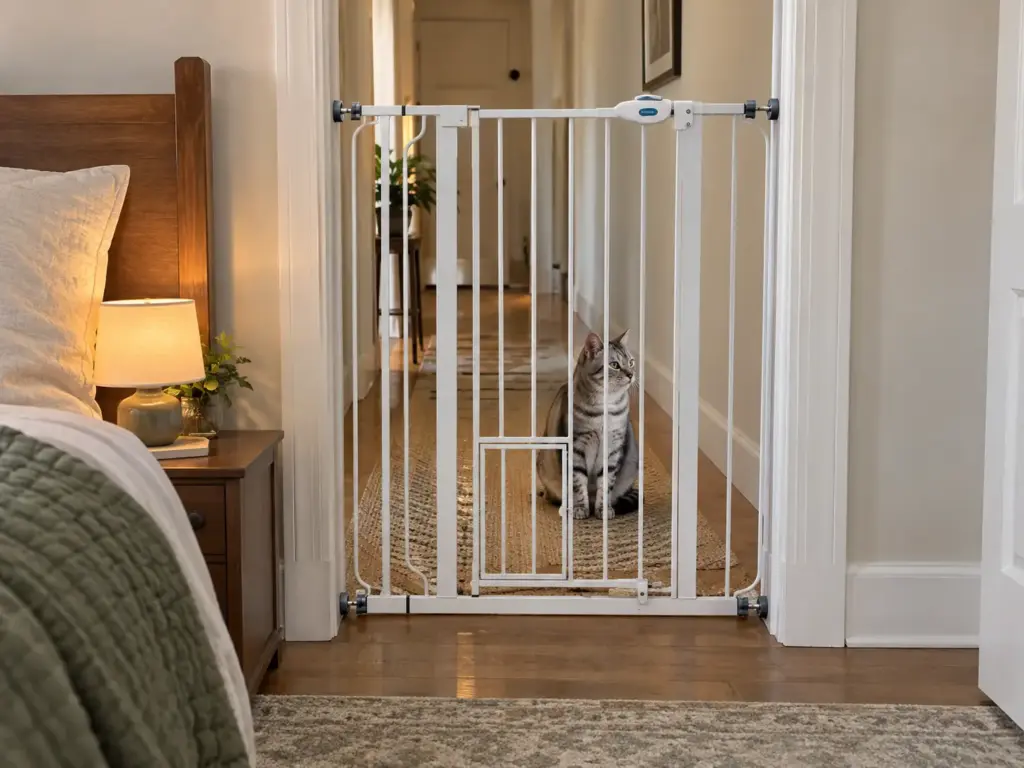
Cats read each other through smell long before they read posture, and a closed door lets that happen without anyone being stared at. American Humane’s guide to introducing cats is specific about the room: “Choose a room that has an inch or two of space under the door for feline introductions.” That gap is the channel. Smell travels through it, and neither cat can get a paw or a face through it, which is the right amount of contact for a first day.
PetMD puts the cost of getting this wrong in one line: “Even visual contact between cats can cause stress and start the relationship off negatively.” So the newcomer does not walk past the resident on the way in. She goes from the carrier to her room with the door shut, and the resident meets her as a smell under a door, which is a meeting he can walk away from.
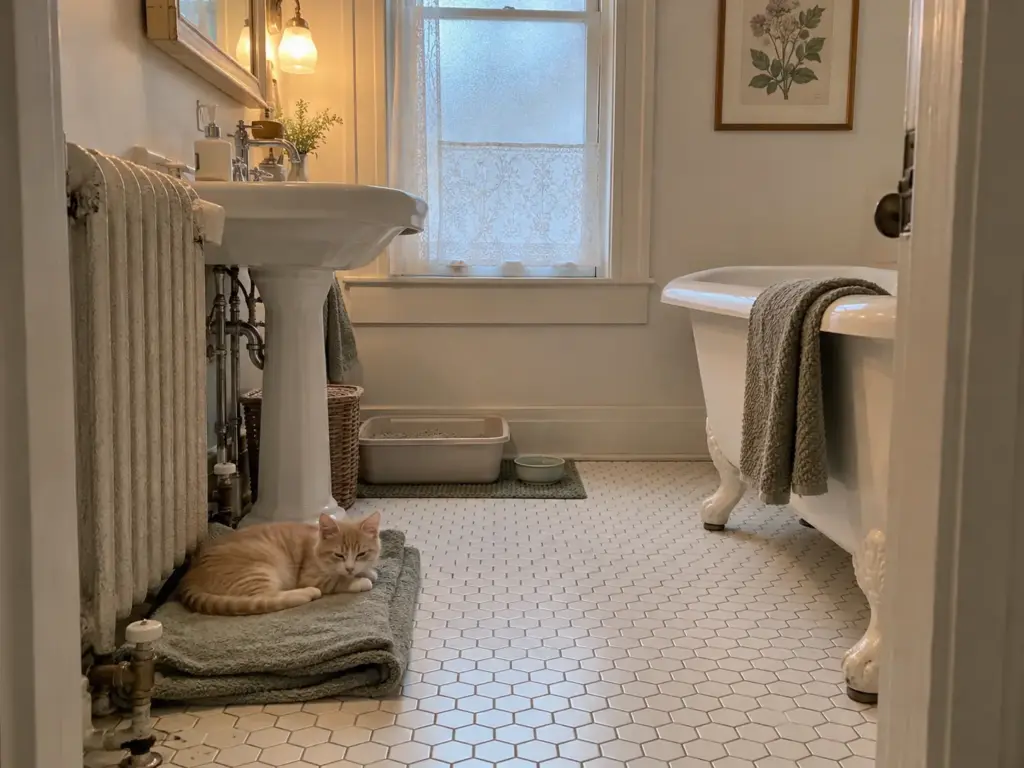
Before buying anything, look at the door you already have. Crouch in the hall and check the clearance under it: a thick rug or a draft stopper that fills the gap blocks the smell as well as the paws, so roll it aside before the newcomer arrives.
A Closed Door Gives Each Cat Time to Say No
The door also lets each cat refuse something before anyone has to hiss. PetMD suggests the two cats spend about 15 minutes alone in each other’s space while the door stays between them, so each one can walk through the other’s smell on its own terms. And because the same source puts every step at days or weeks, a skipped step is not a saved afternoon. It is a step done in front of the cats.
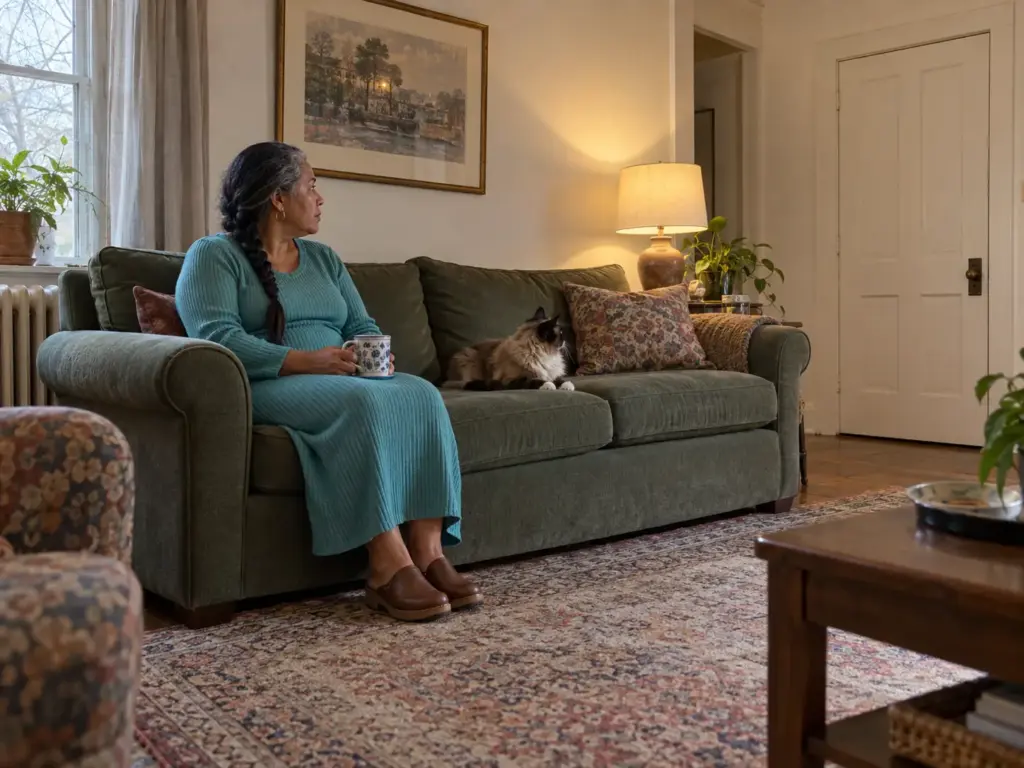
Meals on either side of the door are the quietest test of whether two cats can share a home. A cat who leaves his dish beside the door has given you an answer before anyone hisses. How to set up two feeding stations in a small home without one cat guarding the other’s dish is covered in feeding two cats in a small apartment, and the same stations are what the day-one test below uses.
The Barrier Is the Stage People Skip Last
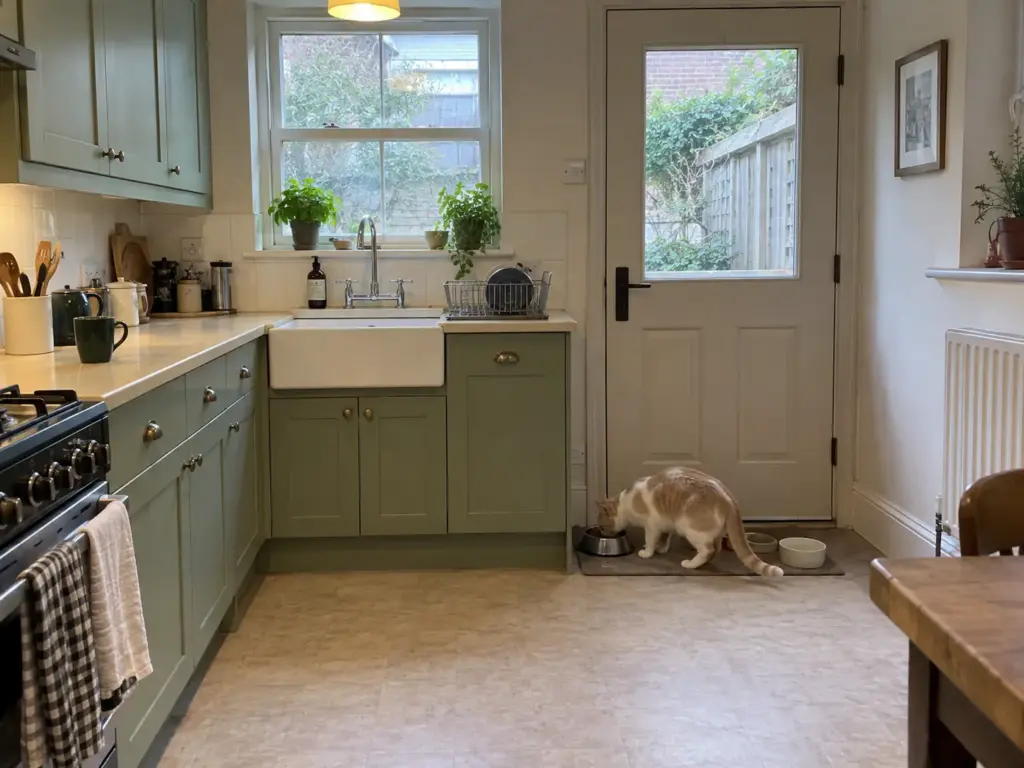
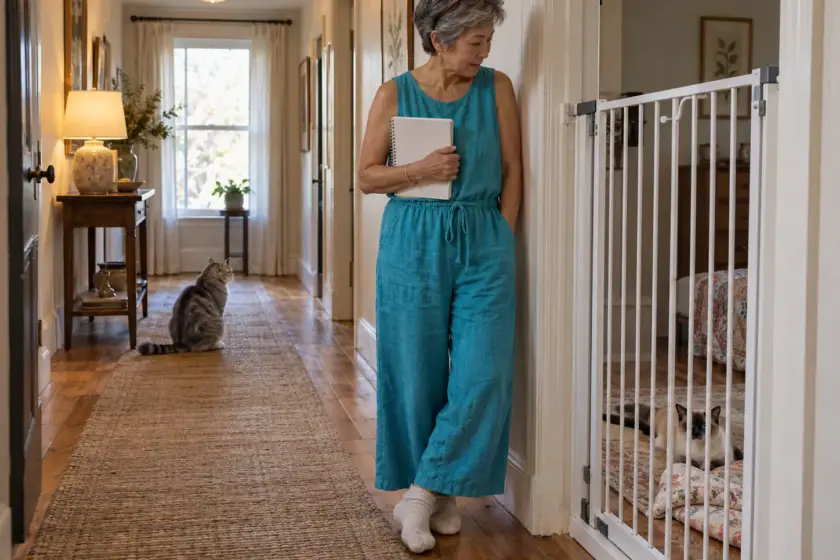
The first barrier is the door, and it is free. A barrier you can see across comes later, once scent and meals are going well, and that is where height starts to matter: American Humane says a baby gate is “usually not high enough for cats.” So the height of the barrier is the first thing to check.
The Carlson Extra Tall Walk-Through Pet Gate with Small Pet Door stands 36 inches tall, which is the figure to hold against your cat’s reach. It is a walk-through gate with a small pet door, so it fits a doorway you still need to use. What it does not do is stand in for the earlier stages: it lets the cats see each other, which is exactly the thing the closed door was holding back. Put it up on day one and you have given two strangers a clear view of each other.
Where a Meeting Ends and a Call to the Vet Starts
Some parts of an introduction are not furniture problems, and this is where they get named and handed over. A bite that breaks skin, a cat who stops eating or stops using the box after a meeting, and a fight one cat cannot walk away from all go to a veterinarian, because the apartment cannot explain any of them. (A meeting that went wrong in one of those ways is not the moment to adjust a gate.)
This article does not cover wounds, treatment, medicine, whether stress is behind something medical, vaccines or tests before two cats meet, or whether a particular pair is a match at all, which is a behaviorist’s call.
Not every rough moment is that. American Humane says there may be some hissing or swatting but that cats often work things out by themselves, and the concern is injury and trouble that keeps going for several days, not one bad minute. After the vet has seen the cat, the restart point is the last gate that held.
Skipping Isolation Works for Some Pairs, and the Claim Never Says Which
What American Humane, PetMD and Jackson Galaxy Agree On
All three put separation first. American Humane and PetMD both start with a separate room and a closed door, and Jackson Galaxy calls the no-peeking rule “non-negotiable.” The one voice pulling the other way is a video whose title promises you can introduce cats without isolation, the fast introduction every renter hopes for. The promise is in the title, and a promise like that arrives with conditions attached, which is the part that matters: the same shortcut that suits one household is a lottery for the next.
When the Introduction Went Fast
Some cats have come out of the bathroom base camp the same day they arrived. A same day introduction reads like a green light until you read the two conditions that came with it. The resident already lived with other cats, and higgig “purposefully only looked at cats that were known to get along with other cats.” Those two conditions are a history, not a method, and they become the first check of the test below.
The skip also happens by accident. Even a long, careful plan can end with each cat slipping out and joining the other without human permission. A door that does not hold produces the same skip with none of the preparation, which is why the room and the resident’s habits matter more than the plan on paper.
From the resident’s side the point is the same: you cannot trust the current cat to behave when his territory access is restricted at all. The resident is the test. A cat who has been shut out of part of his own home is not in the mood to meet anyone, and skipping the separation is a lottery with a very unlikely payout. The cat is right about the constraint: it is his house, and the plan that ignores that fails at the door.
Why “It Worked for Us” Is Not a Rule
A pair who got along on day one is a result, not a method, and “no isolation” is a result with conditions. The same afternoon with a different resident goes the other way, and the cost is real: rushing introductions undermines the cats’ ability to establish their relationship and could cause more aggression overall.
What a rushed meeting costs also depends on the goal you hold. PetMD notes that “with some, peaceful co-existence may be the goal rather than them becoming friends.” Two cats at peace at opposite ends of the sofa is a real outcome, and it is a different outcome from two cats who have to share a room every night after a bad first meeting.
As for the clock, PetMD says progress “could be days or weeks for any step of the process,” which is a number that depends on the pair and not on the calendar. The gate counter that turns that into a decision is in how long before introducing cats, so it is not repeated here.
The Day-One Test Before Any Door Opens
The test sits between “I hope” and “I checked.” It decides whether this pair is one of the few that can skip separation, it has four checks, they run before the handle turns, and one “no” ends it.
The Pair’s History
Start with what you already know, because it is the cheapest check and the one that rules out most pairs. Has the resident lived easily with other cats? Is the newcomer a cat who was known to get along with them, according to the shelter, the foster or the home she came from?
Both answers need to be yes. If you do not know, the answer is no. An unknown history is the lottery, and a call to the shelter or foster is a better use of the evening than a hopeful open door.
Eating and the Box at the Door
Put the resident’s bowls where he already eats, put the newcomer’s bowls on her side of the closed door, and set each box where its cat will use it. The resident eats beside the closed door without hesitating and uses his box as usual. The newcomer does the same on her side.
A cat who skips a meal beside the door, or who detours around the box that sits near it, has given you a “no.” (If a cat then stops eating or using the box for good, the test is over and the earlier section on the vet applies. The house has nothing more to say.)
Run the read at mealtime, when appetite is the clearest signal, and write down who ate and what each cat’s ears were doing. A page of notes makes the decision, not the hope that it went fine.
What Body Language Says Through the Gap
At the gap under the door, you see one cat at a time as each one finds the other’s scent, never both together. PetMD lists the signs of a rough meeting: ears flattened against the head, a rigid posture, fur standing on end, bared teeth and dilated pupils. The positive signs are ears pointed forward, a loose posture, and a tail straight up or slightly curled with the fur flat.
Read them at the door, where a cat can still turn and walk off, and not in the room, where he cannot. The stop signs the guides give for a meeting itself add swatting and chasing to that list, and each of them means go back a step.
So the test has four checks: the pair’s history, eating at the door, the box near the door, and the posture of each cat at the gap. The rule is all or none. One “no” sends the pair back to the stage list in the walkthrough, and the door stays closed today.
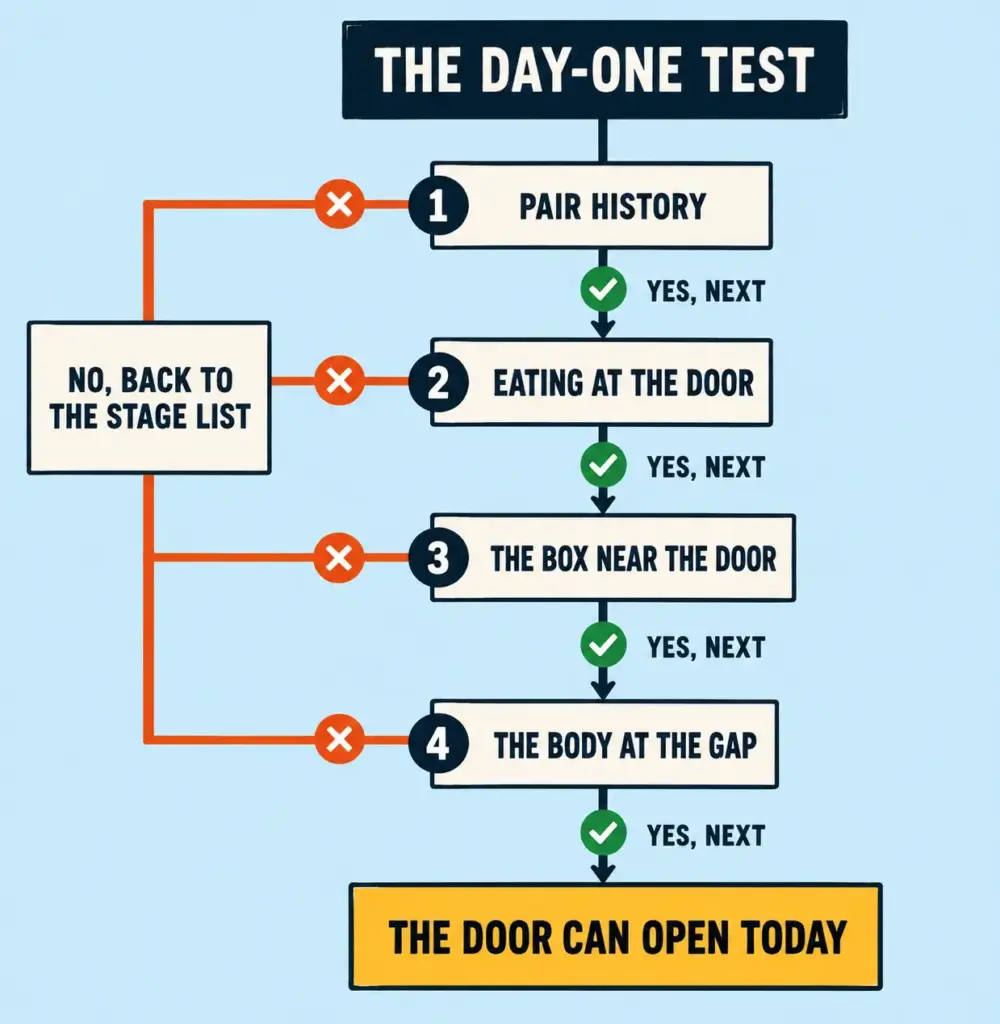
- History: the resident has lived easily with other cats, and the newcomer is known to get along with them.
- Eating: both cats eat beside the closed door without hesitating.
- Box: both use their boxes near the door as usual.
- Posture at the gap: ears forward, a loose posture, a tail up or slightly curled with the fur flat, and none of the negative signs.
Keep this list as the page you write on. What each cat did goes next to each line, so the decision comes from the page.
And be clear about what a pass buys you: a short supervised meeting today, not a forecast of the first week. The test cannot predict that. The cost of being wrong is American Humane’s stop point, problems that keep going for several days, and the answer to that is the last gate that held.
Measure the Escape Route Against the Biggest Cat in the House
Why a Shared Room With No Exit Turns a Sniff Into a Standoff
Jackson Galaxy makes the point about a crate in the living room: a newcomer in it has “no way to escape,” and “cats feel safest when they know they can retreat, hide, or climb away.” The crate takes the route away from the newcomer. A one-room apartment takes it away from both cats, and a sniff becomes a standoff when neither can leave.
So the question when two cats share one room is not whether they like each other. It is whether either of them can get out of the other’s way. The resident, whose territory is being shared, has the least choice of anyone, and a cat who has no choice does the only thing left to him.
Mark the Stretch on the Wall Before You Move Anything
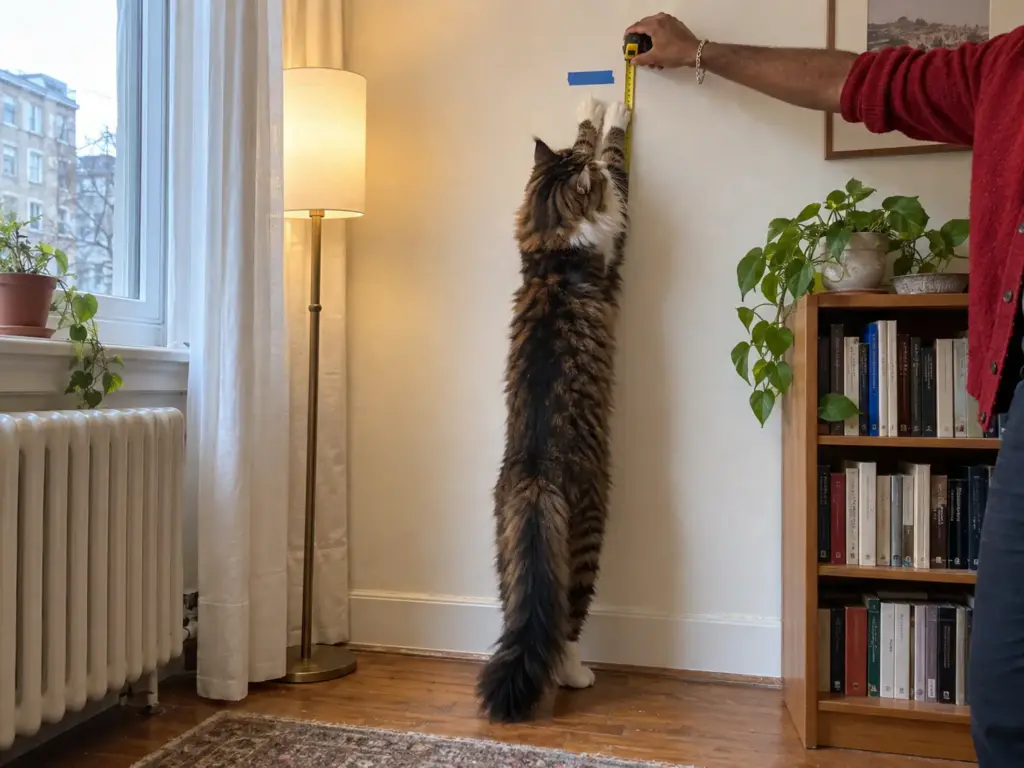
Measure against the biggest cat in the house, not the average one. Stand him against a plaster wall at full reach (a treat held up the wall gets him there on his own) and mark the top of his reach with painter’s tape, which comes off clean in a rental. The retreat spot has to sit above that mark and be reachable by the cat that needs it.
A big cat’s mark can sit higher than the spot you would have picked. And the mark is a floor, not a guarantee, because a cat can also jump, and this article puts no number on that.
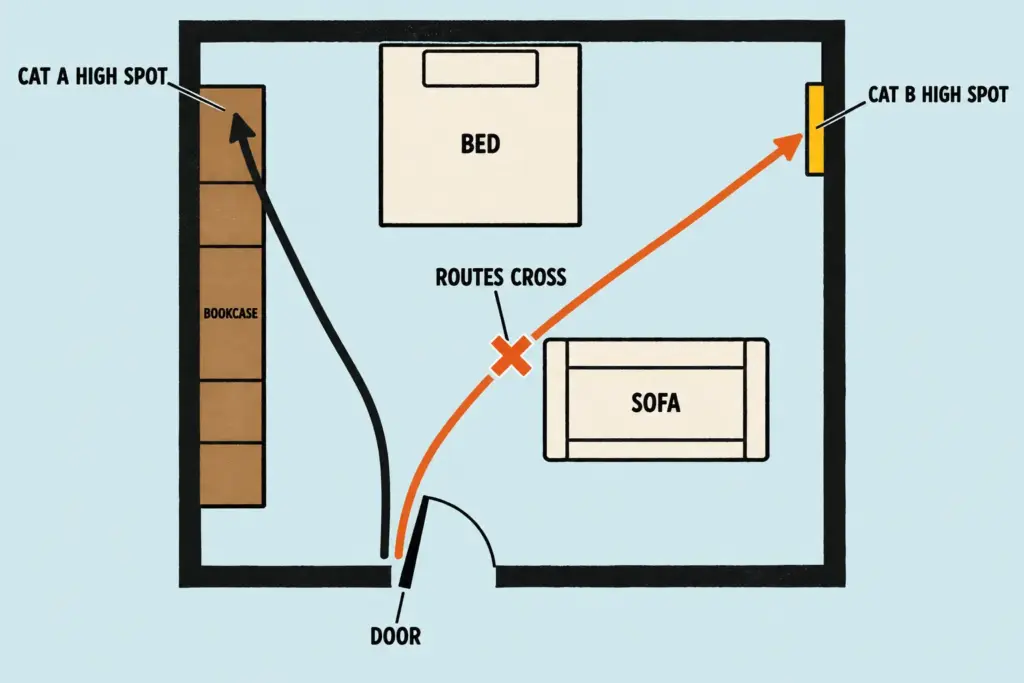
The cat that needs the spot may be the one with the shortest legs. A compact, heavy cat gets up in steps, a chair, then the sofa arm, then the shelf, where a lean climber goes straight up. A spot that passes the tape test but needs a leap the cat will not take is not a retreat. It is a decoration.
Stand the cat’s reach against the wall at the end of a play session, when he stretches on his own, and mark it then. A cat asked to stretch cold will not give you the real number.
The Free Version: A Shelf or Furniture Top the Cat Already Uses
Use what the cat already climbs or hides in: a shelf, a window ledge, a bookcase top, the back of a sofa that sits above the tape, or a hiding spot under the bed. No drilling, no brackets, nothing to buy. The best spot is the one a cat already likes, because it doesn’t ask him to learn anything on the worst day.
If no spot in the room passes, that is a “no” for skipping, and it is also the free answer to whether you need a second room. The one thing to see before the door opens is both cats using their route without crossing the other’s path.
When the Door Does Not Hold in a Rental
The Resident Who Scratches Until the Door Opens
Picture a resident who will scratch at the door until it opens, with an immediate neighbor on the other side (thin walls). A door holds only as long as the resident accepts it. A cat who has been shut out of part of his home can end up having trained you rather than you training the cat, and the hallway stops being a barrier and becomes a conversation.
The answer in a rental is routine, not hardware, because a fast introduction needs a second room most renters do not have. Feed the resident on the far side of the door at his usual times, keep the quiet hours quiet, and make the door where good things happen. It is slower than a lock and it works with the cat instead of against him.
The Cats That Slip Out and Meet Without You
Sometimes the skip happens anyway: the door was not latched, the carrier was opened early, the newcomer got out. Hissing and swatting are common, and American Humane says cats often work things out by themselves.
If the first meeting went badly, go back a step, to the door and the meals, and do not start over. A step back is not a failure, and it is the cheapest correction there is. A cat who is hurt in the scuffle, or who stops eating or using the box, goes to the clinic, as the earlier section says, and the answer stops there.
One Bathroom, Thin Walls and a Newcomer Who Will Not Settle
The bathroom is the room everyone names as base camp, and in a home with one bathroom it carries a cost the advice rarely mentions: two cats, two people and one door. The newcomer’s own box goes in there with her, and the household has to plan around that. PetMD’s rule is one litter box per cat plus one, which is covered in how many litter boxes for two cats, and the room itself gets its own treatment in putting a litter box in the bathroom.
When there is no bathroom with a door, the answer is short: no bathroom with a door? Be creative.
Another, living in 350 square feet, used a very large crate with the essentials and a blanket over the top for privacy. The resident “came out into the area around his crate to play for the first week.” Treat a crate like that as a bedroom the cat can leave, not a cell.
Thin walls make a newcomer who cannot settle a landlord problem as well as a cat problem. The free answer is the pace of the meals and the quiet hours, not a product, and it asks the household to hold a routine for longer than feels reasonable.
Settle the Escape Route and the Test Before the Door Opens
Three things carry from this article. The default is no, because a closed door and a smell are the first meeting and skipping them puts the cats face to face on the worst day. The day-one test is all or none, and it runs at the door, with the cats’ history, their meals, their boxes and their posture at the gap. And the retreat route gets measured against the biggest cat before anything opens.
Three weeks after the door opens is the time to look again: if both cats still eat and use their boxes without detours, and the household routine still holds, the change has held. If a detour has appeared, the pair goes back to the last gate that held.
Today’s step needs nothing from a store. Mark the biggest cat’s reach on the wall with painter’s tape, pick the retreat spot that passes it, and run the test at tonight’s mealtime, with the page and a pen next to the bowls.
Frequently Asked Questions
01Is it okay to introduce cats right away?
Not by default, because scent and a closed door give each cat time to react before the two meet face to face. The exception is a pair that passes the day-one test: easy history, both eating and using the box at the door, calm posture at the gap.
02How long should you wait before introducing your cat?
Each step takes days or weeks, according to PetMD, and what ends a step is what the cats do, not the date on a calendar. The article on how long before introducing cats has the gate counter that turns this into a decision.
03Can you introduce cats in a studio with only one door?
Yes, in stages: the bathroom or another closed room is the newcomer’s base, and a tall gate across a doorway handles the see-through stage later. The full order is in the walkthrough of introducing cats in a small apartment.
04What if the cats met by accident on the first day?
Hissing and swatting are common, and cats often work things out; the concern is injury or trouble that lasts several days. Go back one step, to the door and the meals. A bite that breaks skin, or a cat who stops eating or using the box, goes to the vet.
05Is hissing normal when cats first meet?
Some hissing and swatting is common, according to American Humane, and one rough minute does not end an introduction. A no on the day-one test sends the pair back behind the door, and trouble that lasts several days means stepping back further.
Leave a comment