Best Pet Hair Remover Worth Buying After the Free Fixes
Best pet hair remover by spot: a chamber roller for the couch, a three-groove tool for the cat bed, a sticky roller for shirts (free fixes first).

Alfredo RamsesFounder · Updated October 30, 2026 · 17 min read


On this page9 sections
- 1What the Best Pet Hair Remover Does With the Hair After the Pass
- 2Free Fixes First: A Mist, a Rubber Broom, and the Squeegee That Backfires
- 3The Chamber Roller Keeps the Hair, If You Check the Latch
- 4Rubber and Latex Surfaces Work on Fabric and Fail on Rugs
- 5Cat Bed and Cat Tree: Small Surfaces Need a Small Tool
- 6The Last Pass on Clothes, and the Disc That Rides in the Drum
- 7What Is Worth Buying After the Free Fixes, and What to Skip
- 8Start With the Mist, Then Buy for the Spot Your Cat Picked
- 9Frequently Asked Questions
You have a drawer with three hair tools in it, and the cushion your cat chose is furry again by evening. The tool did not fail because it was cheap or because it was the wrong brand. It failed because of what it does with the hair once the pass is over, and it was bought without a thought for which spot in your apartment the cat picked first.
This is the best pet hair remover answer that starts there: free moves first, then what each kind of tool does with the hair, then the few purchases worth making. The picks come from lab tests by Wirecutter, Good Housekeeping and The Guardian, plus Consumer Reports’ method of counting passes, read against the place where a cat actually sleeps.
The table sorts the options by what each one does with the hair, one row per kind of tool.
| Tool type | Where it works | What it does with the hair | Where it fails |
|---|---|---|---|
| Free first: mist and rubber broom | Upholstery and throws, one corner at a time | Dampens the hair, then drags it into a line you lift by hand | A squeegee balls the hair into a wad; water can mark some fabrics |
| Chamber roller | Couch cushions and the cover of a cat bed | Keeps it inside a chamber | The latch can pop open; too large for shirts |
| Rubber-face glove | Throws, blankets and cushions | Lifts it by friction; the glove washes | Rugs, and some fabrics (a tested glove did poorly on cotton) |
| Small-groove hand tool | Cat beds and cat trees | Pulls it out of seams a big tool cannot reach | Small grooves do little; it can leave stains; not for clothes |
| Sticky roller | Clothes, as the last pass | Holds it on the sheet; tear off a layer when full | A spent layer is spent; wrong tool for the first pass |
| Laundry disc | Washer and dryer loads | Collects it in the drum | Laundry only; does nothing for the couch |
What the Best Pet Hair Remover Does With the Hair After the Pass
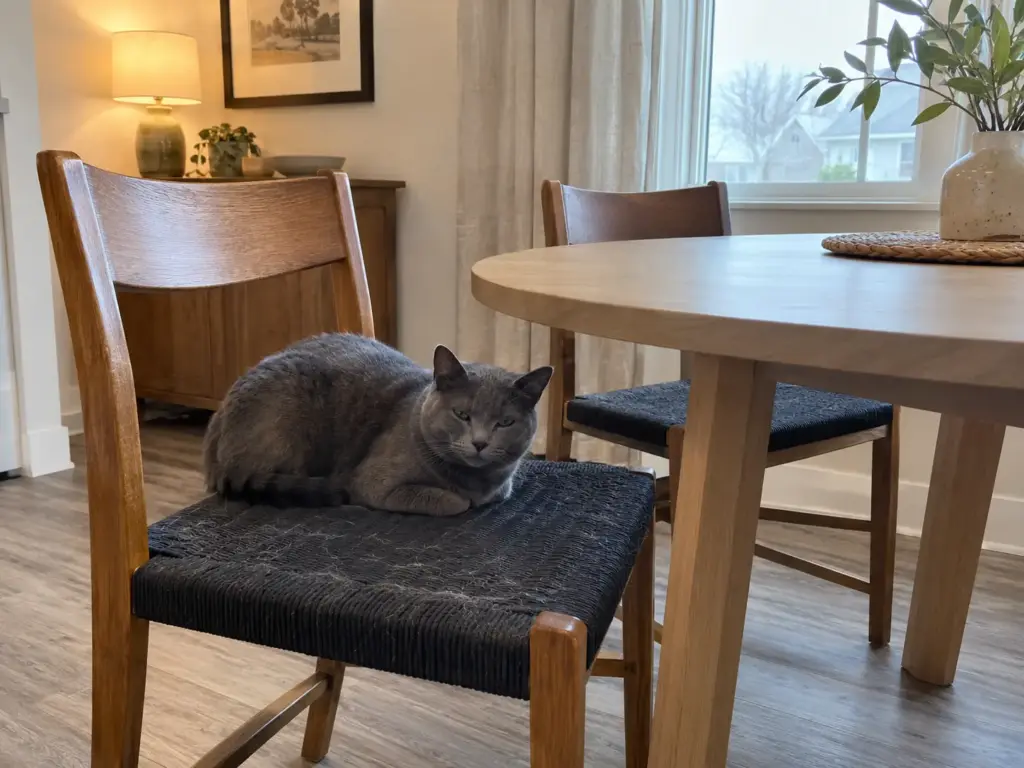
What a pass actually does: keeps, piles, snags or drops it back
Most of the work of clearing cat hair around the house without moving it comes down to one question about each tool: where does the hair go once the tool lets go of it? There are four answers. It goes into a chamber and stays there, it moves into a pile on the surface, it snags in the weave, or it drops back onto the cushion a few passes later. A tool that looks clean after one stroke has told you almost nothing.
Good Housekeeping’s tests found both of the bad answers. A long-handled carpet brush “redeposits hair after a few passes,” and a furniture brush “gathers hair into piles rather than removing and containing it.” A pile looks like progress for about a minute. Then it is a second chore with the same hair in it.
The keeper has its own failure, and it is the mechanical kind. Wirecutter’s staff pick holds the hair in a chamber, and its latch “has popped open on its own a few times.” You can check a latch in two seconds, which is why I would rather own a tool whose weakness is that one than one whose weakness is physics.
The free option people reach for first sits in the same trap. A squeegee dragged across fabric balls up the fur: the cushion looks tidier for a moment, and what you are holding is a wad that still needs picking up by hand. A wad is not a result.
The spot decides the tool, not the rank
Consumer Reports built its test around where cats actually settle: four cats lounging on a couch with velvet-cased pillows. The Guardian’s tester watched a cat nap on black dining chairs, which is a different surface asking for a different pass. Neither test started from a ranking. They started from a cat who had already made a choice.
So do the same. Find the one place your cat has claimed (the velvet cushion, the dining chair, the bed in the corner) and buy for that surface first.
A roller wins on the couch and loses on the cat’s own bed, and the bed is the spot that collects hair every day because it is where he has decided to sleep. The cat did not make a mess. He picked the warmest soft surface in the apartment, and hair is what warm soft surfaces collect.
Count passes, not stars
According to Consumer Reports, “We evaluated all of these options for overall effectiveness, as well as the number of passes required to achieve a minimally linty surface.” That second half is the useful one, because a star rating averages over fabrics you do not own, while a pass count happens on your cushion.
Try it at home. Pick one cushion, and count the strokes it takes until your palm comes back clean when you drag it across the fabric.
A tool that needs five passes on that cushion is a different purchase from one that needs two, even if the box says the same thing about both. The number also moves with the weave: the same tool can take two passes on a smooth cover and five on a plush one. Long hair and short hair lie differently on the same cushion, too, so count on the fabric and the coat your cat brought, not the fabric in the store photo.
Free Fixes First: A Mist, a Rubber Broom, and the Squeegee That Backfires
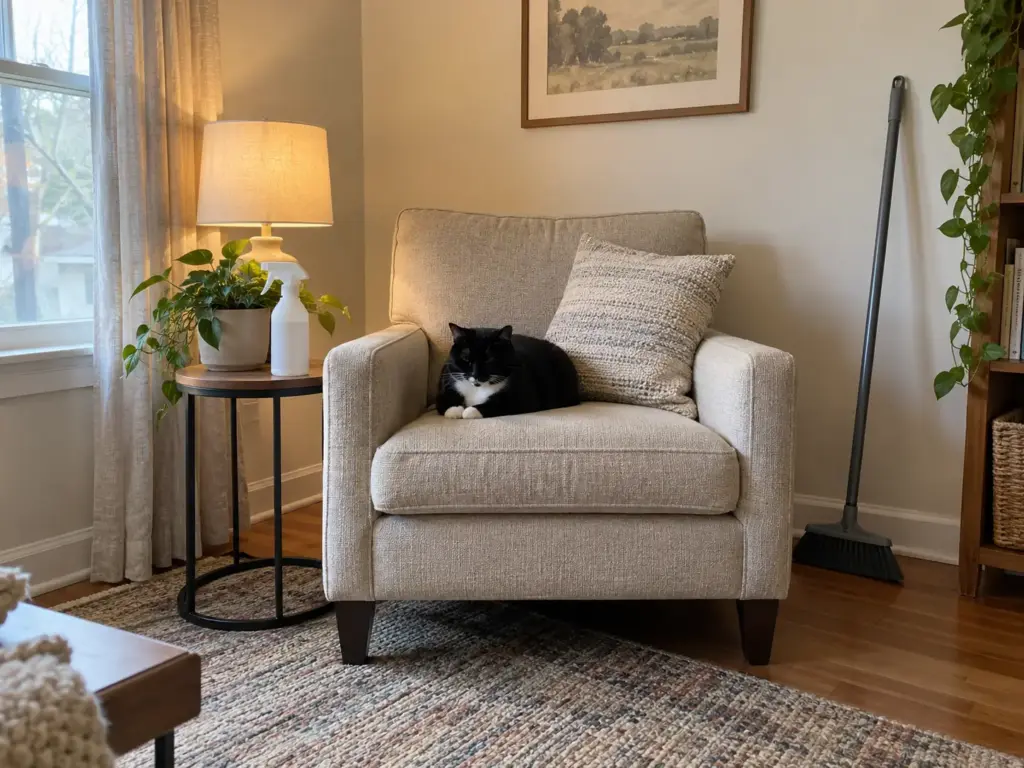
A light mist before you wipe or vacuum, after a corner test
The cheapest move in this article is a spray bottle of plain water. The habit is one light mist over the fabric before you wipe or vacuum, and the logic holds up: damp hair stays put long enough to be lifted instead of floating off and settling a foot to the left. It costs you a spray bottle you probably already own.
One condition. Water leaves a mark on some upholstery, so mist a hidden corner first (under a cushion, or the back of the couch where nobody looks) and check it once it has dried. If the corner stays clean, mist the visible part lightly, not until the fabric is wet. The fabric decides how much water it forgives, so read the tag under the cushion first; the couch guide holds the fabric-by-fabric detail this section skips.
Mist the hidden corner, then wait until it is fully dry before you judge it. Meanwhile watch what the hair on a neighboring dry patch does when you drag a hand across it: if it rolls into a clump, a rubber surface will gather it; if it clings flat, you will want something that grips, like a chamber roller.
A rubber broom on upholstery
The second free move is a rubber broom on furniture. A rubber edge dragged across the fabric in one direction gathers the hair into a line, and the line goes into your hand or the trash. If a rubber broom is in the closet, you are done shopping for the day.
Rugs are a different job, and the cheap tool people keep naming for them is a stainless steel carpet rake. The Guardian’s tester sets a rake at about 45 degrees on low-pile carpet and car mats and at about 90 degrees on plush rugs and sofas, so stand it nearly upright on the couch and lay it flatter on the carpet. Same tool, two angles.
The squeegee that balls up the fur
The squeegee is the most common free suggestion, and for cat hair on fabric it is the one to skip. That is the “balls up the fur” complaint: you pull the blade across the cushion and the hair turns into a wad you still have to pick up. The rubber broom is the version people prefer, because it leaves a line instead of a wad.
There is a quieter reason to start with these three. Every paid tool later in this article is scored by how well it beats a mist and a broom on your fabric. Without that baseline you are guessing whether the purchase did anything. With it, a tool that clears the same cushion in two passes instead of five has earned its place, and one that does about the same as the broom has not.
The Chamber Roller Keeps the Hair, If You Check the Latch
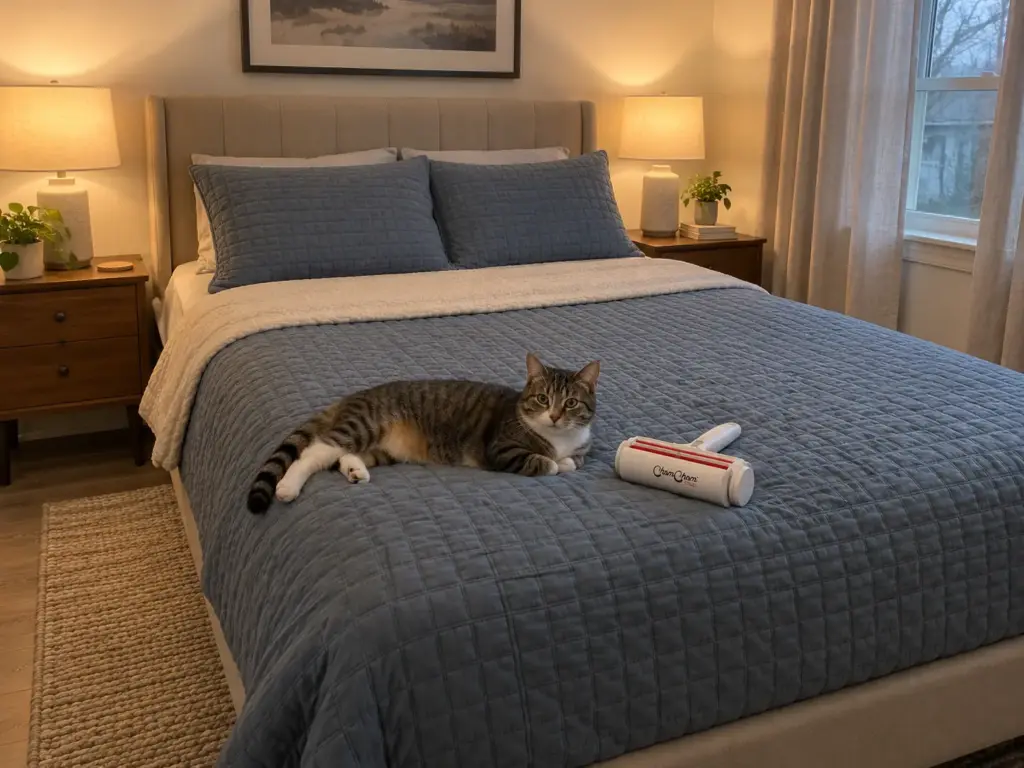
Where a chamber earns its place
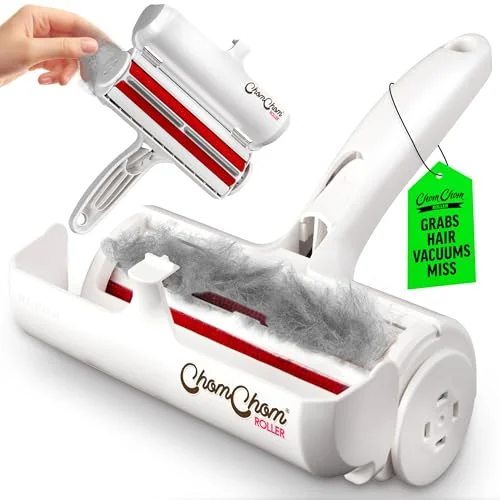
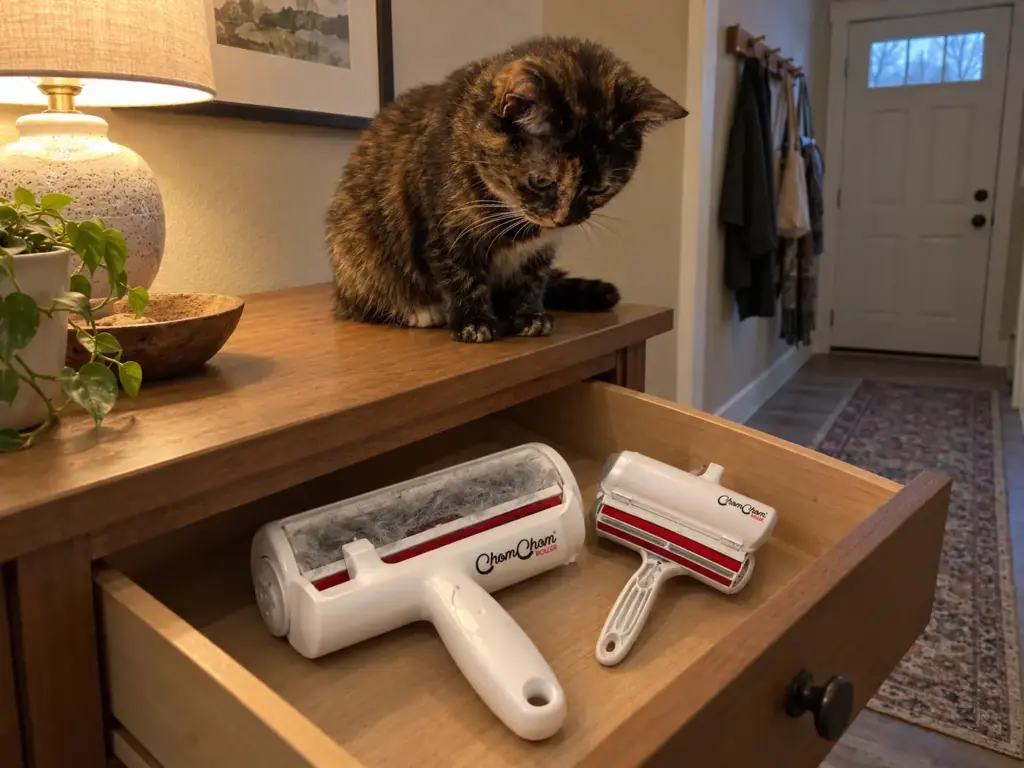
The first purchase worth considering is the one that answers “the hair came back.” A chamber roller pulls the hair off the surface and keeps it inside the tool, so it cannot drop back onto the bed on the next pass. Good Housekeeping named the ChomChom, a pet hair remover roller with a chamber, its best overall, and Wirecutter made it a staff pick. It is reusable, so there are no refill sheets to run out of, which suits a drawer that only has room for one tool.
It is not a universal pick, and it helps to say where it loses. The Guardian does not recommend it for value, and on a flat cushion the free moves above deserve a try first. The obvious pick stops being obvious on a cat bed with seams, which the next section gets to, and on clothing, which comes up below. Where it wins is the big flat surfaces the cat favors: couch cushions and the cover on the bed where he sleeps.
The latch, and the size on clothing
The latch is the check. Wirecutter’s reviewers had it open on its own a few times, so close it, hold the roller upside down over a sheet of paper and give it a shake before you tip it over a bed. If nothing falls out, it is fine for that session.
Empty the chamber before it is full, not after. A chamber that is already packed leaves less room for the hair to roll in, so the roller starts acting like the pile tools it was meant to replace.
The roller measures 2.5 x 7.5 x 7.5 inches, and Good Housekeeping found the large size makes clothing harder to clean. So treat it as a couch-and-bed tool, not a shirt tool. For the shirt, the order of washing and passes does more than any roller, so fix the order, not the roller.
A chamber is a fixed size, so the number of cats matters even though no test counts it. One cat fills it slowly. With several cats it fills fast, and you empty it twice in a session instead of once.
Rubber and Latex Surfaces Work on Fabric and Fail on Rugs
Friction lifts the hair; fabric decides how well
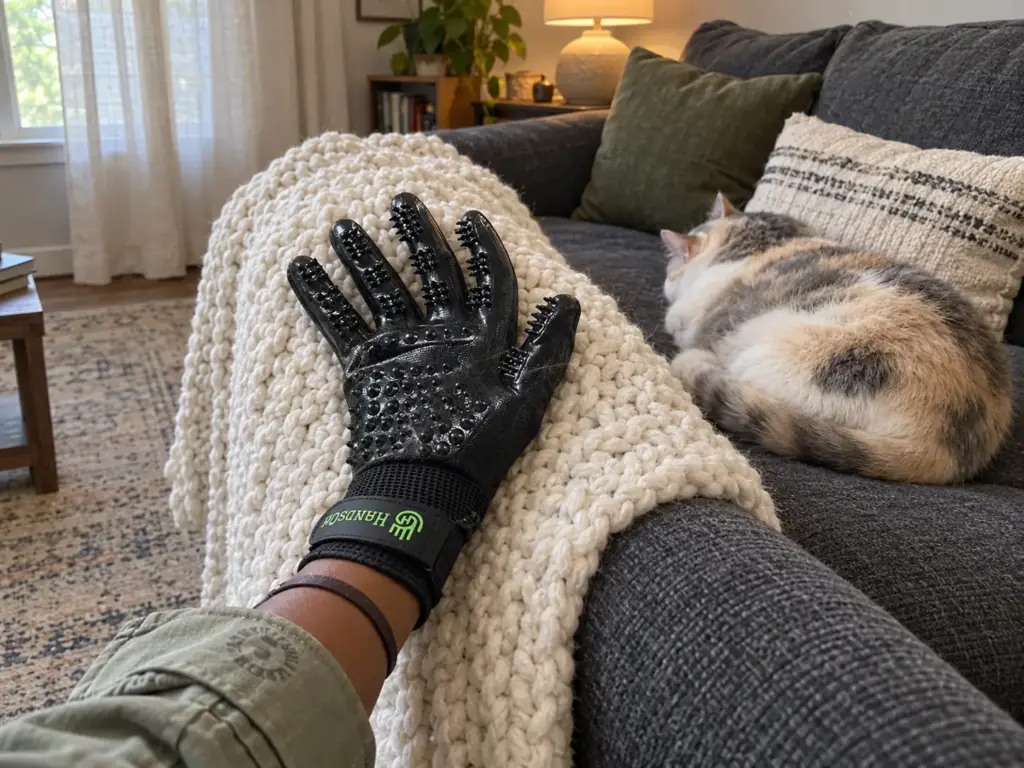
A rubber face works by grip. Drag it across a throw or a cushion and the friction pulls the hair loose and into a ridge, with no sheets to peel and nothing to refill. For the cat’s blanket and the sofa throw, after the free moves, a pair of HandsOn Pet Grooming Gloves gives you a washable rubber surface in a five-finger shape, in the Large size (one pair). What this glove has not earned is a track record: no repeated complaint turned up for this listing, and that is not the same as a clean record.
The fabric changes the result more than the glove does. The Guardian tested a different rubber glove that did poorly on cotton, so test any glove on the throw first, in a corner, before you commit the whole sofa to it. Same logic for a dry latex sponge: YourBestDigs (2022) found one very effective on upholstery, blankets, pet beds and car seats.
Not for the rug
The same friction that works on a throw stops working on a rug. On a rug the hair sits down in the pile, below where a rubber face skims, and the sponge’s own testers said you “can’t really use the sponge on a carpet.” A glove runs on the same logic and has the same limit. For rugs, go back to the rake in the free section; for anything you can lift and shake, a glove is the better-behaved tool.
Cat Bed and Cat Tree: Small Surfaces Need a Small Tool
Why a big roller misses the seams of a cat bed
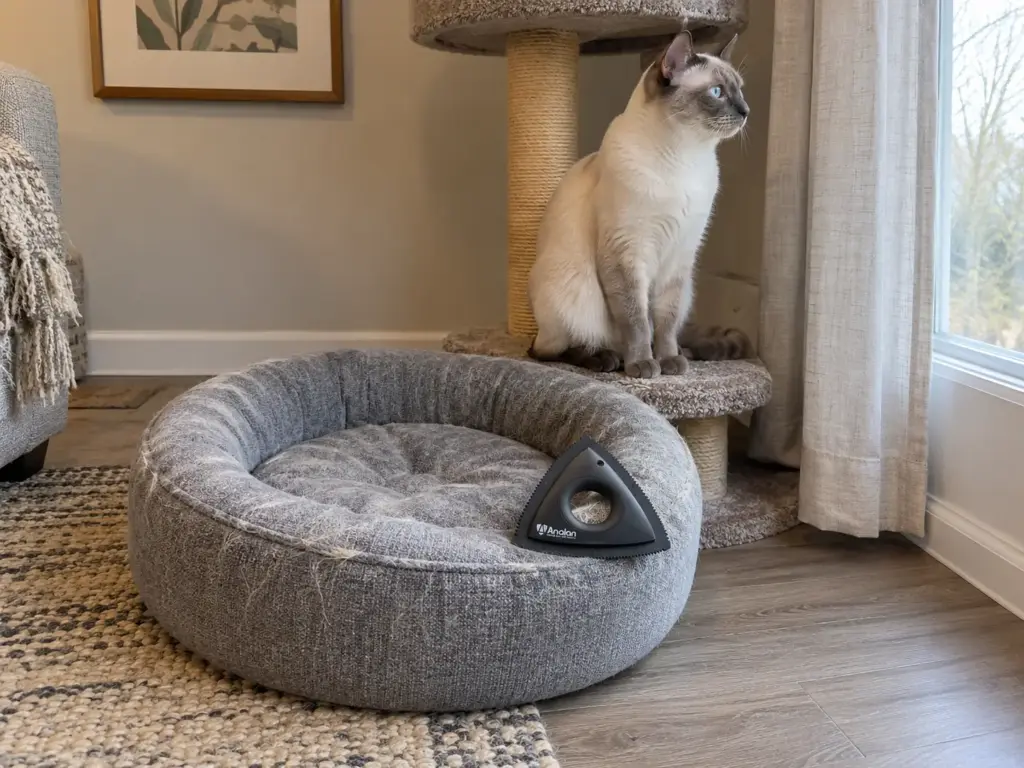
The cat’s own bed is the smallest surface in the house, and it usually gets the biggest tool. The Guardian found that a general-purpose hand remover “doesn’t work as well on smaller surfaces such as cat trees or cat beds,” and the same tester named a small three-groove tool as the pick for exactly those two. That is the measurement most people never make: not the tool’s size on its own, but its size against the thing it has to reach.
Picture it with a roller in hand. You run it over the cushion in the middle of the bed and the middle looks fine. The hair lives in the seam where the cushion meets the wall of the bed, and on the perch of a cat tree where he lies, in places a 7.5-inch roller cannot get its edge into.
There is no inch figure that settles this, so measure against the bed itself: if the tool’s edge will not sit down inside the seam, it will not clear it. (If you only have a roller, a rubber broom can reach the flat part, and you leave the seam for the right tool.)
None of this is the cat’s doing. He chose the bed, and hair is the evidence that he uses it, which is what you wanted when you bought the bed. The tool just has to fit what the cat gave you. And the seam, not the open middle, is where the hair collects, so any tool that cannot reach it leaves you cleaning the same bed again next week.
The large groove, and a corner test
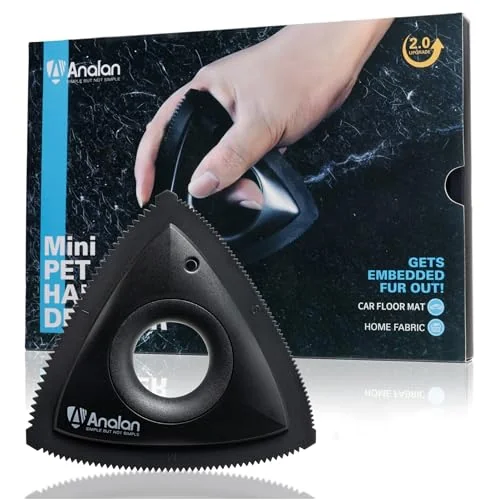
The small tool in question has three groove sizes, fine, medium and large, and the Analan Mini is the one The Guardian picked. The groove you use matters more than the brand. YourBestDigs (2022) called the small grooves “pretty useless” and found the large grooves had more success, so start on the large one and move down only if the hair is fine and stuck.
It was “not great” on area rugs, and the same tester got nothing from car seats, so do not expect it to double as a couch tool. Reviewed.com flagged that it “may leave stains,” which is why the corner test comes first on a pale or dark bed. It is the cheap option in the whole lineup. But it was never meant for clothes.
Start on the large groove, in a hidden corner of the bed, and look at the fabric once it settles. If the hair comes with it and the fabric looks the same, work across the seam; if the fabric looks different, stop there and pick another tool.
The Last Pass on Clothes, and the Disc That Rides in the Drum
Sticky rollers are the last pass on a shirt, not the first. The Evercare Easy-Store Mega is a pet lint roller with 50 sticky sheets, so when one fills you tear it off and keep going instead of throwing the whole tool away. The limit is built into the mechanism: a sheet that has filled is finished, so it earns its place at the doorway, not on the couch. Reviews of this listing were not read for this guide, so there is no known complaint, and that means untested, not proven.
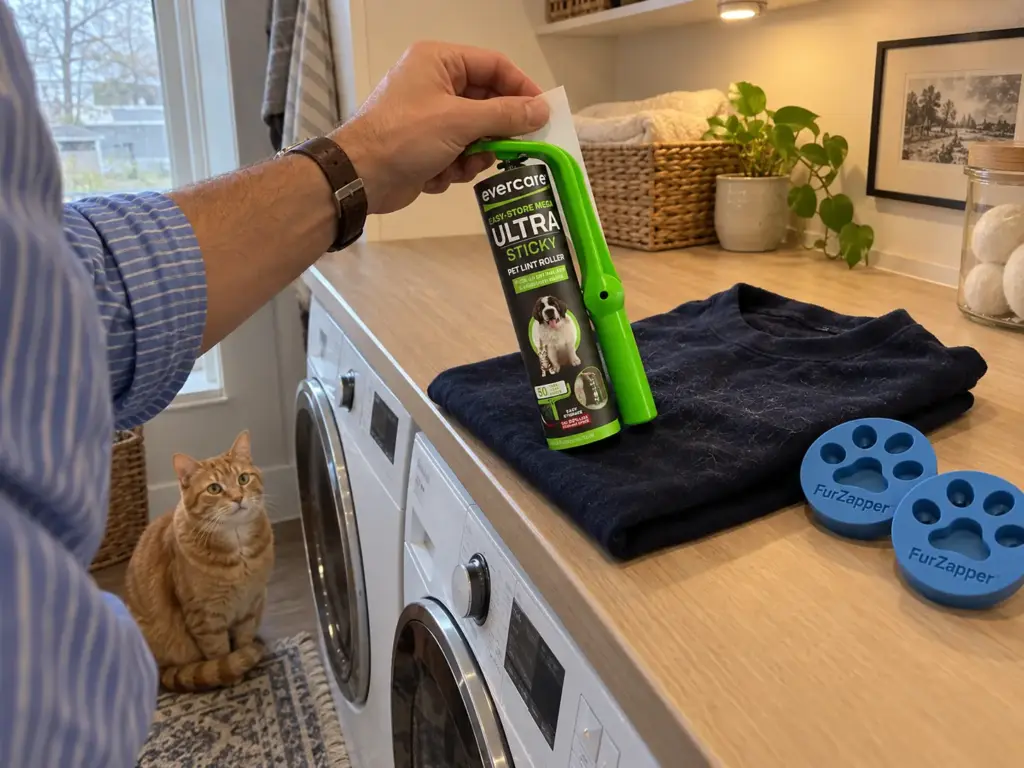
For the wash, a reusable disc is The Guardian’s laundry pick. The FurZapper comes as a pack of two, and unlike a disposable dryer sheet it is a laundry tool you keep: it rides in the drum with the load and collects the hair there, while the dryer’s lint trap catches what comes loose.
No flaw is on record for it either, and the listing gives no size in inches, so read the page before you count on it fitting your machine. Pair it with using the dryer you already have, which does most of the work before any disc does. And for bedding, check the basket first, because the washing machine follows the same logic.
What Is Worth Buying After the Free Fixes, and What to Skip
Pick by where the hair lands, then by what the tool does with it
Match the spot to the mechanism. Couch cushions and the cover of the cat’s bed: a chamber roller or a rubber surface. The cat’s own bed seams and the cat tree: the small tool, large groove first. Clothes: the sticky roller last, with the disc in the drum for the wash.
In a small apartment with room for one drawer and one purchase, it is the chamber roller for the spot he uses most, and everything else can wait until a pass count says otherwise.
One cat or several changes the order
Nothing in the tests counts cats, so this part is logic. More cats fill a chamber faster and use up sticky layers faster, so in a multi-cat home the cheap sheet roller and the disc move up, and the chamber stays where it was. The Guardian’s testers worked in an 850-square-foot home with three cats, so a crowd is a realistic case, not an edge one.
Start with the spot all of them share, then work outward, and the guide to fixing where the hair lands picks up the next step once the tools are chosen.
The one to skip, and why
Skip the small grooves, the squeegee, and any tool that “gathers hair into piles” for a cat that sheds on fabric. A tool that piles is a tool that leaves you the second chore. A sudden jump in the amount of hair is a question for your vet before it is a question for a better roller, and when shedding stops being a house problem is where that line gets drawn. Then back to the cushion.
Start With the Mist, Then Buy for the Spot Your Cat Picked
Three things to take with you. Free first: a mist and a rubber broom set the bar every paid tool has to beat. Match the tool to the cat’s spot, because the cushion, the bed and the dining chair each want something different. And of everything above, the chamber roller for couches and covers and the large groove for the cat’s bed are the two that earn the money.
Look again in three weeks. Run the same palm test on the same cushion: if less hair comes away and the broom is still on its hook, the routine held; if the cat has moved to a new spot, choose again for that one. The coat itself is a separate job, and the cat’s coat is its own job in the guide to deshedding tools and brushes.
Today, spray a hidden corner of the cushion he sleeps on and let it dry. Whether it marks or stays clean tells you which of these tools you can use there.
Frequently Asked Questions
01What is the best pet hair remover for cat hair?
It depends on the spot, not the brand: a chamber roller for the couch and bed cover, a small-groove tool for a cat bed, a sticky roller last for clothes. Start with the free mist and a rubber broom.
02Does a pet hair removal glove really work on cat hair?
On fabric it can, because friction lifts the hair, but it varies by weave: The Guardian’s tested glove did poorly on cotton. It is the wrong tool for a rug, so test it on the throw first.
03Is there a reusable pet hair remover with no refills?
Yes, a chamber roller is the one people name most, and you should check its latch. A stainless carpet rake covers rugs. Neither needs sheets, so there is nothing to run out of.
04Does a squeegee work on cat hair?
It balls up the fur, which looks clean but leaves a wad you still have to pick up by hand. A rubber broom is the version people prefer on furniture.
05Do I need more than one pet hair remover?
Usually two: one for the spot where the cat sleeps and one for clothes. Testers pick a different winner for each surface, not a single tool that does everything.
Leave a comment