Best Raised Bowls for Whisker Fatigue, Height First
Raised bowls for whisker fatigue need 3-6 inches of lift + 5.5 inches of flat width. Both numbers for every pick, plus what a 15° tilt really does.

Alfredo RamsesFounder · September 7, 2026 · 20 min read

On this page8 sections
- 1Why Height Fixes a Different Problem Than Width
- 2How Much Lift Your Cat Actually Needs
- 3What a Tilt Does That a Flat Riser Doesn't
- 4The Raised Bowls Worth Buying, Scored on Both Numbers
- 5Stability, Which Only Becomes a Problem Once It's Tall
- 6When Elevation Is Doing Too Much
- 7The Short Version
- 8Frequently Asked Questions
The bowl is already elevated. It is already five inches across. You bought it because a roundup told you that elevated bowls were the answer, and the cat still walks away from it with food pushed to the edges.
That exact situation shows up in senior cat threads more than once, always with the same confusion attached: the owner did what they were told and the cat is still voting no. The reason is short enough to say in one sentence, and it is the whole point of this article. Height and width are two different measurements solving two different problems, and almost everything sold as a raised bowl is marketed on only one of them.
The sizing rule this article starts from comes straight out of the bowls cluster, and the elevation guidance comes from the elbow-height rule vets use for raised feeders. Below: how much lift a cat actually needs, what a tilt does mechanically that a flat riser does not, the picks scored on both numbers, and the point where elevation stops helping and starts costing you kitchen floor.
Quick Answer
A raised bowl only fixes whisker fatigue if it passes all three checks, not just the first one.
- Lift the food 3 to 6 inches, never above the cat’s elbow.
- Clear at least 5.5 inches of flat interior width.
- Add a tilt only if the bowl empties deeper than 2 inches.
Why Height Fixes a Different Problem Than Width
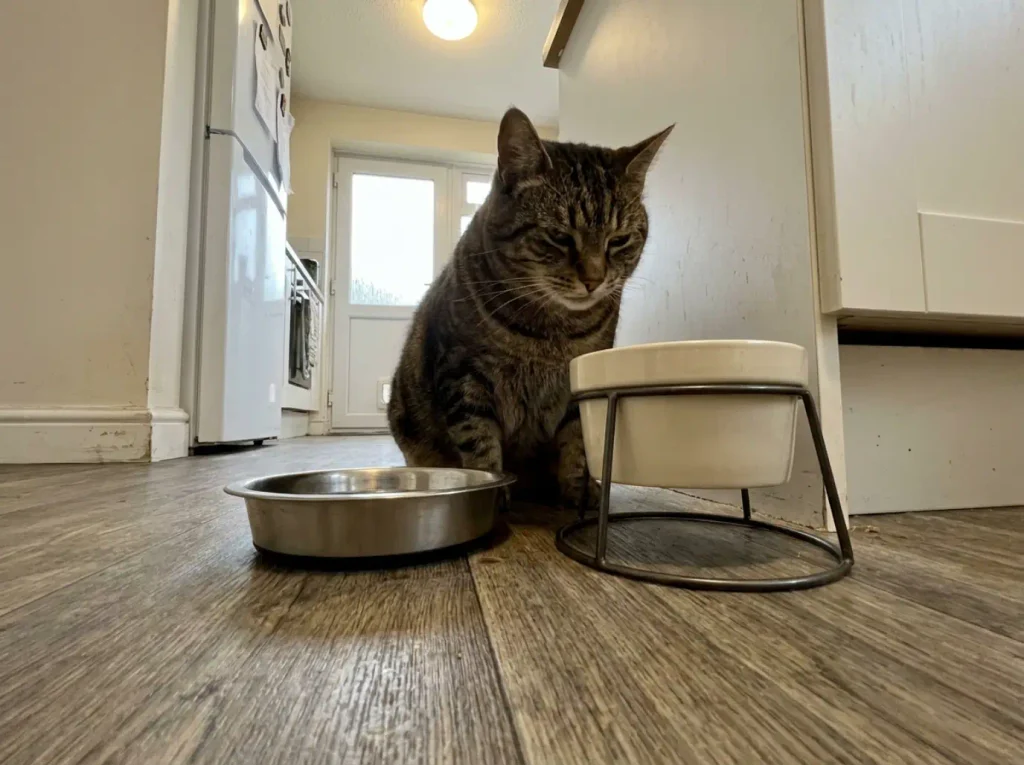
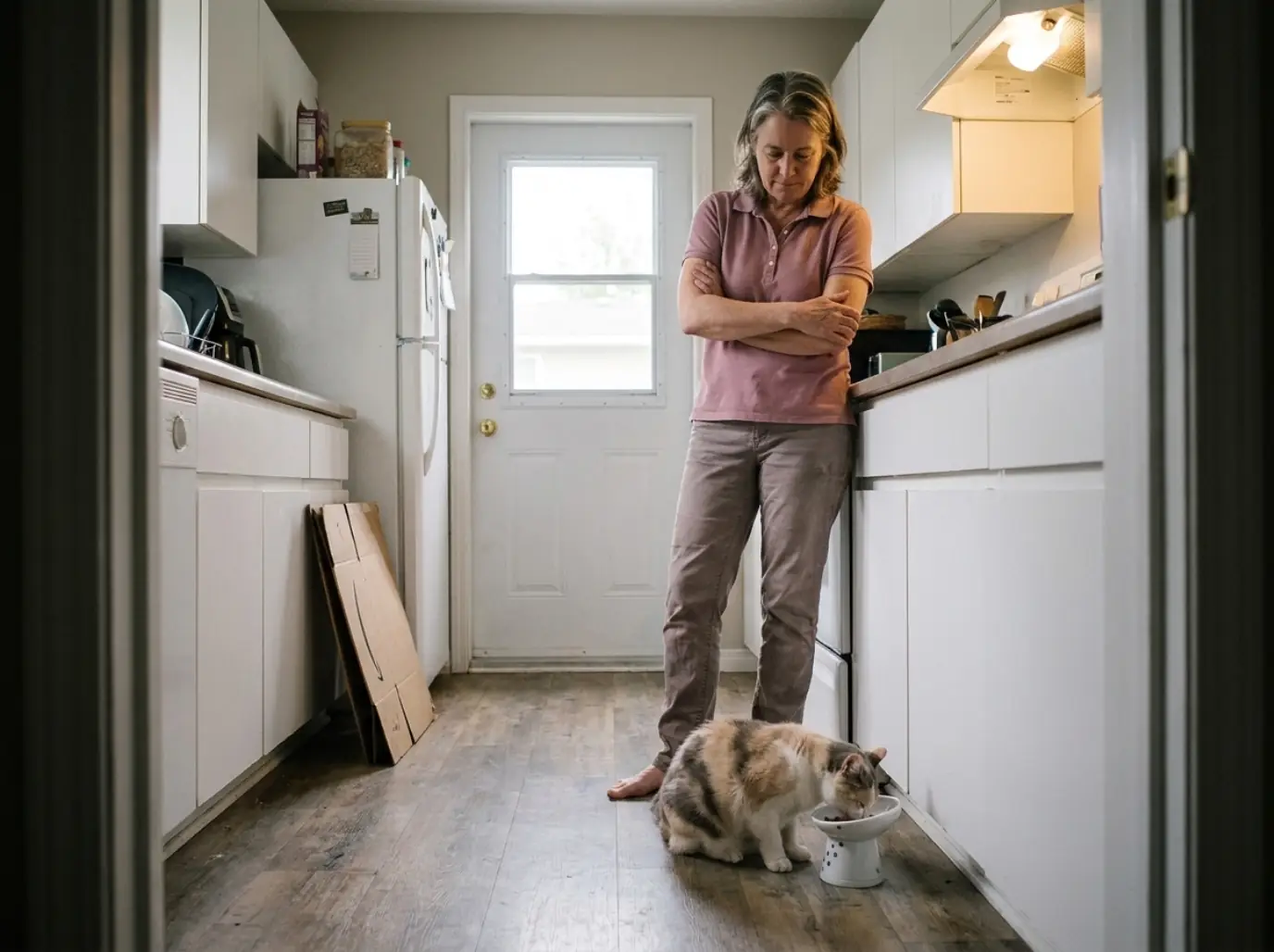
Two specifications got welded together by marketing copy and they were never the same thing. Whisker fatigue is a width problem: the flat interior of the dish has to clear the span of the cat’s whiskers so he can eat without dragging them along a curved wall, and what whisker fatigue actually is, and what the one real study found covers the mechanism in full. Height is a posture problem: the dish sits closer to the chest so the neck does not have to fold all the way down to the floor. A cat can be perfectly comfortable on both counts, or fail one while passing the other, and nothing about the word “elevated” tells you which.
That is the whole reason the senior cat threads read the way they do. Someone has an elevated ceramic bowl with a five-inch mouth, the cat approaches, hesitates, eats the middle and leaves a ring around the outside, and the owner is now debating whether to go up to six and a half inches or switch to a tilted design instead. Nobody in the thread can answer it, because the answer requires separating two numbers that every product page presents as one.
The bowl passed the height test. It never passed the width test. Raising a narrow bowl does not make it wider, it just moves the same whisker contact up to chest level where you can see it happening.
The two are independent, and that is the sentence to hold onto. A tall narrow bowl reintroduces whisker contact at a higher altitude. A wide flat dish sitting on the floor leaves the neck problem completely untouched. The category sells the first as though it solved the second, which is how a reader ends up buying the same mistake twice. Before anything goes in a cart, the flat width a food dish has to clear before anything else matters puts the floor at roughly 5.5 inches of flat interior for a food dish. That number does not change when the bowl goes up on a stand. It just stops being the only number.
There is also a vocabulary problem sitting on top of the measurement problem. Half this category is sold as anti-vomit bowls, and that phrase quietly folds three mechanically distinct issues into one product: regurgitation from eating too fast, whisker contact against the rim, and the hunched posture of a cat reaching down to the floor. They have different causes and they respond to different fixes. A bowl that helps one of them is not automatically doing anything about the other two, and the listing will never tell you which one it is actually addressing.
Before you buy anything, go measure the bowl you already own, and measure the two things separately: the flat interior width at the bottom, and how far off the floor the food actually sits. Write both down. Almost every time, only one of the two is failing, and knowing which one cuts your shopping in half.
How Much Lift Your Cat Actually Needs
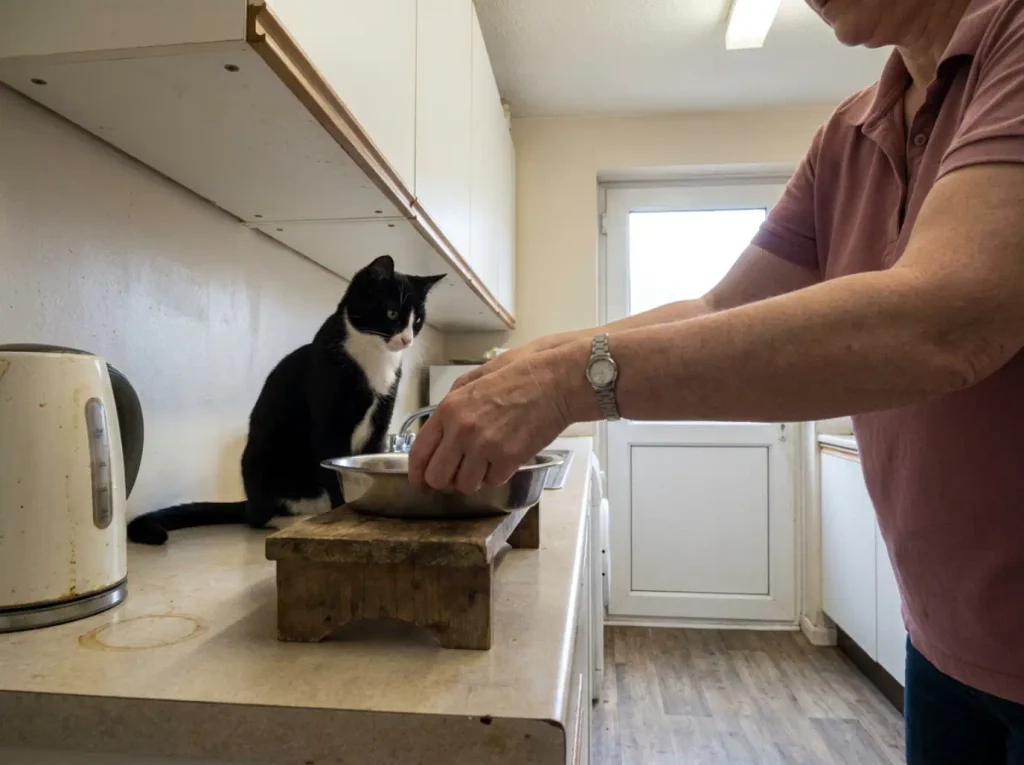
Every listing in this category says elevated. Not one of them says elevated compared to what. The reader is standing between a three-inch riser and a six-inch stand with no way to tell which one their own cat needs, and the product pages are no help because they all report a number without a rule for choosing it.
The rule vets use for raised feeders is a check on the cat, not a spec on the box: the bowl should sit no higher than the cat’s elbow joint, so his head still tips slightly down to eat. That downward angle is the natural feeding position. If the stand is tall enough that his neck goes flat or he has to reach up, you have swapped one posture problem for a different one and the cat will tell you by standing at an angle or by walking off halfway through. You do not need a tape measure for this. Stand him next to the stand and look at where the elbow lands.
The band that legitimate elevated products actually occupy runs roughly 3 to 6 inches of lift. Worth saying plainly, because a lot of the budget tier lives underneath it: below three inches you have bought a riser, not a posture fix. It will look different on the kitchen floor and it will not change what the neck is doing. That is not a scam, it is just a much smaller intervention than the packaging implies.
And start low. Most cats do not need the top of the range. A reader who jumps straight to the tallest stand available is solving a problem their cat might not have, and a bowl that sits too high creates the reaching-up problem described above. The honest sequence is the low end first, then step up only if the cat is still visibly working to get at the food.
So what actually justifies lifting the bowl in the first place? Three observable triggers, none of which require you to interpret anything:
- A cat over ten who has picked up the stiffness that comes with age. Osteoarthritis is common and badly under-diagnosed past that age, and an arthritic cat shows it at the bowl before he shows it anywhere else, approaching slowly or eating in shorter sittings than he used to.
- A long-bodied cat who has to splay his front legs out sideways to get his mouth down to a floor-level dish.
- A cat who eats fast and brings food back up shortly afterward, still recognizable, while standing over the bowl.
Those are things you can watch happen. They are not a diagnosis and nothing here reads them as one. If you want to go deeper on feline wellness in general, Cornell’s Feline Health Center is the reference worth having bookmarked; comfort and mobility while eating are recognized parts of that picture, which is why the elbow rule exists at all.
Now the part the product pages have no reason to tell you. If the dish you already own passes the width test, you do not need a new bowl. You need something under it.
Keep the flat whisker-friendly plate you already know works, set it on a riser you already have in the apartment, and you have bought the height for nothing. It is the route that keeps coming up whenever someone in a bowl thread runs the numbers, and it is worth exhausting before a purchase. Whether the problem can be solved without buying a bowl at all is a whole article on its own, and it goes first for a reason.
What a Tilt Does That a Flat Riser Doesn’t
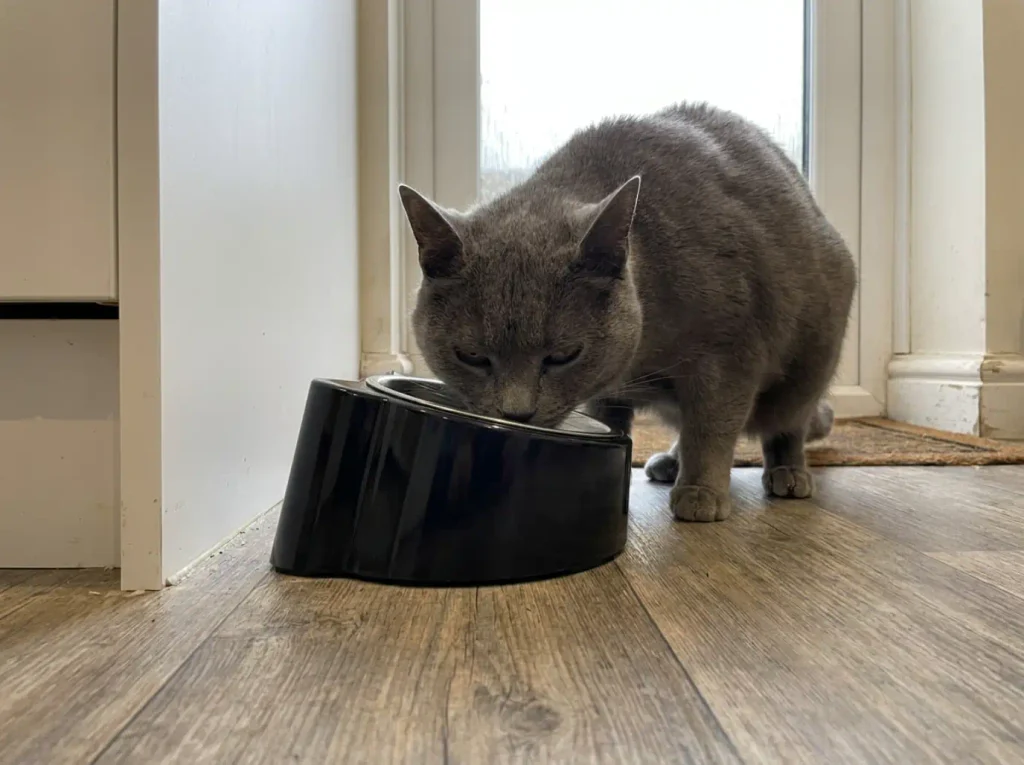
Half the listings here advertise a 15 degree tilt as if the number explained itself. You are being asked to pay for an angle that nobody defines. And the number is not random: 15 degrees turns up across essentially every brand in the category at once, Necoichi, CATPRO, FUKUMARU and Y YHY included. That makes it a de facto standard rather than a coincidence, and it means a bowl advertising something very different, flat or 25 degrees, is the outlier and owes you an explanation.
What the angle mechanically does is bring the food down to the near edge of the dish, so the cat reaches forward instead of down. That is the entire trick. It is also why tilt and height are complementary rather than competing: elevation changes where the bowl sits relative to the cat’s chest, tilt changes where the food sits relative to the bowl. You can have either, both, or a very expensive neither.
Which brings up the thing nobody in this category writes about, and it needs a name to be usable. Call it reach-depth: how far the cat has to lean into the bowl to get at what is left in it. Reach-depth is not fixed. It grows as the bowl empties.
A shallow dish that was genuinely whisker-friendly when you filled it stops being whisker-friendly at the last third, because now the cat is putting his face inside the rim to reach food that has settled into the middle.
This is the mechanism behind one of the most repeated complaints in bowl threads, the cat who eats most of the meal and then abandons a ring around the edge. He did not stop being hungry. The bowl changed shape on him. A tilt keeps that last third against the near lip, where he can still reach it from outside the rim.
The depth number that belongs next to the tilt is about 1.8 inches on the tilted bowls verified for this article. Shallow enough that the rim never becomes the problem the tilt was bought to solve. And material carries over from the flat rule unchanged, because nothing about raising a bowl changes what it is made of: steel or ceramic over plastic, for the same scratch and biofilm reasons laid out in ceramic, steel or plastic, and what fails in each. Plastic gets scratched, scratches hold residue, and residue is how plastic chin acne starts, which is a problem you did not sign up for when you bought a bowl.
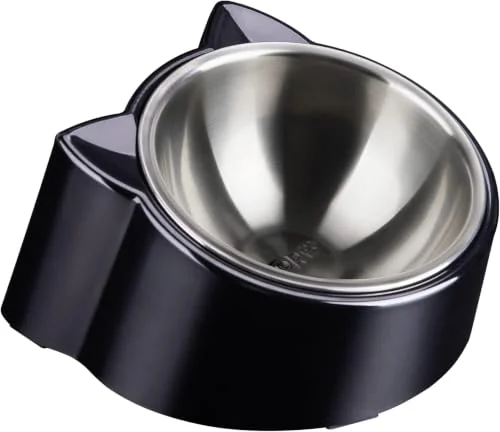
The Raised Bowls Worth Buying, Scored on Both Numbers
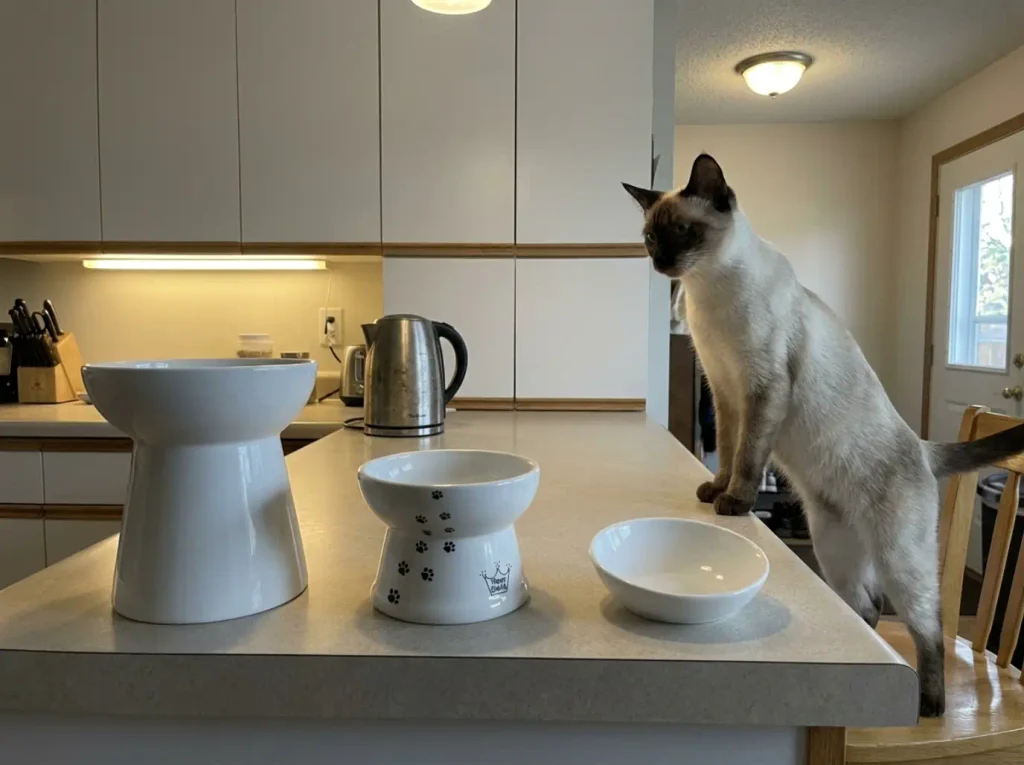
Everything up to here was about the two numbers. This is the section that reports both of them for every pick, which is the promise the title makes and the thing the competition does not do.
One note on scope first: this article is about lift. If your cat has no posture issue at all and the only problem is the rim, you want the flat bowls measured against the cat’s own face instead, and you will save money doing it. Nothing below repeats those picks.
| Bowl | Stand height | Flat diameter | Bowl depth | Tilt |
|---|---|---|---|---|
| Necoichi Extra Wide Tilted | 5.3 in | 6.1 x 5.7 in | 1.8 in | 15° |
| Necoichi Regular, 1-Cup | 3.7 to 4.4 in | 5.2 x 5.1 in | 1.8 in | 15° |
| Y YHY 5 Inch Tilted | Not published | 5 in | Not published | Tilted |
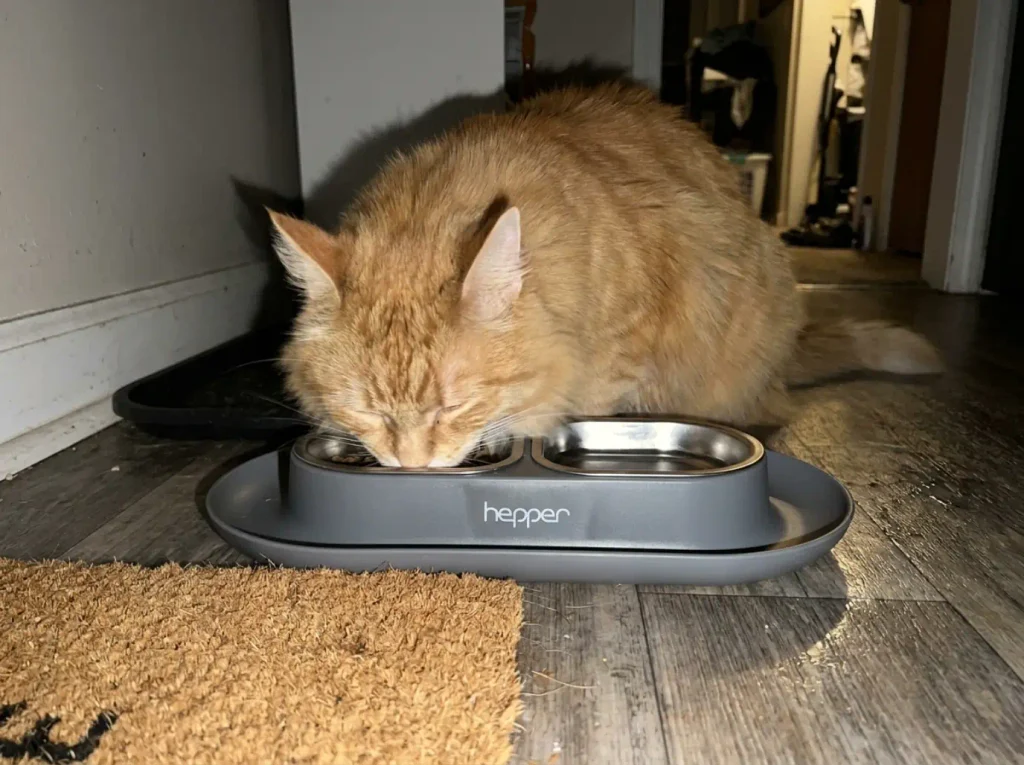
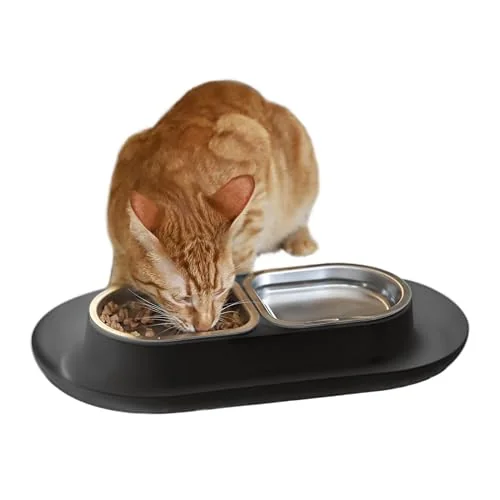
| Hepper NomNom | Low, weighted | Wide, shallow | Shallow | None |
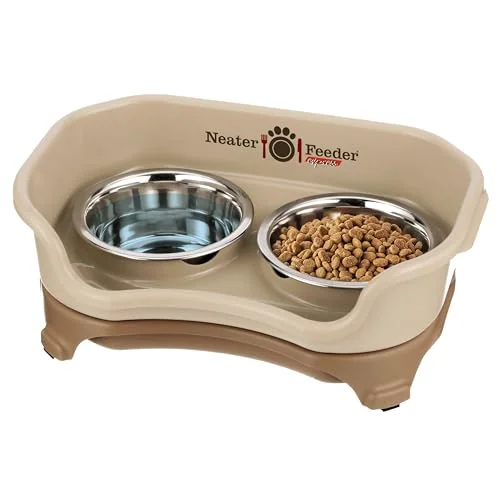
| Neater Feeder Express | ~3 in feeding height | 5.25 in | Deep sided | None |
Read that table as pairs, not as a ranking. A row that publishes only one of the two numbers is telling you something about how the product was designed to be sold, and two of the five rows above are in exactly that position.
The wide-and-tall option is the one for the cat who genuinely needs both, and it is also the only product in this set that publishes height and diameter together in the same listing. That is rarer than it should be.
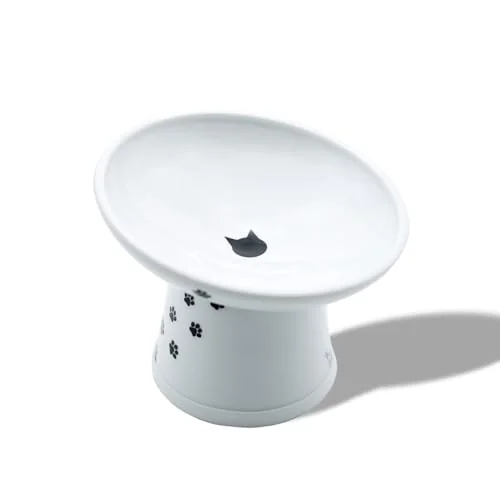
If the last section talked you into starting low, this is that advice made into an object. Same family, same tilt, same 1.8-inch depth, less stand under it. The width drops to 5.2 by 5.1 inches, which sits right on the line rather than clearing it, so this is the pick for a cat whose width was never the problem in the first place.
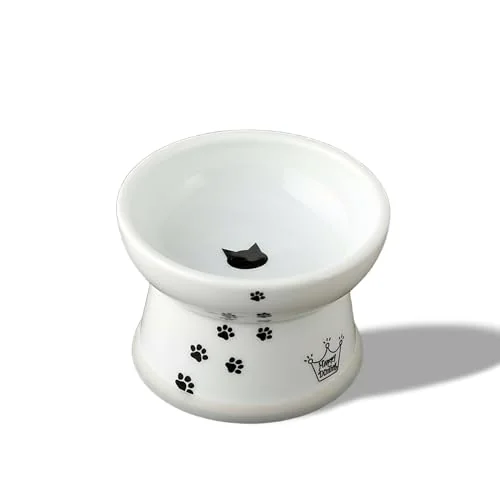
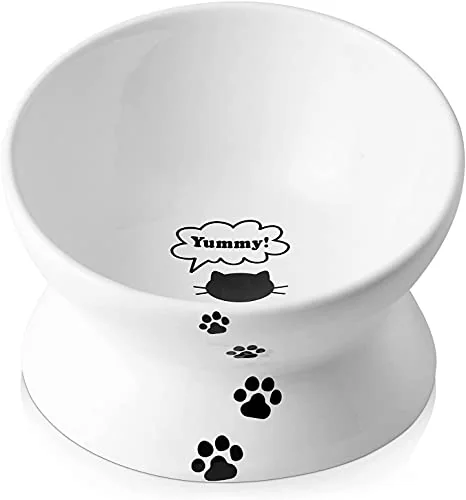
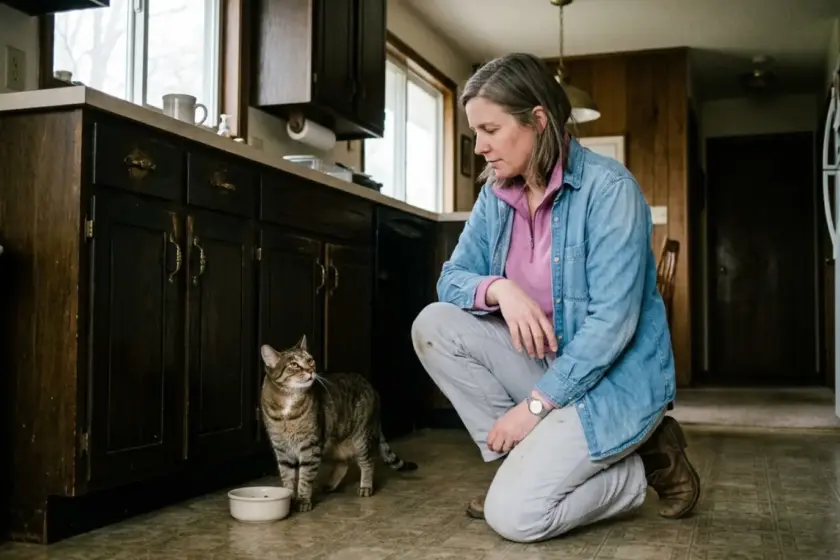
And then there is the budget ceramic, which needs an honest introduction rather than a recommendation. It is five inches wide. Five inches is exactly the width the senior cat owner in that thread already owned when her cat kept leaving food at the edges.
So this belongs here as a reference point more than a default answer: if five inches is what already failed in your kitchen, buying five inches again in a different color is not the fix. If your cat is small, or if width was never the issue and you just want a tilt without spending much, it does the job.
None of these five fixes a cat who has stopped eating. That is a different conversation and it comes up again at the end of this article, because it deserves to be said plainly rather than folded into a product recommendation.
If the bowl you already own clears the width, what you are shopping for is height and nothing else. Height is the cheap half of this problem. A stand costs a fraction of a whole new elevated dish, and it lets you keep the one piece of the setup the cat has already approved.
Stability, Which Only Becomes a Problem Once It’s Tall
Nobody warns you about this part. Lifting the dish also lifts its center of gravity, and the same shove that a floor bowl simply absorbs now has leverage on a stand. A bowl sitting flat on tile has nowhere to go. The same bowl on four inches of ceramic or melamine can rock, slide, or walk sideways across the kitchen under a determined cat, and it gets worse with every inch of height you add.
There is published evidence on this and it comes from a competitor’s own review, which makes it more useful rather than less: a metal elevated stand with no non-slip feet gets knocked around by a large or food-motivated cat. That is a design con named out loud by people who otherwise liked the product. The failure is real, it just has no home in a spec sheet.
Here is the connection nobody makes, though. Tipping force scales with the cat. A heavy, long-bodied cat leans into a bowl with genuine mass behind him; a compact nine-pound cat does not. A Maine Coon at full lean is not the same load as a small shorthair, and it is not close.
So weight and non-slip feet stop being a nice-to-have somewhere around the size where the cat can move furniture, and every review that treats stability as a minor comfort feature is quietly assuming an average-sized cat. That assumption is worth noticing, because there is a related pattern in why a bowl ends up halfway across the kitchen floor and the same physics drives both.
The test costs nothing and takes five seconds.
Put one finger on the stand at roughly the height the cat’s chest meets it, and push sideways. Not down, sideways. If it slides on the floor you actually own, tile or laminate or whatever it is, it will slide with a cat pushing on it, and it will slide worse when it is full. Do that test in the store aisle or the moment the box opens, before the returns window closes.
Ceramic tends to do well here for a reason people misread as craftsmanship. It is not the glaze or the finish. It is the mass. A heavy base resists the sideways push that a light one transmits straight into the floor, and that is most of what “feels well made” means in this category.
When Elevation Is Doing Too Much
Every argument in this article has a stopping point, and this is where they are. The first one is floor space. A full feeding station with a splash guard takes noticeably more room than a single tilted bowl, and in a small apartment kitchen that footprint is the real trade-off, not the shelf price. You are giving up a strip of floor by the counter permanently, in a room where that strip is also where you stand. Worth deciding on purpose rather than discovering after the box is unpacked.
Renting changes less here than it does anywhere else on this site. Every elevated stand in this category is freestanding, so there is no drilling, no bracket and no permission to ask for, which makes a renter-friendly feeding setup mostly a question of where it goes rather than whether you are allowed to have it. The constraint in a rental kitchen is floor, not landlord.
Then the situation no competitor writes about at all, which is strange, because it is the most common real version of this problem.
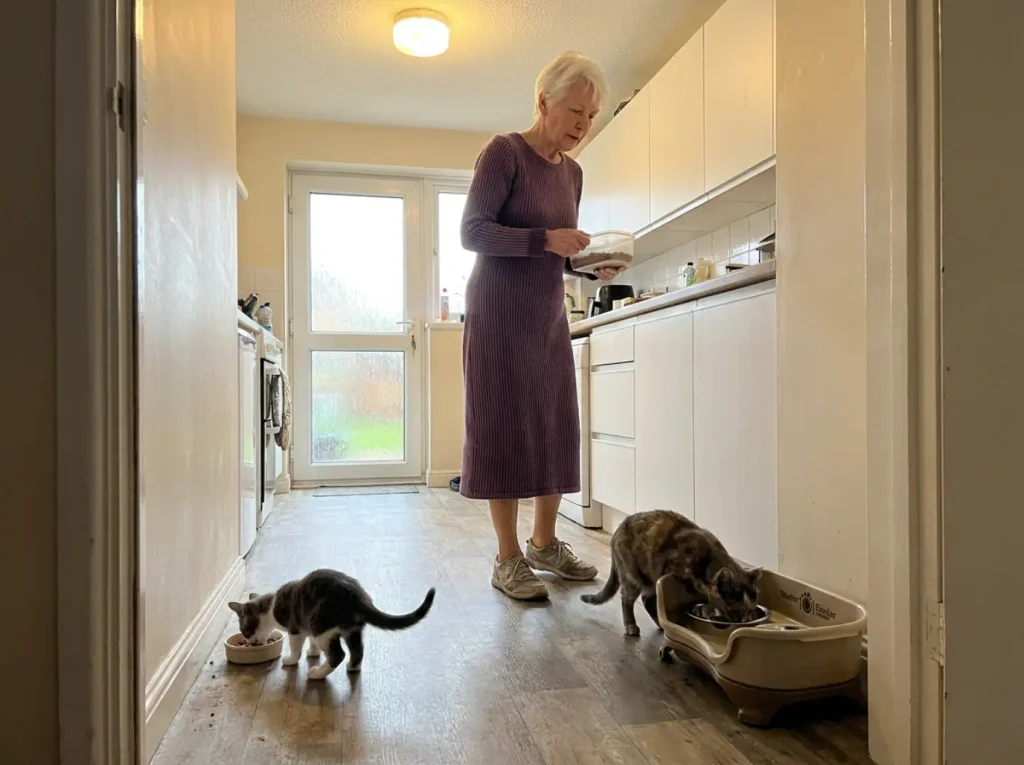
One cat needs lift and the other does not. A household with a stiff twelve-year-old and a four-year-old who can still leap onto the fridge does not have one correct feeding height. It has two. And the instinct is to split the difference, buy one mid-height station and let both use it, which produces a setup that is slightly wrong for both of them: too tall for the young cat to eat in a natural posture, too short to give the older one the relief he needed. The fix is a multi-cat feeding station arrangement rather than a single one: two positions, spaced apart, at two heights, which is also better for the reasons covered in two cats, two bowls, and the one nobody plans for. Feeding is not a shared resource just because it happens in the same room.
With two cats who need different heights, separate the two feeding positions instead of hunting for a compromise height. A middle setting serves neither of them well, and it costs you the same floor space as doing it properly. Put the low one where the young cat already eats and the raised one somewhere the older cat does not have to travel far to reach.
Renting changes nothing structural in this topic, which is a rare piece of good news. Every elevated stand here is freestanding: no drilling, no brackets, no wall anchors, nothing that ever needs explaining to a landlord. The rental constraint on this problem is floor space, not permission.
One boundary, said once. Elevation is an environment change, not a treatment. Occasional regurgitation right after a fast meal is a posture and pace question, and that is the part a bowl can participate in. Frequent vomiting, weight loss, or a cat who has stopped eating is a vet visit, and no bowl on this page changes that. Everything above assumes the vet has already cleared him.
And the caveat that keeps this article honest: no peer-reviewed study establishes that elevation reduces vomiting or whisker fatigue. The reasoning here is mechanical, the reports are from owners, and that is the correct weight to give it. If you want to see how thin the evidence base for this whole topic actually is, what the evidence for whisker fatigue actually amounts to goes through it properly. Buy the geometry, not the promise.
The Short Version
Measure two things before you buy one. The flat width and the height the food sits at are separate numbers solving separate problems, and the bowl already in your kitchen is probably failing only one of them. Find out which before you spend anything.
Start low. The cat’s elbow is the ceiling, not the biggest number in the catalog, and a stand that is too tall creates the opposite posture problem from the one you were fixing.
If the width is already handled, you are only buying height, and height is the cheap half. A riser under a bowl the cat has already accepted beats a new bowl he has not.
Check back in three weeks. That is long enough for a cat to accept or reject a change and short enough that you are not living with a bad setup. What to look at: whether food is still being left in a ring around the edge, whether the bowl has migrated across the floor, and whether he eats standing square and relaxed or still stretching his neck to reach.
Put the plate you already know works on top of something you already own. It costs nothing, it takes about a minute, and if the posture problem disappears you have just saved yourself the purchase entirely.
Amazon’s Audible — free for 30 days
Your cat won’t let you read. Let someone read to you.
Audible is Amazon’s audiobook library — thousands of titles, read out loud, on your phone. Free for a month, plus one audiobook to keep forever.
Frequently Asked Questions
01Do raised bowls help with whisker fatigue?
Only if they are also wide enough. Raising a narrow bowl moves the whisker problem higher up without solving it. The flat interior still has to clear the cat’s whisker span, and elevation is a separate fix for a separate problem.
02How high should a raised cat bowl be?
No higher than the cat’s elbow, so the head still tips slightly down to eat. In practice that puts most cats in the three-to-six-inch band. Starting at the low end is safer than starting at the top, because a stand that is too tall makes him reach up instead.
03Are tilted cat bowls better than flat elevated ones?
A tilt brings the food to the near edge so the cat reaches forward instead of down, which matters most as the bowl empties. It is complementary to height rather than a substitute for it. A tilted bowl that is too narrow still fails on width.
04Do elevated bowls stop cats from throwing up?
Some owners report less regurgitation right after fast meals, but there is no peer-reviewed evidence establishing it and the effect is anecdotal. Frequent vomiting is a conversation for your vet, not a bowl swap.
05Can I just put my current cat bowl on a stand?
Yes, and it is the cheapest route if the bowl already clears the whisker span. You are only buying the height at that point. Check that the combination does not slide when you push it sideways at chest height.
Leave a comment