How to Treat Whisker Fatigue in One Week, Not One Meal
5.5 inches across, under 1.5 deep, 7 days before you judge it. The whisker fatigue numbers no bowl label gives you (+ the free test first).

Alfredo RamsesFounder · September 7, 2026 · 19 min read

On this page8 sections
- 1What Whisker Fatigue Is, and What You Are Actually Fixing
- 2When This Is a Vet Visit and Not a Bowl Problem
- 3The Dish Swap, With the Numbers the Marketing Leaves Out
- 4Where the Dish Goes, Which Is a Separate Problem From What It Is
- 5The Seven Days, and How to Tell Whether It Worked
- 6Two Cats Change the Answer
- 7Conclusion
- 8Frequently Asked Questions
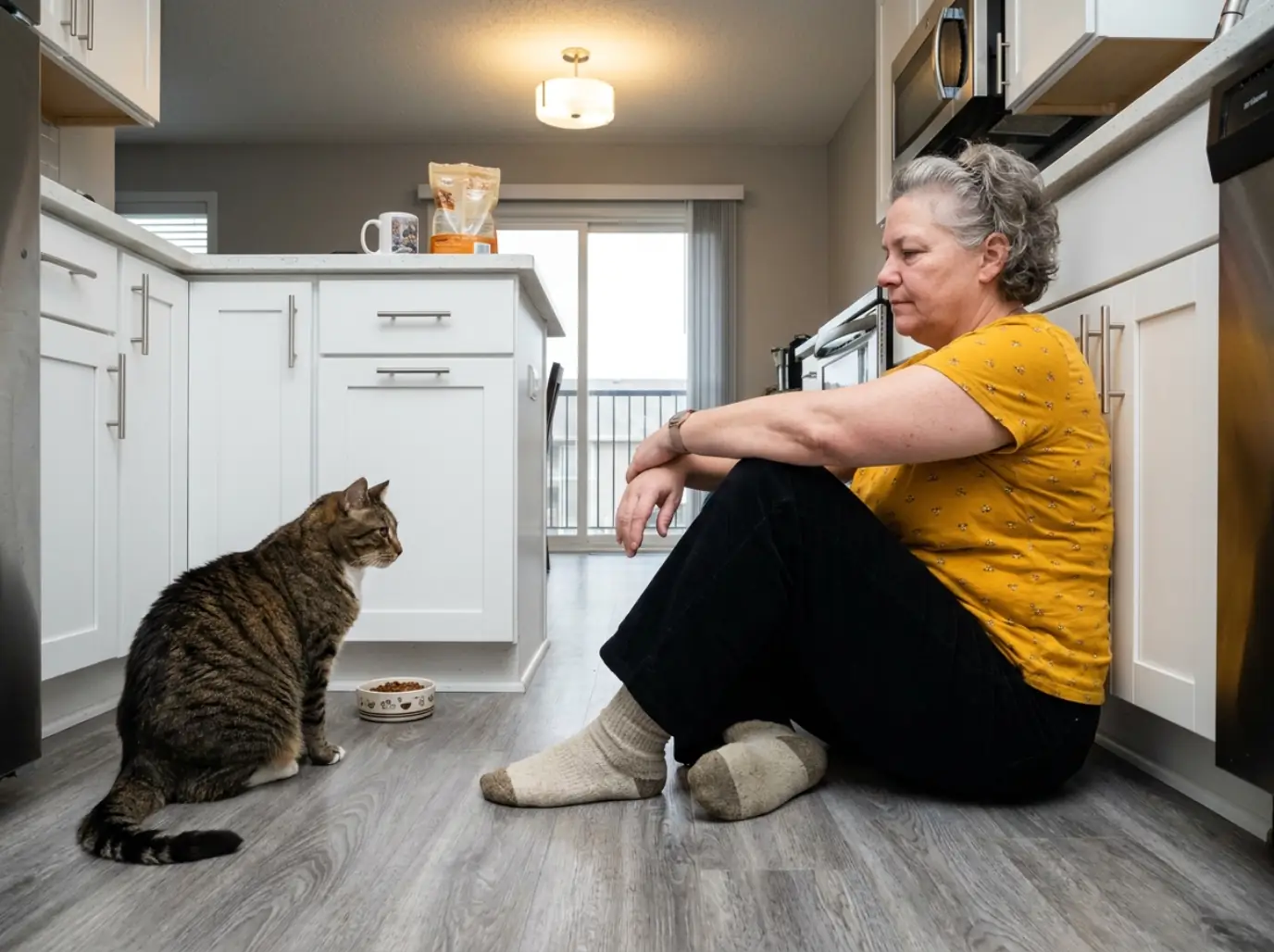
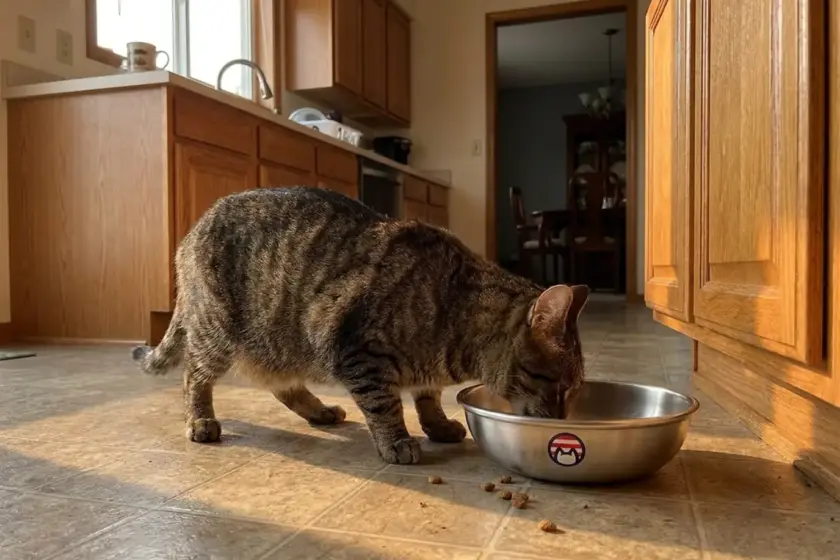
He sits down at a full dish, looks at it, cries, and walks away. Then he comes back an hour later, hooks a paw in, drags three pieces of kibble onto the floor and eats them there. He is not being difficult, and he is not a picky eater or a fussy eater either.
He is telling you the rim is in the way. What gets called whisker fatigue, or whisker stress, is that simple, and there is exactly one controlled trial on this subject, run out of Oklahoma State, which almost nobody selling a “whisker-friendly” dish bothers to quote accurately. So here is how you actually treat whisker fatigue: what to swap, where to put it, and the part everyone skips, which is how long you have to run it before you are allowed to decide it failed.
Quick Answer
Treating whisker fatigue means changing the dish and where it sits, then giving it a real trial window instead of two meals.
- Put dinner on a flat plate you already own tonight.
- Move to a dish 5.5 inches wide, under 1.5 deep.
- Pull it off the wall, away from the litter box.
- Run it seven unbroken days before judging anything.
- On day eight, offer both dishes and watch.
- If he still will not eat, call your vet.
What Whisker Fatigue Is, and What You Are Actually Fixing
You have probably already read three explainers about this. You do not need a fourth. What you need is the one sentence that makes the fix make sense, and it is this: the whiskers are measuring the gap, and a deep rim keeps touching them for the entire length of the meal.
What the whiskers are actually doing at the bowl
Whiskers, or vibrissae, are not stiff hairs. Each one sits in a follicle-sinus complex packed with proprioception receptors, which means they report position rather than simply touch. A cat uses them the way you use the hand you are not looking at, to know where things are in the dark and whether a gap is passable before he commits his shoulders to it.
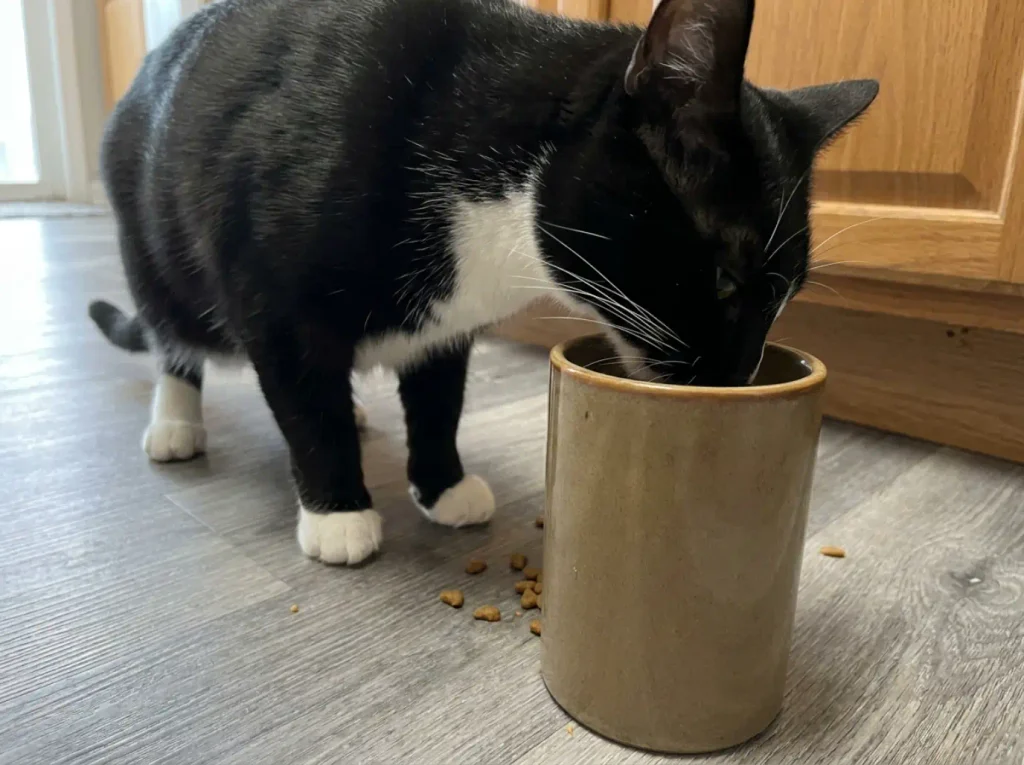
Now put that face in a bowl four inches across with a two-inch wall. Every mouthful presses both whisker fields against the sides, and the reading keeps changing while he is trying to concentrate on food. He is not injured and nothing is wrong with him. He is just eating inside a device that will not stop talking to him.
Why “fatigue” is the wrong word for a right observation
The name is bad. Whisker fatigue is a descriptive label somebody coined for a real observation, not a recognized veterinary diagnosis, and there is no test for it. Saying that out loud is what makes the rest of this worth reading, because a site that tells you it is a syndrome is a site trying to sell you the cure for it.
The observation underneath the bad name holds up fine, though, and it is narrow enough to be testable. Rim contact through a whole meal is unpleasant, so the cat solves it the only way available to him, which is to move the food somewhere with no walls. That is the floor. If you want the origin of the term and the argument about whether it deserves to exist at all, that is the whole subject of the full picture of what whisker fatigue is and where the idea came from.
The behavior you already noticed, named plainly
Before anyone hears the term, they describe it the same two ways in every forum thread: scooping food out with his paws, or he acts starving but will not eat. That description is the symptom list. There is nothing more to it, and if you came here having already said one of those sentences out loud to a friend, you have done the diagnostic work.
What you are treating is the dish and where it sits. Nothing about the cat changes, nothing gets trained, and nothing gets corrected. The AAFP and ISFM environmental needs guidelines treat the feeding setup as one of the five pillars of a workable environment for a cat, so the idea that a feeding area is a lever you can pull is not a blog invention. It is just a lever almost nobody pulls on purpose.
When This Is a Vet Visit and Not a Bowl Problem
If your cat has genuinely stopped eating, close this article. I mean that. The most harmful thing a bowl guide can do is hold the attention of a frightened person for ten minutes while their cat goes another day without food.
The difference between “won’t eat from that” and “won’t eat”
The split is clean and you can run it tonight. A cat who eats fine off the floor, off a plate, off your hand, off anything that is not that dish, has a mechanical problem, and the rest of this article is written for him. A cat who will not eat anywhere, from any surface, in any room, does not have a mechanical problem, and no dish sold anywhere will change that.
Sudden change is the signal, not the specific behavior. Whisker clearance problems build slowly, over months, as a dish stays the same and a cat gets older or an owner finally notices. They do not start on a Tuesday. Something that switched on overnight is worth a call, and the same rule holds for moving food away from the bowl before eating, which looks nearly identical at the dish and has its own list of causes.
What makes it urgent rather than annoying
Dental disease, oral pain, kidney disease and gastrointestinal illness are the reasons a veterinarian rules things out before anyone talks about bowls. I am naming them and stopping there, because that is a conversation for someone who can look in his mouth. Weight loss, drooling, pawing at the mouth, or complete food refusal are the four that turn this from a weekend project into a phone call today.
And there is a timing reason on top of the medical one. A cat who goes without eating gets sick fast, faster than most people expect, which makes waiting out a seven-day trial exactly the wrong call when real refusal is on the table. This article can fix a dish. It cannot tell you why your cat feels unwell, and it is not going to try.
The Dish Swap, With the Numbers the Marketing Leaves Out
You bought a bowl that said whisker-friendly on the box and nothing changed. That is not bad luck. The phrase has no definition behind it, no standards board, no minimum dimension, and a fair number of dishes sold under it are narrower than what was actually tested.
The two dishes the study actually used, in inches
Here is what the only controlled trial of whisker-friendly dishes, published in the Journal of Feline Medicine and Surgery, put in front of 38 cats. Two dishes, both sold as whisker-friendly: a ThinkPet ceramic dish and a Jackson Galaxy stainless one.
The ceramic dish measured roughly 5.5 by 5.9 inches and 1.4 inches deep. The stainless steel dish measured roughly 3.9 by 7.5 inches and 0.4 inches deep. Read that last number again, because it is nearly flat, closer to a plate than to what most people picture when they hear the word bowl.
The detail that reframes the whole topic is buried in the participant data: every single one of those 38 cats owned a normal dish that was narrower and deeper than both study dishes. Not most of them. All of them. Whatever is in your kitchen right now is statistically likely to be in the same category, which makes this less of a niche problem and more of a default one.
So the defensible working minimum, and the only number in this article you should write down, is at least 5.5 inches across and under 1.5 inches deep. That is a spec you can hold a tape measure to instead of a mood. The same threshold does different work depending on what goes in the dish, which is the subject of how bowl size differs for food and water.
Why “wide and shallow” on a label guarantees nothing
Nobody polices that phrase. A listing can call a dish wide because it is wider than the same brand’s other dish, and shallow because the wall slopes instead of standing straight up. Neither of those is a measurement, and the cat is doing arithmetic with actual inches.
I used to think the material was where people went wrong, and that stainless versus ceramic versus plastic was the argument worth having. After reading enough threads where somebody switched materials, kept the exact same shape, and got the exact same pawing behavior, I moved on. Material matters for hygiene and for the cats who react to plastic. It has almost nothing to do with whiskers. Rim height is the whole argument.
The plate in your kitchen cabinet, and what it tells you in one meal
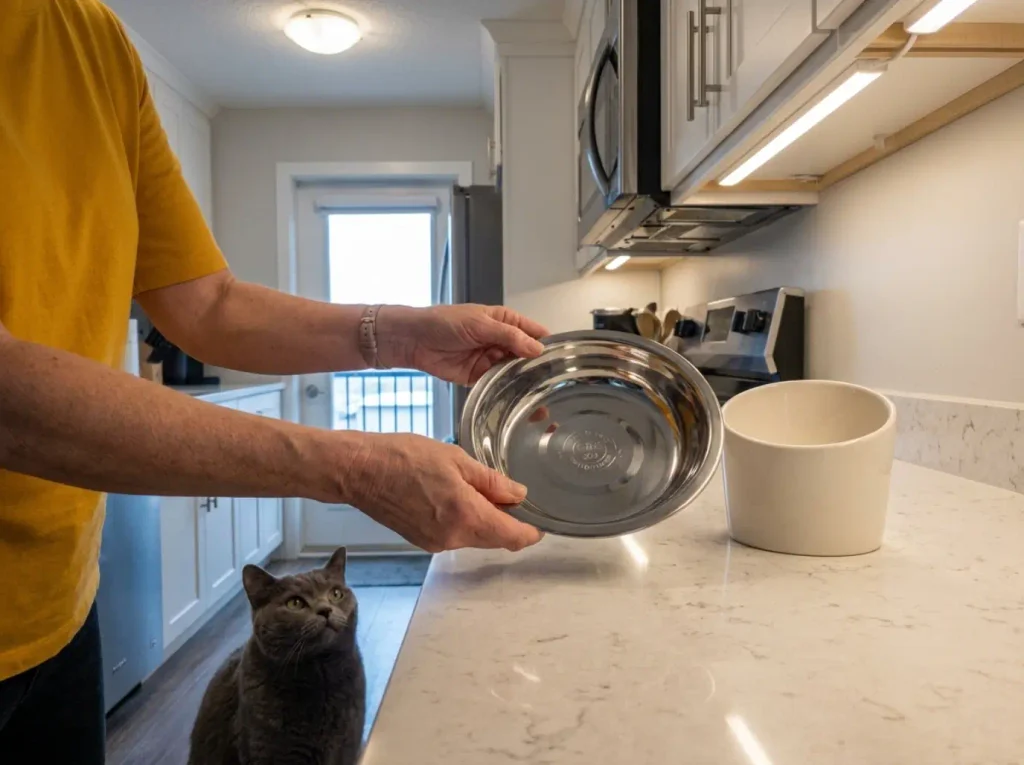
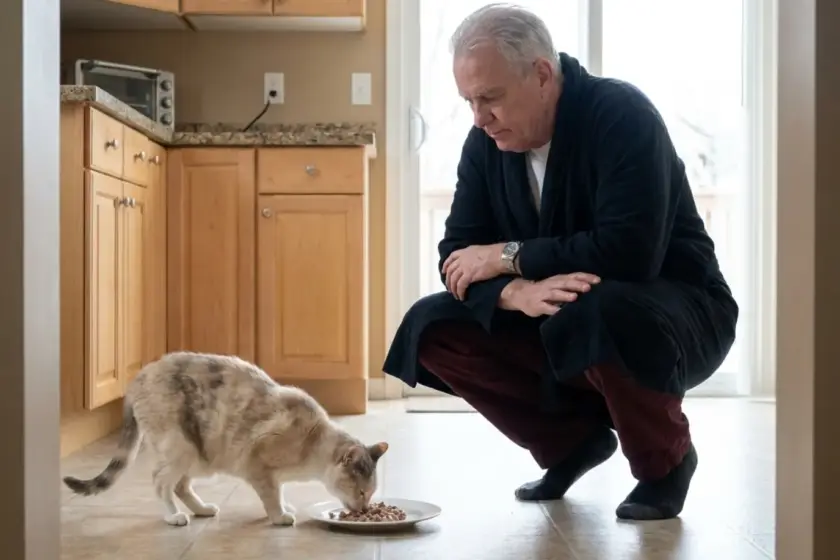
Before you spend anything, go get a saucer. Or a small salad plate, or a bread plate, anything flat and wide that you already own. Put dinner on it tonight.
A flat plate clears the whiskers completely, by definition, because there is nothing there to touch. It is the swap that budget threads suggest first for precisely that reason. One caution on what you grab: skip a scratched plastic bowl if you have the choice, since ceramic and stainless are easier to keep clean.
One meal on that plate tells you whether clearance is even the issue.
If he cleans it, you have your answer for free, and you now know exactly what you are shopping for. If he behaves identically, you just saved yourself a purchase and the next section is where your problem actually lives. That is it. Do it before you read any further.
Measure the dish he has now before you buy anything. Tape measure across the inside at the widest point, then down the inside wall. If it is already over 5.5 inches wide and under 1.5 deep, the dish is not your problem and the placement section is.
Once the saucer has confirmed that clearance is the issue, you probably want something that lives in the kitchen and survives the dishwasher. The 4 Pcs Stainless Steel Cat Bowls run 5.5 inches across with a low wall, which puts them inside the tested range rather than adjacent to it, and coming as a set of four means there is always a clean one when the last one is in the sink. The limitation is honest enough: stainless is light, so a determined cat can push one across a tile floor, and if yours is a shover you will want a mat under it or a heavier material.
Where the Dish Goes, Which Is a Separate Problem From What It Is
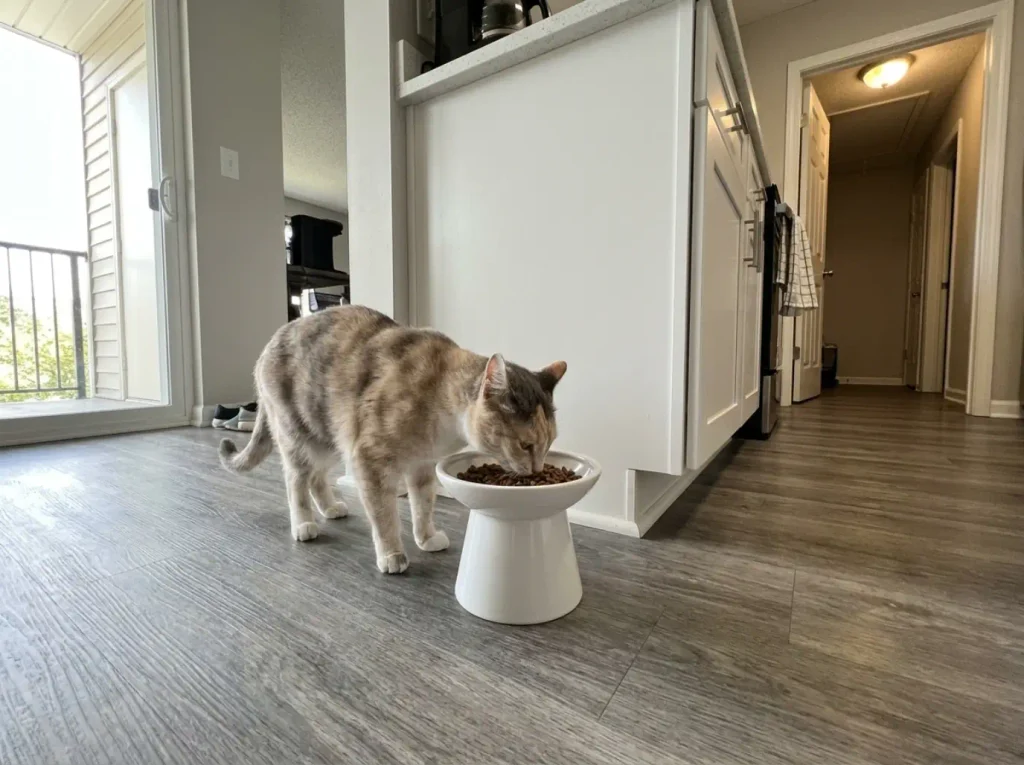
You can buy exactly the right dish, put it in exactly the wrong place, and watch the cat behave precisely as he did before. Then you conclude the dish was a waste of money and go back to the old one. This is the most common way a correct fix gets thrown away.
Width, depth, height — three levers people change at once
There are three separate levers here and they fail in different ways. Width governs whisker clearance, the sideways gap. Depth governs rim contact, how much wall his face has to get past. Placement governs whether he can eat without watching his back, which is not a physical problem at all.
People change all three in one afternoon, see no result, and have no idea which one to undo. Change one, wait, then change the next. It is slower and it is the only way you learn anything. The width and depth thresholds hold up across dish types, and they get more specific once texture enters the picture, which is covered in the depth thresholds that matter for wet food.
What elevation actually fixes, and what it does not
Elevation is a fourth lever and it has nothing to do with whiskers. Raising a dish a couple of inches changes the neck and shoulder angle, which is real and which matters quite a lot for an older cat or a cat with a long frame who has been eating at floor level his whole life. A raised stand with the same deep narrow bowl sitting on top of it fixes nothing about whisker contact. You have simply moved the problem up.
If you want both levers in one object, the CEEFU Extra Wide Elevated Ceramic Cat Food Bowl is 6.2 inches across and shallow and raised, which is the combination that makes the two-lever point concrete instead of theoretical. The caveat is that it commits you to both changes at once, so if you are trying to isolate which lever is doing the work, this is the wrong dish to start your trial with. Start flat and cheap, then come here if the height turns out to matter.
And whatever you decide about the food, keep the water bowl on its own, in a different spot entirely. Water next to food is one of the arrangements cats consistently avoid.
Placement in an apartment with one usable corner
The AAFP and ISFM guidance says to keep the feeding area away from the litter box and out of the traffic lane. In a house that is a throwaway line. In a one-bedroom apartment it is a real constraint, and it usually means the corner of the kitchen rather than the hallway, because the hallway is where everyone walks and the bathroom is where the box is.
Pull it off the wall too.
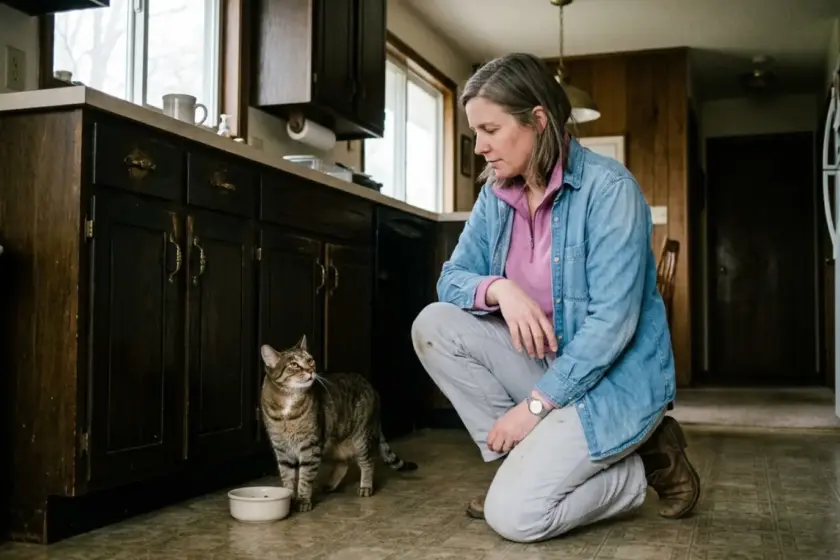
A cat who has to face a wall to eat is giving up the entire room behind him, and some cats will not do that. The setup that fails most often, and the one that gets described over and over in these threads, is a deep dish shoved into a corner next to the litter box, because that is the only spot it fits. Nobody chose that on purpose. The apartment chose it, and then the cat objected, and the objection got read as fussiness.
The Seven Days, and How to Tell Whether It Worked
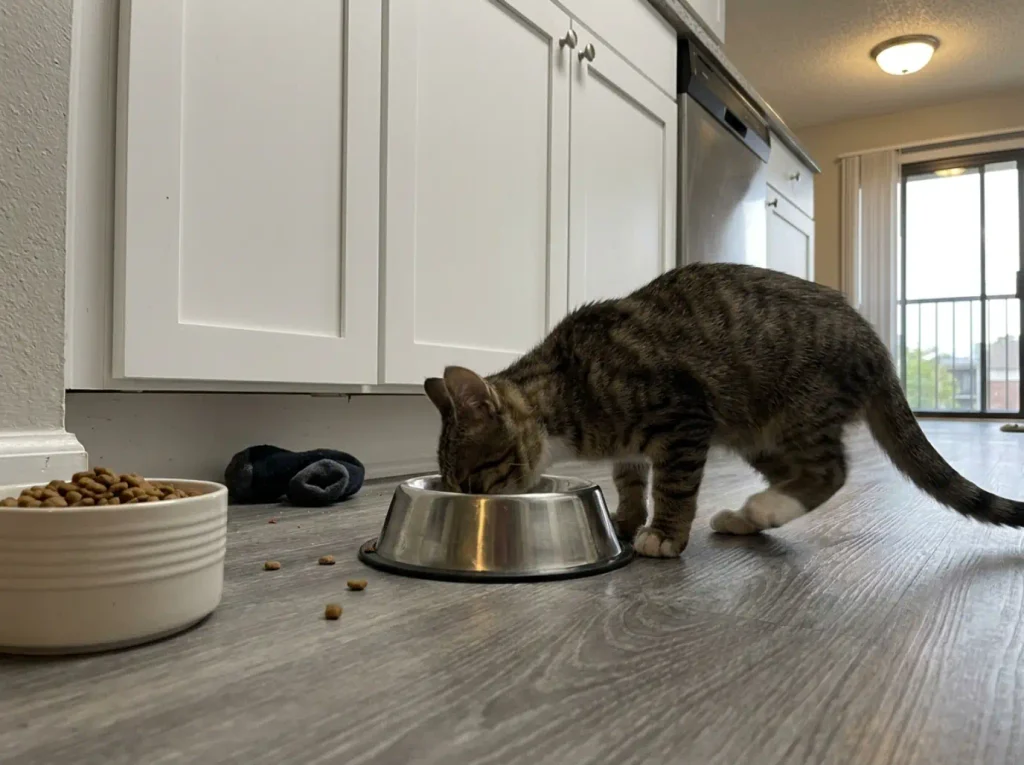
Most people swap the dish, watch two meals, decide nothing happened, and put the old one back in the sink rotation. The study ran a full week before it measured anything. That gap, between two meals and seven days, is where almost every home trial quietly dies.
Why seven days and not two meals
Seven days, unbroken, is not a round number somebody picked because it sounds tidy. It is the study’s own transition window: the cats ate from their normal dish for the baseline, then moved to the whisker-friendly dish for a full week, and only then were re-tested under the same conditions.
There is a reason a week is the right shape. A cat approaching a new object at a familiar spot is doing a risk assessment, not a review, and the first two days tell you about novelty rather than about comfort. By day four or five the object has stopped being new and whatever he does next is a response to the dish itself. Judging on Tuesday what you will only be able to see by Sunday is the single most common reason people conclude the swap did not help.
Do not change the food, the room, or the schedule in the same week you change the dish. One variable at a time is the only way seven days tells you anything at all, and a new flavor introduced on day three makes the entire trial unreadable.
The side-by-side test on day eight
On day eight you stop watching and start asking. Put the old dish and the new one down at the same time, same food, same amount, a couple of feet apart, and see which one he walks to. That is the test the study used, and it is the cleanest signal you are going to get out of a house with one cat in it.
In the trial, 63% of the cats picked the whisker-friendly dish, or 24 out of 38. Nine went back to their old bowl and five had no opinion either way. So this is a majority, not a certainty, and if your cat is one of the nine you have learned something real rather than failed at something. Run it twice on two different days if the first result looks like a coin flip, because a cat who just happened to be standing closer to one dish is not expressing a preference.
What counts as working, and what does not
Here is the part nobody selling bowls will put on the box. The same study found no significant difference in how much the cats ate (0.22 versus 0.21 cups, P=0.7), how long they spent at the dish (198 versus 209 seconds, P=0.8), or how much food ended up on the floor (P=0.9). None of it reached significance. You can read what the trial measured and what it found and check that yourself, which is more than most sources on this topic will let you do.
So “did it work” is not “he eats more.” He probably will not eat more. The honest success criteria are narrower and better: does he stay at the dish instead of backing off mid-meal, does he finish in one visit instead of four, and does he choose it on day eight when given a fair choice.
And one result that looks like failure is not one. More food on the floor after the swap is normal. The study averaged more dropped kibble from the shallow dish, 14.3 pieces against 1, for the obvious mechanical reason that a flat dish has less wall to hold anything in. If the floor gets messier and he stops complaining, you traded a comfort problem for a sweeping problem and you got the better end of it. If the mess is the thing you actually came to solve, that has its own set of causes and its own fixes in food ending up on the floor for reasons that have nothing to do with whiskers.
Two Cats Change the Answer
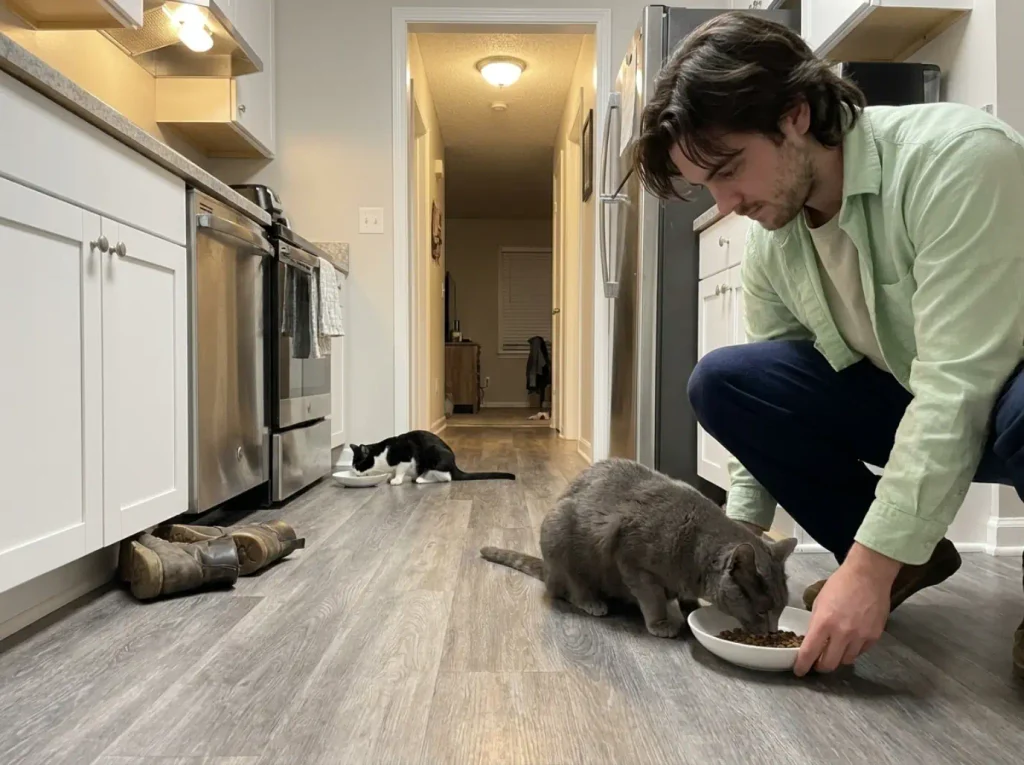
In a multi-cat household the same behavior has a second explanation, and a wider dish will never touch it. Resource guarding at a shared dish looks almost identical to a whisker problem from across the room.
In a one-cat home, the dish is the suspect and the trial above will find out. In a two-cat home there is a second explanation for the identical behavior, and no dish on earth will fix it. This is the part every article on this topic leaves out, and it is the reason a perfectly good swap gets written off as useless.
The same behavior with a completely different cause
A cat who approaches a full dish, hesitates, eats three bites and walks away is either reading the rim or reading the room. Rim contact and another cat standing in the doorway produce the same performance at the same dish, and from where you are standing they are indistinguishable.
The second one is more common than people think, because the watching cat does not have to do anything. He does not need to hiss, block, or approach. He only needs to be somewhere the eating cat can see him, and in an apartment there is nowhere he is not. Nobody is misbehaving here. One cat wants to eat facing an exit and the other one happens to be standing in it.
Separating them for three days to find out which it is
The test costs nothing and takes three days. Feed them in separate rooms with the doors shut, using the same dishes they already have, and watch what the hesitant one does. If he eats normally alone from the exact dish he was refusing in company, it was never the dish, and you can stop shopping right now.
If he behaves the same way alone as he did with the other cat in the room, the dish is genuinely a suspect and the seven-day trial from the last section is the right next move. Either way you now know which experiment you are running, which is a better position than most people ever reach on this.
If he eats fine alone and stalls in company, you have a territory problem wearing a bowl costume. Spend the money on a second feeding station in another room, not on a better dish for the one he already has.
One station per cat, plus one
The AAFP guidance is one feeding station per cat plus a spare, positioned so that neither cat can be watched while eating. That last clause is the one people drop, and it is the one doing the work. Two dishes eighteen inches apart on the same mat is one station with two dishes in it, whichever way you count.
Before you buy anything, do the free version.
Move the dishes you already own to opposite ends of the room, or better, to different rooms. Free, immediate, and it settles the question more often than a purchase does.
If it works and you want the stations to match, a set like the Ceramic Cat Food Bowl Set puts the same wide shallow shape at every station, which matters more than it sounds: a cat who gets the shallow dish one day and the deep one the next is running your trial for you, badly. Ceramic is heavier than stainless and it will chip if you drop it, so if your feeding spot is a tile floor, handle them like plates rather than like pet gear. Whether two cats should be sharing anything at mealtimes is a longer argument, laid out in whether two cats should share a food bowl at all.
Conclusion
Test with a plate you already own before you buy a dish. One meal on a flat saucer tells you whether whisker clearance is even the problem, and it costs nothing but the two minutes it takes to find the saucer.
If you do buy, buy to a number. At least 5.5 inches across, under 1.5 inches deep, because the label alone guarantees nothing and the study’s own dishes are the only published measurements anyone has.
Then give it the full seven days and judge it by the right thing. Does he settle at the dish, and does he pick it in a side-by-side on day eight? Not whether he eats more. He probably will not eat more, and that is not failure.
At three weeks, go and look at where the dish actually is. Not whether you bought the right one, but whether it is still off the wall and still away from the litter box, or whether it has drifted back into the corner where it fits and nobody trips on it. That drift is what undoes this, every time, and it happens without anybody deciding to do it.
Put dinner on a saucer tonight. If he cleans it, you learned the answer for free.
Amazon’s Audible — free for 30 days
Your cat won’t let you read. Let someone read to you.
Audible is Amazon’s audiobook library — thousands of titles, read out loud, on your phone. Free for a month, plus one audiobook to keep forever.
Frequently Asked Questions
01Can you fix whisker fatigue?
You can remove the cause, which is the dish, and most cats respond to that. There is nothing to cure. The whiskers are working exactly as designed, and a dish wide and shallow enough stops them being pressed against a wall all meal.
02How do I help a cat with whisker fatigue?
Move the food to something at least 5.5 inches across and under 1.5 inches deep, put it away from the wall and the litter box, and leave it that way for a week. A flat saucer from your own kitchen works for the trial.
03How long does it take for a whisker-friendly bowl to work?
The only controlled trial used a seven-day transition before testing anything, so give it a full week before you decide. Judging after one or two meals is the most common reason people conclude the swap did not help them.
04Is whisker trimming a fix? Should I trim my cat’s whiskers to fix this?
No. Whiskers are sensory equipment rooted deep in the skin, and trimming them removes information the cat uses to move around. Change the dish, never the cat.
05My cat still drops food on the floor after switching. Did it not work?
Not necessarily. A shallow dish has less rim to hold food in, and the study recorded more dropped kibble from the whisker-friendly dish than from the regular one. Watch whether he stays at the dish, not whether the floor is clean.
Leave a comment