Toxoplasmosis, Pregnancy and a Litter Box With No Spare Room
Toxoplasmosis & your litter box: scoop every 24 hours, 2-3 inches of litter, a 32.3-inch scoop, and a CDC glove-and-wash fallback for small apartments.

Alfredo RamsesFounder · November 16, 2026 · 22 min read

On this page10 sections
- 1What the Litter Box Actually Holds, and Why 24 Hours Is the Deadline
- 2Where the Question Stops Being About the Litter Box
- 3Who Scoops for the Next Nine Months
- 4Gloves, Masks and Dust: What Actually Controls the Box
- 5A Litter Box a Pregnant Woman Can Actually Service
- 6Where the Box Goes When There Is No Spare Room
- 7Handing the Box Over Without Teaching the Cat the Hallway Is a Box
- 8Bagging the Waste, and What in the Kitchen and Garden Outranks the Box
- 9An Hour and a Name for the Box, Starting Tonight
- 10Frequently Asked Questions
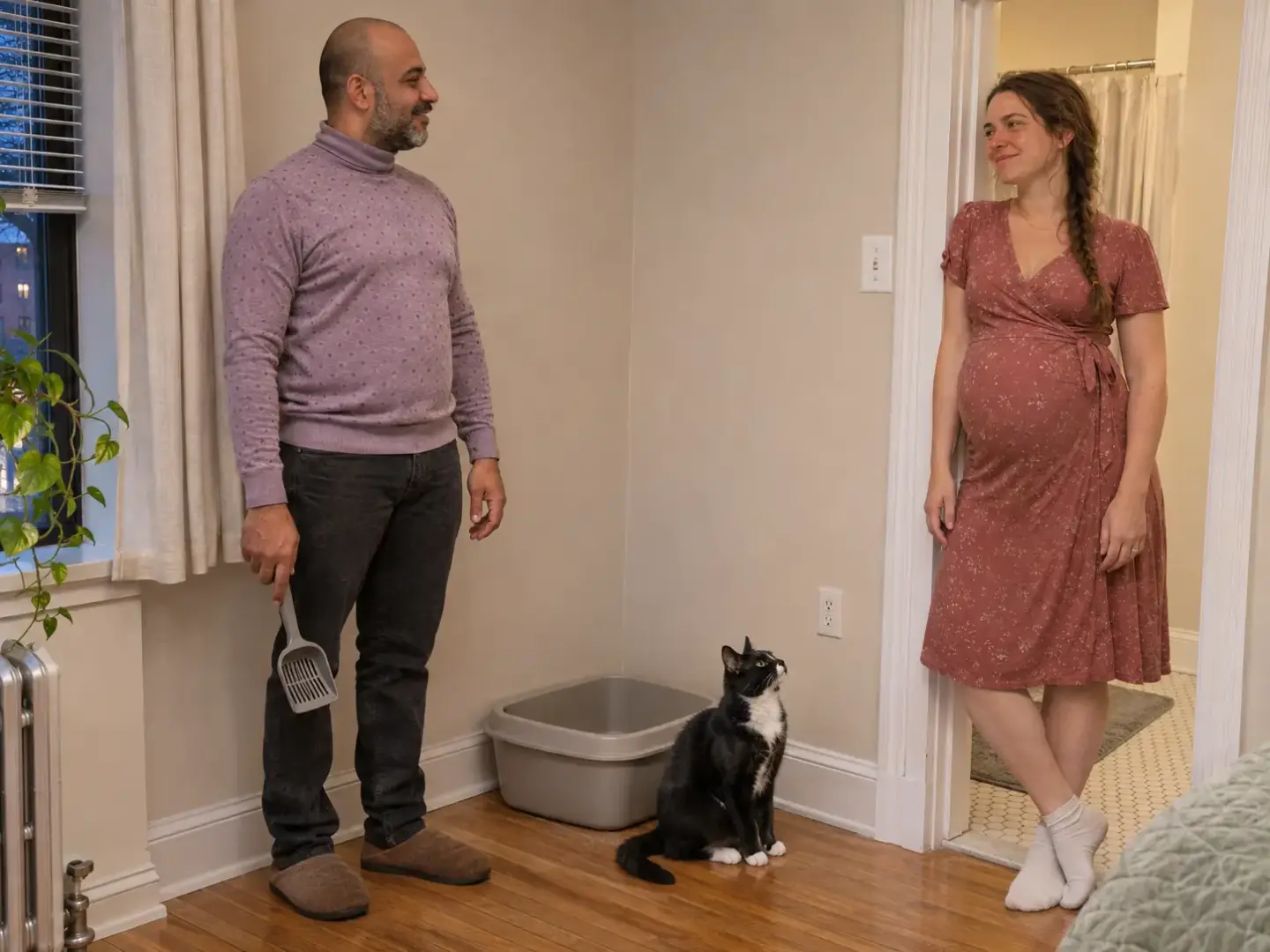
You are pregnant, the only litter box in the apartment sits in the last free corner beside the bathroom door, and someone at the table has just said the cat has to go. The cat is doing what it does every day. The hazard the CDC and Cornell Feline Health Center describe is a box nobody has scooped since Thursday, and both give the same rule for toxoplasmosis and a pregnancy litter box: clear it every day. Below, that rule becomes a schedule with names on it, a glove, a box and a scoop you can work at month eight, a spot in a home with no spare room, and a handover the cat can follow.
Quick Answer
Keep the cat, and scoop the box every 24 hours, because fresh waste is not infectious and needs at least a day to become so. Someone else should scoop. If nobody can, the CDC says disposable gloves and a soap-and-water hand wash. Your own questions go to your doctor, the cat’s to its vet.
What the Litter Box Actually Holds, and Why 24 Hours Is the Deadline
The whole routine hangs on one fact about timing, so it comes first.

Fresh is not the problem; the box left from Thursday is
Wild and domestic cats are the only definitive hosts of Toxoplasma gondii, and they pass it in their stool as oocysts. Those oocysts are not infectious when they land, and oocyst sporulation, the step that makes them so, takes time.
According to the CDC’s toxoplasmosis prevention guidance, “Change the cat litter box daily. The Toxoplasma parasite does not become infectious until 1 – 5 days after a cat shed it in its feces.” So the window runs one to five days, and the rule that follows is to change the litter box daily. Cornell Feline Health Center’s guide to toxoplasmosis in cats adds that where a given deposit sits inside that window depends on conditions, and it puts the floor at 24 hours.
Ohio State’s veterinary college says the same thing flatly: “In fact, no stool actually contains infective material when it’s first defecated.” Fresh waste is not the hazard. Old waste is. That turns a frightening topic into a clock, and a clock is something an apartment can run.
Everything here is written for the small apartment where a cat and someone new on the way share the same few rooms, the household that living in a small apartment with a cat and a child looks at from the other side.
The Friday-to-Monday box, in hours
Do the arithmetic once. If you scoop daily at the same hour, the box never holds a deposit older than a day when the pass happens, which is the floor Cornell gives, so no deposit gets time to ripen. Leave that same box from Friday morning to Monday morning and the oldest deposit is 72 hours old, squarely inside the 1-to-5-day window.
A weekend without a scoop is not a slightly worse box. It is a different object.
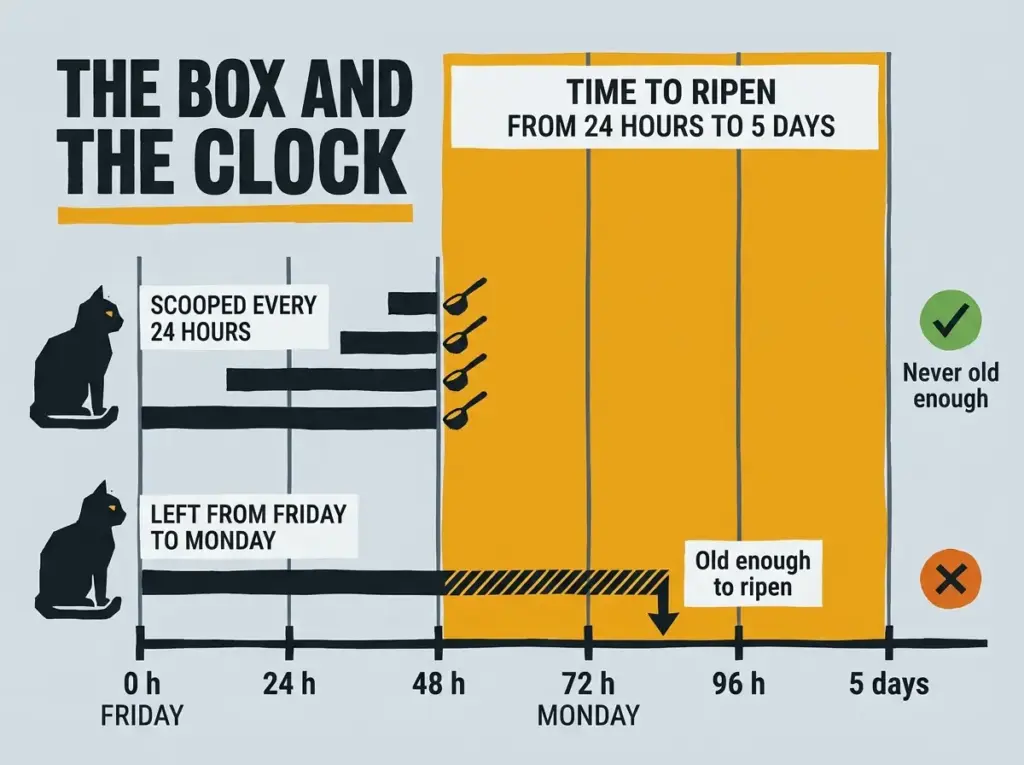
The weekend is also where a routine gets lost. Friday’s pass happens, Saturday’s becomes “later,” and by Sunday evening the box is inside the window without anyone having decided anything.
Put the day’s pass on a phone alarm with an hour attached, not on “when I can.” On the day the usual person is away, the alarm should trigger a handover announced in writing, never a skipped pass.
One cat or three: the clock does not change, the number of deposits does
A second and a third cat add deposits to every day, not minutes to the clock. The deadline for each deposit is the same, so the rule stays at every 24 hours, and it applies to every box in the home, not just one. With two cats and two boxes the work is two stops in the same pass. How often each box needs attention per cat is a separate calculation, set out in how often a box needs scooping per cat per day.
What makes an indoor cat a low-risk box
What goes into the cat decides whether there is anything in the box to think about. A newly exposed cat starts shedding 3 to 10 days after eating infected tissue and keeps going for about 10 to 14 days, according to Cornell, so a cat is a source for a window of roughly two weeks in its life, not for every day of your nine months. Prey, raw meat and time outdoors are how that exposure happens. Cornell calls indoor cats that do not hunt or eat raw meat unlikely to be infected, and an indoor cat on commercial food is the case this article is written for.
Ohio State’s Dr. Missy Matusicky is clear about the limit.
Even when every stool is picked up right away, some residual material stays in the litter and the box, so a small risk remains. The clock removes the deadline. It does not remove the glove.
Where the Question Stops Being About the Litter Box
One boundary runs through this whole topic, and it works better drawn early and once.

What belongs to your doctor at the first prenatal visit
Whether you are protected, what any lab result means, the odds at each stage of pregnancy and anything to do with treatment belong to your doctor, starting at the first prenatal visit. This site works on the box, the floor and the clock. Take your questions there, and take your litter box routine along, because the doctor will want to hear how the box is run.
What belongs to the cat’s vet
The cat’s side works the same way. A cat that stops eating, or changes a habit overnight, is the moment to call the vet, and it goes to its veterinarian before anything in the house is moved. A new routine for the cat is a different subject, and what a cat is telling you when its routine changes covers the behavior side. The part that touches health stays with the vet.
The CDC does not tell you to rehome the cat
The CDC’s own position is that avoiding cats is no longer advised, and Cornell adds that indoor cats that do not hunt prey or eat raw meat are unlikely to be infected. That is where this article stops on the question: it reports what the CDC and Cornell say and leaves the decision with you and your doctor.
The two official sources are not equally strict, and both deserve to be read as written.
The CDC says pregnant women should avoid changing cat litter if possible, and gives gloves and hand washing as the fallback when nobody else can. Cornell says not to let pregnant women or immunosuppressed people clean the litter box at all. Which one applies to your situation is a question for your doctor. The rest of this article assumes someone else scoops, and gives the CDC’s fallback for the days that cannot happen.
That leaves plenty of work that is yours: the schedule, the hand, the reach, the spot and the handover.
Who Scoops for the Next Nine Months
“Someone else will scoop” is the right plan and an incomplete one, because the parasite works on a 24-hour clock and a promise does not.
Handing over the box takes a schedule, not a promise
Delegating litter duty fails in a predictable way, and the question of who cleans the litter box needs an answer with an hour in it. The pattern repeats from home to home.
The handover is announced at dinner and never scheduled, the other adult is “on litter box duty” in name, and “I’ll get to it” has no hour inside it. The box drifts to a four-day cycle, then a six-day one, and the cat starts using a towel or a corner of the hall, because a box nobody tends stops being a place worth using.
Imagine the first day of duty: the box is still full at dinner, and the text that said “I’ll do it before work” gets read after work. Nobody acted in bad faith. “Doing it” simply never got a time. A partner who travels makes it worse, because the name on the chore is away half the week.
A handover that holds has an hour, a name and a named substitute for the days the name is away. When the person of the day cannot do it, the pass moves to someone else and the change is written down, never skipped. The free version comes first, and it is a phone reminder plus a note on the refrigerator saying whose pass it is today. A home that has already split cat chores because one person cannot touch the cat has solved this once, and how a home splits cat chores when one person cannot touch them shows how that division plays out.
The two days nobody is home
Long shifts and weekend trips open gaps longer than a day. The pass happens before anyone leaves and again the moment someone gets back. If the gap between them runs past 24 hours, the box has entered the window, and that is a case for the fallback below or for a trusted friend or neighbor with a key, not for leaving the box exactly where it is.
When you live alone, or the other adult travels
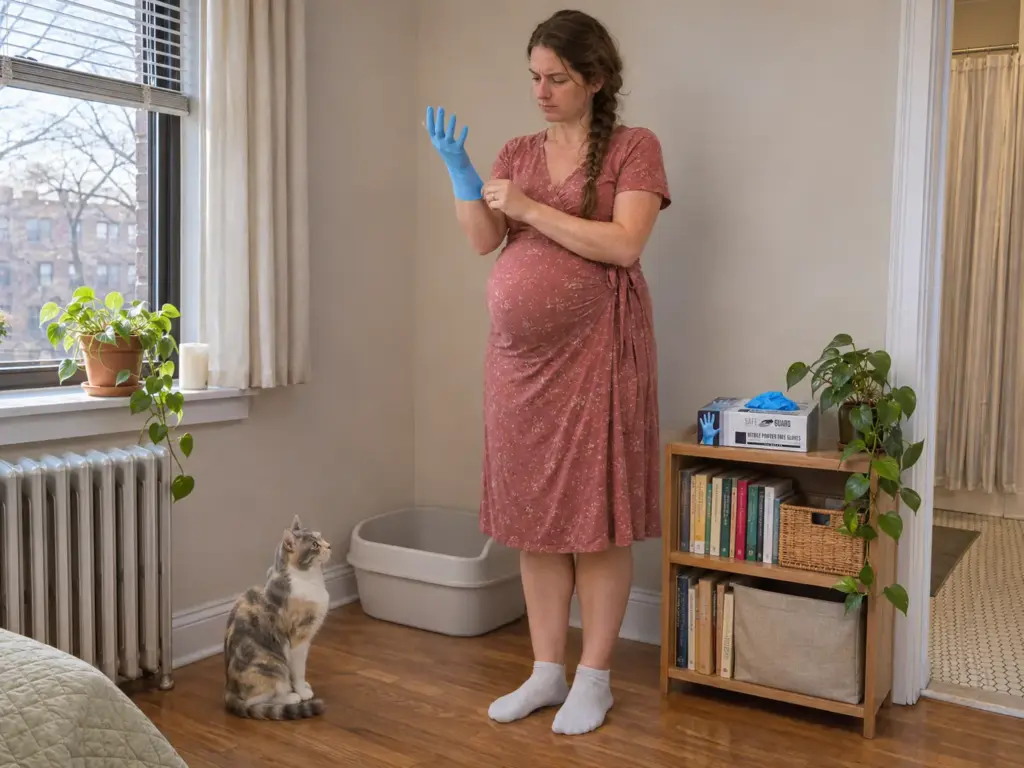
On your own, or with a partner whose work takes them away, the schedule has no second name on it. Ask another adult for the box if you can, even for a few days of the week, and write the day and the hour down. When there is nobody, what the CDC says to do when nobody else can is disposable gloves, and washing your hands with soap and water afterward. That is the fallback, and it should be treated as one, not as the norm.
For the glove half, Safeguard Nitrile Disposable Gloves in X-Large come 100 to a box, powder-free, and the size goes onto a damp hand without a fight. They are thin, and they tear at the wrist if pulled on in a hurry, so size up and ease them on. Any disposable nitrile or latex glove does the same job.
Build the fallback into one trip: a scoop that belongs to this box, the box of gloves and a lidded bucket, all within arm’s reach of the litter. Tape a note above it with the hour and the name for each day of the week.
The one adult who cannot do it
In some homes the only other adult is a toddler, and that is not a plan. Small hands and litter do not mix, and a small child does not scoop a box. What small hands are and are not ready for around a cat covers what a young child can take on with a cat, and the litter box is not on that list. When nobody in the household can take the box, an adult outside it can: a relative who comes by, a friend, a neighbor on a written schedule.
Gloves, Masks and Dust: What Actually Controls the Box
The next question is usually whether a mask makes scooping safe to do yourself. The official guidance answers it without one.
The glove and the tap are the control
Both official pages build the control from the same two pieces. The CDC says to wear disposable gloves and wash your hands with soap and water afterward, and Cornell’s list asks for gloves and hand washing when feces are removed daily. Neither rests its fallback on a mask. Ohio State’s College of Veterinary Medicine on litter boxes and pregnancy explains why the glove stays on even when the pass is daily: residual fecal material can remain in the litter and the box.
Why a mask is the bandage, not the plan
A mask covers smell and some dust.
It does not change what ends up on your hand, and the hand is where the control sits.
Handwashing at the end is the other half of that control. The usual failure runs like this: a box left for days smells strongly enough to drive someone out of the bathroom, she puts on a mask and gloves and does it herself, and she does it at the box’s worst moment. The mask patched the smell of a skipped pass. Smell is a box problem and gets solved in the box, with litter, depth and air.
Low dust comes from depth, not from a new bag
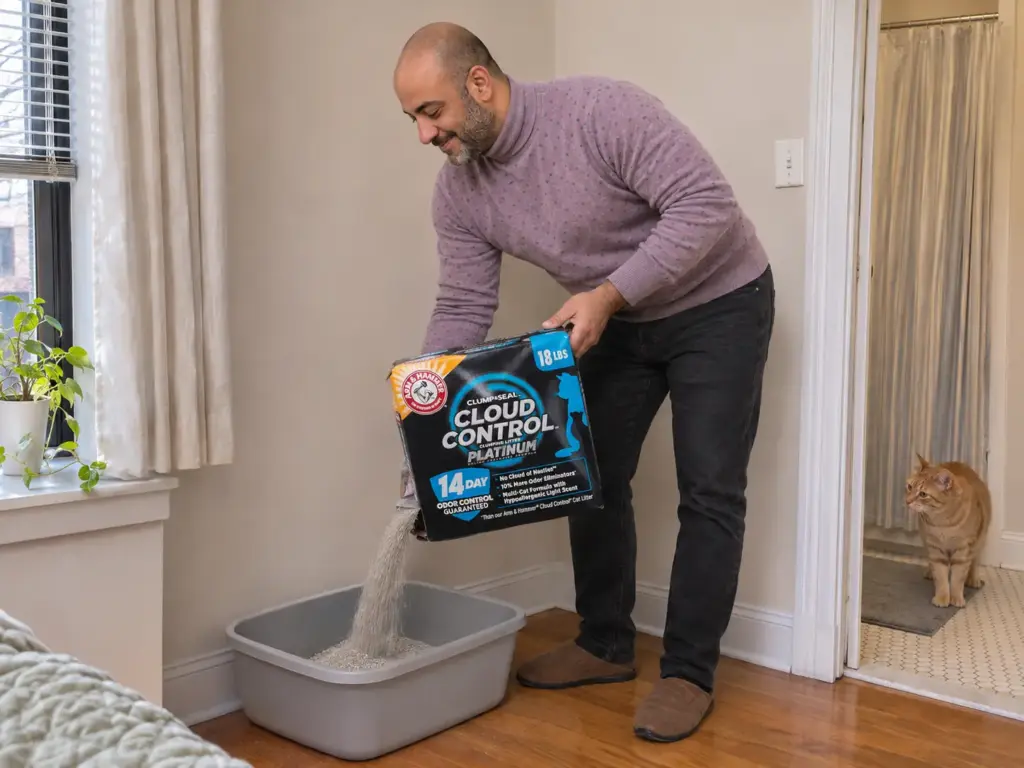
Depth comes first, since it is free: 2 to 3 inches of litter, deep enough that the scoop does not scrape the floor of the box and shallow enough that every scoop does not throw a cloud. Why depth does more than volume explains the mechanics. At that depth an unscented clumping clay litter does most of what a premium bag does. Changing to silica or pine litter in the middle of a handover is one change too many.
If dust still bothers you after that, clumping litters that stay low in dust sorts litters by it, and ARM & HAMMER Cloud Control Platinum in the 18 lb multi-cat bag is a low-dust clumping option that fits the job. It divides the people who use it: some find the smell off, and others find it travels out of the box on paws. Buy the one bag and watch your cat’s reaction before committing to a second.
Air matters too. Ventilation, a window cracked or the bathroom fan running, and the box out of any corner with no movement, lowers the ammonia of a box that is scooped late. That ammonia is the reason many pregnant women end up scooping themselves. Getting the box smell to stay gone covers airflow and routine.
The deep clean is the other adult’s job
Cornell’s list adds a rule for the box itself: wash it frequently with boiling water, and do not allow pregnant women or immunosuppressed people to clean it. Cornell’s sanitation list for the box puts the deep clean on the other adult’s list, not yours. How often the box gets scrubbed, and how, is in how often the box gets a deep clean.
Scooping daily is not the same as emptying the box. A full litter change, when it falls due, does not replace the day’s pass, and a box dumped every fifth day is still dirty on the fourth, however fast the litter bill climbs.
A Litter Box a Pregnant Woman Can Actually Service
The box is sized for the cat and the scoop is sized for you, and the second number almost never gets measured.
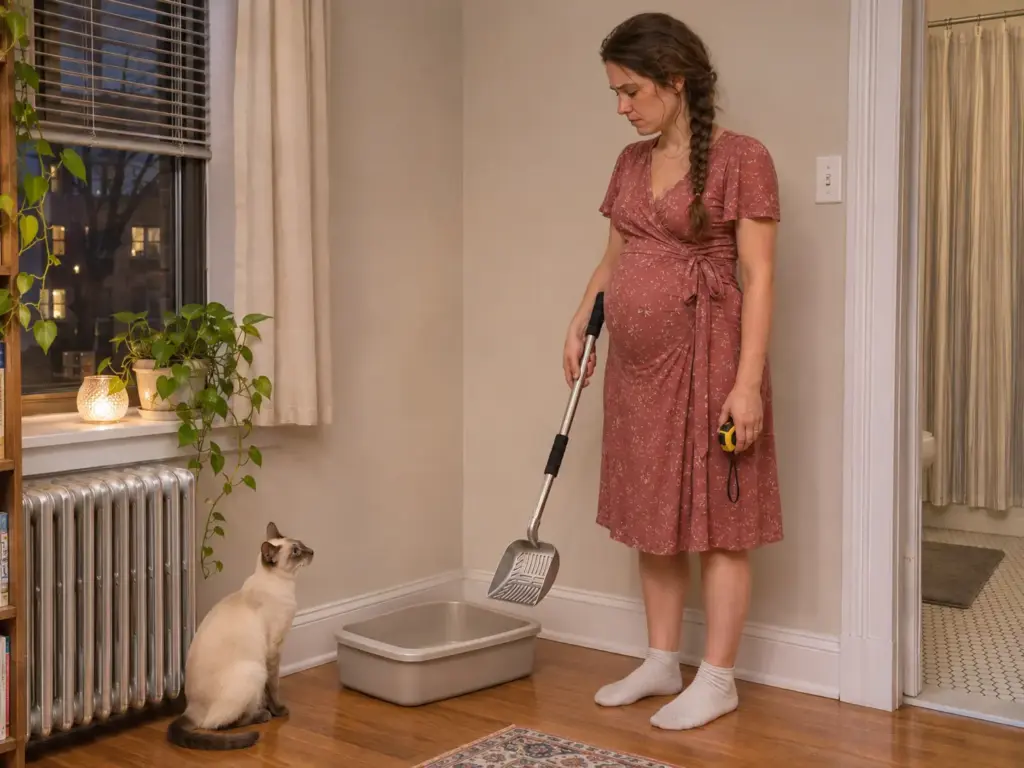
Measure the reach before you buy anything
Picture the morning you work out that you cannot get down to the box in the hallway without pulling a chair over.
Measure before reaching for any fix, including a change in litter box height. Stand next to the box with your hand relaxed at your side and run a tape from your palm to the floor of the box. For a standard box that lands somewhere between 30 and 35 inches, and more for one with high sides. That number is what a scoop handle has to cover so you can empty the box standing up.
The free fix comes first. If moving the box a few feet puts it where you can scoop upright, do that.
Take the tape measure standing up, hand loose at your side, palm to the floor of the box. That one number picks the scoop handle. The size of the box has nothing to do with it.
Why a stand is the wrong fix
A box on a stand looks like the answer and works against the cat. It lifts the box, and with it the edge the cat has to step over, which is too high for an older cat or a short-legged one, and a raised box that is not rock-steady shifts when the cat jumps in. A long handle does the job the stand was meant to do without touching the box.
Yangbaga’s Detachable Long Handle Metal Scoop has a 32.3-inch handle and a stainless steel head of 6 by 5.1 inches, built for exactly that reach, so you scoop standing, with no bending in the hallway and no change to the box. Its flaw sits in the middle of the handle: the two sections screw together and can loosen while you work, and one can crack, so give it a firm turn before every pass. A plastic long-handled scoop works too, as long as you measure it first, because one of 17.5 inches still has you bending. Scoops that do not bend or clog goes through what to look for in a handle.
Box size and litter depth that save the back
The box itself is sized for the cat, not for your back. The interior should run roughly 1.5 times the cat’s length from nose to the base of the tail, which is 24 to 30 inches for an average adult, and that number does not shrink because you cannot bend. A large cat, a Maine Coon for instance, already outgrows many boxes sold as large, and boxes that fit a big cat lists some that do not.
Litter stays at 2 to 3 inches. Deeper fixes nothing, and shallower lets the scoop hit the floor of the box. With two cats and two boxes the measurement is per box, and one long scoop serves both.
Where the Box Goes When There Is No Spare Room
In a one-bathroom apartment every spot is a compromise, so the question is which compromise costs least. Where a box fits in a small apartment works through the geometry, and the rules below cut the list down quickly.
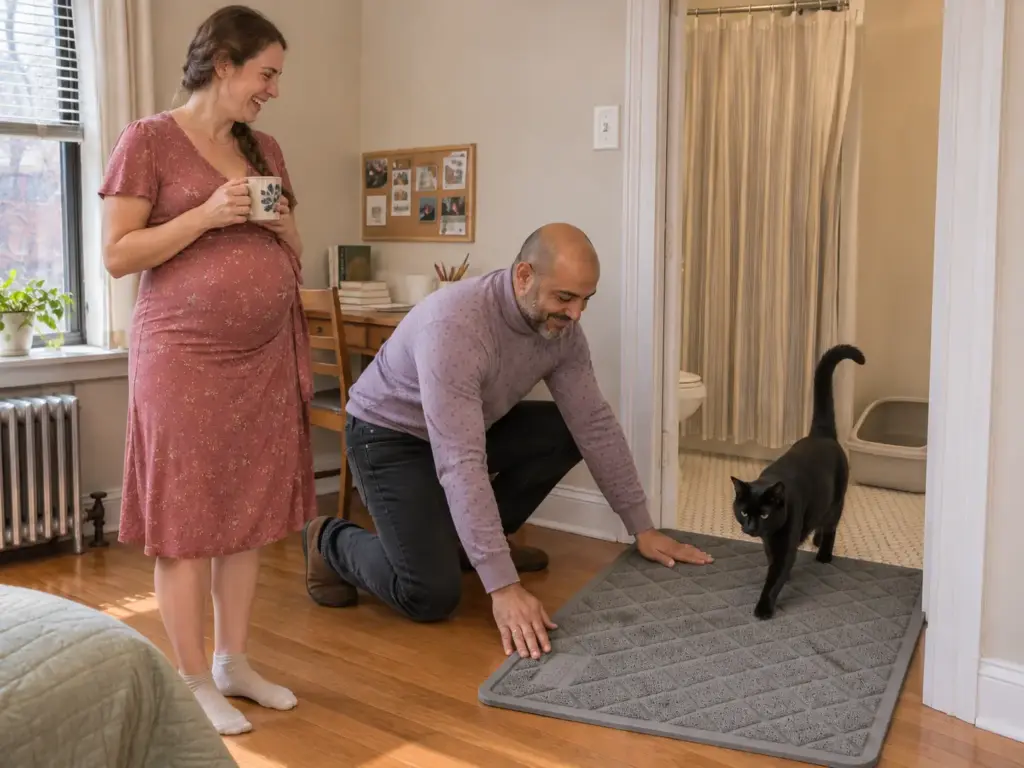
Away from the kitchen counter, and out of the nursery
Litter box placement comes down to two exclusions: keep the box away from the counter where food gets prepared and out of the nursery, and nearly any other spot can work. Give it air: a window or the bathroom fan, because a box in a corner with no movement is the one that drives people out of the room. Put it on a floor that survives a spill, meaning a surface you can mop with hot water, since a box on a rug is a box that creeps.
The general placement rules, including the spots to rule out, are in where a box goes and three places to avoid. With a multi-cat household and more than one box, do not gather them in one corner: each box gets its own spot and its own pass.
The one-bathroom compromise
In a one-bathroom apartment the box often ends up beside the sink, and that is usually the least bad option. It carries a real advantage: the hand-washing spot is a step away, which turns the CDC’s fallback into a single trip. Putting the box in the bathroom covers what to check when a box lives in there.
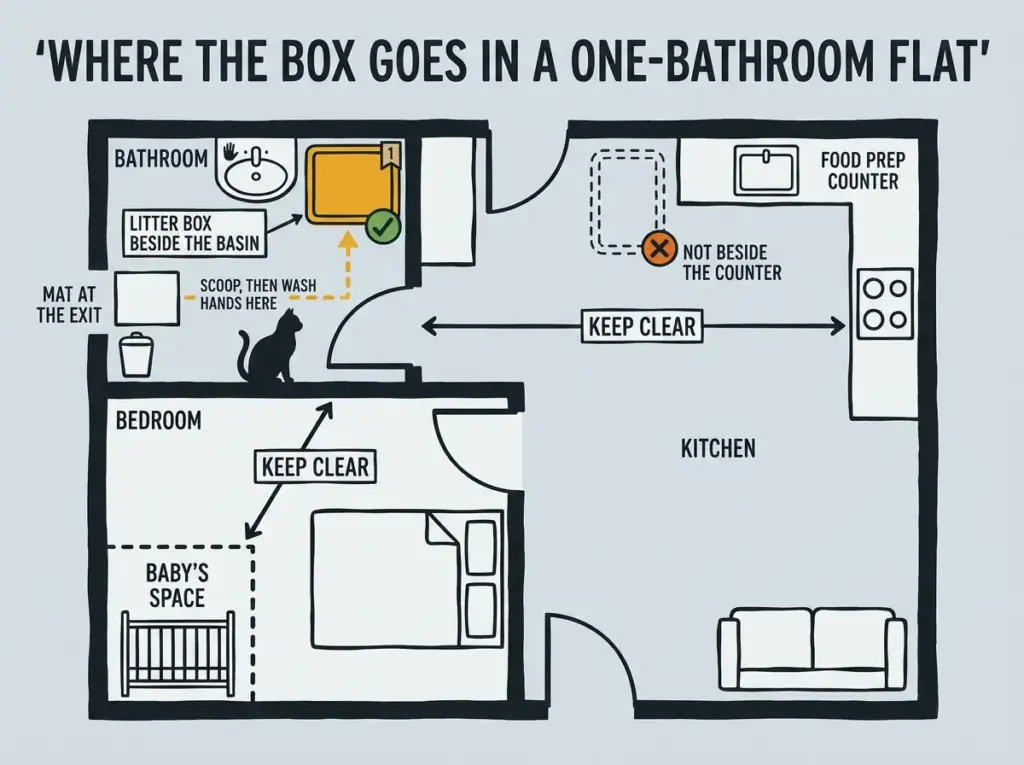
A utility closet or the hallway near the bathroom is the alternative, and it carries a catch. The hallway puts the box in plain view, and it is where a cat that has run out of box options ends up using the floor.
Move the box to the room where the other adult spends the evening, the office or the TV room. A box that sits where someone already is gets noticed and scooped without a reminder, and the move is an adjustment of placement, not a reproach.
The mat at the exit, and the floor that survives a spill
A box tucked beside the bathroom sink drags litter into the hall on every exit.
The mat is what catches it first.
GORILLA GRIP Cat Litter Mat is a coiled mesh of 35 by 23 inches in two layers, wide enough to cover the whole exit, so the paws shed their litter on the mesh and not on the hall floor. Some litter still ends up loose, the coils need shaking out or vacuuming, and the mat is hand-wash only and has to dry in the air.
A bath mat or a shallow tray at the exit does a rougher version of the same job. Mats that actually trap the litter compares what each design holds on to.
Handing the Box Over Without Teaching the Cat the Hallway Is a Box
A tidy schedule can still fail if everything changes at once.

One change a week, in this order
A home that changes who scoops, at what hour and in which room, all in one week, often finds the cat using the bath mat. The cat is not taking revenge. Its map of the house moved several times in seven days, and the box it cannot find is the one that turned into another place. The cat is right about the constraint, and the order of the changes is the thing to fix.
Change one thing a week, in this order: who scoops, with the same hour and the same spot, then the hour, then the place, if the box has to move at all. The new person scoops at the old hour, with the same glove and the same scoop, so the only new thing is the person. Keep strong-scented cleaners out of the handover too, since a change in smell is another change, and switching litter without losing the box covers how to move a cat to a new litter when that is part of the plan.
Moving the box out of the nursery, early
If the box lives in the baby’s room, or will end up inside it, it moves early and in small steps: a few inches a day toward its new spot. With two boxes, each one moves on its own schedule and never both at once, because a cat that loses its box is the one that starts using the other cat’s.
The full timeline of the arrival lives elsewhere. What the nap-time door and the empty crib change for a cat covers the nursery, and the weeks that follow the baby’s arrival covers how the cat’s days change afterward.
When the cat starts using another spot
A cat that suddenly stops using the box, or shows out-of-box elimination, is a vet question before it is a house adjustment, so the visit comes first. A cat that stops eating gets the same call. When the vet finds nothing, the handover is the usual cause, one change too many. Go back one step, to the last person, hour and place that worked, and hold it for a week before trying the next move.
Bagging the Waste, and What in the Kitchen and Garden Outranks the Box
The last stretch of the box’s trip is the trash, and beyond it sits the rest of the list the official pages keep.
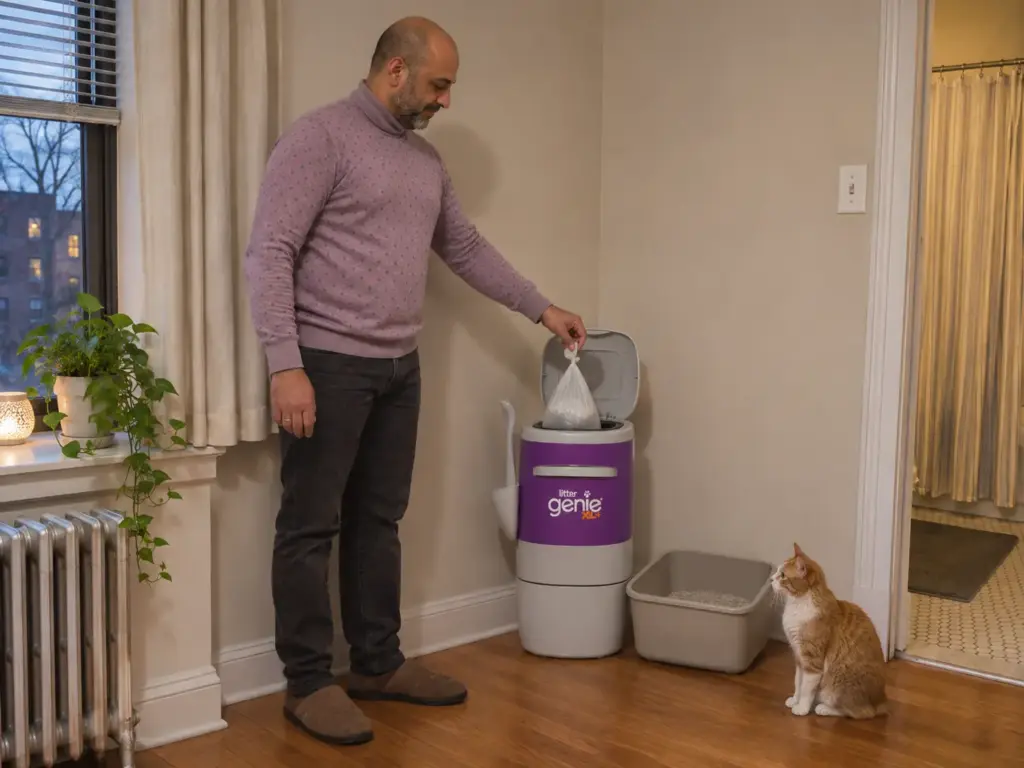
Bag it, bin it, never flush it
Scooped waste goes into a bag and into a sealed bin or the trash. Do not flush cat litter, and do not compost cat litter either. Why clumping litter stays out of the toilet explains the plumbing side. A kitchen trash bag and a lidded bucket beside the box cost nothing, and the trip out with the bag is the part people skip.
For that trip, the Litter Genie XL+ Pail stands 22 inches tall on a 9.45 by 9.45-inch footprint beside the box. You drop the tied bag in, the lid closes and nothing has to leave the apartment that day, and the maker rates a refill for up to 21 days per cat. The hinge plastic cracks easily, though, and the trap door can fail to stay closed, so the lidded bucket with a trash bag is a fair stand-in. More cats fill the bag sooner and the procedure stays the same.
The kitchen outranks the box
What Cornell says people are more likely to catch it from is raw meat, undercooked meat and unwashed produce: in the U.S., people are much more likely to become infected that way than by handling cat feces. The CDC page lists the same food habits, cooking meat thoroughly and washing produce. That is food safety, not medical advice, and it belongs on the same week’s list as the box. A home that has rebuilt its whole litter routine and still handles raw meat without a plan has dealt with the smaller source first.
Garden soil, the sandbox, and what the cat eats
Gloves for gardening or touching soil or sand that cat feces may have contaminated, and a cover on outdoor sandboxes: the CDC’s list for soil, sandboxes and food has all of it. The cat’s own food belongs in the same place, commercial canned or dry or well-cooked table food, with no raw diet and no hunting, according to the CDC and Cornell. That diet is what keeps the box a low-risk case.
An Hour and a Name for the Box, Starting Tonight
The plan reduces to a short list.
The box is scooped every 24 hours by a person with a name and an hour, and on the day that person cannot, the pass changes hands in writing and is never skipped. If nobody can take it, the CDC’s fallback is disposable gloves and hand washing with soap and water. What is yours to ask belongs to your doctor, and what is the cat’s belongs to its vet. The home handles the box, the spot, the reach and the staged handover.
Look at the box the morning after each new pass during the first week, and see whether “I’ll do it” turned into an hour. Look again when the second change of the handover arrives, and once more with whoever scoops before the baby does, when the whole schedule gets a second read.
You can do one thing today with nothing to buy: set the hour and the name for tomorrow’s pass in the phone, run a tape from your resting hand to the floor of the box, and move the box to where the other adult spends the evening if that helps. What you should see afterward is a box that arrives at the next pass with nothing old in it.
Frequently Asked Questions
01Can I scoop the litter box while pregnant if I wear a mask?
A mask is not what the official guidance rests on: the CDC says to avoid changing litter if possible, and otherwise to wear disposable gloves and wash your hands afterward. Daily removal is the point. Dust and smell are box problems, and deeper low-dust litter plus an open window do more than a mask.
02Do I have to get rid of my cat if I am pregnant?
The CDC no longer advises avoiding cats, and Cornell says indoor cats that do not hunt prey or eat raw meat are unlikely to be infected. What changes is who handles the litter box and how often it is cleaned. Questions about your own situation belong to your doctor.
03How often should the litter box be scooped during pregnancy?
Every 24 hours at the most. Cornell puts the minimum time the parasite needs to become infectious at 24 hours and the CDC gives 1 to 5 days, so a box cleared daily never holds a deposit past that window. A box left from Friday to Monday is a different object.
04Who should clean the litter box if I live alone?
Ask another adult to take the box if you can, even a few days a week, and write the day and hour down. If nobody can, the CDC’s fallback is disposable gloves and a hand wash with soap and water afterward. The boiling-water deep clean is the one job to hand to someone else.
05What happens if you get toxoplasmosis while pregnant?
That is a question for your doctor, at the first prenatal visit, and not for a litter box article. What this site can answer is the part that is yours to change at home: the daily scoop, the glove, the placement and the handover.



Leave a comment