How to Break Up a Cat Fight With a Barrier, Not Your Hands
Don't reach into a cat fight. Put a barrier between the cats instead, from a spot your arm can't be bitten from (+ the hour after, door by door).

Alfredo RamsesFounder · November 3, 2026 · 14 min read

On this page5 sections
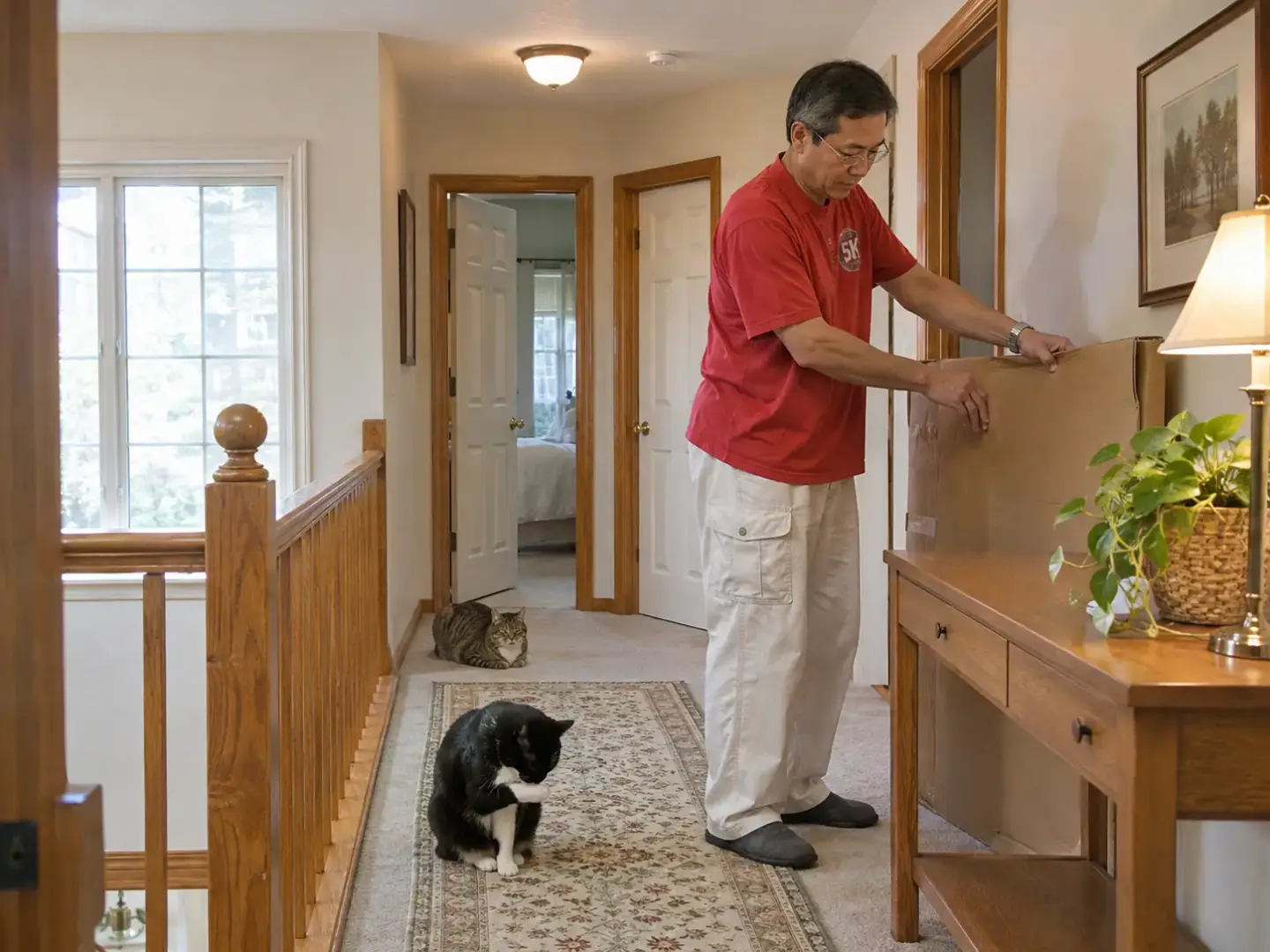
The yowl starts down the hallway and your hand is already moving, because every instinct says to grab one cat and pull. The two cats are not fighting you; they are fighting over a line of sight and a patch of floor, and the closest warm thing within reach of either one is your forearm. A bite to you is a doctor’s visit, a wound or a sudden change in a cat is the vet’s, and everything else about how to break up a cat fight is floor, furniture and distance. This guide covers why the hand loses, what to put between the cats (the free thing first), where to stand so your arm stays out of reach, and what to do with the two of them for the hour after.
Quick Answer
Put something solid between the cats before any part of you gets there.
- Keep your hands and face out of the tangle.
- Stand a barrier on its edge across the whole line between the cats.
- Slide it in from the side, standing farther back than an arm reaches.
- Let each cat leave a different way, then close a door between them.
- Skip the petting and the lifting until both cats have cooled off.
- Phone a doctor about a bite and the vet about a hurt or changed cat.
Why Your Hand Loses the Fight, and Where a Bite Goes Afterward
The reflex is a reasonable one. A noise starts, you want it over, and the only tool at hand is the hand. But from where the cats stand the logic is simple: two animals locked in a standoff in a narrow hallway have no room to retreat, and whatever arrives first, a paw, a shout or your arm, lands in the middle of it.
The Fighting Cat Turns on the Nearest Warm Thing
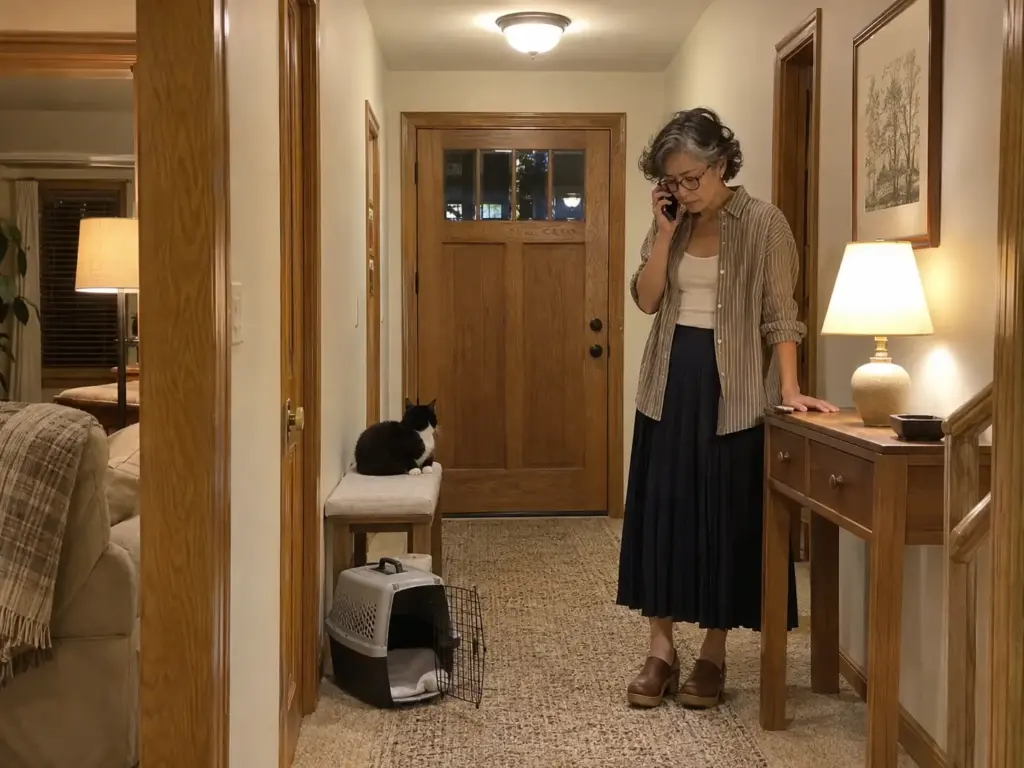
A cat in the middle of a fight is running on adrenaline, and it does not sort whatever comes close into target and bystander. The bite that lands on a person usually comes from the cat that was never the target, because the hand was the nearest thing in reach. Neither cat is picking you. Each one is holding its ground in a space with a single way out, and the arm in the way closed it.
Waiting it out does not work either. According to the ASPCA’s guide to aggression between cats in a household, “Never let the cats “fight it out.” Cats don’t resolve their issues through fighting, and the fighting usually just gets worse.”
The same guide warns that a fighting cat can turn on anyone who comes close, a pattern called redirected aggression, so the choice is not between stepping in and standing back. It is between stepping in with a hand and stepping in with an object.
And if what you are watching might be rough play, there may be nothing to cut at all: a week of notes that sorts play fighting from real fighting settles it better than one loud afternoon.
A Bitten Person Goes to a Doctor Before Anything Else
If a cat’s teeth or claws broke your skin, put this page down and call your own doctor. PDSA’s guidance on cat bites puts it in a single sentence: “Always seek medical advice from your doctor if you have been bitten or badly scratched by a cat.” Nothing else in this guide deals with a bite or tells you what to watch for afterward, because that belongs to someone who can look at it. Say the rule out loud to everyone who lives with the cats, since the person nearest the hallway when it starts is rarely the one who read this.
A Wound, a Sudden Change or a Skipped Meal Goes to the Vet
The cats get a matching rule. A wound you can see, a change in how either cat behaves that arrived out of nowhere, and a cat that skips meals each turn the evening into a call to the vet, and the ASPCA’s guide says a cat that stops eating should see the vet right away. This guide does not interpret any of them. It hands them over and goes back to the hallway, where the furniture and the distance are the parts you can change.
Save two numbers in your phone today, the closest emergency vet clinic and your own doctor, under names you can find with a shaking hand. Searching for either one mid-evening, with a sore arm and two cats out of sight, is a bad time to learn the clinic’s name.
A Noise Is a Bet on Which Way They Run; a Barrier Decides It
The first minute of a fight (hands out, noise kept away from the cats, both left to cool) is laid out step by step in the full guide to stopping cats fighting when there is no second room. What follows covers the object itself and where it goes.
The usual advice for that first second is a clap, a shout or a squirt bottle, and in an apartment it fails a simple test. A noise sends the cats somewhere, but not necessarily apart: they can bolt in opposite directions, or into the sofa, or at each other, and a small home offers few directions to choose from. Either way the trouble stays inside the walls and now carries a fright on top. A barrier decides the direction for them, because it removes the line of sight the standoff runs on, and it adds no fear.
A Barrier Wide Enough for the Standoff, Cheapest First
A barrier has one job: take the other cat out of sight, so nobody has to win the stare. To do that it has to cover the whole line between the cats, stand higher than their heads, and already be in the hall before your hand is. Most of what gets grabbed in the moment manages one of those three.
The Free Barrier Is Already in the Apartment
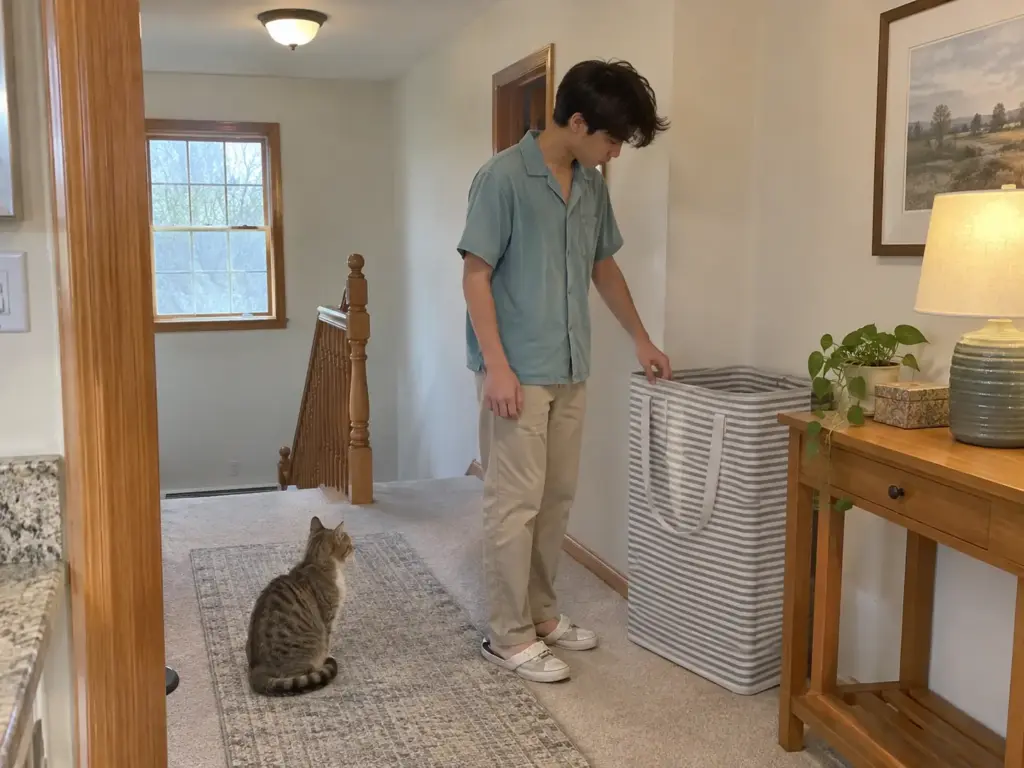
The first candidate is a large cardboard box, flattened and stood on its long edge. It is light enough to slide in from the side and tall enough to hide a cat from a cat, and if the box from the last delivery is still folded behind the sofa, that is your barrier.
- A flattened moving box, stood on its long edge: tall, light and wide enough to cover the line.
- A firm sofa cushion, pushed in on its edge: wide enough to hide a cat, but it flops unless it leans on something.
- A bed pillow: soft and quiet, though it bends where it should stay flat.
- A thick blanket, last of all: it hides the line, and it also scares them.
Nothing here needs a nail or a hook. The box lives on its edge behind the sofa, which suits an apartment where the lease has opinions about holes.
Size It to the Standoff, Not to the Cat
The common mistake is sizing the barrier to the cats when it has to be sized to the gap between them. The test needs no cats at all: stand beside the spot where your two usually square off, hold the box upright across the line they would face along, then crouch to head height and look. If you can still see the far end of the hall around it or over it, the stare survives and the barrier has failed.
So the width is the whole line, doorframe to wall or sofa arm to baseboard. The height is above their heads when they stand tall, and the position is the side of the standoff, so the barrier goes in edge-first without crossing the cats’ space. There is no universal number, because the number is your hallway’s.
Two Barriers Worth Owning: a Flat Mat and a Basket That Stands
When the box is gone or the hall is wider than a box, a flat mat does the job more neatly. The NEWBRAUG Self Healing Cutting Mat 36 x 48 inch is a five-ply board an inch thick, so it takes a push without folding. Stood on its long edge it is 48 inches wide and 36 inches tall, a wall you slide in from the side that closes the line across a narrow hall in one piece (measure your hall before trusting that).
It is built for rotary cutters and dulls their blades faster than expected, so it works better as a dedicated hallway mat than as a craft table that doubles as a barrier. A flattened box does the same job for free, so the mat is for the hall where a box looks too short or too soft to hold.
The Lifewit 80L Collapsible Laundry Basket 2 Pack works the other way, as a barrier that stands up by itself. Each basket opens to 26.4 inches tall on a 15.7 by 11.8 inch base, which hides a stare; a low basket that opens to around ten inches hides nothing, and that height is what decides it. It folds flat for the closet, and the pack gives you two, one for each end of a long hall or one for each floor. It tips when the load inside is uneven, and the listing asks you to weight it evenly, so keep it leaning on a wall or a door casing until the moment it is needed.
Keep the barrier standing and close to where the staredowns start, at the end of the hall or behind the sofa, not folded in a closet. Nobody walks to a closet with two cats mid-standoff.
What Does Not Count as a Barrier
A thin sheet or a jacket gets pushed aside or slides off, and a cat sees through the gap it leaves. A broom is the same story in a different shape: it keeps your arm at a distance and hides almost nothing, so it earns a place further down as reach and none here as a wall.
The blanket is the thing most hands grab first, and I would put it last. It hides the line, but it frightens the cat under it, and it ends with you lifting a cat that is still running hot. Cats Protection advises giving cats time to cool off before anyone strokes or picks them up, which the carry-it-out version breaks on the first move.
Where to Stand, and the Hour After the Break
The barrier is only half of it. The other half is a place to stand, and what to do with two keyed-up cats once the stare is cut.
Choose the Stand-Back Spot Before the Fight
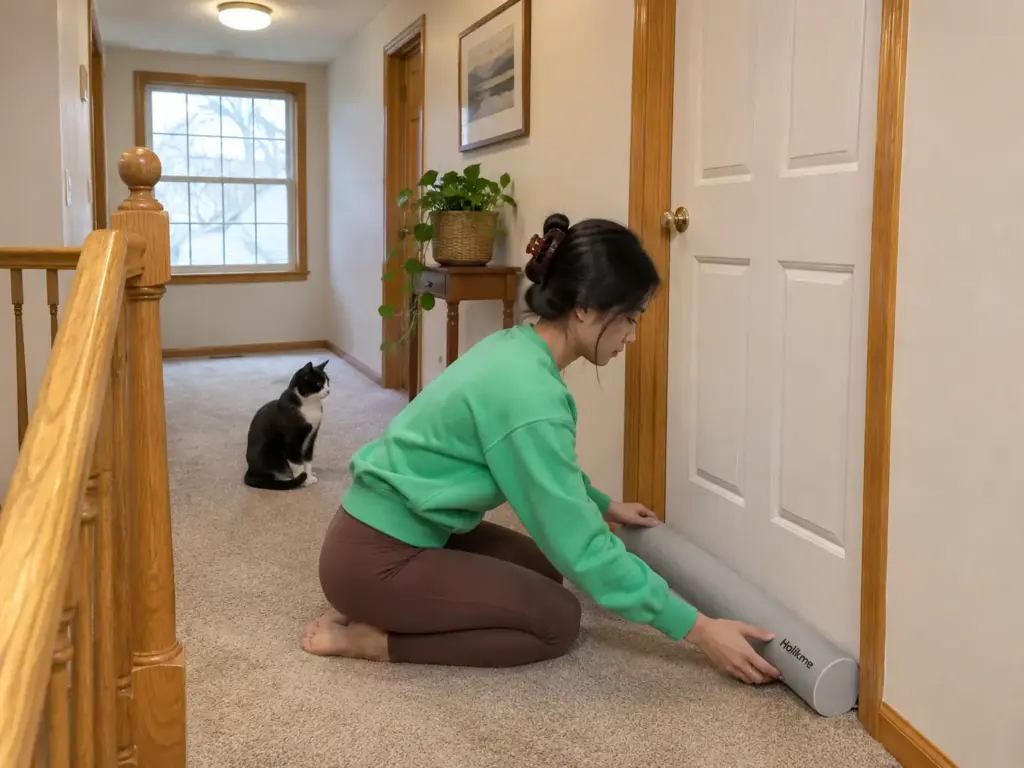
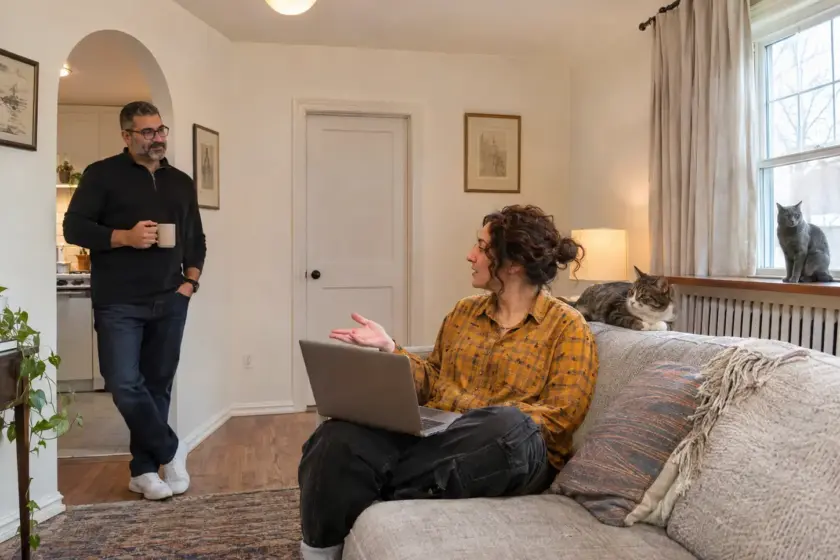
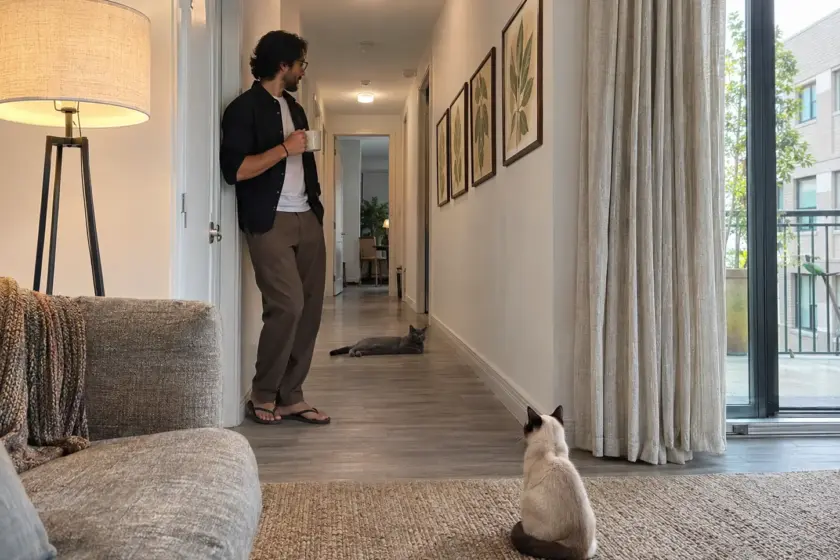
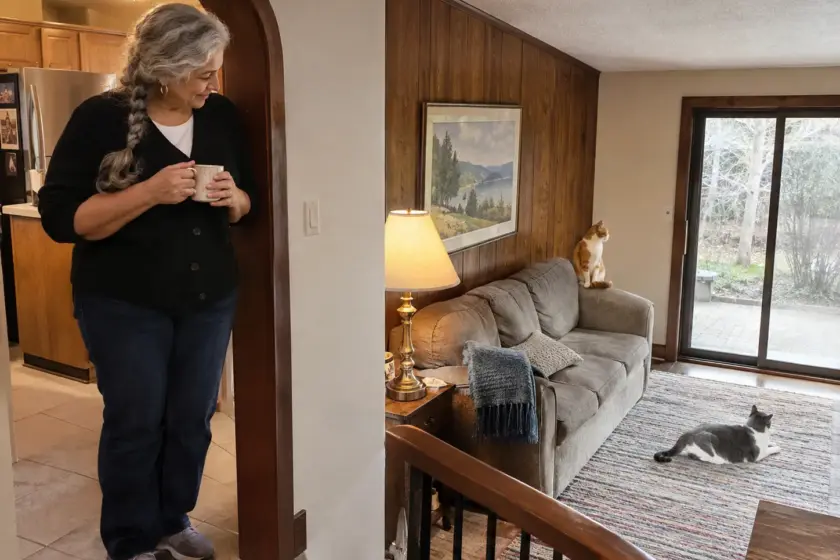
Pick the stand-back spot on a calm day, not mid-standoff. In a hallway it is the wall beside the doorway, a step or two back from where your two usually meet, with the barrier already leaning there. From that spot you slide the barrier in from the side, edge-first, so it lands between the cats while your arm never crosses the space either of them can reach.
How far back is far enough? Farther than an arm reaches, and no fixed number beats that, since the right distance shifts with the cat, the hall and how fast the standoff is moving.
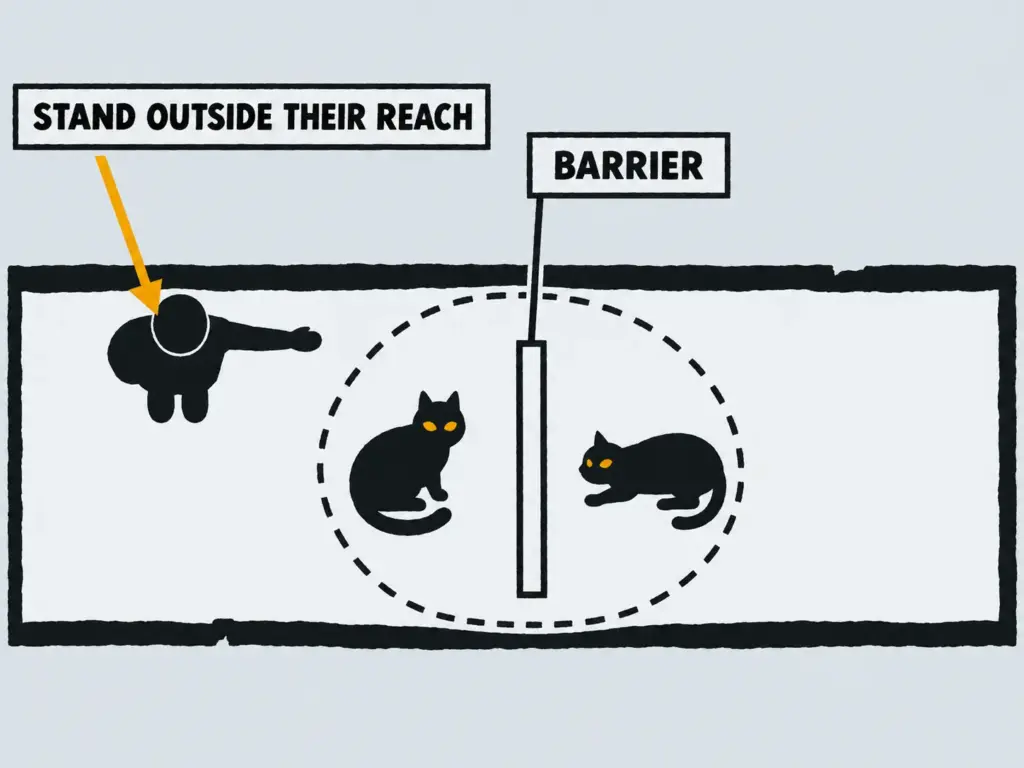
Reach is what a broom adds. If the hall is longer than your arm, a broom can push the box into place from farther back, and the broom in your closet does that for free.
The Heavy Duty Broom 55 Inch Long Handle Angle Broom stands 55.5 inches tall with a head 13.8 inches wide, and that length puts more floor between your forearm and the cats. It gives distance and almost no visual block, so it never replaces the barrier. The handle can work loose in use, a poor trait in a tool whose job is to stay rigid, so tighten it the day it arrives and again whenever it comes out of the corner.
Let Them Go Different Ways, Then Close a Door
Once the barrier is in, let each cat leave in its own direction. Do not chase the one that bolts, and do not carry either one anywhere (a cat moving at that speed is not a cat to pick up). Then close a door to separate cats for the night, so there is a wall where the barrier was, and give both of them time to cool down before anyone goes near.
For a mild case the ASPCA recommends separate rooms for several days or weeks, with each cat keeping its own bed, bowls and litter box. The litter box is the part that gets forgotten, and how many litter boxes two cats need changes once a door splits them, since each side needs one.
A closed door still leaves the gap at the bottom, and a paw fits under it. A rolled towel across the foot of the door shuts that gap for free. Where a towel keeps slipping, the Holikme Under Door Draft Stopper 36 inch measures 36 by 2 by 2 inches and fills a gap up to 1.7 inches, which stops a swat under a closed door. It only suits thresholds up to 0.3 inches high, so check yours first.
Something to Chase on Each Side of the Door
The cat behind the door does not need to be left alone; it needs somewhere to put its energy that is not the other cat. A ball tossed across the room is a distraction that pulls attention to the floor and away from the door, and a crumpled ball of paper does it for free. The Cloverjoyed Ping Pong Balls for Cats 6 Pack gives you six balls, enough to leave a few on each side of the door. They bounce less than the name suggests, so expect rolling over hopping, which suits a bedroom floor.
None of this is a time-out. The cat behind the door is not in the corner for what happened; it is back among its bed, bowl and box, which is what a cat in a tense house is asking for.
When the Door Can Open Again
The door opens on the cats’ schedule, and any fixed number of days would be a guess. The ASPCA puts a mild case at several days or weeks apart; once both cats look relaxed, it says to crack the door one inch and close it at the first hiss or swat. An afternoon with the one-inch gap held and both cats quiet is a pass. A gap that has to close again by the next morning means one more day apart, not a failed cat, and some evenings end with one cat on the sofa and the other in the bedroom, which is a fine place to stop for the night.
Meeting again after a fight is a reintroduction, and the guides for that part apply: how long cats should stay behind a door before they meet again sets the clock, and the signs that a re-meeting is failing between sessions says when to close the door once more. If the fights keep climbing over the weeks with no single event behind them, a look back over the last six weeks is the place to start. And if either cat keeps hiding, skips meals or changes from one day to the next, that is a call to the vet before another step with the door.
After every incident, jot down which door or corner it started in and leave the barrier standing there. Duels tend to keep returning to the same address.
Stand the Barrier Up Before the Next Standoff
The hand loses because it arrives last and lands in the middle; the barrier wins because it is already in the room and takes the other cat out of sight. Choose the stand-back spot on a calm day, farther than an arm reaches from where the cats meet, and close a door behind them once they part. A bite on you goes to a doctor, and a wound, a skipped meal or a sudden change in either cat goes to the vet.
You will know it held when the one-inch gap survives an afternoon with both cats relaxed. If the hiss comes back the next morning, the door closes for another day or so and you try the gap again.
Today, flatten one cardboard box and stand it on its edge beside the spot where the staredowns start. Buying nothing gets you ready.
Frequently Asked Questions
01What’s the best way to break up a cat fight?
Put a solid barrier that covers the whole line between the cats in the way, slid in from the side while your arm stays well out of their reach. Hands stay out of it. The first minute of a fight, step by step, is in this guide to stopping cat fights in a small home.
02At what point do you break up a cat fight?
Break it up once it is clearly a fight and not play, because cats do not settle things by fighting and it usually gets worse. If you cannot tell which it is, a week of watching sorts rough play from a real fight.
03Should I use a squirt bottle or a loud noise to stop a cat fight?
Skip both when you can: a squirt or a shout sends the cats running in no particular direction and adds a fright to a fight already running hot. A barrier takes away the line of sight without adding fear.
04What do I do if a cat bites or scratches me?
Call your doctor, because a cat bite or a bad scratch is a medical question and not one a furniture guide can answer. Keep the cats apart while you go.
05How long should two cats stay apart after a fight?
For a mild fight the ASPCA says to keep the cats in separate rooms for several days or weeks, each with its own bed, bowls and litter box. Once both are relaxed, the door opens one inch and shuts again at the first hiss or swat.

Leave a comment