Best Pet Gate With Cat Door for a Rental Doorway
Pick the best pet gate with cat door by the numbers: 36 or 41 in tall, 5 to 12.2 in openings & the 8 × 8 hole a medium dog squeezes through.

Alfredo RamsesFounder · November 10, 2026 · 25 min read

On this page10 sections
- 1A Pet Gate With a Cat Door Is a Dog Barrier With One Cat-Sized Hole
- 2Why the Gate You Already Own Stopped Working
- 3Measure the Dog's Head and the Cat's Shoulders, Then Pick the Hole Between Them
- 4Fit the Doorway You Actually Have, Without Drilling
- 5How Tall a Gate Has to Be Before the Dog Stops Testing It
- 6Pressure Mount, Screws and the Dog Who Leans
- 7The Opening for a Cat Who Will Not Crouch
- 8A Small Dog, a Second Cat and the Hole That Separates Nothing
- 9The Tape Measure and the Doorstop Come Before the Gate
- 10Frequently Asked Questions
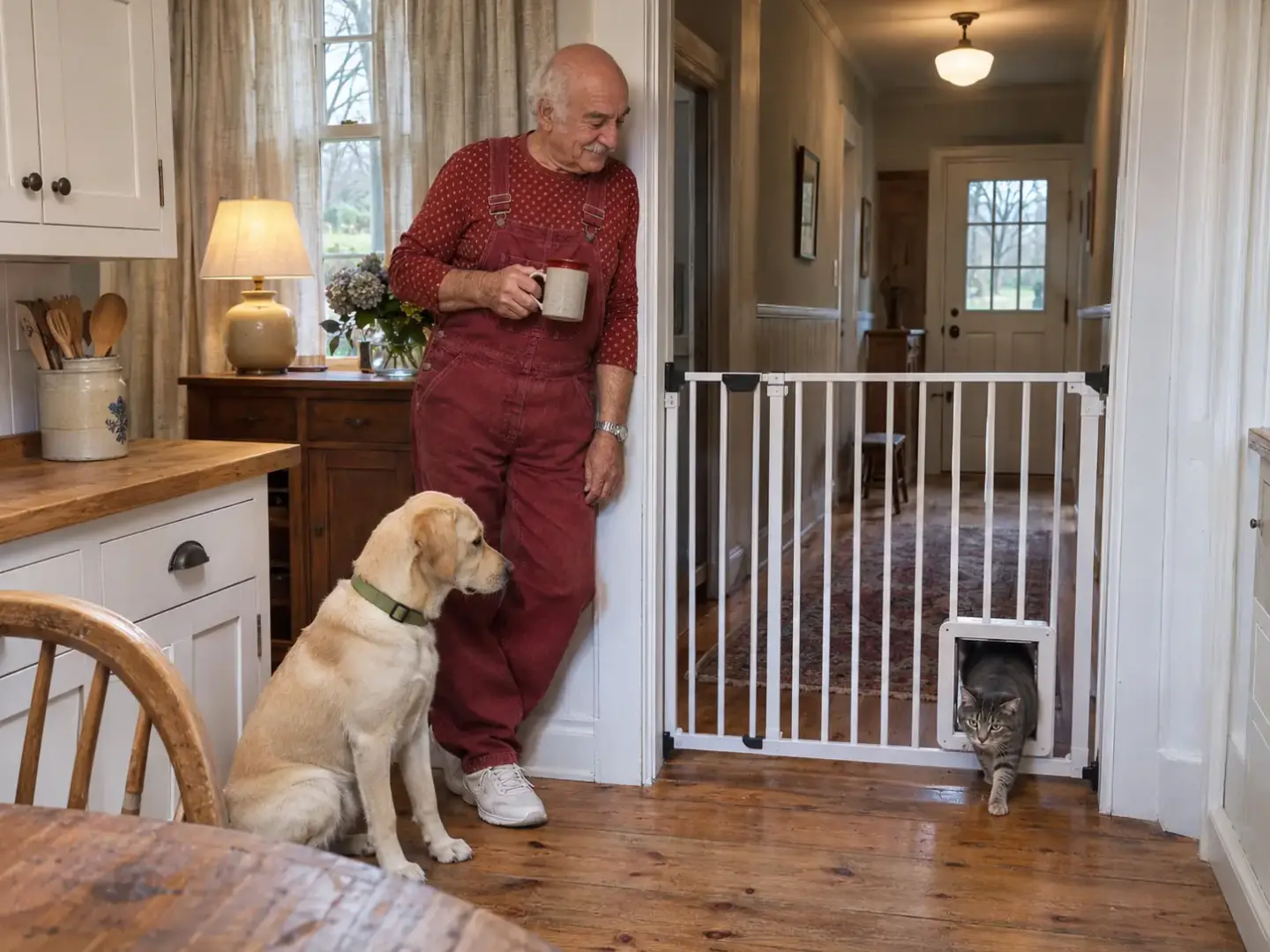
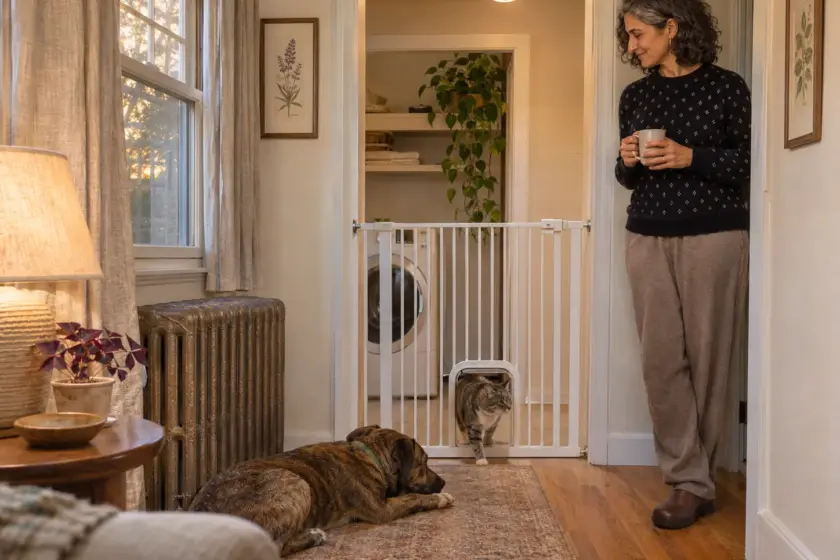
You put the gate across the spare-room doorway, and now the dog lies calmly on one side while the cat sits on the other, studying a hallway he walked down yesterday. The gate did its job on the dog and took the cat’s route along with it, and the cat is right to sit there: a path he used every day is gone.
Almost no gate holds a cat, since he clears a 36-inch panel from a standstill, so a pet gate with a cat door is a barrier for the dog with one hole cut for the cat. The best pet gate with cat door comes from measuring the dog’s head on one side and the cat’s chest on the other, then choosing the opening that falls between the two numbers, and height, mounting and the sill an older cat has to cross follow from that.
Five doorways cover most homes, and the table gives the height and the cat opening that suit each one, along with the gate that has both.
| Your situation | Gate height | Cat opening | What fits |
|---|---|---|---|
| A standard 29 to 36.5 in frame and a dog that does not jump | 36 in | About 7.5 × 7.75 in | Carlson 36″ Extra Tall Walk-Thru |
| A dog that already clears a 36 in panel | 41 in | 5, 6.5 or 8 in high, in three settings | MYPET EasyPass Extra Tall & Wide |
| A large or older cat who will not crouch | 36 in | 7.1 × 12.2 in, six positions | Babelio CatPrivilege II (F7) |
| A toy-breed dog and an older cat | 18 in, low enough to step over | About 7.5 × 7.75 in | Carlson Lil Tuffy 18 in |
| A medium or large dog and a frame up to 43 or 48 in | 36 in, extensions in the box | 7 × 5.5 in, or 7.1 × 12.2 in | Babelio CatPrivilege III (T7) or II (F7) |
A Pet Gate With a Cat Door Is a Dog Barrier With One Cat-Sized Hole
A pet gate with a cat door is sold as a gate and shopped for as if the cat were the animal being managed. He is the one whose route has to survive the purchase. The dog is the one the gate has to hold, and the only real design problem in the product is a hole big enough for the cat and too small for the dog. That makes the gate one piece of a home that has to work for both animals, and the layout that keeps a cat and a dog in the same small home covers the rest of it.
What the gate holds back, and what it never will
A cat crosses a 36-inch gate without a second thought, so no panel pressed or screwed into a doorway is a cat barrier, and a listing that hints at one is promising something the cat will not honor. What the gate holds is the dog. The cat’s share of the purchase is the opening and where it sits, because according to the feline environmental needs guidelines, “Your cat should have a private location they can retreat to.”
In a small apartment that safe room is usually the room with the litter box, or the spare room with his bed, and it is the same room the dog keeps trying to reach. A gate that shuts the dog out and leaves the cat’s way in and out alone protects the retreat and his litter box access. One that blocks the cat’s path has made the retreat unreachable, however well the dog is contained.
Free first: a door held open a few inches
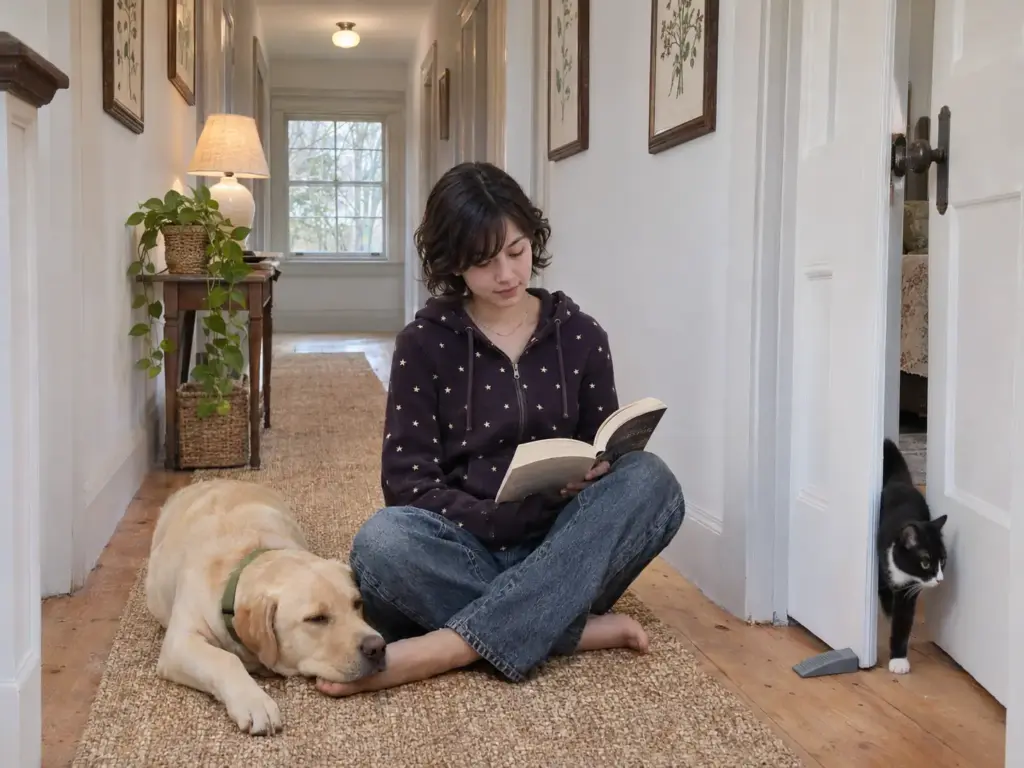
A rubber wedge, or a folded towel pushed under the door, holds the room door open by a few inches. A big dog’s head and shoulders stop at that gap and a cat walks through it, so a piece of rubber does the work a gate with a cat door was bought for. A chair or a cat tree set beside a gate that is already in the doorway does it from the other direction: it gives the cat a way over, and the gate stays a barrier for the dog.
Both have a limit, and the limit is a small dog. His head fits wherever the cat’s does, so the gap holds nothing back. Watch the dog at that gap for a few evenings before anything goes in a cart; the guide that tells you to test the dog’s manners at the doorway before spending anything lists what to look for.
When cutting the door is the better call
Cutting a hole in the door is the other version of this purchase, and it is permanent. In a rental it means a spare door, the original stored in a closet and rehung on the last day, and sometimes a landlord who says no. A gate goes up in a minute and comes down in a minute, which is why it leads for renters.
The cut earns its place when the dog is small enough to follow the cat through any gate hole, or when the doorway is wider than a gate and its extensions can reach. The interior cat door guide spells out what a hole cut in an interior door asks of a rental, from the spare door to the opening size.
Set the wedge so the door opens a few inches, then ask two questions at the gap. Does the dog’s head stop there, and does the cat pass without turning sideways? Two yeses mean the problem is solved with a piece of rubber, and a dog whose head goes through has just handed you the exact number any gate hole has to beat.
Why the Gate You Already Own Stopped Working
A gate that worked for months and then stopped did not get worse. The dog grew, learned a trick or leaned on it, or the frame turned out not to be the one the gate was bought for, and the cat, who had no complaint about the hole, got shut out of it. Four failures cover almost every case, each with a number and a place where it gets fixed.
- The dog jumps it. A 36-inch panel holds most dogs, a 70-pound dog can clear an extra-tall one, and height settles it.
- The dog squeezes through. An 8 by 8 inch opening has let a medium dog through, a 10-inch one a lean small dog, and the two measurements settle it.
- The dog pushes or lifts it. A pressure gate without its wall cups leans on the frame instead of gripping it, and the mounting settles it.
- The gate is stretched. One extended past the width it is rated for stops gripping the frame, and a measurement taken in three places settles it.
Jumped: the dog that found out how high it is
A gate is a promise about one dog on one day. A 36-inch panel holds most dogs until a large, athletic one tries it, and a 70-pound dog can clear an extra-tall gate as though it were not there. The gate did not shrink and the dog did not get cleverer. The gate was sized to a younger, lighter animal, and the animal moved on.
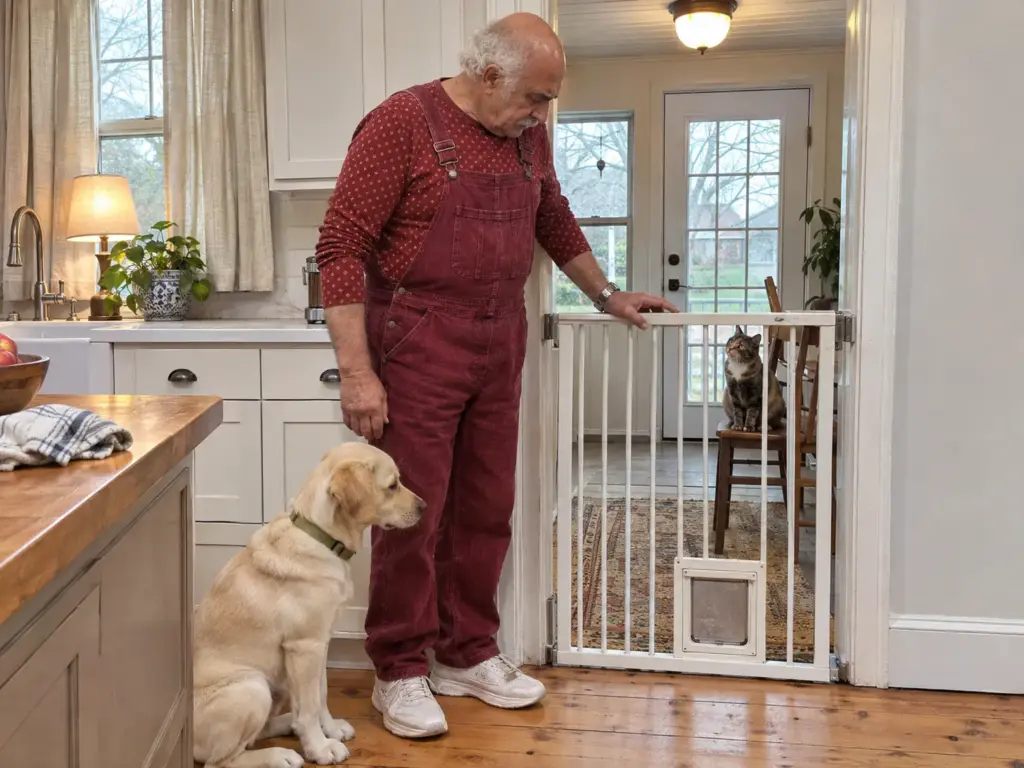
If his back paws leave the floor when he tests it, 30 inches is not the number anymore, and the height section further down is where it gets replaced.
Squeezed: the dog whose head fits the hole
A hole sized for a cat is sometimes sized for a puppy, a terrier or a medium dog with a narrow head. In a test of 27 gates bought and tried in homes, a medium dog was able to squeeze through an 8×8 opening that looked far too small for him, and a lean dog under about 12 to 15 pounds follows a cat through a 10-inch one. The barrier with a cat living in it turned into a dog door that the cat also uses. Bar spacing is the other way through, so look at the gaps between the bars as well as at the hole.
There is a worse version. If that hole is the cat’s only way out and the dog now arrives through it, he has walked into the cat’s retreat by the cat’s own exit. The guide that tells you to plan the cat’s way out before you plan the gate draws that route, and this purchase is the step that comes after it.
Pushed, lifted or stretched past what the frame allows
A pressure gate without its wall cups is a panel leaning on a frame, and a dog who shoulders it, or gets his muzzle under the bottom edge to lift the gate, walks it out of the doorway. Sliding doors are a door problem first. A dog that has learned a slider gives way to a nose will open it again, so the gate becomes the second fix, not the first, and two sliders that meet at a corner give him two chances. A gate stretched past the width it is rated for fails more quietly: it looks installed and grips nothing.
Two cats and one lane
In a multi cat home, a single hole is a single lane. One cat takes it as his, sits in it or near it, and the other quietly stops using it, so a gate that worked for one cat removes a route from the second. The instinct behind that is territory, and why a cat defends its territory lays it out.
Look at your own hallway for two things: where each cat approaches the gate from, and whether the cat on the far side can see the other one sitting at the hole (a cat that meets another cat’s stare at a one-way opening waits or goes around, and neither of those is a passage). The principle is the one behind the guide that says territory in a small apartment comes down to exits: a gate is fine only while it leaves every cat a way out.
Measure the Dog’s Head and the Cat’s Shoulders, Then Pick the Hole Between Them
The box says the gate takes pets up to 30 pounds, and the listing says a cat door is included, and neither says whether this cat fits this hole or whether this dog does. Two measurements do (cat shoulder width and dog head width), and they take five minutes with a tape and a pencil.

The two numbers, one on each side of the hole
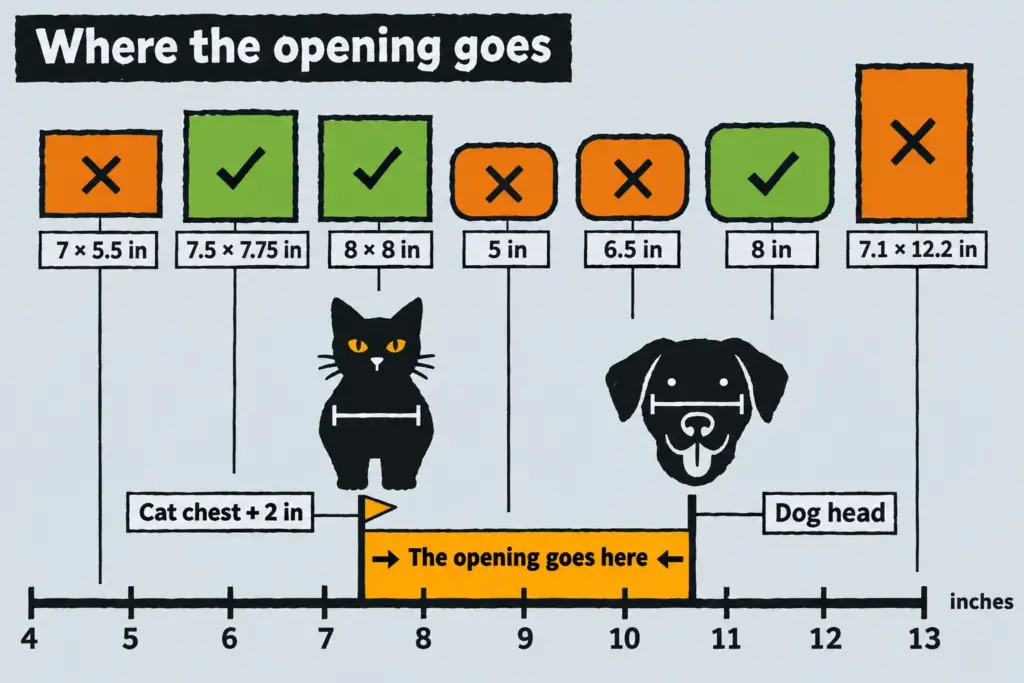
The dog sets the ceiling. Measure his head and shoulders at the width of his ears, because that is the part that has to fit, and write the number on the door frame. A hole narrower than his head is a barrier, and a hole as wide as his head is a door.
The cat sets the floor. Measure his chest at its widest point while he stands, not while he lies down, and add about 2 inches of clearance. The opening has to be at least that wide for him and narrower than the dog’s head, which means it sits between the two numbers; if no gap exists between them, no hole will do the job, and the answer comes from height instead.
The published openings, against those numbers
Every cat door opening on this list is a published number, and they differ more than the listings suggest. One Babelio gate opens 7 by 5.5 inches in two positions. The Carlson gates share a 7.5 by 7.75 inch slot, the same in an 18-inch gate as in a 36-inch one. A MYPET gate offers three heights of 5, 6.5 and 8 inches, and the tallest opening of the group, another Babelio, runs 7.1 by 12.2 inches in six positions.
Set each aperture size against your two numbers before it goes near a cart.
The 7×7 opening that gets quoted as the cat standard is right for a cat up to about 12 pounds. A heavier cat has to duck to get through, and ducking creates hesitation: an 18-pound cat at a 7 by 5.5 opening has a daily negotiation, not a passage. The comfortable range for the cat is 7 by 7 to 9 by 9 inches, measured from the chest plus those 2 inches. But 8 by 8 is also the size that has let a medium dog through, so the roomy hole for a big cat is the same hole that stops separating anything once the dog is bigger than a terrier.
When the dog is smaller than the cat
Sometimes the dog’s head is the narrower measurement. A lean, determined dog under about 12 to 15 pounds follows a cat through a 10-inch hole, and the numbers leave no gap between them: any opening that fits the cat fits the dog. A cat door then separates nothing, and the answer moves to height and to a side the cat can climb, which the last section works out. The dog screening that comes before any gate purchase tells you whether this particular dog belongs in that group.
Measure the cat standing at his widest point, not stretched out asleep, and write both numbers on the door frame in pencil before opening a single store page. Written there, the two numbers answer every listing the moment you read its dimensions.
Fit the Doorway You Actually Have, Without Drilling
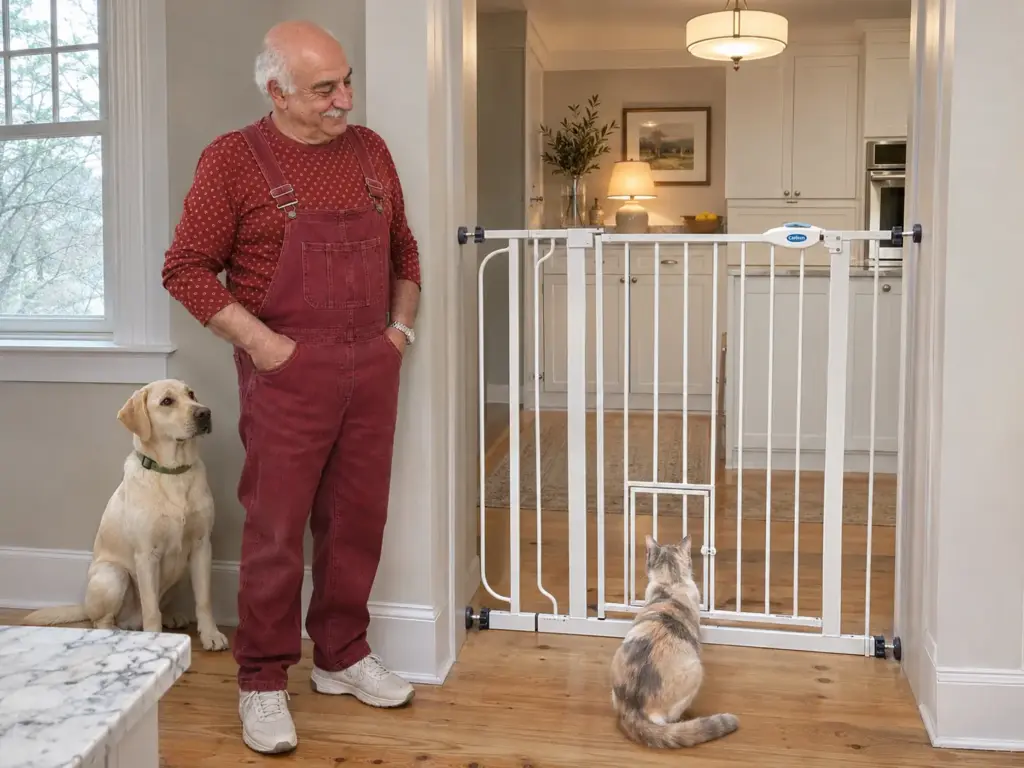
The expensive mistake in this category is buying for the frame you imagine. Doorways are rarely the same width at the top, the middle and the baseboard, and a gate that grips at one reading can sit loose at another.
Measure the opening in three places
Run the tape across the opening at the top, at the middle, and just above the baseboard, where the trim tends to bulge. A reading that differs by an inch across the three is normal in an old building, because walls settle and trim shifts. Every gate lists a width range, and both the narrowest and the widest of your three readings have to land inside it. Frames up to 43 or 48 inches belong to gates with extensions in the box; the standard doorway sits comfortably in a smaller range.
Extension kits beat a wider gate
A 4-inch extension kit stretches the gate you are buying to fit a wider frame, and it usually beats a wider gate: the opening stays the size you measured, and the proportions that you tested stay in place. Think of the width range as arithmetic with one legitimate way to move its top. A frame wider than the range is a different purchase, not a stretched one. The cat-door gate made for 51 to 59 inches, the Carlson Maxi, does not fit a 38 to 50 inch opening and has become hard to find, so a hall that wide is better served by two gates meeting at a corner, or by an extension kit that the maker rates for the gate in question.
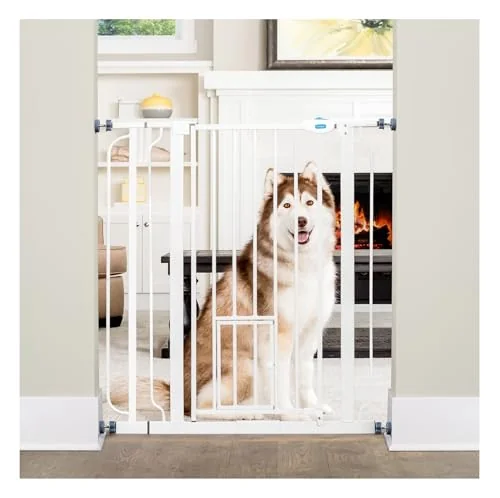
For a standard frame, the place to start is the Carlson 36″ Extra Tall Walk-Thru Dog Gate with Small Pet Door. It stands 36 inches tall, spans 29 to 36.5 inches, presses into the frame with no drilling, and its pet door is 7.5 by 7.75 inches. It is the budget-friendly way into a walk through gate with a real cat door.
Where it gives: the 16.5-inch walk-through is a tight squeeze for a person, and the frame can crack within a couple of months of use. That is a fair deal for a dog who has not yet tested the gate, and a poor one for a dog who has.
The renter’s version: nothing fixed to the building
A pressure gate with wall cups is the renter friendly choice, because it holds by pushing against the frame. Nothing is screwed to the building, and the gate comes down in a minute on the day the landlord visits. A hallway opening between two bare walls suits it better than a door frame, since there is nothing to mark and nothing to patch when the lease ends. The spare door cut for a cat flap is the other renter route, and it belongs to a different guide.
The room where a gate does the most work is the one with the litter box, and the doorway fix for a dog raiding the litter box shows this same gate in that doorway. Here the job is only the frame and the hold.
How Tall a Gate Has to Be Before the Dog Stops Testing It
A 30 inch gate is the workhorse height for gates with cat doors, and it is also where the trouble starts. Gates in this category run from 18 inches to 41, with 36 and 41 being the sizes for a dog that jumps, and the right one comes from the dog, from how high he jumps, not from the label on the box.
The rule of twice the dog’s height
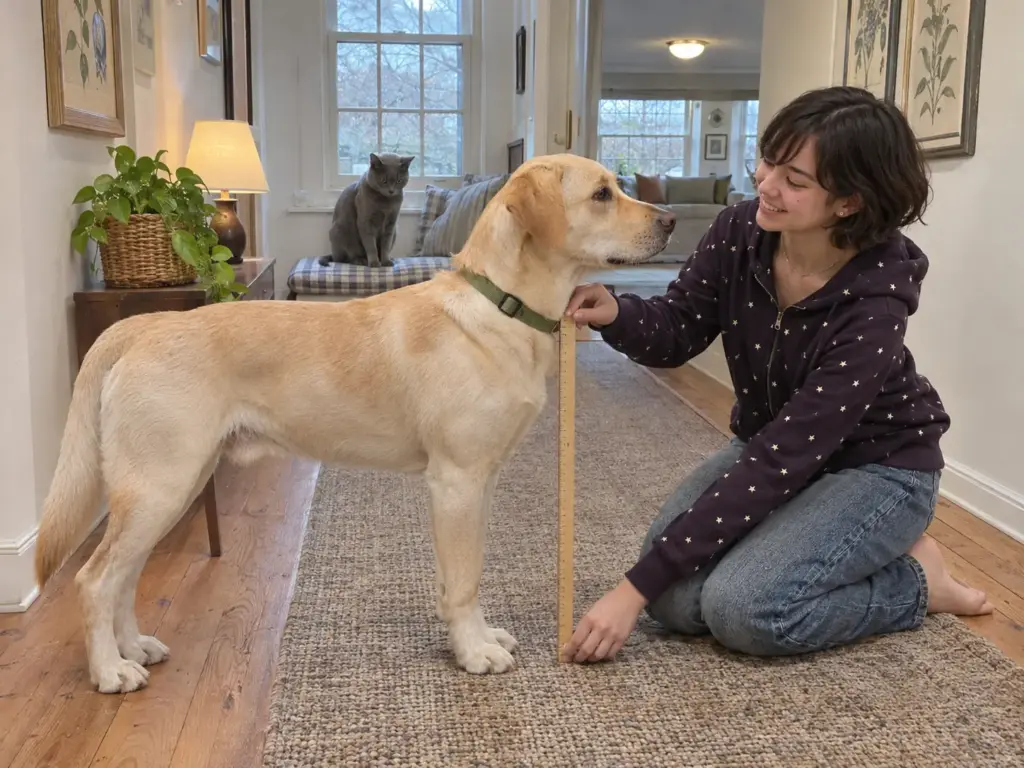
Measure the dog standing, from the floor to the top of the shoulder, and double the number. A dog that stands 20 inches at the shoulder wants about 40 inches of gate, which is already higher than the common 36-inch extra tall.
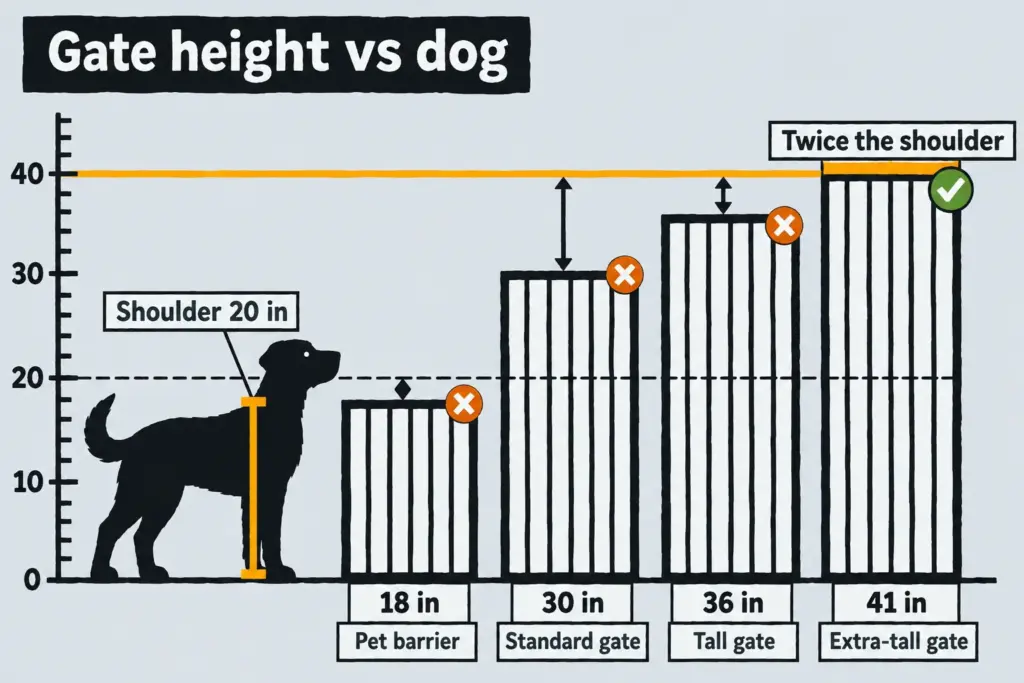
A 30-inch gate labeled extra wide is a wide gate. It is not a tall one, and the label is where most of the confusion starts. The dog reads the height and nothing else.
When the dog clears a 36
A 36 inch gate contains most dogs. The dog that clears it is usually large, young or motivated, and that is the case this extra tall pet gate was built for, the MYPET EasyPass Extra Tall & Wide Walk-Thru Pet Gate.
It is 41 inches high and spans 29.75 to 52 inches with the three extensions in the box. The walk-through for a person is 22 inches, and the pet door comes in three heights of 5, 6.5 and 8 inches, so the opening rises as the cat grows. On the downside, the latch does not always close cleanly and parts break more easily than they should.
There is no cheaper gate at that height with a cat door, so 41 inches is the ceiling of this list. The obvious pick for most frames is the 36-inch gate above, and that is the right call until the day the dog proves otherwise. Before ordering 41 inches, try the wedge from the first section for a few days. A dog who jumps to reach a room sometimes stops when the door stands open a few inches.
The cat at the top of a tall gate
A tall gate does not ask the cat to jump anything. If the opening sits near the floor, he walks through at his own level, and the height becomes the dog’s problem alone. The catch with a tall gate is the sill, and an older cat feels it, which the next-to-last section handles.
A gate that is only a stage in an introduction does not need to be the tallest one in the store. The introductions guide explains when a gate is a stage and not a purchase, and that decides how much gate to commit to.
Stand the dog on the floor, measure from the floor to the top of his shoulder, double it, and hold that number against the gate’s height before you look at the opening. A gate that fails the doubling gets jumped, no matter how well the hole fits.
Pressure Mount, Screws and the Dog Who Leans
A pressure mounted gate sounds like a fixed one. The words describe a method, and what holds is the wall cups and the height they sit at. A gate that trembles when the dog leans on it shuts the cat’s route too, because a cat walks away from a gate that rattles.
Wall cups are the barrier
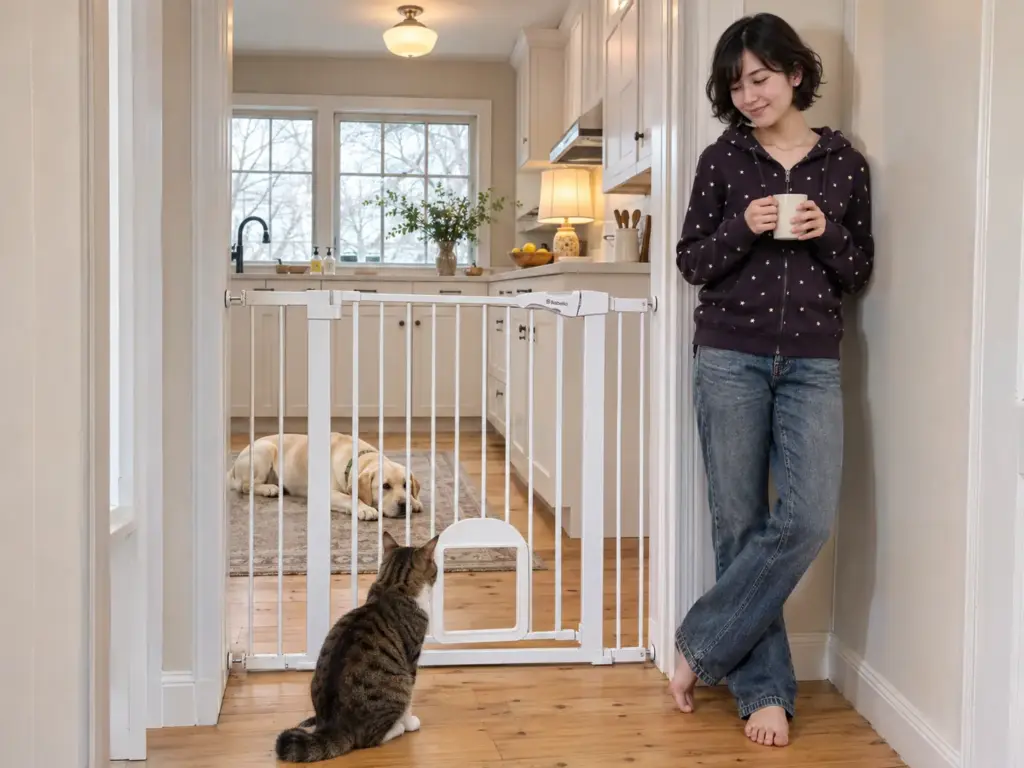
Pressure gates are tested against a push of about 30 pounds, and the ones that ship with wall cups must warn that without them a child can push the gate out and escape. The cups are not a decoration and not an option. Without them a pressure gate is a panel propped in a doorway, and a dog that leans on it, or gets his nose under the bottom edge, moves it.
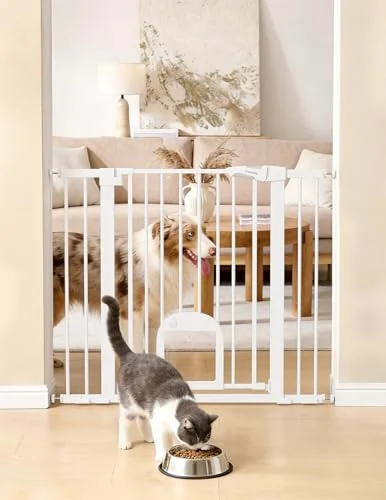
The Babelio 36″ Tall Pet Gate with Cat Door, CatPrivilege III (T7) stands 36 inches tall and spans 29 to 43 inches with the extensions in the box. It mounts by pressure or by screws if the frame will not hold, the maker rates it for 210 pounds of impact, and the cat door is 7 by 5.5 inches in two positions. The extension pieces do not fit snugly, and the latch can be stiff to open.
The top of the stairs is a different gate
At the top of stairs the gate has to be a hardware mounted gate, screwed to the wall, and pressure has no place there. A pressure gate is held by friction alone, and a cat landing on it is a push. In a rental that means telling the landlord first and filling the holes when you leave. At the bottom of the stairs, a pressure gate is fine.
A gate at the foot of the stairs pairs well with a high place for the cat. The kitten guide describes a tall gate and a high refuge for the resident cat, and the same arrangement suits any cat who needs somewhere above the dog.
A gate with a cat door is a pet product now
The rule for child gates drew a line that matters here. The federal gate standard, 16 CFR 1239, points to a version of the ASTM child-gate standard that says expansion gates “shall not include any features or openings within the gate that allow for unassisted pet entry or egress.” A gate with a cat door, even when a listing files it as a baby gate with cat door, is therefore a pet product, and its hole is not a child safety feature.
A crawling toddler fits through the hole. If a child lives in the home or visits it, this gate is not the barrier for that room, and a gate sold for children at the top of a staircase is a separate product.
Push the gate the way the dog would, leaning your full weight into the top, then the middle, then pulling at the bottom edge, before it is left alone with both animals. A gate that gives under your hands will give under his.
The Opening for a Cat Who Will Not Crouch
A cat standing at the gate, waiting, is giving you a measurement. The sill is higher than the step he wants to take, and the gate has turned a passage he used into a hurdle he is negotiating.
The sill is a step, not a door
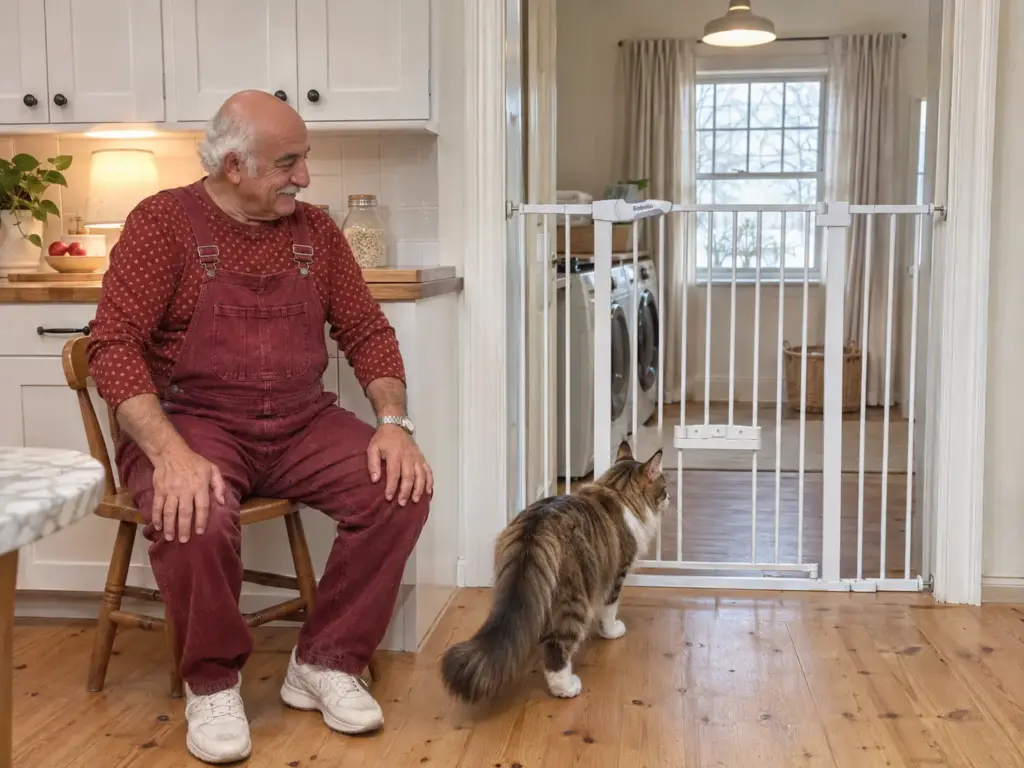
A cat door in a gate is a gap whose bottom edge sits a few inches off the floor, so crossing it is a step. For a senior cat, a step of 3 inches or less is crossed without effort, and above 5 inches some cats start avoiding the crossing. What decides it is how high the cat lifts a front leg and how tall his shoulder stands, not how long he is. Measure from the floor to the point of his shoulder, and compare that number with the bottom edge of the opening.
The correction is easy to miss. The advice is usually to pick the widest hole for a big cat, and width is only half of it. A big cat in a hole that is wide enough and too short still has to duck, and a cat who has to duck every time uses the passage less each week.
A taller hole for a bigger or stiffer cat
A cat who will not duck needs height in the opening, not just width. The Babelio 36″ Tall Dog Gate with Cat Door, CatPrivilege II (F7) has the tallest opening of this list: 7.1 inches wide by 12.2 inches high, with six positions, in a 36-inch gate that stretches to 48 inches. At 7.1 inches wide, the hole is narrow for a dog’s head, but check that against the number you wrote on the door frame. The small sliding door can slip up or down by itself, and in a 29-inch opening it may not fit.
Cats who refuse a flap are the ones for whom a tall opening makes the most sense, because it has nothing in it to push.
When the cat stops jumping altogether
A cat who jumped and climbed for years and quits within a day or two is a question for the vet before it is a question about a gate. The sill is still the part you can change: the lower the edge and the taller the opening, the less each crossing asks of him.
Hold the tape from the floor to the point of the cat’s shoulder, not along his back, and then hold it against the bottom edge of the gate’s opening. The nearer that edge is to the floor, the easier every crossing is on him.
A Small Dog, a Second Cat and the Hole That Separates Nothing
Two homes end up with the opposite of what they bought: the one with a dog smaller than the cat, and the one with two cats and a single hole. In both, the hole is not doing the job a hole is supposed to do.
The dog that fits through the hole
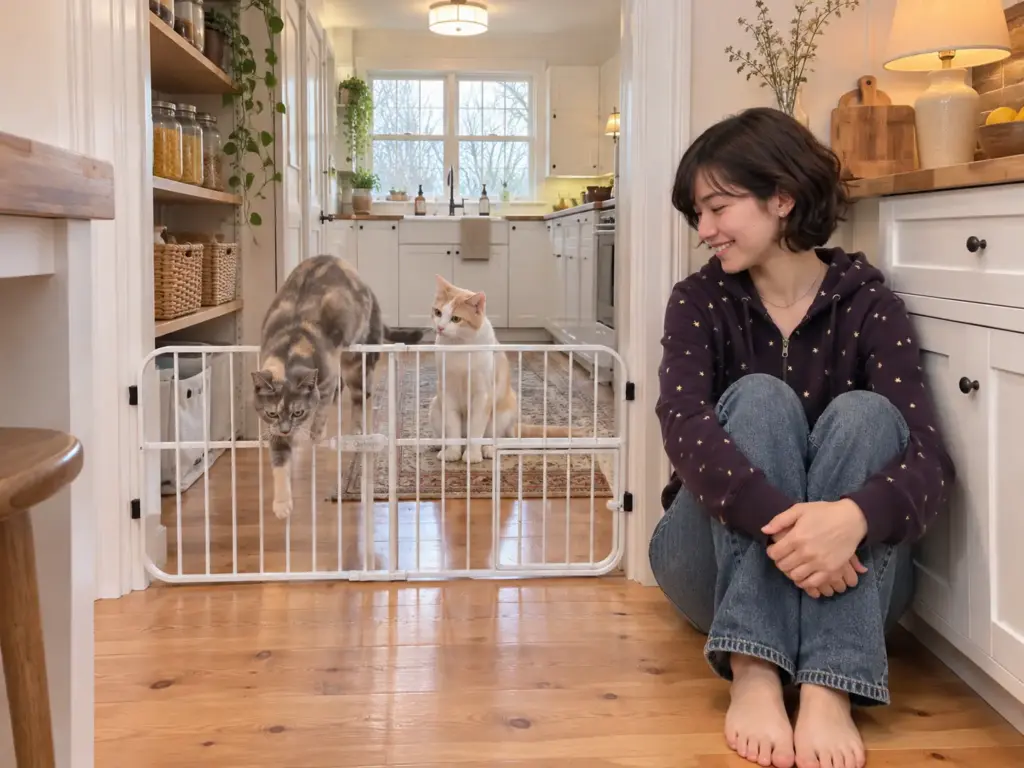
A small dog can be narrower than a cat’s chest, so any hole big enough for the cat is big enough for him, and the cat door turns into a convenience for both of them. The barrier has to come from height or from a side the cat can climb. The Babelio Auto Close Dog Gate with Cat Door, CatPrivilege I (A7) is the nearest thing to an answer: 30 inches high and 29 to 43 inches wide, with an adjustable pet door of about 7.5 by 7 inches that can be narrowed and locked, so the hole can be set to the cat’s chest plus clearance. It is no guarantee, because a very small dog still fits, and the handle can break within the first year.
When the dog is smaller than the cat, the more reliable gate is one the dog cannot get through whatever the hole does. A tall panel does that, with the cat going over by a chair or a tree set beside it.
The low gate for a toy breed and an old cat
The Carlson 22-38″ Lil Tuffy Expandable Dog Gate with Small Pet Door is 18 inches high and spans 22 to 38 inches. It carries the same 7.5 by 7.75 inch pet door as the tall Carlson, and a person steps over the panel in one stride. An older cat uses the door at floor level, with no jump and no climb.
The condition is the dog: if his shoulders fit the 7.5 by 7.75 slot, this gate separates nothing, and the toy-breed label does not change that. The locking pin is awkward to work while you adjust the width.
Two cats, one opening
With two cats a hole is a lane, and it is worth looking before buying anything. Watch where each cat approaches, and whether the one on the far side can see the other sitting at the opening. If one cat takes the hole and the other waits, a second opening, or a side the second cat can climb with a chair or a tree beside the gate, gives him a way.
The dog is not the only animal that takes a resource at a doorway. Food is the other, and a feeding station sized to the dog’s reach puts the cat food where the gate no longer has to guard it. In a one-room apartment where one cat blocks the other, a gate can also split the room, and splitting a one-room apartment between two tense cats explains how.
Spend a day noting which side of the gate each cat settles on and which cat reaches the opening first. The sitting spot decides whether a second opening or a climbable side is needed, and one day of watching is all it takes to learn.
The Tape Measure and the Doorstop Come Before the Gate
A pet gate with a cat door holds the dog, and the cat’s part of the purchase is the opening. That opening falls between the dog’s head and the cat’s chest plus its clearance, the height comes from twice the dog’s shoulder, and wall cups are what turn a pressure gate into a barrier, with screws for the top of a staircase. An older or larger cat needs a low sill or a tall opening, and when the dog is smaller than the cat, or two cats share one hole, the opening separates nothing and height or a second lane decides.
Give the cat a few days at the new passage and watch the first crossings. If he walks through without ducking or going around, the measurement held. If he circles the gate, measure the shoulder against the sill again. A growing puppy changes the numbers, so repeat his head measurement every few weeks, and lean into the gate the same way to test the wall cups; if his muzzle reaches the hole, go back to the two numbers before ordering another gate.
Today, write the dog’s head width and the cat’s chest width on the door frame in pencil, and prop the room door open a few inches with a rolled towel. Spend the evening watching the dog at that gap, and let him show you whether a gate is needed at all.
Frequently Asked Questions
01What is the best doorway gate for cats?
Almost no gate contains a cat, so the best doorway gate holds the dog and leaves the cat a measured hole to walk through. A standard 29 to 36.5 inch frame suits the Carlson 36-inch Extra Tall, and a dog that clears 36 inches needs the 41-inch MYPET EasyPass. Measure both animals first.
02Is there a dog gate that is cat friendly?
Yes, a gate with a cat door lets the cat cross without jumping while the dog stays on his side of the gate. It is cat friendly when the opening falls between the dog’s head and the cat’s chest and the sill is easy to step over. For an older cat, look at a 12.2-inch-tall opening or an 18-inch gate.
03Do pet gates work for cats?
Rarely for holding a cat, because he clears a 36-inch gate, but they work well for holding a dog back while the cat keeps his route. If the goal is keeping a cat inside one room, a gate will not do it, and that job belongs to a door.
04What size cat door do I need in a pet gate?
The opening should equal the width of the cat’s chest, measured while he stands at its widest point, plus about 2 inches of clearance. A 7-inch-wide opening suits cats up to about 12 pounds, and larger cats duck to cross. Then check it against the dog’s head: if his head fits, the opening is a dog door.
05Will a small dog still get through a pet gate with a cat door?
A lean small dog under about 12 to 15 pounds can follow a cat through a 10-inch opening, so a cat door does not separate the two. In that home the barrier has to come from height or from a climbable side. An adjustable opening that closes helps, but it is no guarantee.
Leave a comment