How to Introduce a Cat to a Dog, by Distance and Seconds
Closed door, then 5-25 ft gate sessions of 10-30 seconds, a 36-inch gate with a cat door & a day-10 check: how to introduce a cat to a dog.

Alfredo RamsesFounder · November 9, 2026 · 23 min read

On this page10 sections
- 1How to Introduce a Cat to a Dog Starts With Who Already Lives There
- 2When It Is a Vet or a Behaviorist Call, Before Any Stage Starts
- 3Days 1 to 5: Scent Before Sight, With a Closed Door Between Them
- 4Days 6 to 14: The Gate Stage, in Feet, Seconds and Calm Sessions
- 5Why the Process Goes Back to Day One, and the Shortcuts That Cause It
- 6Days 15 to 30: Leash, Longline and a Gate That Stays Up
- 7The One-Bedroom Version: A Latch Instead of a Gate, a Perch Instead of a Corner
- 8One Dog and Two Cats, and What Success Looks Like When Nobody Cuddles
- 9Let the Cat Set the Pace, and Leave the Gate Up Longer Than You Want To
- 10Frequently Asked Questions
By the end of the first evening your cat is behind the sofa, and your dog is lying in the middle of the floor your cat crossed that morning. Nothing is wrong with the cat: the animal that can fit under a piece of furniture uses it when a stranger walks the same floor, and that is the first fact to build on when you work out how to introduce a cat to a dog. International Cat Care reaches the same place from the other side, asking that whichever animal already lives in the home be affected as little as possible. What follows goes in order, from who arrives at whose home and what belongs to a vet, through scent, the gate and the leash, to a one-bedroom rental and one dog with two cats.
Quick Answer
Introduce them in stages, give every stage a pass mark, and let the cat set the pace. A cat whose habits change overnight goes to the vet before anything else.
- Keep a door closed between them and swap one scented blanket.
- Feed each animal on its own side of that door until both eat calmly.
- Hold gate sessions to 10 to 30 seconds, dog leashed, ended while both are calm.
- Advance only after three calm sessions in a row.
- Put the dog on a longline and leave the cat loose with a clear exit.
- Back up one stage after a bad session; leave the gate up for months.
How to Introduce a Cat to a Dog Starts With Who Already Lives There
The cat under the bed is working on a territory problem, and the other party may weigh several times what he does. Before any blanket or gate comes out, settle who was in the home first, because that decides whose life changes and whose is left alone.
Cat Already Home, Dog Arriving
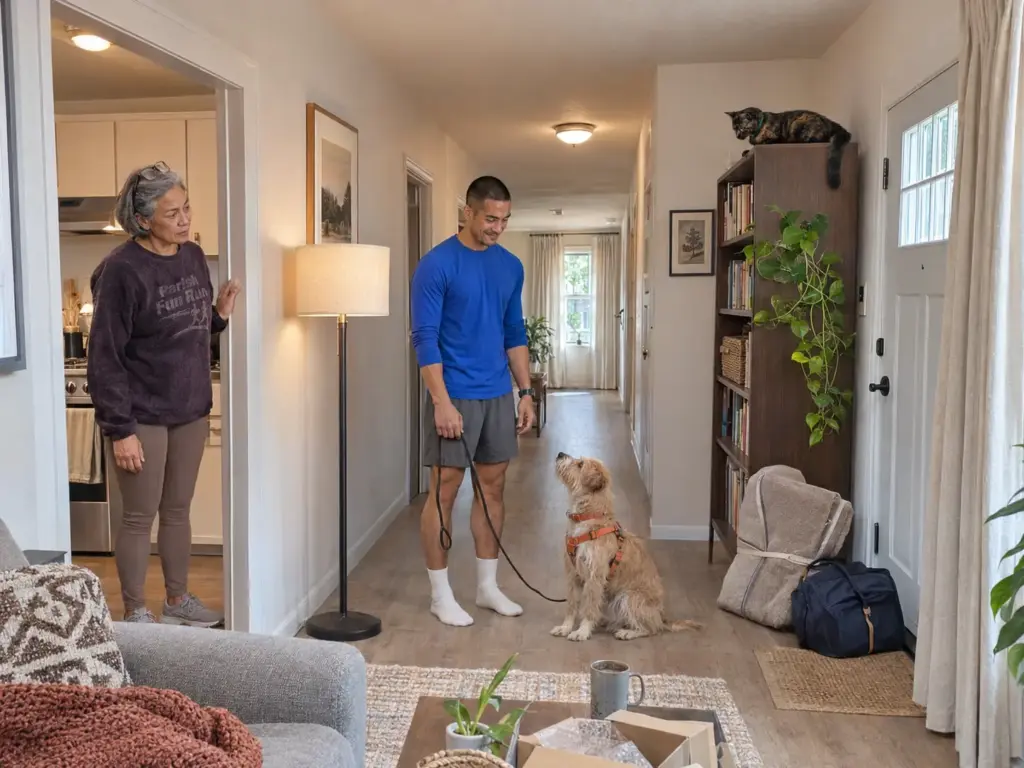
A resident cat owns the floor. He has his rooms, the routes between them and the hours he uses each one, and a new dog, whether a new puppy or an adult dog, walks into ground that already has an owner.
So the cat’s map stays as it is and the dog’s is the one that gets drawn: a first zone for the dog, a door between the zones, and nothing moved in the cat’s territory that does not have to move. International Cat Care’s guidance on introducing cats and dogs sets that out as a rule, with the animal who lived there first kept as unaffected as possible while the newcomer adapts. A cat who still finds his bowl, his box and his window where they always were has far less to defend.
Where the resources go and which routes stay open is a larger job, and the plan for the whole home covers it, so this guide stays with the introduction itself.
Dog Already Home, Cat Arriving
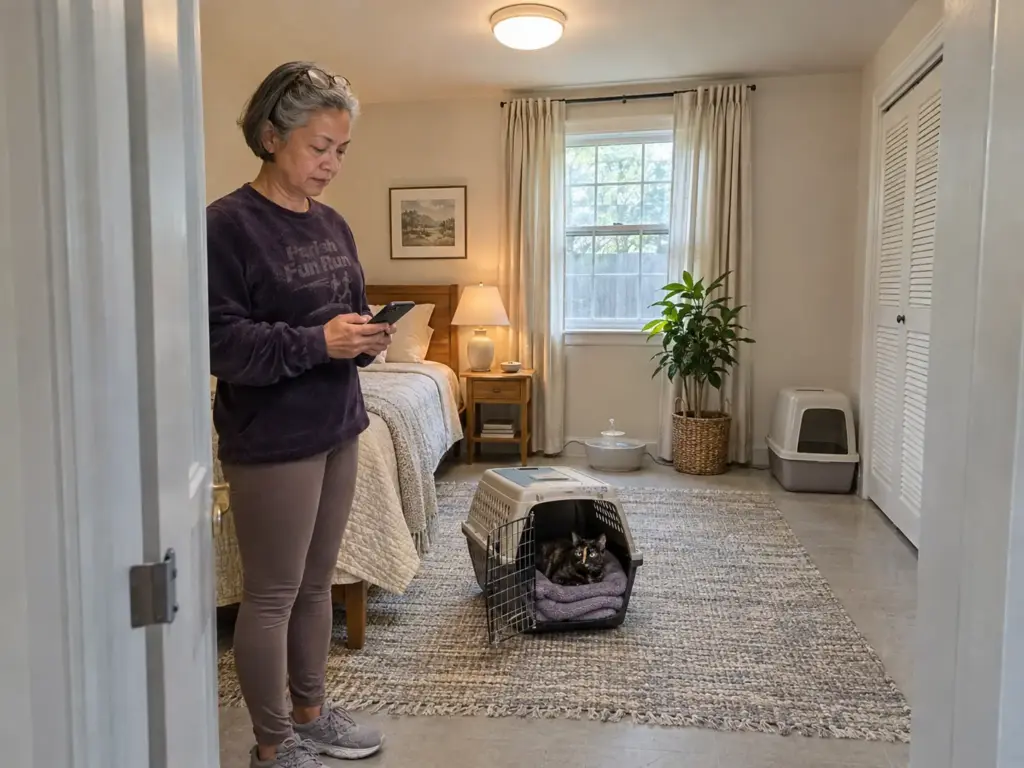
Turn the move around and the cat is the one with no ground. He arrives with nothing marked as his, and the dog’s routine is what has to bend. Give the cat one room before anything else: food, water, box, bed, a perch and a hiding place inside, and a single door that closes, which makes it a safe room. The dog learns to wait on the far side of that door while the cat learns the room with the door shut, and the two of them do not meet at the threshold on day one.
Both directions come back to one rule, and it fits in a short list:
- Cat already home: the dog gets the first zone, and the cat’s rooms, routes and mealtimes stay as they were
- Dog already home: the cat gets one closed room with everything in it, and the dog’s routine bends around the door
- Either way, the animal who was there first keeps the most of the house
A cat in a carrier set down at the dog’s feet is not an introduction, and the part about shortcuts, further down, says why.
What the 3-3-3 Clock Measures, and What It Does Not
The 3-3-3 guideline turns up in every search on this subject, and it is easy to read as an introduction calendar. It is a decompression clock for the animal who arrived. According to the ASPCA’s 3-3-3 adjustment guideline, “The 3 days – 3 weeks – 3 months guideline is important because it provides realistic expectations for both pets and owners.” The numbers are three days of being overwhelmed, three weeks of settling in and three months before the newcomer is fully comfortable, and that clock keeps running whether the first meeting goes well or badly.
The introduction has a clock of its own, made of pass marks, and it will not line up with those dates. A newcomer in the first couple of days has enough to take in without a stranger of another species on the far side of a gate, so the stages below start after that.
When It Is a Vet or a Behaviorist Call, Before Any Stage Starts
You want to start tonight, and somewhere behind that is the question of whether this dog can be trusted with a cat. A door answers neither. Knowing when to call the vet, and when to call a trainer, is easier now than in the middle of a bad session.
What Changes in the Cat Before the Dog Even Arrives
A cat who has stopped eating, stopped using his box or been hiding for days is asking a question for the vet, and no gate will answer it. Get that visit done first and come back to the introduction afterward. A bite or a scratch that breaks the skin, on either animal, is a vet visit the same day, and what happens to the wound is theirs to decide. This guide goes no further into those signs than naming them.
When the Dog Is the Part That Needs a Professional
A dog who goes rigid and fixed on the cat, whines or barks without stopping at the barrier, or lunges when he sees him needs a certified trainer or a behavior specialist. A better gate does not solve that, and whether the dog has the prey drive that makes a cat unsafe is a call for someone who has watched him. Nothing on this page calls a particular dog safe with cats. If you have not yet settled whether this dog should come home at all, test the dog before it moves in covers the check that comes first.
What the house can offer is a door, a barrier, a leash and a rhythm. Add one thing before you start: the sign that ends a session. Pick it while everyone is calm, because a person in the middle of a tense moment improvises, and improvised endings come late.
Days 1 to 5: Scent Before Sight, With a Closed Door Between Them
The first two days belong to settling in and carry no introduction at all. From about day three the stage starts: two smells, two meals and one closed door, with nobody seeing anybody. Your cat has been reading the home through his nose for days and may not yet know there is a second animal, and this stage lets him find out at a distance he controls.
One Blanket, Moved Back and Forth
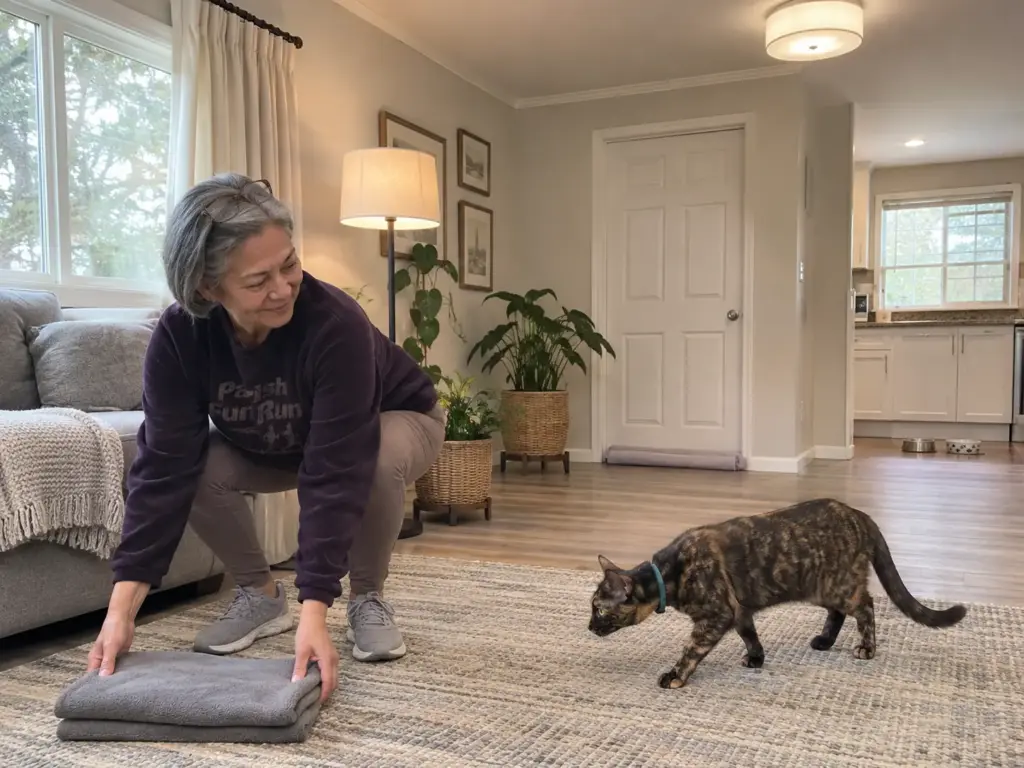
Put a small blanket, or any bedding that smells of the animal, in the dog’s bed for a few days, carry it into the cat’s part of the home, then take the cat’s blanket the other way. Repeat across several days; this scent swapping is the whole stage. The detail that decides it is where the scented cloth lands: well away from the cat’s food, water and bed, because a strange smell beside the bowl can cost him his dinner.
Put it on the floor across the room and watch what he does on finding it. A cat who sniffs and stays, or carries on with his evening, has taken the smell in. One who sniffs, backs away and skips dinner needs the stage stretched.
The same swap between two cats, and where the scented cloth goes and why it backfires, is worked through in more depth elsewhere on the site.
Leave the blanket on the floor where the cat can find it on his own schedule, and watch the first visit. If he settles near it, the stage is moving. If he walks a wide circle around it for the rest of the day, move it farther from where he eats and give the stage more days.
Meals on Both Sides of a Closed Door
Feeding on both sides of a closed door, with no line of sight, is the next layer; separate feeding also tells you quickly whether either animal stops eating. Each of them gets the smell of the other attached to something good, and you learn fast whether either one stops eating. If the dog goes off his food, stretch the stage. If the cat has gone more than a day without touching his, the next call is to the vet and the door can wait.
The Pass Mark Before the Gate Goes Up
This stage ends on a pass mark, not a date: the cat eats his whole meal and uses his box as usual, and the dog sniffs at the door without freezing on it or whining, two or three days in a row. That is a working rule built on the day bands shelters hand out, and it is no deadline. A pair that passes on day four has passed.
The free version of help comes before any product: a base camp built properly, with the box, food, water, bed and a perch where he can watch the room without being in it. A diffuser only helps a camp that is already right. If you want a trial after that, FELIWAY MultiCat Cat Calming Diffuser Kit + 1 Refill is a 48 mL kit whose 30-day vial covers one room, and it goes in a socket where the cat spends his day, not in the dog’s zone. What stands behind it is the 2020 feline pheromone trial in mixed cat-and-dog homes: six weeks, 17 animals per group, and a sharp fall in undesirable interactions, largest in the first week.
Treat one vial as the test. It is not a cure and it does not stand in for the door, and the sting is the price of each 30-day refill, which adds up if the introduction runs long. A closer look at pheromone diffusers compares them for a home with more than one cat.
Days 6 to 14: The Gate Stage, in Feet, Seconds and Calm Sessions
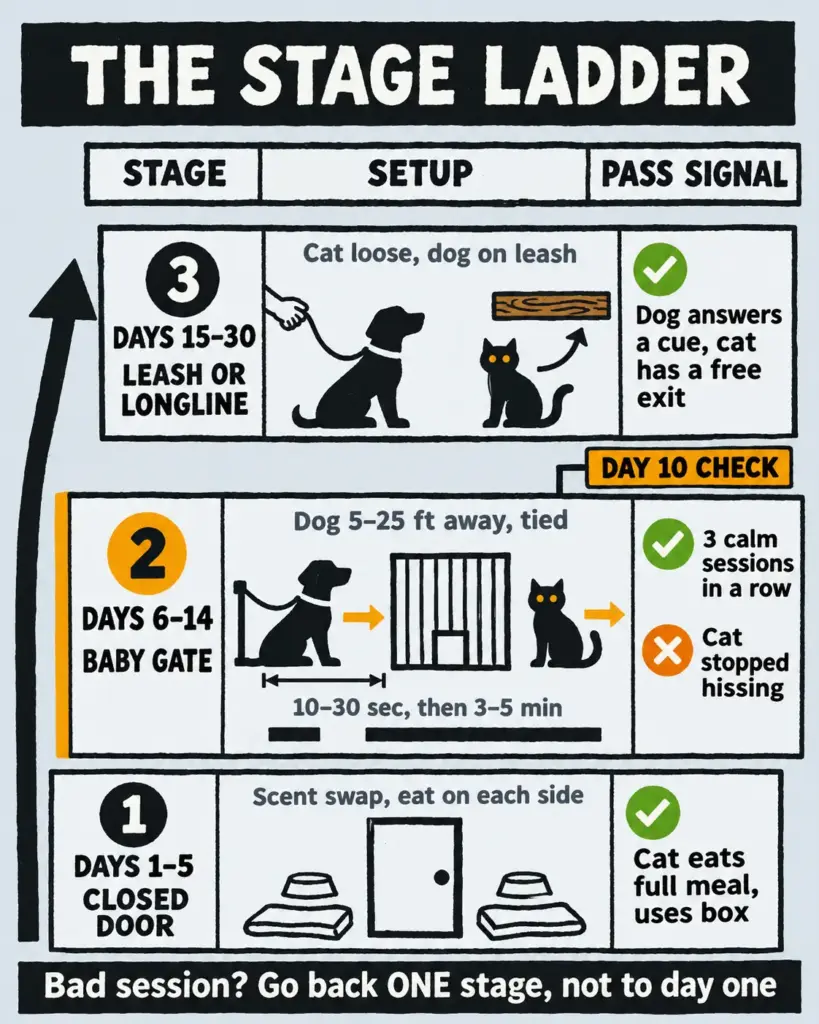
Most people take the barrier down when the cat stops hissing, and that is not a pass mark: a cat can go quiet because he has frozen. This stage swaps “go slowly” for numbers that say how far apart, how long, and how many calm sessions come before anything changes.
Start Where the Dog Can Look and Look Back at You
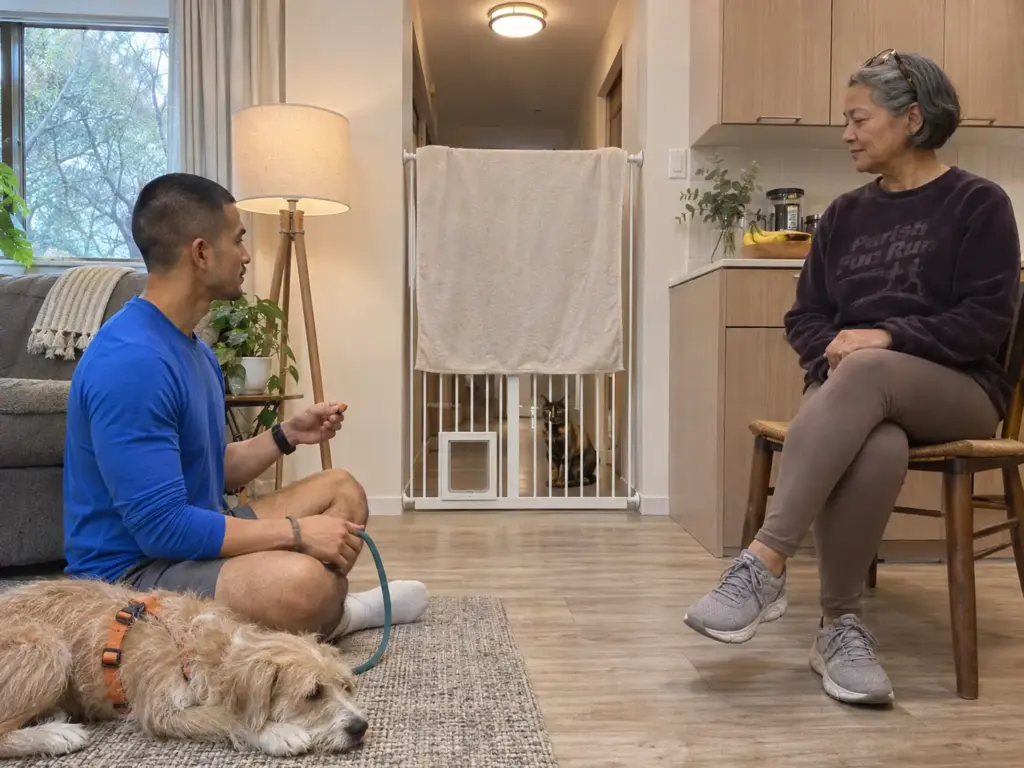
Put the gate up with the dog on a loose leash and the cat loose, his escape route free and never behind the dog. Begin at the far end of the room. The distance that works is somewhere between 5 and 25 feet depending on the dog, and the figure on a handout is the wrong number for your dog until he shows you the right one: the distance at which he can look at the cat and then look back at you. Close the gap a little at a time while that holds, and open it again the moment it stops.
Ten to Thirty Seconds, Then End It
A first session is 10 to 30 seconds of visual contact, once or twice a day. When those go quietly, stretch to 3 to 5 minutes. End while both animals are still relaxed, on the good minute and not the bad one. Stopping early is the habit this stage builds.
Treats on both sides of the gate are plain counterconditioning: the other animal appears and something good follows.
A session that ends while the dog’s face is still soft leaves him with a good memory of the gate, and the cat with one more evening in which nothing happened. The session that ends on a bark or a hiss starts the next one in debt.
Drape a towel or sheet over the top half of the gate so the first days are a glimpse and not a stare, and scatter small treats on both sides. Within days the gate becomes the place where good things happen, and the animals head there on their own.
Three Calm Sessions in a Row
The pass mark is three sessions in a row that were calm, and calm has a definition. A cat who hisses or a dog who whines makes a session not calm, however short, and it does not count toward the three. Count only the ones that qualify, and do not skip ahead because three out of four were nearly fine.
- Dog, ready: loose in the shoulders and legs, soft gaze, tail moving easily, able to look away and back at you
- Dog, not yet: stiff all over, fixed stare, whining, barking, pulling toward the gate
- Cat, ready: eating, moving about, ears in their usual place, an occasional slow blink
- Cat, not yet: ears back, tail lashing, frozen in place, gone from the room, or swatting at the dog through the bars (the distance is too short for him)
The same reasoning works between two cats, where why the gate sets the calendar, not the days lays it out.
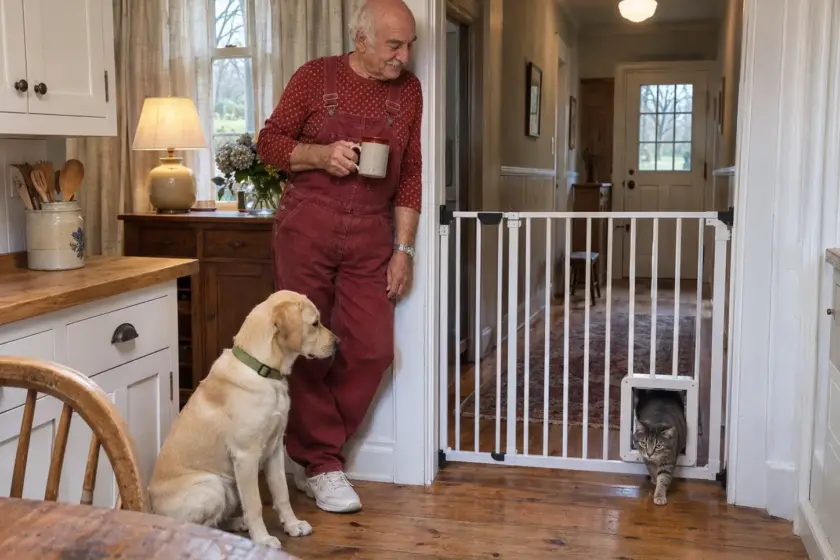
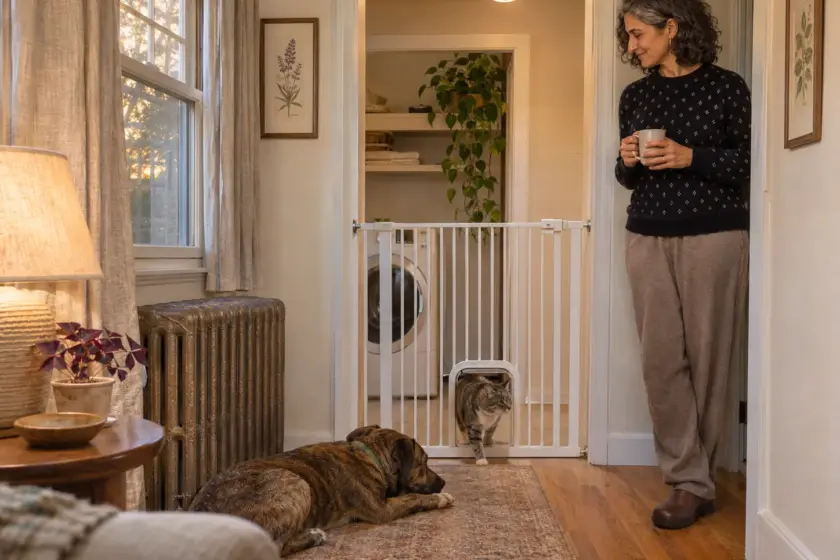
A Gate the Cat Can Cross and the Dog Cannot
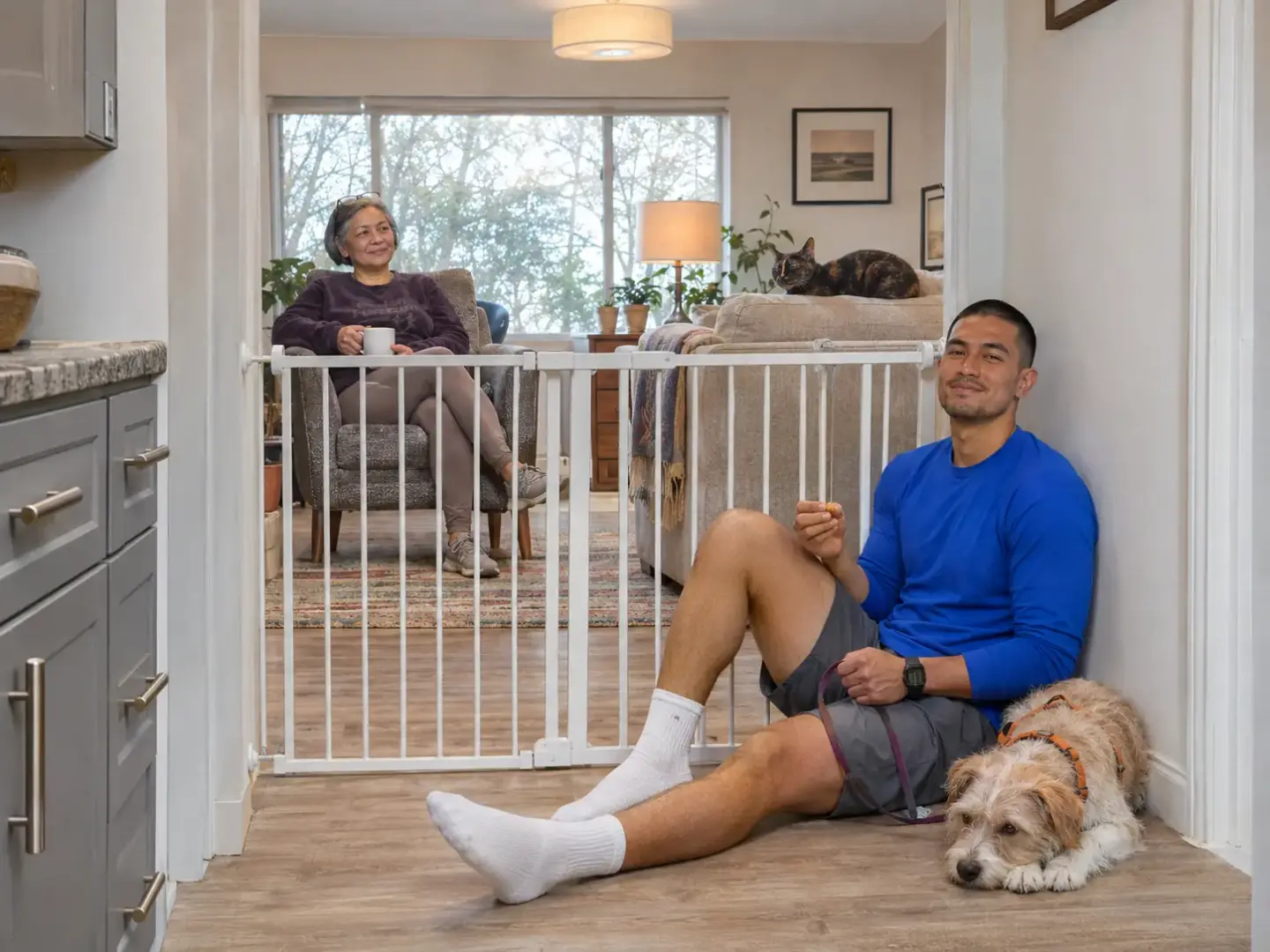
A barrier is only a barrier if a dog’s muzzle cannot fit through the gap and the cat’s way out is not behind the dog. Fail either test and it is a trap, with the cat inside. What you want is a gate that lets the cat through and stops the dog. The free versions come first: a gate you own can be lifted 5 inches off the floor so the cat slips beneath it, and two stacked gates stop a jumper.
If you are buying, Carlson 36″ Extra Tall Walk-Through Dog Gate with Small Pet Door is the one that works out of the box. It stands 36 inches, fits openings from 29 to 36.5 inches, and has a 7.5 by 7.75-inch cat door and a 16.5-inch walk-through for you. The cat passes, the dog does not, and a dog of ordinary size does not clear 36 inches. The walk-through opening is small and the build is uneven, with some units giving out within two months, so check the latch the day it arrives.
The 36-inch standard assumes a dog who does not jump, and the number that decides is the height of the jump, not of the shoulders. For a dog who clears 36 inches, or a doorway no standard gate reaches, the better pick changes. MYPET EasyPass Extra Tall & Wide Walk Thru Pet Gate, 41 in stands 41 inches, spans 29.75 to 52 inches, has a 22-inch walk-through, and its cat door sets to three heights, enough for a big cat while still stopping the dog. The latch does not always lock well and some pieces break easily, so test it every time you close it.
Why the Process Goes Back to Day One, and the Shortcuts That Cause It
Ten days in, you cannot tell whether this is going well, and the things people do out of kindness are exactly the ones that restart the clock. A checkpoint comes first, then the shortcuts, then what one bad session costs.
The Day-Ten Checkpoint
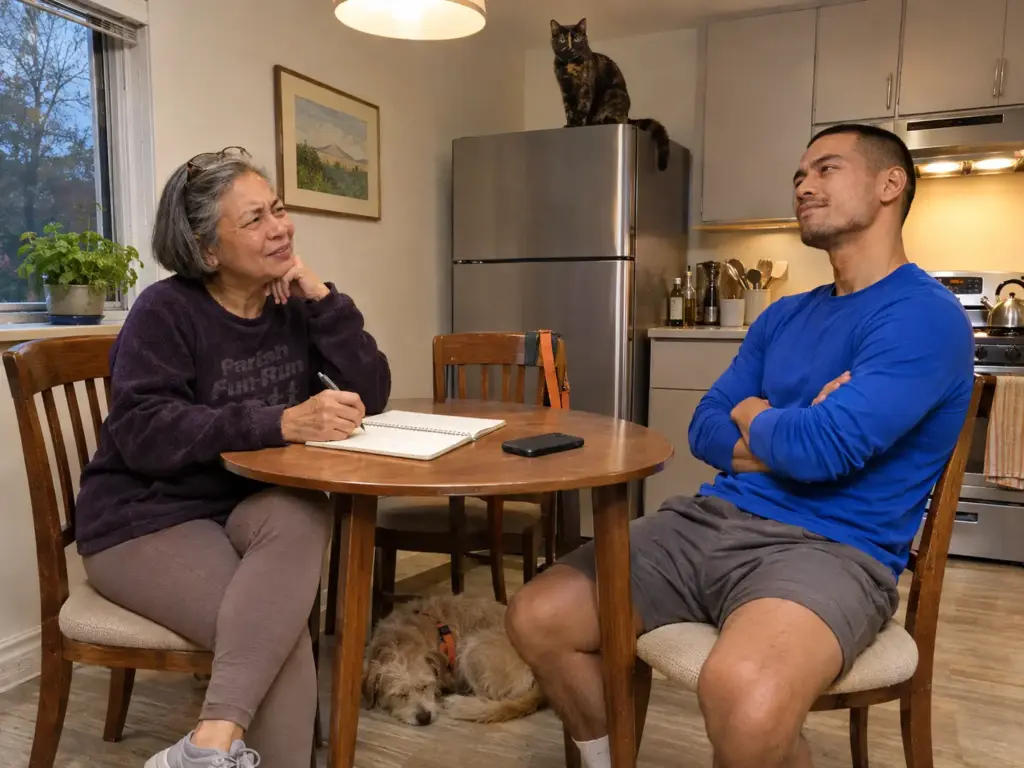
Around day ten, ask one question: which of the two keeps tensing? You should be able to name him. If you cannot, because both look fine, you are probably reading silence as calm.
If neither is relaxed and the dog does not answer a simple cue such as a sit, or looking at you when you say his name, change something (more distance, shorter sessions, a different barrier) and do not advance. This is a working rule of the blog and not a deadline. One pair passes it on day eight and another needs a second week.
The Shortcuts That Sound Kind
Each of these is sold as kindness, and each hands one of the animals a bad experience.
- The cat in a carrier on day one: International Cat Care says never, because the cat is the one who must be able to leave, and a carrier takes that away
- Picking the cat up and carrying him to the dog so they can meet: he swats, you let go, and the dog learns that the cat is something that runs
- Meals together before the gate sessions are calm: food adds a reason to guard to a meeting that is already tense
- Letting them sort it out: that is the end of supervision, not a stage
- A dog parked in the cat’s hallway: the route is gone for the cat even while the dog sleeps
In every case the cat loses the one thing that makes the meeting bearable, which is the ability to leave, and in several the dog learns the wrong lesson at the same moment.
After every session, write one line on your phone: who tensed, at what distance, and how long it ran. By day ten the checkpoint reads straight off those lines, and it stops depending on how the last session felt.
One Bad Session Costs One Stage, Not All of Them
A session goes wrong: the dog lunges at the end of the longline, or the cat bolts and is gone for the evening. The reset is to go back a step, one stage, and day one is not it. If it happened on the longline, return to the gate; if it happened at the gate, return to the closed door and the meals. The mistake that keeps repeating is restarting the stage that failed, at the same distance and with the same hopes, and getting the same session again.
Between sessions, watch the cat’s routes. When a cat stops crossing a hallway he used every day, the dog is already on his route, even asleep, and the next session starts farther away. The same pattern between two cats is described in what a failing introduction looks like between sessions.
Days 15 to 30: Leash, Longline and a Gate That Stays Up
The leash feels like the last stage and it is the middle one. The cat needs to leave the room without passing the dog, and the gate does not come down at day thirty. The calendar these stages tend to follow runs like this: days 15 to 30 with the cat loose and the dog leashed, days 31 to 44 with both loose and the gate still in place, and the gate staying for months after that. It is a pattern, and no promise.
Dog on a Longline, Cat Free to Leave
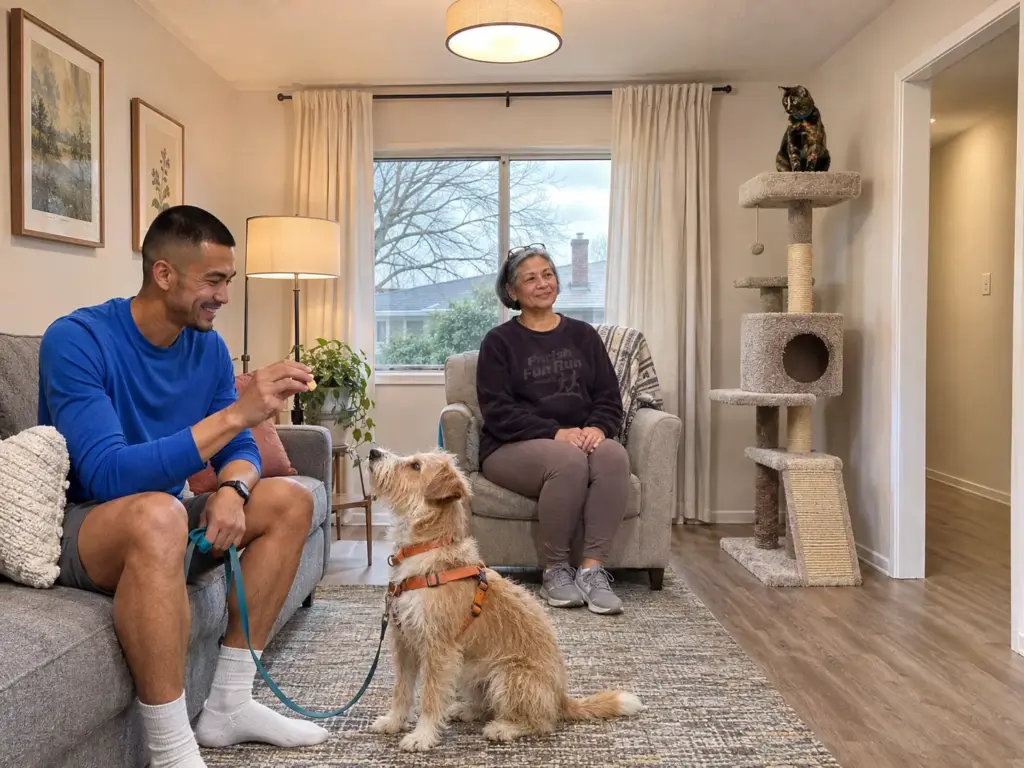
A harness with a longline gives the dog more say over his own space than a six-foot leash does: he can choose to step back, instead of reaching the end of the leash and lunging. The cat is loose, and his exit does not run past the dog. Use two people, one with the dog and one near the cat who opens the way out and does not touch him.
Treats create distance, and no animal is ever picked up. Three cues are worth having: leave it, look at that (the dog looks at the cat and back at you), and a dependable recall. If the dog will not answer even one of them away from the cat, it is not leash time yet.
Reading Both Animals at Once
Reading posture is the whole job here.
Watch both, not only the one that worries you. In the dog, look for loose against stiff, soft eyes against fixed ones, an easy tail. In the cat, ears back, a lashing tail, freezing or disappearing, against a slow blink. The moment either one goes up a level, end the session.
Spotting the dog going rigid is much easier for a person who has only that job, which is the point of two people.
Give the two people two separate jobs. Whoever holds the dog never touches the cat, and whoever stands by the cat never touches the dog. If you are home alone, wait until there is a second pair of hands.
The Pass Mark: The Cat Walks Past the Dog to His Bowl
The pass mark is a cat who crosses the room in front of the dog on his way to his bowl without changing pace, three times in a row. It is a smaller event than it sounds, and it shows the cat is treating the room as his again. A cat who sits near the dog and refuses to look at him is giving an answer too, a slower one, and this stage runs on his timing.
Height the Dog Cannot Reach
By now the cat needs high ground, somewhere to go that sits above the dog’s head. The free version first: the top of a wardrobe or a cleared shelf, with a way up from a bookcase or sideboard. The taller option is Feandrea Cat Tree, 68.1 in Multi-Level Plush Cat Tower, which stands 68.1 inches on a 44.4 by 13.8-inch footprint, with a top platform, two caves, a hammock and an anti-tip kit. That height puts the cat above even a large dog’s head with a place to land, and a 54-inch tree does not.
The kit matters the first time a 12-pound cat launches off the top, so fit it. The bases arrived misaligned on some units, so build the tree on the floor and check that every piece sits flat before the cat is allowed on it.
The One-Bedroom Version: A Latch Instead of a Gate, a Perch Instead of a Corner
You have a living room, a bedroom and a bathroom, and advice about giving the cat a room of his own sounds written for a house. In a one-bedroom rental the same stages hold, and what changes is where each one happens and what you are allowed to screw into.
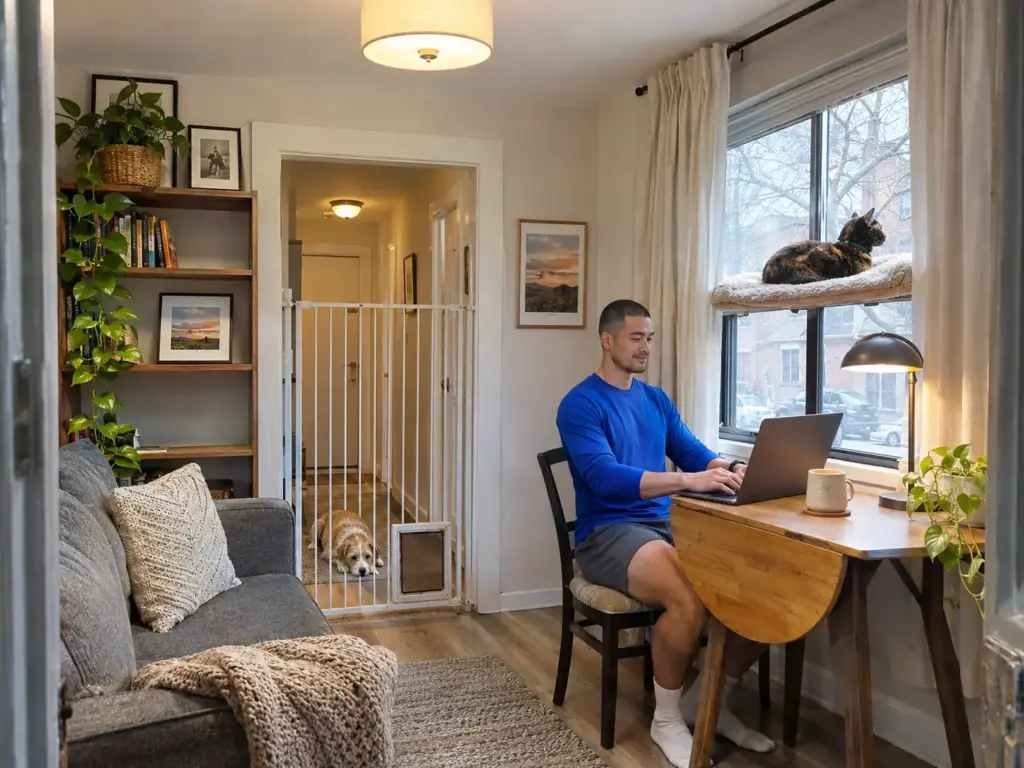
The Cat’s Refuge Is Not the Bed You Sleep In
The usual advice is to give the cat the spare room, and in a one-bedroom there is no spare room. The better call is the bathroom or any room with a door that closes, and not the bedroom you sleep in, because the cat would lose his night refuge along with his daytime one. A bathroom with a closed door is small, and it is also the room where the dog has the fewest reasons to push.
Measure the Doorway Before You Buy a Gate
A pressure-mounted gate that does not fit is a wall. The 36-inch gate above fits openings from 29 to 36.5 inches and the 41-inch one from 29.75 to 52, so the doorway tells you which of the two you are shopping for before the dog’s jump does. In a rented doorway where a gate will not sit square, lifting it 5 inches off the floor lets the cat go under.
Measure the doorway with a tape at the top, the middle and the bottom, and write down the width and the height. Door frames in older buildings are rarely square, and the smallest of the three numbers is the one that counts.
No Gate: The Door Held Open a Hand’s Width
No gate fits, or no gate is allowed? A wedge or a folded towel under the door holds it at the width of a cat for nothing.
If the door will not stay put, Door Buddy Pet Door Latch for Cats is an adjustable strap that holds the door open between 2 and 6 inches, with no drilling. The adhesive lets go on some doors, and on others it can damage the door, so try it on an inside edge you can live with. And it suits a room the dog is kept out of, because a strap is no barrier for the visual stage.
The Loop That Matters More Than the Square Footage
In a one-bedroom what counts is the loop, not the meters: sofa back, shelf, window sill, hallway, back to the sofa. Every room the cat uses needs a way past the dog, and a loop gives it to him without a door. A cat with a loop treats the dog as weather, and a cat without one treats him as a roadblock. The reasoning is laid out in why a small apartment’s territory comes down to exits.
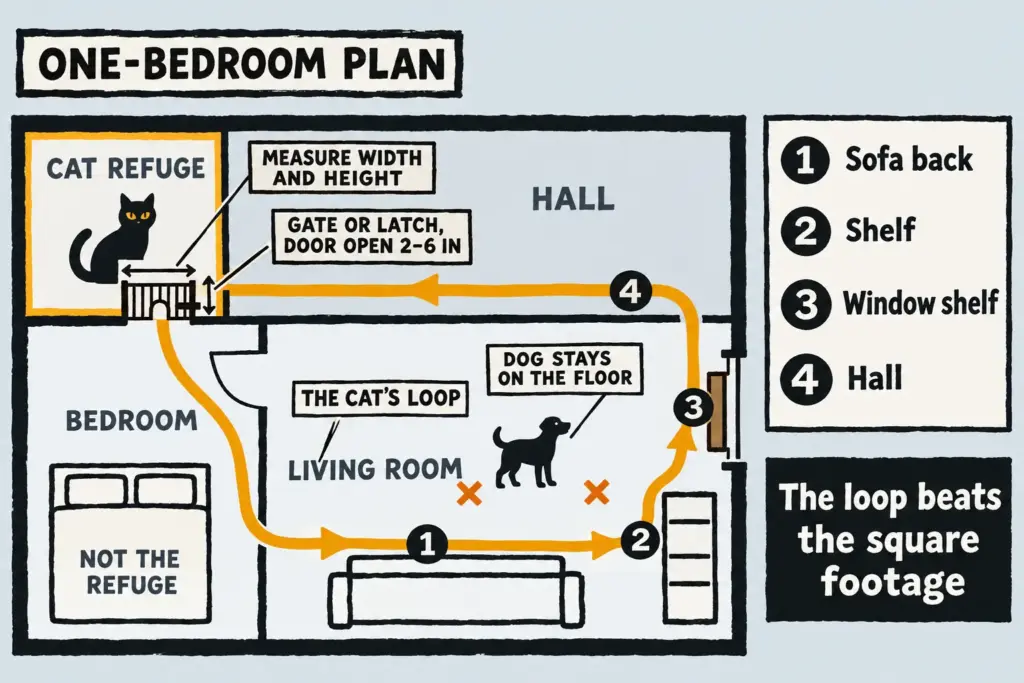
The free version is a cleared shelf, and it takes no floor at all. A window sill extends the loop without a tree: K&H Cat Window Perch, EZ Mount Kitty Sill, 23 x 12 in is a 23 by 12-inch platform for glass 27 inches wide and 23 inches high, held on by suction cups, so no screws and no floor. The suction cups lose their grip on some windows, so press them onto clean glass and check the platform each morning at first.
Keep the cat’s food and his box out of the dog’s reach as well, and feeding the cat out of the dog’s reach shows how to measure that height.
One Dog and Two Cats, and What Success Looks Like When Nobody Cuddles
Picture a confident cat walking up to the gate on day six while the shy one stays in the bedroom. Watch only the first and everything seems fine.
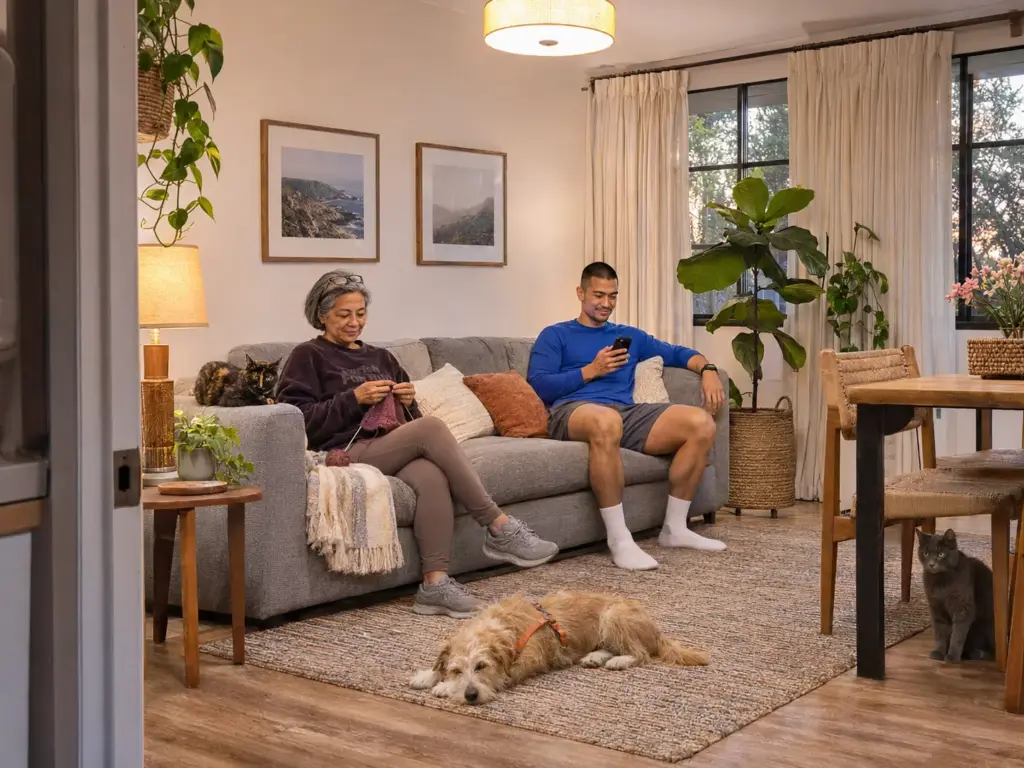
Each Cat Gets Its Own Pace
Each cat gets his own introduction, on his own route and at his own pace. The dog fixes on the more reactive of the two, and the calm of the confident cat proves nothing about the shy one. Run each cat through the stages separately before the three of them share a room, and give each cat the resources he needs under one resource per cat plus one.
The Shy Cat Is the Measure
If the shy cat has stopped passing through a room, that is the measurement, and it sets the pace for the group. The dog must not reach the litter box at all, which turns the gate from a tool of the introduction into a piece of furniture you keep. How many litter boxes two cats need gives the count, and the boxes go behind the gate.
Tolerance Is the Honest Goal
For most adult pairs success means sharing the house and minding their own business: civil roommates, with a cat who approaches, stays or passes by. Friendship is not the target, and the photo of the two curled up together is the person’s wish, and the cat gives no sign of it. Nothing here promises that a pair will get beyond tolerance.
If the introduction stalls, a certified trainer or a behavior specialist is the next call for the dog, and the vet is the next call if the cat’s habits change.
Let the Cat Set the Pace, and Leave the Gate Up Longer Than You Want To
Everything above reduces to a few decisions. The cat sets the pace, because he is the one who can only leave. Each stage ends on a pass mark, and a pass mark is a thing you saw, not a day on the calendar. One bad session sends you back a single stage.
The gate stays for months. And a cat whose habits change from one day to the next goes to the vet before another session is scheduled.
When the first month is over, walk through the home once the way the cat does and see whether he still uses the rooms and routes he used before the dog arrived. If a hallway has fallen out of his day, that is the part to rework.
Today needs no purchase at all: close one door, move a blanket to the far side of the room, and write down what the cat did when he found it.
Frequently Asked Questions
01How long does it take to introduce a new cat to a dog?
Plan on days to weeks for the stages and months before the gate comes down, because each stage ends on a pass mark, not a date. A common calendar runs closed door on days 3 to 5, gate on days 6 to 14, cat loose with the dog leashed on days 15 to 30.
02What is the 3-3-3 rule for dogs and cats?
The 3-3-3 rule says a newly arrived animal needs about 3 days to feel overwhelmed, 3 weeks to settle in and 3 months to feel fully at home. It clocks the newcomer’s adjustment, not the introduction, which runs on pass marks.
03How do I know if my cat will accept a dog?
You cannot know in advance, so you watch at each stage whether the cat eats, uses his box and keeps walking his usual routes. A cat who drops any of those, or whose habits change overnight, needs the vet before another session.
04How do I introduce a cat to a dog in an apartment?
Give the cat a room with a door that closes (not your bedroom), measure the doorway before buying a gate, and keep him a route past the dog in every room. If no gate fits, a door strap holds the door a few inches open without drilling.
05What if my dog fixates on the cat and will not look away?
A dog who fixes on the cat and will not look away needs a certified trainer or a behavior specialist, not a better gate. Keep the barrier closed and the stages paused until one of them has seen the two.
Leave a comment